Retaliation is not a misunderstanding. Under federal law, it is a constitutional violation.
By Aaron Christopher Knapp, BSSW, LSW Investigative Journalist, Editor, and Public Records Advocate
Chapter 1: The Day the Dam Breaks
There are moments in any long fight with government where the truth finally surfaces, not because those in power decide to act with integrity, but because the facts can no longer be buried. For nearly two years, the City of Lorain insisted that no emails existed showing Chief James McCann contacting my professional licensing board, discussing me behind my back, passing judgment on my mental health, and insinuating that I was some kind of unstable threat. I was told that nothing existed, that no records could be found, that they had already answered the essence of my requests. I was told that if such records ever existed, they would have been provided. I was told the law prevented disclosure, when in reality the law was being used as a shield to hide misconduct.
But then, after twenty months of obstruction, delay, and denials, the city finally produced the very emails they spent almost two years pretending never existed. It did not come with an apology. It did not come with an explanation. It did not come with any admission that the previous denials were false. One day I was staring at yet another “no records exist” response, and the next day the city began dripping out the very communications they had fought to conceal. With every page that arrived, the truth became clearer. McCann had contacted my board. He had fed them misinformation. He had personally initiated an investigation into me that would never have occurred without his interference. He had used my own protected licensing process as leverage in his campaign to silence me. And then he turned around and cited the existence of that investigation – the very one he created – as his justification for denying my public records requests.
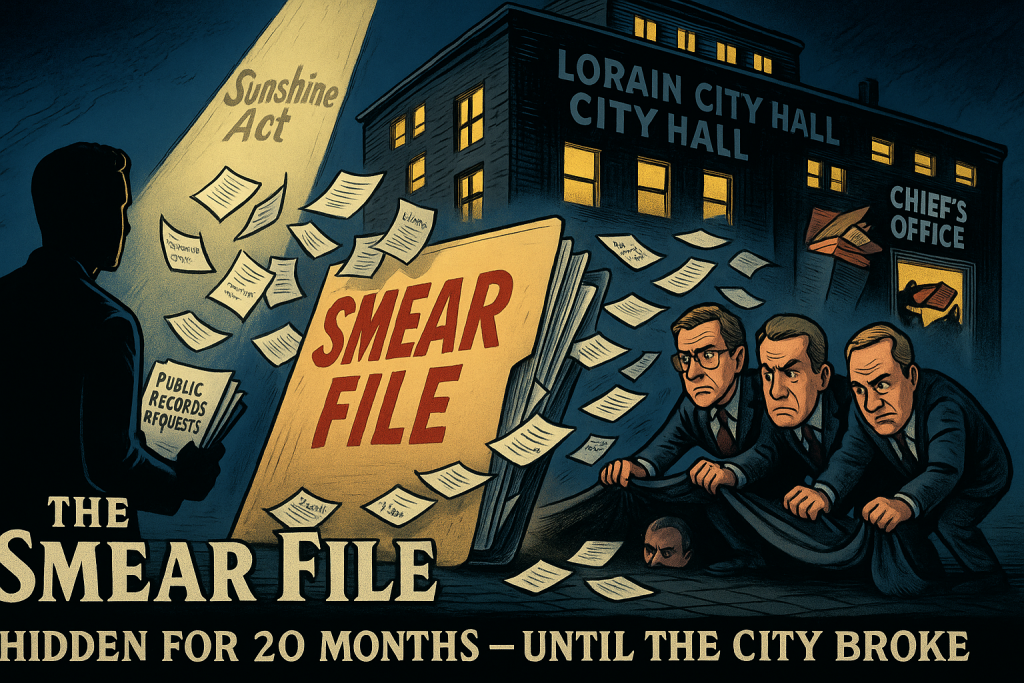
What I saw in those emails was not just retaliation. It was not just misconduct. It was not just unprofessional behavior. It was a coordinated effort by a sitting Chief of Police to weaponize confidential administrative processes against a citizen who had criticized his department. He did it while hiding behind the badge, the office, and the machinery of the city. When I finally saw the emails, it felt like uncovering a secret file, a smear file constructed solely to harm me, discredit me, and undermine my credibility as both an advocate and a reporter. Every denial, every excuse, every tactic they used to conceal those emails now looks even more deliberate.
Chapter 2: The Trigger – How McCann Sparked the Investigation Against Me
The most powerful lie the city told was that the investigation into me came from my licensing board. They portrayed it as a board initiated review that had nothing to do with the Lorain Police Department. They insisted the board acted independently and that the city merely responded when the board asked questions. The newly released emails reveal a very different story. The board did not initiate anything. They did not have questions about me. They did not have concerns about my conduct. They were not pursuing any allegations. They did not even know who I was until McCann told them.
The board did not initiate anything. They did not know my name until McCann told them. His email triggered the entire investigation.
The timeline tells the truth. In mid 2023, McCann emailed the board. He reached out directly. He informed them that I had criticized his department. He transmitted claims that I had engaged in misconduct. Those claims turned out to be false, unsubstantiated, and retaliatory. He framed me as unstable, unhinged, and professionally questionable. He sent these accusations not in response to any complaint from the board, but as an act of personal retaliation. The board did not start the process. McCann did.
Once he emailed them, everything changed. Within days, the board opened a review. Within days, I received notices. Within days, a process that never should have existed was created from thin air. Every step that followed can be traced directly back to the Chief’s email. He triggered the process. He set it in motion. He shaped the narrative. He inserted himself into my professional life, not because of any legitimate law enforcement concern, but because he was angry that I had criticized him publicly. Then, after triggering the review, he weaponized its existence. He pointed to it as justification for denying records. He used his own retaliatory act as proof that records must remain hidden. He created the conditions he then used as his legal shield. That is circular retaliation. It is misconduct wrapped inside bureaucracy wrapped inside deceit.
McCann created the investigation, then used the existence of the investigation he created as his excuse to deny public records.
Chapter 3: The City’s Lies – Twenty Months of Denials, Deflections, and “No Records Exist”
For nearly two years, every official response from the City of Lorain told the same story. The records did not exist. The city had no emails. Nothing responsive could be located. Everything had already been provided. The essence of my request had been fulfilled. I was told that they had complied, even when compliance was impossible because the records were still being concealed. As I filed follow up request after follow up request, the answers shifted in wording but not in substance. The Law Director denied. The Chief denied. The Records Department denied. The Mayor denied. The Safety Service Director denied. Every internal actor held the same line.
Internally, they were forwarding my requests to each other. We now see Captain Mathewson sending my questions to Law Director LaVeck. We see the Law Department telling McCann how to respond. We see the Chief playing dumb and claiming he did not know anything beyond what he had already told me. Each of them knew what they were hiding. Each of them maintained the position that no records existed, even as they coordinated among themselves about those same records. It was a structure of denial built on the hope that I would stop asking. It was a coordinated effort to protect the Chief from accountability.
The city said no records existed for twenty months until they were forced to release the very emails they claimed were never written.
When I compare the email denials to the timeline of what they actually knew, the pattern is unmistakable. The city was never confused. They were never unsure. They were never unaware. They were hiding evidence that implicated the Chief in malicious and retaliatory conduct. They did so knowing exactly what they were doing.
When the emails finally surfaced, they were worse than expected. McCann did not merely ask a procedural question. He did not express a good faith concern. He did not inquire neutrally about whether a complaint existed. He launched into a narrative designed to harm me. He depicted me as unhinged, as someone whose mental stability should be questioned. He claimed my actions were dangerous. He insinuated that I had misrepresented my credentials. He inserted false allegations into an official communication with my licensing board, bypassing due process, bypassing proper channels, and bypassing professional standards.
He painted me as ‘unhinged’ and professionally questionable, not because of facts, but because I criticized him.
He also linked unrelated events together in ways that made them appear sinister. He referenced my public records requests. He referenced my criticisms of his department. He referenced my efforts to expose misuse of authority. All of this was framed as instability. He did not dispute my facts. He did not correct my reporting. He attacked my credibility instead. He attacked my professional integrity. He attempted to undermine my livelihood by using his badge and position to poison my relationship with the board.
These were not stray comments. They were intentional, strategic, and calculated to do harm. They were designed to create fear, uncertainty, and doubt. They were delivered to a licensing authority that holds power over my career. This was not an officer acting in good faith. This was a government official abusing his authority to retaliate against someone who challenged him publicly.
He did not just go after me as a critic. He attacked my license, my livelihood, and my reputation, all while hiding behind the badge.
The pattern becomes clear when the emails are laid out chronologically. McCann had grown increasingly hostile as my public records requests intensified and my reporting expanded. When I questioned whether he had improperly run my name through LEADS, he became defensive. When I criticized the city’s policies, he lashed out. When I asked questions that touched upon internal affairs, he saw it as a threat. Rather than respond with transparency, he responded with retaliation. He sought to silence me not through evidence, but through intimidation. When he realized that he could not stop my reporting, he went after my license.
The retaliatory strategy was simple and ugly. Take a citizen who is asking uncomfortable questions, recast him as unstable, undermine his credibility, question his qualifications, and paint him as a danger. The emails show that he took my constitutionally protected speech and recast it as evidence of professional instability. This pattern mirrors what was done to others, including Lt. Corey Middlebrooks, who also faced selective enforcement and exaggerated accusations after challenging leadership. This is how power is used when it cannot tolerate scrutiny.
The city’s participation in hiding these emails confirms that this was not a one off lapse or a momentary lapse in judgment. It was part of a broader culture of retaliation. When public records are treated as a threat instead of a duty, and critics are treated as enemies, retaliation is not an accident. It is a method.
Chapter 6: The Coordination Inside City Hall
The emails reveal a chain of coordination that extends far beyond McCann. When I asked for records, my requests did not simply vanish into a black hole. They were forwarded up the chain. Captain Mathewson sent them to Law Director LaVeck. LaVeck provided legal guidance on how to respond. The Mayor’s office was copied. Safety Service Director Rey Carrion was looped in. The Prosecutor’s Office was aware. Each of these actors had opportunities to correct the false denials. None of them did.
This was not confusion. It was coordinated concealment across the Chief, the Law Department, the Safety Service Director, and City Hall itself.
This coordination shows that the concealment was not accidental. It was deliberate and reinforced at multiple levels. It reveals a culture inside city government that prioritizes protecting the Chief over obeying the law, following the Sunshine Act, or ensuring transparency. They knew what the Chief had done. They knew the significance of the emails. They hid them anyway.
What emerges is not just a picture of a single official acting on personal vendettas. It is a picture of a municipal government willing to bend rules, distort facts, and deny public records to protect him. It is a networked effort to suppress information that would expose retaliation. Every official who claimed that no records existed was standing on top of a file they already knew about.
Every official who claimed no records existed knew these emails were real. They forwarded my request among themselves while denying the truth.
Chapter 7: The Timeline, Told as It Happened
The timeline begins in mid 2023, when I submitted a series of public records requests to the City of Lorain. These requests were straightforward. I asked for emails, internal communications, and evidence of whether anyone had improperly run my name through LEADS. The city responded with delays. The Records Department told me that my requests were being forwarded to the Law Director. The Law Director insisted the essence of my requests had already been fulfilled. The Chief claimed that there were no records.
At the very same time these denials were being sent to me, McCann was writing to my licensing board and to court actors, framing me as unstable and pushing them to view me as a problem. He was telling one story to them and another story to me. To me, he claimed that nothing existed. To them, he was building a case. To the public, he pretended everything was normal. Behind the scenes, he was smearing me while hiding those communications inside a bubble of supposed confidentiality.
As the months went on, I continued to follow up. I filed new requests, narrowed old ones, and asked for the same records through multiple channels. The city responded with the same phrases. No such records exist. The request has been forwarded. The essence has been answered. At no point did anyone in authority admit that McCann had gone outside normal channels to contact my board, or that those communications had been withheld.
By the time 2024 arrived, they had denied the existence of these records for nearly a year. I filed additional requests and began escalating the dispute through legal channels. The pressure mounted. The contradictions became harder to maintain. It was not until late 2024 and into 2025, under that pressure and under the threat of further action, that the city finally began producing the emails. When they did, it became obvious why they had been hidden. The emails revealed retaliation, falsehoods, misuse of government authority, and calculated efforts to undermine my professional standing. They revealed a Chief who sparked an investigation into me, then used the existence of that investigation as justification to deny records. They revealed a city government that worked collectively to protect him.
This timeline is not just a chronology of events. It is the story of how long it took for the truth to break through a wall of coordinated denials.
Chapter 8: The Legal Analysis – Section 1983 Retaliation
The legal implications of these emails are significant and far reaching. When McCann contacted my board, he was acting under color of law. He used his official position to influence a licensing authority and cause harm to my professional reputation. That constitutes retaliation for protected First Amendment activity. Under Nieves v. Bartlett, the government may not take adverse action against a citizen based on their speech. Under Hartman v. Moore, retaliation is established when the adverse action is causally linked to the protected activity. Here, the causal link is direct. The board acted because McCann triggered the process.
Retaliation is not a misunderstanding. Under federal law, it is a constitutional violation.
The deprivation of access to public records, when done as retaliation, also raises constitutional concerns. When government actors intentionally withhold records to obstruct transparency and protect retaliatory misconduct, they are not simply making administrative errors. They are using secrecy as a tool to cover up a First Amendment violation. They are interfering with a citizen’s ability to hold government accountable. That implicates both free speech and due process.
Portraying me as mentally unstable and misrepresenting my conduct to a licensing board also implicates defamation under Ohio law and constitutes an attempt to interfere with my employment and professional opportunities. When such interference is carried out by a government official abusing their authority, it becomes actionable under Section 1983 as a deprivation of liberty interests and as retaliation.
The concealment of the emails for twenty months also violates Ohio’s Public Records Act. The city is required to provide records or cite a valid exemption. They did neither in any genuine way. They denied that the records existed at all. They claimed they had already produced the essence of the request. They maintained those positions even while privately circulating my requests among themselves. That is not a mistake. It is a violation of the law.
When you put all of this together, the picture comes into focus. The Chief’s conduct is not merely unethical. It is illegal.
This story is not just about me. It is about what can happen when a government official decides to retaliate against a citizen who questions or criticizes authority. If a Chief of Police can contact someone’s professional licensing board in secret and spark an investigation based on false information, then every citizen is vulnerable. If the city can deny records that clearly exist, then the law becomes meaningless. If public offices can coordinate to hide misconduct, then transparency collapses. If retaliation becomes normalized, then truth becomes dangerous.
If a Chief of Police can secretly contact a citizen’s licensing board over criticism, every resident of Lorain is at risk.
This is why public records laws exist. This is why transparency matters. This is why the lawsuit now underway is not merely a personal dispute, but a fight for the integrity of local government. When power is misused in secret, the public suffers. When accountability breaks down, the truth has to step forward. When officials weaponize their positions, the only antidote is exposure.
I have heard the argument that pursuing this is petty, or personal, or obsessive. That is what people in power say when someone refuses to back down. It is easier to attack the persistence of the critic than to admit the wrongdoing of the system. But what these emails show is that persistence was the only reason the truth emerged at all. If I had accepted their denials, this smear file would still be hidden. The board would have been left with one narrative, written by the Chief. The public would never know he had done it. The record that now exists would still be a rumor.
The truth does not arrive politely. It does not knock on the door. It does not wait for permission. It comes crashing through the walls built to contain it. That is what happened here. For nearly two years the City of Lorain insisted that the smear file did not exist, that no such emails were ever written, that nothing had been concealed, and that all of my questions were based on misinterpretations or paranoia. They held that line with confidence because they believed that the structure surrounding the Chief was strong enough to keep the truth contained. They believed that the Law Department, the Mayor’s Office, the Safety Service Director, and the records supervisors could maintain the facade indefinitely. They miscalculated.
When the city finally produced the emails, the facade shattered. Every denial they had issued, every lecture they had delivered about how I misunderstood public records law, every attempt to portray me as unreasonable or obsessive, every accusation that I was imagining things, fell apart in an instant. The emails were real. The smear campaign was real. The retaliation was real. The concealment was real. The pattern was exactly what I said it was. And the most important part is this: I did not discover anything new about myself in these files. I discovered who they were.
This was not an internal investigation. This was a smear file, constructed in secret, hidden for twenty months, and exposed only because the city finally broke.
The lengths they went to in order to keep this from the public tell you everything you need to know about how threatened they were by the truth. They did not hide these emails by accident. They hid them because revealing them would expose a culture of retaliation that had grown comfortable in the dark. They hid them because they believed the public would not care. They hid them because they assumed no one would persist long enough to prove they were lying. They hid them because the Chief’s actions, once revealed, would undermine the credibility of the entire department and every official who protected him.
This is not the story of a rogue officer acting on his own. This is the story of a municipal government that aligned itself around a false narrative because exposing the truth would require admitting that they failed to control the misconduct taking place inside their own building. It is the story of a political structure that prioritized loyalty over legality, silence over transparency, and protection over accountability. When government actors unite to hide the truth, they reveal the very corruption they are trying to conceal.
People will say that I am making this personal. They will say that I should let it go. They will say that exposing this is divisive, that it will undermine trust in local institutions, and that I am only continuing the fight because of some imagined vendetta. They will be wrong. Nothing about this is personal. It is public. It is documented. It is verified. It is what happens when a private citizen stands up to a public official who believes he should never be challenged. It is what happens when transparency becomes a threat and retaliation becomes a reflex.
The fact that the city produced these emails at all is proof that the system only bends when you push with everything you have. They did not volunteer this information. They did not cooperate in good faith. They complied because the law forced them to comply. They complied because the pressure became too great. They complied because maintaining the lie became untenable once the evidence began to surface from multiple directions. The same system that tried to silence me is now the one documenting the Chief’s misconduct in its own handwriting.
There will be more stories like this because there are more records. There will be more revelations because the truth rarely travels alone. What the city tried to protect is already unraveling. The narrative they built cannot withstand what the documents show. In the end, the only thing that kept this story from disappearing into the bureaucratic abyss was persistence. Without persistence, these emails would still be buried. Without persistence, the public would never know the Chief sparked the investigation into me. Without persistence, this smear file would have remained a hidden weapon used against me in the dark.
Aaron Knapp
The truth is the only thing I ever asked them for. And they spent two years trying to keep it out of my hands. Now it belongs to the public. Now it belongs to the record. Now it belongs to the courts. And now it belongs to every resident who has ever wondered whether their government would weaponize itself against them. This is why transparency matters. This is why public records laws exist. This is why accountability must be pursued even when it is uncomfortable. Because if a Chief of Police can secretly contact a citizen’s licensing board, create an investigation from nothing, smear that citizen, lie about the existence of records, and convince an entire government structure to hide the evidence, then the question is not whether I was targeted. The question becomes who else was.
Legal Disclaimer: Everything in this article is based on public records, sworn statements, released emails, and verified communications. All individuals are presumed innocent of wrongdoing unless and until proven otherwise in a court of law. Nothing in this article is intended as legal advice. It is investigative reporting and opinion protected by the First Amendment.
AI Disclosure: Portions of this article were drafted with the assistance of artificial intelligence for organization, formatting, and language support. All facts, interpretations, and conclusions are my own and are grounded in public records and documentary evidence.
Byline: Written by Aaron Christopher Knapp, BSSW, LSW. Investigative Journalist, Editor of Lorain Politics Unplugged, and public records advocate committed to exposing misuse of power in Lorain County and beyond.