
The Records That Disappeared and the Questions No One Would Answer

Emails show public records requests, missing council archives, and a Records Commission under scrutiny while the same officials acknowledge authority but fail to produce the documentation that would explain what happened
By Aaron Christopher Knapp, BSSW, LSW
Investigative Journalist and Public Records Litigant
Editor-in-Chief, Lorain Politics Unplugged
Knapp Unplugged Media LLC
I. INTRODUCTION WHEN THE RECORD SHIFTS FROM RESPONSE TO ACTION
What this next set of emails establishes is not a continuation of a dispute that is still forming, but a transition into a phase where the record has already been built and the focus shifts to how the system responds after that record is in place. By the time this communication occurs, the issues are no longer new, the evidence is no longer developing, and the officials involved are no longer being introduced to the claims for the first time. The record shows they have already been given the information, already been placed on notice, and already had the opportunity to respond. What changes here is not the substance of the allegations, but the way the system begins to operate around them.
The emails move directly into the internal structure of the City, focusing on the Records Commission, the handling of public records, and the removal of previously accessible council materials from public view. Requests are made under Ohio Revised Code sections 149.43 and 149.39, and they are not framed as general inquiries. They are precise, statutory demands for five years of Records Commission minutes, for the identification of the individual responsible for maintaining those records, and for an explanation of why council meeting minutes and on demand video archives that once existed on public platforms are no longer available. The communication does not leave room for interpretation about what is being asked. It ties each request to the legal framework that governs retention and disposal of public records and places that framework directly in front of the officials responsible for complying with it.
The responses that follow do not resolve those questions. The Mayor acknowledges the Records Commission and identifies its members, stating that it includes “Mayor Jack Bradley, Frank Sipkovsky, Pat Riley or his designate, Joe Koziura or his designate,” and confirms that the commission meets and will consider the inquiry at a scheduled meeting. At the same time, he states that his office does not control the information being questioned and suggests that someone else within the same communication chain may be able to provide the answer. That distinction is not procedural. It creates a separation between authority and accountability at the exact moment when both are being demanded in the same request. The body responsible for approving the removal and retention of records is acknowledged, yet responsibility for explaining what happened to those records is deferred.
What unfolds within the same thread brings that contradiction into sharper focus. An invitation is extended for a member of the public to attend a Records Commission meeting and “voice your concerns,” which on its face reflects an open and accessible process. Within that same communication, it is stated directly that the same individual being invited to attend a public meeting is also being prosecuted in connection with attending a public meeting, and that even the administration has acknowledged that no illegal conduct occurred while the charge remains in place. That is not an inference drawn from outside the record. It is a contradiction documented within the record itself, presented to the same officials who are part of both actions.
This is the point where the tone of the record changes in a way that cannot be ignored. The communication is no longer limited to whether records can be produced or whether a prior response was sufficient. It begins to document how the system behaves when the same issues persist and when the same individuals continue to engage with it through lawful channels. The emails show that access to information, access to participation, and the enforcement of rules surrounding both are not operating in alignment. They show a system where records can disappear from public view without a clear explanation, where authority is acknowledged but not exercised in a way that produces accountability, and where participation can be both invited and penalized within the same structure.
The continuity of the individuals involved reinforces that this is not a separate issue unfolding in isolation. The Mayor, the Law Director’s Office through Patrick Riley or his designate, the Safety Service Director, members of City Council, and multiple external entities remain part of the same communication chain. The record does not reset between one set of emails and the next. It carries forward the same participants, the same unresolved questions, and the same structural issues that have already been documented.
What this introduction establishes is that the focus has moved beyond how the City responds when confronted with a completed record and into how it operates after that confrontation has occurred. The earlier emails showed the demand, the evidence, and the response. This record begins to show what happens next when those same issues move into different parts of the system and are handled in real time by the same officials who were already on notice.
This is not the beginning of a new issue.
It is the continuation of the same record, now entering a phase where the actions taken carry as much weight as the responses that came before them.
II. WHEN PUBLIC RECORDS ARE QUESTIONED AND RESPONSIBILITY BECOMES UNCLEAR
What develops next in this record is not simply a request for documents, but a direct examination of how the City defines responsibility when it comes to maintaining, producing, and explaining public records that were previously available and are now missing. The communication does not approach this as a vague concern or a general complaint. It identifies specific categories of records, including council meeting minutes and on demand video archives prior to 2024, and asks a question that goes to the core of public transparency, which is who authorized their removal and whether that removal complied with Ohio law.
That question is placed squarely within the framework of Ohio Revised Code sections 149.39 and 149.381, and the emails do more than reference those statutes. They explain them. The structure of the Records Commission is outlined in detail, including its composition, which consists of the chief executive, the chief fiscal officer, the chief legal officer, and an appointed citizen, along with a designated secretary responsible for maintaining its records. The duties of that commission are also described, including its obligation to meet regularly, to establish retention schedules, and to review and approve the disposal of public records. By placing that framework directly into the communication, the record removes any ambiguity about where authority is supposed to exist and how decisions regarding public records are supposed to be made.
What makes this portion of the record significant is how the response interacts with that clearly defined framework. The Mayor acknowledges the existence of the Records Commission and identifies its members, stating that it includes “Mayor Jack Bradley, Frank Sipkovsky, Pat Riley or his designate, Joe Koziura or his designate,” and confirms that the commission is the body responsible for records oversight. At the same time, he states that his office does not control the information being questioned and suggests that someone else on the same email chain may be able to provide the answer. That response does not deny that the records existed. It does not deny that the commission has authority over them. It redirects responsibility for explaining what happened to those records away from the office that is explicitly identified as part of the body responsible for their oversight.
This creates a gap within the record that is not based on missing information, but on missing ownership. The authority to manage and approve the disposition of records is clearly defined within the statutes cited in the communication. The individuals who make up that authority are identified within the same exchange. Yet when the question is asked about specific records that appear to have been removed from public access, the response does not align with that structure. It separates the existence of authority from the obligation to explain how that authority was exercised.
The communication does not allow that separation to stand without challenge. It follows up by requesting five years of Records Commission minutes and the identity of the secretary responsible for maintaining them, stating plainly that these records should exist if the commission has been meeting and performing its statutory duties. The request is not broad or unfocused. It is designed to trace the decision making process through the documentation that the law requires to be kept, asking in effect for the record that proves whether the process was followed.
At the same time, the communication makes clear that this is not the first time these questions have been asked. It states that prior requests have gone unanswered and that the issue has remained unresolved despite repeated attempts to obtain clarification. That repetition matters because it transforms the absence of a response from a delay into a pattern. When the same questions are asked, the same statutes are cited, and the same officials are included, the lack of a substantive answer becomes part of the record itself.
What this section ultimately shows is that the issue has moved beyond whether records can be requested and into whether the system responsible for those records can account for its own actions.
The law defines the structure. The communication identifies the individuals within that structure. The questions target specific records that appear to have been removed from public access. The response acknowledges authority but does not connect that authority to accountability.
That gap does not close within this exchange.
It becomes the next point of focus as the record continues to press for clarity in a system where responsibility is clearly defined, but no one provides the answer.
III. WHEN ACCESS DISAPPEARS AND THE RECORD QUESTIONS WHETHER IT WAS LAWFUL
What becomes unavoidable in this portion of the record is that the issue is no longer limited to requests for documents that have not yet been produced, but extends to records that were once publicly accessible and are no longer available in the same form. The communication identifies this directly and without ambiguity, asking why “access to the meetings on demand and regular council meeting minutes prior to 2024” has been removed from the City’s public access pages. That question alters the entire posture of the dispute, because it is not asking for something that may or may not exist. It is asking about something that did exist, that was available to the public, and that is now absent without explanation.
That distinction carries legal weight. Under Ohio law, the removal or destruction of public records is not a discretionary act that can occur without process, documentation, and approval. The same communication that raises the question also places the governing statutes directly into the record, explaining that records retention and disposal are controlled by defined procedures, including review by the Records Commission and adherence to retention schedules that dictate how long records must be preserved. Once those standards are placed alongside the disappearance of publicly available records, the issue is no longer simply about access. It becomes whether the legal process that governs the handling of those records was followed at all.
The response that appears within the record does not engage with that question in a way that resolves it. The Mayor reiterates the composition of the Records Commission and confirms its role in overseeing records, but does not address whether the commission approved the removal of the specific materials being questioned. There is no reference to a retention schedule that would justify the removal, no explanation of when or why the records were taken down, and no documentation provided that would show the process required by law was followed. The existence of authority is acknowledged, but its exercise in this instance is not explained.
The communication responds to that gap directly and with increasing precision. It states that the Records Commission “can only approve removal and retention of public records,” and demands an “official response signed by every member of the Records Commission,” tying accountability to the individuals who are legally responsible for those decisions. This is not a general request for information. It is a targeted demand for confirmation that the removal of public records was reviewed, approved, and documented by the body that the law requires to oversee that process.
What emerges from this exchange is a clear imbalance between what is known and what is explained. The authority is defined. The statutes are cited. The records that have disappeared are identified. Yet the response does not connect those elements in a way that answers the central question of whether the removal was lawful. The absence of that explanation does not leave the issue unresolved in a neutral way. It becomes part of the record itself, raising the question of whether the required process was followed or whether it occurred at all.
This is where the focus shifts in a meaningful way. The issue is no longer limited to whether records can be requested or whether they will be produced. It expands into how public access is controlled and how decisions affecting that access are documented and justified. When records that were once available to the public disappear without a clear explanation grounded in the statutory framework that governs them, the absence becomes evidence of a larger issue.
What this section ultimately shows is that the record has moved beyond delay or incomplete response and into the question of removal without documented justification. The communication identifies the records, cites the law, and demands proof of compliance. The response acknowledges the structure but does not answer the question.
And when access disappears without a clear record of how and why it happened, the issue is no longer retrieval.
It is accountability.
IV. WHEN PARTICIPATION IS INVITED AND PROSECUTED AT THE SAME TIME
What emerges next in this record is not simply a contradiction in language, but a contradiction in action that goes directly to how public participation is treated within the same system. The emails show that an invitation is extended for a member of the public to attend a Records Commission meeting and “voice your concerns,” establishing on its face that participation in that process is not only permitted but encouraged. The invitation is not limited, not conditional, and not framed as restricted access. It is presented as an open opportunity to engage with the very body responsible for overseeing the records at issue.
Within that same communication chain, the record identifies a conflicting reality that cannot be reconciled through simple explanation. The statement is direct and specific, pointing out that the same individual being invited to attend a public meeting is also being prosecuted for attending a public meeting, and that the administration has acknowledged that no illegal conduct occurred while the charge remains in place. This is not presented as speculation or opinion. It is documented within the same record and placed in front of the same officials who are part of both actions.
That contradiction carries weight because it moves the issue beyond records and into the core question of access to government. Public meetings are not discretionary spaces. They are established for observation, participation, and engagement by the public. When participation in those spaces is encouraged in one context and penalized in another, the issue is no longer about isolated enforcement decisions. It becomes about whether the rules governing access are being applied consistently or selectively.
The communication does not allow that inconsistency to exist without being directly addressed. It places the contradiction into the record in real time, tying the invitation and the prosecution together within the same exchange. The effect of doing so is that the issue cannot be separated into different conversations or different explanations. It is documented as a single, unified inconsistency presented to the same individuals responsible for both sides of it.
At the same time, the record connects this contradiction to prior conduct, stating that the treatment described “mirrors how I was treated” when a lawful claim was dismissed with a one word denial and only later addressed after outside pressure was applied. This connection is not made to introduce a new grievance. It is made to establish that the pattern being described is not isolated to a single individual or a single moment. It reflects a broader approach in which participation and accountability are handled differently depending on the context in which they occur.
What makes this portion of the record particularly significant is that it ties together two areas that are often treated separately, which are public records and public participation. The removal of records from public access and the inconsistent treatment of individuals attending public meetings are not presented as unrelated issues. They are shown as part of the same environment in which access to information and access to participation are both subject to control.
What this section ultimately shows is that the issue has moved beyond whether records can be obtained or whether questions can be asked. It now includes whether individuals can engage with their government in a consistent and lawful manner without being subjected to conflicting treatment within the same system.
Because when participation is both invited and prosecuted at the same time, the issue is no longer procedural. It is structural.
V. WHEN THE RECORD CONNECTS PROCESS TO RETALIATION AND NAMES HOW IT OPERATES
What develops next in this record is not a departure from the earlier issues, but a direct connection between them, because the communication no longer treats the handling of records, the removal of public access, and the treatment of individuals as separate problems. It brings those elements together and identifies a common thread in how the system functions. The language used is explicit and deliberate, stating that the administration “continues to weaponize process, discourage public participation, and retaliate against residents for simply demanding accountability.” That statement is not presented as a broad accusation. It is grounded in the sequence of events that has already been established within the same record.
The context for that statement matters. It follows a documented pattern in which public records are requested under statute and not fully accounted for, where access to previously available council minutes and video archives is questioned without a clear explanation, and where participation in public meetings is treated inconsistently within the same system. The communication does not introduce a new issue at this stage. It interprets the pattern that has already been laid out and explains how those separate actions operate together rather than in isolation.
What makes this portion of the record particularly significant is that it moves beyond describing events and begins to define how those events are connected through the use of process. The term “process” is not used loosely. It refers to the formal mechanisms that govern records retention, public access, meeting procedures, and enforcement. These are the systems that are supposed to ensure transparency and accountability. By framing those same mechanisms as being used in a way that discourages participation and produces retaliatory outcomes, the communication shifts the focus from individual decisions to the operation of the system itself.
At the same time, the record makes clear that the impact of that operation is not theoretical. It ties the use of process directly to real consequences for individuals attempting to engage with their government in a lawful manner.
The communication states that invitations to participate “ring hollow” when they exist alongside actions that penalize that same participation, reinforcing the contradiction already documented within the record and connecting it directly to the broader claim of retaliation. This is not presented as an abstract concern. It is tied to specific actions and outcomes that appear within the same exchange.
The response within the record does not engage with that characterization. There is no attempt to dispute the connection being made between process and outcome. There is no explanation offered to reconcile the actions described with the statutory framework that governs records and public participation. The pattern that has already been established continues, where the communication becomes more detailed and more explicit in defining the issue, while the response does not address the substance of what is being presented.
What this section ultimately shows is that the record has reached a point where it is no longer limited to documenting individual actions and responses. It is identifying how those actions function together within a system that controls both information and participation. The connection between records, access, and enforcement is not implied. It is stated directly within the communication and supported by the documented sequence of events.
Once that connection is made, the focus shifts away from isolated decisions and toward the way the system itself is being used.
Because when process is identified as the mechanism through which accountability is discouraged and participation is limited, the issue is no longer about a single action.
It is about how the structure operates as a whole.
VI. WHEN THE RECORD SHOWS COORDINATION IN PLAIN SIGHT
What becomes increasingly difficult to ignore in this portion of the record is not just what is being said, but who is receiving it and at what level, because the distribution of these emails places the same information in front of nearly every layer of the City’s operational structure at the same time. This is not a limited exchange between a resident and a single department. The communication is directed to the Mayor, the Safety Service Director, the Law Director’s Office through Patrick Riley or his designate, members of City Council, the Clerk of Council, law enforcement contacts, the prosecutor’s office, and external recipients that include media outlets and oversight entities.
The record itself reflects that scope. The Mayor, Jack Bradley, responds within the same thread and identifies the Records Commission and its members by name, stating that it includes “Mayor Jack Bradley, Frank Sipkovsky, Pat Riley or his designate, Joe Koziura or his designate,” confirming that the individuals responsible for records oversight are not only identified but are part of the same communication chain receiving the request. That detail matters because it places the legal authority over records directly inside the conversation where questions about those records are being asked.
The inclusion of the Law Director’s Office is equally significant. Patrick Riley, as Law Director or through his designate, is identified as part of the Records Commission and is included in the distribution at the same time that statutory obligations under Ohio Revised Code sections 149.39 and 149.381 are being outlined in detail. The legal framework is not being discussed in isolation from the individuals responsible for applying it. It is being placed directly in front of them, alongside the specific questions about missing records and the demand for documentation that would demonstrate compliance.
The Safety Service Director is also included within the same communication, alongside law enforcement and prosecutorial contacts, which ties together the administrative, legal, and enforcement sides of the system in a single exchange. This is not a situation where records issues are handled separately from enforcement decisions or where legal review occurs outside of the context of the communication. The record shows that all of these functions are aware of the same information at the same time.
What follows from that level of distribution is not a coordinated response that reflects that shared awareness. The Mayor provides acknowledgment and partial information about the structure of the Records Commission, but does not answer the central question regarding the removal of records. Responsibility is redirected with statements that his office does not control the information being questioned, despite being part of the body that oversees records retention and disposal. There is no comprehensive response from the Law Director’s Office that engages with the statutory framework that has been cited. There is no unified explanation from the offices included that accounts for the records that have disappeared or the process that was followed.
This creates a situation where coordination exists in terms of awareness, but not in terms of response. The same information is delivered to the individuals who have authority over records, legal compliance, and enforcement, yet the response does not reflect that collective knowledge. Each part of the system is present within the communication, but the system itself does not respond as a unified structure capable of explaining its own actions.
At the same time, the inclusion of external parties within that same distribution changes the nature of the record itself. Media outlets, state agencies, and oversight bodies are not passive recipients. They are in a position to review the communication, compare it against public records and prior reporting, and determine whether further inquiry or action is warranted. The record is not confined to internal handling. It is being shared in real time with individuals and institutions that operate outside the City’s control.
What this section ultimately shows is that the issue is not a lack of awareness or a failure of communication. The record demonstrates that the relevant parties are aware, that they are included, and that they have been given both the factual record and the legal framework necessary to respond. The absence of a substantive and coordinated response does not occur because the information is missing.
It occurs alongside the presence of that information. And when coordination is visible in how the record is distributed, but not in how it is addressed, the focus shifts to what that gap represents. Because the system is not unaware of the record. It is choosing how to respond to it.
VII. WHEN THE LEGAL FRAMEWORK IS PUT ON THE RECORD AND THE LAW DEPARTMENT DOES NOT APPLY IT
What defines this portion of the record is not the absence of law, but the deliberate placement of it directly into the communication in a way that removes any ambiguity about what governs the issues being raised and who is responsible for applying it. The emails cite Ohio Revised Code sections 149.39 and 149.381, and they do not stop at citation. They explain the statutes, outline their requirements, and connect them directly to the specific actions being questioned, including the removal of access to public records and the absence of any documented explanation for that removal. The communication makes clear that these statutes govern how records are retained, how they may be disposed of, and what process must be followed before any such action can occur.
The structure of the Records Commission is laid out in detail within the same exchange, and that structure places the Law Department at the center of the issue. The Mayor, Jack Bradley, responds and identifies the members of the commission, stating that it includes “Mayor Jack Bradley, Frank Sipkovsky, Pat Riley or his designate, Joe Koziura or his designate.” This is not a general description of a body that exists somewhere outside the conversation. It is a direct identification of the individuals responsible for overseeing records retention and disposal, and it includes the Law Director, Patrick Riley, or his designate, as a named participant in that process. That detail is critical because it establishes that the legal authority to interpret and apply the statutes being cited is not external to this exchange. It is present within it.
The communication goes further by explaining what the Records Commission is required to do under the law. It states that the commission must meet, maintain minutes, and approve any retention or disposal of public records, and it emphasizes that the commission “can only approve removal and retention of public records.” This is not presented as a suggestion or a general guideline. It is framed as a legal requirement that must be followed if records are to be removed from public access. The disappearance of council meeting minutes and on demand video archives is then placed directly within that framework, creating a clear question that requires a legal answer, which is whether the required process was followed and where the documentation of that process exists.
What follows from that is not a legal response from the Law Department that engages with those requirements. The Mayor acknowledges the existence of the Records Commission and identifies its members, including the Law Director’s Office, but states that his office does not control the information being questioned and suggests that someone else on the email chain may be able to provide an answer. That response does not address whether the commission approved the removal of the records. It does not reference any retention schedule that would justify the action. It does not provide documentation showing that the process required by law was followed. It acknowledges the structure while declining to explain how that structure operated in this instance.
The absence of a response from the Law Department is where the issue becomes more defined. Patrick Riley, as Law Director, or his designate, is identified as part of the body responsible for ensuring compliance with the statutes cited in the communication. The legal framework is placed directly in front of that office, and the questions being asked are framed in a way that requires legal analysis and explanation. There is no indication within the record that the statutes are being disputed, that they are being interpreted differently, or that they do not apply. There is also no indication that the Law Department provides a written response that applies those statutes to the facts being raised or explains whether the removal of records complied with the law.
This creates a situation where the law is present, the legal authority is present, and the question is presented in a way that requires a legal answer, yet that answer does not appear within the record. The communication establishes what should have occurred under the statutes, including review, approval, and documentation by the Records Commission. The individuals responsible for that process are identified by name and included in the exchange. The Law Department is not removed from the conversation or unaware of the issue. It is part of the structure that is being directly addressed.
What is missing is the application of the law to the facts.
The communication does not ask for a general statement of compliance. It requests documentation, including five years of Records Commission minutes and an official response signed by the members of the commission, that would demonstrate how decisions were made and who approved them. The expectation is not that the City will assert that it acted lawfully. It is that it will produce the records that show it did.
What this section ultimately shows is that the issue is not a lack of legal guidance or a misunderstanding of the statutes that govern public records. The law is clearly stated, the responsibilities are clearly defined, and the individuals tasked with enforcing those responsibilities are identified within the same communication. The Law Department, through Patrick Riley or his designate, is part of that structure and part of that exchange.
Yet within this record, the law is not applied to answer the question that has been asked, and the documentation that would demonstrate compliance is not produced. Under those circumstances, the issue is no longer what the law requires. It becomes whether the entity responsible for enforcing that law is willing to apply it to its own actions and provide the proof that the law demands.
VIII. WHEN THE RECORD SHOWS THE SAME DEFLECTION PATTERN UNDER A DIFFERENT ISSUE
What becomes clear as this portion of the record develops is that although the subject matter has shifted into Records Commission oversight, missing public records, and statutory compliance under Ohio law, the response pattern itself has not changed. The earlier emails focused on records requests, internal communications, and formal demands tied to documented evidence. This set of emails focuses on specific categories of public records that were previously available and are now absent, along with the legal framework that governs their retention and removal. Despite that shift in subject, the way the City responds follows the same structure that has already been established across the prior record.
The communication asks direct and verifiable questions that are grounded in statute and tied to identifiable materials. It asks who removed the records, when they were removed, whether that removal was approved by the Records Commission, where the minutes exist that would document that approval, and who is responsible for maintaining those minutes. These are not broad or speculative inquiries. They are tied directly to Ohio Revised Code sections 149.39 and 149.381, which require that such actions be reviewed, approved, and documented by a defined body that includes the Mayor, Jack Bradley, the Law Director, Patrick Riley or his designate, and other named officials. The questions are framed in a way that should produce a clear answer if the system is operating as required.
The responses that appear within the record do not resolve those questions. The Mayor acknowledges the existence of the Records Commission, identifies its members, and confirms that it meets and will consider the inquiry, but at the same time states that his office does not control the information being questioned and suggests that someone else within the same communication chain may provide the answer. That response does not deny that the records existed. It does not deny that the commission has authority over their removal. It does not provide documentation or reference any retention schedule that would justify the disappearance of those records. It shifts the focus away from the specific question without answering it.
This is the same structural pattern that appeared earlier in the record when public records were requested and responses acknowledged the request without producing the underlying material in a way that resolved the issue. The subject matter has changed from internal communications to Records Commission oversight, but the method remains consistent. Questions are acknowledged. Authority is referenced through general descriptions of the governing body. Responsibility for specific actions is diffused or redirected. The core issue, which is whether the law was followed and where the documentation exists to prove it, remains unaddressed.
What makes this portion of the record particularly significant is that the pattern now appears in a context where the legal framework has been fully defined and placed directly in front of the individuals responsible for applying it. The statutes governing records retention are cited and explained. The composition and duties of the Records Commission are outlined, including the role of the Law Director’s Office. The specific records at issue are identified as council meeting minutes and on demand video archives that were previously available to the public. The communication does not leave room for confusion about what is being asked or what the law requires.
Despite that clarity, the response does not engage with the central question of whether the required process was followed. There is no confirmation that the Records Commission approved the removal of the records. There is no production of minutes showing that such approval occurred. There is no written explanation from the Law Department applying the statutes to the facts. The presence of law, authority, and documentation requirements within the record does not change how the response is structured.
At the same time, the record shows that this is not a one time exchange. The questions are repeated. The statutory framework is restated. The request for official documentation remains in place. The persistence of the inquiry reinforces that the issue has not been resolved and that the absence of a substantive answer is not the result of a single incomplete reply. It reflects a continuing pattern in which the same type of response is given regardless of the subject matter.
What this section ultimately shows is that the system’s approach to handling questions does not change when the subject changes. Whether the issue involves prior communications, formal legal demands, or the removal of public records governed by statute, the response structure remains the same. The record continues to expand, the questions become more precise, and the legal framework becomes more explicit.
The response continues to move around the issue rather than through it, even when the issue is defined in legal terms and directed at the officials responsible for applying that law. That consistency is what ties this portion of the record back to everything that came before it, because it shows that the pattern is not limited to a single dispute or a single type of request. It follows the record wherever it goes.
IX. WHEN THE RECORD TURNS FROM REQUESTS INTO DEMANDS FOR PROOF
What defines this stage of the record is that the communication no longer operates within the framework of a request that may be acknowledged, delayed, or partially answered. It becomes a demand for proof that the system acted in compliance with the law that governs it, and that shift is reflected clearly in both the language used and the level of specificity that follows. The emails move away from asking for explanations and toward requiring documentation that can verify how decisions were made, who made them, and whether those decisions complied with the statutory framework already placed on the record.
The communication does not leave that standard undefined. It explicitly requires an “official response signed by every member of the Records Commission,” tying the answer directly to the individuals who are legally responsible for approving the retention and disposal of public records, including Mayor Jack Bradley, Law Director Patrick Riley or his designate, and the other identified members of that body. This is not a request for interpretation or opinion. It is a demand for confirmation, in documented form, that the process required by Ohio Revised Code sections 149.39 and 149.381 was followed and that the individuals tasked with overseeing that process are willing to stand behind it in writing.
At the same time, the scope of what must be produced is expanded in a way that is deliberate and tied directly to that demand for proof. The communication requests five years of Records Commission minutes, identifies the need to confirm who served as secretary responsible for maintaining those records, and connects those materials directly to the question of whether public records were lawfully removed from access. This is not an expansion for volume or leverage. It is a method of tracing the decision making process through the records that are required to exist if the system is functioning as defined by law. If the Records Commission met, those meetings should be documented. If it approved the removal of records, that approval should be reflected in those minutes. If a secretary is designated to maintain those records, that individual should be identifiable.
What makes this portion of the record particularly significant is that it removes any remaining ambiguity about what would constitute a sufficient response. The communication does not allow for general assurances, partial disclosures, or redirected answers. It defines the documentation that must be produced and identifies the individuals who must be accountable for producing it. The standard for compliance is no longer implied through statute alone. It is written directly into the demand and tied to specific, verifiable records.
The response within the record does not meet that standard. There is no indication that the requested documentation is produced. There is no signed statement from the members of the Records Commission confirming their role in the actions being questioned. There is no production of minutes showing whether the commission met, what decisions it made, or whether it approved the removal of the specific records identified. The Law Department, despite being part of the body responsible for ensuring compliance, does not provide a written explanation that applies the law to the facts or produces the documentation that would resolve the issue.
This creates a clear divide within the record. On one side, the communication establishes a path to resolution that is grounded in documentation, statutory compliance, and identifiable accountability. On the other side, the response remains within the same pattern that has already been documented, acknowledging the structure while not producing the proof that the structure was followed.
What this section ultimately shows is that the record has reached a point where the issue is no longer whether information can be requested or whether questions can be asked. It is whether the system can produce the documentation that demonstrates it acted within the law. The communication defines what that documentation must look like, identifies who is responsible for it, and places that requirement directly in front of the individuals tasked with fulfilling it.
When that standard is set and not met within the record, the issue moves beyond access and into something more consequential.
It becomes a question of whether the required proof exists at all, and whether the system that is obligated to maintain that proof can produce it when it is demanded.
X. WHEN THE RECORD EXPOSES A SYSTEM THAT CANNOT ANSWER ITS OWN QUESTIONS
What emerges at this stage is not simply a failure to respond to a specific request, but a deeper structural problem that becomes visible across the entire communication, because the questions being asked are no longer external challenges directed at the system. They are internal questions about how that system operates, and the record shows that those questions are not being answered by the very offices and individuals who are responsible for providing those answers. The communication does not speculate about how the system should work. It defines it, names it, and then asks it to account for itself.
The emails identify the governing body in detail, cite the statutes that define its authority, and name the individuals who are part of that structure. The Records Commission is described not as a concept, but as an operational body composed of Mayor Jack Bradley, Law Director Patrick Riley or his designate, and other identified members, with a designated secretary responsible for maintaining its official records. The communication explains that this body is required to meet, to maintain minutes, and to approve any retention or disposal of public records under Ohio Revised Code sections 149.39 and 149.381. The request for five years of minutes, the identification of the secretary, and the demand for a signed response from the commission members are all tied directly to that framework.
What the record shows is that even with all of that structure clearly defined and placed directly in front of the responsible parties, the system does not produce an answer that resolves the issue. The questions are not unclear. They are specific and verifiable. The authority is not undefined. It is identified by statute and by name. The individuals responsible are not unknown. They are included in the communication and are part of the body being questioned. Yet the response does not connect those elements in a way that explains what happened to the records that were removed from public access or whether that removal was reviewed and approved in accordance with the law.
This is where the record begins to reflect something more significant than delay or incomplete communication. It shows a system that is either unable or unwilling to provide a clear account of its own actions even when the framework for doing so has been fully established within the same exchange. The Law Department, through Patrick Riley or his designate, is part of the Records Commission and part of the communication where statutory compliance is being questioned, yet there is no written response applying the law to the facts or producing the documentation that would answer the question. The Mayor acknowledges the structure but does not provide the explanation. The system is present, identified, and engaged, but it does not produce the answer that its own structure requires.
At the same time, the communication reinforces that this is not a matter that can be resolved through general statements or informal explanations. By requesting documentation that traces decision making through official records, including minutes and signed responses, it establishes a standard that requires proof rather than acknowledgment. The absence of that proof does not remain outside the record. It becomes part of it. It shows not just what was asked, but what was not provided in response.
What makes this portion of the record particularly important is that it shifts the focus from individual actions to systemic function. The issue is no longer limited to whether a specific record can be produced or whether a single question can be answered by a particular office. It becomes whether the system as a whole can account for its own processes when those processes are examined in detail and under the framework of the law that governs them.
That shift carries forward into everything that follows, because once the record demonstrates that the system cannot provide a clear answer to questions about its own operations, the implications extend beyond the specific issue at hand. They affect how every subsequent response, every enforcement action, and every claim of compliance is evaluated, particularly when those actions involve the same individuals and the same structure that appear within this exchange.
What this section ultimately shows is that the record has reached a point where the problem is no longer limited to missing records or unanswered requests.
It is about whether the system responsible for those records can explain itself when required to do so under its own governing framework.
Within this exchange, it does not provide that explanation.
IX. WHEN “DEALING WITH HIM” BECOMES A DOCUMENTED POLICY DECISION
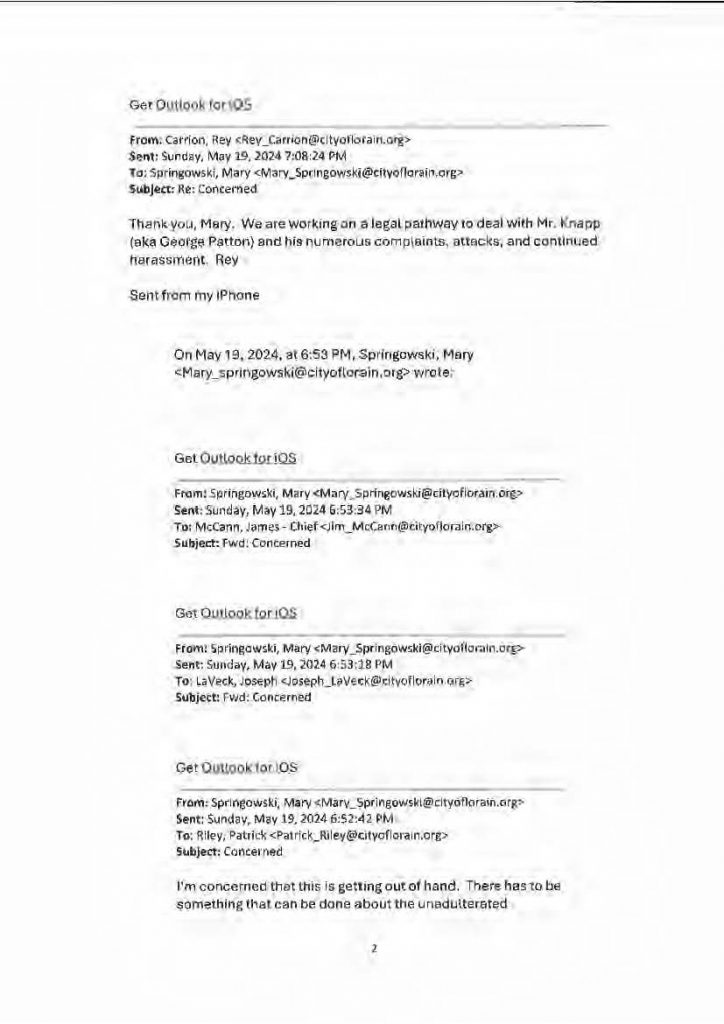
What these additional records do, when layered on top of the email chain already established, is remove any remaining ambiguity about what “we are working on a legal pathway to deal with Mr. Knapp” actually turned into in practice. It is no longer just language in an internal email. It becomes action, documented through court filings, internal investigations, and formal reports that all involve the same names, the same offices, and the same sequence of escalation.
The most direct piece of evidence is the Civil Stalking Protection Order filed by the City’s Safety Service Director against Aaron Knapp in the Lorain County Court of Common Pleas. The order itself confirms several critical facts that tie directly back to the earlier email language. First, it establishes that the legal pathway discussed internally was not hypothetical. It was executed. Second, it confirms that the action was taken by the same official who, months earlier, stated in writing that a legal pathway was being developed to “deal with” Knapp. Third, it shows that the outcome of that pathway was not a response to records requests or statutory compliance issues, but a court order restricting access, movement, and contact.
The terms of that order go further and directly intersect with public participation itself. The order includes a provision stating that Knapp is “prohibited from Lorain City Hall except for purposes of public meetings” and must “sit in the last row of the public gallery and abide by all terms of this order.” That is not a neutral restriction. It is a condition imposed on access to a public building, tied to a legal action initiated by the same official who had previously discussed creating a legal mechanism to address Knapp’s complaints. When read alongside the earlier emails, the connection is not speculative. It is structural.
At the same time, the incident report filed by Aaron Knapp provides the operational context in which that legal action emerged. The report details a February 16, 2026 incident inside Lorain City Hall involving the City’s Safety Service Director, describing physical contact at a public access doorway, repeated re-engagement after separation, and escalation from verbal interaction to physical proximity and contact. The report also documents that Chief Michael Failing was present and declined to take a contemporaneous report, stating, “I don’t do reports,” and directing Knapp to file elsewhere.
That moment matters because it shows how the system functions in real time when an incident occurs. The same structure that was included in the earlier email chains is present again. The Safety Service Director is involved. The Chief of Police is present. The incident occurs in a public government building during a public meeting environment. Yet the immediate response is not documentation, investigation, or preservation of evidence at the scene. The report states that no contemporaneous documentation was created despite the presence of witnesses, video recording, and an active complaint being made at the scene.
When that is placed next to the earlier administrative findings, the pattern becomes clearer. In February 2024, the Safety Service Director issued a formal letter concluding that prior complaints submitted by Knapp were “unsubstantiated” and closing the case, while directing any further questions to Law Director Patrick Riley. That letter explicitly references a timeline of complaints, investigations, and communications, and confirms that the Law Department was part of the review process. It also confirms that the complaints were evaluated, categorized, and ultimately dismissed within the same internal structure that was later discussing how to “deal with” the complainant.
The role of the Law Department is consistent across all of these records. Patrick Riley is copied on the administrative closure letter. He is included in the email chains where concerns are raised and legal strategy is discussed. Joseph LaVeck is included in the same communications. The Records Commission, which Riley is part of, is simultaneously being questioned in those same threads for its failure to document retention and disposal of records under Ohio Revised Code 149.39 and 149.381. Yet in none of these records is there a substantive legal explanation addressing those statutory obligations. Instead, the documented actions show administrative closure, redirection, and ultimately legal action directed at the individual.
What makes this section of the record particularly significant is that it shows escalation across multiple layers of the system, all involving the same individuals. The sequence is consistent. Complaints are filed and documented. Internal communications characterize those complaints as attacks or harassment. A legal pathway is discussed. Administrative findings close the complaints as unsubstantiated. An incident occurs in a public setting involving the same officials. Law enforcement declines to document it in real time. A protection order is filed. Restrictions are imposed on access to public space.
This is not a collection of unrelated events. It is a progression.
The prosecutor’s office correspondence adds another layer to that progression by formally acknowledging a “conflict, or an apparent conflict, with Aaron Knapp” and referencing prior interactions where Knapp was described as “belligerent” and removed from a government building. That letter explicitly states that the matter “would be a matter for the Lorain City Law Director to review,” again directing the issue back into the same legal structure already involved in the prior communications. The repetition of that referral is not incidental. It shows that even external offices, when confronted with the situation, route it back to the same internal authority that had already been part of the decision-making process.
What emerges from this full set of records is not simply a disagreement between a resident and a city. It is a documented shift in how the system responds once persistent legal and records-based challenges are made. The language of “dealing with him” becomes a throughline that connects internal emails, administrative actions, law enforcement responses, and court filings. The same individuals appear at each stage. The same offices are involved at each stage. The same issues remain unresolved at each stage.
And the legal framework that was repeatedly placed into the record, cited by statute and explained in detail, is never substantively addressed at any stage.
What this ultimately shows is that the question raised in Section IX is no longer theoretical. The record does not just suggest that the focus shifted from compliance to the individual. It documents how that shift was implemented. It shows the internal discussion, the administrative outcome, the on-the-ground response, and the legal action that followed.
And once all of those pieces are read together, the phrase “we are working on a legal pathway to deal with Mr. Knapp” is no longer just language.
It is the blueprint for what happened next.
XII. FINAL THOUGHT WHERE THE RECORD LEADS AND WHAT IT NOW DEMANDS
What this record ultimately establishes is not simply that questions went unanswered, but how a system responds when those questions persist, become more precise, and are tied directly to law that requires documentation, accountability, and transparency. This did not begin as a confrontation. It began as a series of public records requests grounded in Ohio Revised Code, specifically sections 149.39 and 149.381, asking for records that should exist, decisions that should be documented, and processes that are required to be followed. Those requests were structured, repeated, and supported by a clear legal framework that left little room for confusion about what was being asked or why it mattered.
By the end of this exchange, the issue is no longer about whether those requests were received or whether the statutes apply. The record shows that they were received, that the statutes were cited, and that the individuals responsible for applying them were directly included in the communication. The Records Commission is identified by name and composition. Its statutory duties are outlined in detail. The Mayor is part of that body. The Law Director, Patrick Riley, or his designate, is part of that body. The responsibility for approving the retention and disposal of public records is not disputed within the record. What is missing is the documentation that would show how that responsibility was exercised.
That absence is not neutral. It becomes part of the record itself. When five years of Records Commission minutes are requested and not produced, when the identity of the secretary responsible for maintaining those records is requested and not clearly provided, and when a signed response from the members of that commission is demanded and not delivered, the issue moves beyond access. It becomes a question of whether the system can demonstrate compliance with the law that governs it.
At the same time, this record does not end where the emails end. It sits directly in front of what follows. The same individuals who are part of this exchange remain in place as the situation evolves. The same offices that were asked to respond to statutory obligations are the ones involved in later actions, decisions, and enforcement. The same structure that appears here, where authority is acknowledged but responsibility is redirected or left unanswered, is the structure that carries forward into the next phase.
That continuity is what gives this record its weight. It shows that what happened next did not occur in the absence of information. It occurred after the issues were raised, after the law was cited, and after the opportunity to respond with documentation and clarity was already provided. The record does not suggest that the system was unaware. It shows that it was aware and that it chose how to respond.
Where this leads is no longer uncertain, because the record itself defines the next step. When statutory requests are made, when the legal framework is clearly established, and when the documentation required to demonstrate compliance is not produced, the process moves beyond informal communication. It moves into a forum where questions cannot be redirected, where responsibility cannot be diffused across multiple offices without explanation, and where answers must be supported by evidence that can be examined in full.
That is the point this record reaches.
It does not conclude with resolution, and it does not close with agreement. It concludes with a standard that has been clearly set and not met within the exchange, and with a documented sequence that shows how the system responded when it was asked to account for its own actions under the law.
What happens next does not begin with new questions. It begins with the same questions that have already been asked, now carried into a setting where they are no longer optional and where the answers must be complete.
Because the record does not show a misunderstanding of the issue.
It shows that the issue was presented, explained, and supported by law, and that the opportunity to respond was given to the individuals and offices responsible for doing so.
What follows is determined by what was done with that opportunity, and by what the record already shows when those answers were not provided.
Legal Disclaimer
This article is part of an ongoing investigative journalism series authored by Aaron Christopher Knapp and published by Knapp Unplugged Media LLC. It is based on documents obtained through lawful public records requests, including email correspondence, attachments, official reports, and related materials maintained by public offices, as well as the author’s direct knowledge and participation in certain events described. All factual assertions are derived from those records or are expressly identified as allegations, claims, or statements made by third parties within those records.
This publication addresses matters of legitimate public concern, including the conduct of government officials, the administration of public offices, and compliance with Ohio’s Public Records Act and related statutes. Any analysis, characterization, or conclusions expressed herein constitute the protected opinion of the author, based on disclosed facts and a good faith review of the available documentary record. Where opinions are expressed, they are clearly based upon and supported by the underlying materials described.
All individuals referenced in this article are identified in their official capacity as public officials, public employees, or participants in matters of public concern, or are otherwise referenced as they appear within the public record. Such references are made solely for purposes of news reporting, commentary, and public accountability. Nothing contained in this publication is intended as a direct communication to, or solicitation, instruction, or demand directed toward, any individual, attorney, public official, or party referenced herein.
Certain subject matter discussed in this article relates to ongoing or pending legal proceedings. This publication is not intended to interfere with, influence, obstruct, or prejudice any investigation, legal matter, or judicial proceeding. It is not directed to any court, judge, tribunal, juror, or party, and is disseminated solely to the general public as protected journalistic activity in furtherance of transparency and the public’s right to know.
No statement in this article is made with knowledge of falsity or reckless disregard for the truth. To the extent this article includes allegations, claims, or characterizations made by third parties, those statements are clearly attributed and are reported for the purpose of documenting their existence within the public record. The author does not assert the truth of third party allegations unless independently supported by verifiable documentation. Readers are encouraged to review the underlying records and draw their own conclusions.
This publication is intended for general informational and journalistic purposes only. It does not constitute legal advice, and any references to statutes, legal standards, or case law are provided solely for contextual and analytical purposes.
All content is published in accordance with and under the full protections of the First Amendment to the United States Constitution and applicable provisions of Ohio law governing freedom of speech and freedom of the press.
© 2026 Knapp Unplugged Media LLC. All rights reserved. Unauthorized reproduction or redistribution of this material, in whole or in part, is prohibited without prior written permission, except as permitted under applicable fair use doctrines.
About The Author