
THE INVESTIGATION THEY WOULD NOT NAME
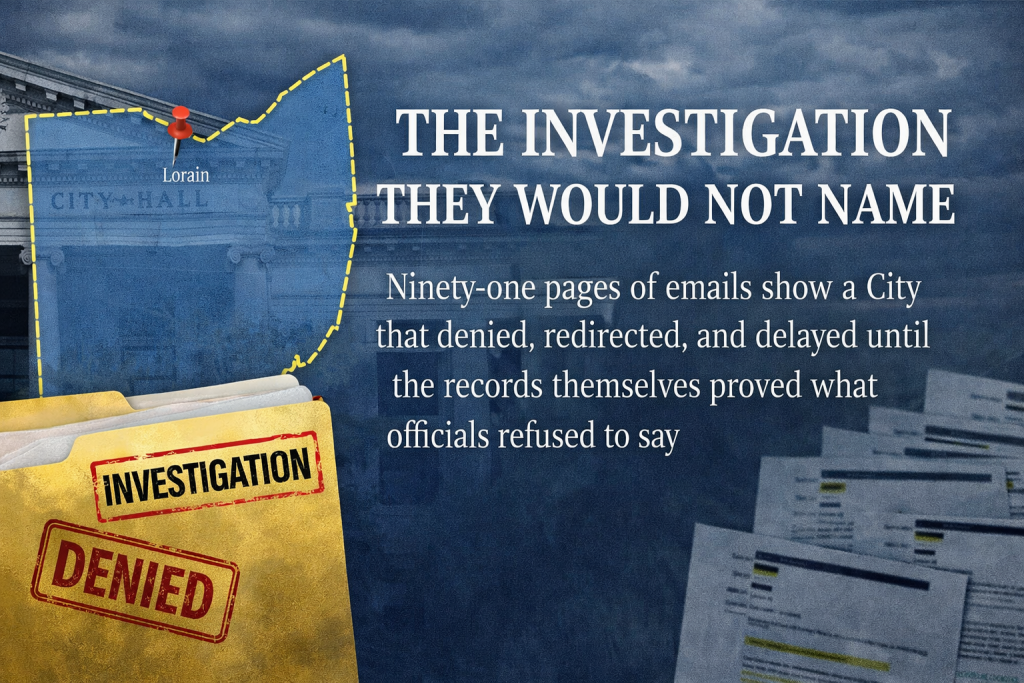
Ninety one pages of emails show a City that denied, redirected, and delayed until the records themselves proved what officials refused to say
By Aaron Christopher Knapp, BSSW, LSW
Investigative Journalist and Public Records Litigant
Editor-in-Chief, Lorain Politics Unplugged
Knapp Unplugged Media LLC
I. INTRODUCTION THE SHIFT FROM DENIAL TO DEFLECTION
By the time this portion of the record begins, the volume alone forces a different kind of analysis. This is not a single exchange or a handful of follow ups. This is ninety one pages of emails, spanning weeks of communication, repeated requests, repeated responses, and a record that does not break, does not reset, and does not resolve. What that volume shows is not confusion or miscommunication. It shows a system that remains engaged, remains aware, and remains in control of how it responds while the underlying issue continues to go unanswered.
In the earlier portions of this series, the City’s position was direct. Records did not exist, were not in custody, or were not subject to disclosure. That phase is already documented. What appears here is something more structured and more deliberate, where the focus shifts away from whether records exist and toward where responsibility can be moved. The issue is no longer framed as a question of existence. It is reframed as a question of ownership, custody, and whether the City can position itself outside the obligation to produce what its own communication shows was created, discussed, and circulated.
That shift is not implied. It is written directly into the responses issued by Assistant Law Director Joseph LaVeck. In one response, LaVeck states, “The City of Lorain is not the repository of any relevant investigatory records,” while continuing in the same communication to acknowledge that “other individuals on the referenced email chain are members of the Ohio CSWMFT Board” and that “any investigative material that the Board possesses are confidential.”
That language does not eliminate the investigation. It relocates it.
At the same time, it confirms something that had already been building across the earlier sets. The investigation is not denied. It is not described as nonexistent. It is described as existing somewhere else, within a chain of communication that includes City officials, City email systems, and individuals acting within or alongside City operations. The City does not separate itself from the communication. It separates itself from the responsibility to produce records tied to that communication.
That distinction is where this set becomes critical.
Because the same record shows that the City was part of the chain. The same record shows that emails were sent, received, and circulated using City resources. The same record shows that officials, including the Law Department, were aware of the communication and engaged in it. Yet when the obligation to produce records is triggered under R.C. 149.43, the response shifts away from engagement and toward avoidance, where the focus becomes identifying another entity rather than fulfilling the duty imposed by law.
That is not a procedural detail. That is the structure of the response.
Across these ninety one pages, the pattern repeats. Requests are made with increasing specificity. Legal arguments are laid out in detail, citing R.C. 149.43, R.C. 149.011(G), and controlling case law defining what constitutes a public record. Questions are asked directly, including what the investigation was, who initiated it, and who holds the records documenting it. Those questions are not ignored. They are answered in a way that never actually answers them. The response moves laterally, pointing to others on the email chain, referencing external entities, and maintaining that the City itself is not the repository.
What makes this shift stand out is that it occurs alongside continued control of the communication. Joseph LaVeck remains the point of contact. The Law Department continues to process the request. At one point, LaVeck states that he is “in the process of re reviewing your original request, the response provided, and checking City records.” That statement confirms that the City is actively reviewing records while maintaining the position that it is not the repository of those records. The contradiction is not hidden. It is embedded in the response itself.
At the same time, the broader context of the communication continues to show the stakes of what is being requested. The emails reference an “investigation” that had been described as ongoing by then Chief McCann. They reference communications involving the Ohio CSWMFT Board. They reference actions that impacted my employment and licensure. These are not abstract records. These are records tied to identifiable conduct, identifiable officials, and identifiable consequences. The existence of those issues is not disputed within the communication. What is disputed is whether the City will acknowledge responsibility for producing the records that document them.
That is what transforms this from a continuation of the earlier sets into something more defined.
This is no longer a situation where the City is simply denying records.
This is a situation where the City is redefining where those records exist, who is responsible for them, and how far it can move that responsibility without violating the law.
That is where this set begins, and everything that follows builds on that shift.
II. THE INVESTIGATION THAT EXISTS EVERYWHERE EXCEPT WITH THE CITY
The central issue in this portion of the record is not complicated, and it is not something that requires interpretation to understand. It is defined by a single question that is asked repeatedly, in different forms, across multiple emails, and never directly answered. What was the investigation that was referenced, who conducted it, and where are the records that document it. That question does not appear once and disappear. It is pressed over and over again across this ninety one page record, each time with more specificity, more legal grounding, and more context drawn from the City’s own prior statements, including direct references by then Chief McCann that an investigation was ongoing and would be “wrapped up.”
When that question is put directly to Assistant Law Director Joseph LaVeck, the response does not clarify the issue or resolve the request. It redirects it. In one exchange, after being asked directly what the investigation was, LaVeck responds by stating that “perhaps those persons on the email chain are better suited to answer that question.” That response does not deny that an investigation exists. It does not state that there are no records. It avoids identifying who conducted the investigation, who documented it, and most importantly, who is legally responsible for producing records tied to it.
That redirection becomes even more significant when placed alongside LaVeck’s other statements within the same chain. In the same sequence of communication, he asserts that “The City of Lorain is not the repository of any relevant investigatory records,” while also acknowledging that individuals on the email chain are connected to the Ohio CSWMFT Board and that “any investigative material that the Board possesses are confidential.” The effect of that language is not to eliminate the investigation. It is to place it somewhere else, without ever identifying where that somewhere actually is in a way that satisfies the City’s obligations under Ohio law.
Under R.C. 149.43, that is not a sufficient response. A public office is required to do more than suggest that someone else may have information. It is required to make a good faith effort to identify and produce responsive records or, at a minimum, to identify the actual custodian of those records if they are not in its possession. That obligation is not optional, and it is not satisfied by pointing generally to “persons on the email chain” without naming them, without identifying their role, and without clarifying whether they are acting as public officials, private individuals, or representatives of another agency.
What the record shows instead is a pattern where the responsibility to answer the question is moved, but never actually assigned. The investigation is referenced. The existence of communication about that investigation is confirmed. The involvement of individuals connected to both the City and an external licensing board is acknowledged. Yet when the question becomes who holds the records and who must produce them, the response shifts away from identification and toward avoidance.
At the same time, LaVeck’s response introduces another layer of contradiction that is directly addressed within the emails themselves. He acknowledges that the Ohio CSWMFT Board may possess investigative materials and asserts that those materials are confidential, but he does not address the separate and controlling legal issue raised in the request. If a City employee created or sent a document using a City issued email account or City resources, and that document relates to official conduct, then it is a public record under R.C. 149.011(G), regardless of where it was sent or who ultimately received it. The confidentiality obligations of the receiving agency do not retroactively remove the public nature of the originating record held by the City.
That distinction is not left implied. It is explicitly laid out in the communication sent to LaVeck, including citation to statutory definitions and controlling case law. The argument is made clearly that the City’s copy of any such communication remains subject to disclosure unless a specific exemption applies directly to the City, not to a separate agency. That argument is not addressed in a way that resolves it. It is not rebutted with a specific statutory prohibition. It is not corrected with an identified custodian. It is left in place while the response continues to rely on redirection.
Across the full scope of these emails, the same question continues to be asked with increasing clarity. What was the investigation. Who conducted it. Where are the records. Each time, the response acknowledges pieces of that question without ever bringing them together into a complete answer. The investigation is treated as something that exists, but not within the responsibility of the City. The records are treated as something that may exist, but not within the custody of the City. The obligation to identify a custodian is treated as something that can be deferred to unnamed individuals within an email chain.
That is the structure that defines this section of the record.
The investigation is never denied.
It is never produced.
And it is never assigned to a custodian in a way that satisfies the law.
What distinguishes this set from the earlier ones is not simply the persistence of the request but the level of legal clarity being placed directly in front of the City and its Law Department. This is not a vague complaint, and it is not a generalized objection. It is a structured legal argument, set out point by point, that explains why the City’s position is incorrect under Ohio law and why the record being sought remains subject to disclosure. The argument is not buried in implication. It is written plainly, sent directly to Joseph LaVeck, and supported by statute, case law, and the Ohio Attorney General’s own public records guidance.
The argument begins with the controlling question of what a public record is under Ohio law. In the written response sent to LaVeck, I state that under R.C. 149.011(G), a public record includes any document, regardless of physical form or characteristic, that is created or received by or comes under the jurisdiction of a public office and serves to document the organization, functions, policies, decisions, procedures, operations, or other activities of the office. From there, the argument narrows to the exact point the City is trying to avoid. If an email was created or sent by a City employee using City issued systems, and if that email documented official conduct or communication tied to a complaint, investigation, or other activity of the City, then the City’s copy of that email is a public record. That is true even if the email was sent to an outside board, an outside investigator, or another agency with its own confidentiality rules.
That is not an aggressive reading of the law. It is a basic one. The argument laid out in the email to LaVeck explains that the confidentiality rules governing the Ohio CSWMFT Board do not automatically extend to the City’s own copy of the same communication. In other words, the Board’s duty to keep its investigative materials confidential does not erase the City’s separate obligation to disclose public records in its possession unless the City can point to an actual statute that specifically prohibits the City itself from releasing them. That distinction is laid out directly in the correspondence. I wrote that LaVeck’s interpretation “misapplies these statutes by conflating the confidentiality obligations of the receiving agency with those of the originating public office,” and then spelled out exactly why that matters.
The legal support for that position is not thin. It is not improvised. It is built on Ohio authority that has existed for years. In the written submission, I cite State ex rel. Wilson-Simmons v. Lake County Sheriff’s Department, 82 Ohio St.3d 37, for the proposition that records created or maintained by a public office in the course of official business fall within the Public Records Act. I cite State ex rel. Toledo Blade Co. v. Seneca County Board of Commissioners, 120 Ohio St.3d 372, 2008-Ohio-6253, for the settled principle that emails relating to public business sent from public systems can constitute public records. I cite State ex rel. Cincinnati Enquirer v. Krings to make the point that the public’s right of access does not depend on where a record ends up, but on where it originated and whether it documents public business. I cite State ex rel. Findlay Publishing Co. v. Hancock County Board of Commissioners, 80 Ohio St.3d 134, to address the exact issue the City is trying to leverage, namely whether a public record becomes confidential merely because it later travels to another agency with stricter disclosure rules. The answer, under that line of authority, is no.
The argument also addresses the exemption the City has been leaning on. The City’s position, repeated through Joseph LaVeck, invokes R.C. 149.43(A)(1)(v) and the confidentiality provisions tied to the Social Work Board. The written response sent to LaVeck explains why that is legally insufficient. R.C. 149.43(A)(1)(v) excludes from disclosure only those records “the release of which is prohibited by state or federal law.” That means the City has to identify a law that prohibits the City of Lorain from releasing the record. It is not enough to identify a law that binds a different agency. It is not enough to gesture toward confidentiality in the abstract. The statute has to apply to the public office that is withholding the record. That point is stated directly in the correspondence, where I wrote, “Again, R.C. 4757.38(B)(1) governs the Board, not your office, not the police department,” and further explained that unless the City can cite an actual statute forbidding it from releasing an email authored and sent by one of its employees from City servers, the record remains public and must be disclosed.
This is where the silence of the City becomes more important than any single denial. Because once that argument is put in front of Joseph LaVeck in full, complete with statutory analysis and controlling authority, the Law Department does not respond with a competing legal analysis that actually addresses those points. It does not identify a statute that expressly bars the City from releasing its own copy. It does not explain why the cited case law would not apply. It does not rebut the distinction between the receiving agency and the originating public office. Instead, the response returns to the same evasive posture, where the City says it is not the repository, suggests others on the chain may know more, and avoids answering the legal issue at the center of the request.
That absence matters because this is the stage where the City can no longer credibly claim that the issue has not been explained to it. The legal question is framed for them. The cases are cited for them. The distinction between the Board’s confidentiality obligations and the City’s disclosure obligations is spelled out for them. The argument that the City’s copy remains public is placed directly before Assistant Law Director Joseph LaVeck in writing. Yet the record does not show a meaningful legal response to that argument. It shows a return to position, not a response to substance.
That is what makes this section of the record so important. The issue is not just that the City denied records. The issue is that when the denial was challenged with a detailed legal argument grounded in Ohio law, the City did not truly answer that argument. It stepped around it. It redirected it. It left the central question untouched while continuing to withhold or disclaim responsibility. In a public records dispute, that is not just a weak response. It is the point where denial stops looking like legal judgment and starts looking like refusal.
IV. THE RETURN TO THE SAME LANGUAGE
Despite the escalation in detail, the expansion of the record, and the fact that the legal argument has now been laid out in full with statutory citations and controlling case law, the responses from the City do not evolve in a way that resolves the issue. What appears instead is a return to the same language that has already been shown, across multiple prior sets, to conflict with the record itself. The phrasing does not change in any meaningful way. The structure does not change. The substance of the response remains fixed, even as the questions being asked become more specific and more difficult to avoid.
Joseph LaVeck continues to rely on the same core statements that have defined the City’s position from the beginning of this exchange. He reiterates that the Law Department is not the repository of records. He reiterates that the request is still being processed. He reiterates that a response will be provided when that process is complete. These statements are not new, and they are not adapted to address the legal arguments that have been presented. They are repeated, almost verbatim, across the span of the ninety one pages, even as the context around them continues to shift.
At one point in the communication, LaVeck states that he is “in the process of re reviewing your original request, the response provided, and checking City records.” That statement carries more weight than it appears to on its face, because it confirms active internal review at the same time that the City continues to assert that it is not the repository of the records being sought. The City cannot be both actively reviewing records tied to the request and entirely outside the chain of custody for those records without creating a contradiction. The act of reviewing “City records” necessarily acknowledges that records exist within the City’s systems that are responsive to the request or at least relevant to it.
That contradiction is not resolved by the response. It is carried forward.
The pattern that emerges across this section of the record is one where internal activity continues without being reflected in the outward position taken by the Law Department. The request is being processed. The records are being reviewed. The communication remains active. Yet the answer provided to the central question does not move. The City does not identify a custodian. It does not produce the requested materials. It does not reconcile its internal review with its external claim that it is not the repository. The response remains fixed even as the record continues to grow around it.
This repetition becomes even more significant when viewed in the context of the legal argument that has already been placed before the City. The issue is no longer whether the City understands the request. The issue is no longer whether the legal basis for disclosure has been explained. Both have been addressed in detail. The continued use of the same language, without adjustment or clarification, shows that the response is no longer evolving in relation to the substance of the dispute. It is being maintained regardless of that substance.
What this creates is a record where the same statements appear alongside an expanding body of evidence that calls those statements into question. The Law Department says it is not the repository, while reviewing City records. The Law Department says the request is being processed, while the request itself becomes more defined and more legally grounded. The Law Department says a response will be provided, while the same unanswered questions continue to be asked across multiple emails.
The structure does not change because the structure is the response.
And within that structure, the contradiction does not resolve. It repeats, it reinforces itself, and it becomes more visible with every additional page of the record.
V. THE ESCALATION TO COURT OF CLAIMS AND WHISTLEBLOWER CLAIMS
By this point in the record, the tone of the communication changes in a way that reflects more than frustration. It reflects a shift into formal legal posture, and that shift is documented just as clearly as everything that came before it. The requests are no longer framed as routine follow ups or informal attempts to obtain compliance. They are accompanied by explicit notice that the dispute is moving toward enforcement, including stated intent to file with the Ohio Court of Claims under R.C. 2743.75 and the identification of potential whistleblower retaliation claims tied directly to the conduct reflected in the emails themselves.
That escalation does not appear suddenly or without foundation. It is built step by step across the ninety one pages of communication that precede it. The record shows repeated requests for the same category of documents, repeated explanations of why those documents qualify as public records under R.C. 149.011(G), and repeated challenges to the City’s reliance on inapplicable exemptions. It shows direct questions being asked about the nature of the investigation, the identity of the custodian, and the existence of responsive materials. It shows those questions being redirected, deferred, or answered in a way that avoids resolving them. By the time legal enforcement is raised, the groundwork for that step has already been laid in detail.
The language used in the emails reflects that progression. At one point, I provide clear notice that the delay has exceeded what can reasonably be considered prompt under the statute, stating that it has been “15 days on this matter (and longer due to previous denials)” and that the City should “accept this as 3 days notice of intent to file with court of claims.” That is not a general complaint. It is a formal notice tied to a specific enforcement mechanism created by the Ohio legislature to address exactly this type of dispute. R.C. 2743.75 exists to provide a streamlined process for challenging the denial of public records, and its invocation marks the point where the issue moves out of internal communication and into adjudication.
At the same time, the record shows that the dispute is not limited to access to documents. It is tied to the underlying conduct those documents reflect. The emails reference a complaint that was allegedly submitted in the name of the Lorain Police Department, communication that was sent using City resources, and actions that affected my employment and professional licensure. Within that context, the escalation to a potential whistleblower retaliation claim is not an unrelated threat. It is a direct extension of the issues already documented in the record, where I state that I will “consider filing a whistleblower retaliation claim based on the retaliatory nature of the original complaint and the City’s subsequent actions affecting my employment and licensure.”
That matters because it shows that the dispute has moved beyond access and into accountability. The failure to produce records is no longer viewed in isolation. It is connected to the question of why those records are being withheld and what they would show if they were produced. The refusal to identify a custodian is no longer just a procedural failure. It becomes part of a broader pattern where the movement of information, the handling of complaints, and the impact on an individual are all tied together within the same body of communication.
Throughout this escalation, the City is given repeated opportunities to resolve the issue within the framework of the Public Records Act. The requests are clarified. The legal arguments are provided. The relevant statutes and case law are cited. The specific records being sought are identified with increasing precision, including requests to search City email servers, including those associated with Chief McCann, for communications sent to the Social Work Board during a defined time period. These are not open ended demands. They are targeted requests that provide the City with a clear path to compliance.
Those opportunities are not used to resolve the dispute.
Instead, the record shows the same pattern continuing through this stage. The Law Department maintains its position that it is not the repository of the records. The request continues to be described as being processed. The identity of the custodian remains undefined. The central questions remain unanswered. The escalation to legal enforcement does not interrupt that pattern. It exists alongside it, documenting the point where continued engagement without resolution leads directly to formal action.
What this section ultimately captures is the transition from persistence to enforcement. The communication does not stop, and the requests do not change in substance. What changes is the recognition, documented in writing, that the dispute will not be resolved through email alone and that the mechanisms provided under Ohio law will be used to compel an answer.
VI. THE SAME NAMES THE SAME AUTHORITY AND THE QUESTION OF CONFLICT
By the time this portion of the record is read in full, another pattern becomes impossible to ignore, and it is not tied to a single email or a single response. It is tied to the same names appearing over and over again across different roles, different stages of the dispute, and different functions within the system. Joseph LaVeck is not just responding to public records requests. He is acting as Chief Assistant Law Director and Police Legal Advisor. Patrick Riley is not just a passive supervisor. He is the Law Director whose office is shaping the legal posture of the City. Those same offices and the authority they carry do not exist in isolation from the rest of the system that is now interacting with me.
That overlap matters because the dispute documented in these emails does not remain confined to a records issue. It moves into enforcement, into prosecution, and into proceedings where the same underlying facts, the same communication, and the same individuals are now part of a different process. The same Law Department that is responding to records requests and maintaining positions about what exists and what does not is also part of the structure that connects to the prosecutorial function handling charges against me. The authority of that office does not stop at records. It extends into the legal system that is now acting on the same underlying conduct.
At the same time, the record reflects that the municipal court system itself has already recognized the existence of conflict. Judges within that system have recused themselves. They have stepped away from the case, acknowledging that their position within the structure creates a situation where they cannot preside. That action is not taken lightly, and it is not taken without cause. Recusal reflects a determination that the appearance or existence of conflict is significant enough to require removal from the proceeding.
That raises a question that the record itself now forces.
If the municipal judges have determined that conflict exists to the extent that they cannot remain involved, why does that same recognition not extend to the broader structure surrounding the case. Why does the same Law Department remain in place, continuing to assert positions, continuing to represent City officials, and continuing to operate within a system where its authority overlaps with the prosecutorial function connected to the same matter.
The emails show that Joseph LaVeck is not an uninvolved party. He is directly engaged in the dispute, responding to requests, shaping the City’s legal position, and addressing issues that are tied to the same underlying conduct. Patrick Riley’s office is not detached from that process. It is the authority behind it. At the same time, that same structure is connected to the prosecution that has been initiated, where the facts and communication documented in these emails become part of a different legal proceeding.
That overlap is not theoretical. It is structural.
The question that follows is not whether any one individual acted improperly within a single email. The question is whether the system itself can continue to operate in multiple roles at once without addressing the conflicts that arise from that overlap. When the same office is involved in responding to records requests, advising officials, and connected to the prosecutorial process acting on the same underlying facts, the issue is no longer limited to disclosure. It becomes a question of impartiality, separation of roles, and whether the matter should be handled by an agency that is not already embedded within the dispute.
Nothing in the record shows that such a step has been taken.
The communication continues through the same channels. The same officials remain involved. The same legal authority remains in place. Even as the matter escalates and even as parts of the system acknowledge conflict through recusal, the broader structure does not change.
That is what this section establishes when read in full context. The record is not just documenting a dispute over records. It is documenting a system where the same individuals and the same offices continue to appear across multiple roles, even as the implications of that overlap become more pronounced.
And once that overlap is visible, the question is no longer whether conflict exists.
The question is why it has not been addressed.
VI. THE LAW DIRECTOR’S OFFICE THE PROSECUTOR AND A STRUCTURE THAT DOES NOT SEPARATE ITSELF
What makes this stage of the record different is that the overlap is no longer something that has to be inferred from emails alone. It is documented in the City’s own description of how its legal system is structured and who answers to whom. The same names that appear throughout the email chains, Joseph LaVeck and Patrick Riley, are not operating in isolated roles. They exist inside a system where the Civil Division, the Criminal Division, and the prosecutorial function are all tied together under the same Law Director’s Office.
The document titled “2022 Report of Law Director and 2021/2022 VOCA Grant Summary” lays that structure out directly. On its face, it identifies Joseph LaVeck as “Asst. Law Director & Police Legal Advisor” and places him within the Civil Division, while also describing the Criminal Division where the City Prosecutor operates. That same report explains that the Lorain City Prosecutor’s Office “represents the State of Ohio and City of Lorain in the prosecution of criminal and traffic law violations” and works directly with the Lorain Police Department to determine charges and present cases to the judges.
That is not a separation of roles. That is a structure where legal advice, civil representation, and prosecution exist within the same office, under the same leadership, operating within the same chain of authority.
The report goes further. It states that attorneys within the Civil Division, including Joseph LaVeck, were “fully dedicated to the Civil Division” but also acknowledges that they “covered cases for the Lorain City Prosecutors Office” when necessary. That single sentence removes any argument that these roles are strictly divided. The same attorneys who are advising the City, responding to records requests, and shaping legal positions are also capable of stepping into prosecutorial functions within the same system.
At the same time, Joseph LaVeck is identified as continuing to serve as the Lorain Police Department Legal Advisor, providing daily legal service to the police department. That places him directly in the chain between law enforcement, legal advice, and the City’s response to the very issues being raised in the emails. He is not just responding to me as a requester. He is advising the department whose conduct is part of the dispute.
Overlay that structure with what is happening in the record, and the overlap becomes unavoidable.
Joseph LaVeck is responding to public records requests about an investigation.
Joseph LaVeck is advising the police department connected to that investigation.
Patrick Riley, as Law Director, is the authority over the office shaping those responses.
The City Prosecutor, operating within that same office structure, is pursuing charges tied to the same broader set of facts and communication.
That is not a series of independent roles. That is a single system operating across multiple functions without separation.
At the same time, the municipal court system has already acknowledged conflict at the judicial level. Judges have recused themselves. They have stepped away from presiding over the matter, recognizing that their position within the system creates an issue that requires removal. That action establishes something critical. It establishes that conflict is not hypothetical. It has already been recognized formally within one part of the system.
That recognition raises a question that this record now forces into the open.
If the judges within the municipal system have determined that conflict exists to the extent that they cannot remain on the case, why does the same analysis not apply to the structure surrounding the case. Why does the Law Director’s Office remain in place, continuing to represent City officials, continuing to respond to the underlying records dispute, and continuing to operate within the same chain of authority that includes the prosecutorial function now acting against me.
Nothing in the record shows that the matter has been referred out to an independent agency.
Nothing in the record shows that a separate prosecutor has been brought in from outside this structure.
Nothing in the record shows that the City has taken steps to create distance between the individuals responding to the dispute and the individuals acting within the enforcement side of that same dispute.
Instead, what the record shows is continuity.
The same office.
The same authority.
The same individuals.
Operating across roles that intersect directly with each other.
This is not just a question of optics. It is a question of whether the system can operate in multiple capacities at once without addressing the conflicts that arise from that overlap. When the same office is advising, responding, and prosecuting within the same factual framework, the issue is no longer limited to records or compliance. It becomes a question of whether the structure itself is capable of producing an outcome that is independent of the positions already taken within it.
The document outlining the Law Director’s duties does not hide this structure. It confirms it. It shows a unified legal system within the City where civil, criminal, and advisory functions are intertwined rather than separated.
And when that structure is placed alongside the record that has been built across these email sets, the question is no longer whether overlap exists.
The question is why the case remains inside that structure at all.
VII. FINAL THOUGHT THE QUESTION THAT WAS NEVER ANSWERED UNTIL IT WAS FORCED
By the end of this portion of the record, the question at the center of everything is not unclear, and it is not complicated. It is a question that was asked repeatedly across ninety one pages of emails, in multiple forms, with increasing precision, supported by statute, supported by case law, and supported by the City’s own prior statements. What was the investigation, who conducted it, and where are the records that document it. That question did not appear once. It did not get lost in the exchange. It was placed directly in front of Assistant Law Director Joseph LaVeck, tied to specific dates, tied to specific communications, and tied to statements made by then Chief McCann that an investigation existed and would be completed.
What the record shows is not confusion about that question. It shows refusal to answer it in a way that complies with the law.
The City never said the investigation did not exist. In fact, through its own responses, it confirmed that there were communications tied to individuals on the email chain connected to the Ohio CSWMFT Board and acknowledged that investigative materials existed within that context. The City did not produce the records when asked. The City did not identify a custodian in a way that satisfied R.C. 149.43. Instead, it redirected the request, stating that “those persons on the email chain are better suited to answer that question,” while at the same time maintaining that it was not the repository of the records. That is not a denial. That is deflection structured as a response.
At the same time, the Law Department continued to operate as if the issue was still being handled. Joseph LaVeck stated that he was “in the process of re reviewing your original request, the response provided, and checking City records.” That statement confirms active internal review. It confirms that the City was looking at its own systems, its own emails, and its own records while maintaining the position that it did not possess the records being sought. That contradiction does not resolve itself anywhere in the ninety one pages that make up this set. It repeats, it reinforces itself, and it becomes more visible the more the record expands.
What makes this section different from everything that came before it is that the question does not go away, and neither does the pressure to answer it. The legal argument is fully developed. The statutory obligations are clearly laid out under R.C. 149.43 and R.C. 149.011(G). The case law is cited. The distinction between the City’s obligations and the confidentiality rules of the Social Work Board is explained in detail. The City is given multiple opportunities to respond with a legally sufficient answer. Those opportunities are not used to resolve the issue.
And yet, despite that refusal, despite the denial, despite the redirection and delay, the record does not end there.
Because the emails were eventually produced.
Not because the City clearly identified a custodian and complied with the request in the way the law requires. Not because the Law Department provided a complete and consistent explanation that aligned with the record. They were produced after the pressure continued, after the dispute escalated, and after the mechanisms for enforcement were put in motion. The same records that were described as not being in the City’s custody, or not being the responsibility of the City to produce, became part of the record that now exists.
That changes the meaning of everything that came before it.
Because the question was never answered in the way the law requires. It was never resolved through a clear identification of the investigation, the individual or entity that conducted it, and the custodian responsible for the records. Instead, the answer appears in a different form. It appears in the existence of the records themselves. The fact that the emails exist, that they were created, that they were sent, that they were reviewed, and that they were ultimately produced establishes what the responses never admitted directly.
The investigation existed.
The communication existed.
The records existed.
What did not exist within this ninety one page record was a straight answer acknowledging those facts in a way that complied with the obligations imposed by Ohio law.
That is what defines this set when it is read in full context. It is not just a record of denial. It is a record of a system that refused to answer a direct legal question while continuing to operate around it, until the existence of the records themselves made that answer unavoidable.
The City never resolved the question in its responses.
The record resolved it for them.
Legal Disclaimer
This article is part of an ongoing investigative journalism series authored by Aaron Christopher Knapp and published by Knapp Unplugged Media LLC. It is based on documents obtained through lawful public records requests, including email correspondence, attachments, and related materials maintained by public offices. All factual statements contained herein are derived from those records or from the author’s direct involvement in the events described.
This publication addresses matters of public concern involving the conduct of government, the actions of public officials, and the administration of public records under Ohio law. Any analysis, interpretation, or conclusions expressed are the protected opinion of the author based on disclosed facts and a good faith review of the available evidence. To the extent that statements may be interpreted as opinion, they are presented as such and are grounded in the underlying record.
This article may reference individuals who are public officials, public employees, or participants in matters of public concern. All such references are made strictly in a journalistic context for the purpose of reporting, analysis, and public accountability. Nothing in this publication is intended as a direct communication to, or solicitation of action from, any public official, government employee, attorney, or party referenced herein.
Certain subject matter discussed in this article relates to ongoing legal proceedings. This publication is not intended to interfere with, influence, or prejudice any pending case, nor is it directed toward any court, judge, or tribunal. It is a work of journalism disseminated to the general public in furtherance of transparency and the public’s right to know.
No statement in this article is made with knowledge of falsity or reckless disregard for the truth. Allegations, claims, or statements attributed to third parties are identified as such and are included for the purpose of reporting on their existence within the documented record. Readers are encouraged to review the underlying materials and draw their own conclusions.
All content is published in accordance with the protections afforded by the First Amendment to the United States Constitution and corresponding provisions of Ohio law governing freedom of speech and freedom of the press.
This article does not constitute legal advice. Any references to statutes, case law, or legal standards are provided for informational and analytical purposes only.
© 2026 Knapp Unplugged Media LLC. All rights reserved. Unauthorized reproduction or redistribution of this material, in whole or in part, is prohibited without prior written permission, except as permitted under applicable fair use doctrines.
About The Author