
Selective Disclosure Is Not Transparency

Why informal forwarding of investigative submissions is a governance failure, not a paperwork issue
Introduction
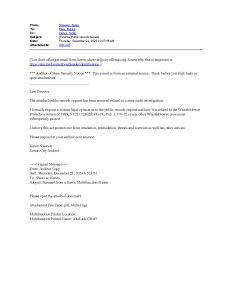
I am writing this analysis because the facts do not require embellishment, inference, or tone to be serious. They require clarity. A resident provided investigative materials to the City of Lorain for the purpose of governmental review. Those materials were later sent, unredacted, by a sitting councilmember, Mary Springowski, to a private citizen, Loraine Ritchey. That act did not occur through a public records request. It was not accompanied by redactions. It was not routed through the City’s records custodian. It was not logged, explained, or justified under Ohio Revised Code 149.43.
This is not a personality dispute. It is not about who likes whom, who writes what online, or who is politically aligned with whom. It is about process, power, and the rules that govern how public officials handle materials entrusted to them in their official capacity.
What follows is a plain analysis of why that act matters.
The Nature of the Records at Issue
When a citizen submits documents to a city for investigation, those documents enter government custody for a defined governmental purpose. They are no longer private correspondence, nor are they the personal property of the official who happens to receive or possess them. Under Ohio law, records received by a public office in connection with official business are public records, regardless of who created them or where they originated.
That designation, however, does not mean those records are free to be circulated informally, selectively, or at the personal discretion of an individual officeholder. It means they are governed by statute. Ohio’s Public Records Act does not authorize ad hoc disclosure by elected officials acting on their own initiative. It establishes a structured process by which records are requested, reviewed, redacted when necessary, and released through the records custodian in a manner that is neutral, uniform, and accountable.
Here, the materials that were shared went far beyond a single email or isolated document. The disclosures included my email filings to my professional licensing board, records and findings related to my unemployment proceedings, and materials reflecting licensing board outcomes and determinations. Each of those categories carries heightened sensitivity, not because they are automatically exempt from disclosure, but because they are the type of records that routinely require careful statutory review and redaction before any release.
Those records were submitted to the City for a specific governmental purpose. They were not provided for political commentary, informal distribution, or private circulation. Once in City custody, any disclosure decision had to be made through the lawful public records process, with attention to applicable exemptions, redaction obligations, and the rights of third parties referenced within the materials.
That did not occur. Instead, the records were transmitted wholesale and unredacted to a private individual, outside the public records framework, without a request, without review, and without documentation of any legal basis for the disclosure.
The method of disclosure is not a technicality. It is the safeguard.

What Did Not Happen Here
This disclosure did not occur through any mechanism recognized by Ohio law or by ordinary municipal practice. No public records request was submitted by the recipient, oral or written. No written response was issued by the City acknowledging a request, identifying responsive records, or explaining the basis for any release. No redaction review was performed to assess whether the materials contained exempt information, protected personal data, or context requiring withholding. No legal exemption analysis was documented or even referenced, despite the nature of the materials involving investigations, employment, and licensing matters. No notice or explanation was provided to the individual who submitted the materials to the City for official use.
Instead, and this is the critical point, investigative materials submitted to the City for governmental purposes were forwarded, in full and unredacted, to a private individual outside City government, without request, without process, and without oversight.
That is not a procedural misstep. It is a complete bypass of the statutory framework that governs how public records are handled. Standing alone, that single fact is sufficient to raise serious legal, ethical, and institutional concerns, because it replaces neutral, accountable process with unilateral discretion by an individual officeholder.
Why Selective Disclosure Is a Serious Problem
Ohio public records law is built on a simple but nonnegotiable premise: equal access under neutral rules. Records are not supposed to move through government based on relationships, irritation, sympathy, political alignment, or personal judgment. They are released to anyone who asks, in the same manner, subject to the same review, governed by the same statute, and constrained by the same redaction obligations. That symmetry is the entire point of the Ohio Public Records Act. It is what separates lawful transparency from favoritism.
When an official bypasses that system and sends records directly to a private citizen, the official is not merely accelerating disclosure. The official is substituting personal discretion for statutory process. That substitution matters. It collapses the distinction between a public office acting as a custodian of records and an individual officeholder acting as a gatekeeper who decides who deserves access, when, and on what terms. Ohio law does not authorize that role. In fact, it was written to prevent it.
Courts have consistently warned that selective or informal disclosure undermines the Public Records Act even when the underlying records are public in nature. The problem is not whether a document could eventually be released. The problem is how it is released and to whom. The law requires that disclosure occur through a defined channel that includes identification of the requester, identification of the records, review for exempt material, and accountability for the decision made. When those steps are skipped, the release ceases to be a public records response and becomes an act of unilateral distribution.
That distinction is especially important where the records involve investigations, complaints, licensing matters, employment issues, or allegations that can cause reputational or professional harm. In those contexts, the redaction process is not optional and the role of legal review is not cosmetic. Ohio Revised Code 149.43 does not permit officials to decide on their own that review is unnecessary because they personally believe disclosure is justified. The statute places that responsibility on the office, not the individual, and it requires that the process be documented, defensible, and repeatable.
Selective disclosure also destroys auditability. When records are released through the statutory process, there is a paper trail that shows who asked, what was requested, what was reviewed, what was withheld, and why. That record protects both the requester and the public office. Informal transmission provides none of that. It leaves no explanation, no exemption analysis, no redaction log, and no accountability if the release turns out to be improper. That absence is not accidental. It is the predictable consequence of acting outside the law.
Most troubling of all, selective disclosure weaponizes access. It allows an official to withhold communication from the person directly affected while simultaneously disseminating sensitive materials to a third party who did not ask for them. That inversion of access is the opposite of transparency. It signals that records are being used not to inform the public neutrally, but to influence narratives, recruit allies, or punish disfavored individuals without the discipline of legal process.
That is why this conduct cannot be dismissed as casual or harmless. Transparency does not mean “whoever I choose gets the records.” Transparency means the law governs disclosure, not temperament or convenience. Anything else is discretion without accountability, and discretion without accountability is precisely what Ohio’s public records law exists to prevent.
The Dual Standard in Practice
That problem is not theoretical here. The City’s own handling of related records exposes a stark and indefensible dual standard. When I submitted a public records request seeking Lorraine Ritchey’s emails, the City treated those communications as sensitive government records subject to formal review. They were processed through the Law Department, produced only after delay, and released with extensive redactions. The City asserted privacy concerns, exemption analysis, and redaction obligations. In short, the City treated those emails as records requiring careful statutory handling.
At the same time, those same safeguards were abandoned in the opposite direction. While my request for Ritchey’s emails triggered redaction and restriction, my communications, investigative submissions, licensing correspondence, and employment related materials were transmitted to Ms. Ritchey directly, unredacted, without any request from her, without any public records process, and without any documented legal review. The City simultaneously claimed an obligation to redact her emails while exercising no such obligation when disseminating mine.
That asymmetry is not accidental and it is not neutral. It demonstrates that redaction and caution were not being applied as a matter of law, but as a matter of discretion. The Public Records Act does not permit that kind of one way protection. An office cannot invoke privacy and exemption standards when withholding records from one party, while discarding those same standards when distributing related records to a favored private recipient.
This is precisely why selective disclosure is dangerous. It reveals that the statutory process was not guiding disclosure decisions. Personal judgment was. And once disclosure decisions are driven by discretion rather than statute, equal access collapses and the protections of the Public Records Act become meaningless.
Investigative Submissions Are Not Political Props
When a citizen submits documents to a city for investigative or review purposes, those materials enter government custody for a defined governmental function. They are no longer private correspondence, nor are they the personal property of the official who happens to receive them. Under Ohio law, records received by a public office in connection with official business are public records regardless of who created them. That designation is not discretionary, and it does not fluctuate based on irritation, familiarity, or political convenience.
But the fact that a record qualifies as a public record does not mean it is free to circulate informally. The Ohio Public Records Act does not authorize ad hoc disclosure by individual officeholders. It establishes a structured, uniform process by which records are requested, reviewed, redacted when required, and released in a manner that is neutral, documented, and legally defensible. The process is the protection. It is what prevents abuse, favoritism, and misuse of information obtained through government channels.
Here, that process was abandoned.
The materials at issue were investigative submissions. They included complaints, supporting exhibits, communications with licensing bodies, employment related information, and documentation involving third parties. These materials were provided to the City with the expectation, reasonable or not, that they would be evaluated by officials or staff charged with investigating or responding to them within the ordinary course of government business. They were not submitted for redistribution. They were not submitted for commentary. They were not submitted to be forwarded selectively to private individuals.
Investigative submissions often contain untested allegations, contextual narratives, personal identifiers, licensing information, and employment related records. Stripped of governmental framing, those materials are particularly susceptible to misinterpretation or misuse. That is precisely why Ohio law places responsibility for review and redaction on the public office itself, not on individual officials acting alone. The statute does not permit an official to decide unilaterally that review is unnecessary because the official personally believes disclosure is justified or convenient.
Despite that, the investigative materials were forwarded unredacted to a private citizen outside City government, without any public records request, without any documented review, without any redaction analysis, and without any legal consultation. The recipient did not ask for them through lawful channels. The City did not issue a response letter. No exemption analysis was performed. No explanation was provided to the submitter. There is no paper trail showing that anyone paused to consider whether this disclosure complied with Ohio Revised Code 149.43.
That single fact is enough to trigger concern. But it is not the only one.

The Absence of Any Lawful Justification
There is no provision in Ohio Revised Code 149.43 that authorizes a councilmember to disclose records informally to a private individual. The statute does not contain a carve-out for elected officials acting on their own initiative. There is no “councilmember exception,” no discretionary privilege, and no parallel disclosure track that allows records to bypass the public records process because an individual officeholder believes disclosure is warranted, helpful, or justified under the circumstances.
Public records authority resides with the public office, not with individual officials. The law vests responsibility for disclosure in the records custodian and, by extension, in the institutional processes that govern record review, redaction, and release. An individual councilmember does not acquire independent disclosure authority merely by possessing or receiving records in the course of official business. Possession is not permission. Custody is not discretion.
Ohio’s Public Records Act is explicit about how records are released. Records are disclosed in response to a request. They are reviewed for exempt material. Redactions are applied where required. The requester is identifiable. The decision is accountable. None of those steps are optional, and none of them can be skipped simply because an official chooses to act outside the system.
If the materials at issue were disclosable public records, the lawful course was straightforward and uncontroversial. They could have been released through the records custodian upon request, with appropriate redactions, citation to any applicable exemptions, and documentation of the release. That process protects the public, the requester, and the office itself.
If the materials were not disclosable, then they should not have been released at all. Ohio law does not permit officials to test disclosure boundaries by selectively forwarding records to private individuals and seeing what happens. The statute does not authorize “informal release now, justification later.” Disclosure decisions are supposed to precede disclosure, not follow it.
The act of informal disclosure fits neither category. It was not a lawful public records release, because it did not follow the statutory process. It was not a protected withholding, because the records were in fact disclosed. It exists entirely outside the framework the law establishes.
That matters because when conduct falls outside the statute, it is not merely a technical deviation. It is a failure to comply with the only authority that governs the handling of public records. The absence of a statutory justification is not cured by good intentions, personal beliefs, frustration with a submitter, or alignment with a recipient. Ohio law does not measure compliance by motive. It measures compliance by process.
In short, there is no lawful theory under which this disclosure can be defended as routine, authorized, or permissible. The Public Records Act provides a binary choice: disclose through the law or do not disclose at all. What occurred here was neither.
Dereliction of Duty and Abuse of Office Concerns Raised by Informal Disclosure
The conduct at issue does not exist in a vacuum. It must be evaluated against the duties inherent in holding public office and the limits Ohio law places on how authority may be exercised. While councilmembers are elected officials rather than classified employees, that distinction does not place them outside the ethical and operational boundaries that govern the use of government systems, government information, and government power.
At its core, this episode raises a fundamental question of role fidelity. A councilmember is entrusted with public authority to legislate, deliberate, and oversee, not to act as a parallel records custodian, investigator, or distributor of sensitive materials. When an official steps outside those bounds, the issue is not merely procedural error. It becomes a question of whether the office itself is being misused.
Abuse of Office Is About Function, Not Job Title
Ohio law has long recognized that abuse of office does not require criminal intent or personal gain to be problematic. It arises when a public official uses the authority, access, or resources of their position in a way that is not authorized by law and not tethered to an official function.
Here, the disclosure of investigative submissions did not serve a legislative purpose. It did not advance deliberation, oversight, or policymaking. It was not part of a council proceeding, a committee referral, or a formal inquiry. Instead, it involved the unilateral transmission of materials obtained through government channels to a private individual outside government, without process, review, or documentation.
That matters because access to investigative submissions exists only because of the office. A private citizen could not have received those materials absent the councilmember’s position. Using that access to circulate records informally is not neutral conduct. It is an exercise of power that exists solely because of public office, deployed outside any lawful framework.
Dereliction of Duty Can Include Failure to Respect Process
Public duty is not limited to affirmative acts. It also includes adherence to required processes, especially where those processes exist to protect fairness, neutrality, and accountability.
Ohio’s public records framework deliberately separates individual officials from records decisions. That separation is not bureaucratic trivia. It exists to ensure that disclosure decisions are made consistently, with legal review, redaction analysis, and documentation. When an official bypasses that structure, they are not simply being informal. They are disregarding a duty imposed by law on the office as a whole.
Dereliction, in this context, does not require proof of malicious intent. It arises from the failure to respect known procedural safeguards when exercising official authority. Forwarding investigative materials without routing them through the records custodian or legal review abandons the very mechanisms designed to prevent misuse.
Electronic Communications and Information Governance Concerns
Although councilmembers may not be subject to every provision of an employee handbook, they routinely use the same electronic systems, email infrastructure, and document platforms governed by those policies. Municipal electronic communications rules typically exist for a reason. They regulate how official communications are sent, stored, shared, and protected, precisely because misuse creates legal exposure for the City.
If the City’s electronic communications or information governance policies prohibit the unauthorized dissemination of sensitive or investigative materials, the conduct here is at minimum in tension with those standards. Even if enforcement mechanisms differ for elected officials, the policy expectations still articulate what constitutes proper and improper use of City systems.
Using City email to transmit investigative submissions to a private citizen without authorization, review, or redaction is not a gray area in principle. It is exactly the type of conduct those policies are meant to prevent. The absence of formal discipline authority does not transform improper conduct into acceptable conduct.
The Dual Standard Exposes the Breakdown
The seriousness of this conduct becomes unavoidable when contrasted with how the City treated requests involving the same private citizen.
When records involving Lorraine Ritchey were requested through the Public Records Act, the City treated them as sensitive. They were reviewed. They were redacted. Portions were withheld. The statutory process was followed, and the City exercised caution.
At the same time, that same private citizen was receiving investigative materials concerning another individual directly from a councilmember, unredacted, without request, without review, and without documentation.
That dual standard is not accidental. It reflects a conscious departure from neutral process. It demonstrates that the City knew redaction and review were required when records flowed through official channels, yet those safeguards were abandoned when disclosure occurred informally.
That is not merely inconsistent. It is evidence that the official disclosure was outside the ordinary course of government business.
Why This Cannot Be Dismissed as Informal or Harmless
Public officials sometimes attempt to minimize this type of conduct by characterizing it as casual communication or constituent engagement. That framing fails here.
Investigative submissions are not casual materials. They are not political talking points. They are not personal correspondence. They are documents submitted for governmental action, often containing sensitive information, third party references, and contextual allegations. Treating them as disposable or freely shareable strips them of the protections the law deliberately assigns.
Once an official decides, unilaterally, to circulate such materials, the official assumes a role the law does not grant. That assumption of authority is the problem. It is what converts informal sharing into potential abuse of office.
Accountability Does Not Require Criminality
It is important to be precise. Identifying dereliction of duty or abuse of office concerns does not require alleging criminal conduct. It requires acknowledging that public authority was exercised outside lawful bounds.
Ohio law does not require proof of corruption to demand accountability. It requires fidelity to role, respect for process, and adherence to the structures that govern public power. When those are abandoned, scrutiny is not optional. It is required.
What happened here is not a matter of tone or temperament. It is a structural failure. An official acted as a records distributor without authority, bypassed safeguards designed to protect neutrality, and created a dual system of access that favored a private individual while withholding communication from the person directly affected.
That is not how public office is supposed to function. And it is precisely why Ohio law draws firm lines around who controls records, how disclosures occur, and why process matters more than personal judgment.
Context Matters Even Without Alleging Motive
This analysis does not require a claim of retaliation, malice, or bad faith. Ohio law does not demand proof of intent to find a violation of duty. It demands adherence to process.
That said, context still matters. The submitter of the materials was a vocal critic of City conduct. When investigative submissions from a critic are forwarded to a private third party without redaction, the act carries an inherent chilling effect. It signals to residents that engaging with their government may result in loss of control over how their submissions are handled.
That is not an abstract concern. It goes to the heart of the right to petition government for redress of grievances. Government does not function when residents fear that submitting information will lead to informal dissemination outside official channels.
Institutional Risk and Governance Failure
Beyond individual accountability, this incident exposes a systemic governance failure that extends well past any single councilmember. City government does not function on improvisation or personal discretion. It functions through defined roles, assigned authority, and internal controls designed to prevent exactly this kind of breakdown. Records custodians manage records. Law departments evaluate disclosure obligations and exemptions. Investigative materials are reviewed, redacted, and released through a controlled process. Councilmembers legislate, deliberate, and exercise oversight within those boundaries. When those boundaries collapse, the problem is no longer interpersonal. It becomes institutional.
Allowing or tolerating informal disclosure by elected officials destroys the City’s internal control structure. It creates parallel channels of information flow that operate outside policy, outside legal review, and outside accountability. Once that happens, the City loses the ability to say, with credibility, that it knows who has access to sensitive materials, why they received them, or under what authority. That loss of control is not theoretical. It is measurable risk.
From a governance standpoint, this conduct invites inconsistency and arbitrariness. One resident receives unredacted investigative materials without asking. Another must submit a formal request and accept heavy redactions. One disclosure is filtered through legal review. Another bypasses it entirely. That is not transparency. It is fragmentation. And fragmentation is how institutions fail quietly before they fail publicly.
The legal exposure is equally obvious. Informal disclosure strips the City of its defenses. When records are released through the statutory process, the City can point to compliance, redaction standards, exemption analysis, and documented reasoning. When records are sent ad hoc, none of that exists. There is no decision record. No exemption analysis. No defensible explanation if harm occurs. The City is left exposed, not because disclosure happened, but because it happened without process.
There is also a corrosive internal signal being sent. When elected officials act as though procedure is optional, staff learn that rules are negotiable. Custodians learn that their role can be bypassed. Legal review becomes advisory rather than controlling. Over time, that culture erodes compliance across the board. Policies stop functioning as safeguards and start functioning as suggestions. That is not a personnel issue. It is a governance failure.
Most damaging of all is the erosion of public trust. Citizens expect that sensitive materials submitted for investigation will be handled consistently, carefully, and lawfully. They do not expect those materials to be circulated informally based on personal relationships or political alignment. When that expectation is violated, the harm is not limited to one individual. It undermines confidence in the City’s ability to govern itself.
A city that allows councilmembers to distribute investigative materials at will is a city that has abandoned internal discipline. It is a city signaling that process yields to convenience and that authority travels with personality rather than office. No functioning government should accept that as normal. And no responsible institution should ignore the warning signs when it happens.
Why This Matters Going Forward
This is not about undoing a past disclosure. That cannot be done. Once records leave government custody without restriction, they cannot be recalled, unshared, or meaningfully contained. The harm, if any, has already occurred. The question now is not remedial. It is institutional. It is about whether the City recognizes what this act represents and whether it intends to prevent it from becoming an accepted practice.
Precedent does not require a written policy. It forms when conduct goes unchallenged. If investigative materials can be forwarded informally today, they can be forwarded again tomorrow. If unredacted disclosures are tolerated once, they will be tolerated again under the same justifications or under new ones invented after the fact. Each instance lowers the threshold for the next, until the exception becomes routine and the statutory process becomes optional in practice.
That trajectory carries real consequences. Every informal disclosure increases the City’s legal exposure while simultaneously reducing its ability to defend itself. Each time records are released outside the statutory process, the City forfeits documentation, consistency, and review. It loses the ability to demonstrate that disclosure decisions were made neutrally, lawfully, and with due regard for privacy, exemption, or harm. Over time, that erosion does not merely create risk. It institutionalizes it.
Public trust degrades along the same path. Citizens do not evaluate transparency based on volume alone. They evaluate it based on fairness, predictability, and adherence to law. When one person receives records without asking while another is forced through a formal request and redaction process, the message is unmistakable. Access is not equal. Process is not uniform. Outcomes depend on who you are, not on what the law requires.
Ohio’s Public Records Act exists to prevent exactly this result. It is not an obstacle to transparency. It is the mechanism that makes transparency lawful, defensible, and fair. The statute does not exist to slow disclosure. It exists to discipline it. It ensures that records move through government in a way that is neutral, documented, and accountable rather than discretionary, informal, and opaque.
If this incident is treated as an anomaly rather than a warning, the City will have learned the wrong lesson. The correct response is not silence or minimization. It is clarification, correction, and recommitment to process. Because the real risk is not what happened once. The real risk is what happens next if nothing changes.
Final Thought
Public officials do not lose their obligations when they act casually. The law does not evaporate when a record is forwarded instead of formally released. And accountability does not hinge on whether anyone believed the exchange would remain unseen.
What happened here cannot be reduced to tone, temperament, or interpersonal conflict. It is not a misunderstanding. It is not a paperwork error. It is a structural failure of process, judgment, and role discipline. When investigative materials submitted to a city are circulated unredacted to a private citizen without request, without review, without documentation, and without legal authorization, the issue is no longer about transparency. It is about power exercised outside the law.
This matter demands scrutiny precisely because of the contrast it exposes. When the subject of those records sought access to emails involving the same private citizen, the City responded through the formal public records process. Redactions were applied. Exemptions were asserted. Legal review was evident. Process was invoked. Yet at the very same time, that same private citizen was receiving the subject’s investigative submissions directly, unredacted, and without any request at all. That dual standard is not incidental. It is the heart of the problem.
Ohio public records law does not permit officials to decide who receives information freely and who must navigate procedural barriers. It does not allow sensitivity to be determined by irritation, alignment, or convenience. It does not recognize a category of “informal disclosure” for records that would otherwise require review and redaction. The statute was written to prevent precisely this type of discretionary handling, because discretion without process always produces unequal outcomes.
The fact that these materials were investigative submissions only deepens the concern. Such records are inherently contextual. They contain allegations, exhibits, third party references, and professional or licensing information that can cause harm when removed from the environment in which they are evaluated. That is why Ohio law places responsibility for review on the public office as an institution, not on individual officeholders acting independently. When that safeguard is bypassed, the risk is no longer hypothetical. It is foreseeable.
What makes this incident particularly troubling is not merely that it occurred, but that it reflects a collapse of internal boundaries. Councilmembers do not serve as records custodians. They do not perform legal exemption analysis. They do not conduct redaction review. They do not decide, unilaterally, how investigative materials are disseminated. Those divisions exist to protect the public, the subject of records, and the City itself. When they are ignored, governance gives way to improvisation, and improvisation is where abuse takes root.
This is not a question of intent. Ohio law does not require malicious motive to find improper disclosure. It requires adherence to process. When that process is abandoned, accountability follows regardless of whether the act was framed as casual, helpful, or justified after the fact. The absence of a lawful justification is not cured by confidence or conviction. There is no councilmember exception to the Public Records Act.
Most dangerous of all is what silence would signal. If this conduct is minimized, excused, or treated as harmless, it becomes precedent. It teaches that rules apply selectively. It invites repetition. It increases exposure. And it communicates to the public that access to information is governed not by statute, but by relationship and discretion.
Government only belongs to the people when it follows the rules that bind it to them. Transparency is not who gets records first. It is whether records move through government lawfully, neutrally, and accountably every time. Anything less is not openness. It is power exercised without constraint.
An Ongoing Pattern, Not an Isolated Incident
Finally, this incident cannot be viewed in isolation. Standing alone, it would already warrant concern. Placed in context, it becomes something more serious. Over time, a record has developed showing repeated instances in which government resources, official communications, and institutional authority have been used not neutrally, but selectively, in ways that disadvantage one individual while empowering others. When the same name appears again and again in internal emails, complaint narratives, informal disclosures, and coordinated discussions about how to “deal with” a citizen, the question stops being whether this was accidental.
Patterns matter in public governance. A single act can be explained away. A series of acts, aligned in direction and effect, cannot. Here, the pattern reflects the use of government assets and channels to circulate allegations, characterize conduct, and shape narratives about a private citizen outside lawful process, while simultaneously restricting that citizen’s access to information through formal barriers. That asymmetry is not random. It is systematic.
At some point, the accumulation of conduct forces a reframing. What might once have been described as misjudgment begins to resemble dereliction of duty. What might have been defended as discretion begins to look like abuse of office. And what might have been dismissed as coincidence begins to raise questions of coordination, collusion, and retaliatory intent. Ohio law does not require blind acceptance of repeated irregularities simply because each one is explained separately. The law looks at the whole course of conduct.
Government officials are entrusted with public assets, public authority, and public credibility. When those tools are repeatedly turned against a single individual, especially through informal channels that evade transparency safeguards, the issue ceases to be about disagreement or criticism. It becomes about misuse of power. At that point, the burden shifts. The public is entitled to ask how else this conduct can reasonably be understood.
This is why the story does not end with one email or one disclosure. It continues because the behavior has continued. And until it stops, scrutiny is not only justified. It is necessary.
Editorial and Legal Disclosure
This publication is for journalistic and informational purposes only. It does not constitute legal advice, legal opinion, or legal representation. The author is not acting as an attorney in this publication, and nothing herein should be relied upon as a substitute for advice from qualified legal counsel.
This article examines matters of public process, public records handling, and governmental governance based on documents, emails, and records obtained through lawful means. Any legal discussion is provided for analytical and explanatory purposes and is grounded in publicly available Ohio law.
Nothing in this article alleges criminal conduct by any named individual. References to terms such as “abuse of office,” “dereliction of duty,” or similar concepts are used in their descriptive and analytical sense, not as assertions of criminal guilt. All individuals are presumed to have acted within the scope of their understanding and authority unless a court or competent authority determines otherwise.
The opinions and conclusions expressed constitute protected commentary on matters of public concern and are based on disclosed facts, quoted records, and documented actions. Quotations are reproduced verbatim from source materials. Interpretive analysis is clearly presented as such.
This article is separate from any pending litigation, public records enforcement actions, or administrative proceedings involving the author or any public office. Nothing herein waives any rights, claims, objections, or defenses under state or federal law. All rights are expressly reserved.
The author writes in an independent capacity as an investigative journalist. Any professional credentials referenced are provided for context only.
About The Author