
WHEN THE STATE SAYS “UNKNOWN”
From Facebook Pages to City Hall Doors, and the Accountability Gap in Ohio
By Aaron Christopher Knapp, BSSW, LSW
Investigative Journalist | Founder, Lorain Politics Unplugged
Knapp Unplugged Media LLC
INTRODUCTION
A RIGHT WITHOUT A REMEDY IS NOT A RIGHT
There is a fundamental difference between a right that exists in theory and a right that can be enforced in practice. Constitutional protections are often discussed in broad terms, but their practical meaning is determined by whether there is a mechanism to challenge a violation. A right without a process for review is not self executing. It depends entirely on whether an individual has the resources, time, and ability to bring that issue into a courtroom.
If there is no mechanism to enforce a right, the right itself becomes functionally meaningless. It may exist in statute. It may exist in case law. It may exist in constitutional text. But without a process to challenge violations, it is reduced to something that exists only on paper. Enforcement is what gives a right substance. Without it, the burden shifts entirely to the individual, and the question becomes not whether the right exists, but whether the individual can afford to fight for it.
That distinction is not abstract. It becomes real when a person attempts to challenge the actions of a public official and cannot identify any agency responsible for reviewing that conduct. At that point, the issue is no longer about a single incident or a single decision. It becomes a structural question about how accountability is supposed to function. A system that recognizes rights but does not provide a path to enforce them is not a complete system. It is a system that depends on litigation as its only meaningful check.
This is not a new issue in Lorain. The question of how public officials control communication, particularly on government operated social media pages, has been raised before. Under former Chief James McCann, the Lorain Police Department restricted public interaction on its Facebook page, limiting the ability of citizens to comment, respond, or engage with official communications. When that decision was challenged, the response acknowledged that government social media is subject to constitutional constraints, but at the same time failed to identify any clear policy, standard, or reviewing body governing how those decisions should be made.
That response revealed a larger problem. There is no uniform policy governing how public officials in Lorain use social media as an extension of government communication. There is no clearly defined standard distinguishing personal accounts from official ones. There is no consistent framework for determining when a platform becomes a public forum. There is no uniform policy governing employee conduct on social media when that conduct intersects with their official role. And critically, there is no identified process for reviewing decisions when participation is restricted or communication is controlled.
What exists instead is discretion. Individual departments, individual officials, and individual actors make decisions about how communication is managed, who is allowed to participate, and when that participation can be limited. Those decisions may implicate constitutional protections, but there is no consistent mechanism to review them. The result is a system where the exercise of authority is not matched by a clear structure for accountability.
This story is not about one interaction, one meeting, or one official. It is about what happens when multiple events, across different contexts, all lead back to the same unanswered question. When a public official restricts participation, limits communication, or controls access to a government related forum, who reviews that decision. If there is no answer, then the system is not functioning as an accountability system. It is functioning as a system where the only meaningful check is litigation.
THE LETTER
A QUESTION ABOUT STRUCTURE
Before filing any action in court, I directed a question to the State of Ohio. That question was not framed as a complaint. It did not name any individual. It did not request an investigation. It did not seek records. It asked for clarification on jurisdiction and process.The purpose of the inquiry was to identify whether any administrative mechanism exists to review alleged First Amendment violations by a public official. If such a mechanism exists, it should be identifiable. If it does not, that absence defines the structure of the system.
The following is the exact letter that was sent:
To Whom It May Concern,
I am writing in my capacity as an investigative journalist seeking clarification regarding jurisdiction over a specific type of complaint involving elected officials and constituent access to communication platforms.
I am currently reviewing a matter in which a constituent alleges that an elected official restricted the individual’s ability to participate on a social media account used to communicate with the public. The allegation is that the restriction was based on viewpoint and occurred within a platform that may be used for official government communication.
I am not requesting an investigation or action in any particular case. I am seeking clarification on process and jurisdiction.
Specifically, I request clarification on the following:
Does your office have jurisdiction to review complaints alleging that an elected official restricted constituent participation in a communication platform used for official or quasi-official purposes?
If your office does not have jurisdiction, which agency or body, if any, is responsible for reviewing such complaints?
Are there any formal procedures or mechanisms within Ohio for a constituent to seek review of alleged First Amendment violations by a state legislator outside of civil litigation?
If no administrative process exists, is the only available remedy for such a claim a civil action filed in court?
Are there any internal legislative processes, ethics rules, or oversight mechanisms that address this type of conduct?
I am seeking to understand how these types of complaints are handled within Ohio’s existing legal and administrative framework.
If there are any written policies, guidance documents, or publicly available materials addressing this issue, I would appreciate being directed to those resources.
Thank you for your time and consideration. I look forward to your response.
Sincerely,
Aaron Christopher Knapp, BSSW, LSW
THE RESPONSE
THE STATE DOES NOT IDENTIFY A REVIEWING BODY
The response did not identify an agency responsible for reviewing the conduct described in the inquiry. It began by addressing a point that was not actually at issue, explaining that a request for information is not a proper public records request under Ohio law. That statement is correct within the scope of Ohio Revised Code section 149.43. Public offices are required to provide access to existing records. They are not required to answer questions or create new documents. However, that was not what was requested. The inquiry did not seek records. It did not ask the Commission to compile information or generate a report. It asked a jurisdictional question. It asked which agency, if any, has authority to review a specific type of conduct. It asked what process exists. It asked where a citizen is supposed to go.
The response then shifted to the limits of the Ethics Commission’s authority. It explained that the Commission’s jurisdiction is confined to the Ohio Ethics Law, specifically provisions dealing with financial conflicts of interest and the improper use of public office for personal financial gain. That clarification is important, because it defines the boundary of what the Commission is authorized to review. If a public official has a definite and direct financial interest in a matter, that conduct may fall within the Commission’s jurisdiction. If the issue does not involve financial interest, it generally does not.
In doing so, the response made clear what the Commission does not review. It does not review general conduct by public officials. It does not review alleged First Amendment violations. It does not review restrictions on participation in public forums. It does not review the use of social media platforms as government communication tools unless a financial interest is involved. Those issues fall outside the scope of its statutory authority.
That explanation answers one part of the question. It establishes that the Ethics Commission is not the reviewing body for the type of conduct described in the inquiry. However, the inquiry did not stop there. It specifically asked which agency does have jurisdiction, whether any administrative process exists, and what mechanism is available to a citizen seeking review of that conduct.
That is where the response becomes significant. After outlining what it does not review, the response did not identify an alternative agency. It did not provide the name of a reviewing body. It did not describe a process. It did not point to an administrative mechanism. Instead, it indicated that no such body could be identified.
That is not an omission. That is the answer. The State was asked to identify the process, and the response did not identify one. When the agency responsible for enforcing ethics laws is unable to identify any administrative body with jurisdiction over alleged constitutional violations by a public official, the conclusion is not that the question remains open. The conclusion is that no clearly defined administrative process exists.
That is what makes this response critical. It does not simply decline jurisdiction. It fails to identify where jurisdiction exists. That is the gap.
THE LOCAL APPLICATION
WHEN THE GAP BECOMES PERSONAL
The significance of the State’s response is not limited to theory. It becomes meaningful when applied to real situations, where the absence of a reviewing body is not abstract, but directly affects a person’s ability to challenge the actions of a public official. That is where this issue moves from structure into practice.
In my case, the question is not simply whether a right exists. The question is where that right can be enforced when access is restricted by the City itself. Following an interaction at City Hall, I received a directive stating that I was not to enter or remain on City of Lorain property until further notice. That directive was issued without a hearing, without defined standards, and without any identified process for review or appeal. It was not limited in duration, and it was not accompanied by any formal determination of wrongdoing. That matters because City Hall is not a private space. It is a public building where citizens attend meetings, observe government, and engage with public officials. Restricting access to that space is not simply an administrative decision. It implicates the ability of a citizen to participate in public processes, to engage in newsgathering, and to exercise rights that are fundamental to transparency and accountability.
The question that follows is the same question raised in the inquiry to the State. Who reviews that decision.
If a directive is issued by a City official restricting access to public property, what process exists to challenge it outside of filing a lawsuit. What agency evaluates whether the directive is lawful. What mechanism allows for review of the facts before the matter reaches a court. Based on the State’s response, no such administrative process has been identified.
That leaves a system where the same entity that issues the restriction is the entity responsible for interpreting it, enforcing it, and determining whether it remains in place. There is no independent review at that level. There is no neutral administrative body to evaluate the conduct. There is only the option of litigation. That structure raises additional questions when multiple officials are involved in the same course of action. Communications, directives, and enforcement decisions do not occur in isolation. They are often the result of discussions, coordination, and internal decision making. When a restriction is imposed, particularly one that affects access to public space, the process by which that decision was reached becomes relevant.
That is not an accusation. It is a matter of record and process. If multiple officials participated in discussions or actions that resulted in a restriction, the existence and content of those communications become part of the factual background. They are subject to public records law. They are subject to review. And they are relevant to understanding how and why the decision was made.
The issue is not whether officials communicate with one another. The issue is whether those communications result in actions that restrict public access without a defined process for review, and without a mechanism to challenge the decision outside of court. That brings the analysis back to the same point. The State was asked to identify where a citizen can go to challenge this type of conduct. The answer did not identify an agency. It did not identify a process. That means the only available avenue is litigation.
THE FOLLOW UP
CONFIRMING THE STRUCTURE
Because of the implications of the initial response, a follow up was sent to confirm whether the interpretation of that response was correct. The purpose of the follow up was not to argue the law, and it was not to present a factual dispute. It was to ensure that the structure of Ohio’s legal and administrative framework was being accurately understood based on the State’s own answer.
The original inquiry, sent on February 16, 2026, was narrowly tailored. It did not seek an investigation. It did not identify a specific official. It did not request the creation of records. It asked a jurisdictional question. It asked whether any administrative body exists within Ohio that has authority to review complaints alleging that a public official restricted constituent participation in a communication platform used for official or quasi official purposes, particularly where the restriction implicates viewpoint discrimination or First Amendment concerns.
The State’s response did not identify such a body. It explained the limits of the Ethics Commission’s jurisdiction and clarified that the inquiry was not a public records request, but it did not point to any alternative agency, process, or mechanism responsible for reviewing those types of claims. That left a single unresolved question. Was the absence of a process intentional, or was it simply not identified.
The follow up, sent on February 21, 2026, was designed to resolve that question directly. It did not expand the scope of the inquiry. It did not introduce new issues. It asked the State to confirm whether the absence of an identified reviewing body was, in fact, the structure.
The follow up acknowledged the Commission’s explanation of its jurisdiction under Chapter 102 and sections 2921.42 and 2921.43 of the Ohio Revised Code. It then asked a series of focused questions. It asked whether the Ethics Commission has any jurisdiction to review allegations involving viewpoint based restrictions or First Amendment related conduct when those allegations do not involve a financial interest, a family member, or a business associate. It asked whether, if the answer is no, the Commission is aware of any state level administrative agency, board, or process within Ohio that has jurisdiction over such complaints. And it asked, if no such process is known, whether the Commission can confirm that there is no state level administrative remedy and that the only available avenue for review is through the courts.That is a narrow and direct request. It does not ask for legal advice. It does not ask for an opinion on any specific facts. It asks for confirmation of structure. Either a process exists and can be identified, or it does not.
That distinction is critical because it defines how accountability functions in practice. If an administrative process exists, then there is a place for a complaint to be received, reviewed, and evaluated before it reaches a court. If no such process exists, then litigation is not simply an option. It is the only identified path. The follow up was not an attempt to expand the inquiry. It was an effort to confirm the conclusion already suggested by the State’s response. Either a reviewing body exists, or it does not. If it does not, then that absence is not incidental. It is a defining feature of the system.
That is why the clarification matters. It determines whether a citizen has any avenue for review outside of litigation, or whether the system is structured in a way that requires every such challenge to begin in court.
WHAT THAT ANSWER MEANS
A STRUCTURAL GAP
The significance of the response lies in what it does not identify. The inquiry asked a direct set of questions. It asked which agency has jurisdiction, what process exists, and where a citizen is supposed to go to have such claims reviewed. The response did not identify an agency, did not outline a process, and did not provide a mechanism for review. Instead, it indicated that no such body could be identified. That absence is not a minor omission. It defines the structure of the system. If there is no identified agency with jurisdiction, there is no intake process for these complaints. Without an intake process, there is no administrative investigation, no findings, and no corrective action at that level. There is no place where the facts are reviewed, no neutral body evaluating the conduct, and no determination made before the issue reaches a court.
In practical terms, that means that when a public official restricts participation, limits communication, or excludes individuals from a government related forum in a way that implicates constitutional protections, there is no administrative pathway for review. There is no mechanism for a citizen to file a complaint and have that conduct evaluated within the structure of the State. There is no system that sits between the individual and the courts. The result is that the burden shifts entirely to the individual. The only identified method of challenging that conduct is through litigation. That requires filing a civil action, navigating the court system, and bearing the time, cost, and complexity associated with that process. There is no intermediate review, no preliminary finding, and no administrative correction before the issue reaches that stage. That is not a matter of interpretation. It is the structure reflected in the response itself.
HOW THIS PLAYS OUT IN PRACTICE
FROM SOCIAL MEDIA TO PUBLIC SPACE
The issue raised in the inquiry is not theoretical. It arises directly from how public officials communicate and exercise authority in modern government. Public communication no longer occurs exclusively in council chambers, hearings, or formal proceedings. It increasingly occurs on social media platforms, where officials announce decisions, respond to constituents, and interact with the public in real time. Those platforms are often presented as personal, but when they are used to conduct government related communication, they function as extensions of official activity.
That shift creates a constitutional dimension that is not always acknowledged in practice. The First Amendment does not depend on the physical location of speech. It applies to government controlled forums, whether those forums exist in a meeting room or on a digital platform. When a public official opens a space for public interaction, the ability to control participation is not unlimited. An official may choose not to host discussion at all and may disable comments entirely, but once interaction is permitted, the rules governing that interaction must be applied in a manner that does not discriminate based on viewpoint.
This issue has already been raised in Lorain. Under former Chief James McCann, the Lorain Police Department restricted public interaction on its official Facebook page, limiting or eliminating the ability of citizens to comment on government communications. When that decision was questioned, the response acknowledged that government operated social media pages are subject to legal and constitutional constraints. At the same time, those constraints were described as unclear, and no uniform policy was identified governing how those decisions should be made.
That response reflects the same structural issue identified in the State’s answer. Authority is exercised, but there is no clearly defined framework governing that exercise, and no identified body responsible for reviewing it. There is no uniform policy distinguishing personal accounts from official platforms. There is no consistent standard for when a social media page becomes a public forum. There is no defined process for reviewing decisions to restrict participation. And there is no administrative mechanism for a citizen to challenge those decisions outside of litigation.
That pattern is not limited to social media. It extends into other forms of public communication and access. The same questions arise when participation is limited in public meetings, when access to officials is controlled, or when individuals are restricted from engaging in government spaces. Each situation involves a different set of facts, but they all raise the same underlying issue. When participation is restricted or access is limited by a public official, who reviews that decision.
Based on the response received, there is no identified administrative answer. The only identified path is litigation.
WHAT THAT ANSWER MEANS
A STRUCTURAL GAP
The significance of the response lies in what it does not identify. The inquiry asked a direct set of questions. It asked which agency has jurisdiction, what process exists, and where a citizen is supposed to go to have such claims reviewed. The response did not identify an agency, did not outline a process, and did not provide a mechanism for review. Instead, it indicated that no such body could be identified.
That absence is not a minor omission. It defines the structure of the system. If there is no identified agency with jurisdiction, there is no intake process for these complaints. Without an intake process, there is no administrative investigation, no findings, and no corrective action at that level. There is no place where the facts are reviewed, no neutral body evaluating the conduct, and no determination made before the issue reaches a court.
In practical terms, that means that when a public official restricts participation, limits communication, or excludes individuals from a government related forum in a way that implicates constitutional protections, there is no administrative pathway for review. There is no mechanism for a citizen to file a complaint and have that conduct evaluated within the structure of the State. There is no system that sits between the individual and the courts.
The result is that the burden shifts entirely to the individual. The only identified method of challenging that conduct is through litigation. That requires filing a civil action, navigating the court system, and bearing the time, cost, and complexity associated with that process. There is no intermediate review, no preliminary finding, and no administrative correction before the issue reaches that stage. That is not a matter of interpretation. It is the structure reflected in the response itself.
HOW THIS PLAYS OUT IN PRACTICE
FROM SOCIAL MEDIA TO PUBLIC SPACE
The issue raised in the inquiry is not theoretical. It arises directly from how public officials communicate and exercise authority in modern government. Public communication no longer occurs exclusively in council chambers, hearings, or formal proceedings. It increasingly occurs on social media platforms, where officials announce decisions, respond to constituents, and interact with the public in real time. Those platforms are often presented as personal, but when they are used to conduct government related communication, they function as extensions of official activity.
That shift creates a constitutional dimension that is not always acknowledged in practice. The First Amendment does not depend on the physical location of speech. It applies to government controlled forums, whether those forums exist in a meeting room or on a digital platform. When a public official opens a space for public interaction, the ability to control participation is not unlimited. An official may choose not to host discussion at all and may disable comments entirely, but once interaction is permitted, the rules governing that interaction must be applied in a manner that does not discriminate based on viewpoint.
This issue has already been raised in Lorain. Under former Chief James McCann, the Lorain Police Department restricted public interaction on its official Facebook page, limiting or eliminating the ability of citizens to comment on government communications. When that decision was questioned, the response acknowledged that government operated social media pages are subject to legal and constitutional constraints. At the same time, those constraints were described as unclear, and no uniform policy was identified governing how those decisions should be made.
That response reflects the same structural issue identified in the State’s answer. Authority is exercised, but there is no clearly defined framework governing that exercise, and no identified body responsible for reviewing it. There is no uniform policy distinguishing personal accounts from official platforms. There is no consistent standard for when a social media page becomes a public forum. There is no defined process for reviewing decisions to restrict participation. And there is no administrative mechanism for a citizen to challenge those decisions outside of litigation.
That pattern is not limited to social media. It extends into other forms of public communication and access. The same questions arise when participation is limited in public meetings, when access to officials is controlled, or when individuals are restricted from engaging in government spaces. Each situation involves a different set of facts, but they all raise the same underlying issue. When participation is restricted or access is limited by a public official, who reviews that decision.
Based on the response received, there is no identified administrative answer. The only identified path is litigation.
A RECENT EXAMPLE
LIMITING PARTICIPATION ON A PUBLIC PLATFORM
This issue is not limited to one department or one office. It is not confined to one level of government, and it is not specific to one set of officials. It arises anywhere a public official uses a platform to communicate with the public and exercises control over who can participate in that communication. A recent example illustrates that point.
A judge in Ohio used a public facing social media page associated with their role and limited public comments on that page. The details of that decision may vary, and the justification for it may be explained in different ways, but the underlying issue is the same as the one presented in the inquiry. When a public official uses a platform to communicate in an official or quasi official capacity, and that platform allows for public interaction, what standards govern the restriction of that interaction.
The distinction is not complicated, but it is critical. If comments are disabled entirely, the forum is closed. The official has chosen not to host public discussion in that space. That is one type of decision. If comments are allowed, however, and participation is permitted, the analysis changes. At that point, the platform functions as a forum for public interaction, and the rules governing that interaction carry constitutional implications.
The question then becomes whether restrictions are applied in a content neutral manner or whether they are based on viewpoint. A restriction applied evenly, based on neutral criteria, is fundamentally different from a restriction that targets specific viewpoints or individuals based on the content of their speech. That distinction is not a matter of preference or policy. It is a constitutional question. However, regardless of how that question is ultimately analyzed, the structural issue remains unchanged. Who reviews that conduct. If a citizen believes that participation has been restricted in a manner that implicates constitutional protections, where is that claim evaluated before it reaches a court.
Based on the response received from the State, there is no clearly identified administrative body responsible for doing so. There is no defined process to submit that complaint, no agency tasked with reviewing it, and no mechanism for issuing findings at that level. The only identified path is litigation. That is not unique to this example. It is consistent with the structure described in the response.
PUBLIC RECORDS AND ACCESS TO GOVERNMENT
TRANSPARENCY WITHOUT ENFORCEMENT
The issue of participation cannot be separated from the issue of access to information. The Ohio Public Records Act establishes that public records belong to the public and must be made available within a reasonable period of time. That principle is not optional. It is the foundation of transparency in government. It is what allows citizens to see how decisions are made, how resources are allocated, and how authority is exercised. The law is designed to create access. It is intended to ensure that government activity is not hidden behind internal processes or selective disclosure. It recognizes that accountability depends on the ability of the public to obtain records and review them. Without that access, oversight is not possible.
However, access to records is only one part of access to government. The ability to request information exists within a broader framework of engagement. Citizens do not interact with government solely through records requests. They attend meetings. They ask questions. They communicate with officials. They participate in public forums, both in person and through digital platforms. Those interactions are part of how accountability functions in practice. When those forms of participation are restricted, the practical ability to exercise rights is affected. A citizen may still have the right to request records, but if their ability to engage, question, or participate is limited, that right exists in a more constrained environment. Access to information does not operate in isolation. It is connected to access to officials, access to forums, and access to the processes where decisions are made.
That is where these issues intersect. Restrictions on communication, participation, and access do not occur as separate events. They are part of a broader framework in which public officials control how and when the public can engage. Decisions about whether comments are allowed, who can speak, who can remain in a public space, and how information is released are all part of the same system.
In Lorain, that framework has been visible across multiple contexts. Questions have been raised about the restriction of public comment on government social media pages. Questions have been raised about access to public meetings and the conditions placed on participation. Questions have been raised about delays, denials, and limitations in the public records process itself. Each of those issues may be addressed separately, but they are connected by a common factor. They involve the exercise of control over public access.
When those issues arise, the same structural question returns. If a citizen believes that access has been restricted in a way that is inconsistent with law or constitutional protections, where is that claim reviewed. The Public Records Act provides a path to the Court of Claims. Open meetings law provides for judicial remedies. But when the issue involves participation, communication, or access to a government controlled forum, there is no clearly identified administrative mechanism to review that conduct.
The result is a system where transparency exists in statute, but enforcement depends on the individual. The right to access records exists. The right to participate exists. The right to speak exists. But when those rights are limited or restricted, the only clearly defined path for challenging that conduct is through litigation. That is the connection. Access to information and access to participation are both rights that depend on enforcement. Without a defined process for review, those rights are not self executing. They exist, but their enforcement is left to the individual to pursue.
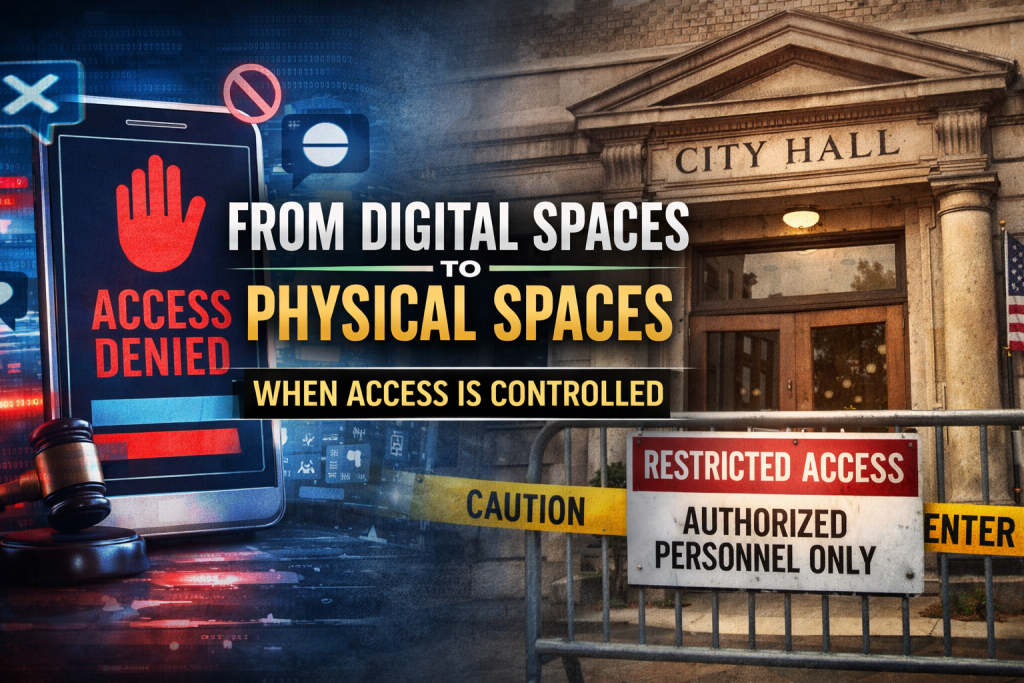
FROM DIGITAL SPACES TO PHYSICAL SPACES
WHEN ACCESS IS CONTROLLED
This issue is not limited to online platforms. It does not end with social media pages, comment sections, or digital communication. It extends into physical spaces where government operates and where the public has historically been able to observe, question, and engage with officials.
Public buildings, including City Hall, are not simply offices. They are places where government functions in view of the public. They are where meetings are held, where decisions are discussed, and where officials interact with the people they serve. Access to those spaces is part of how transparency is maintained. It is part of how accountability is exercised in practice.
When access to those spaces is restricted, the same question arises that exists in the digital context. It is not a question about policy preference or internal procedure. It is a question about authority and review. When a public official limits or restricts an individual’s ability to access a government space, to be present, or to engage in that environment, who reviews that decision.
That question is not theoretical. It has already arisen in Lorain. Recently, a letter was issued restricting access to City Hall and other city properties. That action was not taken through a court order. It was not the result of a criminal conviction. It was an administrative decision made within the structure of the City. It directly affected the ability of a citizen and a journalist to access public spaces and engage in government activity. That type of action carries significant implications. Access to a public building is not the same as access to a private facility. When government space is involved, restrictions on access intersect with constitutional protections, including the ability to observe public proceedings and to engage in newsgathering. Those issues are not abstract. They are tied directly to how government operates in public view.
At the same time, the process by which those decisions are made is often unclear. There is no uniformly defined standard for when such a restriction is appropriate, what procedural safeguards apply, or what level of review is required before or after the decision is implemented. There is no clearly identified administrative body tasked with evaluating whether such a restriction is consistent with law. That returns the analysis to the same structural issue identified in the State’s response. If a citizen believes that access to a government space has been restricted in a way that is improper, where is that claim reviewed. What agency receives that complaint. What process evaluates the decision before it reaches a court.
Based on the response received, there is no clearly identified administrative answer. There is no intake process. There is no investigation at that level. There is no finding issued by a neutral body. The only identified remedy is litigation.
That is not a different problem. It is the same problem, appearing in a different setting. Whether the restriction occurs on a social media platform or in a public building, the question is the same. Who reviews the decision. The answer, based on the structure described, does not change.
THE COMMON THREAD
These situations differ in their facts. They involve different officials, different settings, and different forms of communication. However, they raise the same underlying issue. When a public official restricts participation, limits communication, or controls access in a way that implicates constitutional protections, there is no clearly identified administrative body responsible for reviewing that conduct. That is not a conclusion drawn from any one incident. It is the structure reflected in the response to the inquiry.
FINAL THOUGHT
A SYSTEM WITHOUT A DOOR
At the center of this is a simple question that should not be difficult to answer. If a right exists, there should be a place to go when that right is violated. Not in theory, not in a legal textbook, but in practice. There should be an agency, a process, or some identifiable mechanism where a citizen can bring that issue forward and have it reviewed. That is the question I asked the State of Ohio. I did not ask for an investigation, I did not ask for legal advice, and I did not present a specific case. I asked a structural question. When a public official restricts participation, limits communication, or controls access in a way that implicates constitutional protections, who reviews that conduct and what process exists.
The response did not identify an answer. It explained what the Ethics Commission does not handle, but it did not point to any agency that does. It did not describe a process, and it did not identify any mechanism for review. When that answer is read as a whole, the conclusion is not complicated. There is no clearly defined administrative pathway for these types of claims.
That matters because this is not an isolated issue. This is something that has come up repeatedly in Lorain, across different situations and different forms of government activity. It came up when the Lorain Police Department limited public comment on its social media page and there was no clear policy explaining how those decisions were made or who reviewed them. It comes up in public meetings when participation is controlled, speakers are removed, or access is limited, and the only answer anyone can point to is that a person can file a lawsuit. It comes up in public records, where the law clearly states that records belong to the public, but the primary enforcement mechanism is through the Court of Claims or civil litigation. It has now extended into physical access as well. When a person is restricted from entering a public building, when access to City Hall is limited without a court order, or when a journalist’s ability to gather information is interfered with, the same question arises. Where does a person go to have that decision reviewed before it becomes a lawsuit.
Based on the response that was provided, there is no clear administrative answer to that question. There is no intake process where a complaint is received, no agency assigned to review the conduct, and no system that issues findings at that level. The only clearly identified path is to go to court. That does not mean the rights do not exist. The First Amendment exists. The Public Records Act exists. Open meetings laws exist. The legal framework is there. But a right that can only be enforced through litigation is not the same as a right that has a built in mechanism for review. It means that accountability depends entirely on whether an individual has the time, resources, and willingness to take that fight into the legal system. That is the structure. And when that same structure appears across social media, public meetings, public records, and access to government buildings, it stops being about any one situation. It becomes a question about how accountability actually works in practice.
If there is no place to go, then the system is not designed to resolve the issue before it reaches a court. It is designed to require the individual to bring it there. That is not a theory. That is what the response reflects.
DISCLAIMER
This article is for informational and journalistic purposes only and is not legal advice. The statements contained herein are based on official correspondence, sworn filings, and publicly available information. All individuals are presumed innocent unless and until proven otherwise in a court of law.
SUPPORT LOCAL INVESTIGATIVE JOURNALISM
Independent reporting requires time, documentation, and persistence. If you value record-driven investigative journalism focused on government accountability in Lorain County, consider supporting this work through sharing, subscription, or direct contribution.
Knapp Unplugged Media LLC
Lorain Politics Unplugged

LEGAL DISCLAIMER
This publication is an investigative and analytical report addressing matters of public concern, including government conduct, public records access, and constitutional issues. All information presented is based on publicly available records, documented communications, and firsthand observations.
This publication is not legal advice. Any discussion of statutes, case law, or legal principles is provided for informational and journalistic purposes only and should not be relied upon as legal guidance. Readers are encouraged to consult qualified legal counsel for advice regarding their specific circumstances.
Any individuals or public officials referenced are discussed in the context of their public roles and documented actions. This publication does not make findings of guilt or liability. All individuals are presumed to have acted lawfully unless otherwise determined through appropriate legal proceedings.
The analysis contained in this publication reflects the author’s interpretation of the available information and is subject to change as additional facts become known. Government agencies and officials may have information not available to the public at the time of publication.
This publication concerns matters of public interest and public accountability and is protected speech under the First Amendment to the United States Constitution and applicable Ohio law.
COPYRIGHT
© 2026 Knapp Unplugged Media LLC. All rights reserved.
This publication, including all text, analysis, and original content, is the intellectual property of Knapp Unplugged Media LLC and may not be reproduced, distributed, or republished in whole or in part without prior written permission, except for brief quotations used for purposes of commentary, criticism, or reporting as permitted by law.
Unauthorized use, reproduction, or distribution of this material is strictly prohibited.
About The Author