
When The Rules Do Not Apply: A Councilman, A Police Cruiser, And A Pattern Lorain Cannot Ignore
How This Landed In My Inbox, Not My Feed
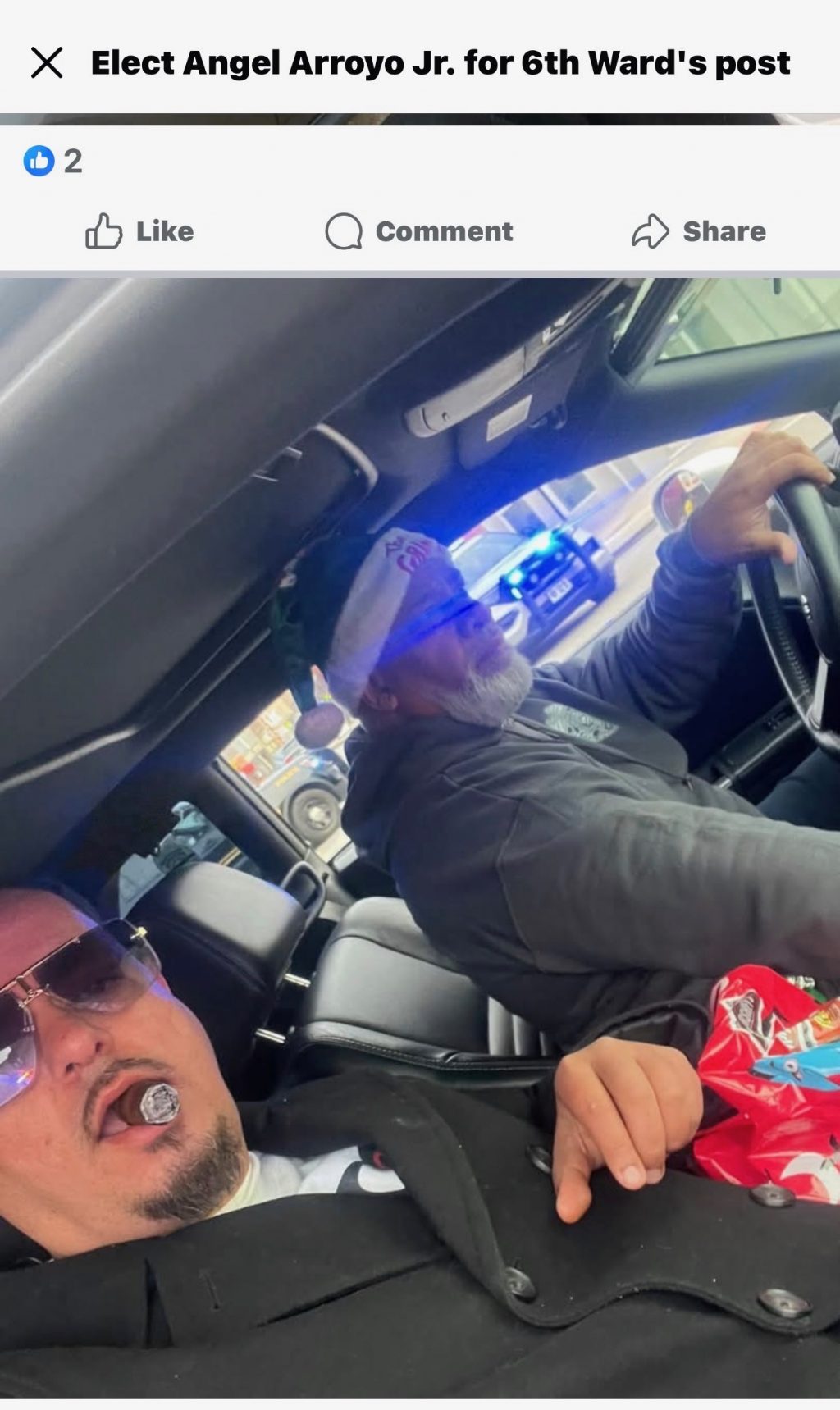
I did not see this post because I follow Angel Arroyo Jr.’s campaign page. I saw it because someone else sent it to me. I am blocked from his campaign page, and that matters because it means I could not respond publicly, ask questions directly, or challenge the post in real time. It reached me the same way a lot of things in Lorain do, through a third party rather than through open discussion.
The person who sent it did not treat it as a private gripe. They made clear that the same images and concerns were also sent to multiple newspapers. This was intended to enter the public record. Along with the screenshots, the sender wrote in their own words that they were almost one hundred percent certain the City of Lorain has ordinances against smoking on city property, including police department vehicles, and that smoking causes cancer and is not a role model or example for children. That language belongs to the source, not to me. My role is not to repeat it uncritically but to verify it against what the city itself has written down.
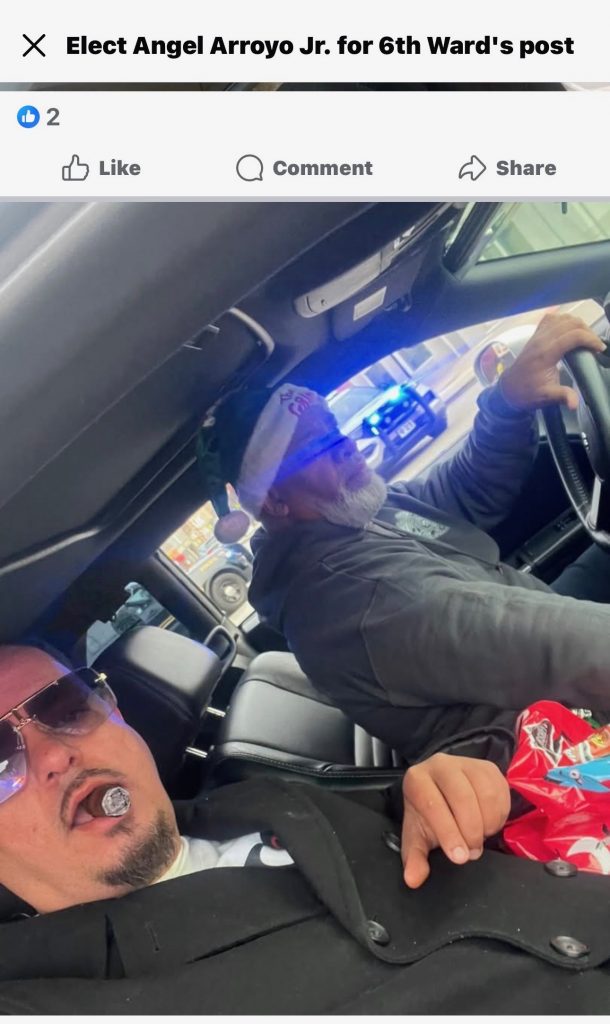
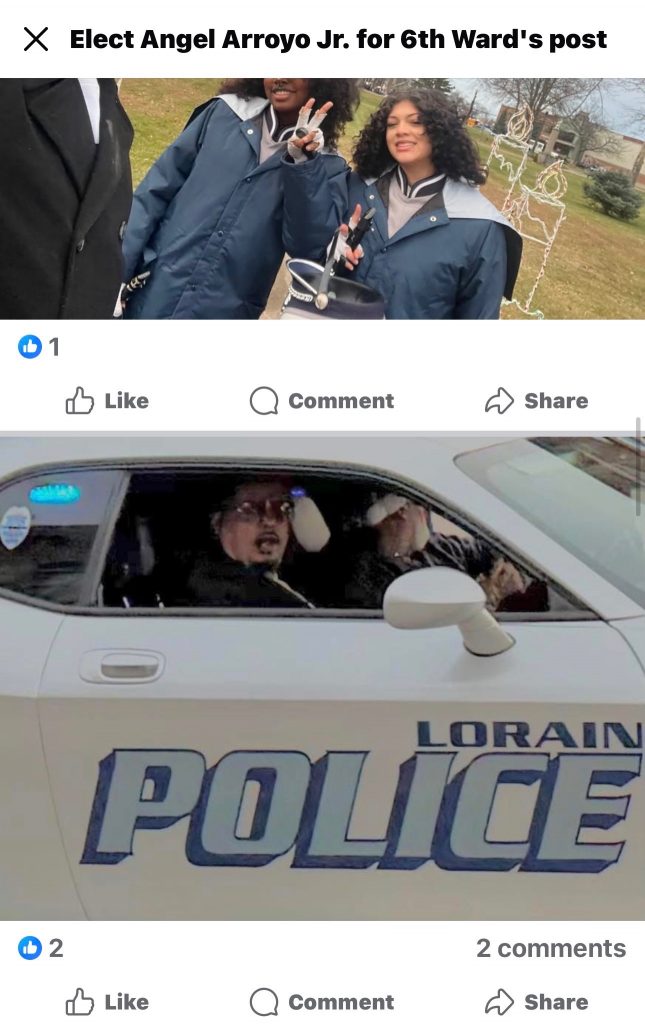
What they sent were images from a campaign Facebook post thanking a Lorain police officer for letting Councilman Angel Arroyo Jr. ride in the front seat of a nice heated vehicle during the Winterfest parade. The images were not ambiguous. One of them clearly shows Arroyo seated in the front passenger seat of a marked Lorain Police cruiser while the parade is in motion, emergency lights visible outside, with a cigar in his mouth inside the vehicle as the officer drives.
This was not an accidental background moment. It was a campaign-branded post presented as something positive.
That is where the problem begins.
What The City’s Own Rulebooks Actually Say
Before opinions, personalities, or political loyalties enter the discussion, the only thing that truly matters is what the City of Lorain’s written policies actually say. To remove any ambiguity, I am embedding both of the governing documents below so that anyone reading this can verify the language themselves.
Lorain Police Department Manual
The City of Lorain Employee Manual contains a Tobacco Free Workplace Policy that explicitly prohibits the use of tobacco by staff and visitors on city property and makes clear that this ban also includes all city-owned vehicles. The same manual directly references Ohio law by stating that smoking in municipal vehicles is prohibited under Ohio Revised Code 3794.01(C).
The Lorain Police Department Policy Manual goes even further. It prohibits smoking and tobacco use by members and visitors in all department facilities, buildings, and vehicles. It also assigns responsibility to officers to ensure that no person under their supervision smokes or uses tobacco inside city facilities and vehicles. The policy further bars officers themselves from using tobacco anytime they are in public view representing the department.
Those are not advisory guidelines. They are written and adopted rules. There are no carve-outs in either document for parades, council members, holidays, or Winterfest.
A Public Violation Framed As A Feel-Good Moment
Placed against those written rules, the Winterfest images take on weight that cannot be brushed off as harmless seasonal fun. A sitting councilman is shown inside a marked police cruiser during a public parade with a lit cigar in his mouth. The officer is on duty. The cruiser is in active service. The moment is posted proudly as part of a campaign narrative.
If an ordinary resident lit a cigar in the front seat of a police cruiser during a traffic stop, a transport, or any routine police interaction, there is no serious argument that it would be ignored as festive. The policy requires enforcement. The law requires enforcement. The officer is required to stop it.
Here, however, enforcement appears to have stopped at the boundary of political status.
This is not about whether someone likes cigars. It is about whether written rules still mean what they say when cameras are rolling and politicians are involved.
The Public Health And Role Model Dimension
This was not a private gathering among adults. This was a family-centered Christmas parade filled with children, parents, schools, churches, and community organizations.
Smoking is not neutral. Smoking causes cancer. Smoking kills people. That is medical fact rather than moral opinion.
Elected officials do not get to turn off their role-model status when they step into public view. A councilman photographed smoking inside a police cruiser at a Christmas parade sends messages about health, authority, and whether rules still apply when they become inconvenient.
A Documented Pattern Of Rules And Resistance
The Winterfest cruiser incident did not occur in isolation. On July 21, 2025, I sent a group email to City Council, Mayor Jack Bradley, Law Director Patrick Riley, Safety Service Director Rey Carrion, my attorney Robert J. Gargasz, and others after observing what appeared to be active phone use during a public council meeting by both Law Director Riley and Councilman Arroyo.
In that email, I cited Ohio’s Open Meetings Act and reminded Council that text messages sent during meetings about public business are subject to disclosure under Ohio’s Public Records Act. I asked members to refrain from using phones during meetings and reiterated that I was still awaiting production of text messages from prior sessions.
Minutes later, I sent images documenting the conduct observed during the meeting.
Councilman Arroyo responded later that night with a brief message thanking me for watching the meeting. No electronic communications were produced.
Later that same evening, I again requested production of all electronic communications sent during the meeting and cited the mandatory openness training required under council rules. I warned that further failure to comply would lead to additional Court of Claims filings.
Seven minutes later, I issued a written correction acknowledging that I had misspoken earlier when I referred to him as elected. I clarified that he had been appointed rather than elected and took full responsibility for the error.
Five days later, I renewed my request. Councilman Arroyo replied that he uses his city phone only to read the council agenda during meetings. No communications were produced.
The issue then was simple. Rules existed. They were raised formally. Compliance was resisted.
Campaign Imagery And Uniformed Officers
On October 26, 2025, months before the Winterfest parade, I sent a separate formal email to City Council, Sheriff Jack Hall, several media outlets, my attorney, and others as a candidate for Ward 6. I respectfully asked for guidance on whether Ohio law permits the use of uniformed municipal police officers in campaign materials.
I made clear that I respected the sheriff as an elected political official who may appear in uniform. My concern was specific to municipal police officers whose presence in campaign content can create the appearance of official endorsement and the use of public office for partisan gain.
Councilman Arroyo responded by stating that the post contained no endorsement language and wished everyone a good Sunday. That response did not address the legal question itself. A disclaimer line does not cure the use of uniformed public employees in campaign branding.
I followed up by citing Ohio law governing political use of public employees. No corrective action followed.
When False Statements Replace Accountability
By late October, the pattern moved beyond policy disputes and crossed into something more serious with the publication of false public statements followed by a refusal to correct them after being confronted with documentation. On October 26, 2025, Councilman Arroyo circulated statements accusing me of filing misleading lawsuits, operating multiple fake Facebook pages, making racist remarks, and disrespecting women. These were presented as claims of fact about my conduct and my character. They were false.
That afternoon, I sent a direct email requesting a retraction and correction of the record. The request was factual and lawful. Hours later, his response stated that there was nothing to retract and nothing further to say.
Later that same night, I sent a detailed written correction addressing each claim point by point. I explained that every legal filing I have made carries verified case numbers and sworn statements and that none have been deemed frivolous or misleading by any court. I clarified that I have openly acknowledged exactly one satirical account created during a documented period of harassment, not multiple accounts as alleged. I explained the context of the distorted claim involving women and invited him to identify any verified example supporting his accusations. No evidence was provided.
The Retraction Deadline And The Silence That Followed
On November 3, 2025, I issued a formal retraction demand pursuant to Ohio Revised Code 2739.02 and attached my prepared Complaint for Defamation Per Se. The demand identified each false statement and provided a same-day deadline for a public retraction with equal prominence. The deadline passed without any retraction being issued.
At that point, the issue ceased being political disagreement and became a straightforward legal and ethical question of whether a sitting public official could knowingly allow false statements about a private citizen to remain in circulation after being given full written notice and a clear statutory opportunity to correct the record.
The Email Timeline That Establishes The Record
The documentary record establishes the sequence clearly. False statements were published accusing me of specific misconduct. A retraction was formally requested in writing the same day. A written refusal to retract was issued that same evening. A detailed correction disputing each claim and requesting verification was sent. A formal statutory retraction demand with a prepared defamation complaint attached was served. No retraction was ever issued. This sequence matters because it removes speculation and replaces it with verified documentation.
Why The Winterfest Photo Actually Matters
The Winterfest cruiser photo did not create this story. It exposed it. By the time that image surfaced showing a councilman seated in the front passenger seat of a marked police cruiser with a cigar during a family Christmas parade, there was already a documented history of rule disputes, transparency conflicts, ethics warnings, unanswered formal challenges, and now provably false public statements left uncorrected after notice.
Taken together, the texting disputes, the refusal to produce communications, the use of uniformed municipal officers in campaign imagery, the public dismissal of ethics concerns, the posting of a clear municipal and police policy violation, and the refusal to retract false allegations do not appear isolated. They appear consistent.
The cigar itself is not the core issue. The consistent treatment of rules as optional is.
Full Disclosure And Legal Disclaimer
For complete transparency, I ran against Councilman Angel Arroyo for Lorain City Council, Ward 6. He won with approximately seventy four percent of the vote. That election is over. This reporting is based on documentary evidence, email correspondence, public policy manuals, and public record communications. This article reflects journalistic analysis and commentary only and does not constitute legal advice. All individuals referenced are presumed innocent of criminal wrongdoing unless and until proven otherwise in a court of law.
Campaigns end in November. The obligation to follow the law does not.
About The Author