
WHEN THE RECORD STARTS COLLIDING
Removed Public Records, Public Accusations, and the Same System Handling Both
By Aaron Christopher Knapp
Investigative Journalist | Lorain Politics Unplugged
I. INTRODUCTION
By the time this next set of emails enters the record, the story is no longer moving in a straight line and it is no longer about a single request working its way through a public office. What the record now shows is a system being hit from multiple directions at the same time, with each issue carrying its own legal weight, each issue being raised clearly in writing, and each issue being handled inside the same structure by the same officials. This is the point where the pattern that has been building across earlier sets does not just continue, it compounds.
The emails do not open with speculation or general complaints. They open with a direct public records demand grounded in Ohio law that forces a very specific question. The request seeks all Lorain City Council meeting minutes and video recordings that have been removed from the City’s website. It goes further and demands the internal documentation that would justify that removal, including disposal records, correspondence with the Records Commission, and the RC-1 and RC-3 forms required under Ohio Revised Code 149.38 and 149.39. That is not a routine request. That is a request that tests whether public records were handled lawfully after they were created.
That matters because there is no middle ground on that question. If records were removed, there must be documentation showing that the removal complied with the law. If that documentation exists, it can be produced. If it does not exist, the issue shifts immediately from access to compliance. The record shows that this question is put directly in front of City leadership, including Mayor Jack Bradley, and that it is routed through the same channels that have handled prior requests.
The response that follows does not answer the question being asked. Instead of confirming whether records were removed in compliance with the law or whether the required documentation exists, the direction given is to gather records and submit them to the Law Department for review before anything is released. That decision does not resolve the issue. It changes the process. It places the production of records behind a layer of internal control at the exact moment the request is asking whether the handling of those records was lawful in the first place.
At the same time, in the same chain of communication, a second issue emerges that carries its own set of consequences and raises a completely different type of question. Councilwoman Mary Springowski makes a statement on the public record that directly accuses another member of council of misconduct involving the Clerk of Council. The language used is not vague or indirect. It states that one of the members of council “essentially aided and abetted in this attack on our council clerk.” That is not a policy disagreement or a procedural complaint. It is an allegation of participation in wrongdoing by an elected official.
That statement triggers an immediate and equally direct follow up request. The question is simple and unavoidable. Who is being accused and what is the basis for that accusation. The record shows that this question is placed in front of the same system that received the records request, including the Law Department led by Patrick Riley and Joseph LaVeck, as well as council leadership.
The response to that question does not provide clarification. It does not identify the individual being accused. It does not indicate whether the statement is supported by any investigation or evidence. Instead, the request is dismissed as not being a proper council agenda item, and Council President Joel Arredondo concurs with that determination. That response does not address the substance of the accusation. It removes it from formal consideration without resolving it.
When these two issues are examined together, the pattern that has been building throughout this series becomes more difficult to ignore. A request is made that forces the City to show whether public records were removed lawfully and in compliance with state requirements. An accusation is made on the public record that suggests misconduct by a council member against a City employee. Both issues are raised clearly. Both are documented in writing. Both are presented directly to the same officials responsible for responding.
In both cases, the system responds in a way that avoids producing a definitive answer.
The same individuals remain central to both threads. Law Director Patrick Riley and Assistant Law Director Joseph LaVeck are included in the communications where these issues are being raised and addressed. Mayor Jack Bradley is involved in directing how records are handled. Council leadership is involved in determining what will be brought forward and what will be excluded. The structure does not shift based on the nature of the issue. The response remains consistent.
What also changes in this portion of the record is the scope of who is seeing these communications. These emails are not confined to internal discussion within City Hall. They include law enforcement, state oversight agencies, media outlets, and members of the public. The same information is being transmitted across that entire network at the same time. That means the issues are no longer contained within a closed system where responses can be managed without external visibility.
The effect of that distribution is that the record is no longer simply documenting a dispute. It is documenting how the system responds when multiple issues with legal implications are raised in front of a broad audience that includes entities outside of the City’s control. Every request, every response, every redirection, and every refusal to resolve becomes part of a record that is not only preserved but shared.
This is the point in the series where the story stops being about a single request and starts showing how the system functions when it is required to address more than one issue at once and when each of those issues demands a clear answer that is not being provided.
II. THE RECORDS QUESTION
What Was Removed and Whether the City Can Prove It
The first issue that defines this portion of the record is not based on interpretation, assumption, or speculation. It is grounded in a direct public records demand that forces the City of Lorain to address a very specific and legally significant question. The request seeks all Lorain City Council meeting minutes and video recordings that have been removed from the City’s website, and it does not stop at simply asking for those materials. It requires the City to produce the internal documentation that would justify that removal, including disposal records, correspondence with the Records Commission, and the RC-1 and RC-3 forms required under Ohio Revised Code 149.38 and 149.39. Those forms are not administrative formalities. They are the statutory mechanism that governs how public records can be lawfully destroyed, transferred, or removed from public access.
The request places the City in a position where it must demonstrate compliance rather than simply respond to a request. If records were removed, there must be documentation that shows the removal was authorized, reviewed, and approved in accordance with the law. If that documentation exists, it can be produced. If it does not exist, the issue is no longer confined to whether records can be accessed. It becomes a question of whether the law governing public records retention and disposal was followed at all.
The record shows that this request is received and processed through the same structure that has handled prior requests throughout this series. Mayor Jack Bradley is included in the communication and responds by forwarding the request internally with instructions that staff gather the relevant materials and submit them to the Law Department for review before anything is released. That directive is significant because it shifts the focus away from the substance of the request and toward the process of controlling the response. The question being asked is whether the removal of records was lawful and properly documented. The response does not address that question directly. It establishes that any production of records will be subject to internal legal review before disclosure.
The involvement of the Law Department, led by Patrick Riley and Joseph LaVeck, reinforces that shift in focus. The request is not treated as a straightforward obligation to produce records that should already exist within the City’s retention system. It is routed through legal review, which introduces a layer of control over what will be produced, how it will be produced, and when it will be released. That approach does not answer the question of whether the required documentation exists. It delays that answer and places it behind a process that is not defined in the statutes governing public records.
What is not present in the response is as important as what is included. There is no confirmation that the requested RC-1 or RC-3 forms exist. There is no statement that the removal of records was conducted in compliance with the City’s approved retention schedule or the requirements of the Records Commission. There is no indication that the documentation required by law is available and will be produced in full. The central question raised by the request remains unanswered within the record.
The timing and nature of the request make that absence more significant. The materials being requested are not obscure or difficult to identify. They are records that should exist as part of the City’s routine compliance with state law if records were removed from public access. The need to route the request through internal review rather than provide a direct answer suggests that the issue is not simply locating records. It is determining how the existence or absence of those records will be addressed.
Under Ohio law, public offices are required to organize and maintain records in a manner that allows them to be made available for inspection and copying within a reasonable period of time. When a request specifically seeks documentation that would demonstrate compliance with records retention and disposal requirements, the obligation is not limited to providing access. It extends to demonstrating that the statutory process was followed. The RC-1 and RC-3 forms are central to that process because they document approval for the destruction or transfer of records and ensure that such actions are not taken without oversight.
The record does not show that demonstration taking place. It shows a request that clearly identifies the documentation required to establish compliance, and it shows a response that acknowledges the request while placing the production of records behind internal review without confirming whether the documentation exists. That gap becomes part of the record itself, because it reflects the difference between what the law requires and what the response provides.
At this stage of the series, the issue is not simply whether records will be produced. It is whether the City can produce the documentation that proves those records were handled in accordance with the law. The request has been made in clear and specific terms. The response has been structured in a way that does not directly answer the question. The result is a record that shows the issue has been raised and that the obligation to demonstrate compliance remains unresolved.
III. THE ACCUSATION ON THE RECORD
What Was Said and Why the City Refused to Address It
Running at the same time as the records request is a second issue that carries a different kind of legal weight but is handled through the same structure. This issue does not involve documents being removed or retained. It involves a statement made on the public record by an elected official that directly accuses another member of council of participating in misconduct against a City employee. The significance of that statement does not come from interpretation. It comes from the language used and the setting in which it was made.
Councilwoman Mary Springowski states on the record that one of the members of council “essentially aided and abetted in this attack on our council clerk.” That statement is not framed as speculation or opinion. It is presented as a factual assertion tied to conduct that allegedly occurred. The phrase “aided and abetted” carries a specific meaning. It suggests that another individual knowingly participated in or assisted with conduct that is being characterized as an attack. When that statement is made by a sitting council member during official proceedings, it becomes part of the public record and carries implications that extend beyond internal disagreement.
The record shows that this statement does not go unnoticed. A direct request is made to identify the council member being referenced and to provide the basis for the accusation. The request is not complicated and it does not require interpretation. It asks for clarification of a statement that was made publicly and that implicates the conduct of an elected official. The question is whether the accusation can be substantiated and who it applies to.
The response to that request follows the same pattern that appears in the handling of the records issue. The Clerk’s office, referencing the Law Department, does not provide clarification, does not identify the individual being accused, and does not indicate whether any investigation has taken place. Instead, the request is dismissed on procedural grounds with the explanation that it is “not a proper council agenda item.” Council President Joel Arredondo concurs with that determination, and the issue is effectively removed from formal consideration without addressing the substance of the accusation.
That response is significant because it does not engage with the content of the statement at all. It does not deny that the statement was made. It does not challenge its accuracy. It does not provide any information that would allow the public to understand whether the accusation has merit. It shifts the issue from substance to procedure and uses that shift to avoid providing an answer.
The involvement of the Law Department, led by Patrick Riley and Joseph LaVeck, reinforces that this is not an isolated decision by the Clerk’s office. The determination that the request is not a proper agenda item is made within a structure that includes legal oversight. That means the decision to avoid addressing the accusation is not accidental. It is part of the same decision making process that has handled other issues throughout the record.
The context in which this occurs makes the response more consequential. The statement by Councilwoman Springowski is not made in a private setting. It is made on the public record during official proceedings. That means it carries weight not only as a statement of opinion but as a representation of conduct made by an elected official in an official capacity. When a statement of that nature is made, the expectation is that it can be clarified, supported, or addressed through appropriate channels. The record shows that this does not occur.
Instead, the issue is closed procedurally without being resolved substantively. The question of who was being accused remains unanswered. The basis for the accusation is not provided. There is no indication in the record that any investigation was initiated or that any findings exist. The statement remains on the record without clarification, and the attempt to obtain that clarification is denied.
When this issue is viewed alongside the records request, the consistency in how both are handled becomes more apparent. In each case, a direct question is raised that requires a clear answer. In each case, the response acknowledges the question but does not provide the information necessary to resolve it. The structure of the response remains the same regardless of the nature of the issue.
The significance of that pattern is not limited to this single statement. It reflects how the system responds when confronted with issues that carry potential legal consequences. The accusation involves the conduct of an elected official and the potential implications of that conduct. The decision not to address it leaves the statement unresolved and part of the public record without explanation.
At this stage of the record, the issue is not whether the statement was made. It is documented that it was. The issue is whether the system responsible for addressing such statements is willing to engage with them in a way that produces a clear and accountable answer. The record shows that in this instance, that engagement does not occur.
IV. THE SAME RESPONSE TO DIFFERENT PROBLEMS
How the System Handles Everything the Same Way
When these issues are placed side by side, the most important part of this record is not the details of either one in isolation. The most important part is what happens when both are raised at the same time and the system responds to each of them in exactly the same way. The subject matter is different. The legal implications are different. One involves the removal of public records and compliance with Ohio law. The other involves a public accusation made by an elected official that suggests misconduct by another member of council. What does not change is how the City responds.
The record shows that both issues are received, both are acknowledged, and both are routed through the same internal structure. Mayor Jack Bradley is involved in directing how the records request is handled. The Law Department, led by Patrick Riley and Joseph LaVeck, is involved in reviewing what will be produced and how responses are framed. Council leadership, including Council President Joel Arredondo, is involved in determining what issues will be addressed and what will be excluded from formal consideration.
The structure is consistent across both issues. The request for documentation regarding removed public records is not answered directly. It is placed into a process that involves internal review before any production occurs. The question of whether the required documentation exists remains unanswered in the record. At the same time, the request to clarify a public accusation is not addressed substantively. It is dismissed on procedural grounds without identifying the individual involved or providing any basis for the statement that was made.
This consistency is not accidental. It reflects a pattern that has appeared throughout earlier portions of the record and continues here without variation. The system does not ignore the issues that are raised. It engages with them in a way that allows a response to be issued while avoiding the need to resolve the underlying question. That distinction is critical because it defines the difference between responding and answering.
The record shows repeated instances where the City provides a response that acknowledges the existence of a request or a concern but does not provide the information necessary to bring that issue to a conclusion. In the case of the records request, the response focuses on gathering and reviewing materials rather than confirming whether the documentation required by law exists. In the case of the public accusation, the response focuses on whether the issue can be placed on an agenda rather than whether the statement itself can be clarified or substantiated.
The involvement of the Law Department in both situations reinforces that these are not isolated decisions made without oversight. The same legal structure that is responsible for advising the City on compliance with public records law and other statutory obligations is present in both threads. That means the decision to respond in this manner is not a matter of oversight or error. It is part of the way the system operates when confronted with issues that carry potential legal consequences.
The broader distribution of these communications also plays a role in understanding the significance of this pattern. These emails are not limited to internal discussion within City Hall. They include law enforcement, state oversight agencies, media outlets, and members of the public. The same information is being transmitted to all of these parties at the same time, which means the responses are not only being documented but also observed by entities outside of the City’s internal structure.
Despite that visibility, the pattern does not change. The system continues to respond in a way that avoids producing a definitive answer. The presence of a broader audience does not alter the structure of the response or the outcome of the issues being raised.
At this stage of the record, the significance of this pattern becomes more pronounced because it is no longer tied to a single type of issue. It applies to different problems with different legal implications and produces the same result. The record shows that the system is capable of processing multiple issues at the same time, but it does not show that it is capable of resolving them.
This is not a question of whether the City is responding to requests or acknowledging concerns. The record makes clear that it is. The issue is whether those responses lead to resolution or whether they function as a way to manage the issue without addressing it. The pattern reflected in this portion of the record shows that the latter is occurring, and that this approach is consistent across different types of issues raised within the same system.
V. ESCALATION INSIDE THE SAME THREAD
When the Tone Changes but the Outcome Does Not
As this portion of the record continues, the most noticeable change is not in how the City responds, but in how others begin to respond to the City. The tone shifts, the language becomes more direct, and the accusations become more explicit. What does not change is the outcome. The system continues to operate in the same way, even as the pressure around it increases.
Attorney Robert Gargasz enters the same chain of communication and does not treat the issues as procedural or administrative. His response is not framed around whether a request was properly submitted or whether an item belongs on an agenda. He addresses the conduct itself and describes it in terms that are far more direct than anything previously stated in the record. He refers to the actions in question as fraudulent bullying, calls out what he identifies as false statements, and characterizes the situation as part of an orchestrated effort that involves misuse of process and authority.
Those statements are not made privately. They are sent to the same network that has been included throughout this series. That network includes City officials, members of the Law Department, law enforcement, state agencies, media outlets, and members of the public. The scope of the audience means that these statements are not confined to an internal dispute. They are part of a public record that is being shared across multiple levels of oversight and observation.
The introduction of that language changes the tone of the record, but it does not change the structure of the response. The same issues remain unresolved. The request for documentation showing whether public records were removed in compliance with Ohio law is still not answered directly. The question of which council member was accused of aiding and abetting misconduct is still not clarified. The system continues to respond, but it does not move toward resolution.
The presence of the Law Department, including Patrick Riley and Joseph LaVeck, remains consistent throughout this escalation. Their role in reviewing records, advising on responses, and shaping how issues are addressed does not change as the tone of the communications shifts. That continuity reinforces that the response is not being driven by the intensity of the language used by others. It is being driven by the same internal structure that has been present from the beginning.
What becomes more apparent as the escalation continues is that the system is capable of absorbing increasingly direct and critical language without altering its approach. The emails show that accusations can be raised, challenged, and expanded upon within the same thread, and the response from the City remains consistent with what has already been documented. It acknowledges the communication, it processes it through internal channels, and it avoids providing a definitive answer to the underlying issues.
The broader distribution of these communications amplifies the significance of that pattern. When statements describing conduct as fraudulent or orchestrated are being transmitted to law enforcement, state agencies, and media outlets, the expectation is that the response may shift to address those claims more directly. The record does not show that shift occurring. Instead, it shows the same pattern continuing, regardless of the audience or the language being used.
At this stage of the record, the escalation does not create resolution. It highlights the absence of it. The difference between earlier portions of the record and this one is not that the issues have become more complex. It is that the language used to describe them has become more direct, while the system responsible for addressing them continues to operate in the same way.
The result is a record that shows increasing pressure applied to the same unresolved issues without a corresponding change in how those issues are handled. The escalation is documented. The responses are documented. The lack of resolution remains documented as well.
VI. WHAT THIS ACTUALLY SHOWS
A System That Manages the Issue Instead of Resolving It
When this portion of the record is read as a whole, the most important takeaway is not any single request, response, or accusation. It is the pattern that continues across all of them and becomes more visible as more issues are introduced into the same system. The record does not show a failure to respond. It shows a system that continues to respond in a way that allows the issue to remain open.
The public records request forces the City to demonstrate whether records were removed in compliance with Ohio law and whether the documentation required to support that action exists. The accusation made on the public record raises questions about the conduct of an elected official and whether that conduct can be identified and substantiated. The escalation introduced by outside participants places those same issues in front of a broader audience that includes law enforcement, state agencies, and the media. Each of these issues carries its own set of consequences and requires a clear and definitive answer.
The record shows that those answers are not provided. Instead, each issue is handled through the same structure. The records request is acknowledged and routed through internal review without confirming whether the required documentation exists. The accusation is acknowledged and dismissed on procedural grounds without being clarified or investigated. The escalation is acknowledged and absorbed into the same communication chain without altering the response. The system continues to function in the sense that it processes each issue and generates a response, but it does not produce a resolution.
The involvement of the same officials across all of these issues reinforces that this is not a series of isolated decisions. Law Director Patrick Riley and Assistant Law Director Joseph LaVeck remain central to the process of reviewing records and advising on responses. Mayor Jack Bradley is involved in directing how requests are handled. Council leadership, including Council President Joel Arredondo, determines what issues are addressed formally and what issues are excluded. The same structure applies regardless of the nature of the issue being raised.
The consistency of that structure is what defines this portion of the record. The system does not differentiate between a request for records, an accusation of misconduct, or an escalation involving outside participants. It applies the same approach to each, which results in the same outcome. The issue is acknowledged, processed, and left unresolved.
The broader distribution of these communications adds another layer to that pattern. These emails are not confined to internal discussion. They are shared with law enforcement, state oversight agencies, media outlets, and members of the public. The presence of that audience does not change how the system responds. The same pattern continues even when the issues are being observed by entities outside of the City’s control.
What this section of the record ultimately shows is not confusion or disorganization. It shows a consistent method of handling issues that allows a response to be given without requiring the issue to be resolved. The distinction between responding and resolving becomes critical because it defines how the system operates when confronted with questions that carry legal or factual consequences.
At this stage, the record does not leave the issues unaddressed. It leaves them unresolved.
VII. FINAL THOUGHT
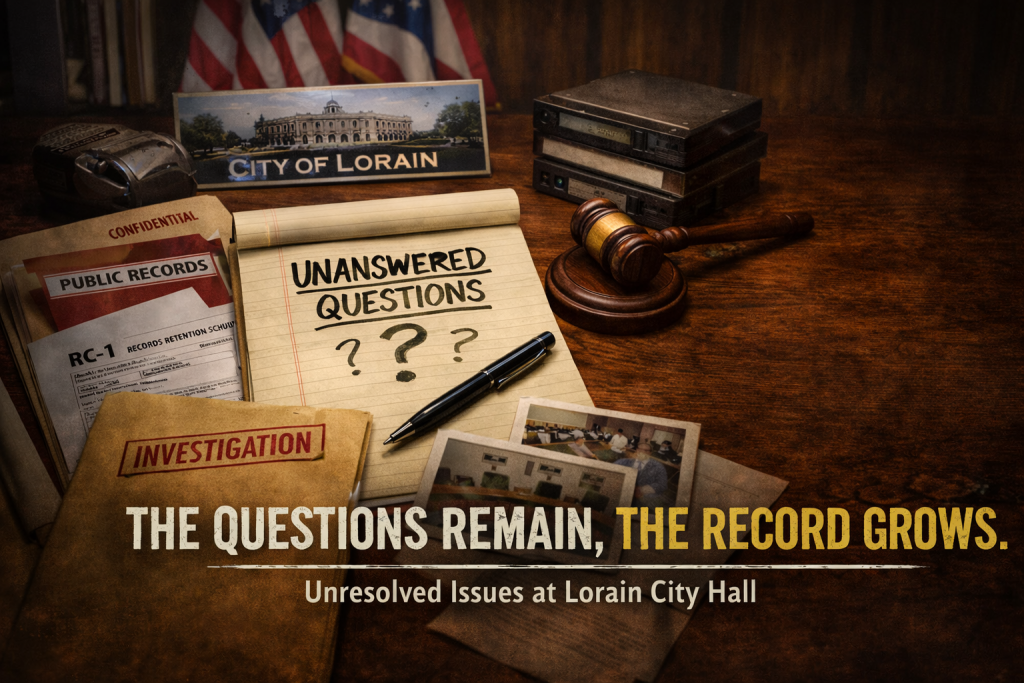
The Questions Stay. The Record Grows.
By the time this portion of the record reaches its end, there is no uncertainty about what was asked, who was involved, or how the system responded. The requests are written clearly. The accusations are stated on the public record. The responses are documented in full. What remains is not a lack of information. What remains is the absence of resolution.
The request for records that were removed from the City’s website still stands as a direct challenge to demonstrate compliance with Ohio law. The documentation that would confirm lawful removal, including RC-1 and RC-3 forms, has not been confirmed within the record as existing or produced. The question has not changed. It has not been withdrawn. It has not been answered in a way that resolves it.
The accusation made by Councilwoman Mary Springowski also remains on the public record without clarification. The statement that a member of council “aided and abetted” misconduct against the Clerk has not been explained, supported, or withdrawn. The request to identify the individual involved and provide the basis for that statement was dismissed on procedural grounds, leaving the substance of the accusation unaddressed.
The escalation that follows does not resolve either issue. It amplifies them. Additional participants enter the same communication chain. The language becomes more direct. The audience expands to include law enforcement, state agencies, media, and the public. The record grows, but the outcome does not change.
The same officials remain present throughout. Law Director Patrick Riley, Assistant Law Director Joseph LaVeck, Mayor Jack Bradley, and Council leadership continue to receive the same information and respond through the same structure. The consistency of that structure is what defines this stage of the record.
The system does not stop responding. It continues to process each issue, generate replies, and move the communication forward. What it does not do is bring the issues to a point of resolution. The distinction between activity and outcome becomes more pronounced as the record expands.
At this stage, the most important aspect of the record is not what is missing. It is what remains. The questions that were raised at the beginning of this set are still present at the end. They are documented, distributed, and preserved without being resolved.
This is where the series moves next.
The record does not close these issues.
It carries them forward.
LEGAL DISCLAIMER:
This article is a work of investigative journalism based on public records, direct communications, and supporting documents obtained through lawful means, including requests made pursuant to Ohio Revised Code 149.43. The material presented reflects the author’s analysis and interpretation of the documented record and is published in the public interest.
Certain matters referenced in this publication are the subject of ongoing litigation and administrative proceedings. Nothing contained herein is intended to interfere with, influence, or circumvent any pending legal action, nor should it be construed as a filing, argument, or submission to any court or tribunal. All statements are made outside of judicial proceedings and are presented solely for journalistic and informational purposes.
References to named individuals, including public officials and candidates for office, are made in connection with matters of public concern. Any conclusions drawn are expressly presented as opinion based on disclosed facts and are protected under the First Amendment to the United States Constitution and Article I, Section 11 of the Ohio Constitution. No statement should be interpreted as a definitive assertion of criminal liability unless expressly supported by cited law and adjudicated findings.
This publication does not constitute legal advice. All individuals and entities are presumed innocent unless and until proven otherwise in a court of law. The author reserves the right to update, correct, or expand upon this material as additional records become available.
© 2026 Knapp Unplugged Media LLC. All rights reserved.
About The Author