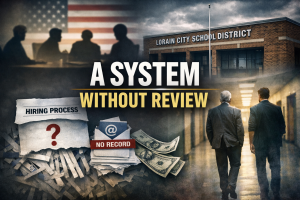

WHEN THE RECORD DOES NOT MATCH

WHAT THE COMMISSIONERS SAID UNDER OATH AND WHAT THE RECORD SHOWS
By Aaron C. Knapp
Investigative Journalist
Lorain Politics Unplugged
Knapp Unplugged Media LLC
INTRODUCTION
WHEN SWORN TESTIMONY DOES NOT ALIGN
There are moments in public governance where the issue is not a single decision, not a single vote, and not even a single outcome. The issue becomes the record itself. Not the public statements that follow, not the summaries provided after the fact, but the sworn record that emerges when officials are placed under oath and required to answer questions without preparation, without messaging, and without the ability to revise their answers later. That is the point at which the public is supposed to see the system clearly, because testimony under oath is not about politics. It is about truth.
This is not a story about revisiting a settled matter. The underlying dispute involving J.D. Tomlinson and Jennifer Battistelli has already been resolved. The payment has been made, the litigation has concluded, and that chapter is closed as a legal matter. The purpose here is not to relitigate those facts or to revisit the underlying allegations. The purpose is to examine something different and far more consequential for the public. The question is whether the elected officials responsible for approving the use of public funds can be trusted to act on complete and accurate information.
Because when the record is examined under oath, what emerges is not alignment. It is conflict.
When public officials are asked to explain how a decision was made, especially one involving a substantial payment of taxpayer funds, their answers should align around a shared understanding of the facts. They do not need to agree on every interpretation, but they should agree on what information existed, what was presented, and what was known at the time the decision was made. That alignment is the foundation of public trust. It is the assurance that decisions were made with awareness, not assumption.
In this case, that alignment does not exist.
Under oath, different officials describe fundamentally different versions of what they knew, what they were told, and what information was available. Some testify that critical documents were never provided to them. Others confirm that those same documents did in fact exist and were reviewed internally. Some describe the matter in general terms, while others acknowledge specific details that were never communicated to the officials responsible for approving the payment.
That is not a minor inconsistency. It is a structural failure.
One commissioner, when shown the actual document that formed the basis of the dispute, acknowledged under oath that what he was seeing did not match what had been presented at the time of the vote. The testimony is direct.
“That’s not what this complaint’s about, no.”
That statement does not go to interpretation. It goes to knowledge. It establishes that the understanding of the complaint at the time of the vote did not match the document itself. When a public official is voting to authorize taxpayer funds, the expectation is that the decision is based on the actual facts, not a summarized or incomplete version of them.
Another admission is even more direct.
“We didn’t know what happened.”
That is not a legal argument. That is not a technical defense. That is a statement of fact. The decision was made without knowledge of the underlying circumstances. When public money is approved under those conditions, the issue is no longer the underlying claim. The issue is whether the process itself is functioning as it should.
At the same time, the sworn testimony from within the Prosecutor’s Office confirms that the information did exist and was known internally. Assistant Prosecutor Dan Petticord testified that the EEOC complaint was received, reviewed, and shared with key individuals.
“I showed it to J.D. Tomlinson and Jim Burge.”
That statement establishes that the document was not missing. It was not unknown. It was in the possession of decision makers. It had been reviewed. It had been discussed. The record confirms that it existed at the time the matter was being evaluated.
And when asked whether the contents of that document would have political consequences if released, the answer was unequivocal.
“Oh, absolutely.”
That acknowledgment matters because it provides context for what happened next. If a document is known, if it is reviewed, and if it is understood to be politically damaging, the decision not to disclose it becomes something more than an oversight. It becomes a deliberate choice with implications for both the decision makers and the public.
The divergence continues when the issue turns to public records. Requests were made for documents related to this matter. Those requests did not result in the production of the document that is now confirmed to have existed. Instead, the responses that were provided did not include it. Under oath, that omission is acknowledged.
“It did not include the EEOC charge.”
That is not a dispute about interpretation. It is an admission about what was produced and what was not. A responsive document existed, was known, and was not included in the response to a public records request.
Ohio law is clear on this point. Ohio Revised Code Section 149.43 requires that public records be made available upon request. The statute does not provide an exception based on political sensitivity or potential impact. It requires disclosure. When a document is responsive and exists within the control of a public office, it must be produced unless a specific exemption applies.
Yet when asked who made the decision not to produce that document, the answer shifts again.
“I don’t know if it was Jim or J.D.”
That answer does not identify a decision maker. It does not provide a clear explanation. It reflects uncertainty at the very point where clarity should exist. If a decision was made to withhold a document, that decision should be traceable. It should be attributable. It should be supported by a legal rationale. The absence of that clarity is itself part of the problem.
At the commissioner level, the testimony raises a different concern. The officials responsible for approving the expenditure of funds describe a process in which they were not provided with the full underlying information. They describe relying on representations rather than documents. They describe making decisions without direct knowledge of the facts.
When that is combined with testimony confirming that the documents did exist and were not shared, the issue is no longer whether the decision was right or wrong. The issue is whether it was informed.
This is why the focus of this analysis is not the underlying dispute. It is not about personal conduct or internal relationships. It is about process. It is about whether the system that approves, documents, and discloses the use of public funds is operating in a way that the public can trust.
Because trust is not built on assurances. It is built on alignment. It is built on a record where each participant, when placed under oath, describes the same set of facts. When that does not happen, the public is left with something else entirely. A record that cannot be reconciled, a process that cannot be independently verified, and a system that asks to be trusted without demonstrating that it should be.
The sworn testimony of Commissioner David Moore, Commissioner Jeff Riddell, Assistant Prosecutor Dan Petticord, and Chief of Staff James Burge does not present a single, unified account of what occurred. It presents multiple accounts that diverge in ways that are not easily explained by memory, interpretation, or perspective.
The question is not whether one of them is correct.
The question is whether the public can rely on a system where the decision makers themselves cannot describe the same reality.
DAVID MOORE
APPROVAL WITHOUT REVIEW AND ADMITTED LACK OF KNOWLEDGE
Commissioner David Moore’s testimony does not simply establish that he relied on counsel. When read in full, it reflects something deeper and more concerning for purposes of public accountability. It reflects repeated instances where the individual responsible for approving the expenditure of public funds acknowledged, under oath, that he did not know critical facts, did not review underlying documents, and did not independently verify the actions taken in his name as an elected official.
This is not a characterization. It is a pattern that emerges directly from Moore’s own answers.
At the center of his testimony is the admission that he approved a payment without reviewing the document that justified it. Moore confirmed that he had never seen the EEOC complaint that formed the basis of the claim, yet he voted to approve the payment.
“You’ve never seen the EEOC complaint…?”
“No.”
At the same time, he acknowledged the approval itself.
“And you voted to approve that payment, right?”
“Yes.”
That combination alone raises a question about process. But Moore’s testimony goes further. When asked what he actually knew about the claim he approved, his answer reflects the absence of detail.
“Can you be more specific as to who discriminated against who?”
“I really… it was not that detailed of a discussion.”
That statement is not about disagreement. It is about the absence of information. The commissioner responsible for approving the payment could not identify the basic elements of the claim.
The basis for the decision, by Moore’s own description, was not documentation but representation.
“So basically you accepted the word of Mr. Petticord…?”
“Correct.”
That reliance becomes more significant when Moore is asked what he would have done if he had been aware of the actual allegations contained in the complaint. His answer is direct.
“You would not have approved her payment if you knew of the allegations…?”
“Correct.”
That is not a legal conclusion. It is a factual statement about the decision-making process. The outcome was based on incomplete information, and Moore acknowledges that full information could have changed the vote.
The pattern continues when Moore is questioned about the existence of the complaint itself. Even after the matter became public, his testimony reflects uncertainty about what documents existed and what had been withheld.
“Are you aware that they denied its existence?”
“I’m not aware of that.”
“Are you aware… that there were no more responsive documents…?”
“No, I’m not.”
These are not isolated answers. They reflect a broader lack of awareness about how public records requests were handled in his name as a commissioner.
When asked about the individuals responsible for responding to those requests, Moore again acknowledges that he does not know.
“Do you know who Erik Xamba is?”
“No.”
“Do you know if this is the response filed on your behalf?”
“No, I do not.”
Despite that lack of knowledge, Moore confirms that he took no steps to verify the response.
“Did you take any steps whatsoever to follow up on the public records request?”
“No.”
Instead, he describes a system of complete reliance on the Prosecutor’s Office.
“You relied on them totally…?”
“Correct.”
“You accepted… that there are no responsive documents…?”
“Correct.”
This is not simply reliance on counsel for legal interpretation. It is an acknowledgment that decisions regarding public records compliance were made without independent review or oversight by the elected official responsible for those records.
The same pattern appears when Moore is asked about the existence of the complaint itself. Once the premise is established, his answer is unavoidable.
“If the EEOC letter exists and it was denied… that would be false, correct?”
“It appears to be.”
That statement is not framed as an accusation. It is a logical conclusion based on the facts presented to him.
Moore’s testimony also reflects uncertainty about how key decisions were made within the county structure. When asked how the payment was placed on the agenda, his answers are repeatedly qualified or uncertain.
“Do you know how it got on the agenda?”
“I don’t have the details.”
“Was it that day? That week?”
“I couldn’t tell you.”
“Is it possible it was added the same day?”
“That could have happened.”
These answers are not about minor administrative details. They relate directly to how a six-figure expenditure of public funds reached a vote.
Even when asked about whether he had reviewed the settlement agreement itself, Moore again expresses uncertainty.
“Have you seen that before?”
“I may have.”
“So you can’t say for certain?”
“Correct.”
The same lack of certainty appears in questions involving outside legal counsel and payments made on behalf of the county.
“Did the County pay that firm?”
“I don’t know which case… I do recall paying… something…”
“Was there a court order?”
“I can’t remember.”
“Would you ever ask to see the order?”
“No.”
These are not technical questions. They relate to statutory requirements under Ohio law, including provisions such as R.C. 305.14, which governs the appointment and payment of outside counsel. Moore’s testimony reflects that he relied on others to interpret and apply those requirements without independent verification.
Even on broader issues of oversight, Moore confirms that he did not independently verify the legal authority for actions taken.
“You relied on the county prosecutor…?”
“Correct.”
“Regardless of what the statute says?”
“We relied on the county prosecutor…”
This pattern is consistent throughout the testimony. When asked about key facts, Moore frequently answers that he does not know, does not recall, or did not review the information.
Taken together, these statements do not describe a single oversight or a single gap in memory. They describe a decision-making process in which the elected official responsible for approving expenditures, responding to public records requests, and ensuring compliance with Ohio law repeatedly relied on representations without independent review, and acknowledged under oath that he lacked knowledge of critical facts.
The significance of that pattern is not tied to any single issue. It goes to a broader question. If decisions involving public funds, public records, and legal compliance are made without direct knowledge of the underlying facts, then the question is no longer about any one decision. It becomes a question of whether the process itself is functioning in a way that allows for informed, accountable governance.
JEFF RIDDELL
A DIFFERENT ORIGIN STORY AND A RECORD OF UNCERTAINTY
Commissioner Jeff Riddell’s testimony does not reinforce Commissioner Moore’s account. It complicates it. Where Moore describes a matter presented as a legal issue through counsel, Riddell describes an entirely different entry point into the decision making process. His testimony shifts the origin of the issue away from formal legal presentation and toward informal discussion, personal interaction, and internal framing by individuals directly connected to the matter.
That divergence is not a matter of interpretation. It is reflected in how Riddell describes his own involvement from the beginning.
Riddell testified that his first awareness of the issue did not come from reviewing documents or receiving a formal legal briefing. Instead, it came from a meeting in his own office involving Prosecutor J.D. Tomlinson and Chief of Staff James Burge. The issue, as he described it, was framed through conversation, not through documentation.
The distinction becomes clear when the testimony is examined in detail. Riddell does not describe being presented with a complaint. He does not describe reviewing a demand letter. He does not describe examining the legal basis of a claim. Instead, he describes a situation conveyed to him through discussion.
“How did this first come to your attention?”
“In my office… with Mr. Tomlinson and Mr. Burge.”
That answer establishes the context. The issue did not originate in a document. It originated in a meeting.
The nature of that meeting, as described by Riddell, reflects a general discussion of workplace concerns rather than a detailed presentation of a legal claim.
“What was discussed?”
“It was more of a workplace issue… personnel issues.”
That description stands in contrast to Moore’s testimony, which frames the matter as a discrimination claim presented by counsel. Riddell’s account suggests that, at least from his perspective, the issue was initially understood in less formal terms.
The absence of documentation is a consistent theme in his testimony. When asked whether he reviewed any formal complaint, his answers reflect uncertainty.
“Did you see the EEOC complaint?”
“I don’t recall.”
“Did you review any written demand?”
“I don’t remember seeing that.”
These are not definitive statements of review. They are acknowledgments of uncertainty. They indicate that Riddell cannot confirm that he examined the underlying documents that would have defined the claim.
The same pattern appears when Riddell is asked about the basis for the payment itself. Rather than pointing to a specific document or set of facts, his testimony reflects reliance on what was communicated to him.
“What was your understanding of the claim?”
“That there was an issue… that it needed to be resolved.”
This is not a detailed explanation. It is a general understanding. It reflects the information he was given, not the information he independently verified.
When pressed on whether he knew the specific allegations underlying the claim, Riddell’s answers again show a lack of detailed knowledge.
“Did you know the specifics of the allegations?”
“No, not specifically.”
That statement mirrors Moore’s testimony in one critical respect. Both commissioners acknowledge that they did not have a full understanding of the underlying facts. The difference is how they describe the information they received.
Moore attributes his understanding to legal counsel. Riddell attributes his understanding to conversations with the individuals directly involved.
That divergence becomes more significant when the timeline of events is considered. Riddell’s testimony suggests that discussions about the issue began before any formal presentation in executive session.
“You had discussions before executive session?”
“Yes.”
This indicates that the issue was being communicated and potentially shaped before it was formally presented to the board. That raises a separate question about how the matter was framed when it eventually reached the commissioners as a body.
Riddell’s testimony also reflects uncertainty about key procedural steps, including how the payment was brought forward and approved.
“Do you know how it got on the agenda?”
“No.”
“Do you know who initiated that process?”
“No.”
These answers are consistent with Moore’s testimony. Both commissioners acknowledge that they do not know how the matter moved through the administrative process to reach a vote.
The lack of clarity extends to the role of legal counsel. While Moore describes reliance on the assistant prosecutor, Riddell’s testimony reflects a less defined understanding of who was responsible for presenting and evaluating the claim.
“Who advised you on this matter?”
“There were discussions… with the prosecutor’s office.”
That answer does not identify a specific individual or a specific recommendation. It reflects a general sense of involvement rather than a clear chain of responsibility.
Riddell’s testimony also touches on the question of whether all commissioners were operating with the same information. When asked whether he believed the board had access to the same materials, his answer is not definitive.
“Do you know what the other commissioners were provided?”
“No.”
That statement is critical. It confirms that Riddell cannot say whether the board was working from a shared set of facts. Each commissioner may have been operating based on different information, obtained through different channels.
The implications of that are not abstract. They go directly to the question of whether the decision was made based on a consistent and complete understanding of the issue.
The uncertainty continues when Riddell is asked about the existence of documents that later became central to the matter.
“Were you aware of the EEOC complaint at the time?”
“No.”
“Were you aware of a demand letter?”
“No.”
These answers align with Moore’s testimony in one respect. Both commissioners acknowledge that they were not aware of key documents at the time the decision was made.
At the same time, Riddell’s testimony reinforces a different aspect of the process. It shows that the issue was discussed informally, outside of formal proceedings, and that those discussions played a role in shaping his understanding.
Taken together, Riddell’s testimony does not simply add to Moore’s account. It introduces a different narrative of how the issue originated, how it was communicated, and how it was understood.
Moore describes a decision based on legal representation. Riddell describes a process that began with conversation. Those are not identical accounts. They reflect different pathways to the same decision.
The significance of that difference is not tied to the outcome of any single vote. It lies in what it suggests about the decision making process itself. When multiple commissioners describe the same event in fundamentally different ways, the issue is no longer limited to what was decided. The issue becomes whether the decision makers were operating from the same set of facts, the same documentation, and the same understanding of the issue at the time they acted.
That question, grounded in their own sworn testimony, is what ultimately determines whether the public can rely on the process that produced the decision.
DAN PETTICORD
KNOWLEDGE WITHOUT DISCLOSURE AND AUTHORITY WITHOUT LIMITS
Assistant Prosecutor Dan Petticord’s testimony does not sit comfortably alongside the accounts given by the commissioners. It does something more consequential than contradict. It fills in the gaps they could not explain, and in doing so, it creates a record where knowledge existed at the center of the process while those responsible for approving public funds were left without it.
Where the commissioners repeatedly answered that they had not seen the underlying complaint, Petticord confirms that he had. Where they stated that they relied on what they were told, Petticord confirms that he was one of the people doing the telling. The issue is not whether the document existed. The issue is who had it, who understood it, and who chose not to provide it. Petticord’s testimony establishes that he personally received the EEOC complaint and reviewed it. He does not describe it as something he was vaguely aware of. He acknowledges direct knowledge.
“You received the EEOC complaint?”
“Yes.”
“You reviewed it?”
“Yes.”
That alone places him in a different position from the commissioners. They testified that they had not seen the complaint. Petticord testifies that he had.
The difference becomes more significant when he is asked what he did with it. Petticord confirms that the document did not remain isolated.
“Did you show it to anyone?”
“Yes.”
“Who?”
“Mr. Tomlinson… and Mr. Burge.”
This establishes a defined group of individuals who had direct access to the document. It was not unknown within the prosecutor’s office. It was circulated among the highest levels of that office.
The same clarity does not exist when Petticord is asked whether the document was shared with the commissioners. His answer is direct, but the implications are broader.
“Did you provide it to the commissioners?”
“No.”
That single answer creates a separation in the record that cannot be reconciled through interpretation. The individuals who voted to approve the expenditure did not have the document. The individual advising them did.
This is not a question of misunderstanding. It is a question of access. The pattern continues when Petticord is asked about the flow of information to the board. His testimony does not suggest that the commissioners were given a detailed presentation of the claim.
“Did you explain the full contents of the complaint to the board?”
“No.”
“Did you go through the allegations with them?”
“No.”
These answers align directly with what the commissioners said under oath. They testified that they did not know the specifics of the allegations. Petticord confirms that those specifics were not provided. The result is a record where the central legal advisor possessed the document, understood its contents, and chose not to present those contents to the decision makers. That is not an inference. It is the combined effect of their sworn testimony. Petticord’s testimony also addresses the public records aspect of the case, and it does so in a way that raises a separate set of concerns. When asked who made the decision to withhold the EEOC complaint from disclosure, his answers reflect a lack of ownership over that decision.
“Who decided not to release the document?”
“I don’t know.”
“Was it your decision?”
“No.”
“Do you know whose decision it was?”
“It would have been Mr. Tomlinson or Mr. Burge.”
The document existed. Petticord had it. He shared it internally. It was not provided to the commissioners. It was not disclosed in response to public records requests. Yet the decision to withhold it is not attributed to any single individual. That is not a minor detail. It is a gap in accountability at the exact point where accountability would be expected. The testimony becomes more direct when the discussion turns to the potential impact of the document if it had been disclosed. Petticord does not deny that it would have had consequences.
“Would release of the complaint have been politically damaging?”
“Yes.”
That answer does not assign intent. It does establish awareness. It confirms that the potential effect of disclosure was understood at the time the document was being handled. The process by which the payment was approved is also addressed in Petticord’s testimony, and it aligns with the commissioners’ statements about speed and timing. He explains that the matter was moved forward using a requisition rather than a traditional resolution.
“How was the payment processed?”
“Through a requisition.”
“Why?”
“It was quicker.”
That explanation is consistent with Moore’s testimony that the matter moved quickly and with limited discussion. It provides a mechanism for how that occurred. The use of a requisition does not, by itself, determine whether a decision was appropriate. What it does affect is the amount of time available for review. When combined with the fact that the underlying document was not provided to the commissioners, the speed of the process becomes part of the overall context.
Petticord’s role does not end with this matter. His testimony also intersects with broader questions about the scope of his authority and the boundaries of his role as counsel. At the time of these events, Petticord was serving as assistant county prosecutor and acting as legal counsel to the commissioners. That role carries specific statutory authority under Ohio law. It also carries limits. The prosecutor or an assistant prosecutor represents the county and its officials in an official capacity. The record now reflects that Petticord is no longer in that role. He is employed within the county in a different capacity, including work connected to Job and Family Services. Yet the pattern of involvement in legal matters has not entirely disappeared.
The concern that arises from the record is not simply about past conduct. It is about whether the same individual continues to function in an advisory capacity without the statutory authority that originally defined that role. The distinction matters because under Ohio law, the authority to act as legal counsel for a public office is not informal. It is not implied. It is defined by statute. When that authority is no longer in place, the ability to provide legal advice on behalf of a public office is no longer presumed.
The testimony, when viewed alongside that context, presents a sequence that is difficult to ignore. Petticord possessed the key document. He shared it internally. He did not provide it to the commissioners. He cannot identify who decided to withhold it from the public. He acknowledges that its disclosure would have had political consequences. And the matter moved forward through a process designed to expedite approval. At the same time, the individuals who relied on his guidance testified that they did not have the information he had. That is not a characterization of intent. It is a description of the record.
When the same individual is later identified as continuing to provide legal guidance outside of the formal role that carries that authority, the question is not personal. It is structural. It is about whether the lines between official authority and informal influence have remained clear. That question is not answered by any single statement. It is created by the totality of the testimony. The commissioners state that they relied on counsel. Counsel states that he had information he did not provide. The decision was made.
Those are not competing narratives. They are overlapping statements that, taken together, define the process that occurred. The issue that follows is not limited to one payment or one set of events. It is whether that process reflects a system where decisions are made with full information, clearly defined authority, and identifiable accountability.
JAMES BURGE
THE DECISION POINT THAT CANNOT BE LOCATED
Chief of Staff James Burge does not appear in the record as a peripheral figure. He appears repeatedly, and always at the point where information moves, decisions are made, or authority is exercised. His name is not attached to a single role. It is attached to multiple stages of the process, and that is what makes his testimony, and the testimony about him, central to understanding what occurred. When the record is read in sequence, Burge is not introduced by his own explanation of events. He is introduced through the statements of others. Assistant Prosecutor Dan Petticord places him among the individuals who had direct access to the EEOC complaint. Commissioner Jeff Riddell places him in the initial meeting where the issue was discussed. Commissioner David Moore identifies him as someone connected to the process by which funds were requested and approved. This is not incidental. It establishes that Burge was present at each stage where information was gathered, interpreted, and moved forward. Petticord’s testimony is the most direct on this point. He confirms that the EEOC complaint did not remain isolated within his own review. It was shared with senior officials.
“Did you show the complaint to anyone?”
“Yes.”
“Who?”
“Mr. Tomlinson and Mr. Burge.”
That places Burge among the individuals who had direct knowledge of the contents of the complaint. It is not secondhand knowledge. It is not inferred. It is confirmed.
At the same time, Petticord’s testimony establishes that the commissioners, the individuals who ultimately approved the payment, did not receive that document.
“Did you provide the complaint to the commissioners?”
“No.”
This creates a defined separation. The complaint was known at the top of the prosecutor’s office. It was not provided to the board responsible for authorizing public funds. Burge is positioned on the side of that line where the information existed. Commissioner Riddell’s testimony places Burge at an earlier point in the process. He describes a meeting in his office where the issue was first discussed. That meeting included Prosecutor J.D. Tomlinson and Chief of Staff James Burge. The significance of that description is not simply who was present. It is how the issue was framed. Riddell does not describe the meeting as a detailed review of a formal complaint. He does not describe it as a presentation of documented allegations. He describes it as a conversation.
“It was more of a discussion… about workplace issues.”
“It wasn’t a formal legal presentation.”
This matters because, at the same time that Petticord confirms that the EEOC complaint existed and had been reviewed internally, Riddell describes a process that began without that document being presented to him. The result is a record where the document existed, was reviewed by Burge, and was discussed internally, but was not used as the basis for the initial presentation to at least one commissioner. That is not a conclusion. It is the intersection of two separate testimonies.
Burge’s role does not end at the point of internal discussion. He also appears in the financial and administrative process that followed. The record reflects that he was involved in the submission and approval of legal expenses connected to matters involving the prosecutor. Commissioner Moore’s testimony addresses this directly when he is asked about payments made for outside legal counsel. He is shown an invoice and asked to identify the individual who approved it.
“Who signed this?”
“It looks like James Burge.”
“And who is James Burge?”
“Chief of staff for the prosecutor.”
The question that follows is not theoretical. It is specific.
“So Mr. Burge submitted this bill… to the County for payment?”
“That’s what it appears to be.”
This places Burge at a point where public funds are being requested and approved. It is not limited to internal discussions or document review. It extends to the financial execution of decisions.
At the same time, Moore’s testimony reflects that the commissioners relied on the prosecutor’s office for guidance in making those payments.
“We relied on the county prosecutor to give us… authority.”
“Would you ever ask to see the order before you paid?”
“No.”
This establishes a pattern. Information flows from the prosecutor’s office to the commissioners. The commissioners rely on that information. The decisions are approved. The documentation underlying those decisions is not independently reviewed. Burge’s position, as chief of staff, places him within that flow of information. The issue of public records introduces another point where Burge’s role becomes relevant. Petticord is asked directly who made the decision not to disclose the EEOC complaint in response to a public records request. His answer does not identify a specific decision maker, but it does identify the individuals who would have had that authority.
“Who made the decision not to release it?”
“I don’t know.”
“Who would have made that decision?”
“Mr. Tomlinson or Mr. Burge.”
The document existed. It was reviewed. It was not provided to the commissioners. It was not disclosed to the public. The decision connecting those facts is not attributed to a single individual, but Burge is identified as one of the individuals who would have had the authority to make it. That is not an assumption. It is the answer given under oath. When these elements are placed together, Burge’s position in the process becomes clear. He is present when the matter is discussed internally. He is among those who reviewed the underlying complaint. He is connected to the financial mechanisms through which payments are approved. He is identified as someone who may have been responsible for decisions regarding public records.
What is not present in the record is a clear point at which responsibility is assigned. The commissioners testify that they did not have the document. Petticord testifies that he did. Petticord identifies Burge as someone who also had it. The document is not disclosed. The payment is approved. The decision that links those steps is not located in any single statement. That absence is not created by interpretation. It is created by the structure of the testimony itself. There is no single answer that explains who made the decision to withhold the document, who determined what information would be provided to the commissioners, or who controlled the timing and process by which the matter moved forward.
What exists instead is a pattern where the same names appear at each critical point, but the responsibility for the final decisions is not clearly assigned. Burge’s role, as reflected in the record, sits at the center of that pattern.
WHERE THE TESTIMONY BREAKS
WHEN THE RECORD NO LONGER MOVES IN ONE DIRECTION
When the testimony of all four individuals is placed side by side, the issue is not any single statement. It is not one answer that stands out on its own. The issue is how those answers relate to each other when they are read together, in sequence, as part of a single record. Because sworn testimony is not evaluated in isolation. It is evaluated as a whole. It is measured by whether the explanations provided by different officials describe the same reality, or whether they describe different versions of the same events.
In this record, the testimony does not move in one direction. It fragments. The commissioners describe a process built on reliance. They do not describe a process built on independent review of underlying documents. They do not describe a process in which the factual basis for a decision was examined directly. They describe a process in which they accepted the characterization provided to them.
Commissioner David Moore states this directly.
“Basically you accepted the word of Mr. Petticord…?”
“Correct.”
He does not describe reviewing the complaint. He does not describe examining the allegations. He describes accepting the explanation. At the same time, he acknowledges that the document existed, and that it mattered.
“Would you have wanted to see this?”
“I would say yes.”
“You had no knowledge… of the allegations?”
“Correct.”
That testimony establishes two facts that cannot be separated. The document existed, and the decision was made without it.
Commissioner Jeff Riddell’s testimony does not correct that gap. It reinforces it. He does not describe a process grounded in documentation. He describes a process grounded in discussion.
“It was more of a discussion… not a formal legal presentation.”
And when he is confronted with the actual contents of the complaint, the disconnect becomes explicit.
“That’s not what this complaint’s about, no.”
“We didn’t know what happened.”
That is not a disagreement over interpretation. It is an acknowledgment that the understanding at the time of the decision did not match the content of the document that existed.
At the same time, Assistant Prosecutor Dan Petticord confirms that the document was not only real, but known.
“Did you receive the complaint?”
“Yes.”
“Did you review it?”
“Yes.”
“Did you show it to anyone?”
“Yes.”
“Who?”
“Mr. Tomlinson and Mr. Burge.”
This is not a situation where the document was missing. It is not a situation where the document had not yet been created. It was received, reviewed, and shared internally.
Yet when asked whether it was provided to the commissioners, the answer is equally clear.
“Did you provide it to the commissioners?”
“No.”
The same document that formed the basis of a payment was present within the prosecutor’s office and absent from the board that approved the payment. That is not an interpretation. It is the intersection of two separate testimonies that describe the same document from different positions. The issue of public records introduces a third layer to that same document. The commissioners describe a system in which all public records requests are forwarded to the prosecutor’s office, and the decisions regarding disclosure are made there.
Commissioner Moore explains that process in direct terms.
“Everything goes through the Prosecutor’s Office.”
“Who makes the ultimate decision?”
“The Prosecutor’s Office.”
And when asked whether he independently verified those decisions, his answer is equally direct.
“Did you take any steps… to follow up?”
“No.”
At the same time, the record establishes that the document was not disclosed in response to public records requests.
When Moore is asked to consider that fact, the implication is unavoidable.
“If the document exists and it was not produced… that would be false, correct?”
“It appears to be.”
This is where the testimony stops moving in a single direction. The commissioners relied on the prosecutor’s office to determine what records existed and what would be disclosed. The prosecutor’s office had the document. The document was not disclosed. And when responsibility for that decision is addressed, it is not assigned.
Petticord is asked directly who made the decision not to release the document.
“Who made that decision?”
“I don’t know.”
“Who would have made it?”
“Mr. Tomlinson or Mr. Burge.”
The document exists. The commissioners did not have it. The public did not receive it. The individuals who had access to it are identified. The individual who made the decision is not. These are not independent facts. They are connected through the same document, the same process, and the same set of decisions. If the commissioners did not have access to the complaint, then the question is not whether they relied on counsel. The question is why the document was not provided to them before they approved the expenditure of public funds.
If the document existed and was not disclosed in response to public records requests, then the question is not whether a mistake occurred. The question is who made the decision to withhold it and on what basis that decision was made. If multiple officials had access to the document and were involved in the process, then the question is not whether the system functioned. The question is how responsibility is assigned within that system when the record does not align. These questions do not come from commentary. They do not come from inference. They come directly from the testimony itself, from statements that do not fit together when they are read as a single account.
And when sworn testimony cannot be reconciled, the issue is no longer limited to the underlying decision.The issue becomes whether the process that produced that decision can be trusted.
WHY THIS MATTERS
THIS IS NOT ABOUT RELITIGATING A SETTLED CASE
There is a reason to address this record, and there is a line that has to be drawn at the outset. This is not an attempt to relitigate the underlying dispute. The Barilla matter has been resolved. The County approved a payment in a public meeting, and that payment closed the case. The legal dispute is over. This analysis is not about reopening that case. It is not about reexamining the allegations, the individuals involved, or the merits of that dispute. That is not the purpose of this record, and it is not the question that matters here.
The question is what the sworn testimony reveals about how decisions are made by the officials who control public funds. Because the same commissioners who approved that recent payment are the same commissioners whose own testimony now establishes that, in a prior matter, they approved a six figure expenditure without reviewing the document that formed the basis for that payment. That is not a political argument. That is their own testimony.
Commissioner David Moore does not claim that he reviewed the complaint. He does not claim that he evaluated the allegations independently. He describes a process in which he relied on what he was told.
“Basically you accepted the word of Mr. Petticord…?”
“Correct.”
At the same time, he acknowledges that the document existed, and that he did not see it.
“Have you seen the EEOC complaint?”
“No.”
“Would you have wanted to see it?”
“I would say yes.”
He confirms that he voted to approve the payment.
“You voted to approve the payment…?”
“Yes.”
And he acknowledges that the information he did not have could have changed his decision.
“You had no knowledge of the allegations?”
“Correct.”
“You would not have approved the payment if you knew?”
“Correct.”
That is not an inference. That is a direct statement that the decision was made without full information, and that the outcome may have been different if that information had been provided.
Commissioner Jeff Riddell’s testimony reinforces that same issue from a different direction. He does not describe a process grounded in documentation. He describes a process grounded in conversation.
“It was more of a discussion… not a formal legal presentation.”
And when he is confronted with the actual contents of the complaint, his response is not clarification. It is distance.
“That’s not what this complaint’s about, no.”
“We didn’t know what happened.”
Those statements do not address the merits of the underlying case. They address the level of information that existed at the time the decision was made. At the same time, the testimony from the prosecutor’s office establishes that the document did exist, that it was reviewed, and that it was not provided to the commissioners.
“Did you receive the complaint?”
“Yes.”
“Did you review it?”
“Yes.”
“Did you provide it to the commissioners?”
“No.”
This is the point where the issue shifts away from the underlying dispute and into the process that governs public decision making. Because the same officials who are responsible for approving expenditures of public funds are describing a system in which they rely on representations, do not review underlying documents, and do not independently verify what is being presented to them. And that is not limited to one case. It is a description of how the process operates.
Commissioner Moore explains that process in his own words when asked about public records.
“Everything goes through the Prosecutor’s Office.”
“Who makes the decision?”
“The Prosecutor’s Office.”
“Did you follow up?”
“No.”
The commissioners approve the expenditure. The prosecutor’s office controls the information. The underlying documents are not reviewed. The public record is not independently verified. That is the system described under oath. This is why the recent payment matters. Because when the Board of Commissioners approves another settlement, whether it is thirty thousand dollars or one hundred thousand dollars, the question is no longer limited to that specific case. The question is whether the decision makers are operating with full knowledge of what they are approving.
If the record shows that, in one instance, a six figure payment was approved without review of the underlying complaint, then it is reasonable to ask whether that same process is being followed in other decisions. If the record shows that the commissioners rely entirely on representations made to them, then it is reasonable to ask how those representations are tested. If the record shows that documents can exist, be reviewed internally, and not be provided to the individuals voting on the expenditure, then it is reasonable to ask how often that occurs.
These are not accusations. These are questions that arise directly from the testimony. And they lead to a broader issue that extends beyond any single case. The authority to approve public spending is one of the most significant responsibilities assigned to elected officials. That authority is based on the assumption that decisions are made with full access to the relevant information and with an understanding of what is being approved. When sworn testimony establishes that decisions can be made without that information, the issue is no longer about any single payment.
The issue becomes whether the process itself is reliable. Because if public funds can be approved without full review in one instance, then the question is not whether that happened. The question is where else it may have happened. And that is not a political question. It is a question about the integrity of the system that governs how public money is spent.
This record does not answer that question. It defines it.
WHERE THIS GOES NEXT
FOLLOW THE MONEY, NOT THE EXPLANATION
The record that emerges from sworn testimony does not end with a single payment, and it does not end with the explanation that has already been offered. It establishes something far more significant about how decisions are made, how information is handled, and how public funds are approved. Once that record exists, the question is no longer whether the same explanation can be repeated. The question becomes whether that explanation can be relied upon going forward, and whether the public can have confidence that similar decisions are being made with full knowledge of the facts rather than assumptions.
Because the same officials who now ask the public to trust their explanations are the same officials who, under oath, described a process in which they approved the expenditure of taxpayer funds without reviewing the underlying complaint, relied on representations instead of primary documents, and acknowledged that the description attached to that payment did not accurately reflect its true purpose. That is not a matter of interpretation or opinion. It is the process as they themselves explained it when required to answer under oath, without preparation and without the ability to shape their answers after the fact.
When Commissioner David Moore was asked about the nature of the payment that was approved, the public record reflects that the requisition was framed in general terms that did not disclose its actual purpose. The language used was broad and administrative, describing the payment as a purchase of supplies and services. That is the description that appears in the record. That is what a member of the public would see if they reviewed the transaction without any additional context. It presents the payment as routine, as part of normal county operations, and not as the resolution of a legal dispute involving public funds.
When Moore was asked directly whether that description accurately reflected what the payment actually was, his answer was direct and without qualification.
“I would have to say no.”
That statement is not technical. It does not rely on legal interpretation. It is a simple acknowledgment that the description used to approve the expenditure did not match the reality of what the funds were being used for. At the same time, Moore confirmed that he approved the payment.
“Yes.”
Those two statements exist together in the same record. A payment was approved under a description that did not accurately reflect its purpose, and the official responsible for approving that payment acknowledged under oath that the description was not accurate. When that is combined with his earlier testimony that he did not review the underlying complaint, the issue becomes larger than any single decision. It becomes a question about how decisions are being made across the board.
If a payment of this size can be approved without review of the underlying facts, then the public is left to ask how often that occurs. If the descriptions attached to public expenditures do not fully reflect their purpose, then the public is left to question how often the record itself does not tell the full story. If elected officials are relying on representations rather than documentation, then the issue is not whether one decision was right or wrong. The issue is whether the process itself is capable of ensuring that decisions are informed.
Those questions are not speculative. They arise directly from the sworn testimony. They arise from the admissions made by the individuals responsible for approving the use of public funds. And once those admissions exist, the next step is not to focus on explanations that attempt to reconcile them. The next step is to examine the structure that allowed those decisions to occur in the first place.
That structure is not found in a single meeting or a single vote. It is found in the broader system of relationships that connects political fundraising, public decision making, and the distribution of public funds. It is found in the records that show who contributes to campaigns, who is appointed to positions of authority, and who ultimately receives contracts, payments, and influence within the system.
This is where the investigation moves next, because the question is no longer limited to whether a single payment was properly reviewed. The question becomes whether the same individuals and entities appear on both sides of that system. Campaign finance records show who provides financial support to candidates and political committees. Government records show who receives public money, who is awarded contracts, and who is placed in positions that influence how decisions are made. When those two sets of records are examined together, they can reveal whether the same names appear in both places.
That is not an accusation. It is a method grounded in verifiable records. It does not rely on intent. It does not require speculation. It requires only that the records be examined in a way that allows the public to see whether there is overlap between those who fund political activity and those who benefit from public decisions.
Because once the record shows that decisions involving public funds can be made without full review of the underlying information, the focus shifts. It shifts from explanation to verification. It shifts from what is said to what can be proven. And the most reliable way to understand how influence operates within a system is to follow the movement of money through that system.
That is the work that follows. Not based on statements made after the fact, but based on records that exist independently of those statements. Records that show where money comes from, where it goes, and who appears at both ends of that process.
FINAL THOUGHT
TRUST IS NOT REQUESTED, IT IS EARNED
This is not a story about revisiting a resolved dispute. The underlying matter has already been settled, and the payment has already been made. That chapter is closed as a legal matter. The purpose of this analysis is not to reopen that dispute or to examine the underlying allegations. It is to examine something that remains unresolved, and that is the process by which public funds were approved and the extent to which that process can be trusted.
Public officials are entrusted with the authority to make decisions that affect the use of taxpayer money. That authority carries with it a responsibility that goes beyond simply casting a vote. It requires that decisions be made with a full understanding of the facts, that the information necessary to make those decisions be reviewed, and that the public record accurately reflect the purpose of those decisions. When those conditions are met, the public can examine the record and determine for itself whether the decision was justified.
In this case, the sworn testimony reflects something different. It reflects that the officials responsible for approving the payment did not review the underlying complaint, that they relied on representations rather than direct access to the facts, and that the description attached to the payment did not accurately reflect its purpose. Those are not conclusions drawn from outside analysis. They are statements made by the officials themselves under oath.
When those statements do not align, when different participants in the same process describe different understandings of what was known and what was provided, the issue is no longer limited to a single decision. It becomes a question about whether the system itself is functioning in a way that can be trusted. Because trust is not created by explanation after the fact, and it is not created by asking the public to accept assurances that cannot be independently verified.
Trust is created by the record.
If the record shows that decisions are made with full information, that documentation is reviewed, and that the public has access to that same information, then trust follows from that process. If the record shows that decisions are made without review, that key documents are not shared, and that the public is not provided with a complete account of what occurred, then trust cannot be assumed. It has to be proven.
And that proof does not come from statements. It comes from records that can be examined, compared, and verified. It comes from a system where the flow of information is transparent, where decisions are supported by documentation, and where the public can see not only what was decided, but how and why it was decided.
When that does not exist, the question is no longer whether the public should trust its government.
The question is whether the government has done enough to earn that trust.
LEGAL DISCLAIMER
This publication is an investigative report prepared by Aaron C. Knapp in his capacity as an independent journalist and public records advocate. The information presented herein is based upon publicly available records, sworn testimony, court filings, and other documents obtained through lawful means, including requests made pursuant to Ohio Revised Code Section 149.43. All statements are intended to reflect the contents of those records as they exist at the time of publication.
This report does not assert or imply that any individual has committed a criminal act unless such a finding has been made by a court of competent jurisdiction. All individuals referenced are presumed innocent unless and until proven guilty in a court of law. Any conclusions drawn are limited to the interpretation of documented evidence and sworn statements and are presented for public interest, transparency, and accountability purposes.
Where quotations are used, they are drawn from transcripts, filings, or records believed to be accurate. Any paraphrasing is clearly presented as analysis of the underlying record. If any party believes that information contained herein is inaccurate or incomplete, they are encouraged to provide documentation for review and correction.
This publication is not intended to interfere with any ongoing legal proceedings, nor is it intended to provide legal advice. Readers are encouraged to review original source materials and consult qualified legal counsel regarding any legal matters referenced.
INVESTIGATIVE REPORTING AND FIRST AMENDMENT NOTICE
This report constitutes protected speech under the First Amendment to the United States Constitution and Article I, Section 11 of the Ohio Constitution. It addresses matters of public concern, including the conduct of public officials, the use of taxpayer funds, and the integrity of governmental processes.
Statements made regarding public officials and public figures are based on documented records and are presented in good faith as fair comment and opinion on matters of public interest. The reporting herein is intended to inform the public and encourage transparency, not to defame or harm any individual.
AI ASSISTANCE DISCLOSURE
Portions of this publication may have been prepared with the assistance of artificial intelligence tools. All content has been reviewed, edited, and approved by Aaron C. Knapp prior to publication. AI tools are used solely to assist in organizing information, drafting language, and structuring analysis.
All factual assertions are based on source materials identified and provided by the author. AI-generated content does not constitute an independent source of fact and is not relied upon as evidence. The author retains full responsibility for the accuracy, integrity, and final presentation of the content.
NO LEGAL ADVICE
Nothing contained in this publication constitutes legal advice. This report is provided for informational and journalistic purposes only. Readers should not rely on this content as a substitute for advice from a licensed attorney. Any legal questions should be directed to qualified legal counsel.
CONTACT AND CORRECTIONS
If you are referenced in this publication and believe that any information is inaccurate, incomplete, or requires clarification, you are encouraged to provide documentation for review. Corrections or updates will be considered in good faith based on verifiable evidence.
PUBLISHER INFORMATION
Aaron C. Knapp
Investigative Journalist
Lorain Politics Unplugged
Knapp Unplugged Media LLC
All rights reserved.
About The Author