
When the Budget Meets the Bench
The Quiet Legal Fight Behind the Turning Point Debate
By Aaron Christopher Knapp
Editor-in-Chief, Lorain Politics Unplugged
This Is Not Just About a Shelter
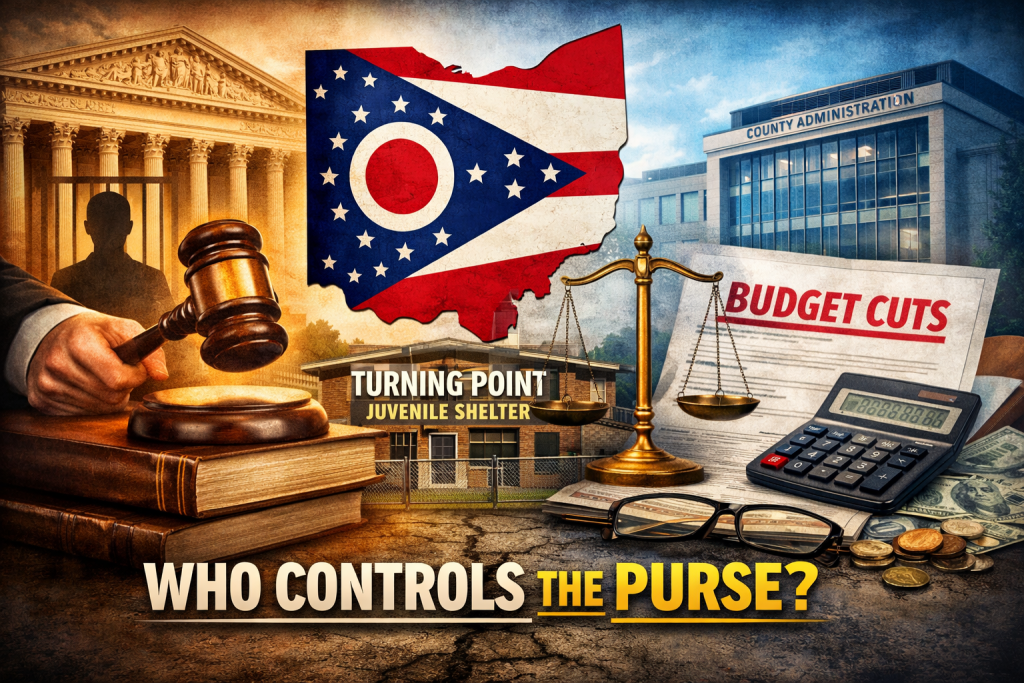
What people are arguing about right now is not really one statute or one case. It is a much larger question that sits at the center of how government actually works in Ohio. It is about who has the final say when it comes to spending public money for the courts, especially when that spending involves something like a juvenile shelter.
Turning Point is not just another county program that can be weighed against road repairs or office staffing. It exists within the juvenile justice system. That distinction matters because the juvenile court is not simply another department asking for funding. It is a court of law with legal duties that it is required to carry out under Ohio law. Those duties are not optional, and they do not disappear when budgets get tight.
That is why the conversation is so heated. This is not just a funding disagreement. It is a structural conflict between two different parts of government, each of which has legitimate authority.
So the real issue becomes clear when stripped down to its core.
When a judge says a service is necessary to do their job, can the county say no because of budget limits.
The answer under Ohio law is not as simple as either side is claiming.
What the Law Actually Says About Spending Public Money
There is a statute in Ohio, R.C. 5705.41(A), that governs how public money is spent. It provides that government entities cannot make expenditures unless those funds have been properly appropriated. In other words, money must be budgeted and approved before it can be used.
That law exists for a reason. It is designed to prevent overspending, to ensure accountability, and to place control of taxpayer dollars in the hands of elected officials. County commissioners are charged with managing finite resources, balancing competing needs, and ensuring that spending stays within legal limits.
The argument based on this statute is straightforward and, on its face, persuasive.
If the money is not in the budget, it cannot be spent.
That is the foundation of fiscal control in Ohio government.
But that is not the end of the analysis. It is only the beginning.
Why Courts Do Not Fit Into the Typical Budget Model
Courts are not just another agency. They are a separate branch of government. That distinction is not symbolic. It has real legal consequences.
Under Ohio law and constitutional principles, the judicial branch must remain independent. It cannot be placed in a position where another branch of government can effectively shut it down by withholding funding. If that were allowed, the balance of power would collapse, and the courts would no longer be able to perform their function as an independent arbiter of the law.
Because of that, Ohio courts have long recognized what is known as inherent authority. This is the principle that a court has the power to secure the resources necessary to carry out its duties.
The reasoning behind that authority is simple and direct.
If another branch of government could refuse to fund the courts, it could shut down the justice system.
So while fiscal statutes like R.C. 5705.41(A) are real and enforceable, they do not operate in a vacuum. They must be read alongside constitutional principles that protect the independence of the judiciary.
Why Juvenile Courts Raise the Stakes
The issue becomes even more complicated when it involves juvenile court.
Juvenile courts are not simply resolving disputes between parties. They are responsible for children. Their statutory duties include overseeing cases involving abuse, neglect, dependency, and delinquency. These are not abstract responsibilities. They involve real children who may need to be removed from dangerous environments, placed in protective custody, or detained for legal reasons.
When a juvenile court issues an order involving a child, that order must be carried out. The court cannot simply say it lacks the resources to comply with the law.
If a judge orders that a child must be placed somewhere, there must be somewhere to place that child.
That is where facilities like Turning Point come into play. A juvenile shelter is not just a program. It is part of the infrastructure that allows the court to fulfill its legal obligations.
Without it, the court may not be able to follow the law.
That is why courts often argue that these types of services are not optional. They are necessary.
The Reality That Both Sides Are Partly Right
One of the reasons these disputes become so contentious is because both sides are relying on real legal principles.
County commissioners do control the budget. They are responsible for managing taxpayer dollars, making difficult decisions, and ensuring that spending remains within the limits set by law. They cannot simply approve every request without considering the financial reality of the county.
At the same time, courts are not dependent agencies. They have the authority to ensure that they can operate. If a service is truly necessary for the court to perform its duties, the court has the power to order that it be funded.
Ohio law does not give one side absolute authority over the other.
Instead, it creates a tension between fiscal control and judicial independence. That tension is not accidental. It is built into the structure of government.
How These Disputes Are Actually Decided
When conflicts like this reach the courts, the issue is not resolved by pointing to a single statute.
The question is not simply whether the money was budgeted.
The real question becomes whether the funding is necessary for the court to perform its duties.
If the court can demonstrate that the funding is reasonably necessary for the administration of justice, then it has a strong legal position. Courts have, in various cases, ordered funding to be provided even over the objections of county officials when that standard is met.
On the other hand, if the commissioners can show that the expense is not necessary, that alternatives exist, or that the request is unreasonable, then the court’s position becomes weaker.
The outcome depends on facts, not slogans.
This is not about who has more power. It is about whether the expenditure is justified.
Why Older Cases Still Carry Weight Today
There is a tendency in public debate to dismiss older case law as outdated. That is not how the legal system works.
Court decisions do not expire with time. They remain binding authority unless they are overturned or replaced by higher courts. Many of the foundational decisions governing the relationship between courts and county funding were decided decades ago, and they continue to shape how these disputes are resolved today.
So when someone cites a case from the 1970s, the question is not how old it is.
The question is whether it is still good law.
In many instances, it is.
What This Means for the Turning Point Dispute
At the end of the day, the legal question surrounding Turning Point is not political. It is not rhetorical. It is not decided by social media arguments.
It comes down to a single, fact driven determination.
Is Turning Point necessary for the juvenile court to do its job.
If the court can demonstrate that the facility is required in order to safely, lawfully, and effectively carry out its statutory duties, then it has a strong argument that funding must be provided.
If the county can show that there are viable alternatives, that the service is not essential, or that the cost is unreasonable, then the county’s position becomes stronger.
That is how these cases are decided in courtrooms, not comment sections.
Final Thought: This Is About More Than a Line Item
It is easy to frame this as a budget dispute. It is not.
This is a separation of powers issue. It is about how government functions when two branches have overlapping authority and conflicting responsibilities.
The county controls the budget, but the courts must be able to function.
Neither side gets unlimited authority.
The law requires a balance, and that balance is determined by whether the funding is truly necessary to carry out the duties of the court.
That is not a political question. It is a legal one.
And ultimately, it is one that will be decided not by arguments online, but by the courts themselves.
Legal and Accuracy Notice
This article is based on general principles of Ohio law, including statutory provisions such as R.C. 5705.41 and established case law regarding judicial authority and separation of powers. It is intended for informational and journalistic purposes only. It does not constitute legal advice. Readers should consult qualified legal counsel for advice regarding specific legal issues or disputes. All individuals and public officials referenced are presumed to be acting in accordance with the law unless and until proven otherwise in a court of competent jurisdiction.
Intellectual Property Notice
© 2026 Knapp Unplugged Media LLC. All rights reserved. This work is original content created for publication on Substack and affiliated platforms. Unauthorized reproduction, redistribution, or use of this material without express written permission is prohibited.
About The Author