

When “Sister Schools” Means Something Else Entirely
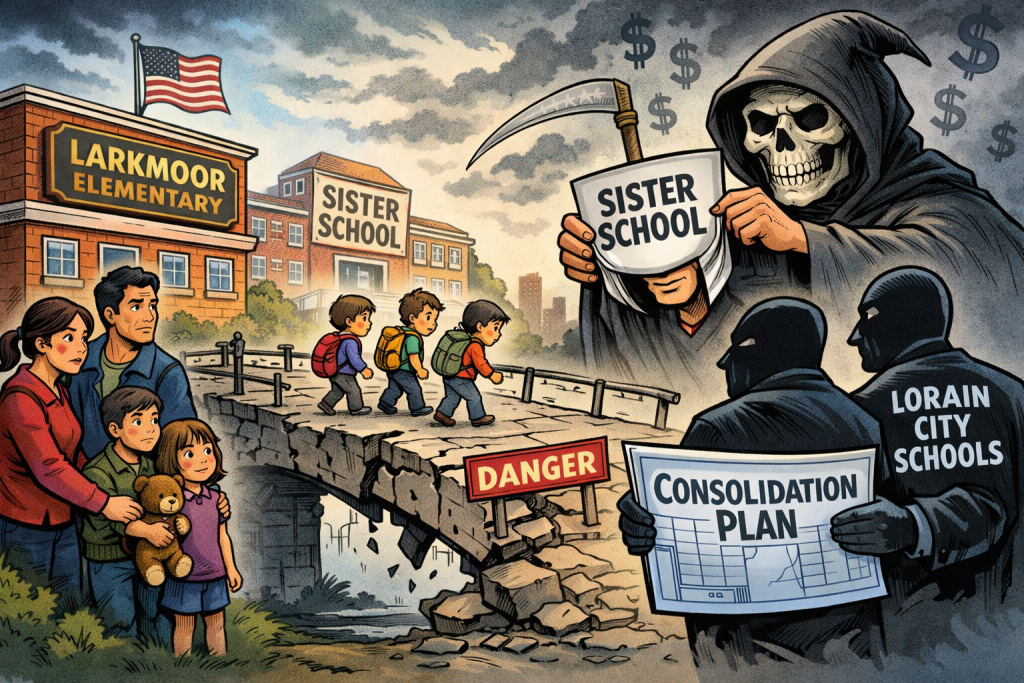
How Lorain City Schools Is Quietly Moving Toward the Displacement of the East Side’s Only Elementary School
By Aaron Knapp
Investigative Journalist
A Message That Was Not Routine and Was Not Reassuring
The message sent to Larkmoor families through ClassDojo was framed as a call for unity, urgency, and parental involvement. On its surface, it read like a community alert. In substance, it read like a warning. The district may not have used the word “closure,” but the implications were unmistakable to anyone familiar with how school systems manage consolidation under financial pressure.
Families were told that Lorain City Schools is discussing proposals that include closing schools, cutting teachers and programs, reducing staff benefits, and creating so-called “sister schools.” Larkmoor Elementary parents were then told what that would mean in practice. Their children could be required to walk across a bridge to attend school in another building.
“That is not a theoretical policy discussion. That is a concrete operational change with immediate safety, accessibility, and equity consequences for young children.”
This is not future planning. It is present impact.
Why Language Matters and Why It Is Being Chosen Carefully
School districts rarely announce closures directly anymore, especially when the affected community is organized and vocal. Instead, they rely on transitional language that sounds temporary, collaborative, or innovative. “Sister schools” is one of those terms. It is not defined in statute, policy, or educational research as a best practice for elementary education. It is an administrative label that allows districts to avoid saying what is actually happening.
In real terms, a sister school model almost always means consolidation without accountability. One building loses grade levels. Students are split across locations. Staff are reassigned or reduced. Enrollment declines because families move or seek alternatives. After a few years, the district points to those declines as justification for permanent closure.
“Requiring elementary-age children to cross a bridge is not a feature of a thriving neighborhood school. It is a symptom of a school being hollowed out.”
What Is a “Sister School” and Why Districts Use the Term
“Sister school” is not a term of art in Ohio education law. It does not appear in the Ohio Revised Code, Ohio Administrative Code, or any binding standards governing school operation, consolidation, or closure. There is no statutory definition, no required criteria, and no formal accountability framework attached to it.
Instead, “sister school” is an administrative label, used by school districts to describe arrangements that functionally resemble consolidation or partial closure while avoiding the political and legal weight of those words.
In practice, when districts invoke a sister school model, it typically means one or more of the following.
Students are split between buildings by grade level.
Programs are relocated rather than preserved.
Staff are reassigned or reduced through attrition.
Enrollment is redistributed without reopening boundary review.
Transportation and safety burdens are shifted to families.
“What is presented as collaboration often operates as consolidation.”
Districts use the term because it sounds temporary, cooperative, and educational rather than financial. It suggests partnership rather than loss. It allows leadership to frame the decision as innovation rather than retrenchment, even when the underlying driver is budget pressure or enrollment decline.
Just as importantly, the term provides institutional cover. If outcomes deteriorate, districts can later point to enrollment drops or logistical challenges as justification for permanent closure, even though those conditions were created by the initial restructuring.
“The damage is often cited as the reason for the final decision.”
For families, the impact is immediate and concrete. Daily routines change. Safety risks increase. Access to teachers and services becomes more complicated. For communities, the effect is long term. Once a neighborhood school is functionally diminished, it rarely returns to full operation.
Calling that process a sister school arrangement does not change its consequences.
It changes only how those consequences are explained.
“Language does not reduce harm. It reallocates responsibility.”
Larkmoor Is Not Just Another Building
Larkmoor Elementary is the only elementary school serving the east side of Lorain. That fact alone makes this proposal fundamentally different from a routine boundary adjustment or internal reorganization. Elementary schools are not interchangeable units on a map. Their location determines whether children can safely walk to school, whether parents can reach teachers easily, whether after-school programs are accessible, and whether the school functions as a neighborhood anchor.
Removing or destabilizing the only east side elementary school does not affect all families equally. It disproportionately impacts families without reliable transportation, families working hourly jobs, families with younger children, and families already navigating economic and logistical barriers.
“When the district saves money, parents absorb the risk.”
That is not equity. That is cost shifting.
Safety and Supervision Are Not Side Issues
The ClassDojo message explicitly raised concerns about safety, supervision, accessibility, and emotional well-being. That matters, because it confirms these risks are already known and acknowledged. This is not speculation by parents. These are admitted hazards.
Elementary students walking across a bridge raises unavoidable questions. Who is responsible for supervision. What happens in winter weather. What happens during emergencies. How are students with disabilities accommodated. How are attendance, tardiness, and after-school pickup handled when children are split between buildings.
“If a proposal creates this many unresolved safety questions at the elementary level, it is not ready for implementation.”
Proceeding anyway would represent a conscious decision to accept risk rather than prevent it.
Why the Timing Feels Rushed
Families are being asked to show up immediately, not to participate in a months-long planning process. That suggests that options are already being narrowed and that community input is being sought late rather than early.
When districts genuinely want collaboration, they begin with listening sessions, data sharing, and transparent criteria. When they want to manage backlash, they announce proposals and ask for comments at the eleventh hour.
“Boards know that empty rooms signal consent. Full rooms signal political cost.”
This meeting is not informational. It is decisive.
What Is Actually at Stake
This is not simply a debate about budgets or enrollment. It is a question of whether the east side of Lorain will continue to have a dedicated elementary school or whether that presence will be gradually erased through consolidation language and administrative maneuvering.
Once a neighborhood loses its elementary school, it rarely gets one back. Property values decline. Family stability suffers. Community identity weakens. Future decisions become easier to justify because the damage has already been done.
“Calling it a sister school does not change the outcome. It only obscures responsibility.”
The Role of Parents and the Record That Is Being Made
Public comment is not just about persuasion. It is about documentation. When parents show up and speak on the record, that testimony becomes evidence. It matters later, when decisions are challenged, when outcomes are evaluated, and when accountability is demanded.
“Silence is often weaponized as consent after the fact.”
If Lorain City Schools chooses to displace the only east side elementary school, it should do so openly, transparently, and honestly. It should not be allowed to pretend the outcome was unavoidable or unopposed.
A Community Decision, Not a Spreadsheet Exercise
Larkmoor is more than a line item. It is a community institution serving some of Lorain’s youngest residents. Decisions about its future should be grounded in safety, equity, and long-term community impact, not short-term cost savings.
If leadership believes this is the right decision, it should say so plainly and defend it openly.
“Because once children are told to cross the bridge, figuratively or literally, the decision has already been made.”
Closing Thought
This Is Not an Isolated Proposal. It Is a Pattern.
What is unfolding at Larkmoor Elementary cannot be honestly understood as a single hard decision forced by circumstances. It fits too neatly into a documented pattern of reactive governance, opaque planning, and downstream damage that Lorain City Schools has repeated for years.
Enrollment declines are treated as causes rather than symptoms. Budget shortfalls are framed as natural disasters rather than outcomes of leadership choices. Community schools are destabilized first and then cited as underperforming later.
“This is not reform. It is managed decline.”
What makes the Larkmoor situation especially consequential is that it exposes the human cost of this approach at the youngest level. Elementary students do not have flexibility. Families cannot adapt indefinitely. When the only east side elementary school is hollowed out under a euphemism, the message is unmistakable.
“You are expected to make do with less, walk farther, accept more risk, and be grateful it was not called a closure.”
This is why showing up matters. Not because public comment alone fixes systemic failure, but because the record matters. Who warned the board matters. Who raised safety, accessibility, and equity concerns matters.
Lorain City Schools does not lack data. It lacks accountability and long-term stewardship.
If this decision goes forward, it should be understood clearly for what it is. Not an innovation. Not a collaboration. Not a sisterhood of schools.
“Another chapter in a documented pattern of mismanagement where neighborhoods pay the price for failures made far above their heads.”
And once again, the question will not be whether families were warned.
The question will be whether anyone listened.
Amendment and Update
Newly Obtained Messages Clarify the District’s Internal Framing
Since publication, additional information has come to light that materially clarifies how Lorain City Schools leadership is internally framing the proposals now being discussed publicly.
A private message exchange, reviewed by this publication, confirms that district leadership is responding to an eighteen million dollar budget shortfall and is actively considering a K–2 / 3–5 grade banding model across elementary schools as a cost containment strategy.
In the exchange, the restructuring is described not as a theoretical option, but as a necessary measure tied directly to fiscal pressure.
The messages further indicate that the district is considering centralized sites for preschool programming and autism services, with remaining elementary schools being paired or reorganized to absorb redistributed students.
This internal description aligns directly with what families at Larkmoor Elementary were warned about publicly, including the possibility that students may be required to attend school in a different building and, in some cases, cross between facilities.
Importantly, the exchange also frames the restructuring as a defensive response to charter school enrollment pressure, stating that failure to proceed could result in the loss of two to four schools to charter competition.
While the district has publicly emphasized collaboration and learning optimization, the internal framing reflects a consolidation driven by budget necessity, not pedagogical reform.
This additional context does not contradict earlier reporting. It reinforces it.
What is being described publicly as “sister schools” is being discussed internally in operational terms such as grade banding, pairing buildings, centralizing programs, and absorbing enrollment shifts. Those are structural changes with predictable and lasting consequences for families, neighborhoods, and school access, particularly on the east side of Lorain.
This amendment is included to ensure the public record accurately reflects the full scope of information now available as families and community members prepare to engage with the Board of Education on decisions that will shape the future of elementary education in Lorain.
Legal and Editorial Disclosure
This article is journalistic analysis and protected opinion based on publicly circulated communications, district statements, and documented patterns of governance within Lorain City Schools. It is not legal advice. No claims of criminal conduct are alleged. All observations are offered in the public interest and for purposes of accountability, transparency, and civic engagement.
Published by:
Knapp Unplugged Media LLC
Independent Investigative Journalism
© 2026 Knapp Unplugged Media LLC. All rights reserved.
About The Author





1 thought on “When “Sister Schools” Means Something Else Entirely”