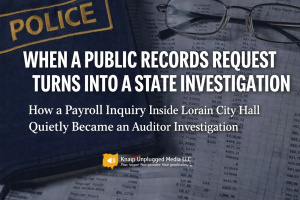

When a Public Records Request Turns Into a State Investigation
How a Payroll Inquiry Inside Lorain City Hall Quietly Became an Auditor Investigation
There is a common misconception about how government investigations begin. Most people imagine a dramatic moment, a whistleblower walking in with documents, a criminal complaint landing on a prosecutor’s desk, an instant escalation from rumor to raid. That version of events feels clean, even comforting, because it suggests that investigations start when someone decisively accuses someone else of wrongdoing.
What the documents and recordings show here is a much quieter origin, and a much more realistic one. This investigation did not begin with a criminal referral. It did not begin with a disciplinary complaint inside the police department. It began when a public records request forced City Hall to pull payroll data, stare at the numbers, and confront questions that could not be answered with assumptions or reputation.
In that sense, the beginning is ordinary. Someone asked the City of Lorain for payroll records. The request reached the city auditor’s office. Reports were generated. Scheduling and compensation records were compiled. Approvals and pay codes had to be reviewed. And once the data was in front of someone’s eyes, the ordinary process of producing records triggered extraordinary consequences.
What matters most is this. The documents show the investigation did not form around one single allegation. It formed around multiple complaints that shared a single vulnerability inside city government. Documentation. The ability to prove what was worked, what was paid, who approved it, and whether the city’s payroll systems match reality.
That is why the last transcript changes the story. It makes clear that there were parallel tracks developing at the same time. One track focused on the police chief and command staff, Telestaff scheduling, and higher position pay. Another track focused on the law department, time sheets, and whether full time benefits could be earned in a system that appears to depend on classification more than actual hours.
Those two tracks are separate, but they collide in the same place. The moment the city has to answer questions with records, not explanations.
The Public Records Request That Started Everything
The origin point of this investigation was not a criminal complaint, and it was not an internal disciplinary review. It did not begin with a political confrontation at City Hall, and it did not begin with a whistleblower stepping forward to accuse someone of misconduct. The starting point was far simpler, and in a way far more revealing about how public oversight actually works when it is functioning the way the law says it should.
It began with a request for records.
Someone asked the City of Lorain for payroll data involving the police department. The request sought compensation information going back several years and focused on the pay of the police chief and command staff, including captains who were eligible to receive higher position pay when filling supervisory roles. On its face, it was not a dramatic demand. It was the kind of routine public record inquiry that cities receive constantly, sometimes from journalists running accountability stories, sometimes from residents trying to understand how their tax dollars are being spent, and sometimes from citizen groups who want hard numbers instead of official talking points.
Most of the time, requests like this are uneventful. The city runs a report, exports a spreadsheet, produces the records, and the matter ends there. The public gets the information. The government fulfills the legal obligation. Nobody holds a meeting at the prosecutor’s office. Nobody brings in state auditors. Nobody starts talking about jurisdiction and conflicts of interest.
But this time, something else happened, and it happened for a reason that matters to every taxpayer.
In order to fulfill the request, the city auditor’s office had to generate payroll reports tied to the police department. That meant compiling the records, examining the pay codes, and pulling the scheduling and compensation data that feeds into payroll. It required staff inside City Hall to do more than simply press a button. It required them to actually look at the information, verify what they were producing, and make sure the output matched what the request asked for.
That process forced a closer look at the numbers.
As the reports were generated and reviewed, the data began to raise questions. What started as an ordinary clerical task, the kind of routine administrative work performed every day in municipal government, began to reveal patterns that did not immediately make sense. The payroll reports showed entries that prompted a deeper look at how the police department’s scheduling system interacted with the city’s compensation structure.
Specifically, the records raised questions about the relationship between the chief’s recorded work time and the periods when captains were receiving higher position pay.
Higher position pay exists for a practical reason. In a public safety agency, supervisory coverage matters. When a higher ranking officer is absent, the department often assigns an acting supervisor, and payroll systems can compensate that acting supervisor at the higher rate for the time the higher duties are being performed. In itself, that is not unusual. It is a mechanism built into compensation systems so departments can maintain command coverage without pretending staffing gaps do not exist.
The problem is that higher position pay only makes sense when the underlying scheduling and work time records make sense alongside it.
When the payroll records were examined in response to the public records request, the data suggested patterns that the city auditor believed required explanation. The reports indicated circumstances where higher position pay may have been issued while the payroll records still reflected a standard work schedule for the chief. That does not automatically prove wrongdoing. What it proves is that the records, as produced, raised questions that could not be resolved by assumption or reputation. If the data suggested overlapping pay situations, then someone had to explain whether it was legitimate coverage, a misinterpretation of how the system works, a documentation problem, or something more serious.
That is the exact moment the situation changed.
What started as a routine response to a public records request evolved into a deeper review of payroll practices inside the police department. Once the questions existed, the auditor began examining how the entries had been generated and whether the payroll records fully reflected the underlying work schedule and approvals that should support public payroll expenditures. Those questions did not remain trapped inside a spreadsheet. They moved into internal discussions, and those discussions eventually reached prosecutors and investigators who were asked to review the matter and determine whether further examination was necessary.
That chain of events matters because it reveals something fundamental about how this entire investigation began.
It did not originate from political pressure. It did not begin with a disciplinary complaint inside the police department. It did not start with a criminal referral from a law enforcement agency. It began because transparency forced the city to produce records, and once those records were produced and examined, the numbers demanded answers.
The Payroll System Behind the Questions
To understand why the public records request raised questions in the first place, it is necessary to understand how the City of Lorain’s payroll system actually operates. Payroll inside a police department is not a simple process where someone records hours and a paycheck is issued at the end of the week. It involves multiple systems, multiple layers of administrative review, and several decision points where scheduling data and compensation rules intersect. When investigators began examining the records generated by the request, they quickly realized that the structure of the system itself was central to understanding what the payroll reports actually meant.
According to the explanations provided during the investigation, the Lorain Police Department relies on a scheduling program known as Telestaff. The software is designed specifically for public safety agencies where staffing must be managed continuously. Unlike many municipal offices that operate on predictable schedules, police departments must account for coverage at all hours of the day and night. Telestaff tracks officer assignments, shift rotations, overtime coverage, and situations where an officer temporarily fills a higher supervisory role.
Every time an officer works a shift, covers a different assignment, or fills in for a higher ranking supervisor, that information can be entered into the system so it becomes part of the department’s scheduling record. Those scheduling entries are not simply operational notes. They eventually become part of the payroll process.
But the transition from scheduling information to a paycheck is not automatic.
Several steps occur between the moment a shift is recorded in the scheduling system and the moment compensation is issued by the city. The first step involves the police department’s payroll clerk. That employee compiles the payroll file using the scheduling data generated by Telestaff. The clerk reviews the entries, organizes the hours worked by each employee, and applies the relevant payroll codes. Those codes determine whether the recorded hours are counted as regular time, overtime, compensatory time, or higher position pay.
Once the payroll file has been assembled, it does not immediately move to the city auditor for payment processing.
Instead, the file travels through a chain of administrative approvals inside city government.
Within the police department the payroll must first be reviewed and approved before it can proceed further in the system. After that departmental approval occurs, the payroll file is transmitted to the Safety Service Director’s office. That office provides an additional layer of administrative oversight before the information is forwarded to the city auditor’s office.
Only after those steps have been completed does the auditor’s office process the payroll and issue the payments.
From a distance, the structure appears straightforward. A scheduling system records assignments. Payroll entries are compiled. Supervisors review the information. The auditor processes the compensation. On paper, the system appears to contain multiple checkpoints designed to ensure that the data moving through the process is accurate and properly authorized.
But when investigators began examining the records more closely, a critical limitation became clear.
The payroll records themselves do not necessarily describe the work that produced the pay.
Payroll reports show compensation categories. They show the number of hours attributed to each employee. They show the approvals that allowed the payroll to move forward through the administrative chain. What they do not always show is where the work occurred or how the employee was performing their duties during the hours listed.
In practical terms, the payroll system documents what was paid.
It does not always document how the work happened.
An employee may appear in the payroll system as having worked a full schedule during a given period, but the payroll report itself will not necessarily indicate whether that work occurred inside the office, from home, during phone communications, or while responding to events outside the city.
For routine patrol shifts, that distinction rarely creates confusion. Patrol officers work scheduled assignments that are clearly documented through operational logs and dispatch activity. Supervisors working inside the building are easily verified through department records and day to day operational oversight.
But when the work involves administrative duties, remote communication, or crisis management that unfolds outside normal scheduling patterns, the payroll entries alone may not tell the entire story.
That limitation became one of the central issues investigators faced as they began examining the records produced in response to the public records request. The payroll system showed compensation entries. It showed hours attributed to employees. It showed that the approvals required for payroll processing had occurred.
What it did not automatically show was how those recorded hours corresponded to the real world events taking place during the same time period.
Once investigators recognized that distinction, the focus of their inquiry began to shift. The issue was no longer limited to the numbers appearing in the payroll system. The issue became whether those numbers could be connected to documented work activity that explained why the compensation had been issued.
At that point, the investigation began to move beyond spreadsheets and into explanations.
The Meeting at the Prosecutor’s Office
Once the concerns raised by the payroll records moved beyond internal discussions inside City Hall, the matter reached a point where outside review was considered necessary. At that stage the issue was brought to the attention of the Lorain County Prosecutor’s Office. What followed was not an informal conversation or a routine administrative consultation. A formal meeting was arranged that brought together multiple officials whose responsibilities placed them directly at the center of any potential investigation involving public funds and government payroll practices.
According to the investigative summary, the meeting took place on May 10, 2023. Present for the discussion were representatives from the Lorain County Prosecutor’s Office, county investigators, and officials connected to the Ohio Auditor’s Special Investigations Unit. The individuals in attendance included Lorain County Prosecutor J.D. Tomlinson, investigators Garrett Longacre and Rich Resendez, James Burge, the prosecutor’s chief of staff, and representatives from the Auditor of State’s office who had been assigned to conduct a preliminary audit review.
https://www.youtube-nocookie.com/embed/fuBnRmufkr8?rel=0&autoplay=0&showinfo=0&enablejsapi=0
The presence of the Auditor of State’s Special Investigations Unit is significant. That office is responsible for examining allegations involving the misuse of public funds, financial irregularities, and other potential violations tied to government operations. When investigators from that unit are present during a meeting at a prosecutor’s office, the issue has moved beyond routine administrative concerns and into territory where the financial practices of a government entity may require formal review.
The meeting itself was recorded, and the written report describing it explains that the discussion began with a review of several complaints attributed to Lorain City Auditor Karen Shawver. Those complaints involved multiple areas of city government and focused broadly on payroll practices and compensation records.
https://www.youtube-nocookie.com/embed/x49H5bDiLro?rel=0&autoplay=0&showinfo=0&enablejsapi=0
Among the issues outlined were allegations involving overtime practices in certain administrative departments, questions about higher position pay within the police department, and concerns tied to payroll and scheduling records connected to the police chief and command staff. Another issue involved payroll questions inside the city’s law department, where auditors had reportedly requested documentation during an outside audit but had not received the full records they had asked for.
Within that broader context, one of the issues drawing particular attention involved the relationship between the police chief’s recorded work time and the periods when captains were receiving higher position pay.
Investigators sought to understand how the city’s payroll system operated, how Telestaff scheduling data interacted with compensation entries, and whether the patterns identified by the city auditor warranted a deeper investigation.
During the meeting, Prosecutor Tomlinson acknowledged that the police chief matter presented a potential conflict for his office. According to the investigative summary, Tomlinson stated that he was personally close friends with Police Chief James McCann and therefore asked the Auditor of State’s Special Investigations Unit to take the lead on examining that aspect of the case.
Shortly after the meeting, investigators received confirmation that the matter would be handled by the state investigative unit.
As the discussion continued, the conversation moved beyond payroll systems and into the circumstances surrounding the police department during the period investigators were reviewing.
At the time, the department was dealing with a highly publicized incident involving a police officer shooting a dog. The event had drawn widespread attention and generated intense reactions across social media platforms and news outlets. The incident had placed the department and its leadership under extraordinary scrutiny.
Assistant Law Director Zaleski addressed that situation directly during the meeting.
“At this point, Assistant Law Director Zaleski stated that we did not know the pressure McCann was under, dealing with the dog shooting incident and the fall out from that, in addition to other crime happening in the city.”
Zaleski
The statement was offered as context for the environment in which the chief had been operating during the time period investigators were examining. According to the city’s legal leadership, the department had been managing both routine law enforcement responsibilities and the intense public backlash generated by the incident.
Law Director Pat Riley expanded on that explanation during the discussion.
“Law Director Riley made the comment that the law department has a great reputation not only in the state but in the country. He added that this was unbecoming, an insult to the core of the people.”
Riley
Riley’s remarks reflected a concern that the scrutiny surrounding the investigation could damage the reputation of the city’s legal and administrative institutions. He also emphasized the scale of the public reaction that followed the dog shooting incident.
“He also said the incident wasn’t just local, but it was international, Australia had reported on the dog shooting.”
The comment illustrates the degree to which the event had extended beyond Lorain itself. According to city officials, the incident had generated national and even international attention, bringing outside scrutiny to the department at a moment when investigators were already examining internal payroll records.
Taken together, the statements made during the meeting reveal the atmosphere surrounding the investigation at the moment it began to take shape. The police department was already dealing with a controversy that had placed the city under a national spotlight. Public criticism was intense, media coverage was widespread, and the leadership of the department was under significant pressure.
Against that backdrop, investigators were now examining payroll records, scheduling systems, and the documentation used to support compensation entries within the department.
For the city’s legal leadership, the timing of those questions could not have been more sensitive. They were being raised during a moment when the department was already facing a level of scrutiny that few local agencies ever experience.
And the officials present at the meeting appeared to recognize that any additional controversy connected to payroll practices would only deepen the spotlight already focused on City Hall.
Questions About the Chief’s Work Hours
Once investigators moved beyond the initial discussion of how the payroll system functioned, the conversation turned to the central issue that had brought everyone into the same room. The payroll reports had raised questions about how compensation was being recorded. The next step was determining whether the documentation behind those entries actually supported the hours reflected in the system.
At its core, the issue investigators were examining was straightforward. If the police chief was receiving compensation based on a standard forty hour work week, investigators needed to understand how those hours had been documented and verified within the city’s administrative records. Payroll entries alone could not answer that question. Payroll records show what was paid. What investigators needed to determine was whether there were records that showed the work associated with that pay.
That distinction shifted the focus of the meeting from systems to evidence.
During the discussion, investigators asked a direct question that cut through the broader conversation about scheduling software, administrative approvals, and the pressure surrounding the department at the time. They wanted to know whether any documentation existed that could demonstrate the chief had actually worked the hours that appeared in the payroll records.
The question was stated plainly during the meeting.
“All parties were asked if they had any documentation showing the Chief worked 40 hours.”
The significance of that question was immediate. It moved the discussion away from explanations about how the payroll system functioned and toward the evidence that would support the entries investigators were reviewing. If the payroll system reflected forty hours of work, investigators needed to determine how that work had been documented and whether records existed that demonstrated what had occurred during those hours.
The response from city officials did not immediately produce a specific document or record. Instead, the discussion shifted back toward the broader circumstances surrounding the police department during the time period under review.
Law Director Pat Riley described the environment in which the chief had been operating at the time. The department was dealing with the fallout from the dog shooting incident that had drawn widespread media attention and generated intense reactions from the public.
According to Riley, managing the response to that incident required substantial involvement from both the chief and members of the city’s legal leadership.
“Mr. Riley said he had spent personal time with McCann to manage the situation, adding that now the city was under attack from dog lovers.”
The remark reflected how city officials viewed the situation during that period. From their perspective, the department was dealing with a crisis that had triggered national attention and emotional responses from across the country. Riley’s comment suggested that responding to that backlash required significant time and attention from the chief and the city’s legal team.
In practical terms, Riley was describing a scenario in which the chief’s work during that period may not have resembled routine administrative duties performed inside City Hall. Instead, the work involved responding to a rapidly evolving public controversy that required communication, coordination, and crisis management.
Assistant Law Director Zaleski added another element to that explanation. He indicated that he had personally communicated with the chief during the period investigators were examining.
“Mr. Zaleski also said he had phone calls with McCann during the time of the incident.”
Those communications were presented as evidence that the chief remained involved in managing the situation while the controversy surrounding the incident unfolded. The implication was that the chief continued performing his responsibilities even when he was not physically present in the city.
From the perspective of the city’s legal leadership, those communications demonstrated that the chief had been actively engaged with the department’s response during the period reflected in the payroll records. The work may not have appeared in traditional shift schedules or daily activity logs, but they argued that it existed through communications, coordination, and decision making tied to the crisis the department was facing.
For investigators, however, the distinction between involvement and documentation remained critical.
Phone calls and conversations could suggest that the chief was engaged with the situation. But the investigation was focused on whether records existed that could verify the work associated with the payroll entries. The question investigators were attempting to answer was not simply whether the chief had been involved in discussions. It was whether there were records that could demonstrate how the time reflected in the payroll system corresponded to documented work activity.
That question would soon lead the discussion to the most concrete piece of documentation offered during the meeting.
The Calendar Explanation
As the discussion about documentation continued, the conversation eventually turned to the most tangible piece of evidence presented during the meeting. Up to that point, city officials had described the pressure surrounding the dog shooting incident, the public backlash directed at the department, and the communications that had taken place between members of the city’s legal leadership and the police chief during that period. Those explanations provided context, but investigators were still searching for something more concrete than recollections of conversations or descriptions of the environment inside City Hall.
The first attempt to provide that documentation came directly from the chief himself.
During the meeting, Police Chief James McCann produced his cell phone and showed investigators his calendar. According to the investigative summary, the calendar contained entries identifying specific dates and times that he said were spent dealing with the aftermath of the dog shooting incident while he was in Florida.
“McCann showed his cell phone calendar with times/dates listed he spent dealing with the situation while he was in Florida.”
The calendar entries were presented as a record of the work he claimed to have performed during the period investigators were reviewing. McCann’s explanation was that even though he had been physically outside the city at the time of the incident, he had remained actively involved in responding to the situation as it unfolded. The response, according to that explanation, involved communicating with city officials, discussing how the department should address the public reaction, and participating in the decisions surrounding how the city would respond to the controversy.
From McCann’s perspective, the calendar entries represented a timeline of the work he had performed while the crisis surrounding the dog shooting incident was developing.
For investigators, however, the calendar represented something more specific. It was the first piece of documentation offered during the meeting that attempted to connect particular hours to particular activity. Until that moment the explanations offered by city officials had focused largely on the circumstances surrounding the department and the conversations that had taken place among city leadership. The calendar introduced the possibility of a record that could be examined alongside the payroll information investigators were already reviewing.
Because of that, investigators asked for a copy of the calendar entries.
They requested that the relevant portions be provided so the dates and times listed could be reviewed and compared with the payroll records associated with the same period.
“He was asked to provide a copy of the calendar, and he said he would do so once he removed other personal info from his calendar.”
That exchange introduced a practical complication that often arises when personal devices intersect with public responsibilities. Personal calendars frequently contain private information unrelated to government work, including family events, medical appointments, or other personal activities. McCann indicated that he would provide the entries related to the incident after removing unrelated personal information from the calendar.
That moment effectively placed the calendar at the center of the discussion.
Until that point, the investigation had largely revolved around payroll entries and explanations about the chief’s involvement in managing the public fallout from the dog shooting incident. Now investigators had been presented with a record that purported to document how the chief accounted for his time during the period in question.
The investigative file later reflects that on October 9, 2023 the chief sent investigators a PDF document derived from his phone records. The document included calendar entries along with associated voice, text, and media communication records connected to the incident. According to the investigative summary, the entries reflected a total of thirty seven hours of work activity between July 3 and July 10, 2023.
Whether those entries ultimately satisfied investigators was not determined in that moment.
What mattered at the time was that the calendar had become the primary documentation offered to support the claim that the chief had been working during the time reflected in the payroll records.
The Pressure on the City
Reading through the statements made during the meeting reveals something else that becomes difficult to ignore once the full context is understood. The payroll questions investigators were examining did not arise inside a quiet administrative setting where the only concern was whether numbers inside a system matched the underlying documentation. They surfaced during a moment when city leadership believed Lorain was already dealing with an extraordinary crisis that had placed the community under an intense public spotlight.
By the time investigators began asking questions about payroll records, the city was already grappling with the fallout from the dog shooting incident that had drawn widespread attention. What might normally have remained a local or regional controversy had quickly expanded into something much larger. The event spread rapidly across social media platforms, drew national media coverage, and triggered emotional responses from audiences far beyond the city itself.
Inside City Hall, officials were clearly aware that the situation had escalated well beyond a routine public relations challenge.
During the meeting with investigators, members of the city’s legal leadership described the atmosphere surrounding the department in terms that made clear how seriously they viewed the public reaction. From their perspective, the city was not simply responding to criticism from local residents or regional media outlets. The incident had become part of a broader national conversation about policing and the treatment of animals during law enforcement encounters.
That environment shaped the way city officials framed their explanations during the meeting.
According to the statements recorded in the investigative summary, the city had been inundated with criticism from individuals outraged by the incident. Social media posts amplified the story, news outlets repeated the details across multiple platforms, and advocacy groups joined the conversation. What began as a single law enforcement event had quickly evolved into a broader narrative about accountability, policing practices, and animal welfare.
Law Director Pat Riley described that moment in blunt terms during the meeting.
“Now the city was under attack from dog lovers.”
Pat Riley
The phrasing may sound dismissive when viewed in isolation, but the remark reflects the intensity of the backlash city officials believed they were facing. The criticism was not limited to residents of Lorain or even to audiences within Ohio. According to officials present at the meeting, the incident had drawn attention from people across the country and beyond, creating a level of scrutiny that local governments rarely encounter.
From the administration’s perspective, the city had already entered a defensive posture.
Officials believed Lorain’s reputation had been damaged. The actions of the police department were being examined in national news coverage, debated across social media platforms, and criticized by individuals who had never previously followed events inside the city. City leadership was suddenly responding to questions from journalists, advocacy groups, and members of the public who had become invested in the controversy.
It was in the middle of that environment that the payroll questions began to surface.
The timing mattered.
For city officials sitting in that meeting, the payroll investigation was not simply a technical review of administrative procedures. It represented another issue emerging at a moment when the department was already facing an extraordinary level of scrutiny.
The chief was dealing with the fallout from a nationally reported incident. The law department was responding to criticism about how the city had handled the controversy. And investigators were now examining payroll records connected to the department’s leadership.
From the administration’s perspective, it likely felt as though pressure was arriving from every direction at once.
That context helps explain the tone that appears throughout the discussion. City officials were not simply answering questions about payroll entries or scheduling systems. They were also attempting to explain the circumstances in which those entries had been recorded. Their argument was that the chief’s time during that period had been consumed by a crisis that extended far beyond routine departmental responsibilities.
Whether that explanation ultimately satisfied investigators was a separate question.
What the meeting clearly shows is that the payroll issues investigators were examining did not emerge in isolation. They appeared during a moment when Lorain had already become the focus of a controversy that extended well beyond the city’s borders.
A Story That Started With Transparency
Strip away the personalities, the politics, and the controversy that often surround any investigation inside a city government, and one central fact remains unavoidable. This entire chain of events did not begin with a criminal allegation, a whistleblower complaint, or a disciplinary action inside the police department. The investigation that eventually reached state officials and prosecutors began in a far more ordinary way. It began because someone asked for records.
A request was submitted to the City of Lorain seeking payroll information involving the police department’s leadership. The request asked for compensation records covering the police chief and command staff over a period of years. On its face, the request was routine. Public records requests like this are filed every day in Ohio by residents, journalists, and researchers who want to understand how public money is being spent and how government institutions operate.
To respond to the request, the city auditor’s office had to assemble the records. Payroll reports had to be generated. Scheduling information connected to those payroll entries had to be compiled. Administrative approvals had to be verified before the information could be released. At first, the task appeared to be nothing more than an administrative obligation, the kind of clerical work that takes place constantly inside government offices when records must be produced under Ohio’s public records law.
But once the reports were generated and reviewed, the numbers prompted a closer look.
Patterns inside the payroll records raised questions about how certain entries aligned with scheduling data and supervisory approvals. The information suggested that additional explanation might be necessary to understand how the compensation entries reflected the underlying work schedule within the department.
Those questions did not remain confined to the auditor’s office. They were discussed internally and eventually shared with prosecutors and investigators who were asked to examine the situation more closely. What had started as a routine response to a public records request gradually evolved into a matter that attracted the attention of the Ohio Auditor of State’s Special Investigations Unit.
The significance of that sequence cannot be overstated. The investigation did not begin because someone filed a criminal complaint. It did not begin because a city official accused another employee of wrongdoing. It began because the city was legally required to produce records in response to a request for information, and once those records were examined the data raised questions that demanded further explanation.
This is how transparency often functions in practice.
Public records laws exist to ensure that government activities remain visible to the people whose tax dollars fund those activities. Most of the time the process is uneventful. Records are requested, documents are produced, and the matter ends there. Occasionally, however, the act of examining those records reveals something unexpected.
When that happens, transparency becomes oversight.
The records request that triggered this investigation forced someone inside city government to review payroll information that might otherwise have remained buried inside administrative systems. Once those records were examined, the patterns they revealed prompted additional scrutiny. That scrutiny eventually brought prosecutors, investigators, and city officials into the same room to discuss how the payroll entries had been recorded and how the chief’s work hours were documented during the period under review.
Looking back at the sequence now, it is impossible to determine with certainty who filed the original request that set the process in motion. The documents show that the investigation began because someone asked for payroll records involving the police department. What they do not reveal is the identity of the individual who made that request.
It could have been a journalist examining city payroll records. It could have been a resident curious about government spending. It could have been someone engaged in a broader effort to review public records connected to the city’s operations.
It is also possible that the request came from someone who had no idea that compiling a payroll report would eventually lead to an investigation involving prosecutors and state officials.
That uncertainty illustrates a larger truth about how public accountability works.
Public records requests are sometimes dismissed by government officials as inconveniences that slow down administrative work. They require staff to locate documents, review data, and respond to inquiries from members of the public who are exercising their legal right to access government information.
But those same requests are one of the most powerful mechanisms for public oversight.
They create moments where records must be examined. They create situations where information that might otherwise remain hidden becomes visible. And occasionally they reveal patterns that force government institutions to explain how decisions were made and how public resources were used.
The events described in this investigation demonstrate exactly how that process can unfold. A request for payroll records required the city to generate reports. The reports raised questions about how the payroll system reflected scheduling decisions within the police department. Those questions led to internal discussions and eventually to a meeting involving prosecutors and investigators.
Whether the questions raised by those records ultimately result in findings of wrongdoing or explanations that satisfy investigators is a matter for the investigative process to determine.
What matters in understanding this story is how the investigation began.
It began with transparency.
Someone asked for records.
And once those records were produced, the answers they raised proved to be far more significant than anyone involved in the original request may have anticipated.
The city produced them.
And once those records were examined, the information they contained set a chain of events in motion that no one involved in the original request may have anticipated.
Closing Thought
The Records Raise New Questions
What you have read in this investigation is the beginning of the story, not the end of it.
The documents and recordings show how a routine public records request forced the City of Lorain to produce payroll data that raised questions about how scheduling systems, supervisory coverage, and compensation entries were being recorded inside the police department. Those questions eventually reached the Lorain County Prosecutor’s Office and the Ohio Auditor of State’s Special Investigations Unit. Officials met, explanations were offered, and documentation such as calendar entries and communications records were presented in an effort to explain how the chief’s work hours were being accounted for during the period under review.
But the meeting described in this article represents only one moment in a much longer chain of events.
What happened after that meeting is just as important as what occurred inside the prosecutor’s conference room.
Over time, additional payroll ledgers, higher position pay records, and scheduling documents began to surface. Some of those records were not part of the explanations offered during the meeting. Others appear to show details that were never discussed at all when investigators were attempting to understand how the city’s payroll system reflected the chief’s work schedule.
Taken together, those records open a new line of inquiry.
They make it possible to reconstruct the timeline day by day, comparing the chief’s payroll entries to the dates when captains were receiving higher position pay to act in supervisory roles. When the records are placed side by side, they allow investigators and the public to ask a far more specific question than the one discussed during the meeting.
Not simply whether the chief was involved in responding to a crisis.
But whether the payroll system accurately reflects the way command coverage was actually documented during those periods.
That distinction matters.
The discussion described in this article relied heavily on explanations offered by city officials and documentation derived from a personal calendar that the chief later produced to investigators. Those explanations were presented as context for how the department operated during an intense moment of public scrutiny.
What the additional payroll records show is that the numbers themselves can also tell a story.
Payroll ledgers, higher position pay reports, and scheduling data create a trail that can be examined independently of anyone’s recollection or interpretation of events. They allow investigators to measure the timeline in a way that does not rely on memory, reputation, or narrative.
It relies on documentation.
Those records will be examined in detail in the next part of this investigation.
Because once the payroll data is reconstructed across the entire timeline, a new question emerges that was never fully explored during the original meeting with investigators.
What exactly do the numbers show when the records are placed side by side?
That is the question the next article will attempt to answer.
Legal Disclaimer
This article is based on publicly available documents, recorded statements, payroll records produced in response to public records requests, and investigative summaries describing meetings between public officials and investigators. The information presented is intended for journalistic, informational, and public accountability purposes.
The reporting contained in this article reflects the contents of those records and the questions they raise. The existence of an investigation, the production of records, or the discussion of payroll data does not establish that any individual has committed wrongdoing.
Under both Ohio law and the United States Constitution, every individual is presumed innocent unless and until proven guilty in a court of law. Any reference to potential legal violations, investigative concerns, or questions raised by public records should be understood in that context.
This article does not assert criminal liability and does not claim that any person referenced has committed a crime. It reports on the existence of records, the questions those records prompted, and the discussions that occurred among public officials and investigators regarding those records.
Readers are encouraged to review the underlying documents and recordings themselves and to draw their own conclusions based on the full record.
About the Author
Aaron Christopher Knapp is an investigative journalist, licensed social worker, and public records advocate based in Lorain, Ohio. His work focuses on government transparency, public accountability, and the analysis of official records connected to local government operations.
Knapp is the Editor in Chief of Lorain Politics Unplugged, an independent investigative journalism platform dedicated to examining public records, government decision making, and issues affecting residents of Lorain and Lorain County.
Publisher Identification
This article is published by Knapp Unplugged Media LLC, an independent media organization focused on investigative reporting, public records analysis, and government transparency.
Knapp Unplugged Media LLC
Lorain, Ohio
All rights reserved. Unauthorized reproduction or redistribution of this article without attribution is prohibited.
What Comes Next
The story you have just read explains how a public records request inside Lorain City Hall quietly turned into a state level investigation involving prosecutors and the Ohio Auditor of State.
But that meeting was only the beginning.
In the months that followed, additional payroll records began to surface. Higher position pay reports, internal payroll ledgers, and scheduling records created a far more detailed picture of how compensation inside the police department was being recorded. When those records are placed side by side, they allow the timeline to be reconstructed day by day.
Those records raise new questions.
Not simply about how the police department documented supervisory coverage, but about how the city’s administrative systems handle compensation, classification, and approvals across multiple departments.
Because the deeper investigators looked into payroll practices, the more the conversation began to move beyond the police department itself.
During the same meeting described earlier, investigators also raised concerns about documentation tied to the Lorain Law Department. Questions surfaced about timesheets, employee classifications, and whether the system used to track full time hours and benefits accurately reflected the work being performed.
Those questions were not resolved in that meeting.
They opened an entirely separate line of inquiry.
In the next article, we examine the payroll records that emerged after the investigation began and the additional questions they raise about how time, classification, and compensation are documented inside Lorain City Hall.
Because once the payroll records are reconstructed across the full timeline, the story no longer involves only the police department.
It begins to lead directly into the Law Department itself.
And that is where the next part of this investigation begins.
About The Author