
Voice Is Not Style
How Sentence Structure Decides Who the Court Holds Responsible
By Aaron Christopher Knapp
Investigative Journalist | Public Records Litigator
Lorain Politics Unplugged
Attribution
This piece builds on a judicial writing insight shared by former Medina County Common Pleas Judge James L. Kimbler through his North Coast ADR Services newsletter. His original discussion focused on the distinction between active and passive voice in legal writing. What follows expands that concept into a broader framework grounded in real litigation, constitutional claims, and the mechanics of how courts actually read and decide cases.
See his News Letter and Subscribe for More
This Was Never About Grammar
There is a tendency in legal writing discussions to reduce issues like voice to style, as if the difference between active and passive is nothing more than polish or preference, something you adjust to sound more professional or more refined on paper. That framing misses what is actually happening.
This is not about sounding better. This is about control.
Voice determines who the court sees as responsible before the court ever decides responsibility. It is not cosmetic. It is structural. It is the first layer of advocacy, the point where accountability is either fixed to a person or allowed to drift into the background where it becomes harder to pin down.
Every judge reading a brief is doing more than reading words. They are building a mental model of the case in real time. They are not waiting until the conclusion to decide who did what. That process starts immediately, line by line, sentence by sentence, often before the legal arguments are even fully developed on the page.
When your writing consistently identifies an actor and ties that actor to conduct, the court begins to associate that person with responsibility almost automatically. The connection becomes natural, even inevitable, because the structure of the writing reinforces it over and over again.
When your writing removes that actor, something different happens. The conduct still exists, but it no longer feels anchored to a person. The case starts to read less like misconduct and more like an event, something that occurred rather than something someone caused.
That shift is subtle on the surface, but it is powerful in practice. It changes how the judge understands the case before any legal standard is applied.
From my own experience as a pro se litigant, this is not theoretical. It becomes obvious very quickly that there is a gap between everyday English and what the system actually responds to. The same set of facts can be written in plain language and ignored, or written in legal structure and taken seriously. Grammar is not just grammar in this setting. Word choice, sentence construction, even capitalization carry meaning that goes beyond ordinary communication. Legal writing has its own dialect, and if you do not recognize it, you are not just misunderstood, you are disadvantaged.
You see this most clearly when you compare how the same event can be written in two completely different ways.
“I chased the suspect and then I tackled him.”
That sentence is direct. It identifies the actor. It describes the conduct. There is no ambiguity about who did what.
Now compare it to how that same event is often written in reports.
“I maintained constant observation on the subject until which time he was apprehended with appropriate use of force.”
Suddenly, the actor fades into the background. The word “I” disappears. The act of tackling becomes “apprehended.” The force used is no longer a physical action by a person, it is something abstract that was “appropriate.” The sentence becomes longer, more formal, and more detached.
The facts have not changed. The framing has.
In the first version, the court sees a person making a decision and taking physical action. In the second, the court sees a process unfolding, almost as if it happened on its own. Responsibility is softened, not by denying the act, but by restructuring how it is presented.
That is the difference between plain English and legal phrasing. One tells the court exactly what happened. The other tells the court what happened in a way that manages how responsibility is perceived.
For everyday citizens in Lorain, this is where the system often feels stacked. You describe what happened to you in clear, direct language. The response you get back is written in a completely different form, one that reframes events, removes actors, and replaces actions with conclusions.
And unless you recognize what is happening, it is easy to miss that the story has already been rewritten before it ever reaches a judge.
Once you see that difference, you cannot unsee it. You start to recognize that the outcome of a case is not just tied to the facts, but to how those facts are framed before the court ever evaluates them.
That difference is where cases are won and lost long before argument ever begins, and long before anyone stands up in a courtroom to speak.
Active Voice and the Construction of Liability
Judge Kimbler’s observation that active voice is clearer and more persuasive is accurate, but stopping there undersells what is actually happening on the page. The deeper reality is that active voice does not just improve readability. It constructs liability in a way that mirrors how courts think, analyze, and ultimately decide cases. That is why it matters, and that is why it is not optional for anyone trying to carry a burden in court.
Every claim a judge evaluates is filtered through a structured framework, whether it is explicitly stated or not. The court is always asking some version of the same question. Who did what, under what circumstances, and with what consequence. That question is not rhetorical. It is the foundation of liability. It is how negligence is evaluated, how constitutional violations are analyzed, and how responsibility is ultimately assigned. Active voice answers that question inside the sentence itself. It identifies the actor, assigns the conduct, and frames the consequence in a way that aligns with how the law operates.
When you write that an officer seized a phone without presenting a warrant, you are doing more than describing an event. You are structuring that event in a way that fits directly into a Fourth Amendment analysis. The actor is identified. The conduct is clear. The absence of a warrant is placed in immediate legal context. The sentence begins to function as more than narrative. It begins to resemble a finding. A judge reading that sentence does not have to search for the issue. The issue is already there, embedded in the structure of the language.
When you write that a phone was seized prior to the presentation of a warrant, the same event is present, but the structure changes in a way that weakens its legal force. The actor disappears. The conduct becomes detached from the person who performed it. The court is now required to reconstruct who acted, how they acted, and whether that action meets a legal standard. That process introduces friction. It introduces distance between the fact and the legal conclusion. And that distance matters, because it creates space where arguments can lose clarity and momentum.
Judges do not read passively. They are constantly processing information, identifying actors, and mapping conduct onto legal standards. Active voice feeds directly into that process. It creates a kind of cognitive shortcut, allowing the court to immediately connect the facts to the law without additional effort. Passive voice interrupts that process. It forces the court to pause, to infer, to piece together responsibility from surrounding context. Across a single sentence, that pause may seem insignificant. Across an entire brief, it compounds. It becomes the difference between a theory that is easy to follow and one that requires work to understand.
There is also a more fundamental principle at play. Liability requires ownership. The law does not impose consequences on events in the abstract. It imposes consequences on people who engage in conduct. Active voice assigns that ownership clearly and directly. It names the actor and ties them to the act. Passive voice disrupts that ownership by allowing the conduct to exist without clearly identifying who is responsible for it. The focus shifts from the person to the event. And when that shift happens, liability becomes harder to establish, even if the underlying facts are strong.
For anyone navigating the system without counsel, this distinction becomes even more critical. Courts are not going to fill in gaps in your favor. They are not going to reconstruct your argument in a way that strengthens your position. If your writing forces the court to do additional work to identify responsibility, you have made your own burden heavier. If your writing does that work for the court, you are aligning your presentation with the way the system actually processes information.
This is where many everyday cases quietly turn. It is not always the facts that fail. It is the structure of how those facts are presented. The system responds to structured assertions that clearly assign conduct and responsibility. It does not respond the same way to narratives that leave those elements implicit. Two people can describe the same event, both truthfully, and receive very different responses simply because one account aligns with the legal framework and the other does not.
In places like Lorain, where the first written account of an incident often comes from law enforcement or a government office, that structure is already in place before a citizen ever responds. Those reports frequently reframe conduct into process, remove actors from sentences, and present events in a way that manages how responsibility is perceived. When a citizen responds in plain language, describing what happened without structuring it in the same way, the two accounts are not competing equally. One is written in a form the system recognizes. The other is not.
Understanding active voice at this level changes that dynamic. It allows you to take the same facts and present them in a way that forces the court to confront conduct directly. It closes the gap between experience and legal recognition. It ensures that responsibility is not left to inference, but is placed squarely in the sentence where the court cannot avoid it.
That is the real takeaway. Active voice is not just clearer. It is how you build liability into the language itself. It reduces the distance between fact and legal consequence. It assigns ownership where ownership is required. And by the time the court reaches the legal argument, much of the outcome has already been shaped by how those sentences presented responsibility from the very beginning.
Passive Voice and the Disappearance of the Actor
Passive voice does not just change how a sentence sounds. It changes what the sentence does, and more importantly, what the court is invited to focus on when it reads it. The shift is subtle on the surface, but it has real consequences for how responsibility is understood and evaluated.
When the actor disappears from a sentence, responsibility does not disappear with it, but it becomes less immediate, less direct, and easier to avoid confronting. The focus moves away from conduct and toward circumstance. Instead of asking who caused harm, the court begins to ask what conditions existed, what environment was present, what sequence of events unfolded. The center of gravity shifts from a person to a situation.
That shift is not accidental. It is a strategic repositioning of the narrative.
If a collision occurred in a poorly lit parking lot, the reader’s attention is drawn to the lighting, the environment, the condition of the space. The question becomes whether the setting contributed to the event. The actor fades into the background. The conduct is no longer the focal point.
If a sentence states that an officer’s actions resulted in the seizure of property, the framing changes again. The seizure is presented as an outcome, not as a direct act performed by a specific individual at a specific moment. The language invites the reader to think in terms of process, procedure, and result, rather than decision, action, and responsibility.
In both examples, the underlying facts have not changed. What has changed is how those facts are organized in the mind of the reader.
That reorganization matters because liability does not attach to environments or outcomes in isolation. The law does not hold a parking lot responsible. It does not hold a condition responsible. It evaluates whether a person, acting under a duty, engaged in conduct that breached that duty and caused harm. That analysis requires a clear connection between actor and act.
Passive voice disrupts that connection. It introduces distance between the person and the conduct. It allows the act to exist without immediately identifying who performed it. That distance creates space, and in litigation, space is where doubt develops, where alternative explanations take hold, and where clear lines of responsibility begin to blur.
For a party defending against liability, that space can be useful. It allows the narrative to expand beyond a single actor and into a broader set of circumstances. It softens the immediacy of responsibility without explicitly denying that anything occurred.
For a party trying to establish liability, that same space can be damaging. It forces the court to work harder to identify who is responsible, and that additional step is not always taken in the way the party would prefer.
This is why passive voice is not simply weaker writing. It is different writing with a different function. It does not eliminate facts. It rearranges how those facts are perceived.
And once the actor disappears from the sentence, responsibility becomes something the court must search for rather than something placed directly in front of it.
The Burden of Persuasion Controls the Voice
The most important part of Judge Kimbler’s insight is not simply that active voice is stronger or more persuasive. It is that voice selection should follow the burden of persuasion, because the burden determines what each side is actually trying to accomplish on the page.
If you carry the burden of persuasion, your task is not just to tell a story. Your task is to eliminate doubt. You must establish that a specific party engaged in specific conduct that satisfies each element of your claim under the law. That is a structured obligation. It requires precision in how facts are presented, clarity in how actions are described, and direct attribution that leaves no ambiguity about who did what.
Active voice naturally aligns with that obligation because it forces the sentence to do that work. It identifies the actor, assigns the conduct, and presents the facts in a way that mirrors the legal elements the court will ultimately apply. It does not leave room for inference where certainty is required. It builds a record that the court can adopt without having to reconstruct it.
If you do not carry the burden of persuasion, your role is fundamentally different. You are not required to prove an alternative version of events. You are required to prevent the other side from meeting their burden. That is a defensive posture, and it operates on a different set of priorities.
In that position, your objective is not to create clarity. It is to resist it where it would lock in liability. That means introducing uncertainty where certainty would hurt you, expanding the context in which events are viewed, and avoiding clean, direct lines that tie a specific actor to a specific act in a way that satisfies the other side’s claim.
Passive voice becomes useful in that space because it allows the narrative to shift away from direct attribution without explicitly denying the underlying facts. It reframes the issue in a way that softens responsibility, redirects attention, and opens the door to alternative interpretations. The sentence still communicates what occurred, but it does so in a way that does not immediately anchor that occurrence to a particular person.
This is not about deception. It is about positioning within the rules of the system. The law assigns burdens for a reason. One side must prove. The other side must resist. Each side uses the tools available to them to fulfill that role, and voice is one of the most efficient tools available because it operates at the sentence level, shaping how every fact is received.
Understanding that relationship changes how you write. It forces you to think not just about what you are saying, but about what your role requires you to do with the facts. If you are proving, you tighten the connection between actor and conduct. If you are resisting, you introduce space between them.
Voice is where that choice is made, and once it is made consistently across a document, it shapes how the entire case is perceived before the court ever reaches the legal argument.
How Judges Actually Read What You Write
Judge Kimbler’s perspective carries weight because it comes from the bench, and that matters more than most people realize. Judges do not read like editors. They are not line editing your work or grading your writing style. They read like decision makers under pressure, often with a stack of filings, limited time, and a need to quickly identify what matters and what does not.
They are scanning for clarity, for responsibility, and for the legal hooks that allow them to resolve a dispute without unnecessary detours. When a sentence clearly identifies an actor and ties that actor to conduct, the judge can process it immediately. The analysis begins without delay because the structure of the sentence already matches the structure of the law.
When the sentence obscures that connection, the judge has to slow down. They have to locate the actor somewhere else in the record or infer responsibility from surrounding context. That introduces cognitive load. It forces the judge to do work that the writing could have done for them.
Sometimes that helps you. Sometimes it hurts you.
If you want the court to confront conduct directly, you remove that load. You make it as easy as possible for the judge to see who acted and what they did. If you want the court to hesitate, to consider alternative explanations, or to avoid locking in responsibility too early, you introduce that load. You allow the structure of the sentence to create distance between the actor and the act.
From my own perspective as a pro se litigant, I have come to believe something even more practical. You do not wait until the end of your brief to make your point. You put your findings up front, in the first few pages, and then you explain them. You give the court the answer before you give them the roadmap.
That approach works because it aligns with how judges actually read. They are not reading your document like a novel. They are looking for the core issue immediately. If you make them search for it, you risk losing control of how they frame the case. If you present it clearly at the outset, supported by sentences that directly assign responsibility, you shape that frame from the beginning.
Voice plays directly into that strategy. If your opening pages clearly identify who did what and why it matters, the rest of your document becomes an explanation of a conclusion the court has already started to understand. If your opening pages are vague, passive, or unfocused, the court is left to build its own understanding, and that understanding may not align with yours.
Voice is one of the fastest ways to control that process without ever announcing that you are doing it. It determines whether the judge sees a clear line of responsibility from the start or spends time trying to figure out where that line is supposed to be
Applying This in Real Cases
This is where the concept stops being academic and starts becoming real, because once you step into an actual case, especially one involving government action, police conduct, or constitutional claims, the difference between active and passive voice is no longer theoretical. It directly affects how the court frames the dispute before it ever rules on it. In my own recent case before Judge Cook, this dynamic became impossible to ignore. The same set of underlying facts was moving through multiple proceedings at the same time, including civil litigation, a protection order, and a criminal investigation. What became clear is that the outcome was not just being shaped by the facts themselves, but by how those facts were framed, repeated, and reinforced across filings and on the record.
When facts are presented in active voice, they force the court to confront conduct directly and tie that conduct to specific actors within the system. When facts are presented in passive voice, they allow the same conduct to be absorbed into a broader narrative where responsibility is less immediate and less defined. That distinction becomes critical at the earliest stages of a case, when the court is forming its initial understanding of what it is actually looking at. In my filings, the issue was not any single isolated event. It was the sequence of actions and how those actions related to each other. Statements were made on the record, and those statements were followed by additional proceedings based on the same underlying conduct, including the filing of a civil protection order, the issuance of a search warrant, and the initiation of a criminal investigation.
There are two ways to present that sequence, and each leads the court down a different analytical path. One version forces the issue into the open by identifying actors and connecting actions. The Court made statements regarding the Plaintiff’s conduct, and those statements were followed by actions taken by other actors within the same system based on the same facts. The other version allows the same sequence to exist without clearly assigning responsibility, stating only that statements were made and subsequent proceedings arose from the same underlying facts. The facts do not change, but the way they are organized in the sentence changes how the court perceives them. One creates a direct line of analysis tied to conduct. The other introduces ambiguity and distance.
This same pattern appears in motion practice. In my motion to stay proceedings, the record reflects that multiple proceedings were initiated based on the same factual narrative while the issue of impartiality was still unresolved. That can be written in a way that assigns responsibility, stating that Defendants and related actors initiated parallel proceedings based on the same facts while the Court’s impartiality was under review. It can also be written in a way that removes that assignment, stating that parallel proceedings were initiated based on the same facts. The difference is not stylistic. The first forces the court to evaluate actions taken by identifiable actors within a system. The second describes a condition that appears to have developed on its own.
That distinction becomes even more important when the court itself has already acknowledged deficiencies in the case. The record reflects that the Court recognized that the City did not appear to have a proper legal basis for the restriction at issue and directed further briefing on that question. If that fact is framed in active voice, it highlights a failure tied to a specific party and invites the court to evaluate that failure under the law. If it is framed passively, it becomes a general uncertainty, something unresolved rather than something done incorrectly. One directs attention to conduct. The other suggests confusion.
In a case involving constitutional rights, that difference is not minor. It is the difference between a rights violation and a misunderstanding. Courts do not impose liability for unclear situations. They impose liability for unlawful conduct. Active voice pushes the court toward evaluating conduct against the Constitution. Passive voice opens the door to explanations about context, uncertainty, or process.
What becomes clear through experience is that once a case is framed a certain way in the early stages, that framing tends to persist. Judges build an understanding of the case as they read, and that understanding carries forward. They refine it, but they rarely reconstruct it entirely from scratch. That means the way facts are written at the beginning influences how the law is applied at the end.
When you write that officers detained an individual without lawful authority, you are directing the court into a constitutional analysis that focuses on conduct and accountability. When you write that a detention occurred without clear authority, you are inviting the court to consider whether the situation itself was uncertain. The facts remain identical, but the legal path the court takes begins to diverge immediately.
That is not just writing. That is strategy.
Advocacy Begins at the Sentence Level
Judge Kimbler closes with the idea that advocacy begins before trial, but the reality is even sharper than that. Advocacy does not begin at the hearing, or with oral argument, or even with the filing of a motion. It begins at the sentence level, in the smallest unit of writing that the court reads and processes.
Every sentence you write is doing work whether you intend it to or not. It is either tightening the connection between a person and an act or loosening that connection. It is either directing the court toward a clear understanding of responsibility or allowing responsibility to diffuse into the background where it becomes less immediate and less defined. There is no neutral sentence in litigation writing. There are only sentences that advance your theory of the case and sentences that quietly undermine it.
Once you begin to see writing that way, the role of voice changes completely. It stops being a matter of preference or style and becomes a deliberate strategic choice. You are no longer asking whether a sentence sounds better. You are asking whether it assigns responsibility in a way that supports your burden, whether it aligns with the legal framework the court will apply, and whether it moves the judge closer to the conclusion you are trying to establish.
From my own experience, especially navigating the system as a pro se litigant, this becomes one of the most important shifts you can make. You start to recognize that you are not just telling the court what happened. You are building a structure, piece by piece, sentence by sentence, that either holds together under legal scrutiny or falls apart because responsibility was never clearly anchored.
Judge Kimbler framed the issue as one of clarity versus ambiguity, and that is certainly part of it. But in practice, it is something more precise and more consequential. It is about how responsibility is assigned before the court ever formally rules on responsibility. It is about whether the court sees a clear line connecting a person to an act or sees a series of events that require interpretation.
Once that assignment takes hold in the mind of the court, everything that follows is shaped by it. The legal arguments, the application of statutes, the evaluation of evidence, all of it builds on that initial framing. By the time the court reaches the conclusion, much of the outcome has already been influenced by how those first sentences presented the case.
That is why advocacy begins at the sentence level. Because that is where the case is first decided in the mind of the person who will ultimately decide it on paper.
Applying This in Real Cases
This is where the concept stops being academic and starts becoming real, because once you step into an actual case, especially one involving government action, police conduct, or constitutional claims, the difference between active and passive voice is no longer theoretical. It directly affects how the court frames the dispute before it ever rules on it. In my own recent case before Judge Cook, this dynamic became impossible to ignore. The same set of underlying facts was moving through multiple proceedings at the same time, including civil litigation, a protection order, and a criminal investigation, and what became clear is that the outcome was not just being shaped by the facts themselves, but by how those facts were framed, repeated, and reinforced across filings and on the record.
When facts are presented in active voice, they force the court to confront conduct directly and tie that conduct to identifiable actors within the system. When facts are presented in passive voice, they allow the same conduct to be absorbed into a broader narrative where responsibility is less immediate and less defined. That distinction became visible in the way the record itself developed. Statements were made on the record regarding my conduct, and those statements were then followed by the filing of a civil protection order, the issuance of a search warrant, and the initiation of a criminal investigation based on the same underlying facts.
There are two ways to present that sequence, and each leads the court toward a different understanding. One version identifies the actors and connects their actions, making clear that statements made within the proceeding were followed by actions taken by other actors within the same system based on the same conduct. The other version allows the same sequence to exist without assigning responsibility, stating only that statements were made and that additional proceedings arose. The facts remain the same, but the structure determines whether the court sees a chain of conduct or a series of events.
That same distinction carries into how legal arguments are framed. In my response to the City’s claimed authority, the issue was not simply whether a directive existed, but whether municipal actors imposed that directive without lawful authority, without procedure, and then attempted to justify it after the fact. That can be written actively, making clear that officials imposed a citywide ban without legal authority and later sought justification, or it can be written passively, suggesting that a directive was issued and that questions about authority later arose. One version forces the court to evaluate conduct against constitutional standards. The other invites the court to view the situation as evolving or uncertain.
This becomes even more significant when the court itself has already acknowledged issues within the case. The record reflects that the Court recognized that the City did not appear to have a proper legal basis for the restriction at the time it was imposed and required further briefing on that issue. That fact can either be framed as a failure by a specific party to act within legal authority or as a general lack of clarity in the situation. One directs attention to a breakdown in lawful conduct. The other softens it into an unresolved question.
At the same time, the Court raised a separate issue regarding the authorship of my filings, suggesting that because the work was structured, legally grounded, and organized, it may not have been authored by a pro se litigant. That moment reflects the same underlying principle discussed throughout this piece. The Court was not simply evaluating content. It was responding to structure, to the way the arguments were presented, to the fact that the writing aligned with legal frameworks it recognized. The structure itself carried weight before any individual argument was addressed.
What becomes clear through this experience is that once a case is framed in a particular way early on, that framing tends to persist. Judges build an understanding as they read, and that understanding carries forward. They refine it, but they rarely reconstruct it from the ground up. That means the way facts are written at the beginning influences how the law is applied at the end.
When you write that officers detained an individual without lawful authority, you are directing the court into a constitutional analysis focused on conduct and accountability. When you write that a detention occurred without clear authority, you are inviting the court to consider whether the situation itself was uncertain. The facts do not change, but the path the court takes begins to diverge immediately.
That is not just writing. That is how a case is built or unraveled before the court ever says a word about the law.
Closing Thought
At some point, this stops being about writing, and it becomes about what writing exposes. Because everything discussed here, voice, structure, attribution, is not just a tool for persuasion, it is a lens. Once you understand how sentences assign responsibility, you begin to see when responsibility is being avoided, when actors are removed, when conduct is softened, and when a clear line of accountability is rewritten into something that feels like circumstance instead of action.
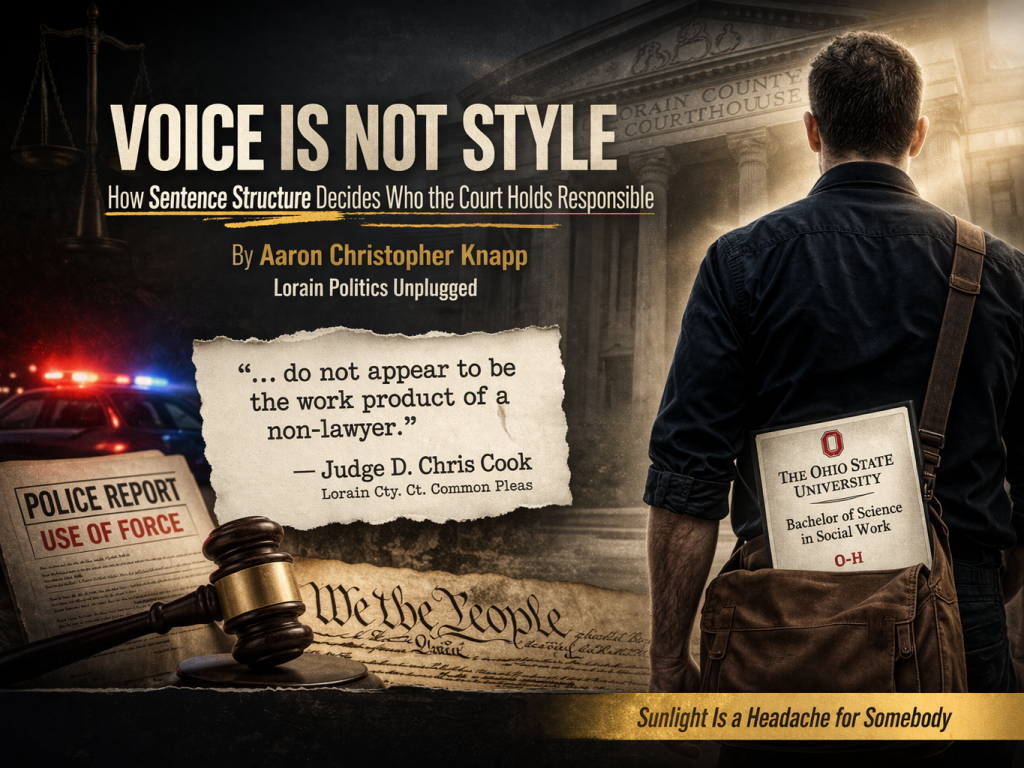
And then something else becomes clear. The system does recognize structure when it sees it. In my own case, the Court acknowledged that my filings were “well-structured, contain correct and accurate legal theory, advance sound arguments, [and] have citations that are accurate… to the Ohio Civil Rules, statutes, and case law,” and went further to state that they “do not appear to be the work product of a non-lawyer.” That should have ended the discussion. Instead, the Court described itself as “a bit incredulous” and began raising concerns about whether someone else must have been involved.
That is not a legal finding. That is an assumption. And it is a bold one. Because what is being said, without being said directly, is that a pro se litigant is not expected to understand the law at that level, that the quality of the work must come from somewhere else. That is not analysis. That is perception, and it is wrong. I have been engaged in pro se litigation for over a decade, and many of those matters have been constitutional in nature. The structure, the citations, and the arguments are not the product of mystery. They are the product of experience, research, and discipline. The assumption that a citizen cannot reach that level without assistance says more about the system than it does about me.
Social workers are trained researchers. A Bachelor of Science in Social Work is grounded in policy analysis, statutory interpretation, documentation, and evidence-based reasoning. That training does not disappear because someone walks into a courtroom without a law license. In this case, that training showed up. A BSSW from Ohio State stood across from multiple attorneys representing the City of Lorain, attorneys with advanced degrees and institutional backing, and held ground. The record speaks for itself. That is not something to question. That is something to recognize.
But the larger issue remains. Why does the government not answer. Why are legitimate constitutional claims met with deflection instead of direct engagement. Why does it feel like the burden shifts, like the citizen is forced to prove innocence while the government avoids proving its own conduct was lawful. How many times does a person have to push back before the system stops questioning the messenger and starts addressing the message.
From my perspective, the Lorain County judiciary has failed me, and it has failed the citizens it is supposed to serve. The record reflects conduct that should have been addressed directly, yet too often the response is to reframe, to delay, or to avoid assigning responsibility where it belongs. That is not how a system built on law is supposed to function. Government officials are not supposed to act first and justify later. They are not supposed to reshape narratives to avoid accountability. They are not supposed to respond to criticism with escalation under color of law.
And yet, even in that environment, something else becomes clear. The system is not untouchable. When you understand how it works, when you understand how to structure facts, assign responsibility, and speak in the language the court recognizes, you can stand in that system and hold your ground. You can force the record to reflect what actually happened. You can remove the ambiguity that allows responsibility to drift.
I am doing that now. Not as an attorney, but as a citizen, as a trained professional, and as someone who refused to accept that understanding the law is reserved for a select few. Social workers are highly trained researchers. Ohio State. O-H…
Legal Disclaimer and Attribution
This publication is written by Aaron Christopher Knapp, Investigative Journalist and Editor-in-Chief of Knapp Unplugged Media LLC, and is published through Lorain Politics Unplugged. This work is intended for informational, journalistic, and public interest purposes only. Nothing contained herein should be construed as legal advice, nor does this publication create any attorney-client relationship. Readers are encouraged to consult with a licensed attorney regarding any specific legal matters.
All statements contained in this article are based on publicly available records, court filings, personal experience, and matters of public concern. Any opinions expressed are those of the author and are presented as protected speech under the First Amendment to the United States Constitution and Article I, Section 11 of the Ohio Constitution. To the extent this publication discusses public officials, government entities, or matters of public interest, such discussion is intended as fair comment, opinion, and/or rhetorical expression based on disclosed facts.
Portions of the analytical framework discussed in this article originate from a legal writing insight shared by former Medina County Common Pleas Judge James L. Kimbler through his North Coast ADR Services newsletter. This publication expands upon that concept for educational and journalistic purposes. Judge Kimbler and North Coast ADR Services LLC are not affiliated with this publication, have not reviewed this article, and do not endorse or take responsibility for any of the opinions, interpretations, or conclusions expressed herein.
All references to legal standards, statutes, and case law are provided for context and discussion and are not intended to serve as a substitute for formal legal briefing or professional legal counsel. Any errors or omissions are unintentional and subject to correction.
Knapp Unplugged Media LLC operates as an independent media entity focused on investigative journalism, public records analysis, and government accountability. All content is published in furtherance of transparency, public awareness, and civic engagement.
About The Author