
They Said It Didn’t Exist While Arguing Why They Couldn’t Release It
Email Series Part 5 reveals a direct legal contradiction inside the City’s own response as Aaron Knapp challenges a records denial tied to a complaint that officials claim they are “not aware of” but still argue is confidential
By Aaron Christopher Knapp, BSSW, LSW
Investigative Journalist and Public Records Litigant
Editor-in-Chief, Lorain Politics Unplugged
Knapp Unplugged Media LLC
Introduction
By the time this fifth set of emails is reached, the record is no longer abstract and it is no longer limited to general communication between a requester and a public office. What has already been shown in the earlier articles is specific and it involves named individuals, identifiable emails, and a pattern of conduct that is now carrying forward into this set.
The prior email sets documented how my communications were being sent not just to a single office, but to a broad group that included members of Lorain City Council, Law Director Patrick Riley, Assistant Law Director Joseph LaVeck, Safety Service Director Rey Carrion, Mayor Jack Bradley, law enforcement personnel, the Lorain County Prosecutor’s Office, and multiple media outlets including the Chronicle-Telegram and the Morning Journal. Those emails were not contained once they were sent. They were forwarded, shared, and circulated within that same network, and my work and communications became part of internal discussions among those officials.
At the same time, those same individuals remained active participants in the communication. They were receiving the emails, responding to them, and continuing to engage, even as the language inside those threads began to shift. Terms like harassment, slander, and escalation began appearing within the same communications that they were still part of. That contradiction has already been established in the earlier sets, and it does not go away here.
What those earlier emails were discussing was not random or disconnected. They involved specific public records requests for council meeting videos, missing public records, Sunshine Law training certificates under Council Rule 41, and communications between city officials and outside entities. They also included direct criticism of city actions, including the release of unredacted juvenile records, allegations of retaliation, and challenges to how the City was applying Ohio’s Public Records Act under R.C. 149.43.
This fifth set picks up exactly where that leaves off, but it narrows the focus into a single issue that runs through multiple emails and multiple responses. The central question becomes whether a complaint was filed against me by someone within the Lorain Police Department and whether that complaint, if it exists, is a public record.
That issue is not raised in isolation. It is raised directly with the Law Director’s Office. It is answered by Joseph LaVeck in his official capacity. It is challenged with specific statutory language and case law. And it is revisited repeatedly as the request remains unresolved.
What changes here is not the communication itself, but the position being taken in response to it.
The City is no longer just engaging with the request. It is defining its position on whether records exist and whether they can be disclosed. And it is doing so while the same communication continues, involving the same individuals, and while the same broader context remains in place.
This is where the story moves from showing how communication was handled to showing what happens when that communication forces a legal answer.
And that answer, as it appears in these emails, becomes the foundation for everything that follows.
I. This is where they get pinned to their own words
By the time this fifth set of emails is read in full, the record is no longer operating in a gray area where responses can be interpreted in multiple ways or explained away as incomplete communication. This is the point where the City of Lorain, through its Law Department, is forced to put its position in writing, and that matters because once a public office takes a legal position on the record, it is no longer flexible. It can be tested, compared, and measured against the rest of what exists in that same record.
This exchange is not happening with a clerk or an unidentified office. This is a direct response from Assistant Law Director Joseph LaVeck, acting within the authority of the Law Director’s Office under Patrick Riley, and it comes after multiple emails, multiple follow ups, and direct requests that had already been circulated among city officials, including Safety Service Director Rey Carrion, members of Lorain City Council, and others who had been copied on earlier communications. This is not a situation where the City can claim it did not understand the request or was unaware of the issue being raised. The communication had already moved through the system, and the people responsible for answering were already involved.
In that context, the statement that is issued becomes critical. I am told directly, in writing, by Joseph LaVeck:
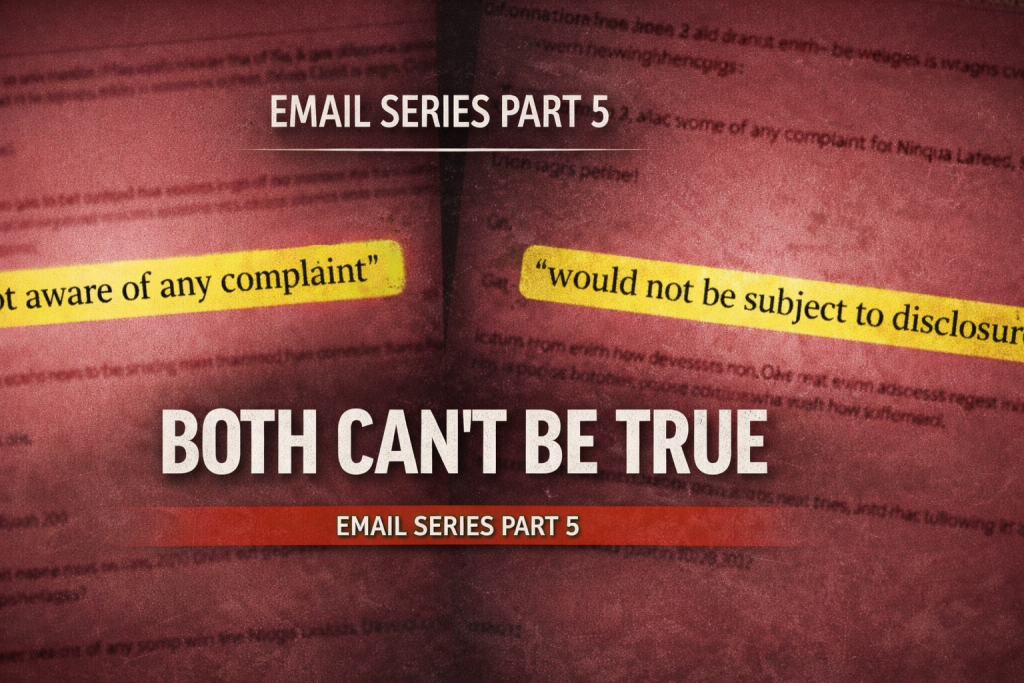
“At this time, the City of Lorain does not possess nor is aware of any complaint allegedly made against you, and even if a City employee did make such a complaint, such complaint would not be subject to disclosure pursuant to R.C. 149.43(A)(1)(v).”
That sentence is not a casual response. It is not a placeholder. It is a structured legal statement that attempts to define both the existence of records and the City’s position on disclosure at the same time. It is also not isolated. It comes after prior communications where I had already raised the issue of a complaint being circulated, tied it to specific conduct, and requested the underlying records directly under Ohio’s Public Records Act. The City is responding to a known issue, not speculating about a hypothetical one.
What makes that statement significant is not just what it says, but how it is constructed. Joseph LaVeck, speaking on behalf of the Law Department, is making two assertions within the same response. First, he is asserting that the City is not aware of any complaint. Second, he is asserting that even if such a complaint exists, it would be exempt from disclosure under R.C. 149.43(A)(1)(v), which pertains to certain confidential law enforcement investigatory records and related exclusions.
That is not a simple denial. That is a dual position.
And that dual position does not hold together when it is read against the rest of the record that had already been established in the earlier email sets. By the time this response is issued, the City had already been included in email chains where my name, my work, and allegations about me were being circulated among officials, including communications that were forwarded into the Law Department itself. The same office now claiming a lack of awareness had already been placed into the flow of information surrounding the issue.
This is why the wording matters. The phrase “does not possess nor is aware” is immediately followed by a legal argument that assumes the existence of the very thing it claims not to know about. The inclusion of the clause “even if a City employee did make such a complaint” introduces a hypothetical that is treated as legally real enough to justify withholding, even while the existence of that complaint is being denied.
That is not ambiguity. That is a constructed position that attempts to cover both possibilities at once.
Because if no complaint exists, there is nothing to analyze under R.C. 149.43(A)(1)(v), and there is no need to assert an exemption. If a complaint does exist and is being treated as confidential, then the issue is no longer whether the City is aware of it, but whether it is properly withholding it under the law. Those are two different legal questions, and they are being collapsed into a single response.
What this section of the record shows is the moment where the City stops operating through incomplete answers and begins asserting a defined legal position that can be tested. It shows who is making that statement, it shows the exact language being used, and it shows that the issue had already been developed enough that the Law Department could not avoid addressing it directly.
And once that happens, the record is no longer open to interpretation in the same way.
It becomes something that can be compared, challenged, and ultimately proven against everything else that had already been said and done.
II. They deny it exists while protecting it at the same time
To understand what is happening in this response, it has to be explained in a way that removes the legal phrasing and shows exactly what is being said and why it matters. The issue I raised in these emails was not general or hypothetical. I was asking for a specific type of record, a complaint that had been made about me, which I had reason to believe existed based on prior communications that had already been circulating among City officials, including emails that had reached the Law Director’s Office. This was not a situation where the City was being asked to speculate or guess. The request was tied to identifiable communications and conduct that had already been discussed internally.
When Assistant Law Director Joseph LaVeck responds, he does not give a direct answer to that request in the way the law expects. Instead, he uses language that appears clear at first but becomes contradictory when it is read closely. He writes that the City “does not possess nor is aware of any complaint allegedly made against you.” That part of the statement, standing alone, sounds like a denial. To an ordinary reader, especially someone without legal training, it would sound like the City is saying there is no complaint. That would normally end the inquiry, because if a record does not exist, there is nothing to produce and nothing further to explain.
However, the response does not end there. It immediately continues by stating that even if a City employee did make such a complaint, it would not be subject to disclosure because it would fall under an exemption in Ohio’s Public Records Act, specifically R.C. 149.43(A)(1)(v). That is where the contradiction begins to take shape, and it is important to slow down and explain why.
The first part of the statement is about whether a record exists. The second part of the statement is about whether a record can be released. Those are two separate legal questions, and they are not interchangeable. When someone asks for a public record, the law requires a public office to answer the existence question first. Either the record exists or it does not. If it does not exist, the response is complete at that point. There is no need to discuss exemptions, confidentiality, or legal protections because there is nothing to protect.
But if a public office begins explaining why a record cannot be released, it has moved into a different category. It is no longer addressing existence. It is addressing classification. It is saying that a record does exist, but it is being withheld under a specific legal exemption.
In this response, both of those positions are being presented at the same time. The City is saying it is not aware of a complaint, while also explaining how that complaint would be treated under the law if it did exist. For a reader, the simplest way to understand this is to recognize that you cannot logically protect something that does not exist. You cannot apply a legal exemption to a record that you are claiming you do not have and do not know about. Those are two different positions that lead to two different obligations under the law.
The wording “does not possess nor is aware” is also important. It does not say definitively that no complaint exists. It says the City is not aware of one. That is a narrower statement, and it leaves room for the possibility that a complaint could exist elsewhere within the system or could have been created, transmitted, or received in a way that is not being acknowledged in that response. Immediately following that with a statement about confidentiality creates a situation where the City has positioned itself to respond in either direction depending on what is later established.
If no complaint is ever produced, the City can point back to the denial and say it was never aware of one. If a complaint is later shown to exist, the City can point back to the second half of the statement and argue that it was always exempt from disclosure. That is not a coincidence. That is how the response is structured.
This matters even more when it is placed back into the context of the earlier emails. By the time this response is issued, my name, my work, and allegations about me had already been circulated among City officials, including communications that had been forwarded into the Law Department itself. The same office now claiming it is not aware of a complaint had already been included in discussions where information about me was being shared and discussed. That does not automatically prove that a formal complaint exists, but it does make the claim of no awareness significantly more difficult to reconcile with the surrounding record.
What this section of the emails shows is not just a disagreement over wording. It shows how a public office can respond to a records request in a way that avoids committing to a single clear answer. Instead of saying “yes” or “no,” the response is written in a way that allows both positions to exist at the same time, depending on how the issue develops later. That is why the contradiction is important, and that is why it stands out when the response is read carefully.
This is not something that has to be inferred or interpreted. It is written directly into the response itself, and it becomes even more significant when it is compared to the rest of the emails that came before and after it.
III. I do not guess at the law, I put it in front of them
At this point in the emails, I am no longer asking open ended questions or trying to get clarification from the City. The issue has already been identified, and the response from the Law Department has already been given. What I do next is lay the law out directly in front of them and force the discussion into a legal framework that cannot be avoided or reworded into something else.
The core issue is simple, and I state it clearly. If a complaint was sent using a City of Lorain email account, then under Ohio law that communication is a public record. That is not a matter of interpretation or discretion. Under R.C. 149.011(G), a public record is defined as any document, device, or item, regardless of physical form, that is created or received by a public office and documents the organization, functions, policies, decisions, procedures, operations, or other activities of the office. When that definition is read together with R.C. 149.43, which requires public offices to make those records available upon request unless a specific exemption applies, the conclusion is straightforward. If the communication exists on a City email system and it documents the actions of a public employee acting in their official capacity, it is a public record.
That is not optional. That is the baseline rule that the entire Public Records Act operates on.
I do not leave it at the statute. I put the case law in front of them as well, because this is not an unsettled area of law. Ohio courts have addressed this issue repeatedly. Cases like State ex rel. Wilson-Simmons v. Lake County Sheriff’s Department and State ex rel. Toledo Blade Co. v. Seneca County Board of Commissioners establish that communications created or received by public officials in the course of their duties are public records, even when those communications involve complaints, internal issues, or matters that a public office might prefer not to disclose.
I explain how that applies here. The complaint I am asking about is not something that originated in a private system. It was sent using a City controlled email account, specifically tied to the Chief of Police. That matters because once that communication is sent through a government system, it is no longer a purely private matter. It becomes part of the documented activity of that office.
That is exactly what eventually proves the point. I was later provided with these records, and they came from the Chief’s City email account. The same type of communication that was being described as either non-existent or confidential was, in fact, sitting inside the City’s own system the entire time.
That directly undermines the position that was taken earlier.
I also address the City’s reliance on the Social Work Board confidentiality statute, because that is the legal shield they are trying to use to justify withholding the records. I explain that even if the Social Work Board has confidentiality obligations under its own governing statute, that does not automatically transfer to the City’s copy of the same communication. The Board’s records are governed by its own rules. The City’s records are governed by the Public Records Act. Those are two separate systems, and one does not override the other simply because the same document exists in both places.
In other words, even if the Board could not release a complaint once it received it, that does not mean the City is allowed to withhold its own copy of that same complaint if it was created or transmitted through a City email account. The origin of the record and the system it resides in determine how it is treated under the law, not where it was eventually sent.
That distinction is not addressed in any meaningful way by the Law Department. They continue to rely on the same citation to R.C. 149.43(A)(1)(v) and the confidentiality provisions tied to another agency, without directly responding to the argument that their own copy of the record is independently subject to disclosure.
What this section of the emails shows is not just that I made a legal argument, but that the argument was specific, grounded in statute and case law, and directly tied to the facts of the situation. The City is not being asked to guess what the law says. It is being shown exactly how it applies.
And instead of answering that directly, they continue to avoid the central issue.
IV. The delay is not accidental, it is documented
What makes the delay in this set of emails significant is not simply that time passed without a response, but that the delay is recorded in the emails themselves through the City’s own words, timestamps, and repeated acknowledgments that the request had not yet been fulfilled. This is not something that has to be inferred by reading between the lines. It is visible in the sequence of communications, in the dates attached to each message, and in the language used by the Law Department as the request remained open.
After the initial request is made and the issue is clearly identified, the Law Department responds through Assistant Law Director Joseph LaVeck. In that response, instead of producing the requested records or providing a complete legal denial as required under R.C. 149.43(B)(3), the City states that it is still working on the request. The exact language used is not ambiguous. LaVeck writes, “The City is still working on processing your public records request.” That statement is not tied to a production date, a completion estimate, or a specific explanation of what is being reviewed. It simply acknowledges that the request exists and that it has not yet been completed.
That same pattern repeats in subsequent emails. In another response, LaVeck states, “I will have a response to you as soon as possible.” Again, there is no defined timeline, no identification of what records have been located, and no explanation of what remains outstanding. What is being provided is not a resolution. It is an acknowledgment of delay.
At the same time, the timestamps attached to these emails show how that delay develops over time. The request is submitted. A response is received that the request is being processed. Days pass without production. A follow up is sent. Another response is issued indicating continued processing. More time passes. Additional follow ups are sent. The language from the City remains the same, but the record shows that the request is not being completed.
This is where the documentation becomes important. Each email in the chain contains a date and time. When those are read together, they establish a clear timeline that shows the request moving from an initial submission into a period of extended delay without resolution. The City does not deny the request outright. It does not produce the records. It remains in a position where it is acknowledging the request while not completing it.
During that same period, I continue to respond within the same email chains. I reference the time that has passed. I follow up on the status of the request. I restate what has been asked for. This is not a situation where the request is abandoned or allowed to lapse. It is actively pursued, and that pursuit is documented in the same threads that show the City’s ongoing delay.
Eventually, that process reaches a point where the law provides a specific next step. Under R.C. 2743.75, a requester has the ability to file a complaint in the Ohio Court of Claims when a public office fails to provide records in compliance with the Public Records Act. That is not a discretionary or extraordinary action. It is part of the statutory enforcement mechanism.
At that point, I state directly within the emails that I am going to take that step. I notify the City that I will be filing with the Court of Claims under R.C. 2743.75. That statement is not made in isolation. It is made after the documented timeline shows that the request has not been fulfilled despite multiple communications and acknowledgments from the City that it is still being processed.
This is why the delay cannot be dismissed as an oversight or a misunderstanding. It is not a single missed response or a brief lapse in communication. It is a sequence of emails where the City repeatedly confirms that the request is open, continues to state that it is being processed, and does not bring that process to a conclusion within the timeframe that the law requires to be reasonable.
When the emails are read in order, with their timestamps and their language intact, they show exactly how long the request remained unresolved, what was said during that period, and how the issue moved from a request to a situation where formal legal action became the next step.
V. This is not just about records anymore
By the time this portion of the emails is reached, the issue has moved beyond a dispute over access to documents and into something that is already affecting my professional life in real time. That shift is not something I am adding after the fact or interpreting based on what happened later. It is written directly into the emails themselves, within the same threads where the requests, responses, and delays are being documented.
In one of those communications, I state clearly and directly, “My employment has been attacked and my license threatened when the police broke the law.” That statement is not made in isolation. It is included as part of the ongoing exchange with the Law Department, in the same sequence of emails where I am asking for records, challenging their legal position, and following up on delays. It is placed into the record at the same time the events are unfolding, not after they have concluded.
That matters because it shows that the consequences of what is happening are already being felt while the requests are still open. This is not a situation where a records dispute ends and then leads to separate issues later. The emails show that the impact is overlapping with the request itself. While I am asking for documents that would explain what actions were taken and why, I am also documenting that those actions have already affected my employment and raised issues involving my professional license.
The context of that statement is also important. By this point, the emails already show that communications about me have been circulated among City officials, including law enforcement and the Law Department. The same system that is being asked to produce records is the system that has already been involved in sharing information about me. When I state that my employment has been attacked and my license threatened, it is in direct reference to that same set of events, not to something unrelated or external.
This is where the nature of the dispute changes. A typical public records request involves a requester seeking documents and a public office responding by providing them or explaining why they cannot be released. In that type of situation, the issue is limited to access. Here, the emails show something different. The request is still being made, the response is still incomplete, and at the same time the effects of the underlying conduct are already occurring.
That is why this cannot be viewed as a routine records dispute. The record shows that the request for information is tied directly to actions that have already had consequences. The documents being requested are not abstract or historical. They are connected to events that are ongoing and that have already impacted my ability to work and maintain my professional standing.
When this section is read together with the earlier emails, it becomes clear that the issue is not simply whether records will be produced. It is whether the records that are being withheld or delayed relate to conduct that has already caused harm. The statement about my employment and my license is not an aside. It is part of the same record, part of the same timeline, and part of the same dispute.
This is the point where the emails stop being only about what the City will or will not release and start showing what has already happened while those records were being requested.
VI. They stay in the communication while changing what they call it
By the time this portion of the record is reached, nothing that was established in the earlier email sets has gone away or been resolved. The same individuals remain part of the communication, the same offices are still included in the threads, and the same emails continue to move through the system. What changes is not the participation, but the way that participation is being described.
The emails show that officials including Assistant Law Director Joseph LaVeck, individuals within the Law Director’s Office under Patrick Riley, and others who had been copied on prior communications continue to receive and respond to emails from me. Those communications are not being rejected or blocked. They are being read, replied to, and in many cases forwarded to additional recipients. The record shows that the communication is active and ongoing, with multiple participants continuing to engage in the same threads over time.
At the same time, within those same communications, the language used to describe that interaction begins to shift. What had been a dispute over public records, legal obligations, and access to information starts to be described using terms that move away from the substance of the requests. References to harassment, slander, and personal targeting begin to appear, not in a separate proceeding, but inside the same email environment where the communication is still actively taking place.
That overlap is critical to understanding what is happening. The individuals who are describing the communication in those terms are not removed from it. They are not stepping away, asking that contact cease, or separating themselves from the exchange. They remain in the emails. They continue to receive them. They continue to respond. They continue to forward those communications within the same network that includes City officials, legal counsel, and outside parties.
This creates a situation where two things are happening at the same time within the same record. On one side, there is continued participation. The communication is ongoing, and the system is actively engaged with it. On the other side, there is a shift in how that communication is being framed. It is no longer being treated solely as a records request or a legal dispute. It is being described in a way that suggests it is something improper, even while the engagement continues.
That is not a small inconsistency. It goes directly to how the communication is being handled and how it is later characterized. If the communication were truly being treated as harassment at that point, the expected response would be disengagement, a clear directive to stop, or a separation from the interaction. That is not what the emails show. Instead, they show continued involvement by the same individuals who are beginning to apply that characterization.
The record reflects that the communication is not one sided. It is not occurring in a vacuum. It is a shared exchange involving multiple participants who remain active in it. At the same time, the description of that exchange begins to change within the same threads, without any corresponding change in participation.
What this section shows is the moment where the communication itself does not change, but the narrative surrounding it does. The emails continue. The participants remain. The responses are still being issued. But the way the interaction is being labeled begins to move in a direction that does not match how it is actually being conducted.
That contradiction is not based on interpretation. It is visible in the emails themselves, in who is included, who is responding, and what is being said at the same time that the communication continues.
VII. What this set actually proves
When this fifth set of emails is read in full, it does not leave room for speculation about what the City knew, how it understood the request, or whether the issue had been clearly presented. The record shows that the request was specific, that it was directed to the correct individuals, and that it was repeated and clarified over time. It also shows that the legal argument was not implied or loosely referenced. It was laid out directly, with citations to R.C. 149.011(G) and R.C. 149.43, and supported by case law explaining how communications sent through a City email system are treated under Ohio’s Public Records Act.
The individuals responding to these emails were not removed from that argument. Assistant Law Director Joseph LaVeck was directly engaged in the exchange, responding on behalf of the Law Director’s Office under Patrick Riley. The issue was not being handled at a clerical level or by someone without authority to address it. It was in front of the City’s legal counsel, and it was presented in a way that required a legal response. The emails show that the City was aware of what was being asked, aware of the basis for the request, and aware of the legal framework that governed how that request should be handled.
Despite that, the response that is documented in this set does not resolve the issue. Instead, it follows a pattern that has now been established across multiple emails. The City denies awareness of the complaint while simultaneously asserting that, if such a complaint exists, it would be exempt from disclosure. It continues to rely on R.C. 149.43(A)(1)(v) and confidentiality provisions tied to another agency, even after being presented with a direct explanation of why those provisions do not apply to the City’s own copy of the record. At the same time, it does not provide a complete denial that satisfies the requirements of R.C. 149.43(B)(3), which would require a clear statement of the legal basis for withholding specific records.
The emails also document the continued delay in producing any responsive records. The City acknowledges that the request is being processed, states that a response will be provided, and continues to engage in the communication without bringing the request to a conclusion. The timeline reflected in the emails shows that this is not a brief or isolated delay. It is an ongoing pattern where the request remains open while responses are issued that do not resolve it.
At the same time, the communication itself does not stop. The emails continue to move through the system. The same individuals remain involved. Responses are sent, forwarded, and received across the same network of City officials, legal counsel, and others who had been included in earlier communications. The City remains engaged in the exchange even as it maintains its position.
What is also documented in this set is that the consequences of the underlying issue are already present while the request is still being pursued. Statements regarding the impact on my employment and the threat to my professional license are included within the same email threads. This shows that the matter is not confined to a request for records. It is connected to actions that have already affected my professional standing, and those effects are occurring at the same time the City is declining to produce the records that relate to those actions.
When all of this is taken together, this email set establishes several things clearly. It shows that the City knew what was being requested and understood the legal basis for the request. It shows that the City chose to respond with a combination of denial, delay, and reliance on an exemption that had already been challenged as inapplicable to its own records. It shows that the City continued to participate in the communication while maintaining that position. And it shows that the consequences of the issue being raised were already taking place while the request remained unresolved.
This is not a record of confusion or miscommunication. It is a record of a defined response to a defined legal issue, and it shows exactly how that response was carried out.
VIII. Final Thought
By the time this fifth set of emails is fully read, the pattern is no longer something that has to be pieced together or interpreted from fragments. It is visible across the emails themselves, in the names attached to them, in the responses that are given, and in the positions that are taken. The communication is not one sided. It involves Assistant Law Director Joseph LaVeck responding on behalf of the Law Director’s Office under Patrick Riley, it involves emails that had already circulated through City officials including Rey Carrion and others, and it involves a record where my requests, my legal arguments, and their responses all exist in the same place at the same time.
The requests are clear, tied to specific records, and grounded in R.C. 149.43 and R.C. 149.011. The legal argument is not implied or loosely referenced. It is stated directly, supported by case law, and applied to the exact facts at issue, including communications sent through a City email account. The response from the City is also clear, not because it resolves the issue, but because it establishes a position. Through Joseph LaVeck, the City states that it is not aware of any complaint while simultaneously asserting that if such a complaint exists, it would be exempt from disclosure. That position is repeated, maintained, and carried forward as the emails continue.
What is equally clear is that the communication does not stop at that point. The emails continue. The same individuals remain involved. The same offices remain engaged. The requests remain open. The delay continues. At the same time, the language used to describe that communication begins to shift, and what started as a records dispute begins to be framed in terms that move away from the substance of the requests and toward the characterization of the interaction itself.
That shift does not stay contained within these emails. The positions taken here, the language that begins to develop, and the way this communication is described all move forward into something else. What is being argued here as a legal dispute over access to public records does not remain in that category. It is carried into a different setting, where the same communication is no longer evaluated as a request under Ohio law, but is instead presented under a different label.
The record shows how that transition begins. It shows the communication while it is still active, while the participants are still engaged, and while the legal arguments are still being made. It shows the moment where the framing starts to change, even though the underlying conduct has not. The same emails that are being sent, received, and responded to by City officials and legal counsel are later taken out of this context and used in a different one.
That process has a direction, and it has an outcome.
It leads to filings that rely on the same communication.
It leads to accusations that are built on the same emails.
And ultimately, it leads to a situation where the narrative that begins forming in these threads is used to justify placing me in handcuffs and calling that same communication harassment.
This set of emails captures the point where that shift is no longer theoretical. It shows the City taking a position, it shows how that position is maintained, and it shows how the communication continues alongside a changing narrative.
What comes next will show what happens when that narrative is carried forward and acted on.
At this point, the record is no longer just documenting events.
It is showing how those events are turned into something else.
Legal Disclaimer
This article is part of an ongoing investigative journalism series authored by Aaron Christopher Knapp and published by Knapp Unplugged Media LLC. It is based on documents obtained through lawful public records requests, including email correspondence, attachments, and related materials maintained by public offices. All factual statements contained herein are derived from those records or from the author’s direct involvement in the events described.
This publication addresses matters of public concern involving the conduct of government, the actions of public officials, and the administration of public records under Ohio law. Any analysis, interpretation, or conclusions expressed are the protected opinion of the author based on disclosed facts and a good faith review of the available evidence. To the extent that statements may be interpreted as opinion, they are presented as such and are grounded in the underlying record.
This article may reference individuals who are public officials, public employees, or participants in matters of public concern. All such references are made strictly in a journalistic context for the purpose of reporting, analysis, and public accountability. Nothing in this publication is intended as a direct communication to, or solicitation of action from, any public official, government employee, attorney, or party referenced herein.
Certain subject matter discussed in this article relates to ongoing legal proceedings. This publication is not intended to interfere with, influence, or prejudice any pending case, nor is it directed toward any court, judge, or tribunal. It is a work of journalism disseminated to the general public in furtherance of transparency and the public’s right to know.
No statement in this article is made with knowledge of falsity or reckless disregard for the truth. Allegations, claims, or statements attributed to third parties are identified as such and are included for the purpose of reporting on their existence within the documented record. Readers are encouraged to review the underlying materials and draw their own conclusions.
All content is published in accordance with the protections afforded by the First Amendment to the United States Constitution and corresponding provisions of Ohio law governing freedom of speech and freedom of the press.
This article does not constitute legal advice. Any references to statutes, case law, or legal standards are provided for informational and analytical purposes only.
© 2026 Knapp Unplugged Media LLC. All rights reserved. Unauthorized reproduction or redistribution of this material, in whole or in part, is prohibited without prior written permission, except as permitted under applicable fair use doctrines.
About The Author