
“Their Decisions Have Put the Lorain County Population at Risk”
Screenshot
What the Threatened Repossession of 41 Sheriff’s Cruisers Reveals About Governance, Accountability, and Public Safety in Lorain County

By Aaron Knapp
Investigative Journalist
Licensed Social Worker, Ohio
Founder and Editor, Unplugged with Knapp
Knapp Unplugged Media LLC
Aaron Knapp is an investigative journalist and licensed social worker based in Lorain County, Ohio. His reporting focuses on government accountability, public records compliance, civil rights, and the intersection of law, policy, and institutional power. Knapp is the founder and editor of Unplugged with Knapp, an independent journalism platform dedicated to document driven investigations and first person accountability reporting grounded in verifiable public records. His work frequently examines municipal governance, court operations, and law enforcement practices, with an emphasis on transparency, constitutional protections, and the public’s right to know.
A Warning Issued in Plain Language, Not Political Code
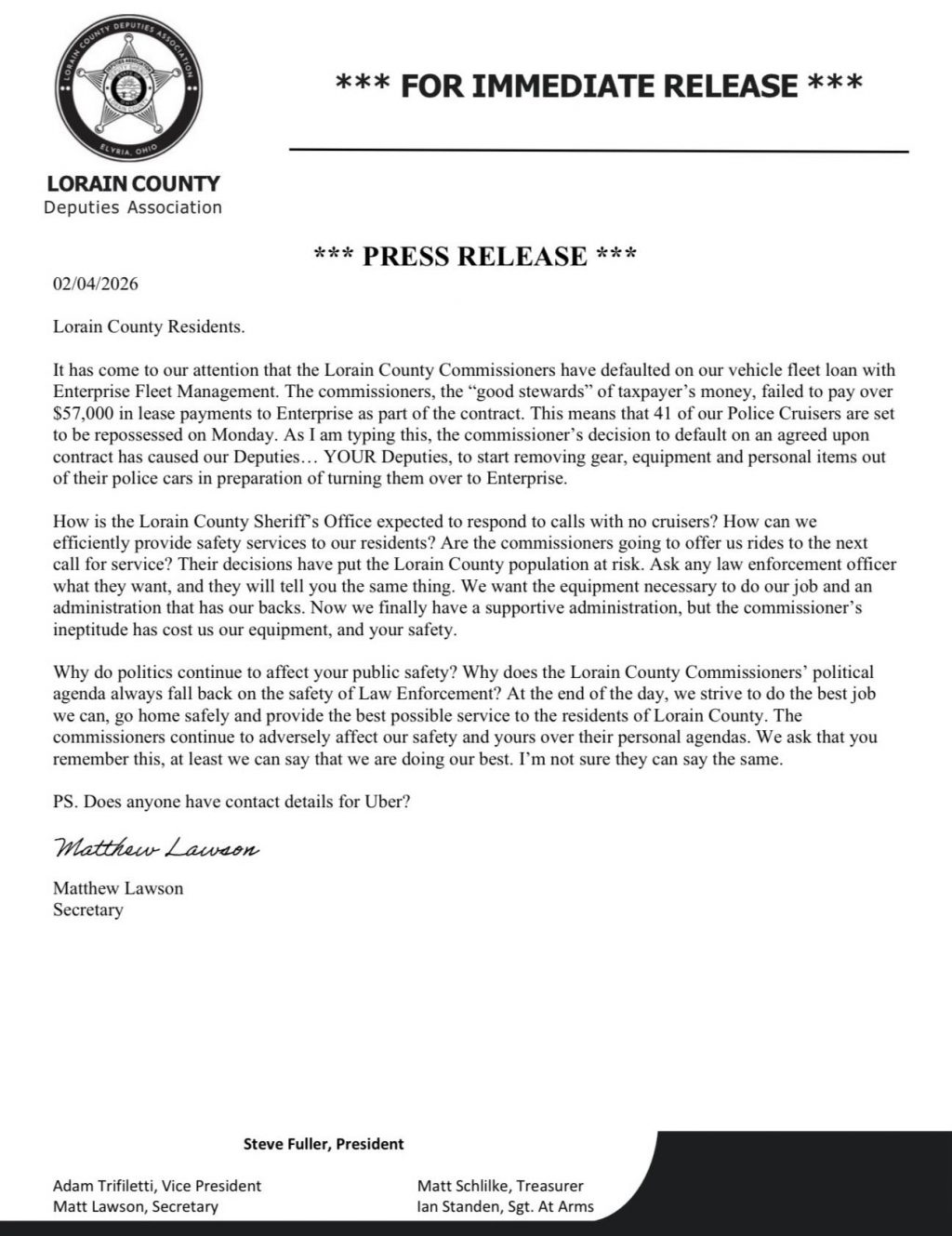
The warning issued this week by the Lorain County Deputies Association was not subtle, hedged, or buried in bureaucratic language. It was direct, urgent, and accusatory, and it was framed around a single claim that cuts to the heart of local government responsibility. Forty one patrol cruisers assigned to the Lorain County Sheriff’s Office could be repossessed as soon as Monday because the Lorain County Commissioners allegedly failed to make more than fifty seven thousand dollars in required lease payments to Enterprise Fleet Management.
According to reporting published February 5, 2026 by 3News Cleveland, the association asserts that the missed payments constitute a default under a fleet lease agreement and that Enterprise has the contractual right to reclaim the vehicles. Deputies, anticipating the loss, have already begun removing department issued equipment and personal belongings from their cruisers in preparation for turning them over. That detail matters because it demonstrates that this is not an abstract dispute between offices. It is being operationalized on the ground.
What the Deputies Are Actually Saying
In the press release posted February 4, the association did not simply complain about funding or politics. It posed a series of blunt operational questions that cut through spin. “How is the Lorain County Sheriff’s Office expected to respond to calls with no cruisers?” asked association secretary Matthew Lawson. “How can we efficiently provide safety services to our residents? Are the commissioners going to offer us rides for the next call for service?”
Those questions are not rhetorical flourishes. Patrol vehicles are the foundational infrastructure of modern law enforcement. Without them, response times lengthen, coverage areas shrink, and officer safety is compromised. The association explicitly warned that the commissioners’ decisions have put the Lorain County population at risk, tying the financial default directly to community safety rather than internal labor concerns.
The association also drew a clear line between the Sheriff’s Office administration and the Board of Commissioners. Deputies stated that they support the current sheriff’s administration and are not blaming command staff for the situation. Responsibility, in their view, lies squarely with the commissioners whose budgeting and payment decisions allowed the situation to reach this point.
The Amount That Makes the Stakes Harder to Ignore
One of the most striking elements of this controversy is the dollar figure involved. The alleged unpaid amount is just over fifty seven thousand dollars. In the context of a county budget that runs into the hundreds of millions, this is not a catastrophic sum. Yet the consequences of nonpayment are potentially catastrophic. The loss of forty one cruisers would immediately strain the Sheriff’s Office ability to provide routine patrol, emergency response, prisoner transport, and backup assistance to municipal departments.
This disconnect between the relatively small unpaid balance and the outsized operational risk raises uncomfortable questions about financial management, prioritization, and internal county governance. It also raises questions about why such a default was allowed to persist long enough to reach the stage of threatened repossession.
Public Safety Versus Political Management
The Deputies Association did not mince words in framing the issue as one of politics superseding safety. The statement asserts that deputies are not asking for special treatment, only for the equipment necessary to do their jobs and an administration that has their backs. That framing resonates because it reflects a basic expectation shared by most residents. Regardless of political affiliation or views on law enforcement, few would argue that patrol deputies should be expected to respond to emergencies without vehicles.
The association’s warning also comes amid broader reporting about budget related disruptions across Lorain County, including service reductions and facility closures. Taken together, these developments suggest a pattern in which fiscal conflict and administrative dysfunction are translating into real world service degradation.
Silence, Responses, and the Burden of Explanation
As of the time of publication, 3News reported that it had reached out to the Lorain County Commissioners, the Lorain County Sheriff’s Office, and Enterprise Fleet Management for comment. Any response from those entities will matter greatly, particularly from the commissioners, who now bear the burden of explaining how a missed lease payment escalated to a point where public safety infrastructure is at risk.
If the association’s claims are accurate, the commissioners will need to explain not only why the payment was missed, but why corrective action was not taken sooner, and how they intend to prevent similar crises in the future. If the claims are disputed, documentation will be necessary to resolve the contradiction, especially given the deputies’ assertion that repossession could occur within days.
Why This Moment Matters Beyond the Headlines
This episode is not just about cruisers, contracts, or even a single budget line item. It is about whether county government can reliably perform its most basic function, ensuring public safety, while managing internal political and fiscal disputes. When deputies are emptying their patrol cars in anticipation of repossession, that is a visible signal that something fundamental has gone wrong.
Residents are now left with an unsettling question that no press release can fully answer. If patrol coverage is reduced or disrupted, who bears responsibility when help arrives late or not at all. That question will not be resolved by sarcasm or blame shifting. It will be resolved only by clear action, transparent explanation, and a demonstrated commitment to keeping essential public safety systems intact.
For now, the warning stands. Forty one cruisers, one unpaid lease, and a county waiting to see whether leadership intervenes before the keys are turned over.
A Familiar Pattern Emerges
The Cruiser Crisis in the Context of Lorain County’s Deepening Financial Troubles
4
This Is Not an Isolated Incident
The threatened repossession of forty one Lorain County Sheriff’s Office cruisers does not stand alone as an unfortunate one off error or a simple clerical oversight. It fits squarely within a broader and increasingly visible pattern of financial strain, internal dysfunction, and delayed decision making that has defined the Lorain County Commissioners’ recent stewardship of public funds. When viewed in isolation, a missed lease payment of just over fifty seven thousand dollars appears inexplicable. When viewed alongside the county’s expanding list of budget driven disruptions, it begins to look disturbingly predictable.
Over the past year, Lorain County residents have repeatedly been told that austerity is unavoidable, that agencies must tighten belts, and that difficult choices are necessary. Yet those explanations have coincided with service reductions that strike directly at core governmental responsibilities, including public safety, youth services, and basic public access to county offices. The cruiser default is simply the most visible and alarming manifestation to date because it involves uniformed deputies potentially responding to emergencies without vehicles.
Budget Cuts With Real World Consequences
This moment arrives against the backdrop of several other high impact financial decisions. Lorain County’s only emergency short term shelter for youth, Turning Point in Elyria, is set to close temporarily due to budget cuts, leaving vulnerable children and teens with fewer options in moments of crisis. The Lorain County Auditor’s Office has announced it will close on Fridays as a cost saving measure, reducing public access and slowing essential administrative functions.
Each of these decisions has been justified individually as necessary belt tightening. Together, they paint a picture of a county government struggling to maintain baseline operations while simultaneously failing to manage relatively modest obligations in a timely manner. The threatened loss of forty one patrol cruisers crystallizes that tension in a way that spreadsheets and press statements cannot. Public safety infrastructure is not discretionary. When it falters, the risk is borne by residents and frontline workers alike.
The Commissioners’ Financial Management Under Scrutiny
The Lorain County Deputies Association has placed responsibility for the cruiser crisis squarely on the commissioners, accusing them of failing to meet contractual obligations and allowing politics to take precedence over safety. Whether the missed payment stems from disputes between county offices, cash flow issues, or broader budgetary miscalculations, the outcome is the same. A core county function is now operating under emergency contingency planning because a relatively small payment was not resolved before default.
This is not the first time questions have arisen about the commissioners’ handling of finances. Ongoing reporting has examined escalating legal costs, disputed contracts, delayed payments, and budget reallocations that appear reactive rather than strategic. In that context, the Enterprise Fleet Management default looks less like an anomaly and more like another stress fracture in a system already under strain.
Public Safety as the Canary in the Coal Mine
Law enforcement agencies often become the canary in the coal mine during fiscal crises because their needs are immediate and non negotiable. Deputies cannot defer patrols, postpone responses, or work remotely when resources vanish. When the Sheriff’s Office is openly discussing distributing a reduced fleet across shifts or even considering the use of personal vehicles, it signals that the margin for error has already been exhausted.
The deputies’ public warning that the commissioners’ decisions have put the Lorain County population at risk should be understood in that light. It is not simply labor advocacy. It is an alarm about what happens when financial instability reaches the point where emergency services must improvise to function at all.
Why This Fits Our Broader Coverage
At Unplugged with Knapp, this story aligns directly with our ongoing examination of Lorain County’s financial governance, including repeated warnings ignored, accountability deferred, and consequences shifted downward to workers and residents. The cruiser crisis is the natural continuation of themes we have documented across multiple beats. Budget cuts announced after the fact. Obligations allowed to lapse. Essential services treated as flexible line items rather than foundational responsibilities.
This is precisely why connecting these dots matters. Residents deserve to understand that the potential loss of patrol cruisers is not an isolated failure but part of a larger narrative about how Lorain County is being managed and what priorities are being honored when money becomes tight.
Continuing the Record
As this situation develops, answers will be required from the Lorain County Commissioners about how this default occurred, why it was not corrected before reaching the point of repossession, and what safeguards exist to prevent similar breakdowns in the future. Transparency after the fact will not undo the risk already created, but it will shape whether public trust can be restored.
For readers seeking deeper context on Lorain County’s ongoing financial and governance challenges, additional reporting and analysis can be found at
https://aaronknappunplugged.com/
Our coverage will continue to track not only whether the cruisers are ultimately repossessed, but what this episode reveals about the broader trajectory of county leadership, fiscal responsibility, and the real world costs of mismanagement when essential services are treated as expendable.
Related Lorain County Budget & Fiscal Coverage
What a $125 Million Payroll Leaves Behind – A County Budget Stripped to the Bone — A document-driven examination of Lorain County’s 2025 payroll based on the county’s own public payroll records, accounting for more than $125 million in personnel costs and the implications of that figure when revenue is constrained and services are being cut.
Lorain County’s Financial Illusion, Part Two: What Comes Next and Why It Matters — An in-depth analysis of how one-time federal relief funds (ARPA) were used to fuel recurring expenses, contributing to structural deficits and fiscal pressure for 2026 and beyond.
The Payroll That Ate the Budget – Unplugged with Aaron Knapp — A focused piece exploring how personnel spending patterns, particularly after COVID, have reshaped Lorain County’s fiscal baseline and pushed essential services into competition with rising salary costs.
How Lorain County’s Big Ideas Keep Failing Its People — Although broader in scope, this analysis documents fiscal decision-making, long-term financial commitments, and past infrastructure investments that illustrate a pattern of budget choices and risk layering.
Other Pages of Ongoing Fiscal Coverage
You can also link to your general County of Lorain category to give readers access to the full spectrum of reporting on governance, budget, transparency, and accountability:
County of Lorain – Category (Full Budget & Government Stories) — A curated index of recent county coverage including fiscal reporting, governance controversies, and public records investigations.
These each document systemic budget pressures, long-term structural choices, and the real-world outcomes of fiscal decisions. They provide clear documentary grounding for why a missed payment of $57,000 matters in the context of sustained, widening budget strains, and why residents should understand the cruiser issue as part of a larger fiscal story rather than as a stand-alone crisis.
Legal Disclosure
This article is published for informational, educational, and journalistic purposes only. It is not intended to provide legal advice, and it should not be relied upon as a substitute for consultation with a licensed attorney. Nothing contained herein creates an attorney client relationship, nor should any statement be interpreted as a legal opinion regarding the rights, liabilities, or obligations of any individual, public official, governmental body, or private entity.
All factual assertions are drawn from publicly available records, on the record statements, contemporaneous reporting by established media outlets, and documents obtained through lawful public records requests. Where allegations, claims, or disputes are referenced, they are clearly attributed to their sources, including labor organizations, public officials, or news reporting entities. Any quoted language is reproduced accurately and in context to the best of the author’s knowledge at the time of publication.
Readers are encouraged to independently verify facts, review original source documents, and seek qualified legal counsel before drawing conclusions or taking action based on the information presented. Ongoing developments may materially change the factual landscape after publication.
AI Use and Editorial Transparency Disclosure
This publication may incorporate limited use of artificial intelligence tools as part of the editorial and production process. AI assistance is used solely as a drafting, structuring, editing, or organizational aid to improve clarity, readability, and efficiency. All final content decisions, factual framing, sourcing choices, legal context, and editorial judgments are made by the author.
No artificial intelligence system independently determines facts, conducts original reporting, verifies sources, or substitutes for human judgment. All material facts are reviewed, contextualized, and approved by the author prior to publication. AI tools do not generate legal conclusions, investigative findings, or editorial positions on their own.
Any images, illustrations, or graphics identified as AI assisted are used for visual or illustrative purposes only and are not intended to depict real persons, events, or scenes unless explicitly stated otherwise.
LLC and Publication Notice
This article is published by Knapp Unplugged Media LLC, an Ohio limited liability company, doing business as Unplugged with Knapp. All content is protected under applicable copyright laws. Unauthorized reproduction, redistribution, or commercial use without permission is prohibited.
The views expressed herein are those of the author and do not necessarily reflect the views of any affiliated platforms, hosting services, or third party distributors. References to public officials, governmental entities, or private organizations are made solely in the context of news reporting, commentary, and public interest journalism.
© 2026 Knapp Unplugged Media LLC. All rights reserved.
About The Author