
The St. Joseph Property: From Hospital to Demolition Controversy
A Property With a Long History in Lorain
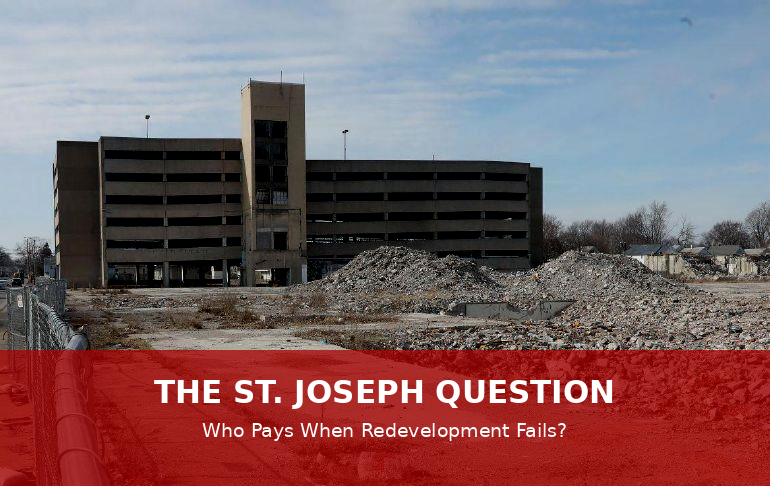
For several years now, the former St. Joseph Hospital site has sat in the center of a growing public controversy. Residents have watched demolition start and stop. Environmental questions have been raised. Debris has remained visible for long stretches of time. Each new development has produced a fresh round of explanations from city officials and contractors about what happened, why the project stalled, and who is responsible for fixing it.
But as the situation has unfolded, something else has become clear.
The story surrounding the St. Joseph site is not only about demolition permits or environmental cleanup. It is also about the network of redevelopment organizations and civic leaders who have shaped redevelopment policy in Lorain for decades.
When you begin to trace the history of the organizations connected to redevelopment projects in Lorain, the same names begin appearing again and again across nonprofit boards, city partnerships, and development initiatives. Some of those names are well known public officials. Others come from nonprofit leadership or local business circles. Understanding that network is essential to understanding how redevelopment decisions are made in this city.
This article is the beginning of a deeper investigation into that system.
This piece is an introduction. The reporting will continue.
How the Hospital Property Became a Redevelopment Project
For decades the property at the center of the current controversy was known as St. Joseph Hospital, one of the major medical institutions that once served residents of Lorain.
St. Joseph Hospital operated for generations as part of the Catholic hospital network in the region. The facility served thousands of Lorain County residents before ultimately closing as healthcare systems consolidated and hospital operations were reorganized across Northeast Ohio.
After the hospital closed, the large complex sat vacant for years. Like many former institutional properties in older industrial cities, the buildings gradually deteriorated as redevelopment plans came and went. Over time the property changed hands through a series of proposed redevelopment projects that never fully materialized.
Eventually the hospital complex was demolished, leaving behind the site that residents now know as the St. Joseph Community Center property. Portions of the property were later used for community programming and redevelopment proposals, but large sections of the site remained underutilized.
That long history is important because the demolition and redevelopment of former hospital properties is far more complicated than tearing down a typical commercial building.
Older hospital structures frequently contain asbestos, specialized mechanical systems, medical waste infrastructure, and other materials that require careful environmental remediation during demolition. These factors often make demolition projects slower, more expensive, and more tightly regulated.
Which is precisely why the current situation surrounding the site has drawn so much attention.
The Modern Controversy
In recent years the former hospital property once again became the focus of redevelopment plans. Demolition work began with the stated goal of clearing the property for future development.
Residents quickly noticed that demolition activity started and stopped several times. Debris remained visible on the site for long stretches. Questions began circulating about environmental compliance and whether demolition work had been properly permitted and monitored.
City officials eventually acknowledged that the property had become a problem site and that additional cleanup efforts would be necessary.
Today the former hospital property sits as a partially demolished redevelopment site that has generated increasing public scrutiny.
What began as a demolition project has turned into a larger discussion about how redevelopment decisions are made in Lorain and who bears responsibility when those projects encounter serious problems.
The Organization at the Center of Many Redevelopment Efforts
One organization that repeatedly appears in discussions about housing rehabilitation, redevelopment projects, and neighborhood initiatives in Lorain is the South Shore Community Development Corporation.
Community development corporations such as South Shore CDC operate as nonprofit entities designed to carry out redevelopment work that municipalities sometimes struggle to perform directly. These organizations are capable of acquiring distressed properties, applying for redevelopment grants, managing housing rehabilitation programs, and coordinating demolition or construction projects using a combination of public funding, tax-credit programs, private financing, and philanthropic support.
In many cities across the United States, this model has become a standard tool for redevelopment. Communities dealing with population loss, aging housing stock, and vacant industrial properties often turn to nonprofit development corporations to help stabilize neighborhoods and reposition abandoned properties for new uses.
Lorain is no exception. Over the past several decades the city has relied on redevelopment partnerships involving nonprofit organizations, city government, and private contractors in an effort to address blight and stimulate reinvestment.
The structure provides flexibility. Nonprofit development corporations can frequently move more quickly than government agencies when applying for grants, assembling redevelopment financing, or acquiring distressed property. Because they are not bound by many of the procurement and administrative rules that govern municipal governments, these organizations are often able to coordinate redevelopment projects that might otherwise stall inside traditional government processes.
Yet that same flexibility can raise important questions about transparency and accountability.
Unlike city departments, nonprofit development corporations do not always operate under the same public records requirements, procurement rules, or oversight mechanisms that apply directly to municipal agencies. Their internal decision making processes, board deliberations, and contractual relationships may occur largely outside the public view.
That does not mean redevelopment organizations operate improperly. Many of these nonprofits perform valuable work rehabilitating housing and stabilizing neighborhoods that might otherwise continue to decline.
But the structure does mean that redevelopment decisions frequently take place inside a network of nonprofit boards, contractors, and municipal partnerships that can be difficult for the public to fully understand.
Because organizations like South Shore CDC often work closely with city leadership, their leadership structures and funding relationships can become deeply intertwined with municipal policy decisions. Board members may include civic leaders, nonprofit administrators, business figures, or individuals connected to development and construction sectors that regularly interact with city government.
In cities the size of Lorain, that network can become particularly concentrated. The same names sometimes appear across redevelopment corporations, nonprofit boards, and civic initiatives tied to housing and economic development.
Which raises a broader question worth asking.
When redevelopment organizations, city leadership, and private developers operate within the same civic network, where exactly does the line between public decision making and private redevelopment strategy begin and end?
That question becomes especially relevant when a high profile redevelopment project such as the former St. Joseph Hospital property runs into serious problems and the city later moves to release the developer from future obligations tied to the site.
The Civic Network Behind Redevelopment
When examining redevelopment initiatives in Lorain, it quickly becomes apparent that a relatively small group of civic leaders has played an outsized role in shaping development efforts over the past several decades.
One of the most prominent political figures associated with redevelopment policy in the city has been Jack Bradley, whose administrations have overseen numerous housing and redevelopment initiatives.
Nonprofit redevelopment organizations frequently work directly with mayoral administrations because cities control key aspects of redevelopment such as zoning decisions, demolition approvals, property transfers, and grant administration.
In addition to elected officials, local civic leaders have also participated in development organizations and nonprofit boards tied to redevelopment initiatives.
Among those individuals is Joel Arredondo, whose name has appeared in connection with community development initiatives in Lorain.
It is not unusual for civic leaders to participate in multiple nonprofit boards related to housing or economic development. In many cities, the same individuals who serve on redevelopment organizations may also participate in chambers of commerce, nonprofit boards, or municipal advisory committees.
That overlap can create both cooperation and concern. On one hand, experienced civic leaders bring knowledge and relationships that help redevelopment projects move forward. On the other hand, overlapping roles can raise questions about how redevelopment decisions are structured and who ultimately benefits from them.
Why the Structure Matters
Community development corporations are frequently used as the operational arm of redevelopment strategies in cities across the United States.
Organizations like the South Shore Community Development Corporation can receive public funding, manage demolition projects, oversee housing construction, and coordinate redevelopment grants that flow through federal, state, and local programs.
In many communities these organizations are tasked with acquiring distressed properties, stabilizing neighborhoods, and implementing redevelopment initiatives that municipal governments may not have the capacity or flexibility to execute on their own.
Because these corporations operate as nonprofits rather than government agencies, the structure that allows them to move quickly can also make their internal decision making processes less visible to the public. Board deliberations, contractual arrangements, and project management decisions may occur within nonprofit governance structures that do not always operate under the same transparency rules that apply directly to city departments.
When redevelopment projects succeed, the results can be meaningful for communities. Abandoned properties are rehabilitated. Blighted structures are demolished. New housing developments emerge where vacant lots once stood. Neighborhoods that had been declining for decades sometimes experience renewed investment and stability.
Yet when redevelopment projects encounter problems, the structure can create a different outcome.
The overlapping relationships among nonprofit redevelopment corporations, private contractors, and municipal agencies can make it difficult to determine who bears responsibility when something goes wrong. A demolition project may involve a nonprofit development corporation coordinating funding, a private contractor performing the work, and a municipal department responsible for issuing permits or overseeing environmental compliance.
When those layers function smoothly the system appears seamless. When a project stalls or leaves behind environmental hazards, however, the lines of responsibility can quickly become blurred.
Was the demolition project directed by the nonprofit redevelopment corporation?
Was the work carried out by a private contractor operating under a redevelopment agreement?
Was the city responsible for inspecting permits and ensuring environmental safeguards were followed?
Or did responsibility fall somewhere between all of these actors?
These are not abstract questions. They go directly to the issue of accountability whenever redevelopment projects leave behind unfinished demolition, contaminated debris, or abandoned redevelopment plans.
And perhaps the most important question remains the simplest one.
When a redevelopment project fails or stalls, who ultimately pays to fix the problem?
Is it the private developer who took on the project?
Is it the nonprofit development corporation that coordinated the work?
Or does the financial burden quietly shift to the taxpayers who fund municipal cleanup and environmental remediation efforts?
Those are precisely the questions residents in Lorain have increasingly begun asking about the property that once operated as St. Joseph Hospital, a site that has now become one of the most visible and contested redevelopment projects in the city.
A Network Worth Examining
The purpose of this investigation is not to presume misconduct or wrongdoing by any individual or organization. Redevelopment projects are inherently complicated undertakings. They often involve multiple regulatory agencies, layered financing structures, environmental compliance requirements, and long timelines that can stretch across multiple administrations and redevelopment strategies. Projects involving former institutional properties such as St. Joseph Hospital can be particularly complex because demolition and environmental remediation must comply with strict regulatory standards before redevelopment can proceed.
At the same time, complexity does not eliminate the need for transparency.
When public land, taxpayer-supported funding programs, and nonprofit redevelopment organizations intersect, the public has a legitimate interest in understanding how those relationships operate. Redevelopment initiatives often rely on grants funded by federal and state taxpayers, municipal planning decisions made by elected officials, and nonprofit organizations that carry out projects on behalf of or in partnership with local governments.
That structure can produce successful redevelopment projects. It can also create a system in which decision making occurs across multiple organizations that operate under different governance structures and oversight rules.
Understanding how those relationships function is essential to understanding redevelopment policy itself.
This investigative series will examine the redevelopment ecosystem operating in Lorain, beginning with the nonprofit development corporations that frequently appear in connection with housing rehabilitation, demolition projects, and neighborhood redevelopment initiatives.
Organizations such as the South Shore Community Development Corporation will be examined as part of that effort, not because their involvement necessarily implies misconduct, but because redevelopment corporations often serve as key operational partners in projects that reshape large sections of the city.
Future reporting will explore the origins of redevelopment corporations operating in Lorain, the individuals who helped establish or govern those organizations, the board structures that guide their decision making, and the funding streams that support their projects. It will also examine how redevelopment corporations interact with municipal leadership, private developers, contractors, and grant funding agencies involved in redevelopment work.
Mapping those relationships is often the first step toward understanding how redevelopment decisions are made.
The questions raised by the situation surrounding the former St. Joseph property cannot be answered by examining a single demolition permit or environmental inspection report in isolation. Instead, those questions require a broader examination of the institutional framework that guides redevelopment projects across the city.
In other words, understanding what happened at the St. Joseph property may require understanding the network that helped shape redevelopment policy in Lorain for many years.
What the City’s Decision Could Mean for the Property, the Taxpayer, and the Developer
One of the most important questions raised by the recent council action involving the former St. Joseph Hospital property is not simply why the vote occurred, but what the legal and financial consequences of that decision actually are.
At first glance the legislation may appear procedural. Cities frequently adopt resolutions connected to redevelopment projects, environmental remediation, or property transfers. Those actions often involve complicated legal language that receives little attention outside of council chambers.
But when a municipality moves to release a developer from future obligations tied to a redevelopment project, the practical implications can be significant. Understanding those implications requires looking at how redevelopment cleanup projects are often structured.
How Liability Normally Works in Redevelopment Projects
When a private developer acquires a property for redevelopment, that developer generally assumes responsibility for complying with environmental regulations, demolition requirements, and property maintenance obligations associated with the site.
If the property contains environmental hazards such as asbestos, contaminated soil, or hazardous building materials, the owner of the property is typically responsible for addressing those conditions in accordance with environmental law and municipal code requirements.
In many redevelopment situations, developers apply for public grants or tax incentives to offset those cleanup costs. Programs administered through the state of Ohio frequently provide funding for environmental remediation, demolition of blighted structures, and redevelopment of contaminated industrial sites.
However, even when public grants are used, developers often remain responsible for portions of the cleanup cost, or for ensuring that remediation work is completed properly.
The liability structure is important because it determines who ultimately bears the financial burden if the redevelopment project fails.
What Changes When the City Assumes Control
When a municipality steps in to assume control over a troubled redevelopment property, the legal and financial dynamics can change dramatically. If the city acquires the property or formally assumes responsibility for remediation work, the city may become the entity responsible for coordinating environmental cleanup, demolition completion, and site stabilization.
That shift can sometimes allow the municipality to access redevelopment grants that private developers cannot easily obtain on their own.
One example involves state and federal brownfield cleanup funding programs. These programs are designed to help communities address contaminated or environmentally distressed properties that might otherwise remain abandoned.
In Ohio, brownfield remediation grants can provide millions of dollars in funding to remove hazardous materials, demolish unsafe structures, and prepare contaminated sites for future redevelopment.
When a municipality takes ownership of a property eligible for those programs, the city may be able to apply for remediation grants and use those funds to complete environmental cleanup work that would otherwise fall to the private owner.
The Financial Question for Taxpayers
This is where the issue becomes particularly relevant for residents.
If a private developer originally acquired a property and began redevelopment work, the expectation is often that the developer will bear at least some responsibility for the cost of completing the project or correcting environmental problems associated with the site.
But if the city ultimately assumes responsibility for the property and uses public grant funding to complete the cleanup, the developer’s financial obligations may effectively disappear.
In that scenario, the cost of remediating the property may be paid almost entirely through public funds administered by state agencies or municipal redevelopment programs. Those funds ultimately originate from taxpayers.
Supporters of this approach often argue that it allows troubled redevelopment sites to be cleaned up more quickly, eliminating blight and preparing the property for future investment. Critics sometimes argue that it allows private developers to walk away from failed projects without bearing the financial consequences. The reality often depends on the details of the redevelopment agreement and the specific legislation adopted by the municipality.
What It Could Mean for the St. Joseph Site
If the City of Lorain ultimately assumes responsibility for completing remediation work at the former hospital property, it could potentially allow the city to pursue brownfield cleanup grants or other redevelopment funding designed specifically for municipal remediation efforts.
Those programs can provide substantial funding to remove contaminated debris, stabilize demolition sites, and prepare land for new development.
At the same time, the developer who previously controlled the property could find themselves relieved of certain financial obligations tied to the unfinished demolition or environmental remediation work.
In practical terms, the city may end up overseeing the cleanup using public funding streams, while the private developer exits the project without paying the full cost of correcting the problems associated with the site.
That outcome may be entirely lawful under redevelopment statutes and grant programs designed to address distressed properties.
But it raises an obvious policy question.
If a redevelopment project fails and the city ultimately uses public funding to complete the cleanup, should the developer who initiated the project bear any responsibility for those costs?
Or should the financial burden shift entirely to public redevelopment programs funded by taxpayers?
Those are the kinds of questions that inevitably arise whenever municipalities step in to resolve troubled redevelopment projects.
And they are questions that deserve careful examination in the case of the former St. Joseph hospital property.
This Is Only the Beginning
The property that once operated as St. Joseph Hospital is, on its face, just a single redevelopment site. It is one parcel of land in Lorain that has gone through the familiar cycle seen in many former industrial cities. A major institution closes. The buildings sit vacant. Redevelopment plans are proposed. Demolition begins. Something goes wrong. Years pass while residents wait to see whether the property will ever become something productive again.
But the longer this story is examined, the clearer it becomes that the St. Joseph site may represent something far larger than a stalled demolition project.
Properties like this often function as windows into the broader systems that shape redevelopment decisions. Behind every redevelopment project sits a network of nonprofit development corporations, municipal departments, contractors, grant programs, and public officials whose decisions determine how property is transferred, how demolition is conducted, and who ultimately bears responsibility when a project fails to proceed as planned.
Understanding that network requires looking beyond the debris piles and demolition permits. It requires examining corporate filings, nonprofit governance structures, redevelopment grant programs, and city legislation that authorizes property transfers or redevelopment agreements. It requires understanding which organizations manage redevelopment funding, who sits on their boards, and how those organizations interact with municipal leadership and private developers.
In Lorain, one of the organizations that repeatedly appears in connection with redevelopment initiatives is the South Shore Community Development Corporation. That organization, like many community development corporations across the country, has participated in housing rehabilitation and redevelopment initiatives intended to stabilize neighborhoods and address blighted properties.
The purpose of examining organizations such as South Shore CDC is not to assume wrongdoing. Community development corporations perform legitimate and often valuable work in cities attempting to recover from decades of economic transition. Redevelopment work is complicated, and many projects succeed because nonprofit organizations are able to coordinate funding and development expertise that cities alone cannot easily assemble.
However, public accountability still matters.
When redevelopment initiatives involve public property, public grants, or city legislation that affects the use of taxpayer-supported resources, the public has a right to understand how those decisions are made and who participates in them.
This investigation will focus on those questions.
In the coming weeks, this reporting will examine the formation and governance of redevelopment corporations operating in Lorain, the individuals who helped shape those organizations, the funding programs that support their work, and the policy decisions that allow redevelopment projects to move forward.
The goal is not to speculate but to document.
Corporate filings, nonprofit records, redevelopment grants, city legislation, and public meeting records will provide the foundation for that reporting. When viewed together, those records can reveal how redevelopment decisions are structured and how various organizations interact with municipal government in shaping the future of the city’s neighborhoods.
And as that process unfolds, another element of this story cannot be ignored.
In recent months, the public controversy surrounding my own presence at City Hall and other municipal properties has intensified dramatically. Public confrontations, escalating rhetoric, and ultimately a temporary ban from city property have all occurred during the same time period in which I began asking detailed questions about redevelopment organizations connected to the St. Joseph property.
That timeline is difficult to overlook.
The public record shows that a series of questions were sent to city officials regarding redevelopment organizations and their roles in local projects. Those questions specifically referenced the South Shore Community Development Corporation and the redevelopment network connected to properties such as the former St. Joseph hospital site.
Not long after those inquiries began, the level of hostility directed toward those questions appeared to increase.
Soon afterward, I was issued a ten day exclusion from city property, preventing access to municipal buildings during a period when city officials were continuing to discuss redevelopment issues tied to the St. Joseph property.
During that same period, the city quietly approved legislation releasing the developer connected to the St. Joseph site from certain future obligations related to the property.
That sequence of events may ultimately prove to be nothing more than coincidence.
But coincidences deserve scrutiny when they occur in the middle of an investigation involving redevelopment decisions, public property, and taxpayer supported projects.
If the public is expected to trust the decisions being made about redevelopment in Lorain, then those decisions must withstand public examination.
That examination begins here.
The St. Joseph site may appear to be just one property. Yet it may also provide a window into a much broader system that has shaped redevelopment decisions in Lorain for many years.
This article is the starting point.
The reporting continues.
Aaron Christopher Knapp, BSSW, LSW
Investigative Journalist | Government Accountability Reporter
Editor-in-Chief, Lorain Politics Unplugged
Knapp Unplugged Media LLC
4220 Talbot Lane
Lorain, Ohio 44055
Phone: (216) 659-9899
Email: A4xbeaverman@yahoo.com
Website: AaronKnappUnplugged.com
Professional Credentials and Affiliations
Licensed Social Worker (LSW), State of Ohio – License No. S.2208309
Member, Cleveland Press Club
Investigative Journalist specializing in public records law, government accountability reporting, and municipal oversight.
Legal Notice and Disclaimer
This publication is produced by Knapp Unplugged Media LLC and is intended for journalistic, educational, and public-interest reporting purposes. The information presented is based on publicly available records, official documents, meeting transcripts, government filings, and other verifiable sources believed to be accurate at the time of publication.
All statements regarding individuals, organizations, or public officials reflect reporting, analysis, and commentary based on those records and sources. Nothing contained in this publication should be interpreted as an allegation of criminal conduct unless such conduct has been formally alleged by competent authorities or established in court proceedings.
Individuals or entities referenced in this publication are presumed innocent of wrongdoing unless and until proven otherwise in a court of law. This reporting is intended to examine matters of public concern involving the use of public funds, government policy decisions, and redevelopment activities affecting the residents and taxpayers of Lorain, Ohio.
Knapp Unplugged Media LLC welcomes factual corrections, clarifications, or responses from any individual or organization referenced in this reporting. Verified responses may be incorporated into future updates as part of ongoing coverage.
Copyright Notice
© 2026 Knapp Unplugged Media LLC. All rights reserved.
This article and its contents may not be reproduced, redistributed, or republished in whole or in part without permission from the publisher, except for brief quotations used for commentary, criticism, or news reporting consistent with fair use principles.
About the Author
Aaron Christopher Knapp is an investigative journalist and licensed social worker based in Lorain, Ohio. Through Lorain Politics Unplugged, he focuses on public records investigations, government transparency, and accountability reporting involving municipal and county government operations across Lorain County.
For tips, records, or correspondence related to ongoing investigations, contact:
About The Author