

THE RECORDS THEY SAID DIDN’T EXIST
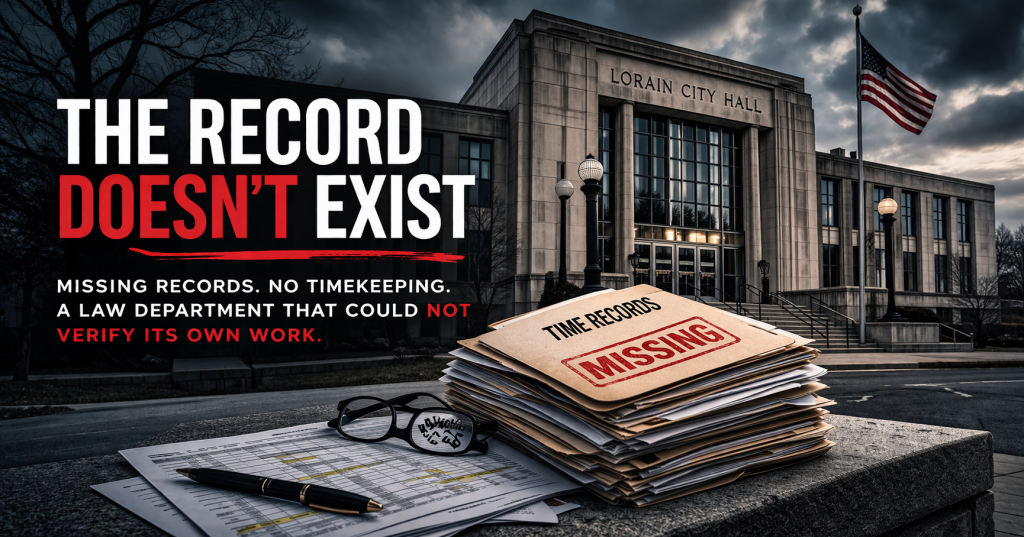
Lorain Officials Claimed They Were Not the Custodians But Their Own Emails Tell a Different Story
Apr 09, 2026
By Aaron Christopher Knapp
Investigative Journalist and Editor in Chief Lorain Politics Unplugged
Knapp Unplugged Media LLC
I. INTRODUCTION WHEN NOT THE CUSTODIAN BECOMES THE ANSWER
There is a phrase that keeps showing up in Lorain’s response to public records requests, and it appears with such frequency and confidence that it begins to take on the appearance of a default position rather than a considered legal determination. It is presented as definitive, as if it resolves the issue the moment it is stated, and it is delivered in a way that suggests there is nothing left to discuss once it has been invoked.
“We are not the custodian.”
On its face, that statement carries the weight of finality. It implies that the requested records are simply not within the possession of the responding office and that any further inquiry must be directed elsewhere. It suggests a clean boundary, a clear division of responsibility, and a straightforward application of the law. For someone outside the process, it sounds like the end of the road.
But that sense of finality begins to unravel the moment it is compared to the City’s own internal communications, because those communications tell a very different story about what is actually happening behind the scenes. The same officials who issue that statement are found participating in extensive email chains where the requests are not only acknowledged, but actively discussed, interpreted, and routed. They are included on distribution lists that span multiple departments, including the Law Department, City Council, administrative staff, and external parties. They are copied on messages that reflect awareness of the substance of the requests and involvement in how those requests are being handled.
The record does not reflect a system that is unaware of the requests or disconnected from the documents being sought. It reflects a system that is engaged, responsive, and fully aware of the issues being raised. Requests are being read, questions are being asked, responses are being drafted, and communications are being forwarded across a network of officials and agencies that extends well beyond a single office. The flow of information is continuous and coordinated, and it demonstrates a level of participation that cannot be reconciled with the claim of noncustodianship when viewed in isolation.
This creates a contradiction that is not subtle and cannot be dismissed as a misunderstanding. A public office cannot meaningfully participate in the handling of a records request while simultaneously asserting that it has no connection to the records at issue. The act of receiving, discussing, and forwarding those requests is itself evidence of involvement in the process, and that involvement carries with it an obligation that cannot be avoided through the repeated use of a single phrase. When that phrase is invoked in the face of clear participation, it stops functioning as a legal explanation and begins to look like a mechanism for distancing responsibility.
At that point, the issue is no longer whether a particular office can technically disclaim custody of a specific document. The issue becomes whether the system as a whole is operating in a manner consistent with the purpose of Ohio’s Public Records Act, which is to ensure access, not to create barriers. When multiple offices are involved in the same chain of communication, when they are collectively aware of the request, and when they are actively engaged in addressing it, the fragmentation of responsibility begins to undermine the very transparency the law is designed to protect.
What emerges from this record is not a simple case of a missing document or an incomplete response. It is a pattern in which responsibility is repeatedly shifted, narrowed, and redirected, even as the underlying communications demonstrate that the system continues to function as an interconnected whole. The emails show movement, coordination, and awareness, while the formal responses insist on separation and limitation. Those two realities cannot coexist without raising serious questions about how public records are being handled and whether the responses being provided reflect the full truth of the situation.
This is where the story begins, because once that contradiction is established, it reframes everything that follows. The focus is no longer on whether a single record was produced or withheld. It is on whether a public system can continue to operate in a way that allows it to engage with information internally while denying its existence externally. When that gap becomes visible, it demands an answer that goes beyond procedural language and requires a clear explanation of how those two positions can be reconciled under the law.
II. THE OFFICIAL POSITION THEY PUT IN WRITING
The City’s position is not abstract, and it is not something that has to be pieced together from implication. It is stated directly, in writing, by identifiable officials acting in their official capacities, and those statements are preserved across multiple email chains.
Chief Assistant Law Director Joseph LaVeck is one of the central figures in these communications, and his language is consistent across multiple exchanges. In one of the earliest preserved threads, LaVeck responds to a question about whether a complaint existed by stating plainly:
“I am unaware of any complaint against you.”
That statement stands on its own, but it does not stop there. In the same communication, LaVeck adds an additional layer that changes the meaning entirely:
“Even if a complaint or information was provided by a City employee to the Board, it would be confidential and not a public record.”
Those two statements are not identical in meaning. One asserts that no complaint is known to exist. The other acknowledges the possibility that information was provided, but claims it would be shielded from disclosure. Both positions are placed on the record at the same time.
That same pattern appears again in later communications when LaVeck addresses the handling of records requests directly. In response to follow up inquiries, he states:
“The Lorain Law Dept. is not the repository of records responsive to your request.”
At the same time, he acknowledges that the request itself is still being processed, writing that the matter “is still being processed” and that others may be in a position to respond.
That combination of statements is critical. The Law Department is claiming it does not hold the records, while simultaneously remaining involved in the processing of the request.
The same structure appears in communications involving Michele Beko, who is acting within the Law Department in responding to a request for a warrant tied to then Chief James McCann. Her response is direct and leaves little room for interpretation:
“The Lorain Law Dept. is not the keeper custodian nor does it have possession of documents responsive to your request. You may wish to direct your request to the Lorain County Prosecutor’s Office.”
That statement does two things at once. It disclaims custody and redirects the requester to another agency. It does not address whether the records exist within the broader system. It addresses only whether that specific office will produce them.
At the same time, within that same chain, the structure of the warrant process is acknowledged by the requester, who points out that warrants are not isolated documents. They are processed through the courts and maintained within the clerk’s system as part of the case file. That point is not disputed in substance. It simply remains unanswered.
LaVeck’s communications also reveal internal awareness of the City’s obligations. In one exchange, he writes:
“You have a legal obligation to assist Mr. Knapp in obtaining what he is requesting.”
That statement is not directed at the requester. It is directed internally. It reflects an understanding within the Law Department that the City has a duty under Ohio law to assist in locating and producing records.
Yet in that same body of communication, LaVeck also writes:
“I am unsure as to what is exactly being requested.”
Those two statements exist side by side. One acknowledges a legal obligation to assist. The other expresses uncertainty about the request. But the surrounding emails show the request being forwarded, discussed, and interpreted among multiple officials.
This is not a situation where the request was ignored or misunderstood in isolation. It is a situation where the request was actively handled while uncertainty and non custodianship were asserted at the same time.
Other officials appear throughout the same chains, including members of City Council, administrative staff, and external contacts. Their role is not always to issue formal denials, but their presence is significant. They are copied on emails, included in discussions, and part of the distribution lists where the subject matter is being addressed. The communications show that the issue was not confined to a single office. It moved across the system.
Taken together, these statements form the official position of the City as it appears in its own words.
Joseph LaVeck states he is unaware of a complaint, while also asserting that any such information would be confidential.
He states that the Law Department is not the repository of records, while acknowledging the request is being processed.
He acknowledges a legal obligation to assist, while simultaneously expressing uncertainty about the request.
Michele Beko states that the Law Department is not the custodian and does not possess responsive documents, and directs the request to another agency.
Each of these statements is defensible when viewed in isolation. Each addresses a specific aspect of the request. But when they are placed together, they create a record that is not consistent.
Because the same system that claims a lack of custody is also demonstrating awareness, involvement, and participation in the handling of the very records it says it does not have.
That is not an interpretation. That is what they put in writing.
III. WHAT THE EMAILS SHOW THAT THE PUBLIC WAS NOT TOLD
What the public sees in a formal records response is only one piece of the story. What the documents reveal behind that response is something far more detailed and far more revealing, because the emails show how the City actually handled the requests in real time, not how it chose to summarize them after the fact.
Within the same set of records where the Law Department is stating in writing that it is not the custodian and does not possess responsive documents, there are active email chains moving those very requests through multiple layers of government. These are not isolated messages. They are extended conversations involving multiple participants, forwarded repeatedly, expanded to include additional recipients, and carried across offices that include the Law Department, City Council, administrative staff, and external contacts.
The emails show that when a request came in, it did not stop at a single desk. It was circulated. It was read by multiple officials. It was forwarded to others for input. It was discussed in terms of how it should be answered. It was included in chains where additional individuals were brought in, not because they were the formal “custodian,” but because they were connected to the subject matter.
Names appear consistently across these chains, and they are not limited to one department. Law Department officials are present, including Chief Assistant Law Director Joseph LaVeck. City Council members and staff are included through distribution lists that extend beyond a single office. Communications include references to the Mayor’s office, to law enforcement leadership, and to individuals outside the immediate structure of City Hall. In several instances, the chains expand to include media contacts and state level offices, including communications copied to watchdog entities and state agencies.
Within those same communications, the subject is not abstract. The subject is specific, and it is repeated.
Aaron Knapp.
His name appears not as a passing mention, but as the central figure in the discussion. Requests submitted by him are being circulated. Questions about those requests are being raised internally. Responses are being drafted with his name in the subject line. Communications sent by him are being forwarded across departments. His allegations, his filings, and his inquiries are being discussed among officials who are actively engaged in determining how to respond.
These are not background references. They are the focus of the communication.
In multiple chains, officials are not only acknowledging receipt of his requests, but actively working through them. They are identifying what is being asked. They are determining who should respond. They are discussing how to frame the response. They are copying additional parties into the conversation as the scope expands. Entire distribution lists are added, including groups that extend beyond the original recipients and bring in individuals who have a stake in the outcome or the subject matter.
What emerges from these communications is a process. It is not a passive process. It is an active one. Requests come in and trigger internal movement. Emails are sent, replied to, and forwarded. Officials communicate with one another to clarify what is being requested and how it should be addressed. The system is engaged.
That level of engagement matters, because it directly contradicts the impression created by the formal responses. A system that is actively receiving, discussing, and routing requests is not a system that is disconnected from those requests. A system that is forwarding communications across multiple offices is not a system that lacks awareness of the underlying records.
The emails also show that the scope of the conversation is not confined to a single issue. The same chains reference public records requests, potential complaints, warrant questions, personnel matters, and broader concerns related to transparency and legal obligations. The subject matter evolves, and as it does, the chains expand. Additional individuals are included. New responses are drafted. The discussion continues.
This is not what it looks like when a public office has no records.
This is what it looks like when a public system is actively handling them.
The distinction is critical. The formal response isolates responsibility and limits the scope to a single office. The emails show a network of involvement that spans multiple offices and demonstrates collective awareness of the requests and the issues they raise. When those two realities are placed side by side, the gap between them becomes impossible to ignore.
The public was told that the Law Department was not the custodian and did not possess responsive documents. The emails show that the same department, along with others, was actively engaged in receiving, discussing, and responding to those requests in a coordinated and ongoing manner.
That is not a lack of records.
That is a record of activity.
IV. THEY KNEW EXACTLY WHAT WAS BEING REQUESTED
At a certain point, the question of whether the City understood the request stops being a matter of interpretation and becomes a matter of record. The emails remove any ambiguity, because they show not only that the request was received, but that it was actively analyzed, discussed, and handled by multiple officials within the system.
One of the clearest statements comes directly from within the Law Department itself, and it is not framed as a denial or a defense. It is framed as an acknowledgment of duty.
“You have a legal obligation to assist Mr. Knapp in obtaining what he is requesting.”
That sentence does not leave room for confusion. It does not suggest uncertainty about the nature of the request or the City’s role in responding to it. It affirms that there is a legal obligation, that the requester is entitled to assistance, and that the responsibility to provide that assistance exists within the system. It reflects an understanding of Ohio’s Public Records Act and the requirement that public offices do more than simply deflect requests. They must make a good faith effort to help fulfill them.
But within that same chain of communication, another statement appears that attempts to move the conversation in a different direction.
“I am unsure as to what is exactly being requested.”
When those two statements are placed next to each other, the contradiction becomes impossible to ignore. On one hand, there is a clear acknowledgment that the City has a legal obligation to assist with a specific request made by a specific individual. On the other, there is a claim of uncertainty about what that request actually is.
That tension cannot be explained away by a lack of clarity, because the emails themselves demonstrate the opposite. The request is being forwarded. It is being broken down. It is being interpreted by multiple individuals. It is being discussed across offices that include the Law Department, City Council, and other participants in the chain. Questions are being raised about how to respond, not about what is being asked. Responses are being drafted and revised. Additional recipients are being added as the conversation expands.
This is not a system struggling to understand a vague or poorly defined request. This is a system actively engaging with a request that it clearly understands, while simultaneously preserving language that suggests uncertainty.
The contradiction becomes even more significant when viewed in the context of the broader record. The same officials who claim uncertainty are participating in detailed discussions about the substance of the request. They are referencing specific documents, specific issues, and specific responses. They are not asking what the request is. They are determining how to handle it.
That is the difference between confusion and strategy.
Confusion would appear as requests for clarification, follow up questions directed to the requester, or an inability to identify the scope of what is being sought. That is not what the emails show. Instead, they show internal coordination, shared understanding, and a collective effort to manage the request across multiple participants.
When a public office states that it is unsure what is being requested while simultaneously demonstrating that it is actively processing and responding to that request, the statement of uncertainty loses its credibility. It becomes part of a pattern rather than an explanation.
Both sides of this equation are documented. The acknowledgment of legal obligation is in writing. The claim of uncertainty is in writing. The detailed internal handling of the request is in writing. There is no need to infer intent or speculate about what was understood.
The record shows it.
They knew what was being requested, and the system responded accordingly.
V. THE SHELL GAME WHEN EVERY OFFICE SAYS NOT US
The warrant request provides the clearest and most concrete example of how this system operates in practice, because it involves a type of record that cannot plausibly be described as informal, optional, or undocumented. A warrant is not a casual communication. It is a formal legal instrument that exists within a defined process, and that process necessarily generates records at multiple stages.
The request itself was straightforward. It sought a warrant associated with then Chief James McCann. It did not ask for interpretation, analysis, or compilation. It asked for a document that, by its very nature, must exist if the underlying action occurred.
The response from the Law Department followed the now familiar pattern. It did not address the substance of the request. It did not confirm whether the warrant existed within the broader system. Instead, it focused narrowly on the role of that specific office.
“The Lorain Law Dept. is not the keeper custodian nor does it have possession of documents responsive to your request. You may wish to direct your request to the Lorain County Prosecutor’s Office.”
That answer does two things at once. It disclaims responsibility and redirects the request. It does not deny that the warrant exists. It does not explain where the record ultimately resides. It simply removes that office from the chain of accountability and places the burden back on the requester to locate the correct custodian.
At the same time, the structure of the warrant process is not in dispute. It is not a matter of opinion or interpretation. Warrants are created within a system that includes law enforcement, judicial review, and court filing. They are issued, reviewed, approved, and maintained as part of a case record. They pass through the court system and are retained by the clerk as part of the official file.
The response from the requester reflects that understanding directly.
“All warrants go through the clerk. The warrant and case are closed. Therefore the court would be one of the record keepers of this document.”
That statement is not speculative. It describes how the process functions. It identifies a specific point within the system where the record must exist if it was ever created. It narrows the question to a definable location within a defined structure.
And yet, even with that clarification, no office steps forward to produce the record.
The Law Department disclaims custody. The request is redirected. The existence of a record keeper within the court system is acknowledged in principle, but no confirmation or production follows. The process resets, and the requester is left to begin again with another office, repeating the same inquiry in a different place.
This is not an isolated occurrence. The same pattern appears in requests for contracts and other records. One office states that it does not have the records and points to another department. Another suggests that a different office may be responsible. Another limits its response to what it is “aware of,” rather than what exists within the broader system. Each response is framed carefully to address only the role of that particular office, and each avoids making a definitive statement about the existence or location of the records as a whole.
Viewed individually, each of these responses can be defended. A specific office may not be the primary custodian of a particular record. A department may not maintain a complete file. An official may only have knowledge of records within their immediate control. Those are all valid limitations when considered in isolation.
But the law does not operate in isolation, and neither does the system that generates these records. When the responses are placed together, they do not form a complete answer. They form a chain of deflection. Responsibility moves from one office to another, from one department to the next, without ever settling in a place where the record is actually produced.
The result is not a clear denial and not a confirmed production. It is an absence created by movement.
This is why the term “shell game” is not rhetorical. It describes a process in which the object being sought is continuously shifted between positions, with each movement creating the appearance of engagement while preventing resolution. The record is not said to be destroyed. It is not explicitly denied in every instance. It is simply never produced, because each office limits its answer to its own narrow role and points elsewhere.
In that environment, the burden does not just remain on the requester. It multiplies. Each redirection requires a new request, a new response, and a new cycle of denial or limitation. The system continues to operate, the communications continue to flow, and the record remains just out of reach.
That is not how a transparent system is supposed to function.
VI. THE LEGAL FRAMEWORK WHAT THE LAW ACTUALLY REQUIRES
Ohio’s Public Records Act is not complicated in its purpose, and it is not written to create technical escape routes for public offices. It exists for a single reason, which is to ensure that the public can access records that document how government operates. It does not demand perfection, and it does not require that every office maintain records in an ideal format or produce them instantly upon request. What it does require is something far more fundamental and far more difficult to avoid once a request is made.
It requires a good faith effort to provide access.
That requirement is not optional, and it is not satisfied by simply issuing a response. Under Ohio Revised Code section 149.43, a public office has an affirmative duty to do more than acknowledge a request. It must respond promptly, and promptness is not measured by whether a reply was sent, but by whether the records themselves are made available within a reasonable period of time. It must identify what records exist that are responsive to the request. It must produce those records unless a specific exemption applies. If any portion of a record is withheld, the office must provide an explanation that identifies the legal basis for the withholding, and that explanation must be tied to the actual record, not stated in general terms.
The law also requires that exemptions be interpreted narrowly. The default position under Ohio law is that records are public. If an office claims that a record is exempt, the burden is on that office to justify the exemption with specificity. It is not enough to invoke a general category or cite a statute without explanation. The office must show how the exemption applies to the particular record being withheld.
Beyond those specific requirements, there is a broader obligation that runs through the entire statute and the case law interpreting it. A public office must assist the requester in obtaining the records. That means more than telling the requester where not to look. It means making a reasonable effort to identify where the records are maintained if they are not held in the responding office. It means directing the requester to the correct custodian in a way that actually leads to access, not in a way that simply shifts responsibility.
What the law does not permit is the creation of a system where responsibility is divided and narrowed to such an extent that no single office can be held accountable for producing a record that clearly exists within the government as a whole. The statute governs public offices collectively, not as isolated entities operating without connection to one another. When multiple offices are involved in the creation, handling, or maintenance of a record, the obligation to provide access does not disappear simply because each office can claim that it is not the primary custodian.
This is where the pattern reflected in the emails becomes legally significant. When one office states that it is not the custodian, that statement does not end the analysis. The obligation remains to ensure that the requester can obtain the record from the appropriate source. When another office fails to produce the record, the responsibility does not vanish. When a third office redirects the request without resolution, the duty to provide access is not fulfilled.
A chain of responses that moves the request from one office to another without ever resulting in production is not compliance. It is avoidance.
Courts evaluating public records disputes do not look only at whether an individual response can be defended in isolation. They look at whether the public office, as a whole, has met its obligation to provide access. If the combined effect of multiple responses is that a requester cannot obtain a record that should exist, the statutory purpose has been defeated, regardless of how carefully each individual response was worded.
The law is designed to prevent exactly that outcome. It is intended to ensure that records do not become inaccessible through fragmentation, delay, or deflection. When a system produces responses that are technically precise but collectively ineffective, it raises a fundamental question about whether the obligation imposed by the statute has been satisfied at all.
In this case, the issue is not whether any single office can justify its response. The issue is whether the system, taken as a whole, has provided the access that the law requires. When the record shows active involvement across multiple offices, coupled with repeated denials of custody and a failure to produce, the answer to that question becomes increasingly difficult to defend.
Because the law does not measure compliance by the number of responses issued.
It measures compliance by whether the public can obtain the record.
VII. WHEN THE SYSTEM CONTINUES BUT THE RECORD DISAPPEARS
The record does not show a breakdown in communication or a lack of coordination. It shows the opposite. It shows a system that is actively communicating across multiple levels of government while simultaneously refusing to produce the records tied to those communications. The emails themselves demonstrate how this works in practice, and they do so in a way that is far more revealing than any formal denial.
Chief Assistant Law Director Joseph LaVeck is present throughout these communications, not as a passive recipient, but as an active participant. He is responding to requests, engaging with other officials, and acknowledging the City’s legal obligations. In one exchange, he states that there is a legal obligation to assist Aaron Knapp in obtaining the requested records, which confirms that the request is understood and that the responsibility to respond exists within the system. At the same time, LaVeck is also asserting that the Law Department is not the repository of those records and is not in possession of documents responsive to the request. These statements are not made in isolation. They occur within ongoing email chains where the request is being actively handled.
Michele Beko, acting within the Law Department, provides another example of how this process unfolds. When responding to the request for a warrant tied to Chief James McCann, she states that the Law Department is not the keeper or custodian of the documents and directs the requester to the Lorain County Prosecutor’s Office. That response is sent within a chain where the subject matter is clearly understood and where the request itself has already been circulated among multiple individuals. The response does not deny the existence of the warrant. It limits the scope of responsibility to the Law Department while redirecting the request elsewhere.
The email chains themselves expand beyond a single office. City Council distribution lists are included in communications where Aaron Knapp’s requests and allegations are being discussed. These are not isolated messages sent to a single official. They are sent to groups that include council members and staff, which means multiple individuals are receiving and reviewing the same information at the same time. The inclusion of these distribution lists shows that the subject matter is not confined to the Law Department. It is being shared across the legislative side of the City as well.
The communications also include references to law enforcement leadership. Chief James McCann’s name appears in connection with the warrant request and related discussions. The subject of the request is known, and the individuals involved in the underlying events are identified within the same set of communications where custody is being denied. The emails show that the system is aware of the individuals, the events, and the records being requested.
The chain extends further to include external parties. Emails are copied to media contacts, including representatives of local outlets, and to state level offices such as the Ohio Attorney General. These recipients are not part of the City’s internal structure, yet they are included in communications that reference Aaron Knapp, his requests, and the issues he has raised. This demonstrates that the information is not only being handled internally, but is also being shared beyond the immediate confines of City Hall.
Throughout these communications, Aaron Knapp’s name is not incidental. It is central. His requests are the subject of discussion. His emails are being forwarded. His allegations are being referenced. Officials are responding to him, about him, and in coordination with one another regarding how his requests should be handled.
The process that emerges from these emails is not one of isolation. It is one of continuous interaction. Requests are received by one office and then forwarded to others. Responses are drafted and circulated for review. Additional recipients are added as the scope of the conversation expands. The same subject matter moves through multiple hands, and each participant engages with it in some capacity.
What does not occur within this process is the production of the requested records.
Joseph LaVeck acknowledges the obligation to assist while maintaining that his office is not the custodian. Michele Beko disclaims possession and redirects the request. City Council members and staff are included in distribution lists where the subject is being discussed. Law enforcement leadership is referenced in connection with the underlying events. Media and state level contacts are copied into the communications. The system continues to function, continues to communicate, and continues to handle the request.
At no point in that process does any office step forward to produce the record.
The emails show how responsibility is distributed across multiple individuals and offices, each of whom participates in the handling of the request while limiting their role when it comes to producing the documents. The result is not a lack of activity. It is a lack of accountability at the point where the law requires it most.
This is not a situation where records are unknown or misunderstood. The communications demonstrate awareness, coordination, and involvement at every stage. The absence of production does not occur because the system is inactive. It occurs while the system is fully engaged.
VIII. FINAL THOUGHT THE RECORD STILL SPEAKS
There is a phrase that government officials often rely on when they believe their position is supported by documentation. It is used to suggest that no further explanation is necessary because the written record will confirm what has already been stated.
“The record speaks for itself.”
In this case, it does, but it speaks in a way that directly contradicts the official responses that were provided to me, Aaron Knapp, over the course of these requests. This first story is based on approximately sixty emails that were recently released to me on a thumb drive. These are not summaries or selected excerpts. They are the actual communications exchanged between City officials, Law Department staff, Council distribution lists, and outside parties while my requests were being processed and, ultimately, denied.
When those emails are reviewed together, they show a system that was actively engaged with my requests at every level. Chief Assistant Law Director Joseph LaVeck appears repeatedly in these communications, responding to my inquiries, acknowledging that there was a legal obligation to assist me in obtaining the records, and participating in internal discussions about how those requests should be handled. At the same time, LaVeck put in writing that the Law Department was not the repository of records responsive to my request and that it did not possess the documents I was seeking. Those two positions exist in the same record and cannot be reconciled when viewed alongside the emails showing his direct involvement in handling the requests.
Michele Beko, also acting within the Law Department, issued a formal response to my request for a warrant tied to Chief James McCann. In that response, she stated that the Law Department was not the keeper or custodian of the documents and did not have possession of any responsive records, directing me instead to the Lorain County Prosecutor’s Office. That response was issued within a chain of communications where the subject of the warrant was clearly understood and where the process that created that warrant was acknowledged. The denial did not address whether the record existed within the system as a whole. It limited the answer to the role of that office and shifted responsibility elsewhere.
The emails further show that City Council members and staff were included in distribution lists where my name, my requests, and the issues I raised were being circulated. These were not isolated communications. They were shared across groups, meaning multiple officials were aware of and engaged in the discussion of my requests. The presence of these distribution lists demonstrates that the matter was not confined to a single office and that the handling of my requests extended beyond the Law Department into other parts of City government.
Chief James McCann is referenced in connection with the underlying subject matter, including the warrant request. Law enforcement leadership is part of the context in which these communications occur, and the events tied to those records are known within the system. In addition, the emails show that communications were copied to media outlets and to state level offices, including contacts associated with the Ohio Attorney General. This indicates that the subject matter of my requests was being discussed not only internally but also shared externally while I was being told that the records did not exist or were not held by the responding office.
Taken together, these communications show that the City of Lorain, through its officials and departments, did not fail to understand my requests and did not lack awareness of the records at issue. Instead, the emails demonstrate that the system was actively handling those requests, discussing them, forwarding them, and coordinating responses across multiple offices. The failure occurred at the point where those records should have been produced.
What each of these officials did, as reflected in the record, was limit their responses to the narrow role of their individual office while continuing to participate in the broader handling of the request. Joseph LaVeck acknowledged a legal obligation to assist while denying that his office held the records. Michele Beko disclaimed custody and redirected the request without addressing the existence of the record within the system. City Council members and staff received and participated in communications about the requests without any office stepping forward to produce the documents. The system as a whole remained engaged, but no single part of it accepted responsibility for providing access.
The result is not simply that a record was withheld. The result is that a system operated in a way that allowed records to be discussed, circulated, and managed internally while never being produced externally. That is not a failure of communication. It is a failure of accountability.
This first story establishes that pattern. It shows how the responses given to me do not align with the communications that occurred behind the scenes. It identifies the officials involved, the statements they made, and the role each played in handling the requests without producing the records.
This is not the full record. It is the beginning of it.
LEGAL DISCLAIMER
This article is based on documents, correspondence, and records obtained through public records requests and other lawful means. All statements are presented as factual reporting, opinion, or analysis derived from those materials. Allegations referenced are supported by documentation in the possession of the author. Any individuals or entities mentioned are presumed innocent of wrongdoing unless and until proven otherwise in a court of law.
© 2026 Knapp Unplugged Media LLC. All rights reserved.
About The Author




Why the deceit?