

THE RECORD IN THEIR OWN ORDER PART THIRTEEN THE FILES THE LAW AND THE CONVERSATIONS THEY DID NOT EXPECT TO BE CONNECTED
Forty nine emails a personnel file a legal opinion and a private conversation all intersect to show how knowledge moved faster than accountability inside the same system
I. INTRODUCTION WHEN THE RECORD IS RELEASED IN THEIR ORDER AND THE PATTERN CONTINUES
Before any formal legal opinion was written and before any official explanation was placed into the record, the issue at the center of this article had already been discussed directly between the individuals who now appear throughout these emails. The conclusions did not begin on paper, and they were not first introduced through a structured response issued by a public office. They began in conversation, in real time, where the facts, the law, and the implications were being worked through directly, long before a single document was drafted or circulated. What follows in this file is not the origin of that process. It is what happened after those conversations moved into written form and became part of the record itself.
This article continues exactly where the last one left off, and it does so deliberately, because nothing here has been rearranged, reinterpreted, or taken out of sequence. These emails are being reviewed in the exact order they were produced by the City of Lorain in response to a public records request made under Ohio Revised Code 149.43. This is the next file in that production, and it contains forty nine emails, attachments, and forwarded materials that expand a record that is already established and already showing a pattern that becomes more defined with each additional document.
At the same time, this section goes further than the prior ones because it is not limited to what the City chose to produce. It incorporates direct email communications between Aaron Knapp and Jack Hall, sent from Hall’s campaign account, “jack.hall@hallforsheriff.com,” along with additional documents and attachments that were exchanged outside of the formal records request process. Those communications are not separate from the record. They intersect with it in both timing and subject matter. They show that the same issues appearing in formal requests and official responses were being discussed directly, in real time, while those formal responses were being developed within the system.
That distinction matters because it places two streams of information side by side. One is the official record produced through a statutory process, where responses are structured, routed, and often limited by claims of custody, authority, or internal determination. The other is the direct communication between individuals engaged in the same issues, where documents are shared, questions are asked, and legal analysis is discussed without those same procedural constraints. When those two streams are read together, they do not conflict. They align. They show the same issues moving through different channels at the same time.
The structure of this article reflects that reality. The order is not constructed for narrative effect. It is preserved from the production itself. Every name, every response, every delay, every production, and every direct communication appears where it was created within the timeline. The reader is not being asked to accept a conclusion without support. The reader is being shown how the record developed, step by step, across both official and direct channels, and how those channels intersect.
What this next set confirms is something that has already been developing across the prior records. The subject matter shifts from public records to personnel files to legal analysis, but the participants do not change. Mayor Jack Bradley appears again in the same threads where authority is acknowledged while responsibility is redirected. Law Director Patrick Riley appears again where legal obligations are defined and then narrowed in application. Assistant Law Director Joseph LaVeck appears again where statutory interpretation is used to shape the outcome of a response. Law enforcement personnel, internal affairs, media contacts, and outside agencies remain part of the same communication network that has been visible from the beginning. At the same time, Hall appears within that same timeline through direct exchanges, sharing documents, offering commentary, and engaging with the same issues from outside the formal City structure.
What begins to take shape in this file is not a series of isolated responses or disconnected events. It is a continuous system in motion, where the same individuals receive the same information at the same time, where the same issues are raised across multiple channels, and where the same legal framework is presented repeatedly as the record moves forward. The pattern is not created by interpretation. It is visible within the structure of the communication itself.
This is not a fragmented system operating in separate parts that do not connect. It is one system, and the record shows how information moves through it, how it is handled once it arrives, and how the same names remain present at every stage of that process.
II. WHEN EVERYONE IS INCLUDED AND THE QUESTION STILL DOES NOT GET ANSWERED
One of the most consistent and revealing features in this record is the scope of distribution, and that scope is not incidental or accidental. These emails are not sent to a single office or handled quietly within one department where a response could be shaped, controlled, and returned without broader visibility. They are sent broadly and deliberately, often including multiple city officials, legal staff, law enforcement personnel, media outlets, and state level contacts all within the same thread. That structure is repeated across multiple exchanges, and over time it becomes part of the evidence itself, showing not just what is being asked, but exactly who is being asked and who is being given the opportunity to respond.
In prior sections of this record, that distribution included the Ohio Attorney General’s Office, local law enforcement agencies, the Lorain Law Department under Law Director Patrick Riley, members of City Council, and multiple media organizations, and that same pattern continues here without deviation. The communication is not routed through a single gatekeeper where responsibility can be narrowed or contained. It is placed directly in front of the same group of individuals who appear throughout the record, receiving the same information at the same time, with the same legal framework and the same questions attached to it. The names do not change, the roles do not change, and the structure of the communication does not change.
At the same time, this section is not limited to the emails produced by the City in response to a public records request. It includes direct communications between Aaron Knapp and Jack Hall, sent through Hall’s campaign email account, where the same issues are being discussed outside of the formal system while they are being raised within it. Those exchanges show acknowledgment, engagement, and real time awareness. In one instance, after receiving a complaint outlining potential election related violations, Hall responds, “Wow, thank you!” That response is brief, but it confirms that the information is not only delivered, it is received and understood. It places Hall within the same timeline as the formal record, engaged with the same issues while they are moving through official channels.
That overlap is not incidental. It shows that the questions are not confined to a single process or a single office. They exist across both official and direct communication at the same time, reaching the same individuals through different channels. The record is not divided into separate conversations that can be isolated from one another. It operates as a single stream of information moving through multiple paths, all of which lead back to the same group of participants.
That level of distribution removes any credible argument that the issue was not known or that the questions were not clearly presented. The record does not reflect confusion, delay caused by lack of clarity, or misunderstanding about what is being requested. It reflects delivery. The information is placed in front of every relevant office, every responsible official, and every potential respondent, with the legal framework explained and the questions stated directly. The system is not lacking awareness. It is saturated with it.
What follows from that is what gives this section its significance. Even with that level of visibility, even with the same emails reaching Mayor Jack Bradley, Law Director Patrick Riley, Assistant Law Director Joseph LaVeck, law enforcement personnel, and external oversight bodies, the core questions remain unchanged. The record continues to ask who has the records, who made the decisions, and who is responsible for the outcome, and those questions are not resolved within the same exchanges where they are raised. The communication continues, the threads expand, the recipients remain the same, and the issue is carried forward without the answers that would bring it to a close.
The questions are not ignored in the sense that they disappear or are removed from the conversation. They are circulated across the system. They are seen by every individual included in the chain. They are acknowledged by their presence and by the continued engagement of the same participants. And yet, within the structure of that same system, they remain unanswered in the form they were asked, creating a record where awareness is complete and resolution is absent.
III. WHEN THE LAW IS EXPLAINED INSIDE THE EMAIL AND STILL NOT APPLIED
This section of the record confirms something that has been building across multiple articles, and it does so in a way that removes any ambiguity about what the issue actually is. The law is not missing from this conversation, and it is not being misunderstood by the individuals involved. It is written directly into the emails, explained in plain terms, and placed in front of the very officials who are responsible for applying it. The legal framework is not something that has to be inferred or reconstructed after the fact. It is embedded within the communication itself, presented clearly and directly within the same threads where responses are being formed and delivered.
At one point, the correct legal standard is stated in a way that leaves no room for confusion. Mayor Jack Bradley writes, “I am the Mayor and as such it would be my responsibility to ensure this request gets to the right party… as it is the law…” That statement is not commentary from outside the system. It is an acknowledgment from within the system of what Ohio Revised Code 149.43 requires. It recognizes that the duty to respond to a public records request is institutional, not personal, and that the obligation rests with the public office as a whole to ensure that the request is properly directed and fulfilled.
What follows that statement is where the pattern becomes clear. The response shifts immediately from an acknowledgment of institutional responsibility to a statement focused on individual possession. The language changes to, “I am not in possession of any of the items you reference in your email.” That shift is not a clarification of the law that was just described. It is a narrowing of the obligation that removes the broader responsibility that had just been acknowledged and replaces it with a more limited position centered on personal custody.
That difference is not semantic. It is structural. The law does not require a public official to personally hold a record in order for the public office to have a duty to respond. The obligation is to ensure that the request is fulfilled, whether that requires forwarding it, coordinating internally, or producing the record through the appropriate custodian. The statement acknowledging that duty is accurate. The response that follows does not carry that duty through to its required conclusion.
What this section shows is a separation between how the law is described and how it is applied. The legal standard remains consistent within the record. It is stated correctly, it is understood by the individuals involved, and it is placed directly into the communication. The response, however, does not follow that standard in practice. Instead, it shifts to a narrower position that limits the scope of responsibility and avoids the action that the law requires.
This is not a failure of understanding. It is not the result of confusion or uncertainty about what the statute demands. It is a difference between acknowledgment and execution that appears within the same exchange, where the law is explained clearly and then not applied in the response that follows.
IV. WHEN THE LAW DEPARTMENT DEFINES THE RESPONSE AND LIMITS THE OUTCOME
By this point in the record, the role of the Law Department is no longer implied or inferred from scattered responses. It is visible, consistent, and central to how the system processes and answers the questions being raised. Law Director Patrick Riley and Assistant Law Director Joseph LaVeck appear repeatedly in the same email chains where statutory obligations are being explained, where requests are being made, and where responses are ultimately formed. Their presence is not incidental. It is part of the mechanism through which the response is shaped, refined, and delivered back into the record.
What emerges from those exchanges is not a series of inconsistent or ad hoc replies but a recognizable pattern that repeats across different requests and different subject matter. When records are requested, the response focuses on custody, identifying whether a specific office holds the documents rather than addressing whether the public office as a whole has an obligation to produce them under Ohio law. When questions are raised about specific materials, the response is redirected, often shifting responsibility to another department or suggesting that the information may exist elsewhere without resolving whether it will actually be produced. When determinations are made about the existence of records, those determinations are reached internally and presented as conclusions without the underlying material being produced for independent review.
This pattern is not abstract. It appears directly in the record. In one exchange, the conclusion that no responsive records exist is based on an internal assessment that certain communications did not involve city business. That conclusion is presented as definitive, yet it is not accompanied by the production of those communications, nor is it supported by documentation that would allow the requester to evaluate or challenge that determination. The decision is made within the same office that is responding to the request, and the result is communicated outward without opening the underlying record to scrutiny.
The significance of that approach lies in how it shapes the outcome of the request itself. The question of whether records exist, whether they are responsive, and whether they fall within the scope of the Public Records Act is resolved internally before the response is issued. The decision is reached inside the system, the conclusion is delivered outside the system, and the material that would confirm or contradict that conclusion is not produced as part of the response. The process does not end with silence or refusal. It ends with an answer that effectively limits what can be examined beyond that point.
What this section shows is not an absence of response or a failure to engage with the request. It shows a defined method of response that controls how the issue is resolved from the outset. The Law Department is not stepping away from the conversation. It is directing it. It is determining how the law is applied in practice, how each request is interpreted, and how the final answer is framed, all within the same structure that is responsible for providing that answer in the first place.
This is not a lack of response.
It is a defined response that determines the outcome before the underlying material is ever placed into the record for anyone outside the system to review.
V. WHEN THE LANGUAGE CHANGES AND THE FOCUS SHIFTS TO THE PERSON ASKING
As the emails continue, the tone does not remain static, and that shift becomes clear when read against everything that has already occurred in the record. The communication becomes more direct, more forceful, and more explicit about the frustration with the lack of answers and the growing perception that the system is not responding in good faith. This is not an isolated reaction or a sudden escalation without context. It develops after repeated requests have been made, after the legal framework has been placed directly into the same threads, and after the same questions have been circulated across the same group of officials without resolution.
That change is reflected in the language that appears within the record itself. Statements such as, “You can try and ignore me. But I’m not going away. I’m watching you and learning,” move beyond procedural language and into direct challenge. They are not framed as formal legal arguments or carefully constructed requests for compliance. They reflect a shift in focus from the mechanics of the request to the conduct of the system responding to it. The communication is no longer limited to asking what records exist or where they are located. It is addressing how the responses are being handled and what that handling suggests about the process as a whole.
The same shift is evident in statements such as, “You’ve allowed him to step down with no charges and no investigation… you DID NOTHING.” That language does not introduce a new issue into the record. It builds on what has already been raised and connects it to a broader concern about inaction. The emphasis is no longer confined to whether records are being produced or whether questions are being answered. It expands to include whether the system is taking any action at all when the issues have been clearly identified and supported by the legal framework already placed in front of the officials responsible for addressing them.
What gives this section of the record its significance is not simply the change in tone but how that change is handled within the same structure. These statements are not removed from the record, filtered out of the communication, or confined to a separate exchange. They are distributed within the same email chains that include Mayor Jack Bradley, Law Director Patrick Riley, Assistant Law Director Joseph LaVeck, law enforcement personnel, and external contacts. The same individuals who received the initial requests and the legal explanations are now receiving communication that directly challenges how those issues are being handled.
The record shows that this shift in language does not move the conversation outside of the system. It remains within it. The same distribution lists are used, the same participants are included, and the same structure that carried the original requests continues to carry the escalation that follows. The communication does not fragment when the tone changes. It stays intact, and the system continues to receive the message in the same way it received every prior request.
What this ultimately shows is that as the responses fail to resolve the issues being raised, the nature of the communication evolves. The questions about records, decisions, and responsibility remain at the center of the record, but they are now accompanied by direct statements about how those questions are being handled. The focus shifts from access and explanation to engagement and response. It reflects a growing recognition that the issue is no longer limited to what information can be obtained. It includes how the system responds to the person asking and how that response changes as the requests continue.
VI. WHEN THE FILES START MOVING AND THE SAME NAMES KEEP SENDING THEM
The record shifts again at the point where the issue is no longer confined to requests, denials, or explanations and instead moves into the actual production and circulation of documents, and that shift changes how the entire sequence has to be understood. Up to this point, the system is responding to questions about records, defining its obligations under Ohio Revised Code 149.43, and shaping those obligations through the way responses are framed. At this stage, the system is no longer just responding. It is producing documents, and once those documents are produced, they do not remain within the boundaries of the office that created them. They begin to move, and they move through the same network of individuals who have appeared throughout every prior section of the record.
A formal public records response is issued by the Lorain County Prosecutor’s Office, and the document produced as part of that response is the County’s policy governing political activity for classified employees, along with related personnel and compliance materials released pursuant to Ohio Revised Code 149.43. The language of the response reflects the statutory structure governing public records production. The communication confirms that the request has been processed, that redactions have been applied to remove personal identifiers, and that the request is now considered closed. That language is consistent with Ohio law, and under normal circumstances it would mark the end of the exchange, with the document remaining between the producing office and the individual who requested it.
What the record shows is that the process does not end at the point of production.
The document is forwarded, and it is not forwarded in isolation. It moves into the same communication chains that have already included city officials, legal counsel, law enforcement personnel, and outside contacts. The same names that were present when the questions were being asked are present again when the records are being shared. That continuity matters because it shows that the individuals who were responsible for responding to the issues are now in possession of the very document that defines those issues.
The content of the document reinforces why its movement through that network is significant. The material outlines the rules governing political activity for classified employees within the county, and it does so in language that is direct and unambiguous. It states that such employees are prohibited from participating in partisan elections as candidates for office and from engaging in campaign activity on behalf of candidates. These are not general principles or advisory guidelines. They are explicit prohibitions written into the policy itself, defining what is not permitted within the scope of public employment.
The document then establishes an even broader standard that extends beyond campaign activity. It states, “Under no circumstances shall an employee engage in other employment or activities which conflict with the objectives, interests, or operations of the County.” That language is definitive. It does not allow for interpretation or selective application. It sets a clear boundary that applies to any activity that could create a conflict with the responsibilities of county employment, and it does so in terms that are absolute rather than conditional.
What gives this portion of the record its weight is not just the existence of that policy but the way it is being handled after it is produced. The document is not summarized, paraphrased, or interpreted through secondary communication. It is shared in its original form, with its language intact, and it is circulated among the same individuals who have been part of the earlier exchanges. The record shows that the system has moved from discussing what the law requires to distributing the document that defines those requirements.
The same officials who received requests, who acknowledged statutory obligations, and who shaped responses are now part of a communication network where the governing policy itself is being transmitted. The record reflects that the information is no longer being filtered through explanation alone. It is being placed directly into the hands of the individuals connected to the issues being raised.
This is not a description of policy offered after the fact.
This is the policy itself, produced under Ohio law, forwarded beyond the office that created it, and circulated within the same system that has been responsible for responding to every question that came before it.
VII. WHEN THE POLICY IS NOT JUST KNOWN BUT DISTRIBUTED
This is the point in the record where the function of the information changes in a way that cannot be overlooked, because the law is no longer being referenced, summarized, or argued within the body of an email. It is being shared in its original form, as a complete document, and placed directly into the same communication network that has carried every prior request, response, and explanation. The shift is no longer about whether access can be obtained or whether the law can be cited. It is about possession and circulation, and once that shift occurs, the record begins to operate differently because the governing standard is no longer abstract. It is present in the record itself.
The document that is forwarded does not leave room for interpretation about what it contains. It sets out, in direct and unambiguous terms, what is permitted and what is prohibited for classified employees. The language is not generalized, and it is not framed as advisory guidance. It is specific and directive. It states that prohibited conduct includes “campaigning by writing for publications, by distributing political material or by making speeches on behalf of a candidate for partisan elective office.” It further states that employees are barred from “soliciting… any contribution… for any political party or political candidate.” These are not suggestions or best practices. They are defined rules that establish clear boundaries for conduct.
The document also reinforces those prohibitions with broader language that removes any ambiguity about conflicts of interest. It states that under no circumstances may an employee engage in outside activity that conflicts with the objectives, interests, or operations of the County. That provision does not operate in isolation. It ties the specific prohibitions on political activity to a wider standard that governs conduct generally, making clear that the restriction is not limited to one type of action but applies wherever a conflict may arise.
What makes this section of the record particularly significant is not just the clarity of those rules but the context in which they are now being circulated. These are not internal documents remaining within a single department or confined to a personnel file. They are being distributed through the same email chains that include Mayor Jack Bradley, Law Director Patrick Riley, Assistant Law Director Joseph LaVeck, law enforcement personnel, and external contacts who have been part of the broader communication from the beginning. The same individuals who have already received explanations of the law and arguments about how it applies are now receiving the document that defines those rules in full.
That movement matters because it eliminates any distinction between knowledge and access. The rules are not being described secondhand or filtered through interpretation. They are being placed directly in front of the individuals connected to the issues being raised, in a form that shows exactly what the policy says, how it is written, and what it prohibits.
The record no longer depends on whether someone claims to understand the law or interprets it in a particular way. It shows that the policy itself has been shared, in full, within the same communication stream.
What this ultimately establishes is that the issue is no longer about whether the rules exist or whether they are known within the system. The record shows that they are both known and distributed. They are explicit in their language, they are clear in their application, and they are now part of the same communication network where the underlying issues continue to be raised, discussed, and left unresolved.
VIII. WHEN PUBLIC RECORDS ARE USED AS INFORMATION AND AS LEVERAGE
Earlier in this record, the central issue revolved around whether records existed, who held them, and whether they would be produced under Ohio law. The focus was on access, on the mechanics of a request, and on the responses that either confirmed or denied the existence of responsive material. That phase was defined by questions grounded in Ohio Revised Code 149.43, by repeated explanations of statutory duty, and by a system that responded by narrowing responsibility through claims of custody and control.
What this section shows is that the record has moved beyond that phase entirely, and it does so in a way that changes how the entire sequence must be read.
The records are no longer being debated in terms of existence. They are being produced. They are being transmitted through formal responses from the Lorain County Prosecutor’s Office. They are being received not only by the requester but by the same network of officials who have been part of the record from the beginning. They are being reviewed in detail, forwarded across email chains, and discussed within the same threads where earlier questions were raised. The material is no longer static. It is active, and it is moving through the system in real time.
That movement is not random and it is not isolated to a single channel. The same names continue to appear, including Mayor Jack Bradley, Law Director Patrick Riley, Assistant Law Director Joseph LaVeck, law enforcement personnel, and external contacts who have been included from the outset. At the same time, direct communications with Jack Hall continue alongside the formal record, meaning that the documents being produced are not confined to official responses or internal routing. They are part of a broader exchange that includes both internal government actors and external participants engaged with the same issues.
As those records move, their function changes in a way that is visible within the communication itself. They are no longer simply the subject of a request or the endpoint of a statutory obligation. They become part of the conversation. They are referenced in follow up emails. They are analyzed in the context of the issues already raised. They are used to support arguments, to question prior responses, and to frame the next set of inquiries. The information contained within them begins to shape the discussion rather than simply respond to it, and the presence of the documents alters how the system engages moving forward.
That shift is what defines this stage of the record. The system is no longer operating solely in a responsive capacity, where it answers requests or explains its actions after the fact. It is producing material that becomes part of an ongoing exchange, and that material is being used within the same network of officials, candidates, and outside parties who have been present from the beginning. The record shows that once the documents exist, they do not sit idle. They are engaged with, circulated, and incorporated into the continuing flow of communication.
What this section ultimately shows is that the campaign’s messaging does not operate in isolation from the legal analysis contained within this record. It operates alongside it, reinforcing it, framing it, and existing within the same timeline in which those legal conclusions were being formed and circulated. The same platform used to build trust, recognize community contributions, and establish authority is also the platform where contested issues are defined, opposition is identified, and narratives are shaped.
When those elements are viewed together, the distinction between public messaging and private analysis begins to disappear. The legal opinion addressing Richard Resendez does not stand alone as a detached document. It exists within a campaign environment that was actively constructing how law enforcement status, eligibility, and credibility would be understood by the public at the same time the election itself was unfolding.
That is where the record changes.
Because at that point, the issue is no longer just what the law says. It is how that law was interpreted, framed, and moved through a campaign that ultimately succeeded.
IX. WHEN THE RECORD TURNS FROM REQUESTS INTO DEMANDS FOR PROOF AND PRIVATE ANALYSIS
At this point in the record, the structure changes in a way that cannot be understood by looking at emails alone, because what is happening is no longer confined to written communication or formal document exchange. The record expands into direct communication, into conversations that occurred before the documents were created, and into the process through which those documents were shaped before they were ever placed into writing. This is where the distinction between what is documented and what led to that documentation begins to matter, because the record now reflects both the written outcome and the underlying process that produced it.
The most significant example of that shift appears in the formal legal opinion that is later sent by Jack Hall, which addresses the status and qualifications of Richard Resendez and specifically analyzes his appointment under an SF-400 as a “special police officer.” That document does not emerge in isolation, and it is not framed as a detached or third party analysis. It is introduced directly with the statement, “Below is my opinion regarding his status as a ‘Special’ police officer,” placing Hall himself as the source of the legal position being presented. The analysis that follows is structured, grounded in statutory interpretation, and focused on distinguishing between classifications of officers, examining the legal definition of a peace officer under Ohio law, and applying those definitions directly to Resendez’s background and claimed authority.
At the same time, the structure of that document introduces a second layer that cannot be ignored.
While the opinion is presented by Hall as his own, the document itself is signed “Aaron Knapp,” placing the written analysis under my name at the point where it is formally concluded.
That combination does not reflect a standard advisory opinion issued by counsel or a routine legal memorandum. It shows a document that is developed within one context, transmitted through another, and attributed in a way that reflects both the communication that preceded it and the record that follows from it.
The record shows that this was not the only issue being examined during this same period, and it was not the only subject of direct communication. The issue involving Antonio Baez was raised separately and discussed directly between Aaron Knapp and Hall outside of the formal structure of a public records request. That discussion was not general or speculative. It involved the application of statutory provisions, the evaluation of Baez’s roles, and the legal implications of those roles within the same framework of Ohio law that appears in the written opinion concerning Resendez.
During that conversation, a request was made that becomes significant when viewed in the context of everything that follows. Hall asked that the matter be left to him to handle. That request reflects an attempt to control the process, to determine how the issue would move forward, and to keep the handling of it within a particular channel. It suggests that the issue would be addressed internally and that any resulting action would occur through the system rather than outside of it.
What the record shows next is that the process did not remain contained within that request. The issue did not stop at the point of conversation, and it did not remain within a single channel. It continued to move forward through additional communication, through public records requests, and through direct engagement with multiple officials and agencies. The decision to continue did not occur in isolation. It became part of the record itself, because it explains why multiple issues, including the analysis of Resendez’s status and the concerns involving Baez, appear across different channels at the same time.
What gives this section its significance is how those parallel tracks begin to converge. The discussion that began privately does not remain private. In the case of Resendez, it results in a formal legal opinion that applies statutory law to a specific set of facts and is transmitted directly by Hall into the record. In the case of Baez, it remains within the broader communication, where the same legal framework is applied, discussed, and carried forward without being reduced to a single formal document. Both tracks rely on the same statutory analysis. Both involve the same individuals. And both exist within the same timeline, moving forward together even as they take different forms.
What this section ultimately shows is that the record is no longer limited to requests for information or responses to those requests. It has moved into a phase where issues are being examined directly, where conclusions are being formed in real time, and where those conclusions are then carried forward into written analysis or continued inquiry. The transition from request to analysis is not theoretical. It is documented through both the formal opinion regarding Resendez and the ongoing communication surrounding Baez, showing how the issues evolved from questions into positions that were either formalized in writing or pursued through continued engagement within the same system.
X. WHEN THE LEGAL OPINION ENTERS THE RECORD AND RAISES ELECTION LAW QUESTIONS
What appears next is not another email, not another request, and not another explanation of the law. It is a formal legal opinion, written, structured, and grounded in statutory analysis, and once it enters the record it changes what is required from that point forward. The opinion is introduced by Jack Hall as “my opinion,” and it analyzes the status of Richard Resendez under an SF-400 appointment as a “special police officer,” applying Ohio statutory definitions to conclude that the designation does not confer the authority of a certified peace officer. (see above emails)
That alone carries legal weight, because it places a candidate for sheriff in the position of making a written legal determination about the qualifications of his political opponent. The opinion walks through statutory classifications, distinguishes between types of officers, and applies those definitions directly to eligibility for office. Once that conclusion exists in writing, the issue is no longer theoretical. It becomes a documented position grounded in law.
What gives this portion of the record its additional significance is how that opinion is structured and transmitted. It is presented by Hall as his legal opinion, yet the document itself is signed “Aaron Knapp.” That dual structure raises a separate legal question, not about the substance of the analysis, but about how it was created, attributed, and used within the context of an election.
Under Ohio law, political activity and campaign conduct are governed by multiple statutes, including Ohio Revised Code Chapter 3517, which addresses campaign practices, and Ohio ethics provisions that prohibit the use of public resources or authority for improper political advantage. There is also a long-standing principle that false or misleading attribution in campaign-related communications can become legally relevant if it is used to influence an election or misrepresent the source of a claim.
The record here does not, by itself, prove a violation of those statutes. What it does show is a set of facts that raise legally relevant questions.
It shows that a candidate for sheriff authored or presented a legal opinion analyzing his opponent’s qualifications.
It shows that the same document was transmitted privately rather than issued publicly.
It shows that the document was signed in the name of another individual, despite being introduced as the candidate’s own opinion.
And it shows that this occurred during an active election cycle involving the same individuals.
Those facts matter because they intersect with how Ohio law treats campaign communications, attribution, and the use of legal analysis in a political context. If a document is used to influence public perception, to challenge eligibility, or to support a complaint or action during an election, the question becomes not only whether the legal analysis is correct, but how it is being presented and by whom.
That is where the standard changes.
Before the opinion, the issue could be framed as a concern, a question, or a developing analysis raised by a private individual. After the opinion, the issue becomes a documented legal position associated with a candidate for public office, delivered in a form that raises questions about authorship, attribution, and intended use.
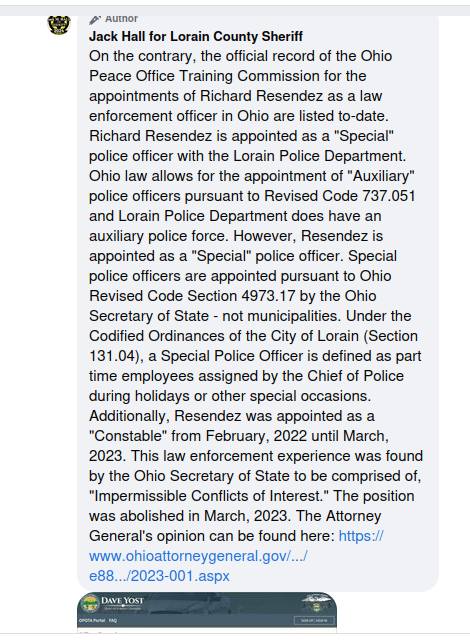
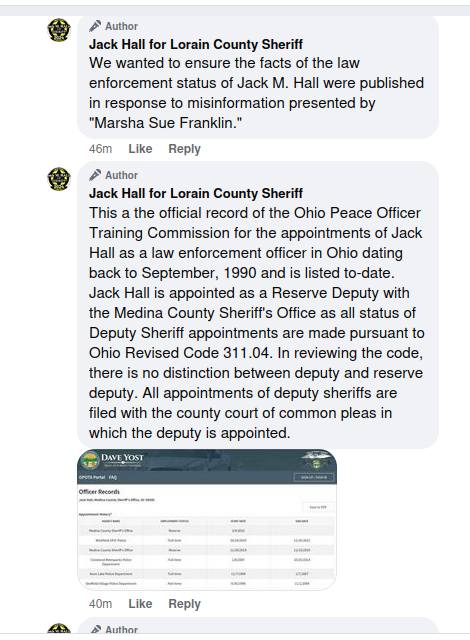
At the same time, the record shows that this opinion does not exist in isolation. It is part of a broader timeline where the same legal framework is being applied to multiple individuals, including the separate concerns raised about Antonio Baez. The difference is that in the case of Resendez, the analysis is reduced to writing and transmitted as a formal opinion, while in the case of Baez, it remains within ongoing communication and continued inquiry.
What this section ultimately shows is not just that a legal opinion exists, but that its existence introduces a new set of legal considerations. The issue is no longer limited to what the law says about qualifications or authority.
It extends to how that legal conclusion was created, how it was attributed, and how it may have been used within the context of an election governed by Ohio law.
X-A. WHEN THE LEGAL OPINION IS PREPARED IN ADVANCE AND ATTRIBUTED BEFORE IT IS SENT
What becomes clear when the record is examined in full is that the legal opinion addressing Richard Resendez did not originate as a document drafted and finalized by the person whose name appears on it. The structure of the communication shows that the document was transmitted in a completed form, with the legal analysis already written, formatted, and attributed before it was ever sent.
The opinion was delivered by Jack Hall through direct email communication, and it was presented as a finished product. The document did not arrive as a draft for review or collaboration. It arrived as a completed legal analysis, with “Aaron Knapp” already placed at the bottom as the signatory. There was no separate act of authorship attached to that name within the record. The attribution was already embedded in the document at the moment it was received.
That detail matters because it separates authorship from attribution in a way that is not visible on the face of the document itself. The record shows that the legal reasoning contained within the opinion was not independently developed by the individual whose name appears on it. In fact, the response to receiving the document reflects that disconnect, with the observation that the level of statutory detail and legal structure contained in the opinion was not consistent with what would be expected from someone without prior knowledge of the issue. That reaction is part of the record, and it reinforces that the document was not the product of independent drafting at the point where it was attributed.
The record further reflects that Hall later acknowledged that others questioned the origin of the document, stating that it was recognized as having been authored by him or someone close to him because of the level of legal analysis it contained. That acknowledgment does not resolve the question of authorship, but it confirms that the attribution appearing on the document was not viewed as consistent with the substance of the analysis by those familiar with the situation.
What this creates is a document with a clear legal conclusion, but an unclear origin when viewed through the lens of how it was prepared and transmitted. The legal analysis may have been developed by counsel or by individuals with a deeper understanding of the statutory framework. The position is presented by a candidate for sheriff as part of an active election. And the document itself is attributed, in its final form, to an individual who received it already completed.
That structure is not typical of a private legal memorandum or an independently authored opinion. It reflects a document that was prepared in advance, attributed at the point of transmission, and distributed in a form that did not require additional drafting or revision before it was shared.
When viewed within the framework of Ohio election law, particularly the provisions governing coordinated activity and the use of materials intended to influence an election, that structure becomes relevant. The law does not turn solely on who physically wrote the words. It looks at how materials are created, how they are attributed, and how they are used in the context of influencing the outcome of an election.
The record does not establish that any violation occurred. It does not show how the document was ultimately used beyond its transmission and distribution. What it does show is that a legal opinion was prepared, attributed in advance to a third party, transmitted as a finished product, and circulated during an active election involving the same individuals.
What this section ultimately shows is not just that a legal opinion existed.
It shows that the document was constructed before it was sent, attributed before it was accepted, and positioned for distribution in a way that raises questions about authorship, attribution, and purpose within the broader context of the election itself.
X-B. WHEN THE CAMPAIGN PUBLICLY FRAMES THE SAME ISSUE
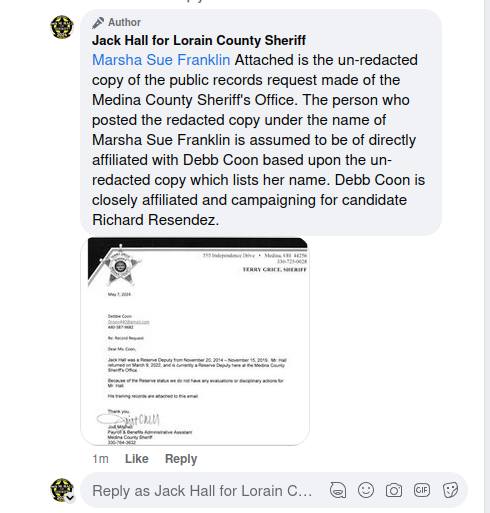
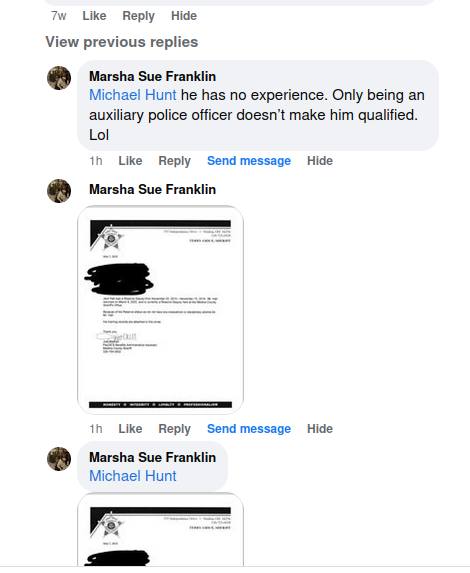
What appears on the campaign’s own public platform confirms that the issue reflected in the emails and legal opinion was not confined to private discussion or internal analysis. It was part of an active and ongoing public narrative during the election. The campaign statement reads, “Our campaign wanted to set the record straight on the facts of the law enforcement status of Jack M. Hall as a candidate for Lorain County Sheriff. This status has been repeatedly challenged and attacked by Facebook accounts with no verifiable source and an individual known as Debb Coon. Below, we have included excerpts of recent posts to our Facebook page from the account of ‘Marsha Sue Franklin.’”
That language does more than respond to criticism. It establishes that the question of law enforcement status and eligibility was already central to the campaign’s messaging at the same time the private communications and legal analysis were taking place. The issue was not isolated. It was being addressed publicly, framed by the campaign as a matter of correcting the record, and tied directly to how voters should understand the qualifications of the candidate.
When that public framing is placed alongside the legal opinion analyzing Richard Resendez, the connection becomes difficult to separate. The campaign is publicly addressing challenges to its own candidate’s status while, within the same timeframe, a legal analysis is being created, transmitted, and circulated addressing the status of a political opponent. Both actions operate within the same subject matter, the same legal framework, and the same election cycle.
The significance of that overlap is not that it proves a particular use of the legal opinion within the campaign. The record does not establish that level of direct connection. What it does establish is that the issue of law enforcement status was being actively contested in both public and private channels at the same time. The campaign’s public statement shows that the topic was part of its outward messaging, while the record shows that legal analysis addressing a competing candidate’s status was being developed and distributed within the same period.
That parallel matters because it places the legal opinion within a broader environment where eligibility, authority, and statutory interpretation were not abstract legal questions. They were active issues in a contested election, being argued publicly and examined privately at the same time.
What this section ultimately shows is that the record does not operate in isolation from the campaign. The same issue appears in both spaces, and the timing of those appearances ties the legal analysis directly to the environment in which the election was being decided.
X-C. WHEN THE CAMPAIGN IDENTIFIES OPPOSITION AND CONTROLS THE NARRATIVE
What the campaign chose to publish publicly adds another layer that cannot be separated from the rest of this record, because it shows not only that the issue of law enforcement status was being discussed, but that it was being actively framed, categorized, and controlled within the campaign’s own messaging. The statement released through the campaign does not simply address a legal question. It identifies specific individuals, labels opposing viewpoints, and defines which sources are considered credible and which are not.
The campaign states, “Our campaign wanted to set the record straight on the facts of the law enforcement status of Jack M. Hall as a candidate for Lorain County Sheriff.” That opening line does not present the issue as unresolved. It presents the campaign as the authority on what the facts are, placing itself in the position of correcting the record rather than participating in a debate about it. The language that follows reinforces that framing by identifying criticism as coming from “Facebook accounts with no verifiable source” and specifically naming Debb Coon as part of that opposition.
That identification matters because it shows that the campaign was not treating the issue as a neutral legal question. It was treating it as a contested narrative that needed to be controlled, defined, and responded to in a way that would shape how the public understood it. The inclusion of excerpts from a Facebook account, identified as “Marsha Sue Franklin,” further shows that the campaign was actively monitoring, selecting, and presenting information to support its position while discrediting opposing voices.
When that public messaging is placed alongside the legal opinion analyzing Richard Resendez, the connection becomes more than timing. The campaign is publicly defending its own candidate’s law enforcement status while, within the same timeframe, a legal analysis is being created, transmitted, and circulated that challenges the status of a political opponent. Both actions operate within the same legal framework, the same subject matter, and the same election cycle.
The image associated with this record reinforces that structure. It shows a formal letter from a sheriff’s office being used within the same narrative, presented alongside commentary identifying affiliations and campaign activity tied to specific individuals. That combination of official documentation and campaign framing reflects a deliberate effort to present certain information as authoritative while positioning opposing voices as lacking credibility or acting with bias.
What this establishes is not simply that the issue was being discussed publicly. It shows that the campaign was actively shaping how that issue was understood, identifying who was to be trusted, who was to be dismissed, and what documentation should be viewed as controlling. At the same time, the record shows that legal analysis addressing the opposing candidate was being developed and circulated within the same environment.
That overlap matters because it places the legal opinion within a broader narrative strategy rather than isolating it as a standalone document. The opinion does not exist outside of the campaign context. It exists within it, alongside public messaging that defines the issue, identifies opposition, and presents selected documentation as the authoritative record.
What this section ultimately shows is that the record is not divided between public messaging and private analysis. Both are operating together. The campaign is defining the narrative publicly while legal conclusions are being formed and circulated within the same timeframe, creating a unified environment where law, messaging, and strategy are all moving at the same time.
X-D. WHEN THE CAMPAIGN SPEAKS IN MULTIPLE VOICES AND BUILDS PUBLIC TRUST
What appears across the campaign’s public Facebook activity adds another layer that cannot be ignored when placed alongside the legal opinion and private communications already in the record. The campaign is not operating in a single tone or on a single issue. It is actively building a public identity that moves across community engagement, law enforcement respect, cultural recognition, and policy commentary, all while maintaining a presence in discussions tied to the same legal questions addressed elsewhere in the record.
Posts highlighting community events, such as recognition of the Borinqueneers and support for the Ohio Hispanic Veterans Memorial, present the campaign as engaged, respectful, and connected to the cultural fabric of Lorain County. The language emphasizes appreciation, honor, and shared community values, reinforcing an image of leadership grounded in public service and inclusion. That messaging is not incidental. It builds credibility, familiarity, and trust with the public audience receiving it.
At the same time, posts honoring fallen law enforcement officers and engaging directly with public policy discussions, such as opposition to jail privatization, position the campaign within the broader framework of law enforcement identity and public safety leadership. These posts are not tied to controversy. They are tied to stability, respect for institutions, and alignment with widely accepted public values. The campaign is not only responding to issues. It is establishing a baseline identity that supports how it will be perceived when more contested issues arise.
That broader context matters because it exists alongside the campaign’s engagement with more contentious topics, including the public discussion of law enforcement status and eligibility. The same platform that is used to build trust, recognize community contributions, and engage in policy discussion is also used to address challenges, respond to criticism, and define the narrative around disputed issues. The audience receiving those messages is not encountering them in isolation. They are encountering them within a continuous stream of communication that builds credibility before and during moments of conflict.
When this is placed alongside the legal opinion analyzing Richard Resendez, the environment becomes clearer. The campaign is not simply reacting to a single issue. It is operating within a structured communication strategy that builds authority, reinforces identity, and then engages directly when its candidate’s status or its opponent’s qualifications are questioned. The legal analysis does not appear in a vacuum. It appears within a campaign that is already actively shaping how it is perceived and how information connected to the election is received.
The interaction with individuals in the comments further reflects that dynamic. Responses to community members, acknowledgment of questions, and continued engagement show that the campaign is maintaining an active presence in public dialogue. That presence reinforces the perception that the campaign is responsive and accessible, even as it addresses more complex or contested issues elsewhere.
What this section ultimately shows is that the campaign’s messaging operates on multiple levels at the same time. It builds trust through community engagement, reinforces authority through law enforcement alignment, and shapes narrative through direct response to criticism and contested claims. When viewed in that context, the legal opinion and the communications surrounding it are not isolated events. They are part of a broader environment where public perception, legal interpretation, and campaign messaging are all moving together within the same space.
XI. WHEN THE RESPONSE EXISTS BUT THE ACTION DOES NOT
By this point in the record, the issue is no longer whether the information was delivered or whether the right people were aware of it, because the record answers that question repeatedly and in detail. The communication is direct, consistent, and documented across multiple channels, including formal complaints submitted under Ohio law, public records requests made pursuant to Ohio Revised Code 149.43, and direct exchanges with Jack Hall during the same time period. The same information is moving through multiple pathways, and each of those pathways leads to the same conclusion about awareness.
The record shows that Hall was not operating at a distance from these issues or learning about them after the fact. He was receiving information in real time, reviewing it, and responding to it as it developed. In one exchange tied directly to election-related conduct, after being provided with a complaint outlining potential violations involving signage and campaign activity, Hall responds, “Wow, thank you!” That response is not a procedural acknowledgment tied to a formal intake process, nor is it a referral directing the complaint elsewhere. It is a direct acknowledgment that the information has been received and understood within the same moment it was delivered.
At the same time, that same complaint does not remain within an informal exchange. It is forwarded into official channels, where it reaches City of Lorain officials, including the Director of Building, Housing and Planning. The response from that office confirms, “Received. We will review these regulations with the City Law Department and take additional steps if necessary.” That statement shows that the issue moves from informal communication into formal review, entering the same system that is responsible for enforcement, compliance, and application of the law.
This pattern repeats across the record in a way that becomes difficult to separate from the overall structure of how the system operates. Information is delivered through direct communication. It is acknowledged by individuals in positions of authority. It is circulated through formal channels. It is reviewed by the offices responsible for interpreting and applying the law. In other sections of the record, it is analyzed in detail and reduced to a formal legal opinion concerning Richard Resendez, including a structured statutory analysis of his status and eligibility. The record shows awareness, engagement, and the development of legal conclusions that are grounded in the same framework that governs the underlying issues.
What the record does not show, within the same sequence, is any corresponding enforcement action that aligns with that level of awareness and analysis. There is no indication that the conclusions reached in the legal opinion resulted in a formal challenge to eligibility, an administrative review with a defined outcome, or any enforcement action that reflects the legal position that was already established. There is no documentation within this record showing that the issues, once acknowledged and analyzed, moved into a stage where they were resolved through action.
What the record does not show, within the same sequence, is any corresponding enforcement action that aligns with that level of awareness and analysis. There is no indication that the conclusions reached in the legal opinion resulted in a formal challenge, an administrative determination, or any action that reflects the legal position that had already been developed and circulated. The absence is not partial, and it is not ambiguous. It is complete.
That absence exists alongside a record that shows delivery, acknowledgment, review, and analysis at every level of the system. The information did not fail to reach the appropriate individuals. The law was not unclear. The policy was not unavailable. The conclusions were not undeveloped. Every component required for action is present within the record itself.
What is not present is the action that should follow when those components exist at the same time.
That is the gap. Not a gap in communication. Not a gap in understanding. A gap between what the system knew and what the system chose to do after it knew it.
XII. FINAL THOUGHT WHERE THE RECORD LEADS AND WHAT IT NOW DEMANDS
This record does not end with uncertainty, and it does not end with a lack of information. It ends with a complete and traceable sequence that shows exactly how the system operates when it is presented with facts, law, and documented analysis at the same time. The progression is not implied or reconstructed after the fact. It is written out across emails, attachments, and direct communications that move in parallel from informal discussion into formal record, and then into a stage where the system has everything it needs to act.
A request is made under Ohio law, specifically under Ohio Revised Code 149.43, and that request is not vague or incomplete. It is tied to identifiable records, identifiable conduct, and a defined legal framework that governs how the public office is required to respond. The law is not introduced later as a justification or an argument. It is placed directly into the communication itself, explained in plain terms, and acknowledged by the very officials responsible for applying it. The obligation is recognized as institutional rather than personal, and the duty to respond is clearly understood within the system itself.
The system responds, and it does not deny the existence of that obligation. Instead, it narrows it. The responses focus on custody, on whether a particular office holds a document, and on internal determinations about whether records exist or whether they qualify as public records. The legal standard remains present in the record, but the application of that standard is limited through the structure of the response. What begins as a statutory duty becomes a question of internal control, and the record reflects that shift in how the system engages with the law that governs it.
Records are ultimately produced through the Lorain County Prosecutor’s Office, confirming that responsive material does exist and can be released under the same statutory framework that was previously being constrained in practice. The production follows the structure of Ohio law, with redactions applied and the request formally closed. At that point, the system has completed what it would ordinarily consider its obligation, but the record shows that the process does not end with that production.
The documents do not remain confined to the request or the office that produced them. They move. They are forwarded. They are circulated through the same network of officials who were present when the questions were first raised. The same names appear again, not as recipients of a request, but as recipients of the records themselves. The policy governing political activity for classified employees is not summarized or paraphrased. It is shared in full, with language that explicitly prohibits campaign activity and conflicts of interest, including clear directives that employees may not engage in partisan campaigning or solicit contributions and that they may not participate in activities that conflict with the interests of the County.
At that point, the law is no longer abstract. It is not being interpreted secondhand. It is present in the record itself, distributed among the same individuals who have been part of the communication from the beginning. The system is no longer operating on explanation alone. It is operating with the governing policy in hand, with its language clear and its application defined.
At the same time, the record shows that these issues were not confined to formal channels. They were being discussed directly with Jack Hall through his campaign email account, in real time, as the same issues were moving through official processes. Complaints were shared. Documents were forwarded. Questions were asked and answered outside of the formal structure, while the same questions were being raised within it. The record shows that Hall was aware of the issues, engaged with them, and responding to them as they developed.
That direct communication matters because it shows that the analysis did not begin with the documents that appear in the record. It began before them. It began in conversation, where statutory provisions were discussed, roles were evaluated, and conclusions were taking shape before they were ever written down. The documents that follow do not introduce the analysis. They reflect it.
That process culminates in a formal legal opinion analyzing Richard Resendez and his status under an SF-400 appointment. The opinion is introduced as a definitive position, grounded in statutory interpretation, and applied directly to the question of eligibility for the office of sheriff. At the same time, the document is transmitted in a form that reflects the same communication structure that preceded it, tying the written conclusion back to the broader network through which the issue was developed.
By that point in the record, there is no missing piece of information. The system has the complaint. It has the law. It has the records. It has the governing policy. It has direct communication confirming awareness. It has analysis that has been discussed in real time and reduced to a written conclusion. The system is no longer operating in uncertainty. It is operating with a complete record.
And still, within that record, the action does not occur. The system does not lack authority, and it does not lack information. It does not lack legal justification, because every element required to act is present, documented, and shared within the same sequence. The only thing that does not appear is the step that connects those elements to a result.
That is where the record stops, not at the point where the issue is unclear and not at the point where the law is unsettled, but at the point where everything necessary to act already exists and the action never follows. The record does not end by asking what happened in the absence of information. It ends by showing what did not happen in the presence of it, and by placing the only remaining question where it belongs, which is why.
LEGAL DISCLAIMER:
This article is a work of investigative journalism based on public records, direct communications, and supporting documents obtained through lawful means, including requests made pursuant to Ohio Revised Code 149.43. The material presented reflects the author’s analysis and interpretation of the documented record and is published in the public interest.
Certain matters referenced in this publication are the subject of ongoing litigation and administrative proceedings. Nothing contained herein is intended to interfere with, influence, or circumvent any pending legal action, nor should it be construed as a filing, argument, or submission to any court or tribunal. All statements are made outside of judicial proceedings and are presented solely for journalistic and informational purposes.
References to named individuals, including public officials and candidates for office, are made in connection with matters of public concern. Any conclusions drawn are expressly presented as opinion based on disclosed facts and are protected under the First Amendment to the United States Constitution and Article I, Section 11 of the Ohio Constitution. No statement should be interpreted as a definitive assertion of criminal liability unless expressly supported by cited law and adjudicated findings.
This publication does not constitute legal advice. All individuals and entities are presumed innocent unless and until proven otherwise in a court of law. The author reserves the right to update, correct, or expand upon this material as additional records become available.
© 2026 Knapp Unplugged Media LLC. All rights reserved.
About The Author