
THE RECORD GETS EXPENSIVE
When Public Records Failures Turn Into Financial Exposure
By Aaron Christopher Knapp
Investigative Journalist | Lorain Politics Unplugged
I. INTRODUCTION
The Moment the Dispute Stops Being Internal
By the time this stage of the record is reached, the dispute cannot be honestly described as a disagreement over access to documents or a routine conflict about how Ohio’s Public Records Act should be applied. What began as a series of clearly stated requests under R.C. 149.43 has already moved through every stage that should have produced resolution. The requests were made. The responses were issued. The legal arguments were presented in writing. The matter was escalated to oversight agencies. The system was given repeated opportunities to correct itself. That process does not continue here. It breaks, and what follows is the consequence of that breakdown.
The record shows that the City of Lorain is no longer responding to a requester. It is responding to a claim.
That distinction matters because it changes the posture of every communication that follows. A public records request asks the government to produce information. A claim forces the government to defend what it already did. The emails in this set reflect that shift with precision. The same names that appeared throughout the earlier records remain present, including Law Director Patrick Riley, Assistant Law Director Joseph LaVeck, Mayor Jack Bradley, and Safety Service Director Rey Carrion, but the role they occupy in the record has changed. They are no longer simply recipients of requests or participants in a legal debate. They are now part of a system that is being evaluated for liability based on how those earlier decisions were made.
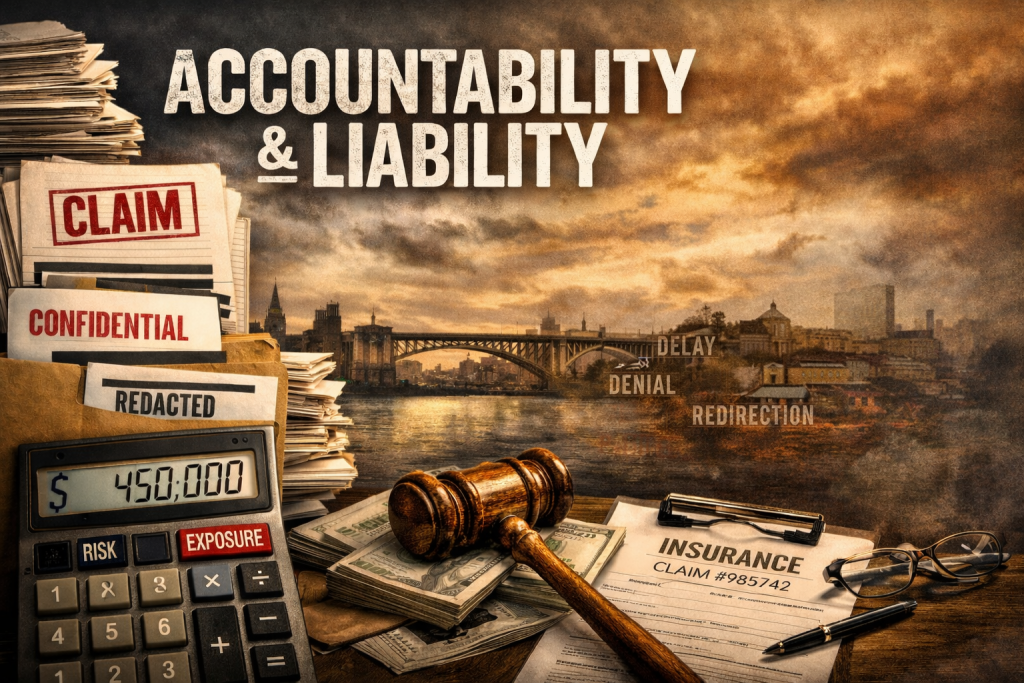
The numbers alone should stop any reader from treating this as a minor administrative issue. The record shows that what was once positioned as a dispute that could have been resolved at a relatively modest level is now being presented as a claim valued at hundreds of thousands of dollars. The communications reference a prior opportunity to resolve the matter for fifty thousand dollars, followed by a statement that the City’s chosen course of delay, denial, and deflection has resulted in a demand that is now nine times higher. That is not rhetoric. That is a direct statement of financial exposure tied to documented decisions.
“I initially offered to settle for $50,000… the City chose instead a path of delay, denial, and deflection… now… forced to submit a claim at nine times my original offer.”
That single sequence reframes everything that came before it. Every email that redirected a request instead of fulfilling it, every response that relied on custody rather than production, every refusal to seek clarification from the Ohio Ethics Commission, and every assertion of privilege that concealed rather than explained becomes part of a chain of decisions that now carries measurable cost.
That is where the redactions themselves take on a different level of importance.
This is no longer just a dispute about whether information should be released. It is a dispute about whether information is being withheld at the exact moment it becomes most relevant to determining liability. The production in Email Set 16 contains extensive redactions that are asserted under claims of attorney client privilege, even as the same record shows those communications being distributed across broad internal and external networks. Those redactions are not occurring in a vacuum. They are occurring in the middle of a claim where the underlying communications directly relate to how the City handled the very issues now being evaluated for financial exposure.
That is why a formal challenge was issued demanding clarification of those redactions.
The request for clarification was not a general objection or a speculative argument. It was based on what is visible in the emails themselves. The communications show forwarding chains, multi department distribution, and inclusion of individuals whose roles do not appear limited to legal consultation. Under Ohio law, privilege depends on confidentiality. When communications are shared beyond those necessary to provide legal advice, that confidentiality is called into question. When confidentiality is called into question, the privilege itself becomes vulnerable.
The City was therefore asked to explain, in specific terms, how each redaction meets the requirements of R.C. 149.43(B)(3), which mandates a clear legal basis for withholding public records. That includes identifying the recipients of the communication, explaining how each recipient fits within a privileged relationship, and demonstrating that confidentiality was maintained rather than waived through distribution. The record does not show that level of explanation. It shows redactions applied across communications that, on their face, raise serious questions about whether privilege can be sustained.
That issue does not stand alone. It sits alongside the broader pattern already established in the earlier files. The same system that declined to resolve competing legal interpretations, the same system that refused to seek outside clarification when presented with ethics concerns, and the same system that redirected requests instead of fulfilling them is now asserting privilege over the very communications that document those decisions. The effect is not simply to withhold information. The effect is to shield the process by which those decisions were made at the exact moment those decisions are being evaluated for their consequences.
The involvement of the City’s insurance structure confirms that the issue has moved beyond internal control. The communications show that the claim has been forwarded to a third party administrator responsible for evaluating risk and handling liability. That means the emails, the redactions, and the underlying decisions are no longer just part of a public records dispute. They are part of a claims process where the question is no longer what the City will say, but what the City will have to pay.
This is the point where the record changes function.
The earlier files documented a system responding to requests, debating the law, and ultimately refusing to resolve the conflicts placed in front of it. This set documents what happens after that refusal. The same record that showed how the system handled the issue now shows what that handling produced. The shift is not subtle. It is structural. The communication is no longer about interpretation. It is about exposure.
By the time this stage is reached, the question is no longer whether the law applies or whether records should have been produced. The question is what the cost will be when a system receives the law, argues the law, refuses to resolve the law, and then attempts to withhold the record of those decisions while facing a claim built on the very same conduct.
II. FROM REQUEST TO CLAIM
When the Paper Trail Becomes Evidence
The earlier portions of the record did not develop in isolation, and they did not end when the last response was sent or when the last refusal was issued. What they created was a pattern, and that pattern is what carries forward into this stage. Requests were made under Ohio Revised Code 149.43 with specificity and repetition. Those requests were not vague, and they were not abandoned when incomplete responses were given. They were followed, clarified, and reinforced with direct citations to the law. The responses that came back from the City, including those from Law Director Patrick Riley and Assistant Law Director Joseph LaVeck, did not deny that records existed. Instead, they consistently focused on custody, directing the requester to other departments rather than producing the records themselves. That distinction defined the early stage of the dispute, and it is the same distinction that now becomes part of the claim.
At the same time, the record shows that the issue did not remain contained within a single department or a single interpretation of the law. The communications were distributed across a wide network that included Mayor Jack Bradley, Safety Service Director Rey Carrion, members of City Council, county officials, state oversight agencies, and multiple media outlets. That distribution ensured that the arguments being made were not hidden, and it ensured that the legal framework surrounding those arguments was visible to everyone involved. The discussion expanded beyond the Public Records Act to include Sunshine Law compliance under R.C. 121.22, ethics obligations under R.C. 102.03, and the Rules of Professional Conduct governing government attorneys. The system did not ignore those arguments. It responded to them, challenged them, and debated them in writing.
What the system did not do was resolve them.
That unresolved history does not disappear when this portion of the record begins. It becomes the basis of what follows. The communications now show that a formal demand has been submitted, and that demand does not treat the earlier exchanges as routine or inconsequential. It treats them as a sequence of decisions that had legal consequences. The claim asserts that the City’s conduct went beyond administrative handling of a records request and entered into territory that may give rise to liability. The allegations extend beyond access to documents and include retaliation, interference, and actions taken in response to the requests themselves.
This is where the structure of the record changes in a way that cannot be overstated. The emails are no longer simply documenting a conversation. They are being used to construct a narrative that is intended for evaluation by entities outside the City’s internal decision making process. Every prior communication, every response, every redirection, and every refusal is no longer just part of a thread. It is part of a timeline.
The claim does not rely on a single moment. It relies on the entire sequence.
That sequence includes the initial requests, the responses that focused on custody rather than production, the escalation to state agencies, the introduction of ethics and conflict of interest arguments, and the refusal to seek outside clarification when it was requested. It also includes the distribution of those communications to a broad audience, ensuring that the issues were known and that the system cannot claim lack of awareness. All of those elements are now being presented together, not as separate disputes, but as a continuous course of conduct.
That is what transforms the record from communication into evidence.
When a matter reaches this stage, the focus shifts from what was said to what can be proven. The emails are no longer evaluated for tone or intent. They are evaluated for content, timing, and consistency. Statements that once functioned as responses are now examined as positions. Decisions that once appeared administrative are now assessed for their impact. The absence of resolution is no longer just a procedural outcome. It becomes part of the argument itself, because it demonstrates that the system had the opportunity to address the issue and did not do so.
The presence of redactions within this set adds another layer to that evaluation. The same communications that are now being relied upon as evidence are also being partially withheld under assertions of privilege. That creates a direct tension within the record. On one hand, the City is participating in a process where its actions are being evaluated for liability. On the other hand, it is limiting access to the communications that document those actions. That is why a formal challenge to the redactions was necessary, and why that challenge demands a record specific explanation for each withholding under R.C. 149.43(B)(3).
The request for clarification on those redactions is not separate from the claim. It is part of it. If the communications are being used to evaluate whether the City’s conduct created liability, then the completeness and transparency of those communications become central to that evaluation. Any attempt to withhold or obscure portions of that record must be justified with precision, not with general assertions.
What emerges from this section is a clear transformation in how the record functions. The earlier emails documented a dispute. These emails document the use of that dispute as the basis for a claim. The same words that were once part of an ongoing conversation are now fixed in place as part of a narrative that is being reviewed for legal and financial consequences.
This is the point where the paper trail stops being something the City manages and becomes something the City must answer for.
III. THE INSURANCE TRIGGER
When the City Is No Longer Just Defending Itself
The most consequential shift in this portion of the record is not rhetorical and it is not procedural. It is structural, and it is confirmed by the involvement of the City’s insurance apparatus. The communications show that the matter is no longer being handled solely within the internal framework of the Law Department. It is forwarded outward, formally and deliberately, to the entity responsible for managing claims, evaluating exposure, and determining whether the City’s actions have created financial liability. That transition marks the point where the dispute stops being something the City can contain through interpretation and becomes something that must be measured.
The record reflects that the claim is opened and assigned through a third party administrator, placing it into a system that operates under an entirely different set of expectations than internal legal correspondence. The involvement of that administrator means the issue is no longer framed around whether a response was sufficient or whether a department properly redirected a request. It is now framed around whether the City’s conduct, taken as a whole, creates risk that must be addressed through settlement, defense, or payment. The same emails that were once part of a dispute are now part of a file that will be reviewed for consistency, credibility, and exposure.
That shift changes the role of every official involved. Law Director Patrick Riley and Assistant Law Director Joseph LaVeck are no longer simply responding to a requester or defending a position in an email chain. Their communications are now part of a record that will be examined by individuals whose responsibility is to assess liability, not to defend internal decisions. Mayor Jack Bradley and Safety Service Director Rey Carrion are no longer just copied recipients in a wide distribution chain. They are now part of a leadership structure whose actions and knowledge may be evaluated in terms of oversight and accountability within the claim.
The presence of an insurance administrator introduces a level of scrutiny that does not depend on internal agreement. The administrators handling the claim are not bound by the City’s prior interpretations of the law, and they are not limited to the positions asserted in earlier communications. Their role is to evaluate the record as it exists, to identify where risk has been created, and to determine how that risk should be managed. That evaluation does not focus on whether the City believed it was correct. It focuses on whether the City’s actions can be defended under the law and what the financial consequences will be if they cannot.
Every prior decision becomes relevant at that point. The responses that relied on custody rather than production are no longer just procedural choices. They are part of a pattern that may be examined for compliance with R.C. 149.43. The refusal to seek clarification from the Ohio Ethics Commission when conflict of interest concerns were raised is no longer just a position taken in a debate. It is part of the record that may be reviewed to determine whether the City failed to use available mechanisms to resolve legal uncertainty. The continued distribution of communications across a broad network while asserting confidentiality through redactions is no longer just a matter of internal handling. It becomes a question of whether privilege was properly maintained or whether it was waived through the very conduct reflected in the emails.
The redactions themselves take on heightened significance in this context. The City is asserting attorney client privilege over communications that are now central to the evaluation of liability. At the same time, the record shows those communications being forwarded, distributed, and shared across multiple participants. That tension does not exist in isolation. It becomes part of the claim, because the completeness of the record directly affects how the claim is assessed. When portions of the record are withheld, the justification for those redactions must withstand scrutiny not only under the Public Records Act but also within a claims process that depends on the integrity of the underlying documentation.
The forwarding of the claim to the insurance administrator also confirms that the City recognizes the potential exposure created by the sequence of events. Claims are not opened for minor disputes that can be resolved through routine correspondence. They are opened when there is a recognized possibility that the City may be required to defend its actions in a formal setting or to resolve the matter through financial means. The assignment of a loss number and the involvement of a claims manager indicate that the issue has reached that level.
What follows from that recognition is unavoidable. The City is no longer simply explaining what it did. It is justifying those actions in a framework where the outcome may include financial consequences. The evaluation will not be limited to whether a single response was correct. It will consider the entire course of conduct, including how requests were handled, how legal arguments were addressed, how conflicts were managed, and whether the system acted consistently with the obligations imposed by law.
This is the point where the earlier decisions begin to take on weight that cannot be dismissed as procedural. Each step that was taken or not taken becomes part of a cumulative analysis. Each refusal to resolve an issue internally becomes part of the explanation for why the issue moved beyond internal control. Each assertion of privilege becomes part of a larger question about transparency and compliance at the moment those qualities are most critical.
The involvement of the insurance structure does not create the problem. It reveals it.
What had been contained within email chains is now part of a formal process that exists to determine whether those communications reflect conduct that creates liability. The record no longer serves only as a history of what happened. It becomes the basis for what may happen next.
IV. THE COST OF DELAY
When Prior Decisions Are Reframed
What emerges at this stage is not a new set of facts, but a new interpretation of the same facts that were already in the record. The claim does not introduce an isolated allegation or a single event that suddenly creates exposure. It takes the entire sequence that has already been documented, including the requests, the responses, the redirections, the legal arguments, and the refusals to resolve those arguments, and reframes them as a pattern of conduct that increased liability over time. The significance of that shift cannot be overstated because it changes the function of every prior communication from something that was simply part of a process into something that now carries measurable consequence.
The communications themselves make this point directly. The claim states that there was an earlier opportunity to resolve the matter at a substantially lower level and that the City chose not to take that opportunity. The number attached to that opportunity is specific and grounded in the record. A prior settlement offer of fifty thousand dollars is referenced, followed by a statement that the current demand has increased to nine times that amount. That is not an abstract comparison. It is a quantified escalation tied directly to the actions that followed the initial offer.
“I initially offered to settle for $50,000… the City chose instead a path of delay, denial, and deflection… now… forced to submit a claim at nine times my original offer.”
That statement does more than describe an increase. It assigns cause. It asserts that the increase is not the result of new events, but the result of how the existing events were handled. The language used is deliberate. Delay is identified as a factor. Denial is identified as a factor. Deflection is identified as a factor. Each of those terms corresponds to patterns that are already visible in the earlier record, where requests were redirected rather than fulfilled, where legal arguments were debated but not resolved, and where opportunities to seek clarification or produce records were not taken.
What this framing does is transform those earlier decisions into part of a cumulative argument. A response that once appeared administrative is now examined as a step in a sequence that contributed to increased exposure. A refusal to engage with a legal argument is no longer just a position taken in a disagreement. It becomes part of the justification for why the dispute escalated instead of resolving. The absence of resolution is no longer neutral. It is presented as a contributing factor.
The involvement of officials such as Patrick Riley and Joseph LaVeck becomes more significant in this context because their responses are now part of the record being evaluated for impact. The same communications that addressed requests under R.C. 149.43 and responded to escalating legal arguments are now viewed through a different lens. They are no longer just explanations of position. They are part of the history that is being used to explain why the claim has reached its current level.
This is also where the issue of redactions intersects directly with the question of cost. The City has asserted privilege over portions of the communications that document how these decisions were made, even as the claim relies on the full sequence of those decisions to establish liability. That creates a direct conflict between what is being evaluated and what is being disclosed. The request for clarification on those redactions is not separate from the claim. It is part of the same effort to determine whether the record, as presented, accurately reflects the conduct that is now being used to justify financial exposure.
The demand for clarification under R.C. 149.43(B)(3) requires the City to explain, with specificity, how each redaction is justified, including how confidentiality was maintained in communications that appear to have been broadly distributed. If those redactions cannot be sustained, then the record becomes more complete, and the evaluation of the claim becomes more precise. If they are sustained without sufficient explanation, then the question becomes whether relevant information is being withheld at the exact moment it is most critical to understanding the scope of liability.
The claim itself removes the need to speculate about whether the earlier decisions mattered. It asserts that they did, and it ties those decisions directly to the increased demand. The difference between fifty thousand dollars and a claim valued at several hundred thousand dollars is not presented as a coincidence. It is presented as the result of a series of choices made over time, each of which is documented in the record.
That is what makes this section so significant. The dispute is no longer being evaluated in terms of whether the City complied with the Public Records Act in a single instance. It is being evaluated in terms of whether the City’s overall handling of the issue created a situation where the cost of resolution increased dramatically. The record does not have to infer that connection. The claim states it explicitly and supports it with the same communications that were previously treated as part of an ongoing exchange.
What this ultimately shows is that delay is not neutral. Denial is not neutral. Refusal to resolve is not neutral. When those actions are repeated and documented, they form a pattern, and when that pattern is presented within a claim, it becomes the basis for assigning cost.
V. THE SAME NETWORK, A DIFFERENT PURPOSE
When Distribution Becomes Accountability
The structure of the communication in this portion of the record does not change, and that is exactly what makes it significant. The same broad distribution that appeared throughout the earlier exchanges remains intact. The emails continue to include City leadership, Law Department officials, members of Council, county level actors, law enforcement, state oversight agencies, and media contacts. Names that have appeared repeatedly throughout the record continue to appear here, including Law Director Patrick Riley, Assistant Law Director Joseph LaVeck, Mayor Jack Bradley, and Safety Service Director RC. The network itself is unchanged. What changes is the function that network serves.
In the earlier stages of the record, that distribution operated as a mechanism of awareness. The emails were deliberately circulated across departments and levels of government in a way that ensured no official could claim that they were unaware of the requests being made or the legal arguments being presented. The inclusion of state agencies and media contacts reinforced that effect by extending that awareness beyond internal operations and into the public sphere. The purpose of that distribution was to place the issue in front of everyone at the same time, with the same information, and to remove any question about whether the system had been put on notice.
At this stage, that same structure produces a different outcome.
The emails no longer circulate a request or a legal argument that can still be debated or redirected. They circulate a claim. The same individuals who received the earlier communications are now receiving documentation that ties those earlier events to a demand for relief and to a quantified level of exposure. The distribution that once ensured awareness now ensures accountability because it places the consequences of prior decisions in front of the same audience that was previously given the opportunity to address those decisions when they were first raised.
This shift is not theoretical. It is visible in how the communications are framed and what they contain. The earlier emails presented statutory citations, legal questions, and requests for action. The emails in this stage present a narrative that connects those elements into a claim that is being evaluated for liability. The inclusion of the same recipients means that the officials who were aware of the arguments are now equally aware of how those arguments have been reframed. The system cannot separate the two stages because they exist within the same communication network, involving the same participants, and referencing the same underlying events.
That continuity matters because it eliminates any argument that the claim emerged without warning or without context. The record shows that the issues were raised repeatedly, that the legal framework was explained, and that the system engaged with those issues without bringing them to resolution. The distribution of the claim to the same network confirms that the consequences are not being introduced after the fact. They are being tied directly to a history that was already known to everyone involved.
The presence of media contacts within that distribution adds another dimension to the shift. The same channels that carried the dispute into the public domain now carry the outcome of that dispute in a form that includes financial exposure and allegations of liability. The issue is no longer confined to internal compliance or legal interpretation. It is now part of a public narrative that connects the City’s actions to measurable consequences. That connection is reinforced by the fact that the communications themselves serve as the source of that narrative, documenting both the arguments that were made and the responses that followed.
The issue of redactions becomes more pronounced in this context. The City continues to assert privilege over portions of communications that are now central to understanding how the claim developed and how the underlying decisions were made. At the same time, those communications have been distributed across a network that includes individuals and entities outside a traditional attorney client relationship. That creates a direct tension between the claim of confidentiality and the reality of distribution, and it raises the question of whether the record is being presented in a complete form to the same audience that is now being asked to evaluate its consequences.
The request for clarification on those redactions, made under R.C. 149.43(B)(3), is therefore not an isolated procedural step. It is part of the broader issue of accountability that this section of the record reflects. If the communications are being used to support or evaluate a claim, then the integrity and completeness of those communications become essential. The City is being asked to explain how privilege is being applied in a way that is consistent with the law, particularly in light of the distribution patterns that are evident within the emails themselves.
What this section ultimately demonstrates is that the network that once carried information now carries responsibility. The same structure that ensured awareness now ensures that the consequences of earlier decisions are visible to every participant who had the opportunity to address those decisions when they were first raised. The system is no longer being informed. It is being confronted with the outcome of what it chose to do with that information.
VI. WHAT THIS ACTUALLY SHOWS
A System That Was Given the Opportunity to Resolve Itself
When this portion of the record is read in full, and not in isolated excerpts, it does not reveal a sudden breakdown or an unexpected event that created the current situation. It reveals continuity. The same names appear, the same legal issues are raised, the same responses are given, and the same lack of resolution persists across each stage. What changes is not the nature of the problem, but the stage at which it is now being evaluated. The system is no longer being asked whether it will resolve the issue. It is being examined based on the fact that it did not.
The earlier communications established the foundation with clarity. Requests were made under Ohio Revised Code 149.43 with specificity and repetition. Those requests were not ignored in the sense of being left unanswered. They were met with responses that consistently relied on custody rather than production, directing responsibility elsewhere without producing a complete result. Legal arguments were introduced in direct terms, citing Sunshine Law requirements under R.C. 121.22, ethics provisions under R.C. 102.03, and the Rules of Professional Conduct governing the conduct of government attorneys. Those arguments were not hidden or confined to a single exchange. They were distributed across a network that included Law Director Patrick Riley, Assistant Law Director Joseph LaVeck, Mayor Jack Bradley, Safety Service Director Rey Carrion, and a broader group of officials, agencies, and media contacts.
That distribution ensured that the system was not only aware of the issues, but fully informed of the legal framework surrounding them. The arguments were not speculative. They were supported with statutory citations and requests for specific action, including the request that the Ohio Ethics Commission be consulted to resolve potential conflicts of interest. That request was not granted. The response that followed asserted that such consultation was unnecessary and closed the discussion without engaging the mechanism that exists to provide authoritative clarification.
At that point, the system was no longer lacking information. It was operating with competing interpretations of the law that had been presented side by side and left unresolved. That condition did not change in the communications that followed. Instead, it persisted. Requests continued to be redirected. Legal arguments continued to be addressed without being resolved. The same issues were raised in different forms, and the same pattern of response continued.
The redactions present in this portion of the record reinforce that pattern rather than interrupt it. The City has asserted attorney client privilege over communications that are central to understanding how these decisions were made, even as those same communications appear to have been distributed across multiple participants. A formal challenge was issued demanding clarification under R.C. 149.43(B)(3), requiring the City to identify the basis for each redaction, to explain how confidentiality was preserved, and to account for the distribution reflected in the emails themselves. That request for clarification is not separate from the pattern. It is part of it, because it seeks to resolve a question that arises directly from how the system has handled the record at every stage.
What this section shows is that the system was presented with multiple opportunities to resolve the issues before they reached this point. It could have produced the requested records in full. It could have referred the requests to the appropriate custodians in a manner that ensured completion rather than redirection. It could have sought clarification from the Ohio Ethics Commission when questions of conflict were raised. It could have addressed the legal arguments in a way that produced a consistent and authoritative interpretation. Each of those steps was available, and each of those steps would have reduced uncertainty.
Those steps were not taken.
Instead, the system continued to operate within a framework where responses were issued but not resolved, where interpretations were asserted but not confirmed, and where the absence of a unified answer allowed the same issues to persist across multiple communications. That persistence is what defines the transition into the claim. The claim does not introduce a new problem. It formalizes the existing one.
The involvement of the insurance administrator and the assignment of a claim number confirm that the matter has moved beyond internal control. The system is no longer in a position to determine whether the issue will be addressed. It is now in a position where its prior conduct is being evaluated by an external process designed to assess liability. The same communications that documented the opportunity to resolve the issue now document the fact that it was not resolved, and that failure becomes part of the analysis.
This is why the current stage of the record matters. It does not represent the beginning of the problem. It represents the point where the consequences of the earlier pattern become visible in a form that cannot be managed through internal response alone. The system was given the opportunity to resolve itself, with full awareness of the issues and the legal framework that governed them. The record shows that it did not do so, and that the outcome of that decision is now being measured in terms that extend beyond procedure and into liability.
VII. FINAL THOUGHT
When the Record Starts Counting
By the time this portion of the record reaches its conclusion, it is no longer functioning as a simple account of communication between a requester and a public office. It has become something far more significant, because the same emails that once reflected a process are now being used to measure the outcome of that process. What began as a series of requests under Ohio Revised Code 149.43 has developed into a documented sequence of decisions, responses, and refusals that are now being examined in terms of liability, exposure, and cost.
Every element that appeared earlier in the record remains present at this stage. The requests are still there, clearly stated and grounded in law. The responses are still there, reflecting the positions taken by officials including Law Director Patrick Riley and Assistant Law Director Joseph LaVeck. The legal arguments are still there, citing Sunshine Law requirements, ethics statutes, and professional conduct rules. The refusals are still there, including the decision not to seek clarification from the Ohio Ethics Commission and the reliance on internal interpretation in place of independent review. The redactions are still there, limiting access to portions of the very communications that now form the basis of the claim, even as a formal challenge demands explanation under R.C. 149.43(B)(3).
What changes is how all of those elements are understood when they are viewed together.
They are no longer isolated entries in an email chain that can be evaluated one at a time. They form a continuous record that shows how the system handled a defined set of issues from beginning to end. That record does not stop at the point where the last response was issued. It continues into the claim that now relies on that same sequence to establish liability. The earlier communications do not disappear when the claim is made. They are incorporated into it, forming the basis for how the City’s conduct is evaluated.
The involvement of the insurance administrator confirms that this evaluation is not theoretical. The assignment of a claim number and the forwarding of the matter for review place the record into a process where the focus is no longer on whether the City believed its actions were appropriate. The focus is on whether those actions can be defended under the law and what the financial consequences will be if they cannot. That process does not rely on internal agreement or interpretation. It relies on the record as it exists.
This is where the shift becomes structural rather than procedural.
The system is no longer in a position where it can determine how it will respond to a request. That phase has already passed. The responses have been given, the positions have been asserted, and the opportunities to resolve the issues internally have already been presented. The system is now in a position where its prior actions are being evaluated by a process that exists to assign responsibility and determine cost. The emails, the redactions, and the decisions reflected in the record are no longer part of an ongoing exchange. They are part of an assessment.
The distinction between interpretation and consequence becomes clear at this point. Earlier in the record, the discussion centered on what the law required and how it should be applied. Different interpretations were presented, debated, and left unresolved. That unresolved condition carried forward into each subsequent stage, allowing the same issues to persist without a definitive answer. At this stage, the question is no longer what the law means. The question is what happens when a system operates without resolving that question and the resulting conduct is subjected to review.
The numbers associated with the claim provide a direct measure of that outcome. The difference between an initial settlement opportunity of fifty thousand dollars and a demand that is now several times higher is not presented as a coincidence. It is presented as the result of the sequence documented in the record. The decisions that were made, the responses that were given, and the issues that were left unresolved are now part of the explanation for that increase.
That is what it means for the record to start counting.
It counts the requests that were made and how they were answered. It counts the opportunities that were presented to resolve the issue and how those opportunities were handled. It counts the legal arguments that were raised and the decisions not to seek clarification through available mechanisms. It counts the communications that were distributed across a wide network and the actions that followed that distribution. It counts the redactions that now limit access to portions of that record and the challenge that demands justification for those withholdings.
Most importantly, it counts the consequences of all of those elements taken together.
The system is no longer defining the issue through its responses. The record is defining the system through its actions. The evaluation that follows does not depend on how the City characterizes its conduct. It depends on what the record shows and how that record aligns with the legal obligations that governed each step along the way.
At this stage, the record does not end with an answer. It moves into a phase where the answer will be determined through a process that measures what has already been done.
LEGAL DISCLAIMER:
This article is a work of investigative journalism based on public records, direct communications, and supporting documents obtained through lawful means, including requests made pursuant to Ohio Revised Code 149.43. The material presented reflects the author’s analysis and interpretation of the documented record and is published in the public interest.
Certain matters referenced in this publication are the subject of ongoing litigation and administrative proceedings. Nothing contained herein is intended to interfere with, influence, or circumvent any pending legal action, nor should it be construed as a filing, argument, or submission to any court or tribunal. All statements are made outside of judicial proceedings and are presented solely for journalistic and informational purposes.
References to named individuals, including public officials and candidates for office, are made in connection with matters of public concern. Any conclusions drawn are expressly presented as opinion based on disclosed facts and are protected under the First Amendment to the United States Constitution and Article I, Section 11 of the Ohio Constitution. No statement should be interpreted as a definitive assertion of criminal liability unless expressly supported by cited law and adjudicated findings.
This publication does not constitute legal advice. All individuals and entities are presumed innocent unless and until proven otherwise in a court of law. The author reserves the right to update, correct, or expand upon this material as additional records become available.
© 2026 Knapp Unplugged Media LLC. All rights reserved.
About The Author