
THE RECORD BEFORE THE TURN
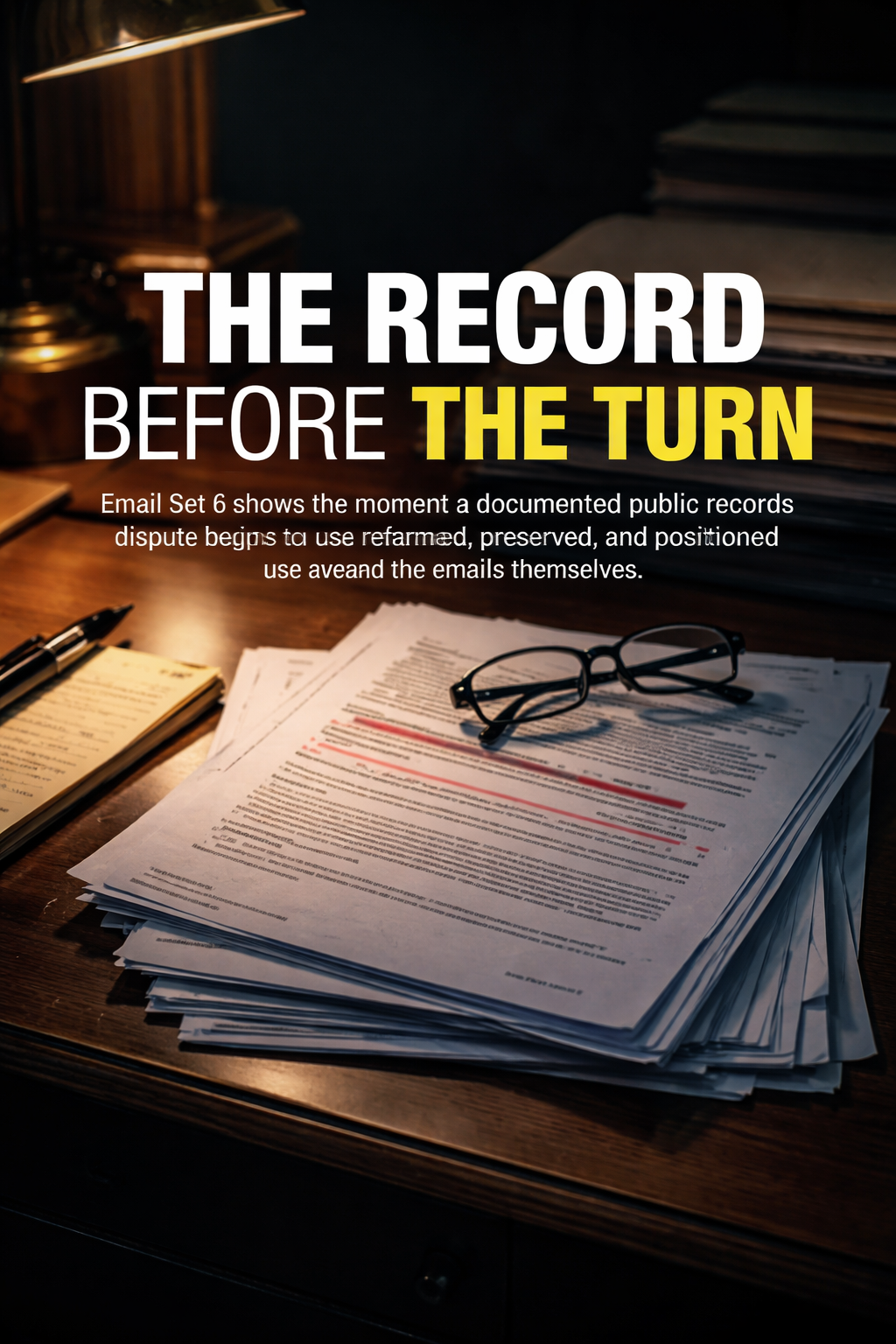
Email Set 6 shows the moment a documented public records dispute begins to be reframed, preserved, and positioned for use beyond the emails themselves
By Aaron Christopher Knapp, BSSW, LSW
Investigative Journalist and Public Records Litigant
Editor-in-Chief, Lorain Politics Unplugged
Knapp Unplugged Media LLC
INTRODUCTION WHAT THE EARLIER RECORD ALREADY PROVED
By the time I reached the sixth email dump they handed over, I was no longer trying to determine whether the communication existed or who was involved in it. That had already been established in the earlier sets, and it was not a close question. My emails were not isolated or ignored. They were sent directly into the center of Lorain city government and received by the people responsible for responding to them. Patrick Riley was on them. Joseph LaVeck was on them. The Safety Service Director, was on them. City Council members were on them. Law enforcement, media, and state offices were included alongside them.
What those earlier records proved is straightforward and cannot be rewritten after the fact. I was not operating outside the system. I was operating inside it, using Ohio law to request records, raise legal concerns, and document conduct that I believed violated statutory and constitutional protections. The responses confirmed that reality. Even when those responses were delayed, incomplete, or legally insufficient, they still acknowledged the communication. The system was engaged. It was aware. It was participating.
At the same time, there was a second layer developing beneath the surface, and I tracked that separately in what I referred to as the side series. While the main record focused on the substance of the communication, that secondary track focused on how the communication itself was being described. It followed the shift in tone, the change in framing, and the early signs that the same emails were beginning to be viewed through a different lens. That context becomes critical here, because this is the point where those two tracks begin to collide.
Email Set 6 is not the beginning of the communication and it is not the end of it. It is the point where something changes in how that communication is treated. The emails themselves do not disappear. The recipients do not disengage. The legal arguments do not stop. What changes is how those same emails begin to be interpreted, described, and eventually used.
This is where the record stops being just a record.
This is where it starts becoming something else.
I. THE CONTENT OF EMAIL SET 6 WHAT WAS ACTUALLY BEING SAID
When you read Email Set 6 in full, not as isolated excerpts but as a continuous chain of communication, what stands out immediately is not silence or disengagement but continued, active communication that remains rooted in specific allegations, legal arguments, and documented concerns. The tone sharpens in places, and there is no reason to avoid that reality, but the substance does not disappear. The emails continue to reference identifiable conduct, cite legal obligations, and demand records that fall squarely within the scope of Ohio’s Public Records Act under R.C. 149.43 and related statutory frameworks.
On February 19, 2025, I sent a detailed email to the City Council group, Patrick Riley, Joseph LaVeck, the Safety Service Director, and multiple other officials, raising concerns about violations of the Ohio Open Meetings Act. The content of that email was not abstract. It identified specific behavior observed during a public meeting, including texting during proceedings and off microphone communication, and it directly tied those actions to legal obligations governing transparency and deliberation. The request that followed was equally specific. I demanded the production of those communications, including text messages, and challenged the validity of meeting minutes that failed to reflect what had actually occurred.
That same email did not stop at a single issue. It expanded into a structured list of outstanding public records requests that had not been fulfilled, including communications involving Tim Weitzel and Chief James McCann, financial records, contracts, and internal documentation tied to city operations. The scope of the request was broad, but it was not vague. Each item identified a category of records that would fall within the definition of a public record under R.C. 149.011(G), and each request was made within an ongoing dispute that had already been acknowledged by the City through prior responses.
In a separate communication sent that same morning, I raised a different issue involving the release of an accident report containing an officer’s driver’s license number. That allegation was not framed as a general complaint but as a specific claim that the City had improperly disclosed protected personal information. The statement that followed made the expectation clear. The City needed to understand what information must be protected and what could lawfully be released.
The escalation in tone becomes more visible in the February 20, 2025 email, where I directly referenced Chief James McCann and accused him of conduct affecting disabled veterans. That language is forceful, and it is likely to be the type of language isolated later when the narrative shifts. What cannot be removed, however, is the context in which it was sent. That email was distributed to the same group of officials, including Patrick Riley, Joseph LaVeck, and the Safety Service Director, as well as members of the media and law enforcement. It was not hidden, and it was not sent outside the existing communication channels.
Another key component of this set is the February 19 update email addressing what I identified as a violation of the Family Educational Rights and Privacy Act. In that communication, I stated that student information had been improperly released and directly challenged prior assertions made by Patrick Riley, Mayor Jack Bradley, and Chief McCann that the release was lawful. I referenced prior statements, identified the legal framework governing the information, and asserted that the conduct had already caused harm, including impacts on my employment and professional standing.
When these emails are read together, the pattern is consistent. The tone varies, and at times it becomes confrontational, but the structure remains intact. Each email ties back to a specific issue, a defined set of records, or an identifiable legal obligation. The communication is not random. It is not disconnected. It is part of an ongoing dispute that is being documented in real time, with the same officials remaining on the threads, the same issues being raised, and the same legal framework underlying each exchange.
That distinction is critical, because it defines what this communication actually is before anyone attempts to redefine it later.
II. THE PARTICIPATION WHAT THEY DID WHILE THIS WAS HAPPENING
What matters just as much as what was said in these emails is what the recipients chose to do while it was happening. The record does not show a breakdown in communication. It shows continued inclusion, continued awareness, and continued participation by the same officials who would later be tied to a very different narrative about this same body of emails.
Every one of these messages continued to include Patrick Riley, Joseph LaVeck, the Safety Service Director, members of City Council, law enforcement, and media outlets. That distribution did not shrink as the tone became more direct. It remained consistent. That detail is not minor. It establishes that the communication was not hidden, not redirected into private channels, and not forced into a space where it could be ignored. It remained exactly where it had been from the beginning, inside official lines of communication that the City itself uses to conduct business.
There is also no indication in this set that anyone attempted to formally disengage. There is no written directive telling me to stop contacting specific individuals. There is no documented notice restricting communication. There is no effort to remove me from distribution lists or to instruct others to do so. Instead, the same officials remained present, continued receiving the emails, and allowed the communication to continue without interruption.
That matters because participation is not passive when it comes to public officials. These are individuals who are fully capable of responding, clarifying, correcting, or formally objecting. They have access to legal counsel. They understand process. They know how to document and enforce boundaries when necessary. The absence of any immediate action to restrict or redirect communication is not an oversight. It is part of the record.
What also stands out is that the City did not attempt to compartmentalize these communications even as they expanded. The emails were still being sent through group lists that included council, administration, legal counsel, and outside observers. That means the communication was being allowed to exist in a space where it could be seen, evaluated, and responded to by multiple decision makers at the same time. If there had been a belief that the communication was improper in its form or scope, there were clear opportunities to isolate it, redirect it through counsel, or formally limit its distribution. None of that happened here.
There is also no evidence at this stage of any contemporaneous documentation labeling this communication as harassment. There are no internal responses within this set that characterize the emails in that way, no written objections preserved in the thread, and no immediate escalation that would typically follow if communication had crossed a line requiring intervention. Instead, what the record shows is a system that continues to receive, continue to observe, and continue to allow the communication to exist without formally challenging it in real time.
At the same time, the issues being raised in the emails were not new or unknown to the recipients. These were ongoing disputes that had already been acknowledged through prior responses, delays, and partial productions. The emails referencing public records, Open Meetings Act concerns, and other legal issues were part of a continuing pattern that the City was already aware of. That context matters because it shows that the communication was not introducing new subjects without warning. It was continuing a dispute that had already been established within the system itself.
This creates a clear and unavoidable point. While the tone of the communication may have become more forceful, the structure surrounding it did not change. The same people were involved. The same issues were being raised. The same channels were being used. The system did not shut down communication. It allowed it to continue.
And when a system allows communication to continue in that way, without restriction, without formal objection, and without contemporaneous characterization as improper, that becomes part of the record just as much as the emails themselves.
III. THE CONTEXT THEY LEFT OUT WHAT THESE EMAILS WERE ACTUALLY ABOUT
What becomes critical at this stage is restoring the context that is easiest to remove later. Because when individual lines from these emails are pulled out and presented on their own, what disappears first is the reason they were written in the first place.
Every communication in Email Set 6 is tied to an underlying dispute that was already in progress. These were not isolated statements sent without purpose. They were part of an ongoing effort to obtain public records, challenge legal positions taken by the City, and force responses to issues that had already been raised multiple times. The emails do not introduce new topics out of nowhere. They continue existing ones.
When I raised concerns about Open Meetings Act violations, I was not making a general accusation. I was pointing to specific conduct observed during a public meeting and tying that conduct to legal obligations under R.C. 121.22. When I demanded text messages and challenged the accuracy of meeting minutes, I was invoking the statutory requirement that public business be conducted openly and that records reflect what actually occurred. That is not harassment. That is enforcement of the law as written.
The same applies to the public records requests that run throughout this set. The emails include requests for communications involving Tim Weitzel and Chief James McCann, financial records, contracts, and internal documentation tied to city operations. Those requests fall squarely within the definition of a public record under R.C. 149.011(G), and the duty to produce them is governed by R.C. 149.43. These were not speculative demands. They were requests grounded in statute, made within a dispute that had already been acknowledged by the City through prior delays and responses.
The FERPA issue follows the same pattern. When I raised concerns about the release of student information, I did so by identifying a specific category of protected data and challenging prior statements made by City officials that the release was lawful. That was not a personal attack. It was a legal dispute over whether federal law governing student privacy had been violated, and whether the City’s interpretation of that law was correct.
Even the language that becomes more forceful later in the set does not exist outside of this context. Statements that accuse officials of wrongdoing are tied directly to these same disputes. They are connected to records that were not produced, to conduct that was observed, and to legal interpretations that were being challenged in real time. When those statements are separated from that context, they can be made to appear as something else entirely. When they are read within it, they remain part of a continuous argument.
Another piece of context that cannot be ignored is the scope of distribution. These emails were not sent privately to a single individual. They were sent to groups that included legal counsel, administrative officials, elected representatives, law enforcement, and media outlets. That distribution reflects the nature of the dispute itself. It was not confined to one office or one issue. It involved multiple actors and multiple areas of responsibility, and the communication reflects that reality.
What this section of the record shows, when viewed in full, is not a series of disconnected messages. It shows a structured, ongoing dispute being documented in real time. The issues are identified, the legal framework is referenced, the records are requested, and the communication is preserved across multiple participants.
That context is what gives the emails their meaning.
And it is the first thing that disappears when those emails are taken out of the timeline and presented as something they were never intended to be.
IV. THE REFRAMING HOW THE SAME EMAILS BECOME SOMETHING ELSE
Once the content and the context are laid side by side, the next step in the record becomes impossible to ignore. Nothing about the underlying communication suddenly changes in a way that would naturally transform it into something entirely different. The same people remain involved. The same issues are being raised. The same legal framework continues to apply. What changes is not the communication itself but how it is later described.
This is where the reframing begins.
The same emails that document public records requests, legal disputes, and ongoing complaints start to be treated as something separate from those purposes. Statements that were tied directly to statutory obligations are pulled away from the law that gave them meaning. Requests that were grounded in R.C. 149.43 are no longer described as records requests. Allegations tied to Open Meetings Act violations are no longer framed as enforcement of R.C. 121.22. Instead, the focus shifts to the tone of the language, the frequency of the communication, and the breadth of the distribution.
That shift does not happen inside the emails themselves. It happens after the fact.
What this means in practical terms is that the substance of the communication is no longer the center of the analysis. The existence of the communication becomes the focus. The question moves away from whether the records were produced, whether the law was followed, or whether the concerns were valid. It becomes centered on how often the emails were sent, who was included, and how the language was phrased.
When that happens, the original purpose of the emails is effectively removed.
The February 20 email referencing Chief James McCann provides a clear example of how this process works. In isolation, that statement can be presented as a direct accusation with strong language. Removed from the surrounding emails, it can be framed as personal or excessive. But within the record, it exists as part of a broader dispute that includes ongoing allegations, prior communications, and repeated attempts to obtain records and responses. The meaning of that statement changes depending on whether the surrounding context is included or excluded.
The same applies to the February 19 email addressing Open Meetings Act violations. When viewed on its own, the language is direct and critical. When viewed within the full chain, it is part of a structured argument tied to observed conduct, statutory obligations, and specific records requests. The difference between those two readings is not the email itself. It is the presence or absence of context.
This is not an uncommon process in disputes that move from administrative communication into legal action. Records that are created for one purpose are later used for another. Statements made in the course of asserting rights are repurposed as evidence of something else. The timeline is compressed, the surrounding communication is removed, and the narrative is simplified in a way that changes how the same words are perceived.
What makes this section of the record significant is that the original context is still intact. The emails have not been lost. The distribution lists are visible. The sequence of communication can still be followed. That allows the comparison to be made directly, without relying on interpretation alone.
When you place the original emails next to the later characterization, the gap becomes clear.
The communication did not transform on its own.
It was reframed.
V. THE FOUNDATION FOR ESCALATION HOW THIS RECORD GETS USED
Once the reframing begins, the next step in the process is not immediate action but preservation. What Email Set 6 shows, when viewed as a continuous timeline, is a body of communication that is still active, still ongoing, and still unresolved at the time it is created. The issues raised in these emails are not closed, the records requested have not all been produced, and the legal disputes have not been answered. The communication is still moving forward in real time, which is exactly what allows it to later serve a different purpose.
Instead of resolving the underlying issues, the communication itself becomes the foundation for escalation. The same emails that document requests, disputes, and legal arguments begin to take on a second function. They are no longer just part of an ongoing exchange between a citizen and public officials. They become a record that can be collected, organized, and later presented in a completely different context. That transition does not require any new conduct. It relies entirely on what already exists within the record.
At the time these emails were sent, they functioned as communication. They were part of an effort to obtain responses, to compel compliance, and to document ongoing issues involving public records, meeting conduct, and legal interpretation. They were directed at officials who had the authority to respond, and they remained within the same official channels that had been used from the beginning. Nothing about their structure or purpose suggested that they were anything other than part of an active and unresolved dispute.
Once those same emails are preserved and revisited later, however, they take on a different role. They become documentation of frequency, tone, and distribution. They become something that can be measured, counted, and selectively presented. The focus shifts away from what was being asked and toward how often it was asked, how broadly it was distributed, and how the language was phrased. The substance of the communication becomes secondary to its existence.
This is how a record built for one purpose becomes the basis for something else entirely. The February communications within this set illustrate that process clearly. Within the timeline, they are part of a continuing dispute involving public records, Open Meetings Act concerns, and alleged violations of law. Outside of that timeline, they can be grouped together, quoted in part, and presented as a pattern. The words do not change, but the framework surrounding them does, and that shift changes how they are perceived.
It also explains why there is no immediate attempt within this set to stop or restrict the communication. There is no directive to cease contact, no formal limitation imposed, and no contemporaneous characterization of the emails as improper. Allowing the communication to continue preserves the record in its most complete form. It captures the full scope of what was sent, who received it, and how it developed over time. That preserved record is far more useful later than a fragmented or interrupted one.
What follows from that preservation is not a continuation of the dispute on the same terms. It is a transition into a different arena, where the communication itself is no longer just evidence of a disagreement but becomes the central issue being addressed. At that point, the original purpose of the emails becomes secondary. What matters is that they exist, that they can be assembled, and that they can be presented in a way that supports a new narrative.
That is the role this set plays in the larger timeline. It is not where the dispute is resolved. It is where the groundwork is laid for escalation that depends not on new actions, but on how existing communication is later used.
V. THE FOUNDATION FOR ESCALATION HOW THIS RECORD GETS USED
Once the reframing begins, the next step in the process is not immediate action but preservation. What Email Set 6 shows, when viewed as a continuous timeline, is a body of communication that is still active, still ongoing, and still unresolved at the time it is created. The issues raised in these emails are not closed, the records requested have not all been produced, and the legal disputes have not been answered. The communication is still moving forward in real time, which is exactly what allows it to later serve a different purpose.
Instead of resolving the underlying issues, the communication itself becomes the foundation for escalation. The same emails that document requests, disputes, and legal arguments begin to take on a second function. They are no longer just part of an ongoing exchange between a citizen and public officials. They become a record that can be collected, organized, and later presented in a completely different context. That transition does not require any new conduct. It relies entirely on what already exists within the record.
At the time these emails were sent, they functioned as communication. They were part of an effort to obtain responses, to compel compliance, and to document ongoing issues involving public records, meeting conduct, and legal interpretation. They were directed at officials who had the authority to respond, and they remained within the same official channels that had been used from the beginning. Nothing about their structure or purpose suggested that they were anything other than part of an active and unresolved dispute.
Once those same emails are preserved and revisited later, however, they take on a different role. They become documentation of frequency, tone, and distribution. They become something that can be measured, counted, and selectively presented. The focus shifts away from what was being asked and toward how often it was asked, how broadly it was distributed, and how the language was phrased. The substance of the communication becomes secondary to its existence.
This is how a record built for one purpose becomes the basis for something else entirely. The February communications within this set illustrate that process clearly. Within the timeline, they are part of a continuing dispute involving public records, Open Meetings Act concerns, and alleged violations of law. Outside of that timeline, they can be grouped together, quoted in part, and presented as a pattern. The words do not change, but the framework surrounding them does, and that shift changes how they are perceived.
It also explains why there is no immediate attempt within this set to stop or restrict the communication. There is no directive to cease contact, no formal limitation imposed, and no contemporaneous characterization of the emails as improper. Allowing the communication to continue preserves the record in its most complete form. It captures the full scope of what was sent, who received it, and how it developed over time. That preserved record is far more useful later than a fragmented or interrupted one.
What follows from that preservation is not a continuation of the dispute on the same terms. It is a transition into a different arena, where the communication itself is no longer just evidence of a disagreement but becomes the central issue being addressed. At that point, the original purpose of the emails becomes secondary. What matters is that they exist, that they can be assembled, and that they can be presented in a way that supports a new narrative.
That is the role this set plays in the larger timeline. It is not where the dispute is resolved. It is where the groundwork is laid for escalation that depends not on new actions, but on how existing communication is later used.
VII. FINAL THOUGHT THE RECORD BEFORE IT IS REWRITTEN
When Email Set 6 is read in full, in sequence, and with every recipient, timestamp, and surrounding communication intact, it presents a record that is far more complete than any single excerpt could ever capture. It shows a continuing dispute that had not been resolved, a system that remained engaged in that dispute, and a series of communications that were tied directly to identifiable legal issues, public records requests, and documented concerns. The tone shifts in places, and the language becomes more direct, but the structure of the communication does not collapse. It remains connected to the same issues, the same officials, and the same legal framework that existed in the earlier sets.
Looking back at what had already been established, those earlier records showed that the communication was acknowledged, distributed, and participated in by the very officials who had the authority to respond. That foundation does not disappear in this set. It carries forward into Email Set 6, where the same individuals remain present, the same issues remain active, and the same channels continue to be used. There is no break in the timeline. There is no moment where the communication is cut off or redirected. What exists instead is continuity, and that continuity is what gives this record its weight.
At the same time, when this set is viewed alongside what follows, it becomes clear that this is the last point where the communication can be understood entirely within its original purpose. The emails are still functioning as part of an ongoing dispute. They are still attempts to obtain records, challenge legal interpretations, and document conduct that had not been addressed. The officials involved are still in a position to respond, and the issues being raised are still unresolved. Nothing within the emails themselves signals that they are about to take on a different role.
What changes later is not the content of these emails but the way they are presented. The same communication that appears here, in full and in context, becomes something that can be reorganized, shortened, and reframed once it is removed from this timeline. Statements that are tied to specific disputes are separated from those disputes. Requests grounded in statute are detached from the law that supports them. The sequence that shows how one issue leads to another is broken apart, and what remains are fragments that can be interpreted without the surrounding explanation.
That is why this set sits at a critical point in the overall record. It connects everything that came before it with everything that comes after it. It carries forward the participation, the unresolved issues, and the ongoing communication established in the earlier sets, and at the same time it provides the material that will later be used in a different context. It is both a continuation and a transition, and it cannot be understood properly without looking in both directions.
Looking forward, what follows is not a continuation of this dispute on the same terms. The focus shifts away from the substance of what was being raised and toward the existence of the communication itself. The emails are no longer evaluated based on the records requested or the legal issues identified. They are evaluated based on how often they were sent, who received them, and how they were phrased. The communication stops being part of the case and becomes the case.
That shift only works if this context is removed.
What Email Set 6 preserves is the context before that removal takes place. It shows what the communication actually was at the time it was created, before it is separated from its purpose and used to support a different narrative. It ties together the earlier sets that established participation and awareness with the later developments that depend on reframing and reinterpretation.
The record does not change.
The way it is used does.
And everything that comes next depends on that difference.
Legal Disclaimer
This article is part of an ongoing investigative journalism series authored by Aaron Christopher Knapp and published by Knapp Unplugged Media LLC. It is based on documents obtained through lawful public records requests, including email correspondence, attachments, and related materials maintained by public offices. All factual statements contained herein are derived from those records or from the author’s direct involvement in the events described.
This publication addresses matters of public concern involving the conduct of government, the actions of public officials, and the administration of public records under Ohio law. Any analysis, interpretation, or conclusions expressed are the protected opinion of the author based on disclosed facts and a good faith review of the available evidence. To the extent that statements may be interpreted as opinion, they are presented as such and are grounded in the underlying record.
This article may reference individuals who are public officials, public employees, or participants in matters of public concern. All such references are made strictly in a journalistic context for the purpose of reporting, analysis, and public accountability. Nothing in this publication is intended as a direct communication to, or solicitation of action from, any public official, government employee, attorney, or party referenced herein.
Certain subject matter discussed in this article relates to ongoing legal proceedings. This publication is not intended to interfere with, influence, or prejudice any pending case, nor is it directed toward any court, judge, or tribunal. It is a work of journalism disseminated to the general public in furtherance of transparency and the public’s right to know.
No statement in this article is made with knowledge of falsity or reckless disregard for the truth. Allegations, claims, or statements attributed to third parties are identified as such and are included for the purpose of reporting on their existence within the documented record. Readers are encouraged to review the underlying materials and draw their own conclusions.
All content is published in accordance with the protections afforded by the First Amendment to the United States Constitution and corresponding provisions of Ohio law governing freedom of speech and freedom of the press.
This article does not constitute legal advice. Any references to statutes, case law, or legal standards are provided for informational and analytical purposes only.
© 2026 Knapp Unplugged Media LLC. All rights reserved. Unauthorized reproduction or redistribution of this material, in whole or in part, is prohibited without prior written permission, except as permitted under applicable fair use doctrines.
About The Author