The Citation Contagion
How AI Hallucinations Are Escaping Their Origin and Contaminating Legal Research
Legal disclaimer: This article is commentary and investigative analysis. It is not legal advice. All individuals and entities referenced are presumed lawful unless adjudicated otherwise. Citations and sources should always be independently verified before reliance in any legal proceeding.
Introduction: The Problem Is No Longer Just Bad Lawyering
For the past two years, the legal profession has comforted itself with a narrow explanation for the rise of fake case citations. The problem, we were told, was individual misuse of artificial intelligence. A lawyer turned to a generative tool for speed or convenience. The tool fabricated case law that looked authentic. The lawyer failed to verify it. The court caught the error. Sanctions followed. The lesson was framed as simple and personal: do not trust the machine, and do your homework.
That narrative is not wrong. It is also no longer sufficient.
What is emerging now is a far more dangerous phase of the problem, one that cannot be dismissed as laziness, inexperience, or blind faith in chatbots. Hallucinated citations are escaping their point of origin. They are no longer confined to chat interfaces or internal drafts. They are appearing in secondary forums, blog posts, internal memoranda, and legal research aggregators that present themselves as legitimate sources of law. Once that happens, the hallucination is no longer encountered as AI output. It is encountered as research.
That shift changes everything.
At this stage, the failure is no longer isolated to an individual lawyer or a single filing. It is systemic. When fabricated authority circulates through platforms that look, sound, and market themselves like legal research, the risk is no longer just that someone will fail to verify. The risk is that the legal information ecosystem itself is becoming polluted in ways that undermine the basic assumption on which legal practice depends: that published authority is presumptively real unless proven otherwise.
This is the point where the conversation must move beyond discipline and deterrence. What the profession is confronting now is an integrity problem, not just a training problem, and the consequences will reach far beyond a handful of sanctioned briefs.
Phase One: Courts React to AI Generated Fiction
The first wave of sanctions was not incidental, and it was not overreaction. It was an inevitable institutional response to a breach that struck at the core of judicial function. Courts were not dealing with aggressive advocacy or strained readings of precedent. They were confronted with filings that cited cases that did not exist at all. Not misquoted holdings. Not marginal authority. Not creative extrapolation. Entirely fabricated judicial opinions, constructed with plausible party names, realistic procedural histories, invented judges, and reporter citations designed to look authentic to a skimming reader.
This was not ordinary error. It was the introduction of fiction into a system that depends on verifiability as a baseline condition of legitimacy.
Judges responded by reasserting a principle that long predates artificial intelligence and does not bend to technological novelty. When an attorney signs a filing, that signature is a certification to the court that the cited authorities exist, that they say what the filing claims they say, and that the lawyer has exercised independent judgment rather than delegated truth verification to a tool. The origin of the falsehood is irrelevant. Reliance on a third party does not excuse inaccuracy. Reliance on software does not dilute responsibility. There is no delegation exception to candor.
Sanctions orders made this explicit. Courts emphasized that Rule 11, professional conduct rules, and the duty of candor do not turn on intent to deceive. They turn on whether a reasonable inquiry was conducted before asserting legal authority as fact. A fabricated citation, once filed, is not treated as a harmless drafting defect. It is treated as evidence that the inquiry never occurred.
Bar associations reinforced the same message in parallel. Competence now explicitly includes understanding the limitations and failure modes of tools used in practice. Diligence requires verification even when speed is tempting and confidence is high. Candor to the tribunal imposes an affirmative obligation to correct false authority once discovered, regardless of embarrassment or downstream consequences. The ethical burden rests with the lawyer, not the machine.
At this stage, the framework was clean and internally consistent. Artificial intelligence was identified as the risk vector. Verification was identified as the cure. The profession told itself that the problem was containable, correctable, and personal.
That belief did not survive contact with reality.
stops looking like an AI mistake and starts behaving like precedent
Phase Two: Contamination of the Legal Information Supply Chain
The second phase is far more complicated, and far more dangerous, precisely because it no longer tracks neatly along generational lines, technological sophistication, or individual tool choice.
Until very recently, there was a quiet but real form of immunity enjoyed by what the profession sometimes derisively calls the dinosaurs. Lawyers who preferred paper reporters, printed advance sheets, fax machines, and conservative research habits were insulated from this problem almost by accident. If you pulled a volume off a shelf, checked the spine, read the opinion, and Shepardized it manually, hallucination was not a risk vector. The sources were finite. The chain of custody for legal authority was visible. Fiction could not masquerade as law without someone physically fabricating a book.
That insulation no longer exists.
An attorney can now avoid generative AI entirely and still be exposed. A lawyer who has never opened a chatbot, never prompted a model, and never relied on AI assisted drafting can nonetheless encounter hallucinated authority simply by researching the law the way he always has, through secondary summaries, practice guides, online databases, or aggregator platforms that have quietly integrated AI generated material into their pipelines. The risk has migrated upstream. The lawyer does not need to touch AI for AI to touch the lawyer.
This is the structural shift that changes the ethical and practical analysis.
Once a hallucinated citation is published anywhere outside the original AI interface, it becomes mobile. It can be indexed. It can be scraped. It can be summarized. It can be reposted. Over time, the citation sheds its origin story. It no longer appears as something a chatbot produced in response to a prompt. It appears as something that exists in the world of legal information.
This is how contamination happens.
A fabricated case name appears in a blog post that looks like routine legal commentary. That blog post is summarized by a secondary research service that does not independently verify primary authority. That summary is ingested by an aggregator that presents itself as a neutral research platform. The aggregator places the fabricated citation alongside legitimate cases, statutes, and commentary. By the time a lawyer encounters it, the citation has passed through enough layers of repackaging that fiction is indistinguishable from authority.
At that point, the hallucination has escaped quarantine.
The lawyer encountering the citation later has no obvious reason to assume fabrication. The platform does not label the material as AI generated. The formatting mirrors real case law. The surrounding content is legitimate. The lawyer’s historical research instincts tell him this is safe territory. The failure mode is no longer naïveté about technology. It is reasonable reliance on a polluted information environment.
This is where the profession’s existing mental model breaks down. Courts and regulators have been operating on an implicit assumption that false citations originate with the lawyer who filed them. In Phase Two, that assumption is no longer reliably true. The origin may be several steps removed, embedded deep in the legal information supply chain, and invisible to the end user.
Once a hallucinated citation is republished as research, it stops looking like an AI mistake and starts behaving like precedent.
That transformation is the critical danger. At this stage, hallucinated authority is no longer just a drafting defect. It is a systemic contamination problem. It turns verification from a simple safeguard into a forensic exercise. It places lawyers who have never adopted AI in the same risk pool as those who rely on it heavily. And it exposes a gap between how courts assume legal research works and how legal information is now actually produced, distributed, and consumed.
This is not a future problem. It is already here..
The Dangerous Shift From Verification Failure to Assumed Misconduct
As courts, regulators, and disciplinary bodies become more alert to the existence of AI hallucinations, a new and more subtle danger has emerged. False citation is increasingly being treated not merely as evidence of inadequate verification, but as circumstantial proof of improper AI use. That assumption is understandable given recent history, but it is no longer reliably accurate, and its growing acceptance carries serious consequences.
The legal system is beginning to slide from evaluating what went wrong to presuming how it went wrong.
A lawyer can now encounter a false citation without ever using generative AI at all. An attorney may rely on secondary materials, practice guides, online summaries, or aggregator platforms that present themselves as conventional legal research tools while quietly incorporating AI generated or AI summarized content upstream. When those intermediaries fail to verify primary authority, fabricated citations can reach end users who have no reason to suspect that anything in the chain involved artificial intelligence. In that scenario, the lawyer’s conduct may be negligent or it may be entirely reasonable depending on what verification steps were taken, but the mere presence of a false citation does not establish AI misuse as a factual matter.
This is where the analytical error begins.
Ethical enforcement is not supposed to operate on vibes, suspicion, or technological shorthand. It is supposed to assess conduct, diligence, and intent based on evidence. The rules governing attorney discipline do not prohibit the use of AI. They prohibit false statements, lack of reasonable inquiry, and failures of candor. When the presence of a false citation is treated as a proxy for AI reliance, the analysis collapses. The inquiry shifts away from whether the lawyer exercised reasonable diligence and toward an assumption about tools that may never have been used.
That shortcut is dangerous.
Conflating a bad citation with AI misuse transforms a factual question into a narrative presumption. It replaces investigation with inference. It encourages disciplinary bodies to ask the wrong question first. Instead of asking how the false citation entered the brief, what sources were relied upon, what verification steps were taken, and whether those sources reasonably represented themselves as authoritative, the system risks jumping directly to why the lawyer must have used AI. Once that assumption hardens, rebuttal becomes difficult, even when the assumption is wrong.
The result is a form of reverse strict liability. The outcome, a false citation, becomes evidence of misconduct regardless of the pathway that produced it.
The danger here is not that courts will insist on verification. That insistence is both appropriate and overdue. The danger is that courts and regulators will stop distinguishing between verification failure and tool misuse, and will begin treating the latter as implicit whenever the former is discovered. That shift erodes the fairness of enforcement and undermines the legitimacy of discipline itself.
False citations must be addressed. But discipline must remain grounded in evidence, not technological suspicion. If the legal system replaces careful inquiry with assumptions about AI, it risks punishing lawyers not for what they did or failed to do, but for what the system believes they must have done. That is not accountability. It is conjecture dressed up as enforcement.
The profession cannot afford that mistake.
Why This Is Not a Defense of Sloppiness
None of what precedes this point excuses a failure to verify. The duty remains absolute, non negotiable, and unchanged. A legal citation must be checked against primary authority. If a case cannot be located in an authoritative source, if the opinion cannot be read in full, or if the quoted language does not appear where claimed, then the citation cannot be used. Full stop. That rule is older than electronic databases, older than the internet, and older than artificial intelligence. It is foundational to the legitimacy of legal argument.
What has changed is not the duty. What has changed is the environment in which that duty must now be exercised.
Historically, a false citation almost always pointed to a discrete human failure upstream. A lawyer misread a case. A clerk relied on a bad note. An advocate exaggerated a holding. In more serious instances, someone fabricated authority outright. In all of those scenarios, the causal chain was short and legible. The error could be traced to a person, a moment, and a decision. Responsibility followed the trail.
That clarity is eroding.
Today, a false citation may originate nowhere near the lawyer who ultimately files it. It may be generated automatically, summarized without verification, repackaged by an intermediary service, indexed by an aggregator, and presented alongside legitimate authority without any disclosure that the material was never validated against primary law. By the time it reaches the end user, the citation may carry every external marker of legitimacy while lacking any internal reality. The lawyer encounters it not as a speculative suggestion, but as something that appears already vetted by the system.
That does not absolve the lawyer of responsibility. But it does change the nature of the failure being examined.
The distinction matters because professional accountability is not supposed to be blunt. It is supposed to be precise. There is a meaningful difference between an attorney who fabricates authority, one who recklessly relies on unverified output, and one who reasonably relies on a contaminated research ecosystem without being aware that the contamination exists. Treating all three scenarios as identical collapses analysis into outcome based punishment rather than conduct based evaluation.
Proper allocation of responsibility is not about leniency. It is about accuracy. Courts, regulators, and disciplinary bodies must still ask how the false citation entered the work, what verification steps were taken, what sources were relied upon, and whether those sources reasonably represented themselves as authoritative. Without that inquiry, enforcement risks becoming arbitrary, and arbitrary enforcement is itself corrosive to professional integrity.
Verification remains mandatory. That will not change. But if the legal system fails to distinguish between individual negligence and systemic contamination, it will misdiagnose the problem and respond with tools that do not fit the threat. Sloppiness deserves sanction. Recklessness deserves sanction. Fabrication deserves sanction. But structural failure demands structural solutions, not moral shortcuts.
Recognizing that difference does not weaken professional standards. It strengthens them by insisting that responsibility be assigned where it actually belongs, rather than where it is most convenient to place blame.
When Fake Citations Become “Real”: How Hallucinated Case Law Enters the Record
What has changed in the last two years is not merely the existence of false legal citations. Bad citations have always existed. Sloppiness, exaggeration, and even outright fabrication are not new phenomena, and for most of modern legal history they were constrained by the structure of the legal ecosystem itself. Authority was finite. Sources were shared. Reporters were physical. Errors were more easily detected because the universe of law was bounded and visible.
That constraint has collapsed.
Fabricated authority can now move fluidly through the system without immediate resistance. A hallucinated case can be generated in seconds, passed to another professional, embedded in a draft, filed with a court, quoted by opposing counsel, summarized in media coverage, and indexed on a public docket before anyone pauses to perform the most basic act of legal hygiene. Does this case actually exist. By the time that question is asked, the citation may already have acquired a procedural footprint that makes it feel legitimate simply by virtue of its presence.
That is the transformation that matters.
Hallucinated citations are no longer confined to private drafting errors or internal work product. They are escaping into the public record. Once a fabricated citation is filed, it is no longer encountered as a mistake. It is encountered as part of the case. It can be searched. It can be cited. It can be relied upon. It can be repeated. And with each repetition, the fiction hardens.
This is how false authority becomes socially real even while remaining legally false.
The danger is not that courts will suddenly accept imaginary law as binding precedent. The danger is more subtle and more corrosive. A hallucinated citation that appears in the record begins to shape behavior. Lawyers assume someone else has verified it. Journalists assume it reflects a real holding. Pro se litigants assume it represents settled doctrine. None of these actors invent the fiction, but all of them help entrench it.
Once that happens, the distinction between law and artifact blurs.
At that point, the problem is no longer confined to individual competence or ethical lapse. It becomes a structural failure of the information environment itself. A legal system that depends on shared, verifiable sources cannot function properly when fabricated authority is allowed to circulate long enough to feel normal. The longer hallucinated citations remain unchallenged in the record, the more work it takes to unwind them, and the more damage they do to the assumption that law, once published, can be trusted to exist.
That is the inflection point the profession has now reached. Not the discovery that false citations exist, but the realization that they can survive long enough, and spread widely enough, to masquerade as law before anyone notices they are fiction.
The Illusion of Reality Created by Filing and Repetition
Courts have now acknowledged something that practitioners across multiple professions have quietly understood for years. A citation does not become persuasive because it is correct. It becomes persuasive because it is repeated, formatted correctly, and embedded in an authoritative context. A case name that looks plausible, paired with a reporter citation that follows conventional structure, gains immediate credibility when it appears in a filed brief bearing an attorney’s signature and a case caption. Once docketed, that filing is indexed, searchable, and quotable. At that point, the citation has crossed a threshold. It exists in the system, even if the underlying decision does not.
What is often overlooked is that lawyers are not the only professionals who rely on this system.
Judges, journalists, policy analysts, compliance officers, educators, advocates, and licensed professionals such as social workers all depend on case law as a source of guidance, boundary setting, and professional safety. In fields like social work, case law is not academic. It governs mandated reporting, confidentiality, duty to warn, involuntary commitment, professional discipline, and civil liability. A misrepresented holding can alter how a professional assesses risk, advises a client, or documents a decision that may later be scrutinized in court or by a licensing board.
This is how hallucinated authority begins to masquerade as law across disciplines.
A lawyer skims a brief and assumes the citation has already been checked. A journalist encounters it in a filing and assumes it reflects a real holding. A pro se litigant finds it through a search engine and treats it as settled precedent. A social worker researching ethical obligations or liability exposure encounters the same citation in a secondary source and reasonably assumes it reflects binding or persuasive authority. None of these actors created the false citation, but all of them may rely on it. The fiction gains traction not because it is true, but because it is embedded.
The danger is amplified precisely because the legal system is treated as a shared source of truth far beyond the bar. When a hallucinated citation appears in the public record, it does not remain confined to litigation strategy. It radiates outward into professional decision making, training materials, policy discussions, and risk management practices that depend on the assumption that published case law actually exists.
Courts Are Now Confronting the Problem Directly
Federal and state courts have begun to document this problem explicitly. In sanctions orders, appellate opinions, and disciplinary referrals, judges have described a pattern in which fabricated cases and fabricated quotations were submitted in good faith reliance on generative tools, then defended after the fact because they looked real. In some instances, courts noted that the fake opinions even contained internal reasoning, footnotes, and procedural histories that appeared coherent on a surface read. The danger was not obvious nonsense. The danger was plausibility.
Judges have emphasized that once such material is filed, the harm is no longer confined to the party who submitted it. Courts have described the time wasted attempting to locate non-existent cases, the risk of judicial reliance on false authority, and the erosion of trust in the integrity of briefing. What is equally important, though less frequently stated, is the downstream harm to everyone else who relies on court records as a proxy for legal reality.
In several public rulings, courts have made clear that the core problem is not artificial intelligence itself. It is the abdication of the duty to personally verify authority before injecting it into the legal bloodstream. Once false authority enters that bloodstream, it affects far more than a single case or a single lawyer. It compromises the reliability of the record on which an entire ecosystem of professionals depends.
That is why this issue cannot be framed narrowly as a problem of advocacy ethics alone. When hallucinated citations are allowed to circulate through filings, they undermine not only judicial decision making, but also the ability of non lawyer professionals to safely and competently rely on the law as written. In that sense, the illusion of reality created by filing and repetition is not just a litigation problem. It is a systemic risk to every profession that treats case law as a foundation rather than a suggestion.hority before placing it into the stream of adjudication. To close this section, it is important to acknowledge a consequence that many practitioners are only now beginning to confront, and that consequence is procedural rather than philosophical.
In some cases, the most responsible course of action is not correction but withdrawal. When a filing is discovered to contain fabricated or unverified case law, even if the error was unintentional and even if it can be explained, the better move may be to withdraw the document entirely and rewrite it without reliance on the suspect authority. That choice is not an admission of misconduct. It is a containment measure. It recognizes that once a document is filed, indexed, and made searchable, the damage caused by false authority does not stop at the case in which it appears.
Leaving a contaminated filing in the record, even with a later correction or clarification, allows the hallucinated citation to continue circulating. It can still be scraped by search engines. It can still be quoted out of context. It can still be relied upon by professionals outside the litigation who encounter it without the benefit of the correction. In that sense, amendment alone may be insufficient. The false authority remains in the ecosystem, continuing to radiate outward long after the original error is acknowledged.
Withdrawal and rewrite, by contrast, interrupts that chain. It removes the fiction from circulation rather than merely annotating it. It prioritizes systemic hygiene over reputational defensiveness. And it reflects an understanding that the obligation to the integrity of the legal information environment may, in some circumstances, outweigh the instinct to preserve a flawed filing at all costs.
That approach will not be appropriate in every case. But as hallucinated authority becomes more mobile and more durable, lawyers and other professionals may need to think less in terms of fixing isolated mistakes and more in terms of preventing contamination. Sometimes the most ethical act is not to patch the record, but to pull it back before the fiction hardens into something that looks, to the outside world, like law.
How Databases Like vLex Expose the Difference Between Appearance and Existence — And Why That Is No Longer Enough on Its Own
Closed legal research systems such as vLex, Westlaw, Lexis, and official court repositories still serve a critical function, but that function has become more complex and more fragile than it once was. Historically, these systems operated as definitive filters. If a case appeared there, it existed. If it did not, it almost certainly did not. That binary assumption is now under strain.
A hallucinated case can be formatted to resemble a federal appellate decision with extraordinary realism, and for a long time the absence of a docket trail, parallel citations, judicial authorship, or subsequent treatment was enough to expose the fiction. In a stable ecosystem, a non existent case could not propagate because it would fail immediately at the database gate.
That is no longer consistently true.
What has changed is not the reliability of primary court records, but the permeability of the systems that sit between those records and end users. Citations that originate as fabrications are now slipping through secondary layers and, in some instances, making their way into closed research environments through ingestion, summarization, cross referencing, or reliance on contaminated upstream materials. When that happens, the presence of a citation in a respected platform is no longer conclusive proof of existence. It is evidence of circulation, not adjudication.
This is the uncomfortable reality practitioners are now confronting.
Lawyers are discovering citations that appear in multiple places, including reputable closed systems, yet still cannot be tied back to an actual opinion issued by a court. These citations exist because they were filed somewhere first, repeated often enough to be indexed, and absorbed into the research supply chain without a hard stop at primary verification. They are real in the procedural sense that they appear in databases and search results. They are not real in the legal sense that they reflect a judicial decision.
That distinction is now critical.
Because closed systems can no longer be treated as single point validators, verification itself must change. One check is no longer sufficient. Presence in a database is no longer dispositive. To responsibly rely on authority in this environment, practitioners increasingly need at minimum two independent verification points, and often more.
At a baseline, that means confirming a citation against an official court docket or reporter, not just a secondary database. It means locating the actual opinion text and confirming authorship, date, and procedural posture. It means checking for parallel citations or subsequent treatment that would naturally exist if the case were real. In higher risk contexts, it may mean cross checking across multiple databases and confirming the case’s existence through the court’s own publication channels.
This is not redundancy for its own sake. It is defensive practice in a contaminated environment.
The fact that fabricated citations can now appear inside closed systems does not render those systems useless. It makes their role more nuanced. They remain powerful tools, but they can no longer be treated as self authenticating. Verification has shifted from a single checkpoint to a process.
The profession is being forced to relearn a basic lesson under new conditions. Appearance is cheap. Existence is not. And in an era where circulation can precede truth, the only safe assumption is that no single source, no matter how reputable, can stand alone as proof that a case is real.
When the Case Exists but the Law Does Not — and How Error Becomes Record Evidence
The most dangerous iteration of this problem is no longer the wholly fabricated case. It is the hybrid error that survives initial scrutiny precisely because it is anchored to something real. In these instances, the case itself exists. The caption is correct. A court did issue an opinion. Yet the citation numbers are wrong, the court or year is misidentified, or the summary attributed to the decision bears little resemblance to what the opinion actually says. Sometimes the holding is subtly distorted. Sometimes dicta is elevated into doctrine. Sometimes language from a different case is silently transplanted into the correct caption.
This is not a harmless technical defect. It is a substantive corruption of law.
Reporter numbers, court designations, and dates are not ornamental. They are the coordinates that allow the legal system to locate authority precisely and test it against the record. When those coordinates are wrong, verification becomes harder and reliance becomes riskier. Even more troubling is the mischaracterized summary attached to a real case. The existence of the case becomes a shield for a false proposition. The citation passes cursory checks because the name is real, even as the law itself has been quietly rewritten.
This category of error is especially insidious because it resists simple verification. A lawyer or other professional searches the case name, finds that it exists, and reasonably assumes the substance must also be correct. Closed research systems and secondary summaries can unintentionally reinforce this illusion. A correct caption surfaces in search results, lending credibility, while the accompanying synopsis or extracted rule is inaccurate or incomplete. If the opinion itself is never read, the error propagates without friction.
At that point, the distinction between error and evidence begins to blur.
Once a hallucinated or distorted citation appears in a filed document, it becomes evidence of something, even if it is not evidence of law. It becomes evidence of a process failure. It may reflect inadequate supervision, overreliance on summaries, breakdowns in professional responsibility, or in some cases reckless disregard for accuracy. Courts have begun to treat the presence of fabricated or misrepresented authority not merely as a mistake, but as an indicator of whether a reasonable inquiry was conducted at all.
This is where the problem escalates from drafting error to structural defect.
A false citation that remains private is an error that can be corrected quietly. A false or distorted citation that is filed and relied upon becomes part of the legal record. It forces courts to expend time and resources untangling fiction from fact. It creates opportunities for strategic abuse by parties who may hope the authority will go unchallenged. And it pollutes the record in ways that future litigants, judges, journalists, and non lawyer professionals must now navigate.
For professionals outside the bar, including social workers, this transformation is not academic. Case law governs real world decisions about confidentiality, mandated reporting, duty to warn, civil liability, and professional discipline. A mischaracterized holding attached to a real case can alter risk assessment and professional judgment in ways that carry serious consequences. The case “exists,” so reliance feels safe. The law, however, has been distorted somewhere upstream.
This is why verification can no longer stop at existence. Confirming that a case name appears in a database is necessary, but it is no longer sufficient. The citation numbers must be accurate. The court and year must match. The holding must actually support the proposition for which it is cited. A real case with false law attached to it is just as dangerous as a fictional case, and often harder to detect.
Once error hardens into record evidence, it stops being a private failure and becomes a public problem. It reshapes the information environment itself. In a system that depends on precision and traceability, even small distortions can cascade. The legal ecosystem cannot function properly when existence is mistaken for accuracy and repetition is mistaken for truth.
That is the threshold the profession has crossed. The question is no longer simply whether a citation exists, but whether the law being attributed to it faithfully reflects what the court actually decided. Anything less turns precedent into rumor and authority into artifact, and once that happens, the damage extends far beyond the page on which the citation first appeared.
Why This Matters Beyond Any Single Case
The legal system depends on shared sources of truth, not just for lawyers and judges, but for everyone who relies on law as a framework for decision making, risk assessment, and professional accountability. Case law is authoritative precisely because it is finite, verifiable, and traceable. It represents decisions actually rendered by courts, applied in real disputes, and preserved so others can rely on them with confidence. When hallucinated or distorted citations enter the record and are not promptly challenged, they erode that foundation at its root.
The danger is not that judges will suddenly begin treating imaginary law as binding precedent. The danger is more subtle and far more widespread. The line between verified authority and plausible fiction becomes blurred enough that verification is no longer assumed as a baseline condition. Once that assumption erodes, reliance becomes hazardous not only for courts, but for the entire ecosystem that treats judicial decisions as a source of truth.
That ecosystem is broad.
Lawyers rely on case law to advise clients, structure arguments, and assess exposure. Judges rely on it to resolve disputes. Journalists rely on it to explain outcomes and inform the public. Policy makers rely on it to shape legislation and regulation. Compliance officers rely on it to define boundaries. Educators rely on it to train future professionals. Advocates rely on it to protect rights. And licensed professionals such as social workers, clinicians, counselors, educators, and administrators rely on it to make real world decisions about confidentiality, duty to warn, mandated reporting, professional discipline, and civil liability.
When false or mischaracterized authority circulates, the harm does not stop at the courthouse door.
A hallucinated citation embedded in the record can shape reporting, influence training materials, inform policy guidance, and alter professional judgment far removed from the original case. A social worker researching ethical obligations may rely on a distorted holding governing confidentiality or reporting. A journalist may summarize a case that does not say what it is claimed to say. A compliance officer may design procedures based on law that never existed. None of these actors are abusing the system. They are relying on it as it has always functioned. When the system is polluted, their reliance becomes a liability.
This is why the issue cannot be framed as a niche problem of legal drafting or a temporary growing pain of new technology. It is a systemic integrity problem.
What courts are signaling now, clearly and publicly, is a return to first principles. If a citation cannot be located in an authoritative source, if the quoted language does not appear in the opinion itself, or if the holding does not support the proposition for which it is cited, then the citation is not merely weak or sloppy. It is false. And once false authority is placed into the public record, the consequences extend far beyond embarrassment, sanctions, or reputational harm. They extend into how law is understood, taught, reported, and applied by professionals who never had reason to suspect the ground beneath them had shifted.
This is the moment the profession is being forced to confront a deeper question. Not whether artificial intelligence can draft text, summarize opinions, or accelerate research, but whether lawyers will continue to perform the non delegable task of verifying reality before turning language into law. Because when that task fails, it is not just a brief that is compromised. It is the shared infrastructure of trust on which every profession that relies on law depends.
The integrity of the legal system has always rested on the assumption that authority, once published, exists. Preserving that assumption now requires more vigilance, more verification, and more humility than ever before.
The Inevitable Shift in Legal Practice Norms
There is also a human face to this shift, and it belongs to the very lawyers the profession has spent years dismissing.
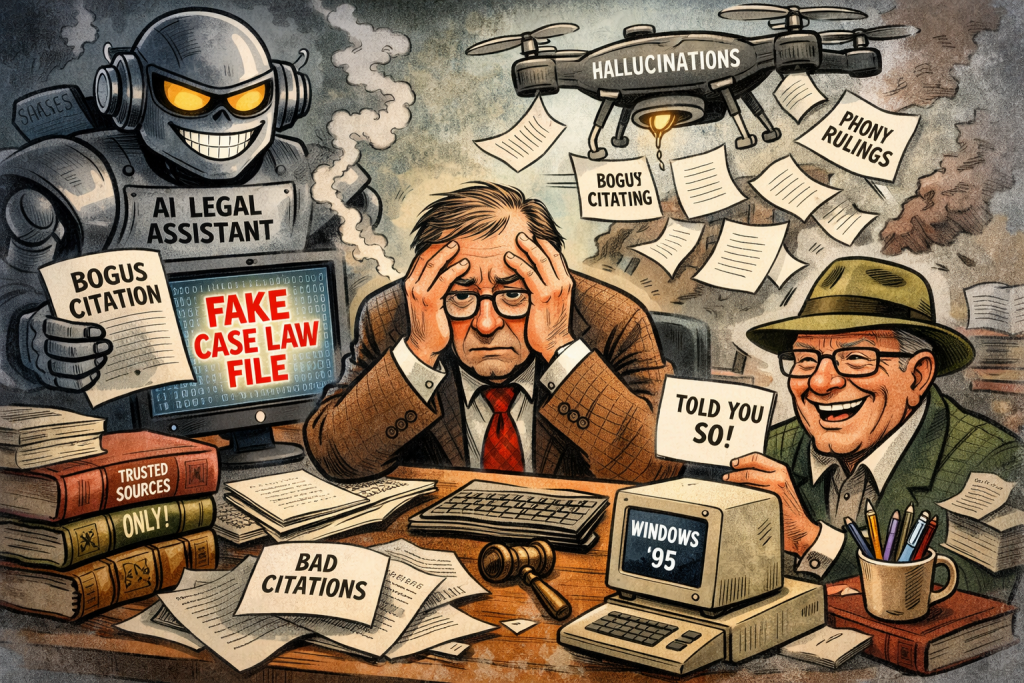
I know one such dinosaur well. He is amused by all of this, and not quietly so. He has been forwarding me emails for months, half joking and half vindicated, about artificial intelligence “taking over” and how everyone laughed when he refused to trust it. He is laughing now because the problem unfolding is precisely the one he warned about, and it is happening in a way that even he did not fully anticipate.
If you walked into his office, you would not find a chatbot prompt, an AI assisted research tool, or even a modern workflow. You would find paper. Lots of it. File folders. Reporters. Notes. And sitting in the corner, almost as a museum piece, an ancient desktop running something that looks like it last saw daylight during the Windows 95 era. Dust it off, pull the hard drive, and you would find exactly zero evidence of chatbot use, AI integration, or generative anything. His computer is barely capable of handling email, let alone hallucinating case law.
And yet even he is no longer insulated.
That is the point that should make the profession deeply uncomfortable. When false or distorted case law begins to poison the well, it no longer matters how cautious, traditional, or technologically abstinent a lawyer may be. The contamination does not require participation. It requires exposure. A lawyer who has spent a career relying on the same research habits, the same sources, and the same conservative instincts can now encounter fabricated or mischaracterized authority simply because it has been allowed to circulate widely enough to appear legitimate.
This is why the dinosaur is laughing. Not because he thinks the problem is funny, but because the profession is finally discovering that his refusal to embrace every new tool was never about fear of change. It was about distrust of systems that insert distance between the lawyer and the source of truth. He understood, instinctively, that the more intermediaries involved, the harder it becomes to know where an assertion originated and whether it was ever real.
What is happening now proves his point in the most ironic way possible. The lawyers most exposed to AI induced contamination are not just those who use AI casually or recklessly. They include the safest lawyers, the slowest lawyers, the ones whose practices were built around minimizing risk by touching primary sources directly. When fabricated authority seeps into the shared research environment, even their caution is no longer enough.
That is why this moment feels different. This is not a debate about whether artificial intelligence can be useful. It plainly can. This is a reckoning with the fact that once false law enters circulation, it affects everyone, including those who never invited it in. At that point, skepticism is no longer resistance. It is self preservation.
The dinosaur did not lose this argument. The profession simply took too long to realize he was right.
Conclusion: This Is a Structural Integrity Crisis
The legal system was built on a foundational assumption that published legal authority is presumptively real. Not persuasive. Not correct. Real. Case law has weight because it represents an actual act of adjudication by an identifiable court, issued on a known date, by a known judge, and preserved in a traceable record. That assumption is not a convenience. It is the load bearing beam on which legal practice, judicial decision making, professional regulation, and public trust all rest.
That beam is now under strain.
When hallucinated or distorted citations migrate into the research ecosystem, the problem stops being about individual tools or isolated misuse. It becomes a crisis of trust, provenance, and accountability. Authority no longer fails loudly. It fails quietly. Fiction no longer announces itself as error. It blends in, circulates, and accumulates credibility through repetition. At that point, the system’s traditional safeguards begin to fail not because lawyers stopped caring, but because the environment they operate in has changed faster than the assumptions that govern it.
Verification will remain mandatory. That cannot change, and it should not. Lawyers must still read the cases they cite. They must still confirm holdings, context, and applicability. They must still perform the non delegable work of turning raw information into reliable authority. But verification alone is no longer the only value at stake.
Fairness must remain intact as well.
If the response to AI driven contamination collapses into reflexive suspicion, the profession risks creating a new injustice. One where lawyers are disciplined not for what they did or failed to do, but for what the system around them failed to prevent. One where the presence of a false citation is treated as proof of misconduct without regard to how that citation entered circulation, what representations were made by intermediaries, or what steps were reasonably taken to verify it. Accountability that loses sight of causation is not accountability. It is punishment by outcome.
This is why the moment matters.
The profession is standing at an inflection point. It can respond with clarity and precision by reasserting first principles, demanding transparency from research platforms, distinguishing negligence from systemic failure, and reinforcing verification without abandoning fairness. Or it can respond with panic and presumption, substituting technological suspicion for careful inquiry and treating every error as evidence of bad faith.
Only one of those paths preserves the integrity of the law.
Law does not survive on speed, convenience, or confidence. It survives on traceability, verification, and trust. If those qualities are allowed to erode, no amount of efficiency will compensate for the damage. The question facing the profession now is not whether artificial intelligence will continue to evolve. It will. The question is whether the legal system will adapt in a way that strengthens its foundations rather than quietly hollowing them out.
The answer to that question will determine whether law remains an anchor in an era of accelerating uncertainty, or whether it becomes just another information stream where appearance is mistaken for existence and repetition is mistaken for truth.
Legal and Professional Disclosures
This article is published as investigative journalism, commentary, and public interest analysis. It is not legal advice, does not create an attorney client relationship, and should not be relied upon as a substitute for consultation with a licensed attorney regarding any specific legal matter. Readers are strongly encouraged to independently verify all legal citations and consult qualified legal counsel before acting on any legal issue discussed herein.
The author is not licensed to practice law and does not hold himself out as an attorney. Any discussion of statutes, case law, court decisions, procedural rules, or legal standards is provided for informational and analytical purposes only, based on publicly available records, court filings, judicial opinions, and official documents. Legal analysis contained in this article reflects the author’s interpretation of those materials and should not be construed as definitive legal guidance.
Professional Capacity and Scope of Commentary
The author is a licensed social worker. References to social work ethics, professional standards, mandated reporting obligations, confidentiality, duty to warn, or related concepts are made within the scope of professional understanding and public record analysis. Nothing in this article should be interpreted as clinical advice, therapeutic guidance, or professional instruction directed at any specific individual or situation.
Where case law is discussed in relation to social work practice, it is done for the purpose of examining how courts have historically interpreted duties, liabilities, and professional boundaries, not to instruct readers on how to act in real-world circumstances. Application of law to individual professional decisions requires fact specific analysis that cannot be provided in a general publication.
Use of Legal Citations and Sources
All legal citations referenced in this article are drawn from publicly available sources and are discussed for analytical and educational purposes. While care has been taken to accurately represent cited authority, the legal landscape is complex and constantly evolving. Readers should not assume that any cited case, statute, or legal principle applies uniformly across jurisdictions or factual contexts.
The author expressly disclaims responsibility for reliance on summaries, excerpts, or secondary descriptions of legal authority. Primary sources should always be consulted directly. The inclusion or discussion of any legal authority does not imply endorsement, approval, or adoption of any legal position by the author beyond the scope of commentary.
No Representation or Endorsement
This article does not represent the views of any court, agency, licensing board, employer, or professional organization. Any mention of public officials, institutions, or professionals is based on public records, sworn testimony, court filings, or documented statements, and is made in the context of investigative reporting and public accountability.
All individuals and entities referenced are presumed lawful unless and until adjudicated otherwise. Allegations, disputes, or critiques discussed herein are presented for public understanding and analysis, not as findings of fact or determinations of liability.
Final Clarification
This publication exists to examine how law functions in practice, how legal information circulates, and how systemic failures affect professionals who rely on accurate legal authority, including but not limited to lawyers, journalists, social workers, educators, and other licensed practitioners. It is not intended to instruct, direct, or advise any reader on legal strategy, litigation decisions, or professional conduct in a specific case.
Accuracy matters. Verification matters. Context matters. And readers are urged to treat this article as a starting point for inquiry, not an endpoint for decision making.
About The Author