

THE BALLARD SYSTEM
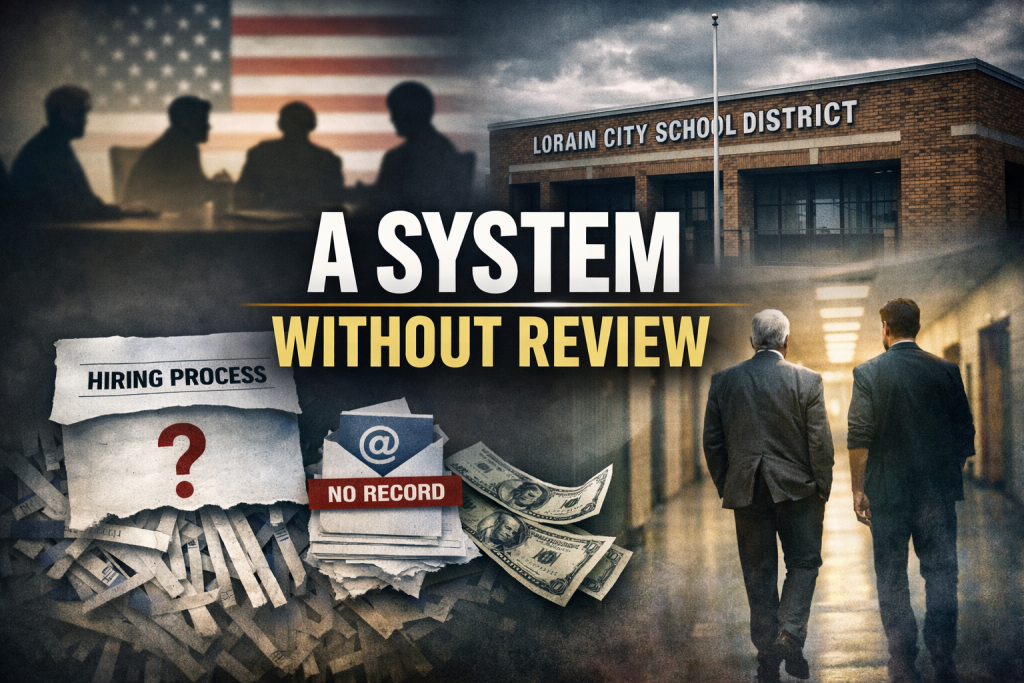
Governance, Communications, and Control Inside Lorain City Schools
By Aaron C. Knapp
Knapp Unplugged Media LLC
INTRODUCTION
THIS IS NOT ABOUT ONE HIRE
There is a moment in the record where the conversation stops being about a job posting and starts being about something else entirely. It is not a policy. It is not a formal decision. It is a sentence. “I’m thinking you don’t want to put anything further in an email?” “Yeah see, you get it.”
That exchange does not describe a hiring decision. It describes an approach. It reflects an understanding that what is written can be requested, reviewed, and scrutinized, and that what is not written cannot. It is a recognition of how public records law works in practice, and more importantly, how it can be avoided without technically violating it.
That is where this story begins.
There is a tendency in public discussion to isolate a single hiring decision and treat it as either justified or questionable on its own terms. That approach is incomplete because public institutions are not defined by isolated decisions. They are defined by patterns that develop over time, across different roles, across multiple administrations, and through the repeated actions of individuals operating within the same structure. The record in this case does not point to a single event. It points to a pattern.
The Ballard hiring cannot be understood as a standalone occurrence. It exists within a broader system that has already taken shape and that can be traced through documents, communications, and structural decisions. That system includes executive continuity without meaningful interruption, communications functions that operate not simply to inform but to shape perception, hiring processes that rely heavily on internal relationships, and governance structures that formally comply with legal requirements while limiting what can actually be reviewed.
The emails matter because they do not prove a single improper act. They reveal how decisions are discussed. They show where documentation stops. They show where the record ends, not because the process ended, but because it was moved out of view. When that happens, the issue is no longer about what can be proven from the record. It is about what the record was designed not to show.
This analysis is not about whether any one individual is qualified or unqualified. That is not the central issue. The issue is whether the system that produced the outcome can be independently verified as fair, transparent, and accountable. In a public institution, that standard is not optional. It is the basis for trust.
And when the record itself reflects an awareness of what should not be written down, the question changes. It is no longer whether a decision can be defended. It becomes whether the system was ever intended to be fully seen.
THE POSITION
A COMMUNICATIONS ROLE WITH GOVERNANCE IMPLICATIONS
The position at issue is not a minor administrative role. It is a Director of Communications and Community Relations, a title that carries responsibilities extending far beyond routine messaging. On paper, it includes media relations, crisis communications, internal messaging, community engagement, and coordination with governmental and institutional stakeholders. In practice, it is something more significant. It is the position that determines how the district explains itself to the public.
That distinction matters because in a district facing financial instability and academic decline, communication is not neutral. It is strategic. The individual in that role does not simply transmit information. They decide how information is framed, what is emphasized, what is minimized, and how decisions are presented to the community. They shape the narrative around levies, budget reductions, staffing decisions, and controversy. They are not operating on the outside of governance. They are embedded within it.
“This is not a routine hire. It is a position that controls how decisions are explained, defended, and understood.”
When a district is asking voters for funding, explaining program reductions, or responding to criticism, communications becomes inseparable from governance itself. It becomes the mechanism through which decisions are justified, defended, and sustained. That is why the hiring of a communications director cannot be treated as a routine staffing decision. It is, in effect, a governance decision.
The history of this role within Lorain City Schools reflects that reality. This is not a position that has operated independently of leadership. It has been shaped by leadership, preserved by leadership, and at critical moments, structurally repositioned to ensure its continuity.
When Erin Graham held this role, the structure of oversight was altered so that the position reported directly to the Board of Education rather than to the Superintendent. That is not a minor administrative change. In a traditional school governance model, operational staff report through the Superintendent, who is accountable to the Board. By placing a communications position under direct Board control, the normal chain of command was bypassed.
That change has significant implications. It places the function responsible for public messaging in direct alignment with the governing body itself, rather than within the administrative structure that executes policy. It collapses the distinction between governance and communication. The body responsible for oversight is, at that point, directly connected to the function that shapes how its actions are presented to the public.
That structure did not emerge in isolation. It reflects a deliberate decision to position communications at the highest level of influence within the district. The role was not only preserved. It was elevated.
The position later transitioned to Tony Dimacchia, whose hiring record reflects a continuation of internal alignment. His personnel file identifies only a single professional reference, and that reference is the Superintendent. That detail is not procedural. It reflects a closed loop. The individual responsible for hiring is also the source of validation. Independent verification is not part of the process.
The position now sits with Moriah Ballard. Her appointment must be viewed within that same continuum. This is not the creation of a new role. It is the continuation of a position that has consistently remained within a defined network of relationships tied to leadership and governance.
The qualifications associated with the current appointment further underscore the importance of process. The role is compensated at an executive level salary. Positions at that level are often associated with advanced credentials and extensive experience. The available record reflects that the selected candidate holds a Bachelor’s degree. That fact does not, by itself, determine qualification. Experience can justify advancement.
The issue is not whether the individual can perform the job. The issue is how the decision was made, what standards were applied, and whether those standards were applied consistently.
Those questions cannot be answered from the current record.
Because when a position that shapes public narrative is structurally aligned with governance, consistently filled through internal relationships, and supported by a record that cannot be fully reviewed, the concern is not limited to a single hire. The concern is the system that determines who controls both the decision and the explanation of that decision. And when the same structure influences both, the distinction between governance and narrative begins to disappear.
THE HIRING RECORD
WHAT THE DOCUMENTS SHOW AND WHAT THEY DO NOT
The available record establishes a set of facts that are not in dispute. The position was posted as a full time executive level role connected to the Superintendent’s staff structure, with compensation tied to a defined salary schedule. Board action later confirms that Moriah Ballard was appointed to that role at an annual salary of $91,020, effective December 1, 2025, under a 260 day contract.
On its face, the process reflects the appearance of a structured and competitive hire. The position was publicly posted. Multiple candidates applied. The process included more than one round of interviews, and candidates were required to complete presentation components. Internal communications indicate that the candidates were evaluated in at least two rounds of scoring, and the Superintendent publicly stated that Ballard “scored the highest in the first round and the second round.”
That statement is important because it implies the existence of a measurable evaluation system.
It suggests that there were defined criteria, that candidates were scored against those criteria, and that the results could be compared.
“The outcome is documented. The process that produced it is not.”
However, the record that is available for review does not include the materials that would allow that claim to be independently verified. There is no scoring rubric that defines the criteria. There are no evaluator notes that explain how candidates were assessed. There are no comparative scoring sheets that show how each candidate performed relative to the others. The outcome is documented, but the process that produced it is not.
That absence is not a minor administrative gap. It goes to the core of how public hiring is evaluated. In a private organization, the internal rationale for hiring decisions may remain internal. In a public institution, the process must be capable of external review. The ability to demonstrate fairness is not optional. It is a requirement.
The record also reflects that the hiring process did not follow a strictly sequential structure. Additional candidates were introduced after initial rounds of review, and at least one candidate appears to have been considered at a later stage in the process. These types of adjustments are not inherently improper. Hiring processes can evolve as additional information becomes available.
However, when a process changes after it has begun, documentation becomes more important, not less. There must be a clear record explaining when candidates were added, why they were added, and how they were evaluated in comparison to those who participated from the beginning. Without that documentation, it is not possible to determine whether the process was applied consistently or whether it shifted in a way that affected the outcome.
The significance of that absence is reinforced by the internal communications surrounding the process. The record includes statements reflecting an awareness of how written documentation can be used and reviewed. When participants in a public hiring process express concern about what should or should not be put into writing, the issue is no longer limited to what exists in the record. It extends to what may have been intentionally kept out of it.
That context matters because public records law, including Ohio Revised Code 149.43, is built on the principle that public business should generate records that can be examined. The law does not require every discussion to be memorialized, but it does establish that the record is the mechanism through which accountability is exercised.
When the record contains the conclusion but not the supporting analysis, the public is left with an outcome that cannot be independently evaluated. The hiring decision may have been fair. The candidates may have been properly assessed. The selected individual may have legitimately scored the highest.
But without the documentation, those conclusions cannot be tested.
In a public institution, that is the difference between a process that is fair and a process that can be proven to be fair. And when that proof is not available, the burden shifts. The public is no longer reviewing the process. It is being asked to accept it.
THE LANGUAGE OF THE PROCESS
WHEN DOCUMENTATION IS AVOIDED
One of the most revealing elements in this record is not a vote, a contract, or a formal decision. It is a short exchange between individuals who understood exactly how the system works.
“I’m thinking you don’t want to put anything further in an email?”
“Yeah see, you get it.”
That is not a discussion about qualifications. It is not a discussion about scoring. It is not even a discussion about the hiring decision itself. It is a discussion about the record. More specifically, it is a discussion about what should not become part of the record.
That distinction matters because in a public institution, the record is the only mechanism the public has to evaluate what occurred. The public does not sit in interviews. It does not participate in internal deliberations. It does not observe how candidates are compared or how decisions are reached. It sees what is preserved.
That is why Ohio Revised Code 149.43 exists. It does not require that every conversation be written down, but it establishes a clear expectation that public business will generate records that can be reviewed. The law is built on a simple premise. If a decision is made using public authority, there should be a record of how that decision was reached.
The exchange in this record reflects an awareness of that premise and a decision about how to operate around it. It acknowledges that written communication is subject to disclosure. It acknowledges that what is reduced to writing can be requested, examined, and challenged. And it acknowledges that what is not written cannot.
That is where the issue moves beyond legality and into transparency.
There is a difference between failing to document and choosing not to document. The first can be explained as oversight. The second reflects intent. When participants in a public process explicitly discuss whether something should be placed into an email, they are not merely communicating. They are making a decision about whether that information will ever become part of the public record.
That decision has consequences.
Records are not simply administrative artifacts. They are the foundation of accountability. They allow the public to reconstruct events, to evaluate reasoning, and to determine whether a process was conducted fairly. Without records, there is no independent verification. There is only the outcome and the explanation provided after the fact.
In this case, the absence of documentation cannot be viewed in isolation. It exists alongside a hiring process where scoring materials are not available, where evaluator notes are not part of the accessible record, and where deviations in the process are not fully explained. The gap is not a single missing document. It is a pattern in which the most critical aspects of the decision making process are not preserved in a form that can be reviewed.
That pattern matters because it changes the nature of oversight. The public is no longer in a position to examine how a decision was made. It is limited to reviewing what is said about the decision after it has already occurred.
The difference between those two things is the difference between transparency and narrative. Transparency allows the public to see the process. Narrative asks the public to accept it.
When documentation is avoided, that shift is not theoretical. It is built into the structure of the system itself.
THE CONFLICT QUESTION
WHEN GOVERNANCE AND EMPLOYMENT INTERSECT
The board minutes confirm that Dr. Mark Ballard abstained from the vote that included the appointment of Moriah Ballard. That fact is not disputed, and it is often presented as the resolution of any potential conflict. Abstention is the visible part of the process. It is what appears in the official record, and it is what can be pointed to as evidence that the issue was recognized.
“Abstention is the visible part of the process. It is not the entire process.”
However, abstention at the moment of final approval is not the beginning of conflict management. It is the end of it. By the time a vote occurs, the critical decisions have already been made. The position has been created or defined, the posting has been approved, candidates have been reviewed, interviews have been conducted, and recommendations have been formed. The vote formalizes the outcome. It does not create it.
That is why the more significant questions arise before the vote ever takes place.
The issue is not limited to whether a board member voted. The issue is whether a board member was involved in the process that led to the vote. That includes discussions about the position itself, access to candidate information, influence over the structure or compensation of the role, and participation in any stage of evaluation or recommendation.
If a board member with a direct familial connection to a candidate had access to those aspects of the process, even indirectly, the abstention at the final vote does not address that involvement. It addresses only the final act of approval, not the steps that produced the decision.
The available record does not answer those questions. There is no documented firewall that defines when the board member was recused from discussions. There is no record showing that access to candidate materials was restricted. There is no documentation outlining safeguards that ensured the process remained insulated from governance influence. The record reflects the abstention, but it does not reflect the separation.
That distinction matters because public confidence is not based on assumptions. It is based on verifiable safeguards. The existence of a familial relationship does not, by itself, establish wrongdoing. Public institutions regularly encounter situations where personal relationships intersect with professional roles. What determines whether those situations are acceptable is the presence of clear, documented protections that prevent influence.
Without that documentation, the public is left with an incomplete picture. It can see the final vote. It cannot see the process that led to it. It cannot determine whether the separation that is implied by the abstention was actually maintained throughout the decision making process.
In this case, the conflict question also has an additional timing dimension that cannot be ignored. If the district’s governance structure changed in a way that placed the communications function under Board control, and if family members entered governance roles in close proximity to a family member’s appointment into the communications role, then the public is entitled to a clear record showing how the district prevented overlap of authority and influence at every stage, not only at the final vote. If the communications position was structured to report to the Board, then the question is not merely who voted.
The question becomes who had supervisory leverage, who had access to decision making, and whether the reporting chain was designed to avoid a conflict or to manage optics.
That demonstration cannot be based on inference. It must be based on the record.
And when the record does not show that separation, the issue is not resolved by abstention. It remains unanswered.
THE BALLARD STRUCTURE
WHEN ONE FAMILY SPANS THE SYSTEM
The Ballard situation does not exist as a single point of concern. It extends across multiple layers of the district’s structure, and the available record reflects how that presence developed over time. What appears at first as a hiring decision becomes more complex when it is placed within the broader context of governance, administration, and community influence operating within the same network.
“This is not a single role. It is a network of influence that spans governance, administration, and narrative.”
The record reflects a progression that does not follow a traditional separation between governance and administration. One individual served as President of the Lorain Board of Education from January 2008 through September 2022, a period of nearly fifteen years during which policy, oversight, and institutional direction were shaped at the board level. That role is defined by its authority to supervise the district, to evaluate leadership, and to establish the policies under which the administration operates.
Immediately following that period, the same individual transitioned into an executive level administrative role within the district as Director of Communications and Marketing in September 2022. That transition did not represent a separation between governance and administration. It represented continuity. The authority to oversee was replaced with a role responsible for shaping how the actions of the district are communicated to the public.
Within approximately one year, that role expanded into Director of Operations in October 2023, a position that carries direct administrative authority over district functions. This is not a lateral move. It is an expansion of operational control within the same institution that had previously been governed. The progression reflects not only continued involvement, but increasing influence over how the district functions internally.
At the same time, the record reflects overlapping roles outside the district that maintain influence within the broader educational ecosystem. Long term involvement as an educator at Lorain County Community College, as well as leadership roles within organizations such as the Boys and Girls Club of Lorain County, demonstrate sustained participation in the same community structures that interact with the district.
Taken together, this is not a single role. It is a network of roles that extends across governance, administration, and community institutions.
That network becomes more significant when viewed alongside the composition of the Board of Education itself. The record reflects that both a father and son are now serving on the same governing body. That fact, standing alone, does not establish wrongdoing. However, it does expand the presence of a single family across multiple points of influence within the system.
When governance authority, administrative control, and communications functions are connected through overlapping relationships, the structure changes. The roles that are intended to operate independently begin to intersect. Oversight is no longer clearly separated from execution. Execution is no longer clearly separated from narrative.
That does not automatically establish that any improper action occurred. Public institutions routinely involve individuals with prior experience and community ties. What determines whether those arrangements are appropriate is the presence of clear boundaries and verifiable safeguards that maintain independence between those roles.
The available record does not clearly demonstrate those boundaries. It reflects continuity. It reflects overlap. It reflects a system in which influence extends across multiple functions that are ordinarily intended to remain separate.
The issue is not whether any one role is improper. The issue is whether the system maintains the separation necessary to ensure that oversight remains independent, that administration remains accountable, and that communication remains a function of transparency rather than control.
When those distinctions begin to blur, the structure itself becomes the question.
COMMUNICATIONS AS POWER
NOT A SUPPORT FUNCTION
The significance of the communications role cannot be understood as a routine administrative function. Within this structure, communications operates as a point of influence that extends directly into governance itself. It is not limited to transmitting information. It determines how information is framed, how decisions are explained, and how the public understands the actions of the district.
“Communications is not just reporting decisions. It is shaping how those decisions are understood.”
The internal communications reflect an awareness of that role. Discussions do not treat communication as neutral. They reflect an understanding of its impact. The ability to shape narrative is recognized as a form of control over how events are interpreted, how decisions are justified, and how criticism is addressed.
That recognition matters because in a public institution, narrative and accountability are closely linked. The public does not have direct access to internal deliberations. It relies on the record and on the explanations provided by the institution. Communications sits at the point where those explanations are constructed.
When communications functions as a strategic tool, the independence of that function becomes critical. It is no longer simply providing information. It is determining how information is presented, what context is included, and what context is omitted. It becomes part of how the institution responds to scrutiny.
That role becomes more significant when it is positioned within a structure that already reflects continuity of leadership and overlap in governance and administration. Communications does not operate in isolation. It operates within the same network that makes the decisions it is explaining.
When that occurs, the distinction between decision and explanation becomes less clear. The same structure that produces the decision is involved in shaping how that decision is understood.
The issue is not whether communications should exist. It is whether communications operates independently enough to ensure that the information provided to the public reflects the full context of the decision making process.
When the process itself cannot be fully reviewed, and the explanation is controlled by the same structure that produced the decision, the balance shifts.
The public is no longer reviewing the process.
It is receiving the narrative.
THE RETIRE–REHIRE CONTEXT
CONTINUITY WITHOUT INTERRUPTION
The structure of leadership reinforces the patterns reflected in the hiring and communications processes. The superintendent’s retire and immediate return to the same position represents a continuity of authority that is not interrupted by transition.
“This is not a transition in leadership. It is the continuation of the same authority under a different status.”
Retirement provisions are generally designed to allow experienced individuals to return to public service under defined conditions, often in roles that differ from those previously held or after a meaningful separation in service. Those provisions create flexibility while preserving the integrity of the system.
When an individual retires and returns to the same position without a meaningful break, the effect is not transition. It is continuity. The same authority remains in place. The same relationships remain in place. The same decision making structure continues without interruption.
That continuity matters because it limits the opportunity for independent evaluation. There is no change in leadership. There is no external review of candidates. There is no structural reset that allows the system to be examined from outside of the existing network.
Instead, the system continues as it was.
When that continuity exists alongside hiring processes that rely on internal relationships, communications functions that shape public understanding, and governance structures that overlap with administration, the effect is cumulative.
Each element reinforces the others. Leadership remains constant. Hiring remains internal. Communications remains aligned with leadership. Oversight remains within the same network.
Continuity, in that context, does not simply preserve experience.
It preserves the system itself.
THE SYSTEM
EACH PART SUPPORTS THE NEXT
When each of these elements is viewed together, a consistent structure emerges. It is not defined by any single decision. It is defined by how those decisions relate to one another.
“Each part supports the next. The same structure that makes the decision is the structure that explains it.”
Leadership continuity allows existing relationships to remain in place. Those relationships influence hiring processes that rely on internal familiarity rather than independently verifiable criteria. Communications functions shape how those decisions are presented to the public. Governance structures overlap with the individuals and roles involved in those decisions.
Each part supports the next.
Decisions are made within the same network of relationships. Those decisions are explained through the same communications structure. Oversight exists within that same network.
The result is a system that is self reinforcing. It does not require formal coordination. It operates through continuity, through familiarity, and through the absence of disruption.
In that system, the record becomes the only mechanism for independent review. It is the only way the public can evaluate how decisions were made, what factors were considered, and whether the process was applied consistently.
When the record is incomplete, the system cannot be independently evaluated.
The public is left with the outcome.
And the explanation of that outcome is provided by the same structure that produced it.
WHAT THE RECORD DOES NOT SHOW
THE ABSENCE THAT MATTERS
The most significant aspect of the available record is not what it contains, but what it does not.
“The absence is not what is missing. The absence is what cannot be verified.”
There is no publicly available scoring rubric that defines how candidates were evaluated. There are no evaluator notes that explain how those criteria were applied. There is no comparative ranking that shows how candidates performed relative to one another. There is no documented firewall that establishes how conflicts of interest were addressed throughout the process. There is no detailed explanation of how a communications role was prioritized during a period of significant financial constraint.
Each of those elements could exist within internal files. Their absence from the accessible record does not prove that they do not exist. However, in a public institution, the ability to review those elements is what allows the public to evaluate the process.
Without that access, the process cannot be independently verified.
That absence is not a neutral condition. It shifts the burden of trust from the record to the institution itself. The public is not provided with the information necessary to evaluate how the decision was made. It is asked to accept the outcome based on the explanations that are provided.
In a system where communications functions shape those explanations, and where the underlying documentation is not available for review, that shift becomes significant.
The issue is no longer whether the process was fair.
It is whether the process can be shown to be fair.
FINAL THOUGHT
A SYSTEM THAT CANNOT PROVE ITSELF
The Ballard hiring does not establish wrongdoing. It demonstrates something more significant. It shows that the system cannot prove that wrongdoing did not occur.
“The issue is not whether wrongdoing occurred. The issue is whether the system can prove that it did not.”
Public trust is not built on assurances. It is built on process. It is built on records that show how decisions were made, on structures that separate authority from influence, and on transparency that allows those decisions to be independently reviewed.
When those elements are present, the public can examine the record and reach its own conclusions. When those elements are absent, the public is left with explanations that cannot be tested against the underlying process.
That distinction matters because the consequences of these decisions are not theoretical. They are reflected in the daily operation of the district.
The district has publicly stated that it must reduce spending by millions of dollars. Staffing reductions have been discussed. Paraprofessional positions have been cut. Programs have been reduced. The ability to maintain full day preschool has been placed in question. At the same time, the district is asking the public for additional funding to sustain its operations.
Those decisions define the priorities of the institution. They determine where resources are allocated and what functions are preserved.
When instructional support is reduced while administrative and communications roles remain funded at executive levels, the issue is not limited to a single hire. It becomes a question of alignment. It becomes a question of what the institution defines as essential.
That question cannot be answered by narrative alone. It requires a record that shows how those priorities were established, how decisions were made, and whether those decisions were applied consistently.
When the record does not provide that information, the system is no longer capable of demonstrating its own integrity.
At that point, the issue is no longer whether a particular decision can be defended.
It becomes whether the system itself can be verified.
And when a system cannot be independently verified, accountability does not disappear.
It shifts to the public.
Because in a public institution, the authority to act is derived from the public itself.
And when the public is not given the record necessary to evaluate that authority, the question remains open.
Not whether a decision was justified.
But whether the system that produced it can prove that it was.
LEGAL DISCLAIMER
This publication is an opinion-based analysis grounded in publicly available records, documents obtained through lawful public records requests, and statements made by public officials. It is intended for informational, journalistic, and public interest purposes only.
All conclusions are based on the information currently available at the time of publication. Any additional records or context may alter the analysis. The absence of documentation in the public record is noted as part of the analysis and is not, in itself, a statement of wrongdoing.
This publication does not constitute legal advice. Any individual or entity referenced is presumed innocent of any alleged conduct unless proven otherwise in a court of law. Readers are encouraged to review primary source materials and draw their own conclusions.
AI USE DISCLOSURE
Portions of this article were assisted by artificial intelligence for drafting, organization, and formatting. All content has been reviewed, edited, and verified by Aaron C. Knapp.
AI tools were used as an editorial aid only. All analysis, conclusions, and final editorial decisions are those of the author.
COPYRIGHT AND MEDIA NOTICE
© 2026 Knapp Unplugged Media LLC. All Rights Reserved.
This article and all associated media are the intellectual property of Knapp Unplugged Media LLC. No part of this publication may be reproduced, distributed, or transmitted in any form or by any means without prior written permission, except for brief quotations for commentary, criticism, or reporting with proper attribution.
KNAPP UNPLUGGED MEDIA LLC
Independent Investigative Journalism
Lorain County, Ohio
Sunlight Is a Headache for Somebody
RELATED INVESTIGATIVE COVERAGE
This article is part of ongoing reporting on Lorain City Schools governance, transparency, and public accountability published across Knapp Unplugged Media LLC platforms. Follow the series below to explore all related stories.
Unplugged with Aaron Knapp — School and Government Reporting
A hub of investigative articles, structural analysis, and public record examinations.
👉 https://aaronknappunplugged.com/
Lorain Politics Unplugged on Substack — Newsletter Reporting
In-depth essays, context, and subscriber commentary on local power, policy, and public institutions.
👉 https://lorainpoliticsunplugged.substack.com/
FEATURED SCHOOLS-RELATED REPORTS
You can link these titles to the specific article URLs once they are published:
How Lorain City Schools Is Quietly Moving Toward the Displacement of the East Side’s Only Elementary School
👉 https://aaronknappunplugged.com/news/when-sister-schools-means-something-else-entirely/
The Enforcement Model in Lorain City Schools
Exploring student safety policies and administrative structures.
👉 (Paste URL here)
Lorain City Schools Governance and Public Record Analysis
A series of analytical articles examining transparency and decision-making.
👉 (Paste URL here)
Related Substack Commentary on School Policy and Accountability
Issues of governance, authority, and public insight.
👉 https://lorainpoliticsunplugged.substack.com/
FOLLOW THE SERIES
Read the full archive of investigative reporting on governance, public records, and institutional accountability:
👉 https://aaronknappunplugged.com/
Subscribe for direct updates, deep dives, and exclusive analysis:
👉 https://lorainpoliticsunplugged.substack.com/
About The Author