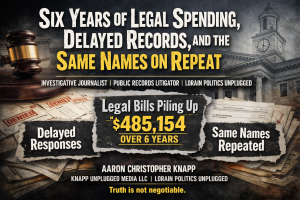

The $485,154 They Didn’t Want You to See
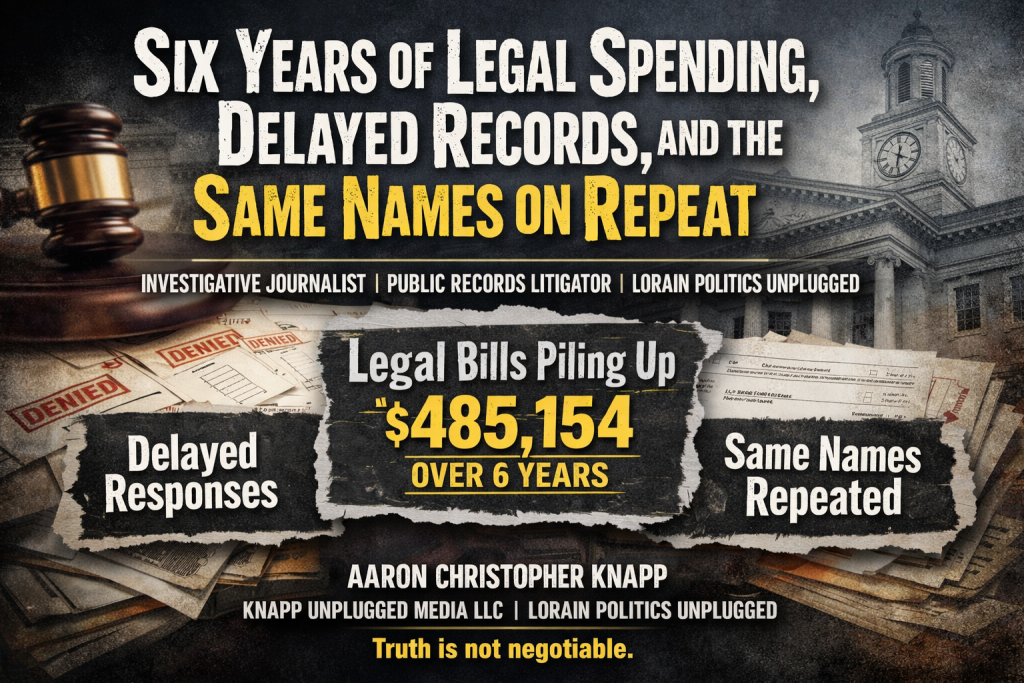
AI Generated
Six Years of Legal Spending, Delayed Records, and the Same Names on Repeat
Investigative Journalist | Public Records Litigator
Lorain Politics Unplugged
Introduction
This Was Never Just a Records Request
This started the way most things do in Lorain. A targeted public records request. Narrow. Specific. Based on statements already made by city officials, based on matters that had already surfaced publicly, and based on the simple premise that the public has a right to understand how its money is being spent and why.
And just like clockwork, the delay came first. Then the denial. Then the familiar language. No responsive records. Nothing exists. We checked.
Except something did exist.
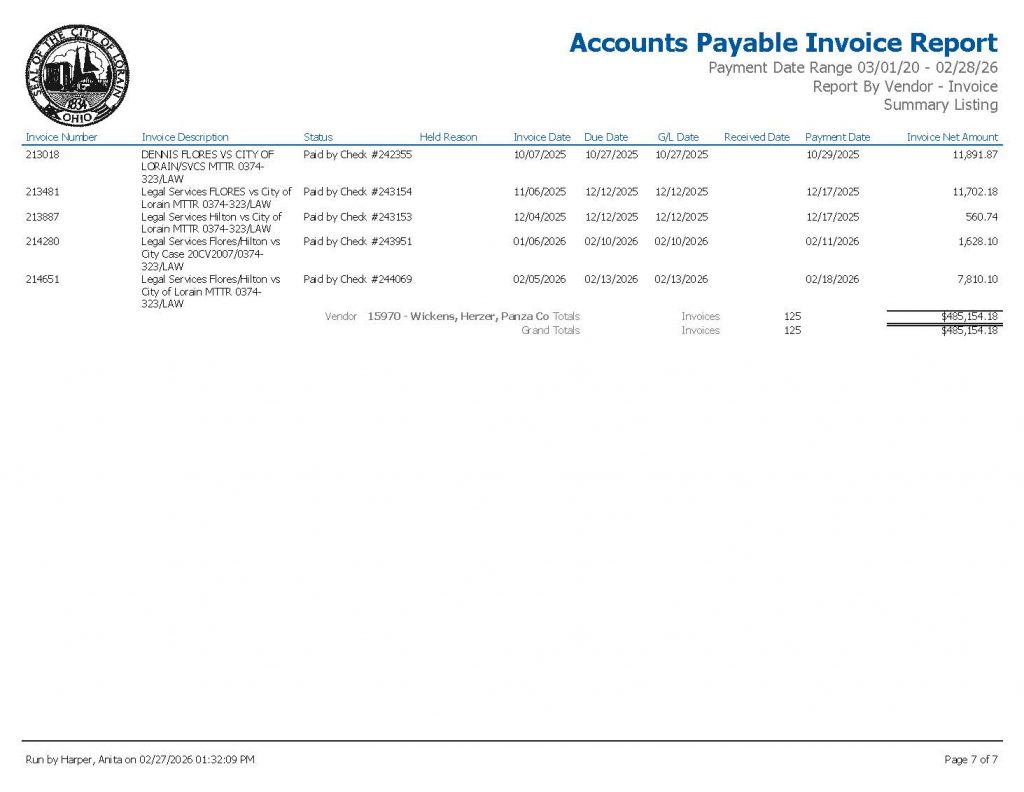
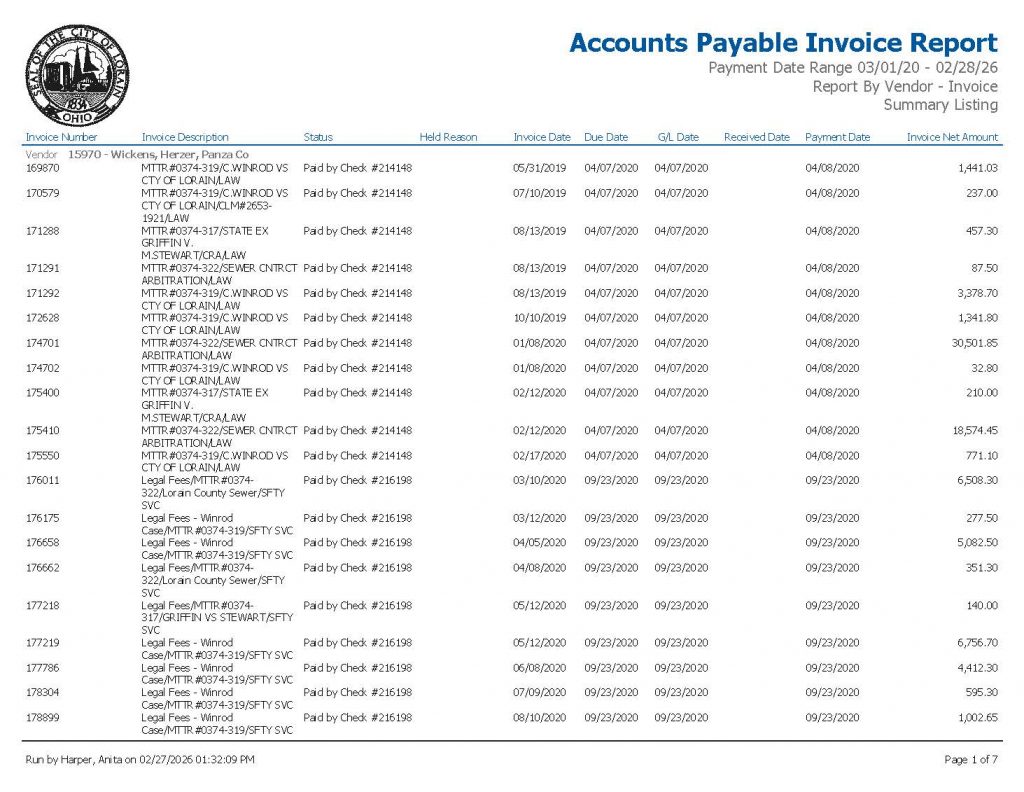
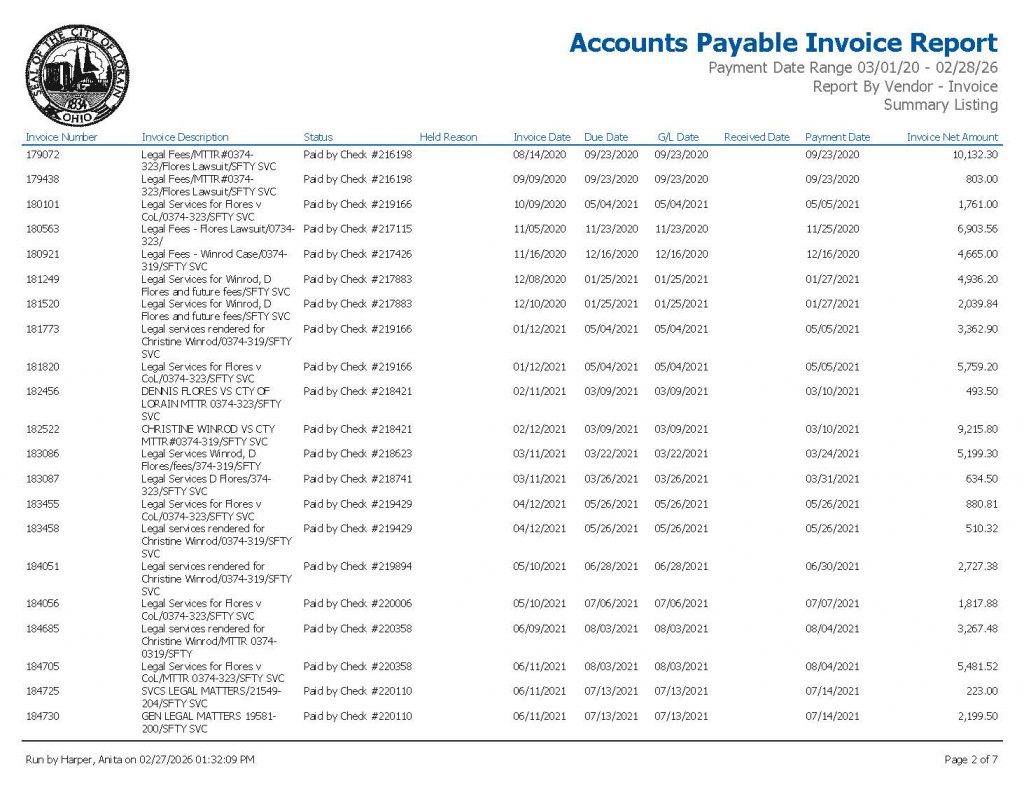
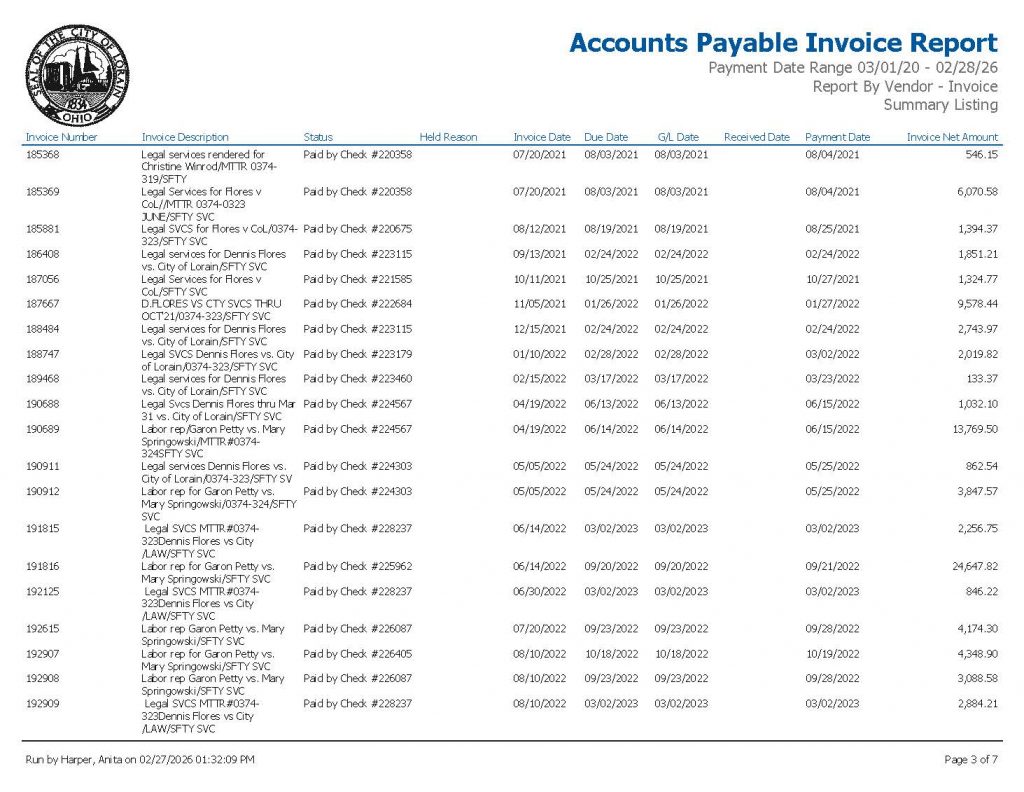
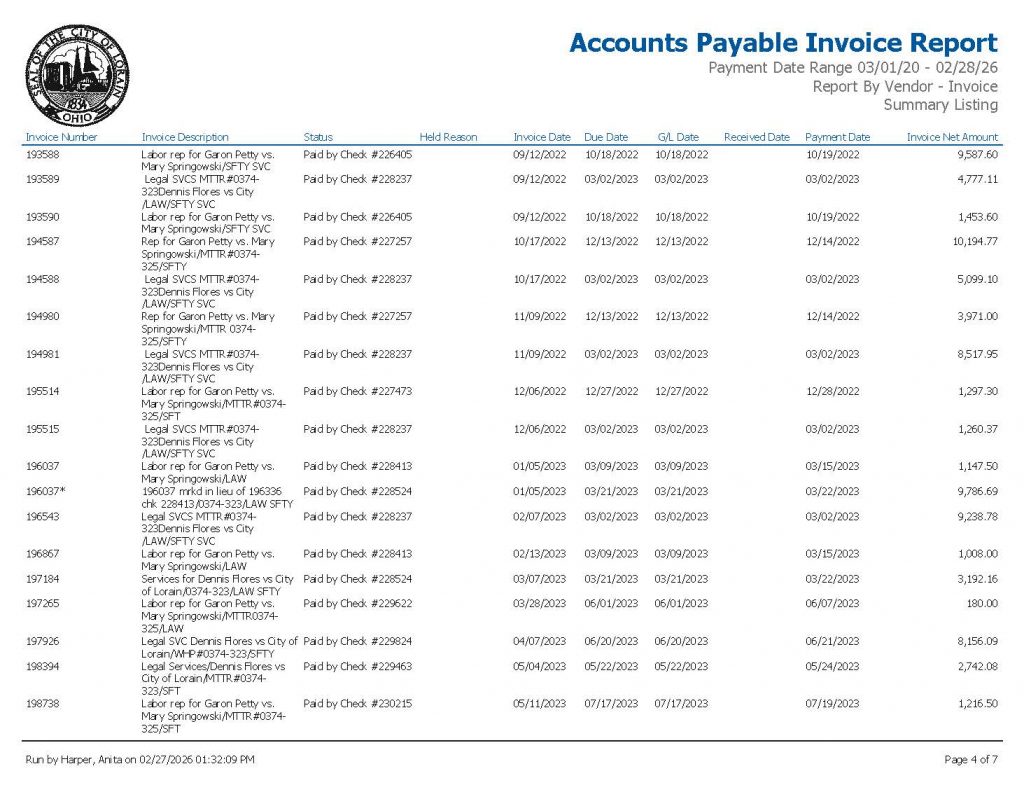
What you are looking at now is a six year financial record the City of Lorain did not volunteer, did not summarize, and certainly did not explain in any plain language the public could easily understand. It had to be pulled. It had to be forced. It had to be reconstructed from the kind of document most people would never be expected to read line by line.
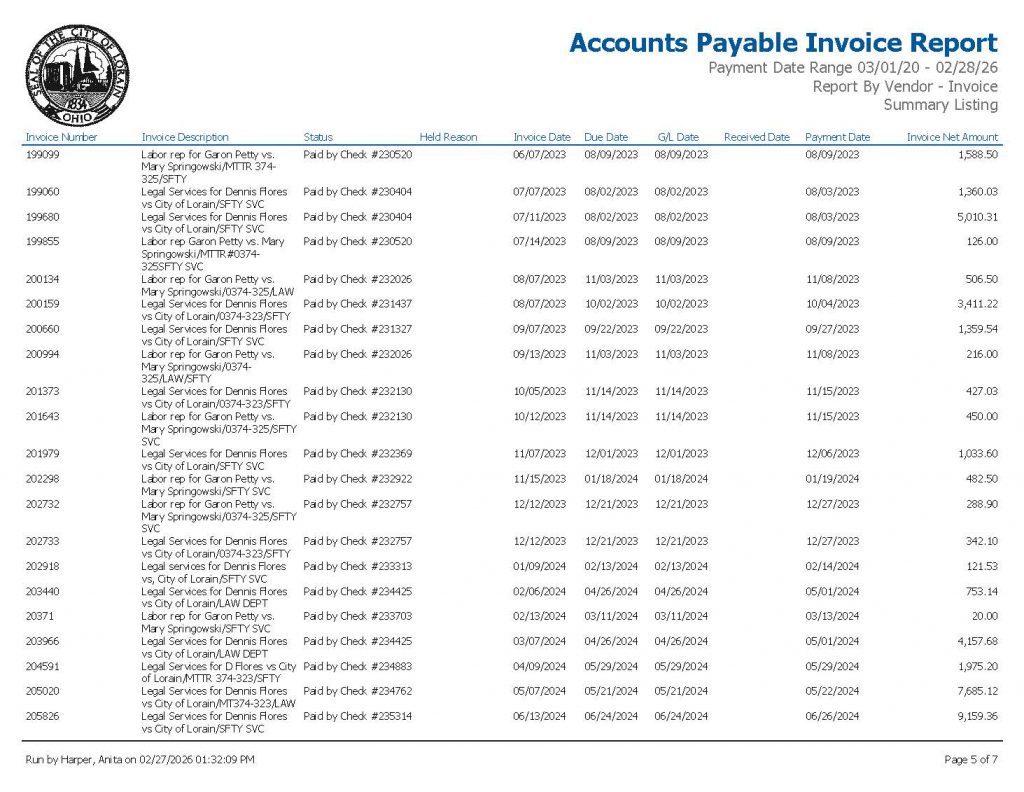
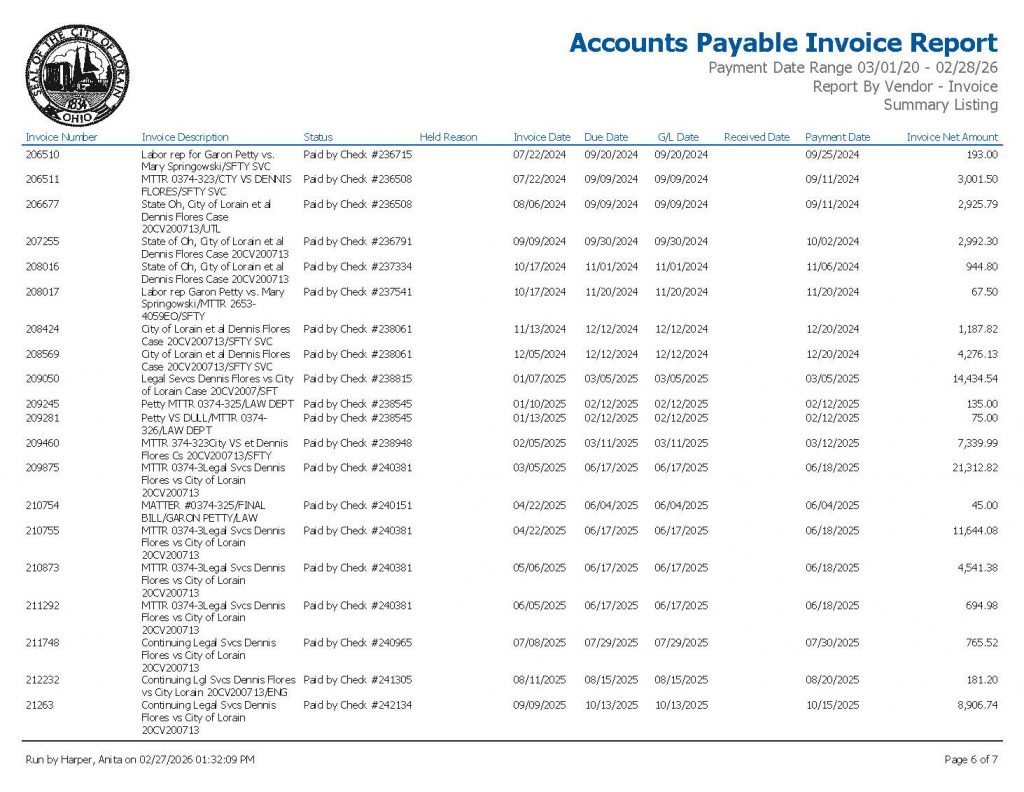
From March 1, 2020 through February 28, 2026, the City of Lorain paid $485,154.18 to a single outside law firm, Wickens, Herzer, Panza Co., across 125 invoices.
That number matters. But standing alone, it is only the headline. The real story is what that number is attached to, what names and disputes keep appearing inside the billing descriptions, and why the city has been so resistant when people like Garon Petty have tried to get the underlying records that would explain the conduct behind the cost.
This was never just a routine request for paperwork. This was a request for the paper trail behind the city’s own legal exposure. That is why the response was delay. That is why the response was denial. And that is why this financial record matters so much.
The Spending Never Stops
Not a Spike, Not a Crisis, a Pattern
Once you line the invoices up year by year, something becomes immediately clear. This is not a city dealing with a one time lawsuit. This is not a municipality hit with a single extraordinary event that temporarily forced it to seek outside help. This is continuous legal exposure across a six year period, with no meaningful sign of decline.
Every year shows activity. Every year shows payments. There is no point where the meter resets. There is no stretch in which outside legal spending meaningfully disappears. Instead, what the records show is a city that appears to have normalized the use of outside counsel for recurring disputes tied to litigation, labor conflicts, and internal controversies that keep reappearing.
That matters for a very simple reason. A one time expense can be explained as an anomaly. A six year pattern cannot.
This is the kind of record that changes how the public should understand legal spending. The usual way these costs are presented is fragmented. A payment here, an invoice there, a voucher approved in a meeting packet that few people read and even fewer people trace over time. That fragmentation protects the system because it prevents the public from seeing continuity. It prevents people from seeing not just that money was spent, but that the same types of problems kept requiring the same response.
And the response was not reform. The response was defense.
The city did not just spend on lawyers. It spent repeatedly to defend itself and its internal disputes through a private law firm while the underlying issues remained unresolved. That is what turns this from ordinary legal spending into something far more revealing. The pattern itself becomes the story.
The Same Names Keep Appearing
Follow the Cases and You Follow the Money
At some point, you stop needing interpretation because the invoices begin speaking for themselves. These descriptions are not random. They are not vague in the way municipal records often are when governments want to keep the public from seeing the substance of what is happening. They identify matters. They name disputes. They repeat individuals and cases across multiple years.
The most obvious example is the Dennis Flores litigation. The case does not appear once and disappear. It stretches through the record. It reappears with descriptions such as “Legal Services for Dennis Flores vs City of Lorain,” “State of Ohio, City of Lorain et al Dennis Flores Case 20CV200713,” and “Continuing Legal Services Dennis Flores vs City of Lorain.”
That last phrase matters more than city officials would probably like. Continuing legal services is not filler language. It is not a meaningless description inserted to satisfy bookkeeping requirements. It tells you the matter continued. It tells you the city remained engaged in active legal defense over time. It tells you there was no neat resolution that ended the financial drain. Public money kept flowing because the case kept going.
Then there is the Petty matter. Here too, the invoices are not silent. They explicitly reference “Labor rep for Garon Petty vs. Mary Springowski” and “Rep for Garon Petty vs. Mary Springowski.” These are not entries you can dismiss as routine administrative advice. They signal a specific dispute involving people tied directly to the city’s own internal structure. And the dollar amounts are substantial. When individual invoices tied to those disputes reach figures like $24,647.82 and $13,769.50, nobody should be pretending this is incidental or trivial. Those are not background costs. Those are serious expenditures of public funds.
Christine Winrod and other labor related matters appear in the same general pattern. The names may change from line to line, but the structure remains the same. Repeated entries. Repeated representation. Repeated outside billing. The city keeps paying because the conflicts keep surfacing.
This is where the records become more than a spreadsheet. They become a narrative of governance through repeated conflict. You can call each case separate if you want. You can describe each invoice in isolation if you want. But once you see the same law firm, the same categories of disputes, and the same continuation language repeating over six years, the idea that these are isolated incidents becomes impossible to defend with a straight face.
This Did Not Start Recently
The Pattern Goes Back to 2020
One of the more important features of this record is that it does not begin with the most publicly visible controversies. One of the earliest matters in the report involves sewer contract arbitration. That matters because it shows the city’s reliance on outside counsel was already established before some of the names now familiar to Lorain residents began appearing in repeated public disputes.
In other words, the mechanism was already there. The city was already turning to outside counsel for legally contested matters. The infrastructure for outsourcing legal defense existed before the more recent labor disputes and litigation records began stacking up. That does not excuse later spending. It sharpens the point. This was not an emergency improvisation. It was a system already in place and ready to be used repeatedly.
By the time you move from 2020 into 2022, 2023, 2024, 2025, and then into 2026, what you are seeing is not a temporary dependence. It is institutional reliance. The city is not occasionally stepping outside its own law department for rare specialized matters. It is repeatedly using outside counsel as a normal operational response to internal conflict and external litigation.
That should raise questions that go well beyond a line item in a budget. Why is a city with its own legal structure continuing to spend so heavily on a private firm over so many years. What internal conflicts, limitations, or liabilities made this level of outsourcing necessary. And why has there been so little meaningful public discussion of cumulative cost, especially where the disputes involve allegations of misconduct, retaliation, labor conflict, or wrongful action by city officials.
The longer the timeline becomes, the harder it is to argue this is ordinary municipal maintenance. A city can have legal disputes. That is reality. But when those disputes become so frequent, so recurring, and so costly that nearly half a million dollars can quietly leave the city over six years to one firm alone, the problem is no longer just legal. It is structural.
The Delays Matter as Much as the Dollars
Because the Records Fight Tells You What the City Already Knows
This is the point where the financial story collides directly with the public records story, and that intersection is where things get especially revealing.
Garon Petty has been asking for records. Others have been asking for records. In case after case, on issue after issue, the same familiar pattern appears. Delay. Deflection. Narrow production. Denial. Claims that records do not exist. Claims that searches were completed. Claims that no responsive materials were found.
But what these financial records show is that there often was something to find. There was enough happening internally and externally to generate 125 invoices to outside counsel. There were enough disputes, enough legal matters, enough labor issues, and enough continuing representations to consume nearly half a million dollars in public money. So when the public is told there is nothing to see, the accounts payable trail tells a very different story.
It is not just that the city spent the money. It is that the spending itself confirms the existence of serious underlying disputes while the city drags its feet when people ask for the records explaining those disputes.
That is not a trivial point. That is the kind of contradiction that reveals motive. Governments do not resist records that are meaningless. They resist records that clarify responsibility. They resist records that connect internal conduct to external cost. They resist records that let the public see not just that a controversy existed, but that the city made taxpayers fund the legal consequences of it.
And once you understand that, the delays stop looking like routine bureaucratic sloppiness. They begin to look like information control.
The Built In Conflict
The Same System That Generates the Liability Controls the Information About It
This is where the structure becomes impossible to ignore.
The same individuals and departments involved in decision making, discipline, internal disputes, or litigation generating events are often closely connected to the same institutional machinery that responds to public records requests about those matters. The people creating the liability are not neatly separated from the people controlling the documentary trail of that liability. They exist within the same system. Sometimes they work side by side. Sometimes they rely on each other. Sometimes they are reviewing their own exposure.
That creates a conflict built into the process itself.
The city wants the public to treat records responses as neutral administrative acts. But neutrality becomes very difficult to believe when the subject matter of the request is the same subject matter generating outside legal bills. If a dispute is serious enough to require private defense counsel and repeated invoices across multiple years, then the public has every reason to scrutinize how records tied to that dispute are handled, delayed, filtered, redacted, or denied.
This is not just about efficiency. It is about incentives. A system with financial exposure has an obvious interest in controlling the information that explains that exposure. That does not mean every denial is unlawful. It does mean every denial deserves heightened scrutiny when it arises from the same structure that is already spending public money to defend itself.
Once you see the overlap, you cannot unsee it. The city is not merely paying to defend disputes. It is also controlling the flow of information that would allow the public to evaluate why those disputes existed in the first place.
That is where secrecy stops being passive. That is where it becomes functional.
What the Flores Matter Suggests
Continuing Legal Services Is a Window Into Duration and Risk
The Flores litigation deserves special attention because it illustrates the broader point better than almost anything else in the dataset. The repeated use of phrases like “Continuing Legal Services Dennis Flores vs City of Lorain” is revealing not just because it shows the matter persisted, but because it shows how municipalities can hide the true scale of legal exposure in plain sight.
Most residents do not read invoice descriptions. Most taxpayers never see them. Even when they do, a phrase like continuing legal services may not mean much at first glance. But in context, it means everything. It means the city did not close the book. It means counsel remained engaged. It means time kept being billed and public money kept leaving.
There is a temptation in local government to treat litigation as a normal cost of doing business. But that phrase should never become a shield for repeated institutional failure. Lawsuits do not arise in a vacuum. Labor disputes do not materialize out of nowhere. When cases remain active over years, one of two things is often true. Either the underlying matter is genuinely complex and difficult, or the system failed to address it in a way that could resolve it earlier and more responsibly.
The invoices alone do not answer every factual question about the Flores litigation. But they do answer one very important question. The city treated it as a serious enough matter to keep paying outside counsel over an extended period of time. That is not speculation. That is what the billing descriptions show.
And once that is established, the public has every right to ask what conduct or policy failures created that need, what efforts were made to resolve it, and why the financial consequences were allowed to continue year after year.
What the Petty Entries Suggest
Public Money Was Used to Defend Internal Conflict
The Garon Petty related entries are especially important because they cut through the city’s usual ability to hide behind broad legal categories. These are not generic descriptions detached from people. These are entries tied to identifiable internal conflict involving Mary Springowski and labor representation.
That matters because labor disputes are often among the clearest indicators of internal dysfunction. They involve personnel decisions, managerial conduct, disciplinary questions, procedural fairness, and often, whether city leadership handled a matter lawfully or competently in the first place. When those disputes escalate to the point where outside counsel must be brought in and five figure invoices are issued, the public is no longer looking at a minor human resources issue. It is looking at a conflict the city believed required outside defense at taxpayer expense.
The significance is not just the amount. The significance is the choice. The city chose to spend public funds on external representation in matters arising from its own internal operations. It chose defense over transparency. It chose outside legal management over public explanation. And when records tied to those matters are then delayed or denied, the public is left paying twice. First through the underlying conduct that triggered the dispute, and second through the legal bill used to defend the city against the consequences of that conduct.
That is why these entries matter. They are not just about Garon Petty. They are about what it says when a city spends serious money defending how it handled one of its own internal conflicts while resisting scrutiny of the documents behind that conflict.
The Winrod and Labor Entries
The Lesser Known Names Still Tell the Same Story
Some of the names in the report are less publicly discussed, but that does not make them less important. In some ways, they are more revealing because they show the pattern extends beyond the cases that have already attracted attention. Christine Winrod and other labor related matters appear in a way that mirrors the same basic structure seen elsewhere. Repeated billing over time. Continued involvement. No obvious indication of quick resolution.
This is how systemic patterns become visible. Not through one explosive case, but through repetition across matters that seem separate until someone lines them up side by side. Once that happens, it becomes much harder for city officials to argue that each controversy was a self contained exception.
Different people. Different case captions. Different factual circumstances. Same law firm. Same spending mechanism. Same reliance on outside defense.
That is the point. The pattern does not depend on any one name. The pattern survives changes in name because the structure producing the spending remains constant.
The Governance Question Nobody Wants to Answer
Who Approved This and What Oversight Actually Existed
At the center of this entire paper trail is a simple governance question. Who was watching this in real time.
Who authorized these expenditures. What thresholds triggered review. Whether cumulative totals were being flagged for council or administrative leadership. Whether anyone asked why the same firm was repeatedly defending the city in the same categories of disputes over multiple years. Whether any effort was made to reduce reliance on outside counsel. Whether the public was ever given a meaningful explanation of what nearly half a million dollars to one private law firm actually represented.
Because if there was robust oversight, the public should be able to see it. There should be evidence of review, discussion, concern, or corrective action. If there was not robust oversight, then the city has a second problem in addition to the disputes themselves. It has a governance failure that allowed the cost of those disputes to accumulate quietly over time.
This is not a narrow legal bookkeeping issue. This is about how public money is monitored and justified. A city can spend taxpayer funds on outside counsel when needed. That is not the controversy. The controversy is when that spending becomes sustained, recurrent, and attached to a pattern of disputes while the city remains unwilling to provide transparent, timely access to the records that would let the public understand what went wrong.
At that point, the spending is not just a legal defense cost. It is a symptom of institutional failure.
Why This Matters Beyond One Article
The Financial Trail Gives the Public a Framework
The reason this document matters so much is that it gives the public something local governments work very hard to avoid giving them. It gives them a framework. It lets people move beyond isolated headlines, isolated denials, isolated grievances, and start seeing continuity.
That is the real power of records work. A denial by itself can be explained away. A lawsuit by itself can be spun. An invoice by itself can be buried. But when the denied records, the known disputes, and the financial trail all begin pointing in the same direction, the excuse structure starts collapsing.
The public no longer has to accept the city’s preferred framing that each issue is disconnected from the next. The public can now see that the city has been spending substantial money to defend recurring disputes while those same disputes or related issues remain shrouded behind incomplete records production, delay, or outright denial.
That changes the conversation. Now the question is not simply whether a particular request was handled poorly. The question is whether the city has developed a durable habit of controlling information while paying outside counsel to manage the fallout from the conduct that information would expose.
That is a much harder question for city officials to evade.
Final Thought
The Cost of Secrecy Is Not Just Measured in Dollars
The most important question raised by this paper trail is not merely how much was spent. It is why the same types of disputes keep appearing, why they keep requiring outside legal defense, and why the records behind those disputes have been so difficult for the public to obtain.
Because once you see nearly half a million dollars sent to one outside law firm over six years, once you see the same names recurring in invoice descriptions, and once you place that next to the city’s habit of delay and denial, the picture changes.
This is no longer a story about routine accounts payable. It is a story about a system that appears to generate liability, fund the defense of that liability with public money, and then control the information explaining how that liability arose in the first place.
That is why this matters.
The public was never meant to see it all at once. They were never meant to line the invoices up, connect the names, connect the cases, connect the delays, and connect the cost. These records were safer for the city when they were fragmented, routine looking, and buried in ordinary financial paperwork.
But once reconstructed, they tell a very different story.
They tell a story of continuity. They tell a story of repeated conflict. They tell a story of outside defense becoming a standard operating expense. And they tell a story of a public that has had to drag this information into daylight piece by piece because the city was not going to present it honestly on its own.
The paper trail is here now.
And it says far more than the city ever wanted said out loud.
Legal Notice
This publication is based on public records obtained pursuant to Ohio Revised Code Section 149.43 and related records review. All factual statements regarding expenditures are derived from documented accounts payable records and invoice descriptions. References to litigation or labor disputes are based on the descriptions contained in those records and publicly identifiable case references. Any analysis or conclusions expressed here are opinion based on the documented record and are not findings of liability unless and until adjudicated by a court or other competent authority.
Footer
Aaron Christopher Knapp
Knapp Unplugged Media LLC
Lorain Politics Unplugged
Truth is not negotiable.
About The Author