

“Jonathan Rosenbaum’s Long Shadow: From Wrongful Convictions to Public Contracts in Lorain County”
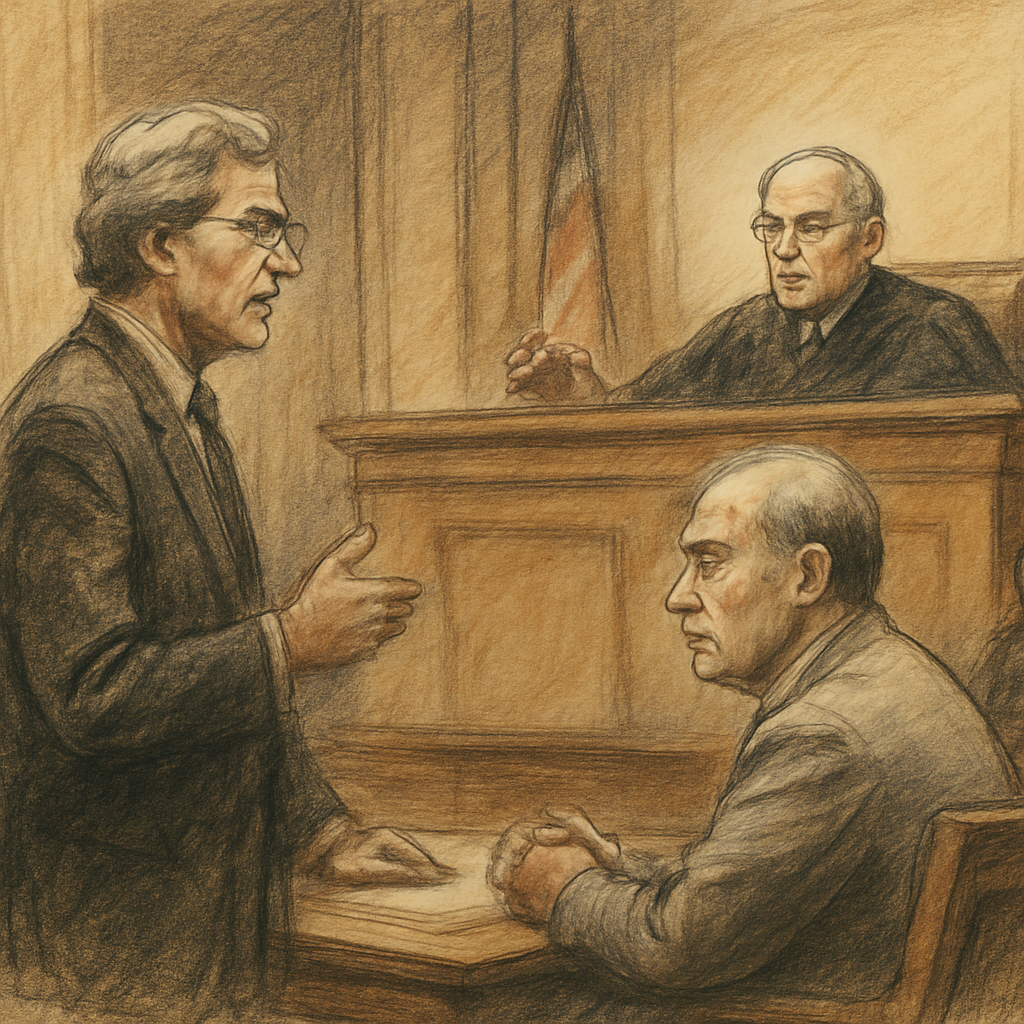
A decades-old case still haunts Lorain County, but it’s not over. The man who once prosecuted Nancy Smith now reaps public funds to defend new allegations—and his influence hasn’t waned
The legal footprint of Jonathan Rosenbaum spans more than three decades of criminal justice in Lorain County, Ohio. From the courtroom where he prosecuted Nancy Smith and Joseph Allen in 1995, to the private legal contracts he secured from the City of Lorain in 2025, Rosenbaum has remained a fixture in the county’s legal and political landscape. Today, with ongoing federal civil rights litigation, wrongful conviction suits, and accusations of conflict-laden payouts by county officials, Rosenbaum’s continued influence raises questions not only about him but about the system that enables such continuity.
At the center of this controversy is the Head Start case. Rosenbaum led the prosecution against Smith and Allen, resulting in convictions that later unraveled after decades of scrutiny. In 2013, Smith was freed on a technical agreement barring her from suing. In 2021, under then-Prosecutor J.D. Tomlinson, a new trial was granted. Charges were dropped in 2022, effectively exonerating both defendants. Rosenbaum, who has never formally recanted his belief in their guilt, now finds himself once again aligned with the levers of public legal power.
That alignment became unmistakable in 2025 when the City of Lorain authorized taxpayer-funded private legal defense for former police chief James McCann in the federal lawsuit Knapp v. City of Lorain, et al. The city selected Jonathan Rosenbaum as McCann’s personal counsel, awarding him a $5,000 contract approved by Mayor Jack Bradley and Safety-Service Director Rey Carrion. Both of those officials are also named defendants in the same litigation. Their vote to approve Rosenbaum’s engagement raises immediate conflict-of-interest concerns under Ohio Revised Code Section 102.03(D), which prohibits public officials from using their positions to secure benefits for themselves or close associates in matters where their impartiality is compromised.
Adding fuel to the fire is evidence suggesting a political and personal nexus between Rosenbaum and Mayor Bradley. Public campaign finance records from 2022 show both Bradley and Judge Thomas Teodosio listed on the same fundraising reports connected to Tomlinson’s election campaign. A photographic exhibit of the campaign report includes both Rosenbaum and Teodosio as contributors within the same reporting cycle. The proximity of their political dealings undermines the notion of judicial neutrality in any case where Rosenbaum holds a stake, particularly Barilla v. Tomlinson, where Judge Teodosio ruled favorably in a matter involving payouts stemming from internal allegations against Tomlinson himself.
Central to that dispute was the Battistelli payout, quietly categorized as a contractual expenditure rather than a legal settlement. Metadata from internal requisition records obtained through public records laws show two versions of the payment entered on the same day—one that did not mention Battistelli and a second, edited later, that included both her payout and attorney fees. The final version was submitted without the standard insurance review by CORSA, despite longstanding requirements for third-party scrutiny of legal claims involving taxpayer funds. The justification for that omission remains unclear. What is clear is that the structure of the payment was facilitated internally with legal guidance that bypassed normal oversight.
Attorney Dan Petticord, then Chief Assistant Prosecutor, was involved in shaping how the payout was handled. He has since acknowledged in internal correspondence that the payment structure, skipping insurance and framing it as contractual, was crafted under his advisement. That same Petticord, now employed in a senior role at Lorain County Job and Family Services, was also involved in prior litigation defending the county’s refusal to release settlement records. His dual role, first defending secrecy in public records disputes, then helping engineer a payout designed to avoid external review, raises serious concerns about consistency, ethics, and transparency. Yet while those who structured and approved the deal remain professionally intact, it is Tomlinson who bore the brunt of political fallout, as if the decision had been made in a vacuum.
This dynamic raises a larger question: was the aim to unravel a flawed payout or to unravel Tomlinson himself?
The proximity of Rosenbaum to the handling of the case, the internal maneuvering of requisition approvals, the political timing, and the silence of others who enabled the payout structure, particularly Petticord, all suggest that what is unfolding may not just be an accountability reckoning but also a deliberate campaign to discredit the one prosecutor who dared to overturn one of Lorain County’s most controversial convictions.
What emerges is not just the legacy of a career prosecutor but a pattern of power insulation. Whether through campaign affiliations, taxpayer-funded legal assignments, or discreet roles in high-stakes settlements, Rosenbaum has remained institutionally embedded. His resilience speaks not only to personal tenacity but to the absence of effective institutional guardrails that should prevent conflicts of interest and ensure transparency.
Lorain County cannot move forward until this network of influence, loyalty, and legal latitude is publicly confronted. Whether through judicial review, independent audit, or federal oversight, the structural questions raised by Rosenbaum’s resurgence and Tomlinson’s public vilification must be answered not only for the sake of historical accuracy but to restore public faith in a system that has too often relied on selective silence.
The Prosecutor
Jonathan Rosenbaum’s role in the 1995 convictions of Nancy Smith and Joseph Allen remains one of the most hotly contested chapters in Lorain County’s legal history. As lead prosecutor, Rosenbaum pursued the case with fervor despite glaring deficiencies in physical evidence and the controversial handling of witness testimony. The charges stemmed from an investigation into alleged child sexual abuse tied to the Head Start transportation program, with Smith accused of delivering children to Allen for abuse. Yet the case lacked any forensic or physical corroboration. Medical reports failed to substantiate claims of abuse, and no physical evidence ever linked either Smith or Allen to the allegations.
Rosenbaum’s courtroom strategy leaned heavily on the emotional weight of child testimony, many of which later came under scrutiny. Several of the children were questioned using leading techniques, and some would eventually recant or contradict their original statements. Despite mounting concerns over the investigative integrity and the psychological suggestibility of child witnesses, Rosenbaum pressed forward. Trial transcripts reveal a reliance on emotionally charged arguments and a narrative structure that obscured the absence of hard evidence. Legal experts, including those from the Ohio Innocence Project, have since characterized the trial as emblematic of a prosecutorial culture more invested in conviction than in objective review.
Throughout the appellate process, Rosenbaum continued to defend the legitimacy of the original prosecution. Even as external reviews and public opinion began shifting toward sympathy for the defendants, his stance remained immovable. Higher courts initially upheld the convictions, bolstered by procedural deference, until Judge James Burge intervened in 2009 to vacate the verdicts, citing flaws in the original sentencing structure. That ruling was overturned by the Ohio Supreme Court, reinstating the convictions, but the groundwork for deeper inquiry had been laid.
The resistance to revisiting the case reached its apex as national attention grew. Journalistic investigations and independent reviews began dissecting the weaknesses of the original prosecution, particularly its failure to meet modern evidentiary standards. Despite this, Rosenbaum never recanted his role or admitted error, maintaining the narrative that Smith and Allen were guilty.
The Head Start case has since become a cautionary tale in wrongful conviction studies, frequently cited in academic, legal, and journalistic circles. It highlights the dangers of tunnel vision, the misuse of child testimony, and the failure to apply rigorous evidentiary standards. At the center of it all is Rosenbaum, whose prosecutorial decisions shaped the outcome and whose unyielding defense of those decisions continues to draw scrutiny. His role in the case remains a central lens through which broader issues of prosecutorial accountability, institutional bias, and systemic inertia are examined.
The Fallout
The unraveling of the Head Start case did not occur overnight. Nancy Smith and Joseph Allen endured more than two decades of incarceration, appeals, and procedural stagnation before any meaningful reconsideration of their case began. The turning point came in 2021 when then Lorain County Prosecutor J.D. Tomlinson filed a motion for a new trial, citing deep flaws in the original prosecution and its investigative foundation. Judge Chris Cook granted that motion, opening the door to a sweeping reassessment of the case. In early 2022, Tomlinson formally dismissed the charges against Smith and Allen, who had long maintained their innocence. For Smith, the dismissal marked a full exoneration. For Allen, it meant the end of a decades-long prison term rooted in contested and controversial testimony.
But the institutional backlash followed quickly. In 2025, Tomlinson’s successor, Prosecutor Tony Cillo, filed a 300-page motion urging the court to vacate the orders that had granted Smith a new trial and led to her exoneration. Cillo accused Tomlinson and former Judge James Burge, who had previously presided over parts of the case and later served as Tomlinson’s chief of staff, of orchestrating what he called a wide-ranging fraud on the court. Central to Cillo’s argument was the claim that the exoneration process had been corrupted by private communications, alleged collusion with defense counsel, and backchannel revisions to Smith’s 2013 plea deal, which had originally barred her from suing for wrongful conviction.
Cillo’s filing did not stop at legal critique. It sought to relitigate the procedural history and question the legal authority under which Tomlinson acted. Yet nowhere in his motion did Cillo directly dispute the overwhelming criticism of the original case, including allegations of coached child testimony, missing forensic evidence, and now-recanted witness statements. Nor did he contend with the public consensus that the 1995 trial had failed basic standards of fairness.
Legal scholars and civil rights advocates have framed Cillo’s motion as emblematic of a deeper resistance within institutions to acknowledge foundational prosecutorial error. While his filing claimed to be motivated by legal integrity, its broader implications suggest a more defensive posture by the county. It reflects a refusal to concede that two people may have been wrongfully imprisoned for decades under its watch. Critics argue that by targeting Tomlinson and Burge, the motion shifts scrutiny away from the flawed investigation and prosecution and redirects it toward the officials who tried to remedy the damage.
At stake is more than the reputations of public officials. If Cillo’s motion succeeds, it could set a chilling precedent for the reversal of exonerations and discourage other prosecutors from revisiting convictions tainted by misconduct or outdated forensic science. For now, the motion is pending before Visiting Judge Janet Burnside, who must weigh whether the original corrective actions were indeed invalid or whether the backlash itself is an effort to shield the county from civil liability and political fallout. Either outcome will shape how Lorain County confronts or avoids the legacy of one of its most controversial prosecutions.
The Defender
Despite a legacy tied to one of the most scrutinized prosecutions in Lorain County history, Jonathan Rosenbaum resurfaced in 2025 as publicly funded legal counsel for former police chief James McCann. McCann is a named defendant in the federal civil rights lawsuit Knapp v. City of Lorain, et al., which includes allegations of retaliatory conduct, constitutional violations, and abuse of authority. Rosenbaum’s engagement was not merely incidental. His $5,000 private legal services contract was approved by the City of Lorain’s Board of Control, which included Mayor Jack Bradley and Safety-Service Director Rey Carrion. Both of those individuals are also named defendants in the very same litigation.
The circumstances of Rosenbaum’s selection raise immediate legal and ethical questions. Under Ohio Revised Code §102.03(D), public officials are barred from using their positions to secure anything of value for themselves or for others where their objectivity may reasonably be questioned. The statute exists to prevent officials from participating in decisions where personal or political loyalties might compromise public interest. The approval of a contract for a co-defendant’s private legal counsel, particularly when the selection was not independently vetted or competitively sourced, strains the boundaries of that statutory safeguard.
The city’s process in executing the contract was similarly opaque. The decision was voted on during a November 2025 Board of Control meeting, without clear public discussion of the potential conflicts involved or any documentation that established the necessity or justification for Rosenbaum’s selection. Absent was any indication of how the city determined that Rosenbaum was the appropriate or sole qualified candidate. Also absent was any demonstration of effort to separate public duty from private loyalty, especially given the intertwined histories and political relationships at play.
That entanglement cannot be dismissed as coincidence. Rosenbaum’s reentry into municipal legal affairs took place against the backdrop of active litigation that threatens to expose systemic failures in law enforcement oversight and political retaliation. His involvement brings with it the weight of unresolved allegations from the past, not just from the Head Start prosecution but from his deep roots in Lorain’s political and legal establishment. Rather than being sidelined in the wake of controversy, Rosenbaum reappeared as a publicly endorsed advocate for one of the city’s most powerful former officials.
The message this sends is not lost on observers. In a legal environment where prosecutorial misconduct, civil rights violations, and political favoritism are the subjects of active federal court scrutiny, the selection of a figure so closely associated with institutional entrenchment sends a clear signal. It suggests that networks of legal and political influence continue to function with little disruption, regardless of past controversies or public criticism. Rosenbaum’s reappointment is not simply about legal representation. It is a reflection of how power persists, how familiar names reemerge at critical moments, and how decisions made behind closed doors often echo with decades of unresolved history.
What makes this decision even more troubling is that James McCann had formally retired from the City of Lorain as of September 2025. At the time the Board of Control voted to approve Rosenbaum’s $5,000 contract, McCann was no longer a city employee and was being sued in his personal capacity under 42 U.S.C. §1983. That statute does not bind municipalities to defend individual actors unless they are sued for actions taken explicitly within the scope of their public duties and under formal indemnification policies. No such finding was made public. No opinion from the Law Department was issued. No motion was filed in federal court asserting that McCann’s actions fell within the legal scope of his employment.
Instead, city officials who are themselves personal defendants in the same lawsuit, Mayor Jack Bradley and Safety-Service Director Rey Carrion, approved taxpayer-funded legal services for their co-defendant without public debate or procedural safeguards. That vote did not protect the city. It protected a peer. In doing so, it strained the plain language of Ohio Revised Code §102.03(D) and (E), which prohibit public officials from securing anything of value for others in cases where their impartiality may reasonably be questioned. It also raised substantial ethical concerns under Rule 1.7 of the Ohio Rules of Professional Conduct, which governs conflicts of interest where personal and professional loyalties intersect.
McCann’s retirement and the nature of the lawsuit make this more than a paperwork irregularity. It is a case study in how a closed circle of officials can use the machinery of public governance to shield one another from legal scrutiny. The Rosenbaum contract was not an accident. It was a choice. A choice made not in the interest of institutional defense, but in defense of the individuals who remain at the helm.
The Power Circuit
Jonathan Rosenbaum’s professional longevity in Lorain County is not merely a function of legal acumen or prosecutorial legacy. It is deeply rooted in a broader political network that has operated with considerable continuity across decades of public office transitions. This network is not theoretical. It is evidenced in campaign finance disclosures, photographic documentation, and shared public appearances that connect Rosenbaum to multiple figures who currently hold, or have recently held, powerful positions in local government and the judiciary.
Public campaign finance records from the 2022 election cycle show Rosenbaum listed as a contributor to then-Prosecutor J.D. Tomlinson, a candidate whose campaign also received support from Lorain Mayor Jack Bradley and Summit County Judge Thomas Teodosio. These disclosures are not merely administrative footnotes. They establish that Rosenbaum was financially active in the same political circuit as the prosecutor whose administration exonerated Nancy Smith and Joseph Allen, the mayor who later approved Rosenbaum’s public legal contract in a federal lawsuit, and a judge who would go on to issue a favorable ruling in Barilla v. Tomlinson, a civil matter stemming from internal allegations involving that very prosecutor.
A photograph of the campaign finance report has circulated publicly, showing the names of Rosenbaum, Teodosio, and others listed in proximity on the same filing. The optics are not incidental. When parties with shared political and financial histories reappear in one another’s professional decisions or legal entanglements, concerns of impartiality and undue influence naturally arise. These connections are compounded by Rosenbaum’s subsequent reentry into publicly funded legal work in 2025, at the direct behest of other figures tied to the same political circuit.
What emerges is not merely a timeline of contributions or mutual endorsements, but a pattern of recurring institutional overlap. That overlap implicates not just campaign finance, but also public contract approvals, legal representation decisions, and judicial rulings, all involving individuals with overlapping histories and political sympathies. In any community, particularly one where public trust in law enforcement and government institutions has been repeatedly strained by allegations of misconduct, transparency and independence are foundational. The repeated appearance of the same names and faces in overlapping legal and political contexts erodes that foundation.
In this light, Rosenbaum’s continued relevance cannot be viewed in isolation. It is part of a larger apparatus in which legal authority, electoral power, and public resources intersect in ways that invite scrutiny. When a prosecutor who once secured controversial convictions later contributes to the campaign of a successor who reverses those outcomes, and when a judge appearing on the same campaign report rules favorably in litigation tied to those events, the appearance of neutrality is undermined, regardless of intent.
This pattern raises legitimate and urgent questions about how power circulates in Lorain County, how alliances are maintained across roles and administrations, and how decisions that should be subject to strict ethical scrutiny instead pass through a network of mutual reinforcement. Public service is meant to reflect the will and welfare of the people. When campaign contributions and personal affiliations become a shadow layer behind official decision-making, the boundary between governance and favoritism becomes dangerously thin.
Jonathan Rosenbaum: The Unbroken Thread
More than twenty-five years after leading one of the most controversial prosecutions in Lorain County history, Jonathan Rosenbaum has not faded into legal obscurity. Instead, he has continued to reappear at pivotal moments, often aligned with politically connected actors and institutions that blur the line between public service and private advantage. The pattern is consistent. When the stakes are high and the narrative tightly controlled, Rosenbaum is seldom far from the room.
His involvement in the 1995 prosecution of Nancy Smith and Joseph Allen remains the anchor of his public reputation. It was a case defined by moral panic, contested testimony, and the total absence of physical evidence. Yet for decades, Rosenbaum has stood by his role, never conceding error even as the case unraveled and the defendants were ultimately cleared of all charges. That refusal to acknowledge fault is not just a personal stance. It is emblematic of a system that rarely audits itself.
In 2025, Rosenbaum surfaced again, this time appointed as private legal counsel for former police chief James McCann in the federal civil rights lawsuit Knapp v. City of Lorain. What made this engagement especially troubling was how it came about. The $5,000 contract was authorized using taxpayer funds by Mayor Jack Bradley and Safety-Service Director Rey Carrion, both of whom are named defendants in the same lawsuit. The City Law Department did not handle McCann’s defense directly, nor was there any public explanation as to why.
The legal implications of this arrangement are serious. Under Ohio Revised Code §102.03(D), no public official or employee shall use or authorize the use of their authority or influence to secure anything of value that could improperly benefit themselves, family members, or business associates. By voting to fund Rosenbaum’s representation of their co-defendant, Bradley and Carrion opened the door to a textbook conflict of interest. That conflict is further exacerbated by §102.03(E), which prohibits public officials from participating in matters where their objectivity could reasonably be questioned.
Further ethical concerns arise under Ohio Rules of Professional Conduct Rule 1.7, which governs conflicts of interest involving current clients. The rule prohibits representation if the lawyer’s independent judgment is materially limited by responsibilities to another client, a former client, or the lawyer’s own interests. When the approval of Rosenbaum’s contract comes directly from parties with aligned legal exposure, the lines between independence and mutual protection blur significantly.
That arrangement was not just irregular. It was part of a deeper fabric of political alignment. Campaign finance disclosures from the 2022 election cycle show Rosenbaum listed as a donor on the same reports that include Judge Thomas Teodosio and then-Prosecutor J.D. Tomlinson. A now-public photograph of a campaign finance filing places Teodosio and Rosenbaum together in the same reporting window. These are not isolated contributions. They reveal a political and financial loop in which legal figures, elected officials, and judicial officers appear to orbit the same power structure, yet despite political proximity or shared campaign activity, Teodosio did not ultimately act in Rosenbaum’s favor, which could lend weight to the theme that personal and institutional ties do not always dictate judicial outcomes, but the perception of entanglement still erodes public trust.
The implications of this network became even more concerning when Judge Teodosio presided over Barilla v. Tomlinson, a case involving politically sensitive claims and internal allegations against Tomlinson. Meanwhile, Dan Petticord, then advising the commissioners, was working to keep those same records hidden. Petticord now holds an administrative post at Lorain County Job and Family Services.
This entanglement of overlapping legal roles and institutional interests raises obvious questions about transparency, influence, and accountability. When viewed together, these moments are not coincidences. They map a pattern in which Rosenbaum remains institutionally embedded across different administrations, legal matters, and levels of government. Whether as a prosecutor, defense counsel, or quiet advisor, his name recurs in disputes where accountability is contested and public trust already strained.
More concerning is the lack of meaningful review or ethical inquiry into how and why these appointments occur. No independent authority appears to have examined the McCann contract for compliance. No ethics body has publicly questioned whether Rosenbaum’s appointment as counsel in a case involving multiple city officials meets the threshold for permissible public funding. The contract was simply authorized, recorded in board minutes, and executed with no public deliberation.
The cumulative picture raises a difficult but necessary question. Is Rosenbaum still present because of his legal ability, or because his involvement signals a willingness to defend not just individual clients but the institutional order they represent? That question speaks not only to Knapp, but to every matter in which Lorain County governments continue to enlist familiar names under questionable circumstances.
In the end, it is not about Rosenbaum alone. It is about what his enduring presence reveals about how power is protected in Lorain County. When yesterday’s prosecutors become today’s appointees and tomorrow’s defense counsel, often without scrutiny or transparency, the issue is not merely legality. It is legitimacy.
The Integrity Questions
The Battistelli payout remains one of the clearest examples of procedural irregularity and possible administrative concealment in recent Lorain County memory. On the surface, the transaction was labeled a routine contractual expenditure, but metadata from internal county requisition systems tells a more complex story. Two different sets of payment entries were generated on the day of approval. The first made no mention of Battistelli. The second was revised at the last minute to include both the payout to her and the fee to her attorney. That version was pushed through without the usual insurance review by CORSA, despite longstanding county policies requiring outside authorization for legal settlements involving taxpayer funds. The decision to bypass that review process, whether by design or negligence, created a critical lapse in oversight and accountability.
At the center of this process was attorney Dan Petticord, who at the time served as Chief Assistant Prosecutor advising the County Commissioners. His involvement in shaping how the Battistelli payout would be categorized and processed is well documented through internal communications. After the fallout, he was neither disciplined nor removed. He is now employed in a leadership position at Lorain County Job and Family Services. That career continuity stands in stark contrast to the treatment of former Prosecutor J.D. Tomlinson, who publicly took responsibility for aspects of the payout but has since been politically sidelined and publicly scrutinized.
Even more complex is Petticord’s historical role in a separate legal matter involving the same themes of transparency and secrecy. Petticord represented the Lorain County Board of Commissioners in litigation against Tom Barilla, who was attempting to force the release of county settlement records under public records law. In that case, Petticord’s role was to defend the county’s decision to keep those documents sealed. Yet Petticord later became involved in shaping internal legal advice on how to process the Battistelli payout. That dual positioning, first defending secrecy in court, then helping design an administrative structure that concealed the nature of a controversial payout, raises fundamental questions.
Was he acting as a neutral legal advisor, or was he helping to shape a system where inconvenient disclosures could be avoided?
All of this unfolded while many of Tomlinson’s former staff remained in place, untouched by the controversy. If the decisions were made collectively, why was only one person held politically accountable?
The parallels do not stop at the county level. In 2025, during the active federal civil rights case Knapp v. City of Lorain, former Police Chief James McCann was granted publicly funded legal representation in his personal capacity. The City of Lorain selected Jonathan Rosenbaum to serve as his attorney. That decision was approved by Mayor Jack Bradley and Safety-Service Director Rey Carrion, both of whom are also named as defendants in the same lawsuit. There was no documented recusal, no scope-of-duty evaluation released to the public, and no explanation of why the City Law Department could not represent McCann. The contract with Rosenbaum was quietly approved for $5,000, despite clear ethical concerns under Ohio law prohibiting public officials from authorizing benefits that might serve their own defense interests.
At the same time, independent journalists and legal advocates were actively investigating Rosenbaum’s public roles, requesting his contracts, filings, and internal communications through public records laws. That context cannot be ignored. Was Rosenbaum’s appointment simply about legal strategy, or was it about consolidating protection within a politically loyal circle?
The deeper question remains. Was the public narrative surrounding Tomlinson’s departure built on genuine concern over process, or was it a calculated campaign to shift blame, protect long-serving internal figures, and preserve the quiet structures of mutual loyalty? Those who designed the payment, processed it, and advised on its legality are still employed by the county. None of them have been meaningfully questioned in public forums. Only Tomlinson faced widespread political and reputational fallout.
This does not appear to be a case of one bad decision. It appears to be the symptom of a system that protects itself from within, shielding architects of controversial decisions while offering up a single name to bear the weight of institutional failure.
The Reckoning to Come
The federal civil rights lawsuit filed by Nancy Smith remains pending, a culmination of more than three decades of legal struggle, public shaming, and institutional resistance. It is not simply a bid for damages. It is an act of defiance against the machinery that once declared her guilty without physical evidence, based on questionable testimony, and under the authority of a prosecutor who continues to stand by the case. Smith’s lawsuit is more than personal. It is a bellwether for whether Lorain County, and Ohio more broadly, is prepared to reckon with the human costs of unchecked prosecutorial power.
While legal filings continue to move through federal court, Smith’s case has already achieved something extraordinary. It has peeled back the outer layer of respectability long worn by those who crafted and defended the original prosecution. It has placed uncomfortable questions on the public record, questions not only about Rosenbaum’s decisions in 1995 but about the institutions that kept him in proximity to influence long after that case began to unravel. What does it say about a county where the man who prosecuted one of the most widely criticized criminal cases in Ohio history resurfaces decades later with a city contract and political backing? What does it reveal when those aligned with Smith’s eventual exoneration find themselves isolated or removed while the architects of her conviction are still called “counselor,” “judge,” or “advisor”?
Smith’s exoneration never triggered a formal investigation into the prosecution’s conduct. No disciplinary action was taken. No internal review of law enforcement methods was made public. The system simply absorbed the reversal and moved forward without so much as a pause. That silence was itself a message—that longevity matters more than accuracy, that those who maintain power through connections rather than conduct will not be forced to account for past harms.
Today, even as the lawsuit inches forward, other signs suggest that the old guard in Lorain County has not just survived but rebranded. It no longer wears the uniform of “prosecutor” or “chief” but instead operates through contract law, appointments, endorsements, and informal influence. There is no need to stage a comeback when power was never actually relinquished. The names remain, only the roles shift.
Smith’s case must be seen in this broader context. Her fight is no longer just about her innocence. It is about whether legal institutions are willing to admit they were wrong, or whether they will continue to protect their own at all costs. Her lawsuit, and the public records and depositions it may compel, could finally force the release of documents long shielded from scrutiny. It could place under oath the officials and attorneys who shaped not just her trial but the county’s institutional culture. It may become the last opportunity for truth to eclipse loyalty.
But that opportunity is fragile. There is still time for the county to circle the wagons, to settle quietly, to redact, delay, or deflect. There is also the risk that any fallout will be contained to symbolic gestures, with real accountability once again deferred.
In Lorain County, what we are witnessing is not just a reckoning over a wrongful conviction. It is a live experiment in how long influence can sustain itself, how durable the alliances are between public institutions and private actors, and how far the public is willing to let legacy power govern without challenge. Smith’s case is not just a lawsuit. It is a test. A test of whether the facts, finally assembled can penetrate a system that has for decades insulated itself with silence, technicalities, and proximity to political power.
This is not just about Nancy Smith or J.D. Tomlinson or Jonathan Rosenbaum. It is about what Lorain County tolerates in the name of continuity and what it may yet expose in the pursuit of truth. The question now is whether the reckoning comes by choice or by force of fact. And whether the public is ready to look unflinchingly at what has been allowed to endure.
Conclusion: The Price of Unanswered Questions
What Lorain County has offered is not merely a cast of recurring names, recycled titles, or rerun scandals. It is a living archive of how institutional power is sustained not through innovation or accountability but through ritual, relationship, and silence. The story of Jonathan Rosenbaum is not an outlier. It is a pattern. A study in the elasticity of influence. He does not disappear because the institutions that elevated him have no incentive to evolve. The same networks that ushered him into the courtroom in 1995 now return him to it in 2025, cloaked in public contracts, sanctioned by former adversaries turned co-defendants, and unburdened by consequence.
In any functioning democracy, the exoneration of two individuals wrongfully convicted would trigger serious institutional introspection. Prosecutors would be questioned, law enforcement practices reviewed, and ethical safeguards scrutinized. But in Lorain County, the focus has shifted not toward the architects of injustice but toward those who tried to reverse it. Former Prosecutor J.D. Tomlinson is now politically sidelined and publicly defamed, while those who shielded settlements, bypassed insurance protocols, and enabled ethically questionable contracts still hold office, sign checks, and offer no explanation. That is not justice. That is preservation.
The same applies to how legal representation is handled when public officials face federal scrutiny. When a city funds personal legal counsel for a former police chief who has already retired and is being sued individually under federal civil rights law, and does so without public debate, legal opinion, or recusal, it is not a technical decision. It is a signal. It tells the public that proximity to power, not principle, will determine who gets protected and who gets left behind. When the selected attorney is the same figure who prosecuted a now-exonerated woman, and who appears in campaign filings and photo records with the very officials approving his engagement, it crosses the threshold from impropriety into something systemic.
What remains is not merely a legal problem but a democratic one. Systems that do not interrogate themselves will eventually be interrogated by the public. That is what this article represents. A public audit where institutional ones have failed. A record of what is seen and what is concealed. A demand for clarity in a county where settlements are hidden behind technical classifications, decisions are made off the record, and figures from the past are summoned to defend the present with public funds.
As the plaintiff in Knapp v. City of Lorain, I write not only as a journalist but as someone directly impacted by these decisions. I have filed the public records requests. I have traced the requisition entries. I have reviewed campaign finance reports and watched officials misstate facts and dismiss their own ethical obligations. What I have seen, and what the documents reveal, is that institutional loyalty still outweighs accountability in Lorain County. Until that changes, the names will rotate but the consequences will not.
We are often told to trust the process. That truth takes time. That justice is methodical. But when the process is designed to obscure, when transparency is reduced to a press release, and when power protects itself through repetition and familiarity, belief turns into farce. What remains is exposure. Documented, factual, and unrelenting.
This is not the last chapter. It is a warning. The longer institutions resist accountability, the more sweeping the reckoning must eventually become.
Aaron C. Knapp
Plaintiff, Knapp v. City of Lorain, et al.
Editor, Lorain Politics Unplugged
Closing Bio
Aaron Christopher Knapp is a licensed social worker, an investigative journalist, and a long-standing pro se litigant with a record that spans multiple jurisdictions, including Idaho, Ohio, and Utah. His work is grounded in documentary evidence, verified public records, sworn statements, and direct encounters with the institutions he reports on, and he has built a reputation for following the trail where it leads, regardless of whether it passes through the police department, the prosecutor’s office, the courts, or the county administration. Across more than a decade of public-records litigation, appellate filings, administrative complaints, and statutory challenges, he has demonstrated a sustained ability to identify unlawful processes, uncover suppressed records, expose procedural contradictions, and force public bodies to comply with the basic legal obligations that many would prefer to ignore. His reporting integrates legal analysis, first-person accountability documentation, and a clear understanding that public institutions, despite their power, remain bound by rules that most citizens never have the opportunity, the knowledge, or the resolve to test.
Aaron’s professional background includes a Bachelor of Science in Social Work from The Ohio State University, licensure as a Social Worker in the State of Ohio, and certification as a Chemical Dependency Counselor Assistant, and he has served in multiple systems that require the application of statutory interpretation, ethical evaluation, and the ability to navigate high-conflict disputes that involve law enforcement, courts, schools, guardians ad litem, clinicians, and public agencies. His experience as a veteran, a parent who litigated across three states, a GAL program appointee, and an investigative writer has shaped an approach that is both disciplined and unafraid. His work has appeared in Lorain Politics Unplugged, NewsBreak, Substack, and other platforms that prioritize government transparency, and he continues to serve as a public-records litigator who challenges unlawful denials, publishes concealed material, and documents retaliation when officials attempt to weaponize their offices against him or others.
He writes with one consistent philosophy: the truth is not negotiable, public institutions work for the people, and sunlight never hurts anyone who is doing their job lawfully.
Legal Disclaimer
The analysis provided in this report is based entirely on publicly available documents, sworn testimony, recorded statements, court filings, and information obtained through lawful public-records requests. Nothing contained in this publication constitutes legal advice, nor should it be relied upon as legal guidance, representation, or counsel. Readers who require legal advice should consult a licensed attorney who can evaluate the facts of their situation within the governing jurisdiction. All individuals and public officials discussed herein are presumed innocent unless and until they are proven guilty in a court of law, and all references to potential misconduct reflect commentary, opinion, or analysis derived from the available public record. This material is presented for investigative, journalistic, educational, and public-interest purposes, consistent with the protections of the First Amendment the rights of citizens to examine and critique the operation of their government.
AI-Generated/Enhanced Content Disclaimer
Some images or visual representations included in this article were generated or enhanced using artificial intelligence tools. These images are illustrative in nature and do not depict actual events, persons, or places unless explicitly stated. No AI-generated content should be interpreted as factual evidence or a literal visual record. Where applicable, all efforts have been made to ensure clarity and transparency regarding the source and purpose of such material. This disclaimer applies to all AI-generated or digitally modified media in this publication.
About The Author




Interesting and Informative Article