

When a Neutral Record Speaks and Power Tries to Shrug It Off

A statutory fact-finding record under Ohio Revised Code Chapter 4117 does not become “optional” because elected officials dislike what the evidence proved
By Aaron C. Knapp, LSW
Investigative journalist and public-records litigator based in Lorain, Ohio
The State Employment Relations Board fact finding report involving Lorain County Job and Family Services and UAW Local 2192 is not commentary and it is not optional reading. It is a statutory product of Ohio public sector labor law, issued after sworn testimony, documentary evidence, and a formal evidentiary hearing conducted pursuant to Ohio Revised Code Chapter 4117, a process that exists precisely because public sector labor disputes cannot be resolved by assertion, preference, or political convenience alone. The fact finder was appointed not to split the difference or soften conclusions, but to determine what the record actually established once both parties had exhausted bargaining and reached statutory impasse.
This was not an informal review or a behind closed doors memorandum. The hearing included live testimony, cross examination, wage tables, insurance cost histories, staffing and classification data, bargaining proposals, and internal County documentation. The report repeatedly distinguishes between meaningfully supported claims and those that failed under scrutiny, using direct language such as “the evidence does not establish” and “the record demonstrates,” making clear that the conclusions reached were driven by proof rather than perception. The fact finder did not merely summarize positions. He evaluated them, accepted some, rejected others, and explained why.
That context is essential when the public is later told, in recent coverage, that the Lorain County Commissioners “disagreed with the report.”
That sentence appears neutral. It is not. Disagreement is not an analytical response, and it is not a legal category within Ohio’s collective bargaining framework. Disagreement does not identify an evidentiary flaw, does not challenge a factual finding, does not rebut sworn testimony, and does not expose a misapplication of law. It simply expresses dissatisfaction with conclusions reached by a neutral examiner applying statutory standards the County itself is required to follow.
Elected authority does not invalidate an evidentiary record by asserting displeasure. A vote does not undo sworn testimony. An executive session does not convert findings of fact into opinion. Once a fact finding report is issued, the record exists independently of whether the employer accepts its recommendations. Ohio law allows rejection of recommendations. It does not allow erasure of findings.
The distinction matters because the report does not offer abstract observations or policy preferences. It makes concrete findings about wage structures that are mathematically incapable of delivering what they promise, leave policies that treat similarly situated employees unequally without rational justification, disciplinary proposals unsupported by evidence of systemic abuse, and benefit costs that are already forcing employees to forgo medical care. These are not philosophical disagreements. They are determinations rooted in exhibits, testimony, and comparative data.
Facts do not require consensus to remain facts. They require only a record.
When Commissioners respond to such a record with a statement of disagreement rather than substantive engagement, that response becomes part of the story. It reflects an institutional posture toward inconvenient facts, particularly when those facts disrupt long standing narratives about fiscal responsibility, management necessity, or employee blame. It signals that conclusions grounded in evidence are negotiable when they collide with preferred outcomes.
This piece exists to restore the proper frame. It exists to explain what the fact finder actually found, why those findings carry weight regardless of political reaction, and what it reveals about local governance when neutral findings are treated as obstacles rather than information. The issue here is not whether the County likes the report. The issue is whether evidence is allowed to matter when it contradicts power.
Facts do not require consensus to remain facts. They require only a record. This record exists, it was created lawfully, and it now stands on its own, regardless of who disagrees with it.
What This Report Is and Why the Process Exists
A SERB fact finder is not an advocate for labor and not an agent of management, and that distinction is not cosmetic or theoretical but foundational to how Ohio public sector labor law is designed to function when negotiations fail. The role exists because Ohio law explicitly recognizes that collective bargaining disputes inevitably reach a point where competing narratives, internal talking points, and positional claims can no longer be resolved through assertion or repetition, and must instead be tested against evidence in a formal, adversarial setting governed by statute rather than politics.
SEE THE REPORT HERE IN ITS ENTIRETY:
https://acrobat.adobe.com/id/urn:aaid:sc:VA6C2:dbbbd879-da2a-4d55-ad31-bf8e015aa391
Once the parties reached statutory impasse, the process shifted out of the realm of bargaining postures and into an evidentiary framework. A neutral examiner was appointed by the State Employment Relations Board, not selected by either party, and a full hearing was conducted where witnesses testified under oath, documents were introduced into the record, and each side was afforded the opportunity to support its claims with proof rather than rhetoric. When that hearing concluded, the record was closed, meaning the fact finder’s task was no longer to negotiate or mediate, but to evaluate what had actually been demonstrated within the four corners of the evidentiary record.
The resulting report reflects that function. It is built from sworn testimony, wage tables, insurance cost histories, staffing and classification records, and the documented history of bargaining between the parties. It traces how the County justified its positions, how the Union challenged those justifications, and where the evidence ultimately landed. It documents what was proven and what was not, drawing clear distinctions between claims supported by the record and assertions that failed when subjected to scrutiny.
The report does not speculate about intent or motive. It does not hedge conclusions to preserve political comfort. It does not blur findings to avoid conflict. Where evidence was insufficient, the report says so directly. Where the record contradicted management narratives, that contradiction is explained. Where concerns raised by employees were corroborated by data and testimony, those concerns are acknowledged rather than minimized. This is not the language of compromise. It is the language of evaluation.
That is precisely why this document carries weight even when one side dislikes it. Its authority does not come from acceptance by the parties, but from the process that produced it. A fact finding report does not become weaker because it is rejected, and it does not become less accurate because it is inconvenient. It stands as an independent account of what the evidence showed at a specific moment in time, created under a statutory framework designed to ensure that facts, once established, cannot be wished away by disagreement.
When officials later reduce that record to a statement of preference, they are not responding to opinion. They are responding to findings that exist whether or not they are embraced. And that distinction is the difference between governance grounded in evidence and governance that treats facts as optional when they interfere with desired outcomes.
Disagreement Is Not a Legal Standard
When Commissioners say they “disagree” with the report, they are not invoking law, procedure, or any recognizable standard of review, because they are not pointing to an error in testimony, not identifying a misstatement of fact, not alleging bias, and not claiming that the fact finder misapplied Ohio law or exceeded his authority. They are doing none of the things that would even begin to resemble a substantive response to an evidentiary record. They are expressing displeasure, full stop, and attempting to substitute that displeasure for engagement with facts they do not like.
Ohio law permits a party to reject a fact finder’s recommendations. It does not permit a party to pretend the findings themselves are optional, advisory in spirit, or disposable by vote. Rejection does not erase the record. It does not undo sworn testimony. It does not make wage tables disappear. It does not turn documented insurance costs into hypotheticals or convert staffing data into opinion. The findings remain findings whether Commissioners accept them, reject them, or wish they had never been written.
What the Commissioners are doing here is not disagreement in any meaningful sense. It is avoidance dressed up as authority. It is the refusal to confront a neutral record that dismantles talking points they have relied on for years, particularly the narrative that frontline employees are the problem, that discipline is the solution, and that fiscal restraint somehow applies only downward. They have offered no alternative facts, no competing analysis, no explanation for why the fact finder’s conclusions are wrong, only the assertion that they do not like them.
That is not governance. That is posturing.
Disagreement, in this context, is not a substantive response. It is a political reflex triggered when evidence refuses to cooperate. It is what happens when a neutral examiner applies the rules honestly and the outcome interferes with managerial convenience. It is the sound of three elected officials discovering that a statutory process exists precisely to prevent power from rewriting reality when the record becomes inconvenient.
This is not a clash of opinions. It is a collision between evidence and ego, and the Commissioners chose ego.
The report does not lose credibility because the Commissioners reject it. The rejection loses credibility because it refuses to grapple with what the report actually says. This is not a clash of opinions. It is a collision between evidence and ego, and the Commissioners chose ego.
And the most damning part is this. If the report were weak, if the findings were sloppy, if the conclusions were unsupported, the Commissioners would have seized on that immediately, quoted it, highlighted it, and explained it in detail. They did not, because they could not. So instead they reached for the vaguest possible word, “disagree,” and hoped that would be enough to make the problem go away.
It will not.
The Wage Structure That Cannot Deliver What It Promises
One of the most important findings in the report concerns the County’s wage structure itself, because it exposes a problem that cannot be solved by slogans about raises or appeals to patience. The fact finder concluded that the current system is structurally incapable of allowing employees to ever reach the maximum of their classification, a conclusion that goes to the heart of whether the County’s compensation system is honest about what it promises workers over the course of a career.
This is not rhetoric and it is not ideology. It is arithmetic. Employees advance through fixed percentage milestones tied to years of service, while the wage range maximum increases at the same annual percentage. Because both numbers move in parallel, the distance between an employee’s wage and the top of the range never closes. The report states plainly that “no employee can ever reach the maximum rate of any pay grade” under this structure, and that once an employee reaches the upper milestone, the gap between their pay and the ceiling “remains constant indefinitely.” That is not a matter of debate. It is a built in feature of the system.
“No employee can ever reach the maximum rate of any pay grade” under this structure, and the gap “remains constant indefinitely.”
The importance of this finding cannot be overstated, because wage ranges are not just accounting tools. They are representations of what a job is worth and what long term service is supposed to lead to. When a County tells employees there is a maximum rate for their classification, it is implicitly telling them that dedication, experience, and longevity will eventually be rewarded. A system that mathematically prevents that outcome is not merely flawed. It is misleading. It creates the appearance of opportunity while structurally denying it.
The report goes further, stating that this permanent ceiling effect contributes directly to wage compression, undermining morale, recruitment, and retention. That matters because these are not abstract workforce concepts. They are operational realities. When experienced employees see that their pay will never meaningfully separate from new hires, institutional knowledge erodes. When prospective employees realize that advancement has a hard stop that cannot be crossed, recruitment suffers. When long term service produces no real economic distinction, retention becomes a revolving door problem rather than a discipline issue.
During testimony, the County acknowledged that some employees already earn above the posted maximums due to rolled in longevity payments from prior agreements. That admission is devastating to the County’s claim that the structure must be preserved for fiscal discipline. A system that management has already bypassed selectively is not a neutral framework. It is a justification invoked when convenient and ignored when necessary. Fiscal discipline cannot be both rigid and optional at the same time.
The fact finder recognized this contradiction and rejected the argument that modest percentage raises alone were sufficient to address the problem. The report explains that increasing wages without correcting the structure simply preserves the defect at a higher dollar amount. As a result, the fact finder ordered structural modification to eliminate permanent ceiling effects, along with general wage increases and retroactive pay after execution of the agreement. That recommendation was not aspirational. It was corrective.
This finding matters because it reframes the entire debate. The issue is not whether employees want more money. The issue is whether the County has been operating a compensation system that can never deliver what it claims to offer. The report answers that question clearly, and it does so based on math, testimony, and documented practice rather than opinion.
When Commissioners say they “disagree” with this finding, they are not disagreeing with a theory. They are disagreeing with arithmetic, with their own admissions, and with the logical consequences of a system they designed and defended. That is why this portion of the report is so dangerous to ignore, because it strips away the illusion that this is a matter of preference and exposes it as a matter of structure.
You cannot fix a system that never lets employees reach the top by telling them to wait longer. The top does not exist in practice. The fact finder said so plainly.
SERB Fact-Finding Report under R.C. 4117.14(C).
Unequal Sick Leave by the County’s Own Admission
The report also addresses a sick leave accrual disparity between bargaining unit and non bargaining unit employees, and this portion of the findings is particularly damning because the County did not merely fail to justify the disparity, it admitted how it came to exist and why it was selectively corrected.
During testimony, the County acknowledged that non bargaining employees accrue sick leave at a higher rate due to a long standing administrative error, an error that was quietly fixed only for management staff once it was identified as a potential audit problem.
SERB Fact-Finding Report under R.C. 4117.14(C).
That admission alone should have ended the conversation. The County knew the accrual rates were unequal. The County knew the inequality was the result of an error, not a policy choice grounded in operational necessity. And the County knew that leaving the error uncorrected for management could create compliance or audit exposure. So it acted. It fixed the problem for itself.
What it did not do was extend that correction to bargaining unit employees performing comparable work under the same attendance expectations, supervised by the same management, subject to the same policies, and carrying the same operational burdens. Instead, the County attempted to preserve the disparity, effectively arguing that an acknowledged mistake should continue to disadvantage frontline workers because correcting it for them would be inconvenient or costly.
The fact finder rejected that position outright. The report states plainly that maintaining unequal sick leave accrual without a rational operational basis perpetuates inequitable treatment, particularly where bargaining unit and non bargaining unit employees perform comparable work and are subject to identical attendance rules. In other words, once the County admitted the disparity was an error, the burden shifted entirely to the County to explain why only managers deserved correction. It could not.
This matters because sick leave is not a perk. It is a basic employment protection, especially in public service environments marked by burnout, high caseloads, and constant exposure to stress. When a County knowingly allows one class of employees to accrue less sick leave than another for no legitimate reason, it is not merely managing benefits. It is institutionalizing inequality.
The recommendation mandates equalization of sick leave accrual rates and limits documentation requirements to cases of actual need rather than routine suspicion. It further states that sick leave cannot function as an automatic disciplinary trigger absent just cause, directly rebuking the County’s attempt to treat illness as misconduct and absence as moral failure.
If the Commissioners “disagree” with this finding, what they are really disagreeing with is the idea that errors should be fixed evenly.
This was not a compromise. It was a correction of something that never should have been allowed to persist once the error was discovered. The County had already demonstrated that correction was both possible and necessary when management interests were at stake. The only question left was whether fairness applied to everyone else.
The fact finder answered that question clearly. The County’s prior conduct answered it just as clearly, and not in its favor.
If the Commissioners “disagree” with this finding, what they are really disagreeing with is the idea that errors should be fixed evenly, that frontline workers deserve the same basic protections as management, and that compliance should not be selective. That is not a policy disagreement. It is an ethical one.
This portion of the report exposes the quiet part of County governance, the part where mistakes are corrected when they threaten power and preserved when they only harm workers. And that is precisely why it had to be written into the record, because left to its own devices, this inequity would have continued indefinitely, normalized by silence and justified by convenience.
Calling this a concession misses the point entirely. It was not something the County gave up. It was something it should never have taken away.
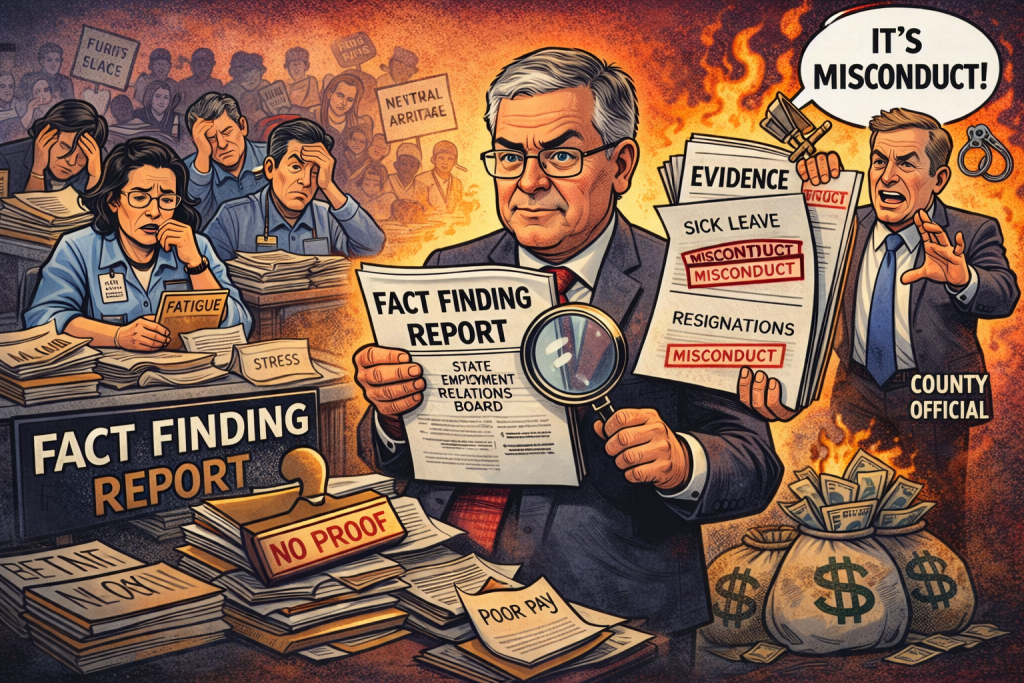
The Attendance Point System That Failed the Evidence
The County’s proposed no fault attendance and tardiness point system was rejected in its entirety, and that rejection matters because it dismantles one of management’s central narratives about why working conditions at Job and Family Services are deteriorating. Management attempted to frame attendance as the problem and discipline as the solution, arguing that a rigid, automatic point system was necessary to address what it characterized as widespread abuse.
The fact finder reviewed the evidence and concluded otherwise. While the record did show high sick leave usage and a troubling number of resignations, those facts alone did not establish systemic attendance abuse. The report makes clear that utilization is not misconduct, that resignation is not evidence of wrongdoing, and that neither can be used as a substitute for proof. The County failed to demonstrate that absences were illegitimate, excessive in a disciplinary sense, or driven by employee misconduct rather than by burnout, workload, stress, or inadequate compensation.
SERB Fact-Finding Report under R.C. 4117.14(C).
This distinction is critical, because management’s proposal depended on collapsing very different concepts into one accusation. It treated illness, exhaustion, caregiving responsibilities, and attrition as evidence of employee failure rather than as warning signs of institutional strain. The fact finder refused to accept that sleight of hand. The report states plainly that the evidence did not support abandoning just cause principles, which exist precisely to prevent discipline from being imposed automatically, mechanically, and without individualized evaluation.
The proposed point system would have imposed penalties regardless of context, intent, or legitimacy, transforming attendance into a numbers game where illness could count the same as misconduct and where discipline would be triggered not by wrongdoing but by arithmetic. That approach was not rejected because it was unpopular. It was rejected because it was punitive, unsupported by the record, and incompatible with established labor standards that require cause, proportionality, and fairness.
The importance of this finding goes beyond attendance policy. The County attempted to use discipline as a management tool to solve problems created by staffing shortages, high caseloads, and retention failures. Instead of addressing why employees were burning out and leaving, management proposed a system designed to punish the symptoms. The fact finder recognized that dynamic and refused to validate it.
The report’s rejection of the no fault system is therefore a rejection of a broader philosophy, one that treats frontline workers as the source of operational failure rather than as the people absorbing it. The fact finder did not excuse absenteeism where it is abusive, but he made clear that abuse must be proven, not assumed, and that discipline must be justified, not automated.
The record showed strain, not misconduct. Burnout, not bad faith. Attrition, not indiscipline.
That conclusion was not ideological. It was evidentiary. The County was given the opportunity to demonstrate systemic abuse and failed to do so. The record showed strain, not misconduct. Burnout, not bad faith. Attrition, not indiscipline.
When Commissioners now say they “disagree” with this rejection, what they are really disagreeing with is the idea that management must prove its accusations before imposing punishment. They are objecting to the requirement that discipline be grounded in evidence rather than convenience.
The fact finder refused to let discipline become a substitute for leadership, and that refusal now sits squarely in the record, regardless of how uncomfortable it may be for those who wanted an easier explanation for a harder problem.
Health Insurance and the Human Cost in the Record
On health insurance, the report technically maintained the existing premium split, but to read that outcome without reading the findings that accompany it is to fundamentally misunderstand what the fact finder actually documented. The report does not treat the current structure as benign or sustainable. It does not gloss over the consequences. It explicitly acknowledges sworn testimony that employees are foregoing medical treatment, specialty medications, and even family coverage because the cost has become unaffordable.
That acknowledgment is devastating, because it places human harm squarely into the official record. This is not speculation and it is not rhetoric from a bargaining table. It is testimony under oath that County employees, the very people responsible for administering public assistance programs, are themselves rationing healthcare, skipping care, and making medical decisions based not on need but on price. Once that testimony is acknowledged in a fact finding report, it cannot be dismissed as exaggeration or anecdote. It becomes a documented condition of employment.
The importance of this finding is that it strips away the County’s ability to hide behind percentages. An eighty five fifteen split sounds reasonable in the abstract. It sounds balanced when reduced to numbers on a spreadsheet. But the report makes clear that the lived reality underneath that split is already producing harm. Employees are not merely dissatisfied. They are uninsured by choice because they cannot afford coverage. They are untreated by necessity because co pays and premiums have crossed the line from burdensome to prohibitive.
SERB Fact-Finding Report under R.C. 4117.14(C).
Rather than validating further cost shifting, the report explicitly encourages caps or economic offsets, recognizing that affordability is already stretched thin and that unilateral increases would only deepen the harm already documented. That is not the language of comfort. It is the language of warning. It is the fact finder saying, in effect, that while the current structure remains, it is already operating at the edge of acceptability and should not be treated as a blank check for management.
This matters because it destroys the moral cover the County relies on when it frames healthcare costs as an abstract budget problem rather than a human one. Once a neutral examiner acknowledges that employees are foregoing care, the conversation changes. At that point, further cost shifting is no longer a technical adjustment. It becomes a conscious decision to exacerbate harm that has already been proven.
When Commissioners say they “disagree” with the report, they are not disagreeing with a policy recommendation here. They are disagreeing with sworn testimony that their own employees cannot afford to stay healthy under the current system. They are disagreeing with the idea that documented harm should constrain future decisions.
Disagreement does not erase testimony. It simply signals a willingness to look away from consequences that are now part of the record.
Disagreement does not erase testimony. It does not undo what employees said under oath. It does not make skipped prescriptions reappear or delayed treatments less real. It simply signals a willingness to look away from consequences that are now part of the record.
And that, more than anything else in this report, reveals the distance between how this County talks about public service and how it treats the people who actually perform it.
Who Has This Report and Why It Cannot Be Ignored
This report is not private, and it is not informal. It was served on the County, its senior administrators, outside labor counsel, the bargaining representative, and the State Employment Relations Board as part of a completed statutory fact-finding process. It is a finalized administrative record created under Ohio public sector labor law, and once issued, it entered the public record stream by operation of law.
What is not clear, and what should not be assumed, is how widely this report has circulated beyond the parties who were formally served. Media outlets may have portions of it. They may have summaries. They may have been briefed selectively by officials who disliked its conclusions. But there is no guarantee that the full report, in its entirety, has been read, reviewed, or published by anyone outside the process itself.
That matters, because partial access is not the same as transparency. Summaries do not carry the same weight as findings. Characterizations do not substitute for language written by a neutral examiner after reviewing sworn testimony and evidence. When the public is told that Commissioners “disagreed” with the report without seeing the report itself, the frame is inverted. Reaction replaces substance. Opinion replaces record.
This is why publishing the report in full matters. Not excerpts. Not paraphrases. Not selected highlights filtered through political response. The entire document, verbatim, so that readers can see exactly what was found, what was rejected, and why.
When Commissioners say they “disagree,” they are not disagreeing with a confidential memo passed quietly between negotiators. They are disagreeing with a document that exists across multiple institutions, that was created through a formal evidentiary process, and that now stands as an official account of what the evidence showed at the moment of impasse.
Whether or not the media has chosen to publish it, minimize it, or ignore it does not change what it is. The report does not require permission to exist. It does not require agreement to remain valid. And it does not lose force because it has been inconveniently quieted.
By publishing the full report verbatim, this article removes the last excuse for pretending the findings are abstract or debatable. The record will speak for itself. And once it does, disagreement will no longer be able to hide behind summary.
Who Made This Choice and Why Their Names Matter
This response did not come from an abstract institution or an unnamed board. It came from specific people exercising public power. The decision to brush past the substance of this report with the word “disagree” belongs to the sitting Lorain County Commissioners who acted at the time, including David Moore, Jeff Riddell, and Marty Gallagher.
These are not appointed administrators operating quietly in the background. They are elected officials. They ran for office. They asked voters to entrust them with oversight of county government, including the Department of Job and Family Services. They now exercise that authority on behalf of the public, and their responses to neutral records are part of how that authority should be judged.
That context matters because when elected officials are confronted with a detailed evidentiary record documenting structural wage failure, unequal treatment of employees, unsupported disciplinary proposals, and documented harm to the workforce, they face a choice. They can engage the findings, explain why they believe the conclusions are wrong, or acknowledge the problems and address them. Or they can dismiss the record without analysis and rely on the assumption that most people will never see what was actually found.
Jeff Riddell’s role deserves particular attention, because he is not only one of the Commissioners associated with rejecting the substance of this report, but is also running for reelection. That means voters are being asked to renew trust in the same judgment that looked at a neutral fact finding record and chose not to grapple with it. That is not an abstract concern. It goes directly to how evidence is treated when it becomes inconvenient.
David Moore and Marty Gallagher share equal responsibility for that posture. Collective authority does not dilute accountability. When Commissioners act together to wave past an evidentiary record rather than confront it, each member of that majority owns the outcome.
These Commissioners oversee an agency responsible for administering food assistance, Medicaid eligibility, and child welfare related services that affect thousands of residents. The employees described in this report are the people carrying that responsibility every day. How leadership responds to documented failures in wages, benefits, and working conditions is not peripheral. It is central to competent governance.
Naming the Commissioners is not about personalization or theatrics. It is about responsibility. Elected officials do not govern anonymously, and they do not get to hide behind the word “disagree” when confronted with a neutral record that dismantles their preferred narrative.
Elections are the mechanism through which accountability is supposed to function. Records like this one are the measure by which judgment is supposed to be evaluated. This report will remain long after press statements fade, and the choices made in response to it will follow the officials who made them.
A Misread of the County They Govern
There is an additional layer to this that the Commissioners appear to be either ignoring or profoundly misjudging, and that is the political and cultural reality of Lorain County itself. This is not a hostile environment for organized labor. This is a union county. It has been one for generations. Union membership is not an abstraction here. It is family history. It is household identity. It is how people paid mortgages, sent kids to school, and survived industrial collapse when corporate loyalty evaporated.
Public sector unions, private sector unions, building trades, service workers, and manufacturing locals are woven into the civic fabric of this county. They are not fringe stakeholders. They are voters. They are donors. They are organizers. They are people who show up, remember slights, and talk to each other across locals and across election cycles. When a neutral fact finding report documents systemic problems affecting a unionized workforce, that record does not land in a vacuum. It lands in a community that understands exactly what it means when management dismisses evidence of unequal treatment and structural wage failure.
That context matters because the response offered here was not cautious, conciliatory, or explanatory. It was dismissive. It sent a signal, intentional or not, that when a neutral process produces findings favorable to workers, those findings can be brushed aside without engagement. In a county with deep union roots, that message does not dissipate quietly. It circulates. It is discussed in halls, at job sites, at meetings, and at kitchen tables.
This is not about whether one bargaining unit wins or loses a particular contract provision. It is about whether elected officials are perceived as respecting the role of organized labor as a legitimate institutional partner or treating it as an obstacle to be managed. The latter posture has consequences in a place like Lorain County, where labor solidarity has long memories and broad reach.
Union communities do not need press releases to understand what happened here. They read records. They understand process. They recognize when a statutory safeguard is treated as an inconvenience rather than a boundary. And they tend to respond not with outrage in the moment, but with patience, coordination, and memory.
If the Commissioners believe this will be viewed as a narrow administrative disagreement, they are likely mistaken. In a pro union county, dismissing a neutral record that validates worker concerns is not interpreted as toughness. It is interpreted as disrespect. And disrespect, in union politics, is rarely forgotten and almost never cost free.
This report will circulate whether officials want it to or not. And when it does, it will not be read in isolation. It will be read against the backdrop of a county that knows exactly what organized labor looks like when it decides it has been dismissed rather than heard.
Why This Record Will Outlast the Moment
Fact finding reports do not vanish because elected officials wish they would, and they do not lose force because they are inconvenient or politically uncomfortable. Once issued, they become part of the official labor relations record, shaping future bargaining, informing mediation and arbitration, and serving as a documented account of what was known, what was admitted, and what was proven at a specific point in time. They exist precisely to prevent disputes from being endlessly reframed once the evidence stops cooperating.
This record will be referenced again, whether the Commissioners prefer it or not. It will be cited in future negotiations when the same arguments are made. It will be remembered when similar disciplinary proposals resurface under new language. It will matter when wage structures are defended as functional and when benefit costs are framed as abstract numbers rather than human consequences. The findings do not expire with a press cycle. They persist as a benchmark against which future claims will be measured.
The Commissioners may disagree today, but disagreement does not erase documentation, does not undo sworn testimony, and does not alter the findings themselves. Tomorrow, next year, and in the next round of bargaining, this record will still exist as a fixed point, capturing what the County knew and how it responded when confronted with evidence that contradicted its preferred narrative.
This is not about labor versus management, and it never was. It is about whether evidence is allowed to matter when it collides with power, and whether statutory processes designed to establish facts are respected or quietly dismissed once they become inconvenient.
Once a record exists, it no longer belongs to the people who wish it did not. It belongs to the public, to history, and to every future decision maker who will have to contend with the fact that these findings were made, these warnings were issued, and these choices were documented.
Final Thought
This Has Been Building, and Voting Is Where It Finally Lands
None of this emerged suddenly, and anyone claiming it did is either unfamiliar with the record or counting on the public to be. What this report reflects is not the start of a controversy but the culmination of a long, slow deterioration that unfolded in stages, first as wage stagnation, then as structural pay inequities, then as benefits erosion, and finally as a full scale compensation and sustainability crisis that could no longer be contained inside meeting rooms or minimized with talking points.
Long before a fact finder was involved, people working inside Lorain County government were raising alarms. Long before insurance costs forced employees to delay or forgo medical care, the pay structure was already failing to meet the basic demands of the jobs it governed. Long before discipline was floated as a management response, burnout had already taken hold. I have been in contact with union members employed by the County for years, and I reported on these concerns when they were still treated as isolated complaints, when they were dismissed as “just about pay,” and when leadership found it easy to wave them away as exaggeration. The record now confirms what workers were saying when it was still politically convenient to ignore them.
Consider who these workers are and what they do. Employees in Child Support Enforcement are reportedly earning wages that barely exceed those of a Speedway cashier, and yet they are entrusted every day with some of the most sensitive information held by County government. They handle Social Security numbers, income data, bank records, tax information, and court ordered payment histories for thousands of parents and children across Lorain County. Their work requires precision, discretion, and strict legal compliance, because a single error can follow a family for years and ripple through the court system, employers, and households already under strain.
The question almost answers itself. Should work of that consequence not command a comparable wage. Should people entrusted with the financial lives of families across the county be treated as disposable labor. Should positions requiring accuracy, confidentiality, and constant public interaction be compensated as though they are interchangeable with entry level retail work.
Now set that reality beside the other half of the County’s compensation story. Political appointees selected by this same Commissioners Board have been paid salaries large enough to later become subjects of public discomfort, distancing, and selective amnesia. Names like Dan Petticord did not surface because frontline workers were overcompensated. They surfaced because the Board approved arrangements that it later seemed eager to disown once scrutiny arrived.
History matters here. Past dealings show a pattern in which transparency becomes flexible when it threatens insiders, while rigidity is enforced when it burdens workers. The same leadership that insists there is no money, no flexibility, and no room for correction at the bottom has shown itself willing to accommodate, protect, and even quietly consult politically connected figures when their compensation or exposure becomes inconvenient. Whether one labels that conduct improper, unethical, or merely reckless, the contrast is impossible to miss. Workers are told to tighten belts, accept less, and absorb the strain, while those with proximity to power are insulated from consequence.
This is not abstract hypocrisy. It is structural. It is the same governance posture that moves swiftly to correct administrative problems when they endanger management, but preserves those problems when they only harm employees. It is the posture that treats burnout as a behavioral issue rather than a policy failure, and that frames discipline as leadership while avoiding accountability.
All of this is unfolding in a pro union county. Organized labor here is not symbolic. It is woven into the civic identity of the community. Union households understand what it means when evidence validates worker concerns and elected officials respond by dismissing it. They understand what it means when essential public service workers are told to accept less while insiders are protected, compensated, and quietly advised. They understand the difference between fiscal responsibility and selective austerity.
That is why voting matters here. Commissioners are not permanent fixtures. They are elected officials who answer not only for what they say, but for what they approve, what they ignore, and how they respond when an independent process confirms uncomfortable truths. When one of those Commissioners now asks voters for another term, the public is entitled to evaluate conduct, not slogans.
This report did not create these problems. It documented them. It put into writing what workers had been saying privately, what unions had been raising collectively, and what some of us were already reporting when the issue was still small enough to be dismissed.
The record has finally caught up. What happens next will not be decided by whether three Commissioners say they “disagree.” It will be decided by whether voters, especially in a union county, are willing to accept dismissal as leadership.
Because once a record like this exists, it no longer belongs to the people who wish it did not. It belongs to the workers who lived it, the unions who organized around it, and the voters who now have the information necessary to decide who should be trusted with power going forward
Disclosure and Disclaimer
This publication is commentary and analysis intended for informational and public-interest purposes. It is not legal advice, it is not a substitute for advice from a licensed attorney, and it does not create any attorney client relationship. Any references to statutes, procedures, public records, labor processes, or legal standards are provided in good faith as general discussion based on publicly describable frameworks and the author’s interpretation of available information, and readers should consult qualified counsel for guidance on any specific legal matter.
This article discusses a labor-relations fact-finding process and describes findings as characterized within the author’s narrative. Readers are encouraged to review original source documents directly whenever possible. Any quoted language appearing in quotation marks is presented as written quotation within the article’s text, and should be verified against the underlying document if used for any formal purpose.
AI and Image Use Notice
If this post contains any illustrations, composite graphics, or stylized images, some visuals may be generated or assisted using AI tools for editorial presentation. AI-generated visuals are used for expressive or explanatory purposes only and are not presented as documentary evidence. Any factual claims in this post rely on the text and the described record, not on any generated imagery.
Author: Aaron C. Knapp, LSW
About The Author