
The Emails That Built a Lie
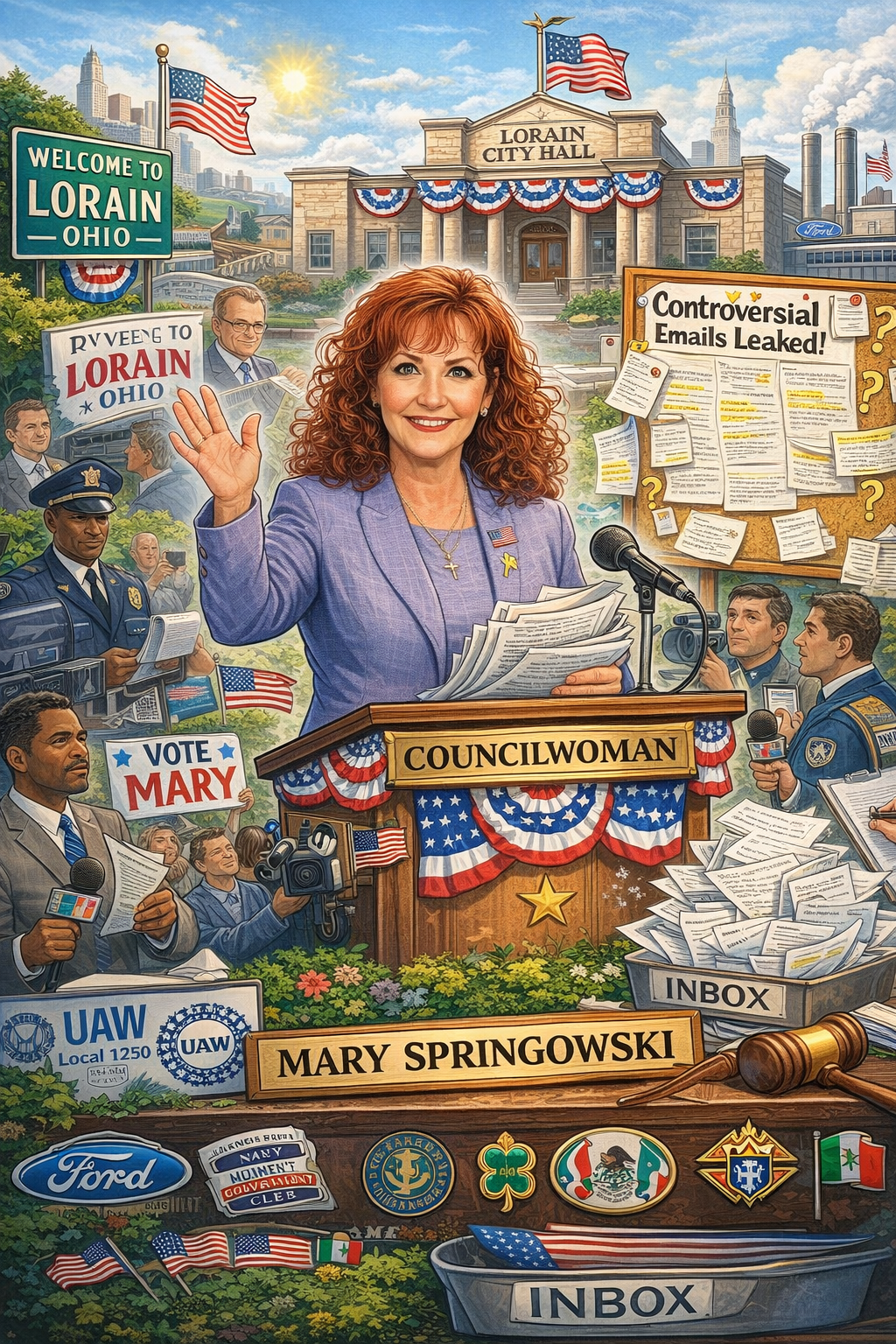
How a Lorain Councilwoman Turned Rumor Into Weaponized Defamation
By Aaron Knapp
Introduction
I am writing this because documents do not lie, even when people do, and because emails have a way of preserving intent long after their authors assume the consequences have faded or the damage has already been absorbed. What follows is not conjecture, not inference, and not a disagreement over tone or perception. It is a record based examination of emails authored, forwarded, and republished by Lorain City Councilwoman Mary Springowski and others, what those emails explicitly say about me, where they were sent, who received them, and why that language carries extraordinary weight when the person being described is a licensed social worker with no criminal history, no record of violence, and no factual basis for the narrative being circulated about him.
This article exists because narratives formed inside government rarely remain confined to government. They move outward by design. They are forwarded, copied, and repackaged through the language of concern, safety, and precaution. They migrate into newsrooms, private inboxes, and informal conversations where the subject of the narrative is absent and unheard. By the time the story has been repeated enough to feel familiar, it is treated as settled truth, even when no evidence ever existed to support it. At that point, the harm is no longer theoretical. It is complete.
I know this because I lived it, in real time, while it was happening, and long after the emails stopped being sent but continued to do their work.
What the Emails Actually Say and Why the Words Matter
The emails authored and forwarded by Councilwoman Mary Springowski portray me as aggressive, unstable, dangerous, and threatening. That is not interpretation and it is not rhetorical shorthand. That is the plain substance of the language used, repeated across multiple emails, to multiple audiences, over an extended period of time. The descriptors change slightly from message to message, but the theme does not. I am framed as someone to be feared. I am framed as someone whose presence constitutes a threat. I am framed as someone whose conduct warrants intervention, despite the complete absence of any conduct that would justify that conclusion.
What is striking about these emails is not only what they say, but what they do not contain. There is no incident cited anywhere in the correspondence. There is no police report referenced. There is no sworn statement attached. There is no contemporaneous documentation of a threat, a confrontation, or a violent act. There is no factual predicate that would normally accompany claims of fear or danger when those claims are made responsibly. Instead, there is assertion, delivered confidently, repeated frequently, and framed almost exclusively through subjective fear language rather than objective fact.
In one such email, Councilwoman Springowski writes that she is “fearful for my personal safety” and that she has “had enough,” language that carries a very specific meaning when directed toward law enforcement, prosecutors, and the media. Fear for personal safety is not a casual phrase. It is a trigger phrase. It implies imminent danger. It signals that intervention may be necessary. Yet nowhere in that email, or any other, does she identify a threat I made, a statement I issued, or an act I committed that would justify that level of alarm. The fear exists in the email. The facts do not.
These emails were not confined to a private request for legal advice. They were copied and forwarded to a wide range of recipients, including members of the Lorain City Law Department, law enforcement officials, prosecutors, reporters, and private citizens. In some instances, they were sent from or forwarded through multiple personal email accounts, expanding the audience beyond any plausible claim of confidentiality or internal deliberation. Each additional recipient amplified the narrative. Each forward carried the same unsubstantiated characterization into another inbox, where it could take on a life of its own.
When fear is asserted by an elected official, it is rarely interrogated. When danger is alleged without detail, listeners often assume the details must exist somewhere else. These emails rely on that assumption. They ask the reader to trust the characterization rather than examine the evidence. They substitute tone for proof and repetition for verification. In doing so, they transform subjective fear into an implied fact, one that follows the subject long after the email is sent.
The contrast between what is alleged and what is verifiable could not be sharper. I am a licensed social worker. I am nonviolent by law and by ethics. I have no criminal history, because I cannot have one and hold this license. I have been in close physical proximity to Councilwoman Springowski on numerous occasions at City Hall, in council chambers, and at public meetings. We have not spoken in over two years. There has been no confrontation. No raised voice. No threatening behavior. No incident of any kind that resembles the portrait painted in these emails. If the narrative were true, there would be evidence. There is none.
The facts are stubborn in that way. They resist being overwritten by repetition. They do not change simply because an allegation is forwarded often enough or copied to enough people with authority. And yet, as these emails circulated, the reputational harm compounded. Employers see words like aggressive and dangerous and stop reading. Agencies see fear language and choose avoidance. Boards see controversy and decide silence is safer. The damage occurs even when no charge is filed, no investigation substantiates the claim, and no corrective message is ever sent.
What makes this especially consequential is that no follow up emails were sent to retract, clarify, or correct these statements. No message was sent to the same recipients saying the claims were unproven or unsupported. No acknowledgment was made that no police report existed. The narrative was allowed to stand unchallenged, which in practical terms meant it was allowed to become the default understanding of who I am. Silence, in this context, is not neutral. It is participatory.
Below is the full set of emails referenced throughout this article, produced in response to public records requests and preserved exactly as they were sent and received.
https://acrobat.adobe.com/id/urn:aaid:sc:VA6C2:96a76323-8bf8-4be2-824d-c59f2455abdf
Readers are encouraged to review the documents themselves. Read the language. Note the absence of evidence. Pay attention to who is copied, who is forwarded, and how often the same characterizations appear without factual support. This is not about tone. It is about record. And the record speaks with clarity, even when the people who created it now wish it would not.
Who She Sent Them To and Why That Matters
These emails were not confined to internal deliberation, confidential consultation, or a narrowly tailored request for legal guidance. They were sent to members of the public. They were sent to political critics. They were sent to reporters. They were forwarded repeatedly, including through multiple personal email accounts, well outside any reasonable claim of protected governmental process. The dissemination was broad, intentional, and designed to ensure the narrative traveled farther than any single office or meeting ever could. Each forward expanded the audience. Each additional recipient multiplied the reputational harm. What was framed as “concern” functioned, in practice, as publication.
Equally important is what this dissemination avoided. By routing these statements outward rather than inward, the sender insulated herself from accountability while maximizing impact. There was no effort to confine the claims to a forum where evidence would be required or tested. There was no sworn complaint. No internal investigative referral grounded in fact. Instead, there was circulation, repetition, and silence after the damage was done. That is not accidental. That is how unverified narratives are preserved while responsibility for them is diffused.
At the same time these emails were being circulated, Councilwoman Springowski refused to engage with me directly. She has openly acknowledged that she does not respond to my emails and instead routes all correspondence to legal counsel. That decision matters, not because seeking counsel is improper, but because of how it was used here. It created a one way communication channel in which accusations and character attacks flowed outward to third parties, while any attempt at correction, clarification, or response was categorically blocked. I was spoken about, not spoken to. I was described, not confronted. I was labeled, not questioned.
The result is a structural imbalance that cannot be dismissed as caution. Defamatory statements were allowed to propagate freely, while the subject of those statements was denied any reciprocal avenue to address them with the same audience. No corrective emails were sent. No follow up communications were issued to retract or contextualize the claims. No effort was made to repair the reputational harm once it became clear that no charges, reports, or substantiating evidence existed.
That is not safety. It is not protection. It is not responsible governance. It is asymmetry by design, one that privileges accusation over accountability and narrative over fact.
The Reality the Emails Ignore
Here is the reality the emails never acknowledge, much less confront. I am nonviolent. I have no criminal history. I cannot have one and hold licensure as a social worker. That is not a rhetorical claim. It is a legal and ethical requirement of the profession. I have never been charged with a violent offense. I have never been accused, with evidence, of a violent act. I have never been found by any court, agency, or authority to pose a danger to anyone. There is no record anywhere that supports the narrative being circulated about me, because no such record exists.
This absence is not incidental. It is foundational. Claims of danger do not exist in a vacuum. They normally leave a trail. Police reports. Incident logs. Witness statements. Security referrals. Something. Here, there is nothing. The emails assert fear while bypassing every mechanism that would be triggered if that fear were grounded in reality. That alone should have prompted skepticism. Instead, the assertions were forwarded and treated as self validating.
The lived reality between Councilwoman Springowski and me further dismantles the narrative. We have been in close physical proximity many times over the years. City Hall. Council chambers. Public meetings. Government buildings. Spaces where security is present, where conduct is observable, and where any genuinely threatening behavior would be immediately evident. Despite this repeated proximity, we have not spoken in over two years. Not once. There has been no confrontation. No raised voice. No hostile exchange. No threatening gesture. No conduct of any kind that remotely resembles the person described in her emails.
This is not a matter of interpretation. It is a matter of observable fact. If I were aggressive, unstable, or dangerous, something would have occurred in those settings. Someone would have intervened. A report would have been filed. An incident would exist to point to. None does. Not because it was overlooked, but because it never happened.
The emails never reconcile this contradiction because they cannot. They do not explain how a person allegedly so dangerous can pass through years of public interaction without incident. They do not account for the complete absence of corroboration. They do not bridge the gap between allegation and reality. Instead, they rely on repetition to substitute for proof, assuming that if the characterization is circulated widely enough, it will be accepted as fact.
Reality does not support the story. And when reality is this incompatible with the narrative being advanced, the problem is not perception. The problem is fabrication.
Why This Is Defamation Per Se
Calling a licensed professional dangerous is not a casual insult, a rhetorical flourish, or a matter of bruised feelings. It is professionally lethal. When the subject of that language is a social worker, words like aggressive, unstable, and threatening are not abstract character judgments. They are disqualifying labels that strike at the core requirements of the profession. Social work is grounded in nonviolence, ethical conduct, emotional regulation, and public trust. To describe a social worker as dangerous is to assert, implicitly and explicitly, that they are unfit to practice. Employers do not investigate those claims in depth. They do not ask for context. They disengage. The decision is made instantly because the perceived risk is too high.
That is why these statements constitute defamation per se. They directly attack my fitness to practice my profession. They were made without evidence. They were published to third parties. They were repeated across multiple channels. And they were never corrected. Under the law, when statements so clearly undermine a person’s professional standing, the damage is presumed because the harm is obvious and immediate. The emails did not merely express opinion. They conveyed factual assertions about my character and dangerousness that any reasonable reader would understand as disqualifying.
The consequences of that language were not theoretical or speculative. They were concrete and immediate. I lost work. I was blackballed. Opportunities disappeared without explanation. Doors closed without conversation. My credibility was destroyed before my career had a chance to begin. I became an unemployed social worker with student debt and a license I could not use, not because of misconduct, not because of incompetence, and not because of any violation of law or ethics, but because individuals with power chose to circulate a story about me that was easier to tell than the truth.
What makes this especially corrosive is that the damage occurred without any formal finding, charge, or adjudication. There was no due process. There was no investigation that substantiated the claims. There was no opportunity for me to clear my name before the harm took hold. The emails did the work on their own. They traveled faster than facts ever could, and once they arrived, the presumption of danger attached itself permanently, regardless of the absence of proof.
That is the real injury here. Not wounded pride, but professional erasure. A career dismantled not by evidence, but by narrative. Not by law, but by rumor elevated through official channels. And once that damage is done, it cannot simply be undone by silence or time. The stain lingers, even when the allegations collapse under scrutiny.
Pattern, Not Panic
This was not a single misunderstanding, nor was it an isolated lapse in judgment. It follows a familiar and well documented pattern in local government and institutional power structures. Men who challenge authority, particularly those who persist, document, and refuse to be quiet, are not answered on the merits. They are reframed as threats. Presence is recast as stalking. Attendance at public meetings becomes following. Advocacy is rebranded as obsession. Ordinary civic engagement is pathologized through language that is intentionally vague and emotionally charged, designed to alarm rather than to inform.
The language used in these situations is remarkably consistent. It is rarely specific. It avoids concrete allegations that could be tested or disproven. Instead, it relies on implication and tone. Words like concerning, escalating, harassing, and frightening appear without reference to an actual act. The effect is to create an atmosphere of danger without the burden of proof. Once that atmosphere is established, the subject is no longer treated as a participant in civic life but as a problem to be managed. At that point, the facts become almost irrelevant, because the narrative has already done its work.
I have watched this same script applied to others, including Garon Petty. The phrasing repeats. The structure repeats. The claimed fear escalates even as evidence remains absent. Assertions are circulated, not investigated. Alarm is amplified, not examined. And when no incident occurs, the absence of proof is quietly ignored rather than acknowledged. The story simply moves on to the next email, the next meeting, the next warning, as though repetition itself were a substitute for truth.
What makes this pattern so effective is that it cloaks exclusion in the language of safety. Officials do not have to say they want to silence someone. They only have to say they are afraid. They do not have to justify removing a person from the conversation. They only have to imply that the person’s presence is disruptive or unsettling. In this way, marginalization is achieved without accountability, and dissent is neutralized without ever being debated.
The goal in these situations is not protection. It is control. It is the quiet removal of inconvenient voices from public life under the guise of concern. And because the language is emotional rather than factual, it is rarely subjected to the scrutiny it deserves. By the time anyone asks for evidence, the damage has already been done, and the person targeted is left to defend themselves against a story that was never true to begin with.
Silence as Complicity
What happened after the emails were sent matters just as much as the emails themselves. In some respects, it matters more. There were no corrective messages issued once it became clear that no police report existed, no charges were filed, and no evidence ever emerged to support the claims being circulated. There were no clarifications sent to the same recipients to explain that the allegations were unsubstantiated. There were no retractions acknowledging that fear had been asserted without factual foundation. The narrative was simply allowed to stand, intact and unchallenged, as though repetition alone could transform allegation into truth.
That choice was not neutral. When public officials permit false or misleading narratives to persist without correction, silence becomes participation. It signals acceptance. It allows third parties to assume the claims were accurate or at least unresolved. In professional and reputational terms, that silence does real harm. Employers do not wait for clarification that never comes. Agencies do not revisit decisions once a person has been informally marked as risky. The absence of correction functions as confirmation, even when no formal action is taken.
Routing everything to lawyers does not erase that damage. Legal silence is not the same as factual correction. Invoking counsel may shield officials from immediate confrontation, but it does nothing to repair the reputational harm inflicted on the person described. In this case, it had the opposite effect. It confirmed that avoiding accountability mattered more than accuracy, and that preserving the narrative mattered more than confronting whether it was true.
When the power to speak is exercised freely, but the responsibility to correct is avoided entirely, the result is not caution. It is abdication. And when that abdication occurs in government, the harm extends beyond the individual targeted. It erodes public trust in the integrity of the institutions that allowed the falsehood to persist.
What the Record Actually Shows, In Their Own Words
What matters most here is not my interpretation, not my tone, and not my anger, although I have every right to all three. What matters is what exists in black and white, written by the very people who now claim confusion, privilege, delay, or misunderstanding when asked to account for their words. Documents do not rely on memory. They do not adjust themselves to narrative convenience. They either say something, or they do not.
And what the public record shows is not a man threatening elected officials. It shows a constituent and licensed professional repeatedly invoking Ohio Revised Code 149.43 in calm, precise language, asking for records that reference his own name, narrowing the scope of requests to reduce burden, and following up patiently over the course of months in the face of government silence. The tone is measured. The language is statutory. The conduct is textbook public-records advocacy.
On August 20, 2025, I wrote, “Pursuant to the Ohio Public Records Act, I am formally requesting access to the following public records from the Lorain City Council and its staff.”
That single sentence alone dismantles the caricature that would later be built about me. It is not aggressive. It is not erratic. It is not threatening. It is the language of law, used correctly, by someone who understands both his rights and his obligations. That same tone repeats across subsequent emails, each one grounded in statute, each one asking either for production or for a legally sufficient explanation, each one unanswered for weeks or months at a time.
By contrast, what emerges from the emails written about me is something entirely different.
Councilwoman Mary Springowski did not simply express private concern or quietly seek legal advice. She forwarded and republished allegations that framed me as dangerous, frightening, and destabilizing, while copying prosecutors, police leadership, reporters, and private citizens. In her own words, she wrote that she was “fearful for my personal safety” and that she had “had enough.” Those are not casual phrases. When sent to law enforcement and the media, they carry a specific and predictable implication. They signal imminent danger. They invite intervention. They prime recipients to view the subject as a threat.
Yet those statements were not accompanied by a police report. They were not supported by a sworn affidavit. They did not cite a specific incident, a date, a time, or a witnessed act. There was no evidence attached, no contemporaneous documentation, and no factual foundation offered to justify the severity of the language being used. Fear was asserted as fact, and assertion was allowed to stand in place of proof.
The same pattern appears in emails authored by Loraine Ritchey, who asserted that my speech had caused “life threats by strangers” and that my rhetoric was “escalating,” again without evidence, again without verification, and again without any attempt to distinguish between protected political speech and actual misconduct. Those claims were not investigated. They were forwarded. They were circulated. They were absorbed into government systems where they took on the appearance of legitimacy simply by virtue of being repeated inside official channels.
Once inside those channels, the allegations were then shielded behind claims of privilege, delay, and redaction, effectively laundering defamatory narratives through government infrastructure while denying me any meaningful opportunity to confront or correct them. That is not an accident. It is a structural imbalance. Statements go out. Silence comes back. And in that silence, reputations are quietly destroyed.
This is why the documents matter. They show not just what was said about me, but how differently I spoke for myself. They expose a stark contrast between lawful advocacy and fear-based characterization. And they make clear that the story told about me was not supported by evidence, but by repetition, authority, and the strategic absence of correction.
How the City Turns Individuals Into “Problems”
What happened to me did not begin with Mary Springowski’s emails, and it does not end with them. The emails are evidence, not origin. They are artifacts of a broader municipal reflex that activates whenever a resident becomes inconvenient, persistent, or legally literate. The pattern is simple and it is repeated with quiet consistency. When the City of Lorain is confronted with scrutiny it cannot easily dismiss, it does not engage on the merits. It reframes the person asking questions as the problem.
This reframing is rarely explicit and almost never documented as policy. It happens through tone shifts, side emails, internal warnings, and informal consensus building. A resident is no longer described as a constituent but as a disruption. Advocacy becomes fixation. Attendance becomes presence. Presence becomes concern. Concern becomes fear. Fear becomes justification. By the time the process completes, the original issue no longer matters because the person raising it has been recast as unstable or unsafe.
That is the function Springowski’s emails serve inside this larger system. They are not outliers. They are accelerants.
Once a person is labeled as a safety concern, every future interaction is filtered through that assumption. Neutral acts are reinterpreted. Silence becomes suspicious. Persistence becomes harassment. And because the label is never attached to evidence, it can never be disproven. The City does not need to win an argument. It only needs to make the person radioactive.
This pattern explains why the City did not respond to my public records requests with compliance or even a lawful denial. It explains why narrowing the request did not lead to production. It explains why inspection was denied without citation. The issue was no longer the records. The issue was me.
The emails did not create that posture. They documented it.
Weaponized Silence as Municipal Policy
There is a myth that government misconduct always looks loud. In reality, it usually looks quiet. It looks like unanswered emails. It looks like referrals to counsel instead of answers. It looks like delay without denial. It looks like partial production stripped of context. It looks like silence used as a tool rather than a failure.
What distinguishes the City of Lorain’s conduct in this matter is not a single denial but a coordinated refusal to resolve anything on the record. At every stage, the City chose the option that preserved ambiguity and prevented accountability. When asked for records, it did not say yes or no. It stalled. When asked to identify custodians, it deflected. When asked to cite exemptions, it remained vague. When asked to permit inspection, it said no without explanation. Each individual act can be framed as procedural. Taken together, they form a strategy.
Silence is not neutral in public administration. Silence shapes outcomes. It exhausts the requester. It delays exposure. It allows narratives to harden without contradiction. In my case, silence worked in tandem with the defamatory emails. While statements portraying me as dangerous circulated freely, the records that would show how widely those statements were disseminated were withheld.
This is not coincidence. It is alignment.
The City’s insistence on routing everything through lawyers did not protect privilege. It protected narrative. By refusing to engage substantively, officials avoided creating corrective records. By avoiding correction, they allowed false impressions to stand unchallenged. By forcing litigation, they shifted the conversation from truth to process, where delay itself becomes leverage.
This is how institutional power operates without ever raising its voice. The City did not need to arrest me, charge me, or silence me directly. It only needed to let fear-based narratives circulate while denying access to the documents that would expose their reach.
A Pattern That Does Not Stop With Me
If this story were only about me, it would be easier to dismiss. That is precisely why it is not. The same rhetorical moves, the same language choices, and the same escalation pattern appear whenever residents cross from tolerated to inconvenient. I am not the first person in Lorain to be reframed as a threat instead of a participant, and I will not be the last.
The City has shown, repeatedly, that it does not distinguish between hostility and accountability. Questioning authority is treated as aggression. Demanding compliance with law is treated as antagonism. Showing up consistently is treated as fixation. This pattern explains why other residents, including Garon Petty, were subjected to similar fear-based framing despite the absence of violence, threats, or criminal conduct.
What changes is not the behavior of the resident. What changes is the City’s tolerance threshold.
Once that threshold is crossed, the machinery activates. Emails are sent. Warnings are issued. Law enforcement is looped in “out of an abundance of caution.” The language is always precautionary and never evidentiary. And because it is framed as safety, it becomes difficult to challenge without appearing dismissive of concern.
This is how a city avoids addressing substance. It reframes dissent as danger and then hides behind its own discomfort.
The Public Records Case Removes All Doubt
There is now a court filing that puts hard edges on what might otherwise be dismissed as political drama or personal grievance. On its face, Knapp v. City of Lorain, et al., filed in the Lorain County Court of Common Pleas, is a public records enforcement action brought under Ohio Revised Code 149.43. In substance, it is something far more consequential. It is documentary proof that the City knew these emails existed, knew they were responsive, knew they carried legal and reputational weight, and nevertheless chose delay, concealment, and obstruction rather than transparency.
This was not a misunderstanding. It was not an administrative backlog. It was not confusion about scope. The record shows months of written notice, narrowing of requests, and explicit statutory citations, followed by silence. When silence could no longer plausibly be maintained, I appeared at City Hall during regular business hours and requested in person inspection, a right guaranteed by law. On three separate occasions, that inspection was denied directly by City attorneys acting in their official capacity. No statutory exemption was cited. No lawful custodian was identified. No privilege log was produced. There was no written denial grounded in statute. There was only refusal.
That posture cannot be reconciled with any claim that the emails were harmless, routine, or innocuous. If the emails were benign, they would have been produced. If they were ordinary constituent communications, inspection would not have been resisted. If they contained nothing more than internal discussion, there would be no reason to redact recipient lists, forwarding chains, timestamps, and attachments. Those elements are not marginal. They are not technicalities. They are publication facts. They are republication facts. They are the very facts that determine how far a defamatory narrative traveled, who received it, who amplified it, and who was influenced by it.
The City’s refusal to permit inspection, followed by partial production only after litigation was filed, tells its own story. Records were eventually produced, but in a form that stripped context, obscured routing information, and rendered portions unreadable. No explanation was offered for why metadata was removed. No justification was given for why dissemination details were hidden. Under Ohio law, that is not compliance. More importantly, it is not neutral. It is a choice, and it is a choice that aligns perfectly with the City’s interest in minimizing exposure rather than illuminating truth.
This is where the abstract becomes personal.
The cost of the lie is not theoretical. Words did this. Emails did this. Not evidence. Not conduct. Not law. Just words, sent casually, forwarded freely, and never walked back. I am a disabled veteran. The Department of Veterans Affairs paid for my education so that I would not be unemployable, so that I could transition from service into a profession built on ethics, nonviolence, and public trust. Within three years of graduation, my career was effectively destroyed, not by misconduct, not by a criminal charge, and not by any finding of wrongdoing, but by a police chief, a councilwoman, and private actors using the color of law and the megaphone of government to circulate a false narrative about who I am.
I became unemployable in a profession Ohio openly admits it desperately needs. I became radioactive not because of anything I did, but because of what was said about me in emails I was never allowed to confront. My credibility was eroded before my career could begin. My license became a liability instead of an achievement. Student debt remained. Work disappeared. And the silence of institutions that should have corrected the record instead confirmed the damage.
And still, despite all of this, I continue to advocate. I continue to help people. I continue to operate within law, within ethics, and within the professional standards I was trained to uphold. I did not become what they described. I did not retaliate. I did not turn violent. I did not disappear. That is the truth the emails cannot withstand, and it is the truth no amount of delay, redaction, or legal obstruction can erase.
Why This Is a Government Story, Not a Personal One
It would be easier, and more comfortable, to frame this as a personal conflict between myself and Mary Springowski. That framing would be wrong. The emails matter not because of who sent them, but because of how the City responded to them, relied on them, and refused to correct them.
A functioning government does not allow unsubstantiated fear narratives to circulate unchecked, especially when they target licensed professionals whose livelihoods depend on trust. A functioning government does not deny records inspection while allowing defamatory statements to spread. A functioning government does not weaponize legal process to avoid factual clarity.
This is not about hurt feelings. It is about how municipal power is exercised when transparency becomes inconvenient. It is about how silence, delay, and fear language are used together to marginalize critics without ever having to prove anything.
That is the pattern. That is the system. And the emails are simply the paper trail it left behind.
Why This Matters Now
These emails still exist. They still speak. And they still shape how people understand who I am unless they are confronted directly.
I am not asking for sympathy. I am asking for accountability.
Because when public officials use fear language to destroy a person’s livelihood without proof, the danger is not the person being described.
The danger is the system that lets lies travel faster than truth and never bothers to call them back.
And if you want to know how easily a career can be destroyed in local government, you do not need a crime, a scandal, or an arrest.
You just need an email and someone willing to press forward.
These emails still exist. They have not evaporated with time or been neutralized by silence. They still sit in inboxes, archives, and servers. They still speak, long after their authors assumed the damage had already been done. And unless they are confronted directly, they continue to shape how people understand who I am, what I represent, and whether I can be trusted, hired, or believed.
I am not asking for sympathy. Sympathy is cheap and fleeting. I am asking for accountability, which is harder and far less comfortable. Accountability requires looking at what was actually written, who it was sent to, how widely it was circulated, and why no one ever took responsibility for correcting the record once it became clear that no crime, no threat, and no danger existed.
Because when public officials use the language of fear to destroy a person’s livelihood without proof, the danger is not the person being described. The danger is not the constituent. The danger is not the critic. The danger is the system that allows accusation to substitute for evidence, that treats concern as immunity, and that permits reputational harm to be inflicted without consequence so long as it is done politely, indirectly, and behind institutional walls.
This is how lies win. They are not shouted. They are forwarded. They are not sworn. They are implied. They are not corrected because correction would require admitting error, and error is inconvenient when power is involved. So the lie is allowed to harden. It becomes background noise. It becomes assumed. And eventually it becomes the version of events people remember, even though it was never true.
If you want to understand how easily a career can be destroyed inside local government, you do not need a crime, a scandal, or an arrest. You do not need a conviction or even an investigation. You need only an email, written with enough authority to be believed, and someone willing to press forward without stopping to ask whether it is true.
That is what happened here. And that is why these emails must be read, named, and understood for what they are. Not because of who I am, but because of what it reveals about how power operates when it is left unchecked.
What This Leaves Behind
There is a point where a story like this stops being about emails, statutes, or even reputation, and becomes about what survives after the noise fades. For me, that point is my child. Everything that has happened here will one day be part of the landscape my child inherits, not as gossip or rumor, but as an example of how power behaves when challenged and how a person responds when the cost of telling the truth becomes personal. This chapter exists because legacy is not what we say about ourselves, but what remains documented when others try to rewrite who we were.
My child will not inherit wealth from this fight. There is no generational safety net being built here, no quiet victory that restores what was taken. What my child will inherit instead is a record. A record showing that when government officials chose fear over facts, silence over correction, and reputation destruction over accountability, I did not retreat into bitterness or disappear into shame. I stayed visible. I stayed lawful. I stayed bound by ethics even when the institutions that preach ethics abandoned them.
That matters because children learn not only from what we protect them from, but from what we endure without becoming something unrecognizable. My child will know that their parent was labeled dangerous without evidence, treated as expendable without process, and isolated without justification, yet never became violent, never became reckless, and never abandoned the principles that made the attack possible in the first place. That is not weakness. That is discipline.
There is a particular cruelty in destroying the credibility of a social worker, because social work is a profession rooted in trust, restraint, and accountability. The irony is not lost on me that the same government actors who speak publicly about trauma, mental health, and community care had no hesitation using fear language to erase a caregiver from the field. My child will see that contradiction clearly one day. They will see how easily words like safety and concern can be weaponized when they are detached from evidence and responsibility.
I want my child to understand that this did not happen because I was reckless, unstable, or dangerous. It happened because I insisted on transparency, because I documented misconduct, because I refused to accept that silence was an answer, and because I believed, perhaps naively, that government would eventually correct itself when confronted with facts. The emails show that instead of correcting, it closed ranks. The records case shows that instead of disclosing, it delayed. The pattern shows that instead of accountability, it chose containment.
That is not a lesson in cynicism. It is a lesson in clarity.
Legacy is also about what we refuse to pass on. I refuse to pass on fear. I refuse to teach my child that survival requires silence or that dignity depends on approval from people in power. I refuse to model compliance with injustice just because resistance is expensive. What I leave behind is proof that even when the system turns on you, you are still responsible for who you become in response.
There will come a time when my child reads these words and understands the full weight of what was taken. The career interrupted before it began. The license placed under suspicion without cause. The months and years of professional exile created not by misconduct, but by narrative. When that day comes, I want the record to show that I did not surrender my integrity to get relief, and I did not trade truth for comfort.
If the City of Lorain, its officials, or its institutions believed that breaking me would erase the questions I raised, they misunderstood the nature of accountability. What they created instead is a documented cautionary tale, preserved in emails, filings, and public records, about what happens when government confuses criticism with threat and substitutes fear for evidence. That story does not end with me. It becomes part of the civic memory my child grows up with.
In the end, legacy is not about vindication. It is about alignment. When my child asks who I was when it mattered, the answer will not be found in rumors or accusations. It will be found here, in the record, in the restraint I maintained, in the law I respected, and in the refusal to become what the lie required me to be.
That is what I leave behind.
Disclosure
This is a commentary and records-based analysis concerning matters of public governance and public records. Where legal terms are used, they are used in their ordinary descriptive sense tied to the documents discussed. Nothing here is presented as legal advice to the reader.
Aaron Knapp
Investigative Journalist and Public Records Advocate
About The Author