

Lorain County’s Five-Year Spiral
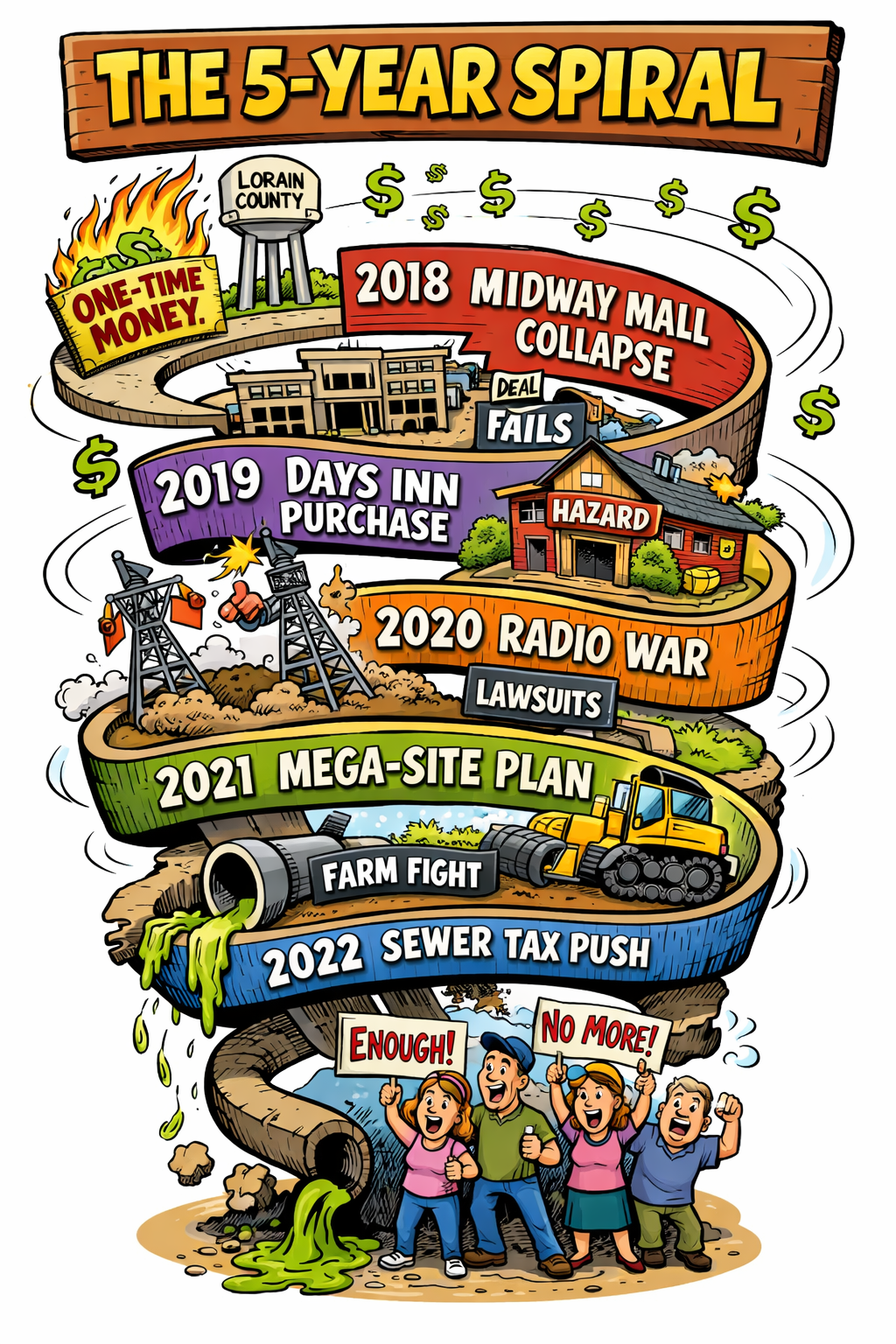
Big Deals, Bigger Claims, and the Public Cost of Manufactured Narratives
By Aaron C Aaron Christopher Knapp, BSSW, LSW
Investigative Journalist, Government Accountability Reporter
Editor-in-Chief, Lorain Politics Unplugged
Licensed Social Worker (LSW)
Public Records Litigant & Research Analyst
AaronKnappUnplugged.comhristopher Knapp
Scope and Purpose of This Report
This is a consolidated accountability report covering roughly 2020 through 2025. It is built deliberately and methodically from documented public actions, recorded votes, official statements, publicly released contracts, litigation filings, and contemporaneous reporting. It is not a reaction piece and it is not a single-issue critique. It is a synthesis. Its purpose is to place multiple high-profile county decisions side by side so the public can see what is usually obscured when each controversy is debated in isolation.
When viewed together, these matters form a coherent record. The Midway Mall transaction and its collapse. The Lorain County Port Authority’s decision to pursue ownership of a condemned Days Inn. The aggressive push for a megasite in New Russia Township and the resulting backlash from residents who refused to be treated as collateral damage. The Brownhelm Township tower dispute and the consent failures surrounding public safety infrastructure. The MARCS versus CCI radio conflict that escalated from policy disagreement into federal litigation. The county’s carefully branded tax relief messaging that avoided confronting structural payroll expansion. The renewed push to centralize sewer governance and other public systems under appointed authorities rather than direct voter control.
Each of these decisions was presented to the public as responsible, unavoidable, or forward-looking at the time it was made. Each was framed as an answer rather than a question. Each came with confident language about efficiency, savings, modernization, or inevitability. What this report does is remove the artificial separation between them and examine what happens when those assurances are tested by time, math, law, and lived consequences.
The Pattern That Emerges When You Stop Looking Away
Individually, any one of these controversies can be defended with talking points. That is precisely how narrative governance works. A failed redevelopment becomes a learning experience. A condemned property becomes an opportunity. A radio system dispute becomes a procurement disagreement. A tower lease becomes a procedural matter. A zoning fight becomes progress versus obstruction. A budget gap becomes a communication problem rather than a policy failure.
Together, however, they tell a different story.
In Lorain County, the problem has not been a shortage of ideas, ambition, or press releases. The problem has been a consistent and repeatable pattern of behavior. Commitments are made before risks are fully disclosed. Public money is deployed before outcomes are clearly defined. Opposition is framed as negativity rather than caution. When results disappoint or liabilities surface, the story changes. Timelines are rewritten. Responsibility becomes diffuse. The public is told to look forward, not backward, while quietly being asked to pay again.
This is not an accident. It is a governance style.
Spending First and Explaining Later
Across these five years, the county has repeatedly converted certainty into uncertainty on behalf of taxpayers. Liquid resources were turned into speculative assets. Temporary funding streams were used to support permanent obligations. Infrastructure decisions were made with political urgency rather than operational patience. Each move narrowed future options while expanding future costs.
What is most striking is not any single vote or contract. It is the refusal to pause when warning signs appeared. Midway Mall did not fail overnight. The radio dispute did not emerge without warning from first responders. Township opposition did not materialize out of thin air. These were not unforeseeable events. They were foreseeable outcomes of choices made without adequate public reckoning.
Narrative Management as a Substitute for Accountability
When consequences arrived, the response was rarely substantive correction. Instead, the response was narrative management. Words were softened. Actions were minimized. Structural decisions were described as technical or procedural. Public concern was reframed as misunderstanding. Transparency became conditional, delayed, or filtered through selective releases.
That is why this report matters. Accountability is not achieved by explaining each failure away on its own terms. Accountability comes from recognizing patterns, acknowledging them openly, and changing behavior before the next cycle repeats.
Why This Matters Now
The cumulative effect of these decisions is not abstract. It shows up in litigation exposure, eroded trust, strained relationships with townships and first responders, and looming pressure for new revenue to paper over structural imbalances. It shows up when residents hear another promise and no longer believe it. It shows up when the public stops asking whether a proposal is good and starts asking who will pay when it goes wrong.
This report does not argue that Lorain County is doomed. It argues something more uncomfortable. The county is not out of options. It is out of credibility. Credibility is rebuilt only when leaders stop treating the public as an audience and start treating them as owners of the consequences.
That is the context for everything that follows.
What This Report Is and What It Is Not
This is an accountability synthesis. It is not a criminal indictment. It does not assert that any individual has been convicted of wrongdoing. What it does establish is a documented pattern of governance where ambitious projects are marketed as transformational, dissent is treated as obstruction, risk is absorbed by public entities, and accountability is deferred until after the money is gone.
Healthy governments do not fear hard questions. They welcome them before commitments are made. Lorain County’s recent history shows the opposite approach. Big announcements first. Details later. Consequences last.

The Commissioners at the Center and the Rise of Narrative Governance
Over the last five years, Lorain County has not suffered from a lack of communication. It has suffered from a surplus of it, deployed strategically to replace clarity with confidence and math with messaging. Public meetings, press statements, glossy mailers, and carefully framed talking points have become the primary tools of governance, while the underlying numbers, contractual details, and long-term liabilities are treated as secondary, inconvenient, or too complex for public consumption. The result is not transparency. It is performance.
Commissioner speeches during this period have followed a consistent pattern. Nearly every major initiative is introduced under the banner of fiscal responsibility, efficiency, or modernization. Words like “savings,” “investment,” “inevitability,” and “best option” are repeated until they sound self-evident. Yet when those same initiatives are examined over time, long-term obligations quietly expand. One-time money becomes permanent payroll. Loans become stranded assets. Legal exposure grows. And when the public asks how those outcomes align with the original claims, the answer is rarely a straight accounting.
Transparency, when it arrives at all, has tended to arrive late and under pressure. Records are produced only after repeated public records requests. Financial details emerge only after watchdog reporting or litigation. Key documents appear in pieces rather than as complete disclosures. This creates an uneven playing field where officials control the pace and framing of information, while the public is forced to react to fragments long after decisions are locked in. That is not an accident of bureaucracy. It is a function of power.
This is what narrative governance looks like in practice. The story is treated as the product, not the policy. Once the story is set, dissent becomes a nuisance rather than a safeguard. Critics are portrayed as negative, uninformed, or resistant to progress. First responders raising operational concerns are treated as obstacles to modernization. Township residents defending land use autonomy are framed as standing in the way of economic destiny. The assumption is always the same. If the narrative holds, the details can be managed later.
That is why this report refuses to treat each controversy as an isolated event. When viewed individually, any single decision can be defended with selective context. The Midway Mall loan can be described as a bold redevelopment play. The Days Inn acquisition can be pitched as strategic cleanup. The radio system reversal can be framed as procurement hygiene. The tower lease termination can be minimized as procedural. The megasite push can be sold as competitiveness. The sewer district revival can be described as efficiency. The tax relief campaign can be marketed as compassion.
But when those decisions are placed side by side, the common operating logic becomes impossible to ignore. Advance the plan first. Manage the optics aggressively. Suppress or delay inconvenient information. And if the outcomes disappoint, rewrite the timeline so responsibility blurs and urgency shifts to the next initiative.
This approach fundamentally changes the role of the public. Residents are no longer participants in governance. They are an audience expected to absorb conclusions rather than examine premises. Public meetings become stages rather than forums. Votes become formalities rather than deliberations. The real work happens elsewhere, often out of view, and is revealed only when something breaks.
The danger of narrative governance is not merely wasted money. It is institutional drift. When leaders become accustomed to selling certainty rather than earning it, they lose the capacity to self-correct. Warning signs are dismissed as noise. External criticism is treated as hostility. Internal doubts are managed rather than addressed. Over time, this produces exactly what Lorain County is experiencing now: compounding risk, eroding trust, and a public that increasingly assumes the next promise will end the same way as the last.
This section matters because it explains why so many different issues in Lorain County feel connected, even when officials insist they are not. They are connected by decision-making culture. Until that culture changes, no individual project, no matter how well branded, will escape the gravitational pull of the same outcome.
Midway Mall
The $13.9 Million Loan That Became a Countywide Stress Test
The Midway Mall transaction stands as the clearest and most concrete illustration of how Lorain County has approached financial risk over the last five years. In 2023, the County Commissioners approved a $13.9 million loan to the Lorain County Port Authority to acquire the long-declining Midway Mall, effectively converting liquid county funds into a speculative redevelopment instrument. This was not a passive role. The County was not merely supporting a third-party project. It was underwriting the deal, assuming exposure, and tying public balance sheets to an asset that had already demonstrated years of commercial failure.
At the time, the public was told this was a strategic investment that would unlock opportunity, stabilize a blighted property, and position the county for transformative redevelopment. The language was confident and forward-looking, framed around vision rather than contingency. What followed over the next year told a very different story. The deal became mired in valuation concerns, due-diligence complications, and uncertainty about market viability. The much-touted redevelopment pathway did not materialize as promised, and after roughly a year of negotiations and shifting expectations, the proposed sale and redevelopment agreement ultimately fell through.
That collapse did not happen suddenly, and it did not happen without warning signs. The underlying risks were visible from the start. A struggling mall with declining tenancy, structural challenges, and an uncertain retail future was always a high-risk asset, particularly in a post-pandemic commercial landscape. Yet the county proceeded without publicly demonstrating that those risks had been meaningfully stress-tested, mitigated, or bounded in a way that protected taxpayers if the optimistic scenario failed to materialize.
When the deal unraveled, the public was left asking questions that should have been answered before the loan was approved rather than after the plan collapsed. Who rigorously challenged the redevelopment assumptions before public money was committed. Who demanded enforceable safeguards to protect the county if the project stalled or failed. Who ensured that taxpayers were not left holding long-term exposure while private redevelopment interest evaporated. Those questions were never clearly or comprehensively addressed in public, and the financial exposure created by the loan did not disappear simply because the deal fell apart.
Instead, Midway Mall became a stress test not only of a single redevelopment gamble, but of the county’s broader decision-making discipline. It demonstrated how quickly public funds can be locked into speculative ventures, how slowly accountability arrives when optimism proves misplaced, and how readily leadership moves on to the next initiative without fully reckoning with the costs of the last one.
The Condemned Days Inn
When Redevelopment Begins With a Nuisance Property
The Port Authority’s move toward acquiring the condemned Days Inn property occurred while the Midway Mall project was already showing visible signs of strain, and that timing matters. Rather than prompting a pause and a reassessment of redevelopment strategy, the shift to another distressed property suggested a continuation of the same risk posture under a different headline. This was not a neutral acquisition. The Days Inn was not a dormant asset awaiting revival. It was formally condemned, the subject of court action, and publicly described as a nuisance property that posed health and safety concerns. By definition, any public entity stepping into ownership of such a structure inherits legal exposure, demolition costs, environmental uncertainty, and reputational risk.
That reality alone should have triggered heightened scrutiny. Condemned properties are not blank canvases. They come with known liabilities and unknown complications, particularly when abandonment, long-term neglect, or code enforcement actions are involved. The public record reflects that the property had already been the subject of litigation and enforcement before the Port Authority expressed interest. Entering that space required a clearly articulated plan addressing remediation, demolition, funding sources, timelines, and worst-case cost scenarios. Instead, what the public received was familiar language about redevelopment potential and future opportunity, without a correspondingly detailed explanation of how the risks would be contained or who would bear them if projections failed.
Acquiring distressed assets is not inherently improper. Public redevelopment authorities do it all the time when the strategy is clear, the numbers are transparent, and the public understands both the upside and the downside. The problem in Lorain County has been the sequencing. Announcements come first. Confidence follows. The hard questions arrive later, if at all. With the Days Inn, the public was asked to accept that demolition and cleanup were manageable, that the property would eventually be repositioned for productive use, and that the Port Authority’s involvement would somehow convert a nuisance into an asset. What was missing was a public accounting of total expected cost, contingency planning if demolition exceeded estimates, and clarity on how long the property might sit as a nonproductive liability before any redevelopment materialized.
This matters because the Port Authority does not operate in a vacuum. Its risks ultimately intersect with county resources, county credibility, and taxpayer exposure. When distressed properties are acquired without a transparent, enforceable plan, public entities absorb uncertainty while political leadership continues to sell optimism. Over time, that pattern erodes trust, because residents begin to recognize that “economic development” is being used less as a defined strategy and more as a justification for taking on open-ended risk.
The Days Inn episode also reinforces a broader concern raised throughout this report. Lorain County leadership has shown a tendency to move from one ambitious project to the next without fully closing the books on the last one. Midway Mall had not resolved. Its redevelopment pathway had already begun to fray. Yet rather than reassessing whether the county’s redevelopment apparatus was calibrated to manage complex, high-risk assets, the Port Authority pivoted toward another property that guaranteed additional cost and uncertainty from day one.
When public entities repeatedly step into distressed situations without publicly demonstrating how risk will be limited, timelines enforced, and taxpayer exposure capped, redevelopment stops looking like revitalization and starts looking like risk migration. The uncertainty does not disappear. It simply moves from private hands into the public ledger.
The Radio War
CCI, MARCS, the Tower Lease, and the Lawsuit That Refuses to Go Away
Nothing in the last five years more clearly exposes Lorain County’s governance failures than the public safety radio conflict, because this issue strips away the luxury of abstraction. This was never about branding, vendor loyalty, or theoretical procurement preferences. It was about whether police officers, firefighters, and EMS crews can communicate reliably when seconds matter and whether the County’s decision-making process respected that reality or treated it as an inconvenience to be managed after the fact.
For years, the Harris-based system supported by Cleveland Communications Inc. had broad first-responder buy-in across the county. Chiefs, line officers, and dispatch professionals consistently emphasized coverage, in-building performance, and operational familiarity. That support did not emerge from politics. It emerged from daily use. Yet that system was abruptly destabilized when the County rescinded its contract, pivoted toward MARCS, and then attempted to reframe the entire episode as a routine procurement correction rather than a fundamental operational rupture.
The County has repeatedly tried to collapse the debate into a false choice between vendors, as though this were simply Harris versus Motorola. That framing is misleading by design. The core issue has never been which logo appears on the equipment. The issue has been process, consequence, and honesty. The County disrupted an existing system, dismissed warnings from first responders, and then minimized the impact of its own actions while insisting that continuity would somehow maintain itself through assurances rather than infrastructure.
That minimization reached its most consequential point when the County terminated the tower lease that physically anchored the CCI system. Officials described that move as procedural, administrative, or merely contractual. That language matters because it obscures reality. A tower lease is not just a lease when it functions as the operational spine of a countywide radio system. Removing access to that tower was not a neutral housekeeping step. It was a forcing mechanism that materially undermined one system while accelerating reliance on another. Pretending otherwise is not miscommunication. It is misdirection.
The consequences of that decision did not remain theoretical. They hardened into litigation. The ongoing federal lawsuit brought by CCI now looms over every subsequent radio-related decision. Legal strategy has replaced public explanation. Motions and filings substitute for accountability. Taxpayers are funding not only the system transition but also the legal defense of the process that produced it. First responders are left operating within a cloud of uncertainty while County leadership insists, again, that everything is under control.
Against that backdrop, the recent decision by Lorain City Council to spend approximately $40,000 to outfit ten patrol cars with Harris radios is not a footnote. It is a warning flare. Local governments do not spend money to maintain or expand dual systems unless they believe redundancy is necessary to protect operations. That purchase raises an uncomfortable but unavoidable question. If the County’s MARCS transition is as seamless, sufficient, and inevitable as officials claim, why are municipalities still investing scarce funds to preserve Harris capability.
The answer is not mysterious. Cities are hedging against risk that the County refuses to acknowledge. They are attempting to protect officers in the field from the consequences of a top-down system war that was never resolved on technical merits. That kind of parallel investment is not efficiency. It is financial fragmentation. It locks the region into overlapping systems, duplicated costs, and long-term maintenance obligations that compound rather than resolve fiscal exposure.
This is where the radio war intersects directly with the broader financial narrative. Maintaining multiple systems while litigating the transition between them is not sustainable. It is not fiscally responsible. It is the very definition of reactive governance. Money is being spent not to achieve clarity, but to buffer against instability created by the County’s own decisions. Each additional purchase, each interim fix, and each legal filing deepens the sunk-cost trap.
At some point, the public has to ask what outcome this path produces. A clean, accountable transition would have required transparent testing, phased implementation, documented responder buy-in, and honest acknowledgment of trade-offs. What Lorain County has instead is a protracted conflict where assurances replace data, litigation replaces dialogue, and municipalities quietly spend their own money to protect themselves from the fallout.
That is not prudent governance. It is control exercised after trust has already been lost. And the longer this conflict drags on, the clearer it becomes that the radio war is not an isolated policy dispute. It is a case study in how narrative governance turns operational systems into financial liabilities and leaves taxpayers paying to manage uncertainty rather than eliminate it.
The Sheriff’s Reassurances and the Limits of “Everything Is Fine”
Public reassurance from the Sheriff’s Office has become a recurring feature of Lorain County governance, particularly during moments of institutional strain. On its face, reassurance is not improper. In times of uncertainty, residents expect leaders to communicate stability. The problem arises when reassurance is used to paper over unresolved facts, unresolved costs, and unresolved accountability. In Lorain County, “everything is fine” has too often functioned as a substitute for disclosure rather than a bridge to it.
This tension is no longer limited to radio communications. It now extends directly into county finances and payroll obligations. Recently, the County absorbed a significant, unplanned salary expense attributed to accounting errors originating in prior administrative tenures. The public was told that these errors created shortfalls that had to be corrected retroactively, resulting in a substantial additional expenditure to cover salaries that were allegedly misaccounted for. That explanation may account for the mechanics of the problem, but it does not account for the timing, the sequencing, or the decisions that followed.
What has gone largely undiscussed in public forums is that during the same period in which these accounting deficiencies allegedly went undetected, the Sheriff’s Office expanded its upper ranks. Several high-ranking positions were filled, and in some cases new positions were created, before a comprehensive audit of departmental finances was completed or publicly disclosed. That sequence matters. Hiring decisions at the top of any department are not neutral acts. They lock in recurring salary and benefit obligations, shape organizational culture, and constrain future budgets. Doing so before confirming the true state of departmental finances is not merely risky. It is structurally irresponsible.
Yet despite this sequence, the public narrative that emerged was strikingly inverted. Rather than confronting why the errors were not caught earlier, why hiring continued amid fiscal uncertainty, or why new positions were authorized before a full accounting was complete, the Commissioners reportedly framed the situation as a success story. The Sheriff, according to that narrative, “saved money” by discovering the error. This framing deserves scrutiny. Catching an error after it has already produced a shortfall is not savings. It is damage identification. The money was still spent. The obligation still existed. The correction still required public funds to close the gap.
This is where reassurance becomes misleading. By presenting the discovery of an error as a form of fiscal stewardship, leadership reframes the outcome in a way that obscures responsibility. The public is encouraged to focus on the act of discovery rather than the duration of the oversight, the decisions made during that period, and the structural weaknesses that allowed the problem to persist. Accountability is shifted from prevention to narrative spin.
The same dynamic is visible in the radio system debate. Reassurance statements emphasize continuity and interoperability while avoiding detailed disclosure of test results, coverage limitations, cost overlap, and legal exposure. In both cases, the message is designed to calm rather than to inform. The public is asked to trust that professionals are handling the details, even as those details continue to generate unplanned costs and operational uncertainty.
True leadership does not rely on reassurance alone. It relies on evidence. If payroll shortfalls were caused by accounting failures, the public deserves to know how long those failures persisted, who was responsible for oversight, and why hiring decisions proceeded without resolution. If radio systems are stable, the public deserves to see objective coverage data, interoperability testing, and total lifecycle costs, including litigation expenses. Confidence that is not grounded in disclosure is not confidence at all. It is containment.
The deeper issue is not whether any one official acted with ill intent. It is whether Lorain County’s governance culture rewards early honesty or late discovery. When leaders are praised for catching problems after they have already cost taxpayers millions, the incentive structure is backwards. It teaches institutions that prevention is optional and that narrative control can substitute for disciplined management.
In that environment, reassurance becomes a warning sign rather than a comfort. It signals that leadership is more focused on managing perception than confronting root causes. And for a county already strained by overlapping systems, stalled projects, and mounting obligations, that is not a sustainable path forward.
New Russia Township
The Megasite Push and the Rural Revolt
New Russia Township did not merely “raise concerns” about the proposed megasite. It rejected it, loudly, persistently, and in numbers that should have forced county leadership to stop and reassess. What happened there was not a misunderstanding or a failure of messaging. It was a direct collision between a county government that assumes authority and a rural community that refused to surrender control of its land, identity, and future.
From the outset, the megasite proposal was framed by county officials as inevitable. The language was economic destiny, competitiveness, shovel-ready acreage, and regional growth. What was notably absent was consent. Residents were not approached as stakeholders to be persuaded. They were treated as obstacles to be managed. Meetings were structured to present conclusions, not to solicit genuine input. By the time the proposal reached public hearings, the decision already felt made, and residents understood that clearly.
The reaction was not subtle. Turnout was overwhelming. Testimony was sustained, detailed, and unapologetically hostile to the plan. Farmers, homeowners, and multi-generation families made it clear that this was not unused land waiting for purpose. It was active agricultural ground, groundwater-dependent property, and a rural community that had deliberately chosen not to become an industrial corridor. Residents did not oppose development in the abstract. They opposed being sacrificed for it.
The megasite failed because it ignored fundamental realities. Infrastructure requirements were massive. Environmental impacts were unresolved. Zoning changes were extreme. And most importantly, the people who actually live there were unequivocally opposed. This was not a narrow faction. It was a community revolt. The proposal collapsed not because it lacked ambition, but because it lacked legitimacy.
What makes New Russia Township especially important is that it did not end the county’s behavior. It exposed it.
Instead of learning from the failure, county leadership treated it as a setback to be routed around. The lesson absorbed was not “we moved too fast” or “we failed to engage.” The lesson appeared to be “try somewhere else.” That is why residents across the county recognized the same pattern emerging again, first in Elyria Township and now in Brownhelm.
In Elyria Township, land-use decisions were advanced with minimal regard for local resistance, reinforcing the perception that the county does not ask, it takes. In Brownhelm, the same dynamic is now playing out around infrastructure and development pressure. Different projects, same posture. County authority asserted first. Local autonomy treated as a nuisance to be overcome rather than a boundary to be respected.
This is why New Russia Township matters beyond its borders. It demonstrates that the county’s development strategy is not collaborative. It is extractive. Sites are identified, narratives are constructed, and communities are expected to fall in line for the “greater good,” even when that good is defined elsewhere and imposed downward.
Residents understood what was at stake. Once land is rezoned, it does not revert. Once industrialization arrives, it does not leave. Once a community’s character is altered, it is altered permanently. That is why the opposition was so fierce and so sustained. This was not a NIMBY moment. It was self-preservation.
The failure of the megasite proposal was not an accident. It was the predictable outcome of a governance style that confuses authority with legitimacy and treats democratic resistance as a delay tactic rather than a veto. When people feel development is being done to them instead of with them, trust does not erode slowly. It collapses all at once.
New Russia Township did not fail the county. The county failed New Russia Township. And by repeating the same approach in Elyria Township and now Brownhelm, county leadership is signaling that it has not internalized the lesson. Until it does, every future “big idea” will be met not with curiosity, but with suspicion, because residents have already seen how this story ends.
Brownhelm Township
Environmental Reality, Federal Oversight, and the Consequences of County Overreach
Brownhelm Township cannot be understood merely as a zoning dispute or a communications tower controversy. It sits at the intersection of active federal environmental oversight, legacy contamination, and mounting development pressure. That context makes the County’s behavior there not just tone-deaf, but reckless. Brownhelm is not a blank slate. It is an environmentally sensitive area already carrying unresolved federal concerns, and that reality fundamentally changes what responsible governance is supposed to look like.
At the center of Brownhelm’s environmental profile is the Chemical Recovery Systems Superfund site, a former manufactured gas plant that left behind contaminated soil and groundwater. This is not historical trivia. The site remains under active Environmental Protection Agency oversight due to the presence of polycyclic aromatic hydrocarbons, PFAS, and 1,4-Dioxane. The EPA has designated multiple operable units, separating soil remediation from groundwater remediation, and continues to conduct five-year reviews to determine whether existing cleanup measures are protective of human health and the environment.
The most recent EPA review did not offer closure. It explicitly concluded that additional information is required, particularly regarding groundwater contamination, vapor intrusion risks, and the behavior of specific chemicals migrating through subsurface pathways. That means Brownhelm is not in a monitoring-after-success phase. It is in a monitoring-because-questions-remain phase. Any significant infrastructure expansion, land disturbance, or increase in population density in or near such an area carries heightened risk and demands heightened scrutiny.
That is the backdrop against which the County advanced infrastructure and development pressure in Brownhelm with little meaningful local engagement. When a MARCS communications tower appeared near a residence and residents learned about it after the fact, the issue was never just visual impact or property values. It was trust layered on top of environmental vulnerability. People living near a federally monitored contamination site are acutely aware that land use decisions have consequences that do not show up immediately and cannot always be undone.
The emergency meeting held by Brownhelm Township residents underscores this reality. Emergency meetings are not called because people are confused. They are called because people believe something is wrong and that it was done without their informed consent. County officials may insist that procedures were followed, but procedure divorced from context is meaningless. In a township with an active Superfund site, minimum notice is not sufficient. Proactive disclosure is required. Silence followed by explanation is not transparency. It is containment.
Compounding the concern is the pressure created by large-scale development proposals, including the broader megasite strategy that residents have already watched fail in New Russia Township. Brownhelm residents are not speculating about abstract harm. They are looking at farmland loss, increased truck traffic, stormwater runoff, and additional strain on soil and groundwater systems that are already under federal review. Development in such an environment is not just a local land-use issue. It is an environmental risk management issue.
The situation is further complicated by regional infrastructure problems tied to the City of Vermilion. Vermilion’s wastewater treatment facility, which serves areas near Brownhelm, has been subject to EPA scrutiny and proposed enforcement action due to violations at its aging plant. The EPA has required upgrades and long-term planning, including evaluation of whether expansion or replacement is necessary. Wastewater treatment issues do not respect municipal boundaries. They affect shared watersheds, shared groundwater systems, and shared environmental risk profiles. Brownhelm residents understand this, even if County leadership prefers to treat each issue in isolation.
Taken together, Brownhelm’s circumstances reveal why the County’s approach is failing. You cannot impose infrastructure and development pressure on a community that is already navigating Superfund oversight, unresolved groundwater questions, and regional wastewater compliance challenges without triggering resistance. Doing so suggests either a lack of awareness or a willingness to discount environmental risk in favor of expediency.
Public safety and economic development are repeatedly invoked as justification, but those words do not erase federal oversight, chemical persistence, or hydrological reality. Safety does not excuse secrecy. Development does not override contamination. Authority does not substitute for consent. In Brownhelm, those truths are not theoretical. They are lived conditions.
The County’s failure here is not that it sought to improve communications or explore development. The failure is that it treated Brownhelm as though it were an empty space on a planning map rather than a community already burdened by environmental legacy and federal scrutiny. That is why residents reacted forcefully. That is why an emergency meeting was necessary. And that is why trust, once lost, will not be restored by assurances that everything is under control.
Brownhelm Township is not resisting progress. It is demanding that progress respect reality. Until Lorain County leadership learns the difference, Brownhelm will not be the last community to push back.
Clearwater and the Sewer District Revival
Centralization Without Elections
The Clearwater sewer district proposal does not exist in a vacuum. It fits squarely within the same governance pattern that has defined Lorain County’s major initiatives over the last several years. Consolidation is presented as modernization. Centralization is framed as efficiency. Control is justified as coordination. Yet beneath that language is a structural shift that should alarm anyone who believes accountability flows from the ballot box.
At its core, the Clearwater proposal would reorganize sewer governance under an appointed regional authority rather than elected local control. Supporters emphasize economies of scale, long-term planning, and access to funding. What they rarely emphasize is what is lost in the process. Ratepayers would no longer have a direct electoral mechanism to influence decisions about rates, debt issuance, expansion priorities, or infrastructure investment. Those decisions would move further away from the people who pay the bills and live with the consequences.
That concern is not abstract. Sewer systems are among the most expensive and least flexible public utilities a community can manage. Once debt is issued, it cannot be wished away. Once rates rise, they rarely come back down. Once control is centralized, it is extraordinarily difficult to claw back. History across Ohio and beyond shows that regional sewer districts often begin with promises of stability and efficiency, only to evolve into opaque authorities with broad power and limited public recourse.
In Lorain County, skepticism toward Clearwater is not cynicism. It is pattern recognition. Residents have watched redevelopment authority concentrate risk at the Port Authority. They have watched public safety communications decisions consolidated upward despite widespread first-responder objections. They have watched township autonomy overridden or minimized in the name of progress. Against that backdrop, being told to trust another centralized authority without direct elections is not reassuring. It is provocative.
The timing also matters. Clearwater is being advanced while the County is still grappling with unresolved financial exposures, litigation over the radio system, stalled redevelopment projects, and environmental compliance issues in multiple jurisdictions. Introducing a new regional utility authority during that period raises legitimate questions about capacity, priorities, and motive. Is this about genuine efficiency, or is it about moving complex, politically sensitive decisions into a structure that is insulated from direct voter accountability.
Critics are right to focus on governance design, not just engineering diagrams. When authority increases while accountability decreases, the public has every right to ask who truly benefits. Ratepayers understand that appointed boards do not face reelection. They understand that future rate hikes will be justified as technical necessities rather than political choices. And they understand that once a regional authority is in place, reversing course becomes nearly impossible without litigation or state intervention.
Clearwater also raises equity concerns. Sewer costs disproportionately affect lower-income households, renters, and fixed-income residents. Decisions made by distant boards with broad mandates can easily prioritize expansion or regional goals over affordability and local impact. Without strong, enforceable safeguards written into governance structures, “efficiency” often translates into cost shifting rather than cost reduction.
The County’s messaging around Clearwater has followed a familiar script. Emphasize inevitability. Minimize governance concerns. Frame opposition as resistance to modernization. What is missing is a forthright discussion of tradeoffs. What specific powers would be transferred. What protections ratepayers would retain. How transparency would be enforced. And why elected oversight is being treated as a problem to be solved rather than a feature to be preserved.
Clearwater matters because it is not just about pipes and treatment plants. It is about who controls essential services in Lorain County and how far decision-making can be removed from the people most affected by it. In a county already strained by trust deficits and unresolved controversies, asking residents to surrender another layer of democratic control without ironclad guarantees is not prudent policy. It is an invitation to the next crisis.
If Lorain County leadership wants buy-in for regional solutions, it must first demonstrate respect for local authority, transparency in cost modeling, and a willingness to submit major governance changes to direct public accountability. Until then, resistance to Clearwater is not obstruction. It is self-defense.
The Public Defender Proposal
Reform Pitch or Future Liability
The proposal to create a county-run public defender’s office has been marketed as reform, efficiency, and fiscal responsibility. Those words should sound familiar by now. In Lorain County, nearly every major initiative over the last five years has been introduced with the same assurances. The problem is not that reform is undesirable. The problem is that reform rhetoric has repeatedly been used to justify structural changes without first answering the hard questions that determine whether a proposal actually saves money or simply relocates risk.
At present, Lorain County relies heavily on appointed private counsel for indigent defense, with a substantial portion of those costs reimbursed by the state. The system is not perfect, but it has a crucial feature that county leadership now seems eager to abandon. Costs fluctuate with caseloads. Staffing obligations are not permanent. And the county is not locked into long-term payroll, benefits, pension, and administrative overhead for an entirely new department. Those distinctions matter, particularly in a county that has already demonstrated a pattern of converting temporary resources into permanent obligations.
The public defender proposal, by contrast, would create a new institutional structure with fixed staffing, recurring salaries, benefits, administrative support, and future pension liabilities. Once created, that structure does not scale down easily. Even if caseloads drop, the payroll remains. Even if funding assumptions change, the positions persist. This is not a theoretical concern. Lorain County is already grappling with unplanned salary corrections and budget shortfalls tied to prior accounting failures. Against that backdrop, adding another permanent payroll base without ironclad financial modeling is not reform. It is risk layering.
County leadership has framed the proposal as a cost-saving measure, yet has not publicly demonstrated those savings in a way that withstands scrutiny. If this proposal is truly about fiscal responsibility, the county should be able to show, in plain terms, the net taxpayer cost after all state reimbursements are accounted for. It should be able to show how many attorneys, investigators, support staff, and administrators will be hired, what their compensation will be over time, and how those costs compare not just in year one, but over a decade.
Just as important is the question of independence. A public defender’s office must be structurally insulated from political pressure to function ethically. That means clear governance protections, transparent appointment processes, and safeguards against budgetary retaliation when representation becomes inconvenient or unpopular. In a county where other systems have been centralized upward and accountability diluted, skepticism about independence is not paranoia. It is a rational response to recent history.
There is also the question of timing. This proposal is being advanced while the county is still dealing with unresolved litigation, stalled redevelopment projects, overlapping radio systems, environmental compliance issues, and looming revenue debates. Introducing a new department with permanent financial commitments during that period raises the question of whether this is about improving indigent defense or about reshaping county operations under the cover of reform language.
Most troubling is how closely this proposal mirrors past patterns. A structural change is introduced as inevitable. The promise of savings is asserted rather than proven. Long-term costs are downplayed. And the burden of proof is shifted to critics rather than carried by those advancing the plan. That inversion is precisely what has produced the county’s current credibility crisis.
If Lorain County leadership wants the public to take this proposal seriously, the bar must be higher than it has been elsewhere. Show the full cost model, including pensions and benefits. Show how independence will be protected from political influence. Show how this office will not become another permanent obligation funded initially by temporary or uncertain money. Show why this approach is demonstrably better than reforming and strengthening the existing appointed-counsel system.
Anything less is not reform. It is repetition. And Lorain County has already paid dearly for repeating the same governance mistakes under different banners.
The Financial Illusion
One Time Money, Permanent Payroll, and Sales Tax Pressure
Lorain County’s most dangerous fiscal habit over the last several years has not been outright waste. It has been something far more insidious and far harder to unwind. The County has repeatedly manufactured a sense of inevitability by using one time money to justify permanent commitments, then presenting the resulting shortfalls as unavoidable crises rather than predictable outcomes. This is not accidental budgeting. It is a structural choice with political utility.
During the influx of federal relief funds, county leadership expanded recurring obligations, particularly payroll and senior administrative staffing. Those dollars were always temporary. That fact was never in dispute. Yet instead of treating them as a bridge to stabilization or a buffer for extraordinary costs, they were used to underwrite ongoing expenses that would persist long after the federal money disappeared. When that money inevitably ran out, the County did not confront the decision that created the gap. It pivoted to rhetoric. The problem was reframed as a sudden fiscal emergency rather than the delayed consequence of deliberate policy.
This is where the illusion takes shape. By separating the decision to expand obligations from the moment those obligations become unaffordable, leadership creates political distance from responsibility. The public is invited to focus on the shortfall, not on how it was engineered. The narrative shifts from choice to fate. Budgets did not tighten because of strategic miscalculations. They tightened because circumstances changed. That framing is convenient, but it is not honest.
The pressure for new revenue follows naturally. Once a structural gap is established, leadership can argue that there are only two options. Cuts or new taxes. The County has increasingly leaned toward the latter, including discussions of sales tax increases that disproportionately burden working families, renters, and residents with fixed incomes. Sales taxes do not scale with wealth. They scale with consumption. That makes them politically expedient and socially regressive, especially when introduced to cover costs that were quietly locked in years earlier.
What makes this approach particularly corrosive is how it is sold. Rather than presenting a full accounting of how the County arrived at this position, residents are given glossy mailers and headline friendly talking points about relief, savings, or responsible stewardship. Meanwhile, the underlying data becomes harder to access. Personnel summaries that once allowed the public to see how payroll expanded become obscured or delayed. Line item transparency narrows just as scrutiny should increase. The more consequential the decision, the less visible the math becomes.
This is not an oversight. It is a pattern. When budgets are healthy, leadership takes credit. When budgets tighten, the public is asked to accept urgency without context. The idea that the County had no choice becomes the central claim, even though the record shows a series of choices that produced the moment. In that environment, fiscal debate is reduced to false binaries. Either accept new revenue or accept collapse. Either trust leadership or be blamed for obstruction.
Fiscal responsibility does not work that way. Responsible budgeting requires separating temporary resources from permanent commitments, resisting the temptation to expand payroll during windfalls, and confronting tradeoffs in real time rather than deferring them to future taxpayers. Lorain County did the opposite. It spent as though the temporary were permanent and then acted surprised when permanence arrived without funding.
Calling this theater is not hyperbole. Theater relies on staging, timing, and selective disclosure. So does inevitability manufacturing. The crisis arrives right on cue. The solution is presented as the only option. The audience is told there is no time to revisit the earlier acts. But governance is not a performance, and taxpayers are not spectators. They are the ones left paying for decisions that were deliberately decoupled from their consequences.
Until Lorain County leadership is willing to publicly reconcile one time money with permanent obligations and admit that the current pressure for new revenue was created, not discovered, any claim of fiscal responsibility rings hollow. Transparency does not mean explaining why the crisis exists now. It means explaining why it was built in the first place.
The Media Layer
How Transparency Gets Rewritten
The Petticord email episode exposed a quieter but equally damaging layer of Lorain County’s accountability problem. It showed how transparency can be technically achieved while substantively undermined, and how timelines can be rewritten in ways that protect institutions rather than inform the public. This was not a dispute over whether records existed. It was a dispute over how and why they entered public view, and who gets credit when disclosure is forced rather than volunteered.
The emails at issue did not surface because government actors suddenly embraced openness. They surfaced because someone would not stop asking. Public records requests were filed. Follow-ups were sent. Deadlines were pressed. Explanations were challenged. The process was neither quick nor cooperative. It was adversarial, resistant, and marked by delay. Only after that persistence did the records become unavoidable. That sequence matters because it reveals the true cost of transparency in Lorain County. Disclosure is not the default. It is the endpoint of pressure.
What happened next is where the damage compounds. Once the emails were public, the story was reframed as though the records had been discovered by media initiative rather than extracted through public records enforcement. The narrative shifted from compelled disclosure to journalistic happenstance. That reframing may seem subtle, but its implications are profound. It erases the role of the records requester. It obscures the resistance that preceded disclosure. And it allows officials to appear cooperative after the fact without ever being held accountable for the delay itself.
Transparency does not begin when a story is written. It begins when a request is made. Everything that happens between those two moments determines whether public records law functions as intended or merely as a suggestion. When that middle portion of the timeline is erased, the public is left with a false impression. It appears as though the system worked smoothly, when in reality it worked only because someone refused to let it fail quietly.
This rewriting of the timeline teaches the wrong lesson. It tells officials that delay is safe, that resistance carries little risk, and that eventual disclosure can still be spun as good faith cooperation. It tells agencies that they can wait out requesters, narrow responses, or slow-walk production knowing that the final headline will focus on the content of the records rather than the obstruction that preceded their release. Over time, this dynamic corrodes the public records process itself.
The media’s role in this ecosystem is not malicious, but it is consequential. When reporting treats compelled disclosure as discovery, it unintentionally reinforces institutional incentives to withhold first and explain later. The public sees the end result without seeing the fight that made it possible. That absence weakens civic muscle memory. Residents learn about scandals, but not about how transparency is actually achieved. The process becomes invisible, and invisibility benefits those with power.
In Lorain County, this pattern aligns neatly with the broader governance style documented throughout this report. Information is controlled, staged, and released on terms favorable to leadership whenever possible. When that control fails, the fallback strategy is narrative adjustment rather than accountability. The Petticord emails were not an anomaly. They were a case study in how systems adapt to pressure without changing behavior.
This matters because public records law is one of the last meaningful checks available to residents when other forms of accountability falter. Elections occur infrequently. Litigation is expensive. Oversight bodies move slowly. Public records requests are immediate, specific, and citizen-driven. When the cost of using them is artificially raised through delay and obfuscation, access becomes a privilege rather than a right.
Rewriting transparency timelines also distorts trust. Officials point to eventual disclosure as evidence of openness, while critics are portrayed as overstating resistance. The public is left unsure whom to believe, and cynicism fills the gap. That cynicism does not distinguish between good faith errors and deliberate obstruction. It simply hardens into disengagement, which serves no one except those who benefit from silence.
The lesson of the Petticord email episode is not about one document or one story. It is about process integrity. Transparency that arrives only after pressure is not transparency in practice. It is compliance under duress. Until Lorain County leadership and the institutions that cover it are willing to acknowledge the difference, accountability will remain performative, and the public will continue to be shown the ending without ever seeing what it took to get there.
In a county already struggling with trust, rewriting how transparency happens is not a harmless narrative choice. It is a decision that shapes future behavior. If delay carries no reputational cost and forced disclosure still earns praise, there is no incentive to change. And when that becomes normalized, the public records law remains on the books while its spirit is quietly hollowed out.
The Long Shadow
Familiar Power and Comfortable Contracts
One of the most corrosive dynamics in Lorain County governance over the last several years has not been any single contract or individual decision, but the persistence of familiar power moving comfortably through public systems with little visible friction. The reappearance of the same legal figures, consultants, and professional service providers across administrations, controversies, and crises has created a perception that access, not merit, is the most reliable qualification for public work in this county.
This concern does not require proving that every individual contract was unlawful or even poorly negotiated. That is not the point. Public confidence is not sustained by technical defensibility alone. It is sustained by a system that visibly prioritizes open competition, arms-length decision-making, and meaningful separation between political relationships and public spending. When the same names recur again and again in moments of controversy, residents reasonably begin to question whether the process is truly competitive or merely procedural.
Lorain County’s recent history offers repeated examples where legal representation, special counsel appointments, and contract work seem to orbit the same small circle. Each instance is explained in isolation. Expertise is cited. Institutional knowledge is invoked. Urgency is emphasized. And standing alone, any one explanation may sound plausible. The problem emerges when those explanations stack on top of each other, year after year, across unrelated matters. At that point, what looks like coincidence begins to look like structure.
This pattern has real consequences. Competitive processes lose credibility when outcomes appear preordained. Smaller firms, independent professionals, and outsiders are discouraged from participating because the field feels closed before bids are even submitted. Over time, the county becomes dependent on a narrow bench of insiders, reinforcing their leverage and reducing institutional resilience. When those insiders are later implicated in controversy or criticism, the county finds itself boxed in, unable to pivot without admitting that its reliance was misplaced.
Opacity accelerates this decay. When contract terms are not fully explained, when selection criteria are vague, or when decision-making authority is diffused across boards and administrators, the public is left to fill in the gaps with suspicion. That suspicion is not irrational. It is a rational response to systems that ask for trust while withholding clarity. Transparency is not just about releasing documents. It is about making the logic of decisions legible to people who do not sit inside the process.
Repetition is what ultimately cements the doubt. Residents do not forget patterns, even when officials hope they will. Each reappearance of a familiar name reinforces the belief that Lorain County operates on continuity of relationships rather than continuity of standards. That belief becomes self-reinforcing. Once confidence erodes, even well-intentioned decisions are viewed through a lens of skepticism, and legitimate governance work becomes harder rather than easier.
The damage extends beyond perception. Insider continuity can distort incentives. When the same actors expect to be called upon regardless of performance or controversy, accountability weakens. Innovation stalls. Risk assessment narrows. The county becomes less willing to challenge advice, renegotiate terms, or seek alternatives, because doing so would disrupt established comfort. Over time, that comfort becomes institutional inertia.
This long shadow matters because it connects directly to every other issue outlined in this report. Stalled redevelopment deals. Prolonged litigation. Escalating legal costs. Shifting narratives rather than clean resolutions. None of these occur in isolation from who is advising, representing, and shaping decisions behind the scenes. When power circulates within a closed loop, mistakes are recycled rather than corrected.
Restoring confidence does not require purges or accusations. It requires sunlight. Competitive processes that are genuinely competitive. Clear documentation of why certain firms are chosen over others. Rotations that demonstrate the county is not dependent on any one advisor or perspective. And a willingness to accept that continuity, when unchecked, can be just as damaging as chaos.
Until Lorain County confronts this dynamic honestly, familiar power will continue to cast a long shadow over public contracts. And as long as that shadow persists, residents will continue to question not just individual decisions, but whether the system itself is capable of reform.
Conclusion
The County Is Not Out of Options. It Is Out of Credibility.
Lorain County’s recent history cannot honestly be explained away as bad luck, unfortunate timing, or unforeseeable complications. What residents are living with now is the accumulated weight of repeated decisions made in plain sight, defended in public, and later walked back only after the damage was done. This is not a story about isolated failures. It is a story about a governing culture that treats warning signs as nuisances and accountability as an afterthought.
Midway Mall did not collapse because redevelopment is inherently risky. It failed because the County chose to underwrite speculation with public money while insulating itself from hard questions until the deal unraveled. The condemned Days Inn did not suddenly become risky after acquisition. The risk was baked in from the start, yet it was framed as opportunity rather than liability. The megasite proposal did not ignite resistance because residents were misinformed. It ignited resistance because residents understood exactly what was being imposed and refused to surrender their land, water, and autonomy to a plan conceived elsewhere.
The radio war did not metastasize into litigation and operational anxiety because of vendor rivalry. It escalated because County leadership disrupted an existing system, minimized the consequences of doing so, and then substituted reassurance for proof while first responders and taxpayers absorbed the fallout. The sewer district revival raises alarms not because infrastructure is unimportant, but because centralization without elections strips voters of meaningful control over costs that will follow them for decades. The public defender proposal provokes skepticism not because indigent defense lacks value, but because this County has already demonstrated how easily temporary funding becomes permanent payroll without a long-term exit plan.
The financial narrative itself keeps shifting because it has to. One-time money was treated as structural revenue. Permanent obligations were expanded under temporary conditions. When the math finally caught up, leadership pivoted to crisis language and began laying the groundwork for new revenue pressure, including sales taxes that fall hardest on working families and renters. That is not fiscal stewardship. It is inevitability manufacturing.
What makes this moment especially damning is that none of this was unforeseeable. It was predicted. Repeatedly. Long before Midway Mall fell apart, critics warned that speculative redevelopment without enforceable safeguards would leave taxpayers holding the bag. Long before the radio conflict hardened into litigation, first responders warned that disrupting a functioning system would create risk. Long before township revolts erupted, residents said plainly that development imposed without consent would fail.
Even informal voices were ringing the alarm bell. As one local observer put it bluntly, Cobra said in his “humble opinion” that this County was “lighting matches in a room full of gasoline and calling it progress.” At the time, that was dismissed as hyperbole. In hindsight, it reads like a roadmap. Another warning, offered half in sarcasm and half in resignation, captured the mood perfectly: “This will all make sense later, when they tell us there was no other choice.” That later has now arrived.
The throughline is not incompetence. It is refusal. Refusal to slow down. Refusal to show the full math. Refusal to accept that authority without legitimacy eventually collapses. And refusal to admit mistakes early, when they could still be corrected, rather than years later, when they have metastasized into litigation, distrust, and structural deficits.
The tragedy is not that Lorain County lacks options. It has plenty. Redevelopment can be done responsibly. Infrastructure can be modernized transparently. Regional cooperation can coexist with local autonomy. Payroll can be managed sustainably. Trust can be rebuilt. But none of that happens through speeches, glossy mailers, or staged optimism. It happens through disclosure before commitments are made, not after they fail. It happens through honest accounting that separates temporary money from permanent obligation. It happens when leaders treat residents as participants rather than audiences.
Until that shift occurs, Lorain County will remain trapped in the same loop. New initiatives will be unveiled. New narratives will be crafted. Old mistakes will be rebranded as lessons learned. And the public will once again be asked to absorb the cost, whether through higher taxes, diminished services, or further erosion of trust.
The County is not out of options. It is out of credibility. And credibility is not restored by insisting everything is fine. It is restored by admitting, openly and without spin, that people like Cobra were right to warn what was coming, and that ignoring those warnings has a price the public should never have been forced to pay.
Disclaimers
Legal disclaimer:
This article is a journalistic and public-interest analysis based on publicly discussed actions, statements, and documents. It is not legal advice and does not create an attorney-client relationship.
Fair comment and accuracy disclaimer:
Statements of opinion are clearly framed as opinion based on disclosed facts. Corrections will be made if materially verified errors are demonstrated.
AI use disclaimer:
Drafting assistance tools were used for structural organization. All factual assertions are intended to be grounded in public records and linked reporting.
About The Author





2 thoughts on “Lorain County’s Five-Year Spiral”