

THE RECKONING PHASE: THE FINAL CHAPTER

The Full Story of How Lorain’s Court Broke the Law, Broke Public Trust, and How It Can Be Repaired — If Anyone Has the Courage to Do It
There is a moment in every investigation when the facts stop shifting and the truth begins to settle into place with a weight that no one in power can ignore. In Lorain, that moment arrived the instant Judge Mark Mihok said the quiet part out loud. His remark that parking enforcement was a “major moneymaker” was not just a candid slip. It was an unintentional confession of institutional philosophy. It revealed the engine under the hood of Lorain’s ticketing operation. And it placed Lorain squarely inside the exact national problem that The Marshall Project and investigative reporter Mark Puente have spent years documenting: municipal courts quietly transforming themselves from guardians of constitutional rights into revenue machines.
Puente’s investigations exposed cities where due process slowly gave way to cash flow, where judges treated fines as predictable income, where officials used the machinery of the courts not as a shield to protect the public but as a lever to extract money from them. In Lorain, the evidence now shows that same transformation unfolding in real time. Auxiliary volunteers with no statutory authority issued criminal summonses. Police administrators allowed it. The legal department failed to stop it. The clerk processed the paperwork. The judges accepted pleas. Residents paid fines, fees, towing costs, and reinstatement charges on cases that were void from the moment the citation was handed to them.
This is not a question of negligence. It is a question of authority. And authority is not something that cities can invent when it becomes convenient.
The Human Cost: Residents Who Paid Into a System That Never Had Jurisdiction
The law is cold. The consequences are not. The people who walked into Lorain Municipal Court during this ticketing campaign did not walk in as abstractions. They walked in as wage earners, parents, disabled residents, shift workers, young drivers, senior citizens, and ordinary people who believed the city when it told them the paperwork was legitimate. They paid hundreds of dollars in fines and court costs for charges that were void the moment the auxiliary volunteer placed the slip under their windshield. They paid reinstatement fees to the Ohio Bureau of Motor Vehicles for suspensions that should never have been triggered. They paid towing and impound fees because cars were marked for enforcement under the color of legal authority that did not exist. They missed work. They lost wages. Some lost jobs. Others lost access to transportation and were forced to rearrange childcare, medical appointments, and responsibilities they never should have had to rearrange.
Not one of them was ever told the truth: the city had no lawful authority to summon them at all.
Under Ohio law, a summons is not simply a piece of paper. It is a command backed by the entire force of the criminal courts. But that power only exists when the summons complies with the law. Crim.R. 3 requires a valid complaint. Crim.R. 4 requires the summons be issued by someone legally permitted to do so. R.C. 2935.01 defines who may initiate a criminal case. R.C. 2935.03 describes the authority of peace officers. And R.C. 109.71(1) defines a peace officer exhaustively, stating:
“Peace officer” means any person who is employed by a political subdivision of this state and who is … commissioned and employed as a law enforcement officer.”
Auxiliary volunteers are not commissioned. They are not certified. They are not in the statutory list. Their authority is zero.
A summons issued by someone with zero authority does not trigger jurisdiction. It triggers nothing. This is not a technicality. This is the legal equivalent of a house built on air. The moment the summons was placed, the case was legally stillborn.
But residents were never told that. They were told they were late. They were told to pay. They were told to appear. They were treated as violators rather than victims of unlawful government action.
One resident stated openly in court that they did not even know they had a court date until a reporter called them. Another disabled resident asked why he could not park near his home anymore, and instead of being told the truth about jurisdiction, he was given another ticket. Others asked why they were never informed about the legal defect that made their cases void. They were ignored. Their ignorance was exploited. Their money was taken.
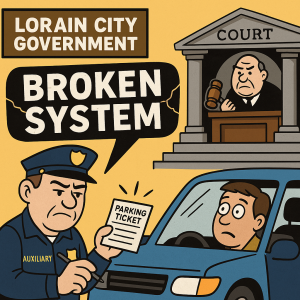
This is not a local anomaly. It is the same pattern Mark Puente uncovered across the nation in his reporting for The Marshall Project. In city after city, Puente documented residents punished without lawful authority, courts quietly extracting revenue from void or defective cases, and systems where the people most affected were the ones kept the most uninformed. Lorain is not the exception. It is the latest example in a nationwide trend where municipal courts slip into revenue roles and lose sight of legality altogether.
Residents were harmed because they trusted a system that did not follow the law. And they paid for it out of their pockets, out of their paychecks, and out of their lives.
The Judicial Role: Where Duty Became a Question Instead of a Promise
Ohio judges are not passive observers. They are the last line of defense between government power and constitutional rights. The Ohio Code of Judicial Conduct is not aspirational. It is mandatory. Rule 1.1 states:
“A judge shall comply with the law.”
Rule 1.2 states:
“A judge shall act at all times in a manner that promotes public confidence in the independence, integrity, and impartiality of the judiciary.”
Rule 2.2 states:
“A judge shall uphold and apply the law and shall perform all duties of judicial office fairly and impartially.”
Rule 2.6 states that judges must ensure defendants understand their rights. Rule 2.16 requires judges to cooperate with investigations.
These rules create a duty to stop illegal cases immediately.
They create a duty to inform defendants when the court lacks jurisdiction.
They create a duty to dismiss cases that were never properly initiated.
They create a duty to protect the public from unlawful government action.
In Lorain, that did not happen.
Judge Elwell openly acknowledged the legal defect when the matter surfaced, stating on the record that there was an issue with auxiliary authority. Yet he still accepted guilty pleas in other cases. Judge Mihok openly acknowledged that parking enforcement was a revenue generator. Yet he processed cases tied to the same unlawful summonses. Neither judge issued a blanket dismissal order. Neither suspended all pending matters once they became aware of the foundational defect. Neither ensured that residents were told their summonses were void.
To be clear, this is not an attack on any judge. This is an accounting of judicial duty.
Ohio courts have repeatedly held that jurisdiction is the first question, the foundational question, the question on which all others depend. When the court lacks jurisdiction, the case ceases to exist. The plea becomes invalid. The fine becomes void. The judicial action becomes a nullity. And the failure to halt such cases becomes a matter of judicial conduct.
The entire purpose of the judicial role is to prevent precisely this scenario. When the most fundamental safeguard collapses and the system continues anyway, the judiciary must explain not what happened but why nothing was done to stop it.
In Lorain, the promise of judicial protection did not hold. The people’s rights were left in the hands of a system that treated legality as optional.
What Accountability Requires: The Fix That Is No Longer Optional
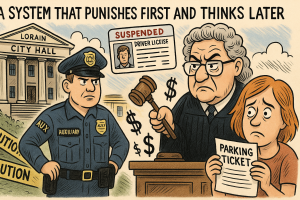
By the time a city reaches the point Lorain now occupies, the conversation stops being political, rhetorical, or hypothetical. It becomes structural and mandatory because the damage inflicted was not the kind of damage that can be brushed off as a procedural mistake or clerical oversight. The harm here was legal harm, committed through actions that violated the core architecture of the Ohio criminal process. And when the harm is legal, the remedy must also be legal. This section is general information only and not legal advice. It explains the corrective framework that cities across the United States have been required to adopt when their enforcement systems collapsed in the same way Lorain’s system collapsed, including systems exposed by Mark Puente’s groundbreaking investigative reporting for The Marshall Project, which chronicled the ways municipal governments across America bent their court systems into revenue machines until the law beneath them finally gave way.
The starting point for any real fix is understanding the nature of a void case. A faulty case can sometimes be amended. A defective case can sometimes be corrected. But a void case cannot be repaired at all. Jurisdiction in Ohio is not a flexible concept. It is binary. You either have jurisdiction or you do not. And if you do not, you never will. The Ohio Supreme Court has repeated this principle for nearly a century. In Patton v. Diemer, 35 Ohio St.3d 68 (1988), the Court held that a judgment rendered without subject matter jurisdiction is “void ab initio,” meaning void from the beginning, and a void judgment is a “legal nullity” that can be attacked at any time, by any person, in any proceeding. Likewise, in State v. Mbodji, 129 Ohio St.3d 325 (2011), the Court reaffirmed that a complaint that does not comply with Crim.R. 3 deprives the court of jurisdiction. And even earlier, in Newman v. Al Castrucci Ford Sales, Inc., 54 Ohio St.2d 1 (1978), the Court explained that jurisdictional defects are not cured by waiver, plea, or agreement.
These cases form a consistent doctrine: once jurisdiction is absent at the beginning, nothing that happens afterward can create it. Not consent. Not payment. Not a plea. Not a signature. Not even the passage of years.
A void summons does not produce a defective case. It produces no case at all.
And that is the exact defect Lorain is now facing.
Under Crim.R. 3, a complaint must be made by a person authorized by law, stating the essential facts and sworn before a magistrate or authorized officer. Under Crim.R. 4, a summons “shall be issued” by a judge, clerk, or law enforcement officer authorized by law. Under R.C. 2935.01(B), a “peace officer” includes only those individuals specifically designated in statute. Under R.C. 2935.03(A)(1), a peace officer may arrest, detain, or cause process to issue only if granted authority. And under R.C. 109.71, the definition of “peace officer” is explicit:
“Peace officer means any person who is employed by a political subdivision of this state and who is commissioned and employed as a law enforcement officer.”
Commissioned means certified, trained, sworn, and legally empowered under state law. Auxiliary volunteers do not meet any of these requirements. They are not in the statutory list. They have no arrest powers. They have no summons authority. They cannot initiate criminal process. The statute draws a bright line the city cannot blur: the authority to summon a person into court is reserved solely for those recognized as peace officers or authorized officials. Not volunteers. Not helpers. Not auxiliaries. Not persons acting under internal policy guidance.
The Ohio Supreme Court has held repeatedly that courts only obtain jurisdiction when the initiating instrument is lawful. In State v. Wallace, 43 Ohio St.2d 1 (1975), the Court explained that jurisdiction cannot arise where the initiating complaint is void. In State v. Miller, 2018-Ohio-1036, appellate courts reiterated that a summons issued without authority deprives the court of jurisdiction.
Lorain’s auxiliary-issued summonses fall squarely within this category.
Once the summons is void, the case is void. Once the case is void, the judgment is void. And once the judgment is void, the city’s entire enforcement campaign cannot be salvaged.
This is the doctrine Puente encountered again and again in his Marshall Project reporting when he exposed towns in Oklahoma, Louisiana, Alabama, and Missouri where ticket mills collapsed because volunteers, clerks, dispatchers, or uncertified personnel initiated cases without authority. In each instance, courts were forced to dismiss thousands of cases, return money, notify residents, and submit themselves to state audits and judicial oversight.
Lorain is now inside that same legal and moral moment.
This is what true accountability requires. It requires understanding that a void enforcement system cannot be “reviewed” into legality, cannot be “adjusted” into compliance, and cannot be “fixed” with a policy memo or updated ordinance. A void enforcement system must be dismantled, corrected, and rebuilt from the ground up, because the harm is embedded in the foundation, not the roof.
The path forward is not optional. It is required by law, precedent, and basic constitutional duty.
The Mandatory Citywide Review: A Full Accounting of Every Case Tainted by the Void Summonses
The first obligation of a government after it has violated the public’s rights is to identify the full scope of the harm. In Lorain, that responsibility begins with a comprehensive review of every case touched by an auxiliary-issued summons. This is not a discretionary action. It is not a courtesy. It is the unavoidable legal reality that flows from a system that collapsed at the point of initiation. Under Crim.R. 3, the complaint is the document that gives the court jurisdiction to proceed. Under Crim.R. 4, a summons must be issued only by someone authorized by law. Under R.C. 2935.01 and its statutory architecture, only peace officers or specially empowered individuals may initiate criminal process. Auxiliary volunteers are not within that statutory universe. Once the initiating document is void, the city has no right to assume anything beyond that point was valid.
Ohio courts have repeatedly held that jurisdiction cannot attach when the fundamental requirement of a lawful complaint or summons is missing. In State v. Mbodji, the Ohio Supreme Court made clear that a defective complaint deprives the court of authority to act at all. In State v. Wallace, the Court emphasized that jurisdiction cannot be retroactively created by subsequent proceedings. Therefore, Lorain’s review must examine every docket, every plea entry, every fine payment, every reinstatement fee, every warrant or suspension, and every administrative action that was built on the void summonses.
This review must be transparent. It must be complete. And it must be public. The city cannot wait for residents to discover the truth through news articles or investigative reporting. The burden now lies entirely on the government to identify and correct the harm it caused. Cities documented in Mark Puente’s Marshall Project reporting were required to do the same when their enforcement systems collapsed. Ferguson, Louisiana parishes, rural Oklahoma towns, and multiple Ohio jurisdictions faced the exact obligation to audit their own actions. Lorain is not exempt.
A government cannot repair what it refuses to identify. Lorain must identify every single affected case.
Vacating Every Void Judgment: The Legal Mandate That Cannot Be Negotiated or Avoided
Once the city of Lorain acknowledges that auxiliary volunteers issued summonses without legal authority, the next step is not optional, strategic, or political. It is mandatory. It is dictated entirely by Ohio law, centuries of jurisdictional doctrine, and repeated rulings by the Ohio Supreme Court. The law does not give the city or the court the power to choose whether to vacate these judgments. The law requires them to vacate them because they were void from the moment they were created.
The distinction between a defective case and a void case is not semantic. It is the difference between something broken and something that never existed at all. A defective case can sometimes be repaired. It can be amended, corrected, or refiled. But a void case cannot be salvaged, reactivated, or retroactively legitimized. It is legally dead. It is dead from birth. It is dead as a matter of law regardless of how many procedural steps followed, how many fines were paid, or how many people walked into court believing they were in a valid judicial proceeding.
Crim.R. 3 defines what a complaint must contain and who may make it. Crim.R. 4 governs who may issue a summons. R.C. 2935.01 defines who may initiate criminal process, and R.C. 2935.03 enforces that only peace officers or properly empowered officials may arrest or cause summonses to issue. And R.C. 109.71 defines “peace officer” in clear statutory language:
“Peace officer means any person who is employed by a political subdivision of this state and who is commissioned and employed as a law enforcement officer.”
Commissioned means certified.
Commissioned means authorized by law.
Commissioned does not mean auxiliary volunteer.
Therefore, the summonses issued in Lorain by people who were not peace officers were void at the moment they were issued. They were not defective. They were not irregular. They were void.
Ohio courts have long held that a void summons cannot vest jurisdiction in any court. In State v. Mbodji, 129 Ohio St.3d 325 (2011), the Ohio Supreme Court reiterated that a valid complaint is a prerequisite to jurisdiction and that the failure to satisfy Crim.R. 3 deprives a court of authority to proceed. Likewise, in Patton v. Diemer, 35 Ohio St.3d 68 (1988), the Court explained that any judgment rendered without jurisdiction is “void ab initio” and must be treated as a “legal nullity” that can be attacked “at any time.” The Court repeated this theme in Newman v. Al Castrucci Ford Sales, Inc., 54 Ohio St.2d 1 (1978), stating that jurisdictional defects cannot be waived or cured through consent or plea.
This is not theoretical doctrine. It is binding law. It means every plea entered under a void summons is void. Every conviction is void. Every fine or cost imposed is void. Every suspension triggered by those convictions is void. Every reinstatement fee paid to the BMV is void. The court had no jurisdiction from the beginning and therefore had no authority to take any action against any resident affected by the auxiliary enforcement.
Lorain Municipal Court has no power to preserve or defend these judgments. The court cannot decide that some judgments should stand because they are inconvenient to unravel. It cannot decide that the residents who paid their fines should be treated differently from those who did not. It cannot decide that dismissing every case is too administratively burdensome. Jurisdiction does not bend for convenience.
Jurisdiction is binary.
It exists or it does not.
Here, it did not.
When cases like this have occurred in other jurisdictions, the corrective action was always the same. In Ferguson, Missouri, when the Department of Justice and investigative journalists uncovered unlawful enforcement practices, tens of thousands of cases were vacated. In Harpersville, Alabama, the entire court was dissolved and judgments vacated after the unlawful jailing-for-fees system was exposed. In rural Oklahoma towns documented by Mark Puente, guilty pleas obtained through defective or unauthorized summons processes were vacated en masse. In Louisiana municipal courts that relied on deputies without proper statutory authority to issue citations, appellate courts ordered the vacatur of years of convictions.
The consistent message across every jurisdiction is simple. When a summons is void, the case is void. When the case is void, the judgment is void. When the judgment is void, the government must clean up its own misconduct, whether it wants to or not.
Vacating these judgments is not a gesture toward fairness. It is not a compromise. It is not an admission of wrongdoing by any individual. It is the inevitable, unavoidable legal consequence of the city’s decision to allow civilians to do what only peace officers may do under Ohio law.
- Every resident whose case originated with a void summons is entitled to a vacatur.
- Every judgment must be erased.
- Every case must be marked as void ab initio.
- There are no exceptions.
- There is no discretion.
- There is no work-around.
Lorain cannot legally continue to hold onto judgments it never had the authority to enter. The court cannot continue to treat void cases as if they are real. The city cannot pretend the law allows a middle ground. And the residents cannot be expected to live with the consequences of cases the law says never existed.
Vacating the judgments is the first true step toward repairing the harm Lorain caused.
It is not optional.
It is mandatory.
And the longer the city delays, the more deliberate the violation becomes.

Returning Every Dollar Taken Without Authority: The Restitution Obligation That Follows Every Void Case
When a court never had jurisdiction, it never had the power to impose fines, costs, fees, or financial penalties. Every dollar collected becomes unlawful the moment the initiating summons is declared void. This is not a radical concept. It is the foundation of Ohio law and a principle affirmed repeatedly by the Ohio Supreme Court. In Patton v. Diemer, the Court stated that a judgment without jurisdiction is a nullity that cannot support any subsequent action. In State ex rel. Foreman v. Bellefontaine Municipal Court, improper assessments were ordered refunded because the court lacked statutory authority to collect the money. And in cases like State v. Beasley, 14 Ohio St.3d 74 (1984), the Court held that a sentencing court cannot impose penalties the law does not authorize. When the law does not authorize the case itself, the conclusion is even clearer.
Residents who paid fines under auxiliary-issued summonses did not pay lawful debts.
They paid money the city had no legal right to demand.
They paid into a system that never had jurisdiction to judge them.
They paid because they trusted the court.
That trust was misplaced because the authority was never real.
The list of restitution obligations is broad and extends far beyond simple fines. A void conviction often triggers a cascade of financial consequences. These include court costs, late fees, collection charges, towing bills, impound fees, storage fees, credit consequences, and the Bureau of Motor Vehicles reinstatement fees. Under R.C. 4510.10 and R.C. 4509.101, reinstatement fees are tied directly to the underlying conviction. If the conviction is void, the reinstatement fee becomes unlawful.
A city cannot keep unlawful money.
A court cannot profit from void judgments.
A government cannot retain funds taken through an illegal process.
Mark Puente’s national reporting documented towns in Alabama, Louisiana, and Oklahoma that were required to return millions when investigations revealed unlawful enforcement patterns. Lorain is now inside the same legal moment. Every dollar must be returned. The residents did not owe it. The city had no authority to take it. And the longer the city keeps it, the deeper the legal exposure becomes.
Telling the Truth to the People Harmed: Mandatory Notification to Every Affected Resident
When a government has imposed unlawful burdens on its citizens, when it has extracted fines through a process that the law never authorized, and when it has allowed convictions, suspensions, and financial penalties to collect like sediment on the lives of ordinary people, the obligation to tell the truth is not symbolic or optional. It becomes a fundamental requirement of due process, public integrity, and constitutional accountability. Notification is the mechanism by which a government acknowledges both the error and the harm. It is the process through which a city demonstrates that it understands the seriousness of violating jurisdictional boundaries. Lorain cannot move forward until it has turned toward its residents with honesty, clarity, and full disclosure, because silence in the face of a void judicial process deepens the harm rather than repairing it. And while courts sometimes minimize the importance of notification, the United States Supreme Court does not. Nor do Ohio courts. The principle is embedded deeply within American jurisprudence: the people who were wronged are entitled to know they were wronged.
This requirement is rooted in due process doctrine that stretches back generations. In Mullane v. Central Hanover Bank & Trust Co., 339 U.S. 306 (1950), the Supreme Court held that notice must be “reasonably calculated” to inform individuals of actions affecting their rights. While Mullane involved trust beneficiaries, the principle is universal. Notice is not a bureaucratic formality. It is the means by which the government provides an individual with the information necessary to protect their liberty, property, and legal status. That logic applies with even greater force when a government has unlawfully initiated criminal or quasi-criminal cases, because those actions affect not merely property interests but reputational interests, driving status, credit history, employment consequences, and in many cases the psychological weight of believing one committed an offense that the law says never legally occurred.
Ohio courts have consistently applied this doctrine in cases involving void judgments. A void judgment is one issued without jurisdiction. Because it is a legal nullity, residents must be notified so they do not continue living under the burden of a conviction that never existed in law. In State v. Beasley, the Ohio Supreme Court explained that courts may not impose penalties that the law does not authorize. If a penalty is unauthorized, it is void and the individual is entitled to correction. In State v. Fischer, 128 Ohio St.3d 92 (2010), the Court reaffirmed that void judgments must be corrected “whenever discovered” and emphasized that the state bears the responsibility of doing so. Similarly, in Patton v. Diemer, 35 Ohio St.3d 68 (1988), the Court held that a judgment rendered without jurisdiction is subject to attack at any time. If a resident is not informed that their judgment is void, they cannot exercise the rights the law gives them.
The obligation to notify residents in Lorain flows from these same principles. When auxiliary volunteers issued summonses without authority under R.C. 2935.01, when they acted outside the strict limits of R.C. 109.71 defining peace officers, and when the city allowed convictions to be entered on void cases, the city created a legal landscape in which residents were deprived of lawful process from the moment their citation was issued. They were never under the court’s jurisdiction, and yet they were treated as if they were. They paid fines. They paid reinstatement fees. They lost work time. They experienced stress and confusion. And they lived, often for months or years, under the shadow of convictions that the law says are legally nonexistent. Residents cannot repair this harm on their own. They cannot intuit that a judgment is void. They cannot be expected to piece together jurisdictional defects from legal rules they were never told existed. They cannot be placed in the position of defending themselves against a conviction that was never real.
That is why the government must notify them.
Not through a press release.
Not through a website.
Not indirectly through reporters.
But directly, personally, and unambiguously.
The notification must be written. It must be formal. It must be individualized. It must explain that the auxiliary-issued summons was void at the moment it was issued. It must explain that the case built on that summons was void. It must explain that any conviction entered on that case was void. It must explain that the resident has the right to receive a refund for any fines, fees, or penalties they paid. And it must explain that the city and the court are taking steps to correct their driving record, their court record, and any collateral consequences tied to the void judgment. Notification must not be a vague or apologetic gesture. It must be a clear, comprehensive, and legally accurate explanation of what happened and what happens next.
This level of transparency is not unprecedented. It is identical to what other municipalities were required to do after their enforcement schemes collapsed. In Ferguson, residents received formal letters informing them that thousands of cases had been dismissed and that the convictions attached to them were void. In Harpersville, Alabama, after the town’s unlawful fee-based jailing system was exposed, courts were required to notify all affected residents and work with civil rights attorneys to ensure every record was corrected. In Oklahoma and Louisiana towns identified in Puente’s Marshall Project reporting, residents were sent notifications explaining that their tickets and arrests were unlawful because they were initiated by individuals without legal authority. The expectation was clear: a government that harms its citizens must tell them the truth about the harm. Anything less compounds the injury.
Lorain owes its residents no less than that. Indeed, because this collapse involved both civil liberties and financial penalties, Lorain’s obligation is even greater. Residents who were harmed deserve to be restored to the position they were in before the unlawful enforcement occurred. They deserve to know that they never committed the offense the city accused them of. They deserve to know that the judicial process they experienced should never have taken place. And they deserve to know that the government accepts responsibility for correcting the damage.
Transparency is not punishment. It is recognition.
It recognizes the dignity of the people harmed.
It recognizes the authority of the law.
And it recognizes that a government can only regain trust by admitting its failures.
Notification is the first honest act Lorain can take after years of unlawful enforcement. It is required not because residents demand it but because the Constitution requires it, due process requires it, the Ohio Supreme Court requires it, and basic institutional integrity requires it. It is the foundation for everything that must come next, because a government that does not tell the truth cannot build a lawful future.
Judicial Conduct Review: Oversight Triggered Automatically When Jurisdiction Fails
When a judicial system processes cases that the law never allowed it to hear, when it accepts pleas on cases that were void from the very beginning, and when it fails to disclose jurisdictional defects to the very people standing before it, the question of judicial conduct is no longer an abstract inquiry. It becomes the first necessary step toward restoring the integrity of the system that failed. Judicial conduct rules exist for precisely this moment. They are not aspirational guidelines. They are enforceable standards designed to ensure that judges do not become passive participants in unlawful practices or unknowing instruments of structural harm. They are the legal guardrails that prevent courts from becoming revenue mechanisms or administrative funnels that process human beings as if they were transactions. Lorain has crossed the threshold where judicial oversight becomes not merely appropriate but unavoidable because the court continued to process void cases, continued to accept plea agreements without jurisdiction, and continued to impose sanctions under circumstances where the law required the opposite.
The Ohio Code of Judicial Conduct places several nonnegotiable duties on judges. Rule 1.1 requires judges to “comply with the law,” a phrase that sounds simple but carries deep meaning. It requires active fidelity to statutory authority, constitutional principles, and binding precedent. A judge cannot follow internal custom when the law requires otherwise. A judge cannot rely on the clerk, prosecution, or police to define the limits of jurisdiction. A judge must personally ensure that every case before them is lawfully initiated. This is not administrative procedure. It is the foundation of judicial power. The Ohio Supreme Court has made clear that courts possess only the authority granted to them by law. They cannot extend their reach by implication, custom, or convenience. When a judge accepts a plea or enters a judgment in a case initiated by someone without authority under R.C. 2935.01 or R.C. 109.71, that judge is engaging in an act the law does not permit.
Rule 1.2 requires judges to “act at all times in a manner that promotes public confidence in the independence, integrity, and impartiality of the judiciary.” Nothing undermines public confidence more than a court accepting pleas on cases that the law never recognized. Nothing erodes judicial integrity more quickly than a judge acknowledging that a case is defective at the jurisdictional level yet proceeding as though the defect were a minor inconvenience rather than a fatal collapse. And nothing jeopardizes impartiality more than a court that appears more concerned with preserving revenue, preserving process, or maintaining workflow than with protecting the rights of the individuals appearing before it. This rule alone makes judicial review necessary because the conduct in Lorain did not promote public trust. It diminished it.
Rule 2.2 requires judges to uphold and apply the law, which includes the law of jurisdiction. A judge cannot uphold the law by ignoring its most fundamental requirement. Jurisdiction is not technical. It is constitutional. It is tied to due process. It is the difference between a government that acts with authority and a government that acts without it. Ohio case law is unambiguous. In Patton v. Diemer, the Ohio Supreme Court held that a judgment issued without jurisdiction is void ab initio, meaning the judge had no authority to act and the judgment must be treated as if it never existed. In State v. Mbodji, the Court held that a defective complaint deprives the court of jurisdiction. In State v. Miller, the court emphasized that a plea does not cure a jurisdictional defect. Judges are required to know these principles because they are the foundation of every proceeding that enters their courtroom. When judges in Lorain accepted pleas on void cases, they were acting without legal authority, which is the exact moment Rule 2.2 becomes relevant.
Rule 2.6 requires judges to ensure that defendants understand their rights. A resident standing before a court has the right to know that the case against them is void. They have the right to know that the city lacked authority. They have the right to know that the court cannot legally accept their plea or impose penalties. They have the right to know that the law protects them from unlawful process. When a court conceals this information or fails to disclose it, residents are placed in a position where they do not and cannot understand their rights. They enter pleas based on silence rather than informed choice. They pay fines because they believe the court has power the law never gave it. This is the type of harm Rule 2.6 was designed to prevent.
Finally, Rule 2.16 requires judges to cooperate with disciplinary authorities. Judicial oversight is not an attack on a judge. It is the mechanism through which the judiciary reaffirms its own integrity. It is the process designed to correct systemic harm, prevent future violations, and rebuild public trust. In Disciplinary Counsel v. Campbell, the Ohio Supreme Court imposed sanctions on a judge not because the judge was malicious but because the judge failed to comply with legal procedures in a way that harmed the public. The Court acknowledged that intent is not the threshold for discipline. Compliance is. When Lorain’s judges continued to accept pleas without jurisdiction, oversight became necessary regardless of whether the conduct was intentional or inadvertent.
The need for judicial review is also supported by the national record. In the enforcement systems exposed by Mark Puente’s reporting, judicial conduct reviews were mandatory components of every major reform process. In Ferguson, judicial oversight was imposed after the Department of Justice found that the municipal court had prioritized revenue generation over due process. In Harpersville, Alabama, the entire municipal court was dismantled after a judge was found to be complicit in an unlawful fee-based jailing scheme. In multiple towns in Oklahoma and Louisiana, judges were required to undergo disciplinary evaluation because they accepted pleas or imposed penalties in cases initiated by individuals without legal authority. The fact pattern is identical. The harm is identical. The remedy is identical. Judicial conduct review ensured accountability not for the purpose of punishment but for the restoration of the rule of law.
Judicial oversight in Lorain is not a matter of personal criticism. It is a structural requirement. It is the only process capable of evaluating whether judicial conduct met the standards required by the Ohio Code of Judicial Conduct. It is the only process capable of determining whether judges applied the law faithfully, disclosed jurisdictional defects to defendants, acted in a manner that preserved public confidence, and fulfilled their duty to protect due process. And it is the only process capable of reassuring residents that the judiciary of Lorain will not repeat the same errors again.
A court that acted without jurisdiction cannot correct itself in silence. A judiciary that allowed void cases to proceed cannot restore trust by denying the need for oversight. Judicial review is not a threat to the court. It is the mechanism that protects the court from the consequences of its own collapse. It is the process through which the judiciary affirms that the law matters, that rights matter, and that the people of Lorain matter.
Rewriting the Law: The Legislative Overhaul That Must Follow a Structural Collapse
When a city’s enforcement system collapses at the jurisdictional level, the legislative body cannot respond with patches or procedural touch-ups. It must engage in a full restructuring of the ordinance framework that produced the collapse. Lorain must now confront the legal architecture that permitted or tolerated a system in which civilians with no statutory authority initiated criminal or quasi-criminal process, issued summonses, made demands for identification, and carried themselves with the indicia of state power. These actions were not merely unauthorized. They were wholly incompatible with the structure of Ohio’s statutory regime governing peace officer authority. And because the collapse is embedded in the text and the interpretation of the city’s own ordinances, the correction must begin with rewriting those ordinances to eliminate ambiguity, remove unlawful delegations of authority, and ensure future compliance with state law.
Ohio’s home-rule authority does not allow a municipality to write its own criminal procedure rules. This is one of the most misunderstood features of home rule in Ohio. Under Article XVIII, Section 3 of the Ohio Constitution, municipalities may adopt local police, sanitary, or similar regulations so long as they do not conflict with general laws. The Ohio Supreme Court has repeatedly held that criminal procedure is a domain exclusively governed by general law and cannot be altered, supplemented, or contradicted by municipal ordinance. In Canton v. State, 95 Ohio St.3d 149 (2002), the Court invalidated a municipal ordinance that attempted to redefine criminal elements in a way that conflicted with state statutes. That case reaffirmed the bedrock principle that municipalities cannot use home rule to alter who may arrest, who may summon, or who may initiate cases under state criminal law.
The core statutes controlling this area are unambiguous. R.C. 109.71 defines peace officers as commissioned law enforcement officials employed by political subdivisions. This is a closed category. It cannot be expanded by local ordinance. It cannot include volunteers. It cannot include auxiliaries who are not certified under R.C. 109.77, which requires peace officers to complete prescribed training. R.C. 2935.01 defines the authorities permitted to initiate arrest or process. Again, the list does not include auxiliary staff. R.C. 2935.03 outlines the territorial and subject matter authority of peace officers. It does not allow a city to assign enforcement authority to civilians. This statutory framework is not optional. It is binding on every municipality in the state. No city may lawfully deviate from it.
Lorain’s ordinance system must be rebuilt to reflect these realities. The current language, structure, and enforcement assumptions have produced a multi-year collapse that harmed residents, undermined legitimate law enforcement, and pushed the municipal court into the position of processing cases it never had jurisdiction to hear. This is not the type of failure that can be corrected by deleting a sentence or inserting a disclaimer. The ordinances must be rewritten in a way that reflects explicit recognition of the statutory limits on who may enforce the law. They must clearly state that only sworn peace officers may issue summonses under Crim.R. 4. They must prohibit any individual not recognized by R.C. 109.71 from participating in activities that could appear to be enforcement. They must remove or revise any language that implies or suggests civilians may engage in conduct reserved to certified officers. Most importantly, they must articulate a standard that aligns with state law rather than local custom.
This process must also include a thorough examination of how internal administrative policy became inconsistent with state law. Ordinances do not operate in a vacuum. They structure the policies that police leadership relies upon. They shape the assumptions of supervisors, clerks, and civilian volunteers. They provide the foundation upon which the court expects cases to be initiated. A broken ordinance system produces a broken enforcement system, and a broken enforcement system produces unlawful cases. This is the sequence documented again and again in the municipalities profiled by Mark Puente in his Marshall Project reporting. In Ferguson, city ordinances incentivized revenue extraction. In Harpersville, the court relied on local contractual arrangements that skirted legal authority. In multiple Oklahoma towns, local ordinances allowed uncertified individuals to issue citations because the ordinances were written carelessly. Lorain must now recognize that its ordinance structure contributed directly to the collapse.
Rewriting the ordinances is not optional. It is required because Ohio law demands that local ordinances must not conflict with general law. It is required because Lorain’s ordinance structure blurred the line between state authority and local convenience. It is required because Lorain’s residents deserve the certainty that the law governing them is lawful itself. And it is required because the only way to prevent this collapse from repeating is to confront the legal architecture that allowed it to happen.
This overhaul cannot be superficial. It must be comprehensive. City council cannot look backward and blame staff. It must look forward and rebuild a system grounded in statutory clarity. The new ordinance framework must codify the legal boundaries the city is prohibited from crossing. It must recognize the supremacy of the Ohio Revised Code in defining who is and is not a peace officer. It must eliminate any suggestion that auxiliary volunteers hold quasi-police authority. And it must explicitly align enforcement practices with Crim.R. 3 and Crim.R. 4, R.C. 109.71, R.C. 2935.01, R.C. 2935.03, and R.C. 2921.51.
Only then will Lorain have a legal foundation sturdy enough to prevent future violations, withstand judicial scrutiny, and begin rebuilding the public trust its enforcement system has eroded.
Rebuilding Police Policy and Training: Aligning Culture With Statutory Authority
The collapse in Lorain did not occur because one volunteer misunderstood their role. It did not occur because one supervisor misinterpreted a statute. It occurred because the enforcement culture inside city government drifted so far away from the legal meaning of authority that the boundaries between sworn peace officers and civilians became indistinct. This was not a momentary lapse. It was a long-term structural drift in which internal policy, institutional memory, and informal practice began to overshadow the clear text of the Ohio Revised Code. When a police department permits civilians to function in roles reserved for peace officers under state law, when it treats auxiliary volunteers as extensions of law enforcement authority, and when it normalizes practices prohibited by statute, the collapse becomes predictable. Correcting it requires rebuilding not merely policy manuals but the culture that produced them.
Lorain must confront the blunt statutory reality that controls law enforcement authority in Ohio. R.C. 109.71 defines who is a peace officer. It is a foundational statute, and the definition is not open to creative interpretation. A peace officer is a person employed by a political subdivision who is commissioned and employed as a law enforcement officer. This definition is reinforced by R.C. 109.77, which requires peace officers to complete specific training prescribed by the Ohio Peace Officer Training Commission. These statutes are not optional. They define the outer walls of lawful police authority. A civilian cannot be converted into a peace officer by internal policy, by wearing a uniform, by riding in a cruiser, by using a radio, or by being directed by police personnel. A civilian is a civilian. The law does not permit any other interpretation.
The statutes governing arrest and summons authority make this distinction even sharper. R.C. 2935.01 and R.C. 2935.03 outline who may arrest and who may cause process to issue. These statutes list peace officers, sheriffs, constables, and other defined categories. They do not include auxiliary volunteers. They do not include civilian employees. They do not include anyone whom the city simply chooses to deputize informally. The language is strict because the authority to detain, summon, or penalize a resident is a profound governmental power that cannot be delegated casually or administratively. When Lorain permitted civilians to issue summonses or demand identification, it permitted acts that the law reserves exclusively to peace officers. That is not merely a procedural mistake. It is an unlawful expansion of police power.
The impersonation statute, R.C. 2921.51, underscores how seriously Ohio views this distinction. The statute prohibits a person from performing “any act that is reserved exclusively for peace officers” unless they are legally authorized. The statute exists to protect residents from exactly the kind of unlawful enforcement activities the city allowed. It recognizes that civilians performing police functions can cause fear, confusion, and constitutional harm. It recognizes that citizens should be able to trust that those who exercise law enforcement authority are properly trained, certified, and legally empowered. And it recognizes that unlawful delegation of authority by police departments is a form of institutional failure that endangers the public.
Rebuilding policy and training requires that Lorain return to these statutory foundations. Training must explicitly teach the limits of civilian involvement in enforcement. It must explain that civilians cannot initiate criminal process under Crim.R. 3 or Crim.R. 4. It must communicate that the authority to demand identification under threat of legal consequence is restricted to peace officers acting within the scope of their authority under R.C. 2921.29. It must eliminate any suggestion that auxiliary personnel, reserve volunteers, or non-sworn staff may enforce parking regulations, traffic laws, or any code violation that carries a penalty or requires court process.
The training must also address the cultural norms that allowed unlawful enforcement to become routine. Officers, supervisors, and administrators must be retrained to recognize that convenience, tradition, or manpower demands do not justify violating statutory limits. The department must establish internal controls that prevent the gradual erosion of legal clarity. It must develop supervision protocols that ensure no civilian is ever placed in a position where the public could reasonably interpret their actions as exercises of police authority. It must rebuild policy language so that every rule, directive, or operating procedure aligns with state law rather than with past practice.
In towns examined by Mark Puente for The Marshall Project, training reforms were one of the first major corrective actions imposed when enforcement systems collapsed. In Ferguson, officers were retrained in constitutional policing after investigative findings revealed that the department had allowed patterns of unlawful enforcement rooted in revenue priorities rather than legal authority. In Harpersville, training reforms were required after the court system collapsed under the weight of fee-based incarceration. In small Oklahoma municipalities, departments were required to retrain officers after it was discovered that uncertified individuals had initiated citations for years. The consistent pattern was that training and policy had drifted away from statutory grounding, and returning them to that grounding was essential to restoring legality.
Lorain must follow the same path. The department must acknowledge that the collapse occurred not simply because volunteers acted beyond authority but because the system allowed them to. It must recognize that a culture that treats civilians as quasi-officers is a culture that will continue to produce unlawful enforcement if it is not corrected. And it must rebuild training protocols that root every officer’s understanding of authority in the actual language of the Revised Code rather than in local habit or informal delegation.
This is the only way to restore the legal integrity of the department. It is the only way to ensure that future enforcement actions are lawful from the outset. And it is the only way to rebuild the trust of residents who were subjected to unlawful process for years. A department that does not retrain itself will repeat its past. A department that rebuilds itself in accordance with the law can prevent this collapse from ever occurring again.
Independent Oversight: The Required External Review When Every Branch Fails Simultaneously
When a city’s enforcement system collapses simultaneously at the administrative, judicial, and executive levels, the integrity of the entire structure becomes compromised. This is the moment when internal investigation becomes inadequate not because those inside the system are necessarily malicious, but because they are inherently incapable of examining a collapse they participated in, tolerated, or failed to recognize. Lorain’s auxiliary enforcement scandal is precisely that kind of collapse. The municipal court accepted void cases. The police department permitted civilians to perform acts reserved for peace officers under R.C. 2935.03 and R.C. 2921.51. The city administration either did not recognize or did not question the system’s legality. City council provided no meaningful oversight. When every branch is implicated, even through passive failure, the city loses the moral and structural legitimacy required to police itself. Independent oversight becomes not a possibility but a necessity.
External review is not a punitive measure. It is a stabilizing measure. It exists for moments when governments drift so far from statutory authority that they cannot reliably identify or correct the full extent of their own violations. The Ohio Attorney General, under his authority over law enforcement certification, public integrity, and civil rights enforcement, may investigate violations tied to unauthorized police functions, misuse of civilian personnel, and unlawful initiation of criminal process. The Auditor of State, under R.C. 117, may investigate unlawful financial collections, improper use of public funds, and revenue generated through void cases. The Supreme Court of Ohio has direct authority over judicial conduct and can investigate whether judges failed to uphold the Code of Judicial Conduct when they processed cases without jurisdiction. The Ohio Peace Officer Training Commission may investigate whether the city allowed individuals who did not meet certification standards to perform law enforcement functions. These bodies exist precisely because Ohio recognizes that some failures cannot be corrected from within.
The case for external oversight becomes stronger when viewed against the national backdrop uncovered by Mark Puente’s Marshall Project reporting. Time and time again, municipalities with deeply unlawful enforcement systems attempted to investigate themselves and failed. They failed because internal stakeholders were invested in defending their own decisions, because the systems had become normalized over many years, and because internal culture had drifted too far from legal standards to recognize how deeply the violations ran. In Ferguson, Missouri, it required the intervention of the United States Department of Justice to uncover how the court and police department had jointly operated a revenue-based enforcement system. In Harpersville, Alabama, it required state intervention to dismantle the court entirely. In Oklahoma towns like Valley Brook, Bethel Acres, and others investigated by Puente, independent review was the only method that revealed the depth of unlawful enforcement conducted by uncertified officers or civilian surrogates. The pattern is consistent: when local systems collapse internally, only outside scrutiny can repair them.
Lorain is now inside the fact pattern that historically triggers external review. The collapse was not caused by one branch of government. It was caused by the composite failure of multiple branches. The police department used civilians beyond the scope permitted by state law. The court accepted summonses it had no authority to enforce. The city administration failed to establish safeguards, failed to review enforcement practices, and failed to ensure compliance with the Revised Code. Council oversight was either absent or ineffective. This type of multi-branch failure is precisely what external oversight bodies are designed to address because no internal actor can credibly investigate the others without structural conflict. A police chief cannot investigate a court. A municipal judge cannot investigate the police department. City council cannot investigate itself. The law does not expect them to. The law provides alternatives.
An external review would accomplish what Lorain’s internal systems cannot. It would identify whether the misuse of auxiliary personnel violated R.C. 2921.51, whether civilians performed acts that constitute impersonation of a peace officer, whether the city violated constitutional protections by initiating criminal process without lawful authority, whether residents were deprived of due process under the Fourteenth Amendment, whether the municipal court violated Crim.R. 3 and 4 by accepting void cases, and whether the city improperly collected revenue based on unlawful enforcement. It would also evaluate whether the collapse reflects deeper issues in training, supervision, or systemic transparency.
Independent oversight also provides legitimacy that Lorain cannot generate for itself. Residents harmed by void cases are unlikely to trust internal reviews conducted by the same offices that allowed the harm to occur. Court litigants are unlikely to trust judges reviewing their own decisions. Civil rights advocates are unlikely to trust police departments evaluating whether they unlawfully delegated enforcement authority. And the public at large is unlikely to trust city officials investigating a system they themselves failed to supervise. External oversight insulates the process from political pressure, personal interest, institutional defensiveness, and historical bias.
This is why external bodies exist. It is why Ohio has a multi-layered oversight structure. It is why national reform efforts repeatedly emphasize independence as a prerequisite to legitimacy. Lorain’s situation is not unusual in the broader context of American municipal failures. It fits the classic failure sequence that Puente’s reporting has documented for years: unlawful enforcement at the base, institutional normalization of illegality in the middle, and judicial participation at the top. Municipalities in this posture do not repair themselves without outside intervention. They cannot. Their systems are compromised. Their personnel are implicated. And their residents have every right to distrust internal assurances of reform.
Lorain must accept external review not because it is politically expedient but because it is legally and structurally required to restore the integrity of the system. The city must allow independent bodies to examine the collapse, identify responsible processes, recommend corrective action, and ensure compliance with state and constitutional law. Only then can Lorain begin to rebuild a system worthy of public trust. Only then can residents believe that the collapse will not be repeated. And only then can the city move from the aftermath stage to the accountability stage that this two-part exposé forces into view.
The Final Reckoning: A System in Collapse and the Duty to Rebuild What Has Been Destroyed
There comes a point in every city’s history when its government can no longer pretend that the system is functioning, when its elected officials can no longer speak in abstractions about “isolated incidents,” and when its courts can no longer hide behind the solemnity of their architecture to disguise the decay taking place inside. Lorain has reached that point. This auxiliary enforcement scandal is not an aberration. It is not an isolated misjudgment. It is not a momentary departure from an otherwise sound system. It is a symptom of something far deeper, something structural, something that has been eroding the foundation of Lorain’s justice system for years until the collapse became too visible to ignore. Part Two is the unavoidable conclusion of that collapse, because the harm inflicted by the unlawful summonses did not occur in a vacuum. It occurred in a larger context of repeated legal missteps, constitutional violations, and a pattern of institutional disregard for statutory limits.
This same government is now facing litigation from its own residents, including the lawsuit we have already filed challenging the city’s unlawful firearms ordinance, an ordinance that attempted to restrict rights protected by Ohio’s preemption statute and the state constitution. That case is a separate matter on paper, but it is part of the same larger truth: Lorain’s government has developed a habit of reaching beyond the limits of its authority, disregarding state law when it conflicts with local preferences, and expecting residents to comply even when the city itself refuses to. The auxiliary enforcement collapse is simply the most visible of these failures because it touched so many people, but the same disregard for legal boundaries is present in the city’s approach to firearms regulation, to public meetings, to records disclosure, and to due process itself.
The pattern extends to the judiciary. A formal complaint is already pending regarding Judge Mark Mihok’s recent misuse of contempt authority in unrelated cases. That complaint did not arise from the auxiliary enforcement scandal, but it illustrates the same underlying issue: a court operating without proper restraint, a court treating its discretionary powers as instruments of administrative control rather than constitutional duty, a court that expresses openly that “parking enforcement is a moneymaker” while processing cases that were jurisdictionally void. When a judge views fines as a revenue stream rather than a judicial sanction, the legal system has already lost its fidelity to justice. The auxiliary enforcement scandal is therefore not merely about void summonses. It is about a court whose approach to its authority has drifted so far from its constitutional purpose that it can no longer be trusted to police itself.
The collapse described in Part Two is not a collapse of technical compliance. It is a collapse of constitutional culture. The municipal court accepted void cases because the court stopped treating jurisdiction as a threshold requirement. The city permitted civilian enforcement because it stopped treating statutory authority as binding. The police department blurred the line between sworn officers and volunteers because it stopped rooting its training in the language of the Revised Code. City council provided no oversight because it stopped viewing its legislative power as a responsibility rather than a privilege. Every branch failed. Every safeguard failed. And every resident who paid a fine, lost a day of work, faced a suspension, or stood in front of a judge in a case that never legally existed suffered because of that failure.
The assistant prosecutors, police supervisors, clerks, and administrators who participated in this system may insist they meant no harm. Intent is not the standard. Constitutional compliance is the standard. The law does not ask whether a government meant to violate the rights of its citizens. It asks whether the government obeyed the law. Lorain did not. And the consequences cannot be minimized.
The most striking example of the collapse sits in the open, in the words of Judge Mihok himself. When he described parking enforcement as “a major moneymaker,” he revealed what Mark Puente spent years documenting across the country: the moment a court begins viewing its residents as a source of revenue, due process becomes secondary and legality becomes negotiable. The courtroom becomes a cash register. The judge becomes a collector. And the people standing at the podium become the commodities through which the institution sustains itself. That is the precise moment when justice ceases to function. That is the moment Puente identified again and again in the towns dissected by The Marshall Project. And that is the moment which Lorain now must confront.
Every city exposed in Puente’s reporting said the same thing at the beginning. They said the violations were isolated. They said the abuses were exaggerated. They said the journalists misunderstood the system. They said the public did not appreciate the pressures faced by the court. And every one of those cities ultimately had to admit that their systems were not only broken but had been broken for years, sustained only by silence, normalization, and a refusal to acknowledge the truth. Lorain is now in that same position. The truth is not a matter of interpretation. It is a matter of law. The summonses issued by auxiliary volunteers were void. The cases were void. The convictions were void. And the harm was real.
Residents lost money.
Residents lost time.
Residents lost trust.
Residents lost faith that the courts of Lorain were functioning as courts.
This is a system in ruins.
But ruins can be rebuilt. And reconstruction begins with honesty. The city must acknowledge the full extent of the collapse, vacate every void judgment, return every dollar it took, notify every resident it harmed, subject its judiciary to external review, rewrite its ordinances to comply with state law, retrain its police department in the requirements of the Ohio Revised Code, and invite independent oversight to ensure that these failures never repeat.
The city cannot correct unlawful firearms regulations while tolerating unlawful enforcement in its courts. It cannot address issues with judicial contempt while ignoring issues with judicial jurisdiction. It cannot rebuild trust in one area while ignoring the collapse in another. The system rises or falls as a whole.
Lorain now stands at a crossroads. It can continue denying, deflecting, and minimizing, or it can accept that the law demands accountability, restitution, and structural reform. The reckoning phase has arrived. It cannot be delayed, and it cannot be negotiated.
This is not personal. It is the news. It is the law. It is the truth that belongs to the residents of Lorain, and it is the truth the city must finally confront.
Byline
Written by Aaron Christopher Knapp, BSSW, LSW
Investigative Journalist, Lorain Politics Unplugged
Legal Disclaimer
This exposé is based entirely on public records, court filings, statutory text, and documented statements.
It is journalistic analysis and commentary for public awareness and civic accountability.
It is not legal advice.
Readers seeking legal guidance should consult an attorney.
About The Author





Good sound accurate discussion on the concept and requirement of Jurisdiction; and the consequences of any order by any court of its lacking. Void means not valid! Not repairable, ever!
Lorain’s law department has responsibility for hoodwinking citizens. What dysfunctional culture and anti-citizen mindset must exist to deny Constitutional protections to Lorain Citizens?
The law Director’s staff and the law Director exist that this type of debacle is not to be tolerated and endured by citizens and taxpayers.
The revenue stream model has no place in The JUSTICE System Constitutionally administered by proper ministers of the law! All must be rebuked for their conduct and roles in this conspiracy to deprive Citizens of their civil rights; it should be noted that the public officials have undeniably been derelict in their public duties; Dereliction of Duty is a potential crime. Who will convene a Grand Jury or cause an investigation of this behavior?
External corruption investigations are required as SELF-REPORTING has been non-existent and indeed the government has been run as a criminal enterprise for money and used illegally against the People to extort, Coerce, and extract filthy lucre from defrauded citizens.
Impeachment of all involved is warranted! Those who have been abused deserve Justice! Time to reap what you corrupt public officials have sown. Resignations and firings are warranted; discipline must be public and apparent.
Retribution and accountability are a must. Restitution and disgorgement of ill gotten gains with interest along with a sincere apology and acknowledgment of wrongdoing must occur.
The culprits must renounce their actions as criminally suspect and accept a faithless servant verdict upon their failings to The People. Forgiveness and Rebuilding of Trust can then be had.
Integrity demands honesty.
End the illusion of ignorance, you did what you did intentionally and by planning it! To fleece the public is not Justice it violates the very Sacred Oaths you all pledged to provide!
Accept Responsibility for your sins uncovered by these investigations and correct ALl transgressions to those you have harmed! DO JUSTICE – End your violence against the Rights of the People!