
The Record Didn’t Stop. It Expanded.
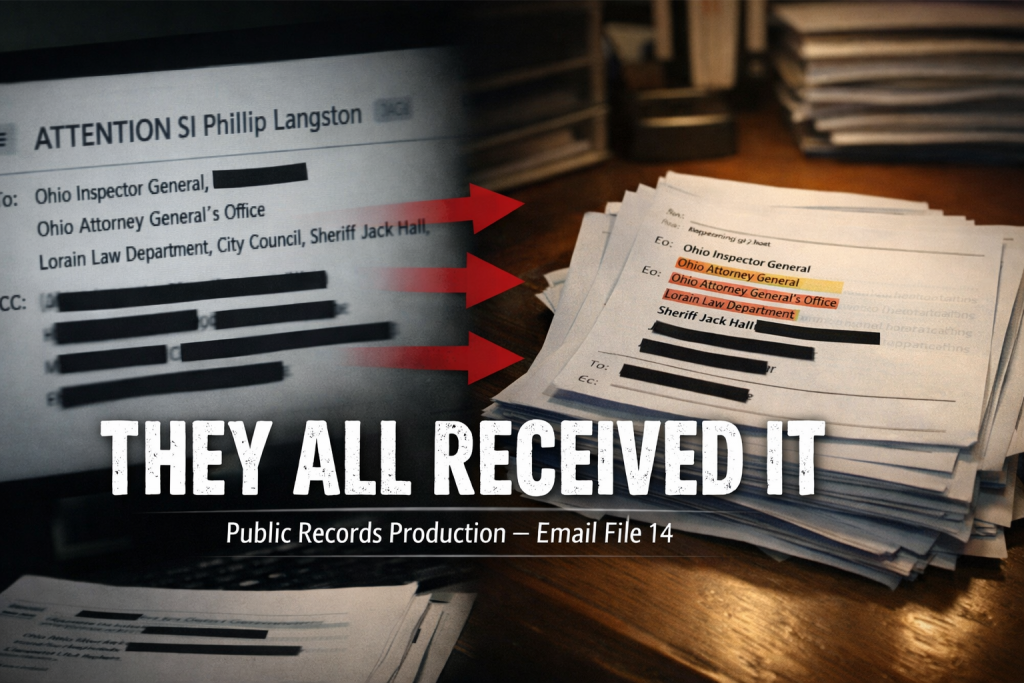
A single record set shows the same materials delivered to the Mayor, Law Department, law enforcement, state oversight agencies, and media, raising the question of what happens when everyone knows and nothing follows.
By Aaron Christopher Knapp
Investigative Journalist | Editor-in-Chief, Lorain Politics Unplugged
Licensed Social Worker (LSW) | Public Records Litigant
I. INTRODUCTION WHEN THE NEXT FILE EXPANDS THE SAME SYSTEM
Before this record was ever reduced to writing, the issues it reflects were already being discussed, questioned, and circulated among the same individuals who continue to appear throughout every prior section of this series. What follows is not a new story and it is not a separate issue. It is the continuation of a documented sequence that is now being reviewed in the exact order it was produced. This section is based on a formally released set of records identified as Public Records Production — Email File 14, one file within a larger production consisting of approximately fifty separate email files and related materials released under Ohio Revised Code 149.43. That context matters because this is not an isolated release. It is one part of a structured production where each file expands the same record, introduces additional communications, and reinforces the same network of participants.
The prior file in this sequence, Public Records Production — Email File 13, established a pattern that is now carried forward. It showed how requests were made, how responses were shaped, and how the same officials remained present across multiple exchanges involving legal obligations, record custody, and internal determinations. That file confirmed that the issue was not a single request or a single response but an ongoing process involving repeated communication with the same individuals. What File 14 does is expand that process outward. It takes what was already visible within the internal structure of the City and shows how that same information moved beyond it, into a broader system that includes state agencies, external oversight bodies, and media organizations.
This file does not introduce new participants to the story. It reinforces the same network that has been present from the beginning. Mayor Jack Bradley appears again within the same communication chains where responsibility is acknowledged and redirected. Law Director Patrick Riley and Assistant Law Director Joseph LaVeck remain part of the same exchanges where statutory obligations are discussed and responses are shaped. Law enforcement personnel, including individuals within internal affairs and command staff, continue to receive the same communications tied to the same underlying issues. At the same time, the record shows that Sheriff Jack Hall is part of that same timeline through direct communication, receiving and responding to information as it is being circulated.
What changes in this file is not who is involved but how far the information travels. The record shows that the communication is no longer confined to internal routing within the City or limited exchanges between departments. It is forwarded outward in a way that places the same materials in front of the Ohio Inspector General, the Ohio Attorney General’s Office, and multiple media outlets, alongside the same local officials who have been part of every prior section of this record. The same names that received the requests are now receiving the records themselves, and those records are moving beyond the system that produced them.
That expansion matters because it removes any remaining argument that the issue was limited in scope or confined to a single office. The record shows that the information was not only created and maintained but actively distributed across multiple levels of authority. It shows that the same materials were placed in front of individuals and entities with the power to review, investigate, and act, all within the same timeframe and through the same communication channels.
What begins to take shape in this file is not simply communication. It is a documented pattern of distribution. The record shows not just who knew, but how widely that knowledge was shared, how consistently it was transmitted, and how often it reached individuals positioned to respond. The distinction is no longer about whether information existed or whether it was delivered. The record answers those questions directly. What remains is the next question in the sequence, which is what happens when that information reaches everyone who has the ability to act on it and still continues to move without producing a result.
II. WHEN THE RECORD IS NOT SENT ONCE BUT SENT EVERYWHERE
One of the most significant aspects of this production is the scope of distribution reflected within it, and that scope is not incidental or accidental when viewed in the context of how public records requests are typically handled under Ohio Revised Code 149.43. These emails are not directed to a single office for review or routed through a controlled chain where responses can be shaped before reaching a broader audience. They are sent broadly, often within the same thread, to multiple recipients across different levels of government, including local officials, legal counsel, law enforcement personnel, and external agencies. The structure of the communication shows that the information was not contained within the City’s internal system. It was deliberately placed in front of a wide range of individuals and entities at the same time, creating a record that reflects distribution rather than isolation.
Within Public Records Production — Email File 14, that distribution is documented in a forwarded email chain titled “ATTENTION SI Phillip Langston Please see attached requested materials,” which reflects not just the existence of the materials but the scope of their transmission. The same packet of information is sent beyond the City to the Ohio Inspector General, the Ohio Attorney General’s Office, and multiple media outlets, while also including local officials who have appeared consistently throughout this record. Members of the Lorain Law Department, including Law Director Patrick Riley and Assistant Law Director Joseph LaVeck, are part of the same communication network, as are members of City Council and law enforcement personnel. At the same time, Sheriff Jack Hall is included within that same timeline of communication, receiving information that is being distributed across both internal and external channels.
That level of distribution matters because it shows that the information was not confined to internal review or limited channels where it could be addressed quietly or resolved without broader visibility. It was placed directly into the hands of oversight bodies, enforcement authorities, and public-facing institutions simultaneously. The record shows that the same materials were delivered to agencies with investigative authority, to officials with administrative responsibility, and to media outlets with the ability to report on what had been produced. This is not a case where information had to be requested repeatedly or discovered through separate efforts. The record shows that it was delivered in a single, coordinated communication that reached multiple levels of the system at the same time.
When viewed in that context, the significance of this section becomes clear. The record does not reflect a failure of communication, a delay in response, or a misunderstanding about who should receive the information. It reflects the opposite. It reflects a level of distribution that ensures awareness across the entire system, from local offices to state-level oversight, all within the same sequence of communication. The issue is no longer whether the information was shared. The record shows that it was shared widely, consistently, and in a manner that placed it directly in front of those with the authority to respond.
What this section ultimately shows is that the system was not deprived of information. It was saturated with it.
III. WHEN THE CONTENT OF THE RECORD DEFINES THE ISSUE
The materials contained within Public Records Production — Email File 14 are not administrative in nature and they are not limited to routine correspondence that can be dismissed as background communication. They include ethics-related documentation, formal complaints, council records, meeting minutes, and supporting attachments that directly address questions of conduct, compliance, and legal obligation within the City of Lorain. These are not secondary summaries or descriptions of events. They are the underlying materials themselves, compiled and transmitted in a way that preserves both their content and their connection to the issues being raised.
Within this production, the record shows that the materials were not simply gathered and held. They were organized, attached, and forwarded together as part of a unified communication that tied those documents directly to the concerns being presented. The inclusion of council minutes and meeting records reflects the official actions and discussions that occurred within the public body, while the ethics-related materials and complaints reflect how those actions were being interpreted and challenged. The communication itself links those documents together, placing them in context rather than leaving them as isolated pieces of information.
That structure matters because it removes any separation between the documents and the issues they address. The record does not require the reader to infer connections or rely on outside interpretation. It shows how the materials were presented at the time they were transmitted, how they were grouped together, and how they were intended to be understood by the individuals receiving them. The issues are defined by the content of the record itself, not by later characterization or analysis.
The presence of these materials within a formally produced public records file also reinforces their status as documentation rather than allegation. These are records that were created, maintained, and ultimately released under Ohio law. They reflect the issues as they existed within the system at the time, and they show how those issues were communicated to officials, agencies, and external recipients. The record does not depend on speculation about what may have occurred. It contains the materials that were used to raise those concerns in the first place.
What this section ultimately establishes is that the issue is defined by the record itself. The documentation provides the framework, the communication provides the context, and the combination of the two shows exactly what was being presented, how it was presented, and to whom it was delivered.
IV. WHEN AWARENESS IS DOCUMENTED ACROSS MULTIPLE LEVELS
What this production establishes with clarity is that awareness of the issues did not exist within a single office or remain confined to a limited group of individuals who could control or contain the response. The record shows that the same materials were transmitted across multiple levels of government and to external entities at the same time, creating a situation where knowledge of the issues was not fragmented or delayed but shared simultaneously among those with different roles and responsibilities. City officials, including Mayor Jack Bradley, members of the Law Department such as Law Director Patrick Riley and Assistant Law Director Joseph LaVeck, law enforcement personnel, and external agencies were all part of the same communication network receiving the same information within the same timeframe.
Within Public Records Production — Email File 14, this is not implied through inference or reconstructed after the fact. It is documented directly through the structure of the email chains themselves. The same communication that includes local officials also includes state-level oversight bodies such as the Ohio Inspector General and the Ohio Attorney General’s Office, along with media outlets and other external recipients. At the same time, Sheriff Jack Hall is part of that same sequence of communication, receiving materials as they are being distributed across both internal and external channels. The record shows that the information was not filtered through separate processes or staggered delivery. It was shared in a way that placed it in front of all relevant parties at once.
That structure creates what can only be described as a documented chain of awareness. The information was not isolated within a department waiting for internal review, nor was it delayed as it moved from one level of authority to another. It was transmitted broadly, received by individuals occupying different positions within the system, and placed into a framework where multiple points of authority had the ability to evaluate it and respond. The record reflects a system where knowledge is not compartmentalized but distributed.
This matters because it eliminates any reasonable conclusion that the issue remained unknown or that awareness was limited to a narrow group of individuals. The record does not support a lack of knowledge. It supports the opposite. It shows that the same issues were known widely, known simultaneously, and known by individuals and entities with the authority to act on that knowledge within the same period of time.
V. WHEN THE SYSTEM HAS EVERYTHING IT NEEDS
By the time Public Records Production — Email File 14 is fully reviewed, the system is no longer operating with incomplete or fragmented information, and that distinction is critical to understanding what follows. The materials have been produced under Ohio Revised Code 149.43, compiled into a structured record set, and distributed across the same network of officials, agencies, and external recipients that has appeared consistently throughout this series. The record reflects not only that the information exists, but that it has moved beyond the stage of inquiry and into a stage where awareness is documented, shared, and sustained across multiple levels of authority.
At this point, the system has what it needs to act. The documentation is present in the form of ethics-related materials, council records, meeting minutes, and supporting attachments that define the underlying issues. The communication is present in the form of email chains that show how those materials were transmitted, received, and acknowledged by individuals responsible for legal review, administrative oversight, and enforcement. The same information has been placed in front of city officials, members of the Law Department, law enforcement personnel, and external agencies, including those with investigative authority. The record shows that Mayor Jack Bradley, Law Director Patrick Riley, Assistant Law Director Joseph LaVeck, and Sheriff Jack Hall are all part of the same timeline of communication, receiving information that has already been compiled, organized, and distributed.
The process has moved beyond the threshold question of whether records exist or whether they can be obtained. That question has been answered through production. It has moved beyond the question of whether the information has been delivered. That question has been answered through distribution. What remains is not a procedural issue. It is a substantive one. The system is no longer being asked to locate or provide information. It is in possession of that information, and it has been placed in a position where evaluation and response are not only possible but expected.
What this section establishes is that the point of uncertainty has passed. The system is not waiting for additional documentation, clarification, or context. It has the materials, it has the communication, and it has the individuals responsible for reviewing and acting on what has been presented. The only remaining question, as reflected within this record, is what will be done with information that has already been fully delivered and fully understood.
VI. FINAL THOUGHT WHEN DISTRIBUTION IS NOT THE PROBLEM
This record does not end with a failure to communicate. It ends with a system that has received the same information across multiple channels, at multiple levels, and within a structure that preserves both the content and the sequence of that communication. Public Records Production — Email File 14 shows that the information was not only created and maintained, but also compiled, forwarded, and shared outward to entities with the authority to review and act, including city officials, members of the Law Department, law enforcement personnel, and state level oversight agencies.
The record reflects that the same materials were delivered to Mayor Jack Bradley, Law Director Patrick Riley, Assistant Law Director Joseph LaVeck, and Sheriff Jack Hall, while also being transmitted to the Ohio Inspector General, the Ohio Attorney General’s Office, and multiple media outlets within the same communication chain. The information was not delayed or filtered as it moved between recipients. It was shared in a way that placed it in front of individuals with administrative authority, legal responsibility, investigative power, and public visibility at the same time.
The issue, as reflected in this file, is not whether the information existed or whether it reached the appropriate parties. The record shows that it did. It shows that the materials moved through the system, that they reached oversight agencies, that they were placed in front of officials with direct authority, and that they became part of a documented chain of awareness that extends beyond any single office or department. The record establishes not only that the information was available, but that it was actively distributed in a way that ensured awareness across multiple levels of the system.
What remains within this record is not a gap in knowledge, and it is not a failure of delivery or communication. The system was not deprived of information. It was provided with it repeatedly, across multiple channels, and in a form that preserved both the substance of the issues and the context in which they were raised.
What remains is the absence of what follows after knowledge exists.
LEGAL DISCLAIMER:
This article is a work of investigative journalism based on public records, direct communications, and supporting documents obtained through lawful means, including requests made pursuant to Ohio Revised Code 149.43. The material presented reflects the author’s analysis and interpretation of the documented record and is published in the public interest.
Certain matters referenced in this publication are the subject of ongoing litigation and administrative proceedings. Nothing contained herein is intended to interfere with, influence, or circumvent any pending legal action, nor should it be construed as a filing, argument, or submission to any court or tribunal. All statements are made outside of judicial proceedings and are presented solely for journalistic and informational purposes.
References to named individuals, including public officials and candidates for office, are made in connection with matters of public concern. Any conclusions drawn are expressly presented as opinion based on disclosed facts and are protected under the First Amendment to the United States Constitution and Article I, Section 11 of the Ohio Constitution. No statement should be interpreted as a definitive assertion of criminal liability unless expressly supported by cited law and adjudicated findings.
This publication does not constitute legal advice. All individuals and entities are presumed innocent unless and until proven otherwise in a court of law. The author reserves the right to update, correct, or expand upon this material as additional records become available.
© 2026 Knapp Unplugged Media LLC. All rights reserved.
About The Author