
THE RECORD WAS REQUESTED THE RESPONSE WAS CONTROLLED
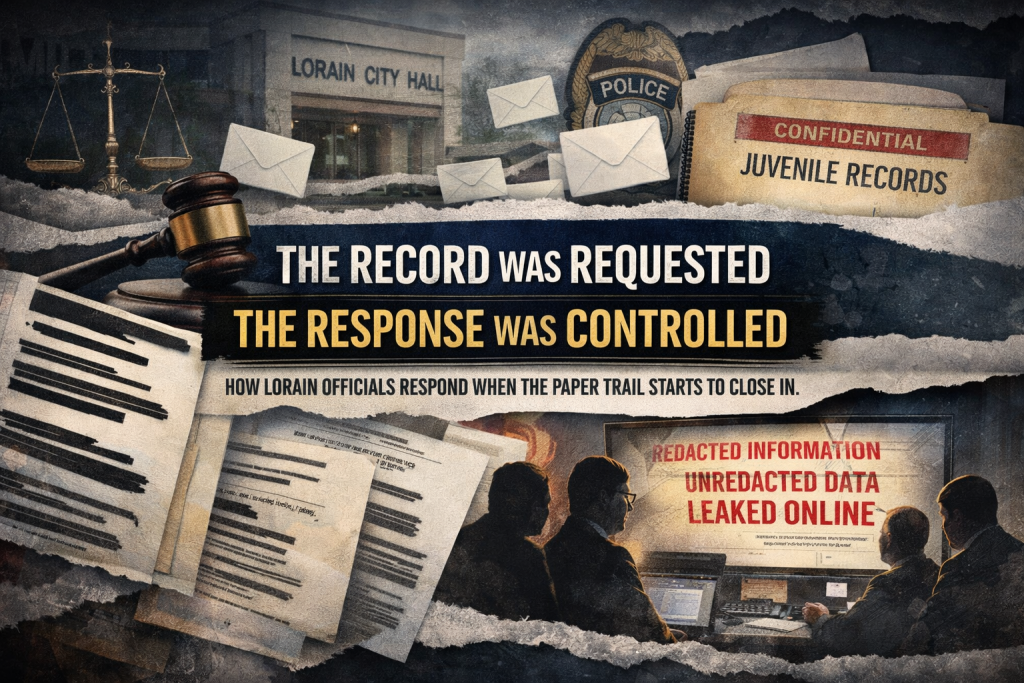
How Lorain Officials Respond When the Paper Trail Starts to Close In
By Aaron Christopher Knapp, BSSW, LSW
Investigative Journalist | Editor-in-Chief, Lorain Politics Unplugged
I. THIS IS NOT A RECORDS STORY ANYMORE THIS IS A RESPONSE STORY
The first time a public records request is denied, there is almost always an explanation that sounds reasonable on its face. The delay is attributed to workload, staffing, or the need to review documents. The refusal is framed as a misunderstanding of what was being requested. Redactions are justified as necessary to protect privacy or comply with other laws. From the outside, the system presents itself as operating within a structured legal framework, governed by Ohio Revised Code § 149.43, where each decision is supposedly anchored in identifiable authority and written justification.
That is how it is supposed to function when it is working properly.
But that structure only holds together as long as the underlying records remain out of view. Once the records begin to surface, once emails are produced, and once internal communications start to contradict the official explanations that were previously given, the framework begins to break down. At that point, the issue is no longer whether the records exist, because the records themselves answer that question. The issue becomes whether the explanations given for withholding those records were ever grounded in law to begin with.
What the documents obtained in this investigation show is that the system does not simply correct itself when those contradictions are exposed. It adapts. It shifts from providing clear answers to controlling how those answers are delivered, and more importantly, whether they are documented at all.
A clear example of this shift appears in communications involving Jeff Graham of Lorain City Schools. In an exchange concerning the public release of student-related information, Graham initially acknowledges the legal concern directly and without ambiguity, stating in writing that if the district had posted the information in question, “it would’ve been a violation of Family Educational Rights and Privacy Act (FERPA).” This statement is not speculative. It reflects a basic understanding of federal law and the obligations imposed on educational institutions that receive federal funding.
FERPA, codified at 20 U.S.C. § 1232g, is a federal statute that governs the privacy of student education records. It applies to public schools, school districts, and most educational institutions that receive federal funding. Under FERPA, schools are prohibited from disclosing personally identifiable information from a student’s education records without consent, unless a specific exception applies. These records include not only academic files but also disciplinary records, reports, and any documentation directly related to a student that is maintained by the institution. Violations of FERPA can result in the loss of federal funding and expose institutions to significant legal and administrative consequences. The law is designed to ensure that sensitive information about minors is not publicly disseminated without proper authorization.
Graham’s initial acknowledgment reflects that understanding. It is a recognition that the release of unredacted student information into the public domain raises serious legal concerns.
But that acknowledgment does not remain consistent.
Within the same chain of communication, the position changes. Graham states that after consulting with legal counsel, “this was not a FERPA violation.” The reversal is immediate and complete. The same conduct that was initially described as a violation is now characterized as lawful.
What is missing from that reversal is the most critical component required under both federal and state law.
There is no statute cited to support the change in position. There is no written legal opinion explaining why the initial assessment was incorrect. There is no documentation identifying which FERPA exception would apply or how the release of the information could be reconciled with the statute’s restrictions. When pressed for that legal authority, the response is not a clarification. It is an admission that the advice was given verbally and that obtaining it in writing would require additional cost.
That moment is where the issue becomes clear.
This is not a disagreement over how the law should be interpreted. This is a refusal to create a record of the legal reasoning being relied upon.
The same pattern appears in communications involving City officials, including Law Director Patrick Riley and Assistant Law Director Joseph LaVeck. A direct request is made for a completed investigation that had already been referenced publicly, with the requester stating plainly, “Please provide me the investigation… I assume you completed it. As it was reported I’d like a copy.” The request is straightforward and falls squarely within the scope of Ohio’s Public Records Act.
Under R.C. 149.43(B)(1), public offices are required to promptly prepare and make available public records upon request. If a request is denied in whole or in part, R.C. 149.43(B)(3) requires the public office to provide a written explanation, including the legal authority for the denial. That explanation is not optional. It is a statutory requirement designed to ensure that decisions to withhold records can be reviewed and challenged.
What the record shows instead is a deviation from that requirement.
The investigation is referenced, but not produced. The legal basis for withholding it is implied, but not stated. The explanation that should exist as a written record never materializes. Instead, the communication shifts toward broader distribution, additional officials are copied, and the discussion expands outward without resolving the core issue at its center.
When these events are viewed together, the issue can be stated clearly and without interpretation.
Records were requested in accordance with Ohio law. Records were acknowledged by officials as existing or having been created. Those records were not produced. When asked to provide the legal authority for withholding them, no written explanation was given.
This is not a matter of delay. It is not a matter of confusion. It is not an issue of caution or careful review.
It is a pattern in which the system responds to scrutiny by avoiding the creation of a written record that would allow its decisions to be examined under the law.
That is where this story begins.
Not with the denial itself, but with what happened after the denial could no longer be sustained.
II. WHEN A REQUEST BECOMES A PROBLEM
The emails obtained and reviewed in this investigation show something that goes far beyond the normal operation of a public records request. Under Ohio law, a request for records is supposed to move through a defined and limited channel. A requester submits a request to a public office. That request is received by a records custodian or designated employee. The office then conducts a search, produces the records, or issues a written denial with a specific legal justification as required by R.C. 149.43(B)(1) and (B)(3). The process is supposed to be contained, documented, and governed by statute.
What appears in these emails is not that process.
Instead, the distribution itself tells the story before any response is even analyzed. The communications are not confined to a clerk’s office or a records department. They are broadcast across multiple levels of government and outside entities. The request and the surrounding issues are sent to City Council as a whole, to the mayor, to Law Director Patrick Riley, to Assistant Law Director Joseph LaVeck, to Safety Service Director Rey Carrion, and to Sheriff Jack Hall. At the same time, members of the media are included in the chain, along with state level officials, including the Ohio Attorney General’s office.
That distribution is not incidental. It is not administrative convenience. It reflects a fundamental shift in how the request is being treated.
In a properly functioning system, a public records request does not need to be elevated to elected officials, law enforcement leadership, and state authorities simply to be processed. The law does not require that level of involvement, and in most cases, it would be considered unnecessary. The fact that it occurs here indicates that the request is no longer being treated as a routine statutory obligation.
It is being treated as something else.
What the record shows is that once the request is elevated to that level, it stops functioning as a request and starts functioning as a problem that must be addressed across multiple actors. The involvement of the Law Department signals that legal exposure is being considered. The inclusion of executive officials indicates that the issue has moved beyond administrative handling into policy or reputational concern. The addition of media recipients introduces a layer of public accountability that changes how every response is crafted. The presence of state level offices suggests awareness that the issue may extend beyond local control.
That is not the normal path of a records request. That is the path of an issue that the system recognizes as carrying risk.
And once that shift occurs, the response changes with it.
Rather than simplifying the process and complying with the statutory requirements, the system begins to manage the situation. Communications expand outward, but clarity does not increase. More people are included in the conversation, but fewer direct answers are provided. The existence of records is acknowledged indirectly, through references and discussions, but the actual production of those records does not follow. Legal concerns are raised, but the legal authority underlying those concerns is not reduced to writing in a way that can be examined.
What replaces compliance is coordination.
The system begins to control not only what is released, but how information about the request itself is communicated. The involvement of multiple officials creates a structure where responsibility is diffused, and where any definitive answer becomes more difficult to attribute to a single decision-maker. This has the practical effect of slowing resolution while maintaining the appearance that the issue is actively being addressed.
From a legal standpoint, that shift is significant. The Public Records Act does not provide for a multi-layered deliberative process before compliance. It imposes a duty to respond promptly and to justify any denial in writing. When the response becomes a coordinated effort across departments rather than a direct fulfillment of that duty, the statutory framework is effectively bypassed without being explicitly violated in a way that is immediately visible.
That is the problem revealed in these communications.
The request did not fail because it was unclear. It did not fail because it could not be processed. It did not fail because the law was ambiguous.
It became something that required management.
And once it was treated that way, the system’s priority shifted from producing records to controlling the conditions under which those records, and the explanations surrounding them, would exist.
III. THE PATTERN OF RESPONSE IS THE STORY
What emerges from the record is not a single inconsistency or an isolated misstatement. What emerges is a repeatable sequence of behavior that appears across different agencies, different officials, and different subject matters. When those communications are read together, rather than in isolation, they reveal a structured pattern in how issues are handled once they carry legal risk or public scrutiny.
The sequence begins with acknowledgment.
In the exchange involving Jeff Graham of Lorain City Schools, the issue centers on the public release of student-related information and whether that release complied with federal privacy law. Graham initially states, in clear and direct terms, that if the district had posted the information in question, “it would’ve been a violation of Family Educational Rights and Privacy Act (FERPA).” That statement reflects a straightforward application of federal law. As previously established, FERPA prohibits the disclosure of personally identifiable information from student education records without consent unless a specific exception applies. The acknowledgment is not ambiguous and does not rely on interpretation. It recognizes the legal risk.
That is the first step in the pattern. It is followed by reversal.
Within the same communication chain, that position changes. Graham states that after consulting with legal counsel, “this was not a FERPA violation.” The shift is not incremental. It is complete. Conduct that was previously identified as a violation is now described as lawful.
What is critical is not simply that the position changes. It is how that change is presented.
There is no citation to 20 U.S.C. § 1232g or any corresponding federal regulation that would justify the reversal. There is no identification of a FERPA exception that would permit the disclosure. There is no written legal opinion explaining why the initial assessment was incorrect. The explanation rests entirely on the statement that counsel was consulted.
When pressed for the legal authority underlying that conclusion, the response does not provide clarification. It does not produce documentation. It does not even attempt to articulate the legal reasoning. Instead, the explanation stops at a general assertion that legal advice was received, with the additional acknowledgment that obtaining that advice in writing would require further action or expense.
At that point, the pattern becomes visible. Acknowledgment is permitted while it is informal. Reversal is permitted because it is attributed to counsel. Justification is withheld because it is not reduced to writing.
The request for the law itself, the specific statute or legal principle that would allow the conduct to be considered lawful, is met with silence.
This sequence matters because it mirrors what has already been documented in public records disputes involving the City and other agencies. Under Ohio law, particularly R.C. 149.43(B)(3), a public office that denies a request for records is required to provide a written explanation for that denial, including the legal authority supporting it. The statute does not allow for a denial based on unwritten reasoning or undocumented advice. The requirement exists precisely so that the public can evaluate whether the decision complies with the law.
What is reflected in these communications is a departure from that requirement.
The justification is present in concept but absent in form. It is referenced, but not produced. It exists only as long as it is not required to be documented, and once documentation becomes necessary, the justification disappears into verbal consultation and generalized statements of compliance.
This is not a failure to respond. It is a method of responding that avoids creating a record that could be tested.
When viewed across agencies, including both educational institutions and municipal offices, the consistency of this pattern becomes difficult to attribute to coincidence. Different actors, operating under different statutory frameworks, arrive at the same functional approach. They acknowledge issues when they are first raised. They reverse or reframe those issues after internal consultation. They decline to provide written legal authority when asked to support that change.
The result is a system where the outward appearance of response is maintained, but the underlying requirement of accountability through documentation is not fulfilled.
That pattern is not incidental to the story. It is the story.
IV. THE DISAPPEARING EXPLANATION
One of the most revealing aspects of the communications is not what is affirmatively stated, but what is consistently avoided at the exact moment the law requires clarity. Across the exchanges reviewed, there is a repeated opportunity for officials to provide a clear legal basis for their positions. Those opportunities arise when a direct question is asked, not about opinion, not about interpretation, but about authority. What law allows this action. What statute governs this decision. What provision justifies the withholding of a record or the release of information that was initially acknowledged as protected.
Those are not complex questions under Ohio law. They are the precise questions that R.C. 149.43(B)(3) anticipates and requires public offices to answer in writing when denying access to records. The statute does not permit ambiguity. It does not allow a public office to rely on generalized assurances of compliance. It requires a written explanation that includes the legal authority supporting the decision so that it can be reviewed, challenged, and, if necessary, adjudicated.
What appears in these communications is a consistent departure from that requirement.
When asked directly to provide the law supporting a position, the response does not take the form required by statute. There is no citation to controlling authority. There is no written legal opinion identifying the applicable statute or explaining how it applies to the facts. There is not even a reference to a specific provision that could be independently verified. Instead, the explanation is reduced to a statement that legal counsel was consulted and that the advice provided was delivered verbally. In some instances, it is acknowledged that reducing that advice to writing would require additional cost or effort, and therefore it is not done.
That is not a legal explanation in the sense contemplated by the Public Records Act. It is not something that can be evaluated for accuracy or completeness. It cannot be tested against statutory language or case law. It exists only as a representation that legal analysis occurred, without producing the analysis itself.
The distinction between those two things is critical.
A written explanation creates a record. It fixes the reasoning in a form that can be examined. It allows a requester, a court, or any reviewing body to determine whether the stated legal basis actually supports the action taken. It also creates accountability for the official or office making the determination, because the reasoning is no longer fluid. It is documented.
A verbal explanation does none of those things.
It cannot be reviewed. It cannot be cited. It cannot be challenged in any meaningful way because it has no fixed form. It allows the position to exist without ever being subjected to scrutiny under the law. That distinction is not incidental. It goes directly to the purpose of R.C. 149.43(B)(3), which is to prevent precisely this type of unreviewable decision-making.
When viewed in that context, the absence of a written explanation is not a gap in the record. It is the result of a deliberate choice.
Once an explanation is reduced to writing, it becomes a public record. Once it is a public record, it is subject to disclosure. Once disclosed, it can be compared against the governing statutes, including Ohio’s Public Records Act and any applicable federal law such as FERPA. If the reasoning is inconsistent with those laws, that inconsistency becomes evident and actionable.
By contrast, if the explanation remains unwritten, none of those steps can occur.
The reasoning can shift without being traced. The justification can change without being documented. The basis for the decision can be asserted without ever being demonstrated. The system continues to communicate, but it does so without creating the one thing that would allow its decisions to be evaluated on their merits.
The result is a form of response that appears complete on the surface but lacks the essential element required by law. There is communication, but there is no documented justification. There is a claim of legal compliance, but no identifiable legal authority supporting it.
In that environment, accountability does not fail because it is denied outright. It fails because it is never created in a form that allows it to exist.
V. A SYSTEM THAT COMMUNICATES WITHOUT RESOLVING
When the full body of emails is reviewed together rather than as isolated exchanges, a broader and more structural issue becomes apparent. The volume of communication is not lacking. In fact, it is constant. Messages are sent at multiple points throughout the day. Responses are issued. Additional officials are copied into threads. Entire departments and outside agencies are brought into the conversation. From a surface-level view, the system appears active, responsive, and engaged with the issues being raised.
But activity is not resolution.
What becomes increasingly clear is that despite the constant communication, the central questions driving those communications remain unanswered. Requests are made for specific materials, including investigations that were publicly referenced or acknowledged. Those requests are not ignored in a traditional sense. They are acknowledged. They are discussed. They are circulated among multiple officials.
Yet the records themselves are not produced.
Instead, what appears in the record is a continuation of discussion about the existence of those materials rather than the delivery of them. References are made to investigations. Statements suggest that matters were reviewed or looked into. The existence of some internal process is implied. But the actual reports, findings, or documents that would confirm those representations are not provided.
The same pattern applies to legal concerns.
Issues involving potential violations of law are raised directly and with specificity. Those concerns are not dismissed outright. In several instances, they are acknowledged as legitimate or at least worthy of consideration. However, that acknowledgment does not result in a written legal analysis that can be reviewed. Instead, the issue is reframed through reference to consultation with counsel, and then left without any documentation identifying the law that governs the situation.
This creates a cycle where each communication generates another response, but no communication resolves the issue that prompted it.
Concerns about unlawful disclosure follow the same path. They are raised with reference to both Ohio law and federal law. They are escalated by including additional officials and agencies. They circulate widely. But at no point is there a definitive response that includes documentation, legal citation, or production of records sufficient to answer the concern in a way that satisfies statutory requirements.
The system remains in motion, but it does not reach a conclusion.
That motion has a functional effect. It maintains the appearance of responsiveness while avoiding the substance required by law. Emails are exchanged. Officials are engaged. The issue appears to be under active review.
But under R.C. 149.43, responsiveness is not measured by how many emails are sent. It is measured by whether records are produced promptly or whether a lawful written explanation is provided when they are withheld.
What is present here is a system that substitutes communication for compliance. It is not silence. It is more effective than silence. It is a continuous flow of responses that never arrive at an answer.
VI. WHEN MULTIPLE OFFICES START ACTING THE SAME WAY
What separates this matter from a single dispute is the consistency of behavior across offices that operate under entirely different legal obligations. The Law Department, City leadership, law enforcement, and the school system are not governed by identical statutes, and they do not serve identical roles. Yet when confronted with the same issue, they respond in functionally the same way.
The Law Department, led by Patrick Riley with involvement from Joseph LaVeck, is placed in a position where legal justification is directly questioned. Under Ohio law, that office is responsible for ensuring that decisions are grounded in identifiable legal authority. Yet within the communications, legal reasoning is referenced but not formally provided. Requests for statutory authority are met without citation or written explanation that can be examined under R.C. 149.43(B)(3).
City leadership is included in communications where concerns are clearly articulated and supported by factual context. Those concerns involve potential unlawful disclosure and failures in process. The inclusion of executive officials expands awareness of the issue, but it does not produce a documented resolution or directive that addresses the problem.
Law enforcement officials are drawn into discussions involving allegations of misconduct and unequal enforcement. These are issues that go directly to the application of criminal and administrative law. Yet the same pattern holds. The issue is acknowledged, circulated, and discussed, but not resolved through documented findings or production of records.
The school system, operating under federal requirements such as FERPA, follows the same trajectory. An initial acknowledgment that conduct would constitute a violation is replaced with a later assertion that it does not, based on consultation with counsel. When asked to provide the legal authority supporting that conclusion, no statute or written opinion is produced.
Different offices. Different roles. Same structure of response. Acknowledgment occurs at the outset. Reframing follows after internal consultation. Written legal justification is not produced. The issue remains unresolved in the record. That level of consistency across independent actors is not incidental.
It reflects an institutional approach to handling issues that carry legal exposure. The system responds in a way that maintains communication, demonstrates engagement, and avoids outright refusal, while also preventing the creation of a written record that would allow the decision-making process to be evaluated.
The effect of that approach is clear. No single office commits to a position that can be challenged. No written legal authority is produced that can be tested against the law. No definitive resolution is documented that would allow for meaningful review. The system continues to function, but it does so without anchoring its actions in a record that can be examined.
VII. WHAT THIS WAS ACTUALLY ABOUT FROM THE START
When the communications are reduced to their substance and separated from the volume of emails surrounding them, the issue at the center of this matter is not complicated. It is direct and grounded in clearly established law.
This entire sequence began with a single question that remains unanswered in any documented form.
Why were juvenile court records and school-related information placed online, unredacted, and publicly accessible?
That question is the foundation of every request that followed. It is the reason the emails were sent. It is the issue that should have been addressed immediately with documentation, legal analysis, and corrective action.
Instead, it was absorbed into a system that responded without resolving it.
The records at issue involved a minor and contained information tied to juvenile court proceedings and school-related documentation. Under Ohio law, particularly within Chapter 2151 of the Revised Code, juvenile records are subject to heightened protections designed to safeguard the identity and privacy of minors. These protections exist because the public exposure of such information can cause long-term harm.
At the same time, federal law under the Family Educational Rights and Privacy Act, 20 U.S.C. § 1232g, imposes independent obligations on educational institutions. FERPA prohibits the disclosure of personally identifiable information from a student’s education records without consent, except under limited exceptions.
Despite these legal protections, the information was placed online without redaction.
The Lorain Police Department, as the agency that disseminated the records, made them publicly accessible in a form that exposed their contents in full. There was no documented limitation, no partial redaction, and no written justification produced that explains how that dissemination complied with the law.
The school system, which had its own obligation to safeguard that information, was aware of the issue. Communications reflect acknowledgment that the type of information involved would ordinarily be protected. Yet that awareness did not result in documented action to prevent or correct the exposure.
There is no record of an immediate report explaining how the release occurred. There is no written legal analysis justifying the decision to allow the records to remain public. There is no documented corrective action demonstrating compliance with either Ohio law or federal privacy requirements.
Instead, the issue was reframed.
The focus shifted from how the records were released to whether the release could be characterized as a violation. Initial acknowledgments that the conduct would violate FERPA were replaced with statements that it did not. Requests for the legal basis supporting that conclusion were met without citation or documentation.
The central issue never changed.
Juvenile court records and school-related information were placed online without redaction.
Those records involved a minor and were subject to legal protections.
The agency that released them did so without producing a documented legal justification.
The institution responsible for protecting that information did not provide a written legal basis for allowing the exposure to stand.
Everything that followed, the emails, the escalations, the involvement of multiple officials, and the absence of written explanations, traces back to that initial failure.
This was never simply a dispute about access to records.
It was a failure to protect information that the law requires to be protected, followed by a system that responded in a way that avoided fully documenting how or why that failure occurred.
VIII. WHAT THIS ACTUALLY SHOWS
When these records are read in isolation, each email can be explained away as a disagreement, a misunderstanding, or a matter still under review. That is how individual communications are often interpreted when they are viewed without context. But when the full set is examined together, across agencies, across timelines, and across subject matter, the explanation changes. What appears is not a series of disconnected disputes. What appears is a consistent method of response.
That method is not defined by what is openly stated, but by what is repeatedly done at critical moments.
There is an initial willingness to acknowledge a problem when it is first raised. That acknowledgment often reflects a correct understanding of the law, whether it involves the Public Records Act, juvenile protections under Ohio law, or federal privacy obligations under FERPA. At that stage, the issue is recognized in clear terms, and the risk is identified without qualification.
That acknowledgment does not remain stable.
As the issue progresses and the potential for legal exposure increases, the position begins to shift. The same conduct that was initially recognized as problematic is reframed. The language changes. The certainty of the initial acknowledgment is replaced with a more ambiguous conclusion, often attributed to consultation with counsel. The issue is no longer described as a violation, but as something that falls within compliance, even when no specific legal authority is identified to support that conclusion.
What follows is the most significant step in the pattern.
When the request is made to provide the law, the actual statute, the written legal analysis, or the documented reasoning that would justify the position taken, that is the point at which the process stops producing records. The explanation is not reduced to writing. The legal authority is not cited. The reasoning is not documented in a form that can be reviewed.
That is not a gap in communication. It is a point of transition.
Up to that moment, the system communicates freely. Emails are exchanged. Officials are included. Issues are discussed in detail. After that moment, the communication continues, but the substance required for accountability is no longer created.
This is where the method becomes visible.
Acknowledgment exists, but only at the outset.
Justification exists, but only in a fluid and shifting form.
Written accountability is avoided at the exact moment it becomes legally required under statutes such as R.C. 149.43(B)(3).
The significance of that pattern is not limited to a single request or a single set of records. It reflects how the system operates once it recognizes that the existence of records can no longer be denied. At that stage, the issue is no longer whether records exist. The issue becomes how to respond without creating additional records that could be used to challenge the response itself.
This is why the focus of the story cannot remain on a single denial or a single document.
The records demonstrate something broader.
They demonstrate how a system behaves when it is confronted with its own paper trail. They show how communication can continue while documentation is withheld. They show how engagement can be maintained while legal accountability is avoided.
What is revealed is not simply disagreement.
It is a structured way of responding that preserves flexibility for the system while limiting the ability of the public to test those responses against the law.
That is what these records actually show.
IX. FINAL THOUGHT THE RESPONSE IS THE RECORD
There is a phrase that public officials rely on when their actions are questioned, when their decisions are examined, and when the public begins to press for answers grounded in law and documentation.
“The record speaks for itself.”
In this case, it does.
But it does not speak in the way it was intended to.
It does not speak through a clear timeline of compliance. It does not reflect a system that followed the law, documented its reasoning, and produced records in accordance with its statutory obligations. Instead, it speaks through something far more revealing, a pattern of behavior that becomes undeniable when the full set of communications is placed side by side and examined as a whole.
It speaks through acknowledgments that were made plainly and then quietly withdrawn when the implications became clear. It speaks through legal justifications that were referenced but never reduced to writing, never cited to a statute, and never preserved in a form that could be tested against the law. It speaks through communication chains that expanded outward to include more officials, more agencies, and more oversight, while the central issue remained unanswered and undocumented.
And it speaks through what it took to force that record into the light.
This did not come without cost. The effort to bring these records forward, to challenge the inconsistencies, and to demand that the law be followed was not theoretical. It carried consequences that reached beyond emails and legal arguments. It affected employment. It affected professional standing. It affected the ability to continue in a career that was built on advocacy, accountability, and public service.
That cost is part of the record too.
Because what these emails ultimately show is not simply how a system responds to a request. They show how a system responds when someone refuses to accept an answer that is not supported by the law, when someone continues to press for documentation, and when someone insists that legal obligations be met in writing, not just referenced in conversation.
The response that emerges is not silence.
It is something more controlled.
It is a response that continues to move, continues to acknowledge, continues to engage, but avoids committing itself to a position that can be clearly defined, documented, and challenged. It is a response that adapts as scrutiny increases, shifting from acknowledgment to reframing to avoidance of written accountability at the precise moment that accountability becomes required.
That is the record.
And when it is read in full, stripped of explanation and reduced to what it actually reflects, the conclusion is not complicated.
The problem was never the request itself. The law governing that request is clear. The obligations imposed on public offices are defined. The protections for juvenile records and student information are established under both state and federal law.
The problem was what happened after the request could no longer be dismissed.
The problem was what happened when the records began to confirm what had already been questioned.
And the problem was how the system chose to respond once it understood that the record was no longer something it could control.
Legal Disclaimer
This article is based on documents obtained through public records requests, email correspondence, and related materials believed to be authentic and accurate at the time of publication. Any conclusions drawn are based on the documented record and are presented for journalistic and public interest purposes. All individuals are presumed innocent of any wrongdoing unless and until proven otherwise in a court of law. This reporting constitutes protected opinion and analysis under the First Amendment.
© 2026 Knapp Unplugged Media LLC | Lorain Politics Unplugged
About The Author