

The Law Department That Could Not Verify Its Own Work
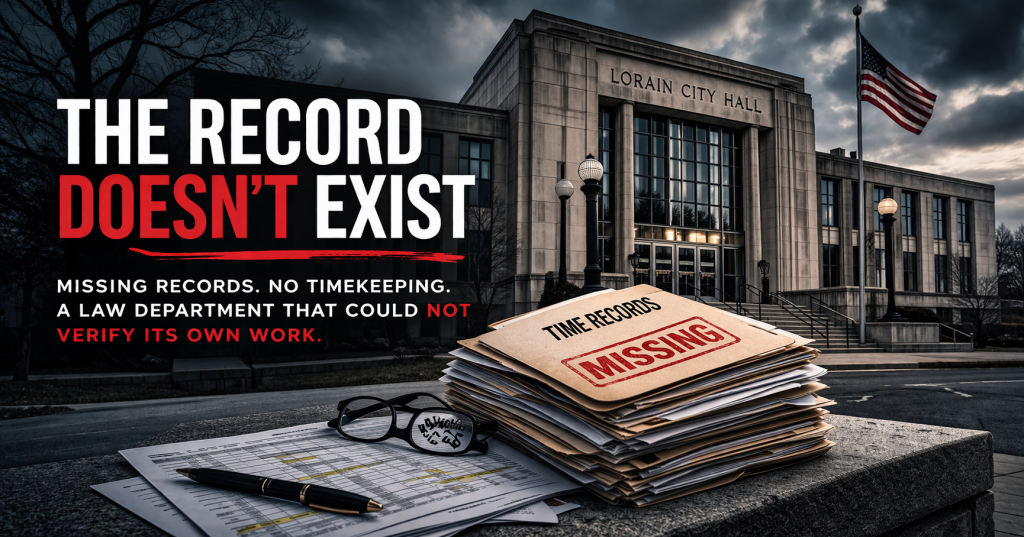
An audit reveals missing records, no timekeeping requirements, and a system that could not prove how public funds were justified
By Aaron Christopher Knapp
Investigative Journalist and Public Records Litigator
Knapp Unplugged Media LLC (2026)
I. INTRODUCTION — THE LAW DEPARTMENT THAT COULD NOT ACCOUNT FOR ITS OWN TIME
There are moments in government where a failure can be traced to a single act, a single employee, or a single decision that went wrong. Those cases are often easy to explain because they have a beginning, a breakdown, and a clear point of responsibility. What emerges from the records tied to the City of Lorain Law Department is not that kind of case. It is something that developed over time, within a structured office, under stable and continuous leadership, and within a system that was expected to produce accountability as a matter of routine.
The question presented by those records is not whether a mistake occurred. The question is how a department responsible for advising the City, prosecuting cases, interpreting law, and defending government action could operate within a framework where the documentation of its own work was inconsistent, incomplete, and at times unavailable. That question is grounded not in speculation but in the City’s own records, findings from the Ohio Auditor of State’s Special Investigations Unit, and internal communications generated as concerns were raised, reviewed, and ultimately left without a clear resolution. Those records do not describe a momentary breakdown. They describe conditions that existed within an established system.
The Law Department is not a peripheral office within City government. It functions as the legal authority through which policies are reviewed, contracts are prepared, litigation is managed, and legal risks are assessed. Under the leadership of Law Director Patrick Riley, who has held the position since 2010, that authority has existed continuously across multiple administrations and through a range of legal and political disputes. Over that period, the structure of the department, the classification of its attorneys, and the systems used to process and certify payroll were not temporary or transitional. They were established, maintained, and operated within that continuity of leadership and within a framework shaped and overseen by that office.
Against that backdrop, the records reveal a system where payroll could not consistently be reconciled with timekeeping documentation, where time sheets were missing or reported as destroyed, and where no clear policy required the documentation necessary to verify hours worked. At the same time, compensation continued to be issued, certified, and paid using public funds, even when the underlying records did not provide a complete or consistent account of the work performed. These conditions did not arise outside of the system. They existed within it, and within the period in which that system operated under continuous legal oversight.
This is not a story about a single time sheet or a single discrepancy. It is a story about a system that, when examined through its own records, could not fully demonstrate how work was documented, how time was verified, or how compensation was justified. When that system exists inside the office responsible for interpreting and enforcing the law, and when it operates over time under continuous leadership, the issue moves beyond administration and into the question of how accountability is defined, applied, and ultimately proven within government itself.
II. THE DISCOVERY — PAYROLL THAT DID NOT MATCH THE RECORDS
The issue did not begin with a complaint about individual conduct or a targeted allegation against a specific employee. It arose during the course of an audit, when financial reviewers attempted to perform a routine reconciliation of payroll against the records that were expected to document the work performed by employees within the City of Lorain Law Department. That process, which should have been straightforward if the system was functioning as designed, instead revealed a series of inconsistencies that could not be resolved through the available documentation. Those inconsistencies were not discovered in isolation or within a period of transition. They were identified within a department operating under an established structure and under continuous leadership.
According to the official case closing memorandum issued through the Ohio Auditor of State’s Special Investigations Unit, auditors were unable to obtain complete timekeeping records for Law Department employees during the period under review. The time sheets that were produced did not provide a consistent or reliable basis for comparison with payroll entries. Instead, the records reflected a pattern of discrepancies that moved in multiple directions at once and could not be reconciled through ordinary administrative explanation. The inability to produce complete records was not limited to a single employee or a single reporting period. It reflected a condition within the system as it operated during that time.
The memorandum documents that in at least one instance, a full-time employee was paid for a forty-hour work week while the corresponding time sheet reflected fewer than forty hours. At the same time, the records showed that employees identified as part-time were recorded as working in excess of forty hours within a single week. These findings were not presented in isolation, but within the broader context of missing time sheets, incomplete documentation, and a system that did not consistently capture or preserve the information necessary to verify hours worked. These conditions existed within a department whose structure, classification practices, and internal procedures were maintained over time within the same framework of leadership.
The significance of those findings lies not simply in the numerical differences, but in the nature of the contradiction itself. The discrepancies did not reflect a single type of error that could be traced to overpayment, underreporting, or a uniform misapplication of policy. Instead, they demonstrated that the payroll system and the timekeeping records were not aligned in a consistent or predictable way. In one direction, compensation exceeded the documented hours. In the other, documented hours exceeded the classification of the employee. Taken together, those conditions indicate that the issue was not limited to individual entries, but was rooted in the structure of how time was recorded, maintained, and ultimately translated into payroll within the system as it operated.
The conditions identified by the audit must also be understood within the context of how the Law Department functioned during the period under review. The inability to produce complete timekeeping records, the presence of conflicting classifications, and the discrepancies between payroll and documentation did not arise outside of the system. They arose within it. The department operated under continuous leadership, with policies, practices, and internal controls established and maintained over time. When auditors encounter inconsistencies of this nature, the inquiry does not end with individual discrepancies. It extends to whether the system itself required accurate documentation and preserved the records necessary for verification.
In any public payroll system, timekeeping records are not merely administrative tools. They function as the underlying verification mechanism that connects work performed to compensation issued. When those records are incomplete, inconsistent, or unavailable, the system loses the ability to demonstrate that public funds are being disbursed in accordance with documented work. In this case, the audit findings establish that payroll could not be consistently tied to the records that were supposed to support it, and that the documentation necessary to perform that verification was either insufficient or missing at the point it was required. Those findings do not describe a temporary breakdown. They describe a system operating without a consistently enforced mechanism for verification.
III. THE MISSING PIECES — TIME SHEETS THAT WERE “DESTROYED”
As auditors attempted to resolve the discrepancies identified during the review of Law Department payroll, they encountered an additional problem that did not clarify the record, but instead further limited the ability to reconstruct it. The difficulty was not simply that records were incomplete. It was that records identified as necessary for verification were no longer available within a system that otherwise retained sufficient information to process and certify payroll.
According to the City’s own explanation, time sheets had been destroyed in error in December 2022. That representation carries weight on its face because time sheets are not incidental documents within a public payroll system. They are the primary source records used to verify hours worked, to support payroll entries, and to allow independent review of how public funds are disbursed. When those records are no longer available, the ability to reconcile payroll with actual work performed becomes significantly restricted, and in some cases cannot be completed with certainty.
The absence of those records must also be understood within the context of how the system was structured and maintained. The Law Department operated under continuous leadership, with responsibility for legal compliance, policy interpretation, and administrative framework residing within that same office. The preservation of records necessary to verify payroll is not an external function. It is a basic component of internal control. When records central to that control are reported as destroyed, the question is not limited to the event of destruction itself, but extends to the systems and safeguards that were expected to preserve those records over time.
The issue, however, is not limited to the absence of records. It is also shaped by the nature of what remained.
The time sheets that were produced during the audit did not reflect the total number of hours worked by employees. Instead, they documented only time spent in the office and did not account for the full scope of work performed, including work completed outside of the office setting. As a result, even where documentation existed, it was not designed to provide a complete record of employee activity over a given work week. That limitation was not incidental. It reflects how the system captured, or failed to capture, the work it was intended to document.
This distinction is critical because the audit was not attempting to determine whether employees were present in the office for a defined number of hours. It was attempting to determine whether the compensation issued by the City corresponded to the work performed. Records that capture only a portion of that activity do not resolve that question. They leave it incomplete, even when those records are available.
The explanation that time sheets were destroyed must also be considered in the context of what records were available and produced in other areas of the investigation. The audit was able to identify payroll entries, compensation levels, and other supporting documentation sufficient to establish discrepancies. At the same time, the underlying timekeeping records necessary to verify those discrepancies were identified as missing. That contrast does not explain the discrepancy. It highlights it.
If the system retained sufficient records to process, certify, and audit payroll, what controls existed to preserve the corresponding timekeeping documentation, and how was it that the records necessary to verify hours worked were the records that could not be produced within that same system?
The result is not simply a gap in documentation. It is a limitation on verification created by the condition of the records themselves. The records that were available did not fully capture the work performed, and the records that may have provided that clarity were no longer available for review. Under those conditions, the audit could identify inconsistencies, but it could not fully reconstruct the underlying activity those inconsistencies were meant to explain. That limitation does not arise outside of the system. It arises from how the system was structured, maintained, and operated over time.
IV. THE ADMISSION — THERE WAS NO REQUIREMENT TO TRACK TIME
If the absence of records limited the audit, the next finding defines why those records were not consistently available in the first place. During the course of the review, the Auditor’s Office sought to identify the policy or ordinance that required employees within the Law Department to complete time sheets or otherwise document hours worked. The response was not ambiguous and did not depend on interpretation. There was no policy that explicitly required time sheets for employees.
That response is not a technical omission. It is a structural condition. In a public payroll system, the requirement to document time is the mechanism that connects work performed to compensation issued. It is the control that allows payroll to be verified, reviewed, and reconciled. When that requirement does not exist, the system is not designed to produce verifiable records of work. It is designed to function without them, and without a consistent mechanism to demonstrate how compensation corresponds to documented activity.
That conclusion must be considered in the context of how the Law Department is organized and governed. The Law Director, a position held by Patrick Riley since 2010, serves as the chief legal officer for the City and is responsible for advising officials, preparing ordinances, interpreting policy, and overseeing the legal framework through which departments operate. Over the course of more than a decade in that role, the Law Director’s office has not only applied the law but has participated in shaping the structure through which City operations are defined, including the policies, ordinances, and administrative practices that govern internal functions such as payroll and recordkeeping.
The absence of a requirement to document time within the Law Department therefore does not exist outside of that structure. It exists within it. Whether through formal ordinance, administrative policy, or accepted departmental practice, the conditions under which employees were not required to complete time sheets developed and persisted during a period of continuous leadership and within an office responsible for defining, reviewing, and advising on the very rules that govern City operations.
That absence of a formal timekeeping requirement must also be considered alongside statements made regarding the structure of the system itself. In describing the framework under which Law Department employees operated, Law Director Patrick Riley acknowledged that a system in which attorneys were compensated without consistent time tracking could be “ripe for abuse.” That observation is not presented as a finding of misconduct in any individual case. It is an acknowledgment of the structural risk inherent in a system that does not require documentation of work performed.
When that recognition is placed alongside the absence of a policy requiring timekeeping, the issue is no longer limited to whether a control was missing. It becomes a question of how a system identified as vulnerable to abuse continued to operate without the implementation of a mechanism designed to mitigate that risk. A system that is described as capable of being abused, but that does not require documentation capable of verifying work, is a system in which the safeguards necessary to prevent or detect that abuse are not built into its structure.
The Law Director’s role is not limited to identifying risk. It includes advising on compliance, evaluating structural deficiencies, and participating in the development of policies and practices that govern City operations. Where a condition is identified as “ripe for abuse,” the expectation within that role is not merely acknowledgment, but the consideration of whether safeguards exist, and if not, whether they should be established within the system.
The record reflects that no such requirement existed. The audit further reflects that the absence of that requirement limited the ability to verify work performed and contributed to discrepancies that could not be fully resolved through available documentation. When those elements are considered together, the issue is not whether risk existed. The issue is how that risk was addressed within a system operating under continuous legal oversight.
The practical effect of that structure is not theoretical. A payroll system that does not require timekeeping is a system that does not require proof of work. In that environment, hours can be assumed, entered, or certified without a consistent underlying record capable of independent verification. The audit findings regarding missing records, inconsistent documentation, and discrepancies between payroll and time sheets do not stand apart from that condition. They arise from it and are explained by it.
The admission that no policy required time sheets does not resolve the discrepancies identified in the audit. It explains how a system could produce those discrepancies without a mechanism in place to prevent them, to detect them in real time, or to fully reconstruct them after the fact within the record itself.
V. A DEPARTMENT BUILT ON VARIABLE WORK — WITHOUT VARIABLE RECORDS
The City’s own description of the Law Department adds a layer that does not resolve the issue, but instead sharpens it. In the Law Director’s report, the structure of the department is explained in terms that are familiar within the legal profession. Attorneys are described as salaried employees who are expected to devote as much time as necessary to complete their responsibilities. Their workload is not defined by fixed hours, but by the demands of litigation, advisory work, contract review, and the ongoing legal needs of the City. That work, by its nature, expands and contracts, sometimes requiring extended effort and at other times allowing for flexibility. This description is not incidental. It reflects how the department was defined and how work within that department was expected to be performed under the framework established and overseen by the Law Director’s office.
That model, standing alone, is not unusual. Legal practice, particularly within government, often operates on a demand-driven basis where the measure of work is not strictly tied to a fixed hourly schedule. What distinguishes this situation is not the existence of variable work, but the absence of a system capable of documenting that variability in a way that allows it to be reviewed, verified, or reconciled within the record.
If attorneys are expected to work as many hours as necessary to fulfill their obligations, then the system used to document that work must be capable of reflecting that range. It must be able to show when work exceeds a standard schedule, when it falls below it, and how those variations relate to the compensation issued. Without that capacity, the description of the work becomes disconnected from the records used to support it. The expectation of variable work, when not paired with variable documentation, does not create flexibility. It creates a system in which the scope of work cannot be independently measured or verified.
This relationship must be considered alongside the acknowledgment that such a system, without consistent time tracking, could be “ripe for abuse.” A system in which workload is undefined by fixed hours, where employees are expected to work as much as necessary, and where no mechanism exists to document that work in a complete and consistent manner, is a system in which the boundaries of work are not clearly recorded within the record itself. Under those conditions, the absence of documentation does not simply limit verification. It defines the limits of what can be proven.
The audit findings demonstrate that this disconnect was not theoretical. Payroll was issued in a consistent and predictable manner, while the documentation that would be expected to reflect the variability of the work was incomplete, inconsistent, or in some cases unavailable. Time sheets, where they existed, did not capture the full scope of work performed. In other instances, those records could not be produced at all. At the same time, compensation continued to be processed and certified without a corresponding system capable of demonstrating how the underlying work aligned with that compensation. These conditions existed within a department operating under a model defined by variable work, but without a system capable of consistently documenting that variability.
This creates a structural inconsistency that cannot be resolved through classification alone. The department is defined as one in which work is variable, demand-driven, and not confined to fixed hours. The records, however, do not reflect that variability in a consistent or verifiable way. Instead, they reflect a system in which payroll remains stable while the documentation used to support it does not provide a complete or reliable account of the work performed. The description of the work and the documentation of the work do not operate together. They operate independently of each other within the system as it was structured.
When a department operates on a model of flexible, demand-based work, the absence of corresponding records does not simplify the system. It removes the mechanism by which that work can be independently confirmed. Under those conditions, the ability to verify how public funds are tied to that work is not limited by isolated gaps in documentation. It is limited by the structure of the system itself, as defined and maintained over time.
VI. THE CLASSIFICATION SHIFT — HOURLY OR SALARIED
The audit uncovered an additional inconsistency that does not resolve the earlier findings, but instead reframes how those findings must be understood within the structure of the system. At the time the discrepancies were identified, Law Department employees were operating under a payroll ordinance that categorized them as hourly employees. At the same time, the appointment letters issued to those same employees described their positions as salaried. Those two classifications are not interchangeable in either structure or consequence. They determine how compensation is calculated, whether hours must be documented, and how overtime eligibility is defined and applied. This inconsistency did not arise in isolation. It existed within a department operating under an established framework of legal oversight and administrative control.
An hourly classification presumes that time is tracked, recorded, and used as the basis for compensation. A salaried classification, while not eliminating the need for accountability, changes the relationship between time and pay by shifting the focus away from discrete hourly documentation. When both classifications exist simultaneously for the same positions, the system governing compensation becomes internally inconsistent. It is no longer clear which standard controls how work is measured or how pay is justified, and the connection between work performed and compensation issued becomes dependent on interpretation rather than uniform application of policy.
That inconsistency was not left unresolved. In September 2023, while the investigation into payroll discrepancies was still ongoing, the City passed an ordinance clarifying that assistant law directors and prosecutors were salaried and overtime exempt. The effect of that ordinance was to align the formal classification of those positions with the language already present in appointment letters. That action brought prospective consistency to classification, but it did so within the same system and under the same leadership structure in which the earlier inconsistencies had been identified.
The timing of that change is part of the record and cannot be separated from the context in which it occurred. It followed the identification of discrepancies, the inability to produce complete timekeeping records, and the recognition that the system lacked a consistent mechanism for documenting hours worked. It occurred while those issues remained under review. The ordinance did not address the missing or incomplete records that existed during the period examined by the audit. It did not reconstruct timekeeping documentation that could not be produced, nor did it provide a method for reconciling discrepancies already identified. Instead, it established a forward-looking framework under which compensation would no longer depend on the same type of hourly tracking that had been at issue.
That sequence must be understood within the structure of authority governing the Law Department. The Law Director’s office is responsible for advising on ordinances, interpreting their application, and participating in the legal framework through which such changes are developed and implemented. The clarification of classification therefore did not occur outside of that system. It occurred within it, and within the same period of continuous leadership under which the earlier structure had operated.
This distinction matters because it separates two different questions that cannot be answered by the same action. One concerns how compensation should be structured going forward under a clarified classification. The other concerns whether the compensation issued during the period under review can be verified through the records that existed at that time. The ordinance addresses the first question by redefining the framework prospectively. It does not resolve the second, because it does not supply the missing documentation or reconcile the inconsistencies identified in the audit.
The result is a shift in classification that brings formal alignment to the system moving forward, while leaving the underlying discrepancies identified by the audit anchored to a period in which the governing structure, the documentation practices, and the payroll system were not consistently aligned. That outcome does not erase the inconsistencies. It defines the point at which the framework changed, and the conditions under which those inconsistencies must still be understood within the record.
VII. WHY THE CASE CLOSED — AND WHAT THAT ACTUALLY MEANS
Despite the inconsistencies identified during the audit, the absence of complete timekeeping records, and the conflicting classification framework that governed the Law Department during the period under review, the investigation did not result in criminal charges. That outcome, standing alone, can be misunderstood if it is not examined in the context of the reasoning that produced it and the structure within which the system operated.
The determination made by investigators was not that the payroll system operated without issue. It was that the available evidence was insufficient to meet the standard required for criminal prosecution. That distinction is not semantic. It reflects the difference between identifying discrepancies and proving, beyond the applicable legal threshold, that those discrepancies resulted from conduct that satisfies the elements of a criminal offense. The audit established inconsistencies. The record did not consistently establish proof.
According to the findings, the absence of complete time sheets, the inconsistency between payroll entries and the documentation that was available, and the structure of salaried employment within the Law Department combined to limit the ability of investigators to reconstruct events with the level of certainty required for prosecution. Where records were missing, incomplete, or not designed to capture total hours worked, the evidentiary chain necessary to establish intent, knowledge, or unauthorized compensation could not be fully developed. That limitation was not the result of a single missing document. It was the result of how the system recorded, preserved, and structured its information over time.
In that context, the classification of employees as salaried becomes relevant, not as a resolution of the discrepancies, but as a factor affecting how those discrepancies could be evaluated. When compensation is not strictly tied to documented hourly entries, the absence of timekeeping records does not automatically establish that compensation was improperly issued. It instead narrows the ability to demonstrate that it was. The classification framework, as it existed during the period under review, therefore did not resolve the discrepancies. It shaped the limits of what could be proven about them.
This is the point at which the outcome of the investigation must be understood carefully. The decision not to pursue criminal charges does not constitute a finding that the system operated correctly or that the discrepancies identified were resolved. It reflects a determination that the system, as it existed, did not preserve the documentation necessary to prove, to the required legal standard, how compensation corresponded to work performed. That system did not operate outside of oversight. It operated within a department under continuous leadership, within a structure that defined how records were maintained, how time was documented, and how compensation was processed.
The conclusion reached by investigators therefore speaks not only to the limits of the evidence, but to the structure of the system that produced it. When a system lacks consistent documentation, when records are missing or incomplete, and when the framework governing compensation does not require detailed tracking of hours worked, the ability to establish accountability through criminal enforcement is constrained by the very design of that system. The absence of charges does not remove the discrepancies. It reflects the limits imposed by the system in which those discrepancies occurred.
In that sense, the closing of the case does not end the inquiry. It defines its boundary. It identifies a point at which discrepancies were recognized, but where the records necessary to fully explain or prove those discrepancies were not available in a form that could support prosecution. That boundary is not determined by what occurred. It is determined by what the system, as it operated, was capable of proving through its own records.
VIII. THE ETHICAL STANDARD — WHAT LAWYERS ARE REQUIRED TO DO
The attorneys within the Law Department are not simply employees performing administrative functions within City government. They are licensed professionals governed by the Ohio Rules of Professional Conduct, which establish the standards that define how legal work is performed, how responsibilities are managed, and how the integrity of the legal system itself is maintained. These rules are not advisory. They are binding and enforceable, and they apply equally to attorneys in private practice and those serving in government roles.
The Rules themselves begin with a foundational principle that defines the role of an attorney in clear terms. As stated in the Preamble, “a lawyer not only represents clients but has a special responsibility for the quality of justice.” That responsibility extends beyond individual cases or isolated tasks. It encompasses the manner in which legal work is performed, the systems through which that work is carried out, and the public trust that is placed in the profession as a whole.
The Rules further establish that in all professional functions, “a lawyer should be competent, prompt, diligent, and loyal.” These are not abstract expectations. They are tied directly to how attorneys manage their workload, how they allocate their time, and how they carry out the responsibilities assigned to them. Competence requires “the legal knowledge, skill, thoroughness, and preparation reasonably necessary for the representation.” Diligence requires that a lawyer “act with reasonable diligence and promptness” and that the lawyer “must control the lawyer’s workload so that each matter can be handled competently.”
The commentary to those rules makes clear why these obligations matter. It states that delay and neglect are inconsistent with a lawyer’s duty and “undermine public confidence” in the legal system. The requirement is not merely that work be completed, but that it be managed, tracked, and performed in a manner that reflects professional responsibility and accountability.
In the context of a municipal law department, those obligations take on an additional dimension. The client is not a private individual. It is the City itself, and by extension the public. The work performed is funded through public resources, and the decisions made by those attorneys affect not only legal outcomes, but the administration of government and the rights of residents. That responsibility includes not only how cases are handled, but how records are maintained, how information is disclosed, and how the system itself responds when questions are raised.
The Law Director’s office, under Patrick Riley, does not operate solely as a passive recipient of legal issues. It functions as the central authority through which those issues are evaluated, defended, and, when necessary, contested. That role includes representing City officials in litigation, responding to claims of misconduct, and advising on the legal positions the City takes in response to public records requests and other forms of scrutiny. Assistant law directors, including those operating under that office, carry out those same functions as part of that structure.
The operation of that system can be seen not only in the audit findings, but in how the office has responded to related issues. In matters involving communications and records, including emails sent by City officials, responses from the Law Department have included withholding, redaction, and assertions of exemption that have been contested and, in some instances, contradicted by the existence of the records themselves. Those responses do not stand apart from the structure identified in the audit. They reflect how the same system manages information, controls access to records, and defines the scope of what is disclosed.
The Rules of Professional Conduct do not mandate a specific method of timekeeping, and they do not require that attorneys maintain time sheets in a particular format. They do, however, require that attorneys manage their workload, perform their duties with competence and diligence, and carry out their responsibilities in a way that reflects the seriousness of their role as officers of the court. They also require candor, responsibility in the handling of information, and adherence to processes that maintain the integrity of the legal system.
When those standards are placed alongside the structure identified in the audit, a question emerges that is not disciplinary in nature, but structural. If a system does not consistently document the work performed, if it does not maintain records capable of reflecting how workload is managed or how responsibilities are fulfilled, and if the same system controls the production, withholding, or defense of those records when challenged, then the system itself provides limited ability to demonstrate that those professional obligations are being met through the record.
The issue is not whether every individual attorney fulfilled their duties in a particular instance. The issue is whether the system in which those attorneys operated produced the type of documentation, transparency, and accountability that the profession itself expects. Where that system does not consistently produce those records, and where it controls how those records are interpreted and disclosed, the connection between professional obligation and demonstrable performance becomes difficult to establish through the record itself.
IX. THE GAP — BETWEEN WHAT IS REQUIRED AND WHAT CAN BE PROVEN
When the record is examined in full, not in isolation but as a system, a clear gap emerges between the obligations that govern the work of the Law Department and the documentation available to demonstrate that work. The structure described by the City reflects a department in which attorneys perform variable, demand-driven work, responding to litigation, advising officials, preparing contracts, and carrying out ongoing legal responsibilities that do not conform to a fixed hourly schedule. That structure was not temporary or informal. It operated over time within a defined framework and under continuous leadership. At the same time, the audit establishes that the City could not consistently produce records capable of reflecting how that work was performed across the period under review.
The result is not a single inconsistency. It is a structural disconnect that exists within the system as it was designed and maintained.
Payroll was issued, certified, and paid through a system that functioned with regularity. Compensation moved through the process as expected. However, the documentation that would ordinarily connect that compensation to work performed did not operate with the same consistency. Time sheets were missing or reported as destroyed. The records that were available captured only a portion of work performed and did not reflect the full scope of activity required of the position. In other instances, the available documentation could not be reconciled with payroll entries in a way that provided a clear and complete account of hours worked. These conditions were not external to the system. They existed within it, and within the period in which that system operated under the same structure of oversight.
When those elements are considered together, the issue is not limited to recordkeeping practices. It is a gap between what is required and what can be demonstrated through the record. The professional obligations governing attorneys require competence, diligence, and the management of workload in a manner that ensures responsibilities are fulfilled. The payroll system reflects that compensation was provided for that work. The documentation, however, does not consistently provide a complete or verifiable account of how that work was carried out. The system, as it operated, does not consistently connect those elements through documentation capable of independent verification.
This creates a layered disconnect that operates across multiple points within the system. There is the work performed, which may vary based on the demands of the position. There is the work recorded, which reflects only part of that activity or, in some cases, is unavailable. There is the work paid, which proceeds through a structured payroll system. And there is the work that can be proven through documentation, which is limited by the absence, inconsistency, or incompleteness of the records produced by that system. Each of those elements exists, but they do not consistently align within the record itself.
The significance of that gap is not theoretical. In a public system, the ability to demonstrate how work performed corresponds to compensation issued is the mechanism through which accountability is established. When that connection cannot be consistently shown through the record itself, the system does not operate on verification. It operates on assumption. That condition is not created by a single failure. It reflects how the system functioned over time, within the structure that defined it and the oversight under which it operated.
X. THE SYSTEM AROUND THE SYSTEM
The findings identified in the audit do not exist in isolation, and they do not arise from a single point of failure within the Law Department. When placed within the broader structure of how the department operates, how concerns were handled, and how authority is exercised, the record reflects a system in which the mechanisms of oversight, interpretation, and response are closely aligned within the same chain of control.
The Law Director, a position held continuously since 2010, serves not only as the head of the department, but as the legal authority responsible for advising City officials, interpreting ordinances, and shaping the framework through which departments operate. That role places the Law Director’s office at the center of both the system being examined and the processes through which that system is evaluated. The absence of a requirement to document time, the structure of compensation, and the policies governing internal operations all developed within that framework of continuous leadership.
The manner in which concerns were addressed reflects a similar alignment. When issues related to payroll and timekeeping were raised, those concerns were directed back through the same office responsible for the structure of the department. That process does not resolve the underlying issue of whether discrepancies existed. It defines how those discrepancies were reviewed, and within what framework that review occurred. When oversight and operational authority are situated within the same structure, the ability to evaluate a system independently is not eliminated, but it is shaped by the design of that system and the control points through which review must pass.
The timing of structural changes further defines the context in which the audit findings must be understood. After discrepancies had been identified and while the review remained ongoing, the City formalized the classification of assistant law directors and prosecutors as salaried and overtime exempt. That action aligned formal classification with existing practice going forward. It did not reconstruct the records that were unavailable during the period under review, nor did it resolve the inconsistencies already identified. It established a framework under which the relationship between time worked and compensation would be evaluated differently moving forward, within the same system and under the same leadership structure.
The Law Department’s role also extends beyond internal structure into decisions that carry direct financial implications for the City. The office is responsible for interpreting legal authority, advising on liability, and participating in decisions regarding the use of public funds for legal defense. In that capacity, the same structure that defines internal operations also participates in determining how those operations are defended when challenged. This does not, in itself, establish wrongdoing. It establishes that the same system that is examined is also the system that interprets, responds to, and defends its own operation.
These conditions are further reflected in matters that extend beyond the internal audit process. In ongoing litigation involving the City, courts have required additional legal justification for actions taken under that same framework of authority, including directives that affect access to public property and the exercise of constitutional rights. Those proceedings do not resolve the issues identified in the audit. They demonstrate that the legal basis for actions taken within the system is subject to external review when presented before a tribunal.
When considered together, these elements describe a system in which structure, oversight, and response are not separated into independent functions, but instead operate within a unified framework. The audit identifies discrepancies in records and documentation. The structure defines how those discrepancies are addressed. The legal authority of the department shapes how those issues are interpreted and defended. The result is not a single point of failure, but a system in which the ability to evaluate, verify, and respond to issues is influenced by the same structure in which those issues arise.
XI. FINAL THOUGHT — A SYSTEM THAT COULD NOT VERIFY ITSELF
This story is not about whether every individual employee worked every hour for which they were compensated, and the record developed through the audit makes clear that this question cannot be answered with certainty. That limitation is not a secondary issue or an unfortunate gap in documentation. It is the central finding that defines the entire system under review.
The inability to answer that question does not arise from a lack of inquiry or a lack of available process. It arises from the condition of the records themselves and the structure in which those records were created, maintained, and preserved. Time sheets were missing or reported as destroyed. The documentation that was produced did not consistently reflect the total number of hours worked. The payroll system operated under classifications that were not aligned, with employees simultaneously described as hourly under ordinance and salaried in appointment. At the same time, no policy required the consistent tracking of time, and no system was in place that ensured the preservation of records capable of verifying work performed.
These are not isolated findings. They are conditions that, when placed together, define how the system functioned over time and within the structure that governed it.
In a public payroll system, accountability is not measured by whether compensation was issued. It is measured by whether that compensation can be demonstrated, through contemporaneous records, to correspond to work performed. That is not a higher standard. It is the basic standard required to ensure that public funds are used in a manner that can be reviewed, tested, and confirmed.
The record examined here does not consistently meet that standard. It reflects a system in which payroll was issued, certified, and paid with regularity, while the documentation necessary to verify the work underlying that compensation was incomplete, inconsistent, or unavailable. It reflects a structure in which timekeeping was not required as a matter of policy, where records necessary to perform verification were not preserved, and where the available documentation did not capture the full scope of work performed. It reflects a framework in which the mechanisms of verification were either absent, limited, or not enforced in a way that produced a complete and reliable record.
The consequence of that structure is not theoretical. When the audit was conducted, investigators were able to identify discrepancies between payroll and documentation. They were able to determine that records were missing, that classifications were inconsistent, and that the available documentation could not be reconciled in a complete or uniform manner. What they were not able to do, as reflected in the closing of the case, was establish, to the standard required for criminal prosecution, what occurred in each instance. That limitation was not due to a lack of identified issues. It was due to the condition of the system and the records it produced.
The absence of prosecution, when understood in that context, does not resolve the findings. It defines the boundary of what could be proven within a system that did not preserve the records necessary to establish that proof. A system that cannot produce complete documentation does not eliminate discrepancies. It limits the ability to fully explain them.
That limitation must also be considered in the context of how the system was structured and maintained. The Law Department operated under continuous leadership for more than a decade. It functioned within a framework in which the requirement to document time did not exist as a matter of policy, in which discrepancies were identified during audit, and in which classification changes were implemented while those issues were under review. Concerns raised within the system were directed back through the same structure responsible for its operation. The legal authority of that same office extends to interpreting law, advising officials, and participating in decisions involving the use of public funds and the defense of City actions.
These conditions do not, by themselves, establish intent or assign individual fault. They establish the structure within which the system operated, the conditions under which the records were created and maintained, and the limitations that existed when those records were later examined.
When those elements are placed side by side, the issue is no longer confined to payroll practices or administrative oversight. It becomes a question of how accountability is defined within a system that is expected to enforce it.
The Law Department is the office responsible for interpreting the law, advising the City, and ensuring that government action operates within legal bounds. That responsibility carries with it an expectation that the systems within that office will reflect the same standards of clarity, documentation, and verifiability that are required elsewhere in government.
When the records show that the system could not consistently demonstrate how work was performed, how time was documented, or how compensation was verified, the question that remains is not whether every discrepancy can be individually explained. The question is whether a system that cannot consistently verify its own operation can fully satisfy the standard of accountability it is entrusted to uphold.
That question is not answered by the closing of a case.
It is defined by the record that made that closing necessary.
LEGAL DISCLAIMER
This publication is produced by Knapp Unplugged Media LLC (2026) and is based on public records, audit findings, and other materials obtained through lawful means, including requests under Ohio Revised Code § 149.43. Statements are intended to reflect the contents of those records, and any analysis constitutes opinion based on disclosed facts.
This content is for journalistic and informational purposes only and does not constitute legal advice. No statement herein should be interpreted as an assertion of guilt or liability beyond what is supported by the referenced records. All individuals are presumed innocent unless proven otherwise in a court of law.
This publication addresses matters of public concern, including government operations and the use of public funds, and is protected under the First Amendment.
© 2026 Knapp Unplugged Media LLC. All rights reserved.
About The Author