
Congress Shall Make No Law
What Happens When the Right to Speak Meets the Power to Exclude
Mar 26, 2026
By Aaron Christopher Knapp
Investigative Journalist | Public Records Litigator
Editor-in-Chief, Lorain Politics Unplugged
The Constitutional Baseline Is Not Complicated
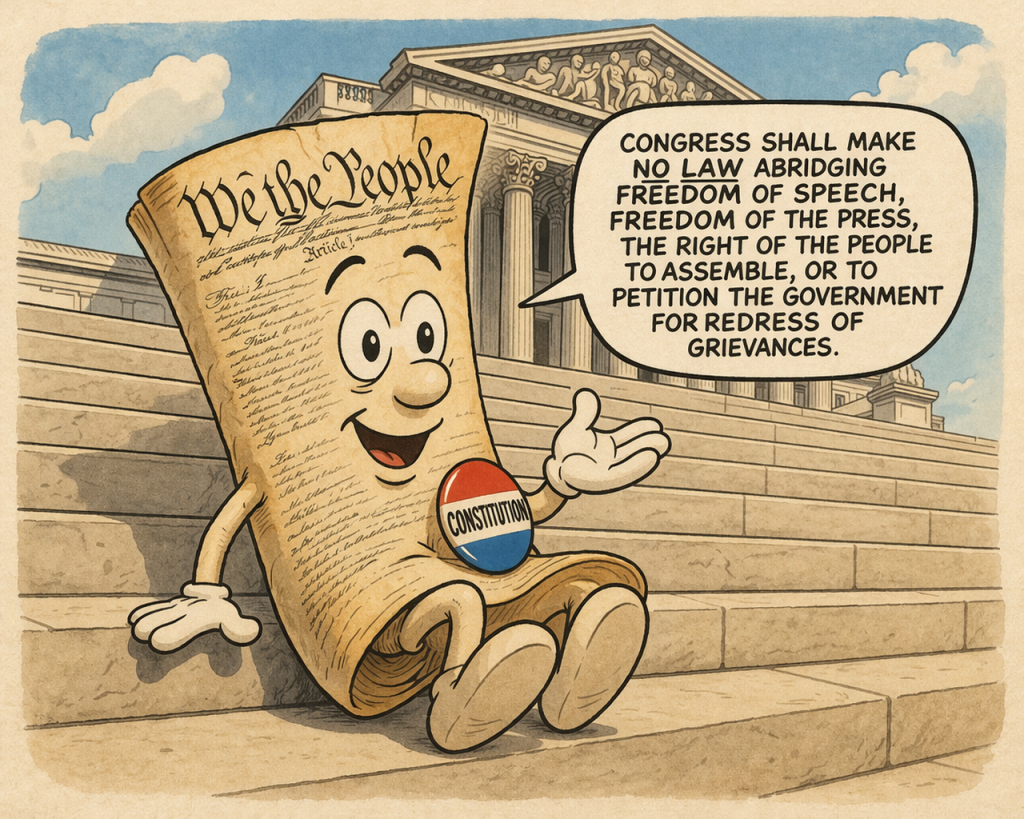
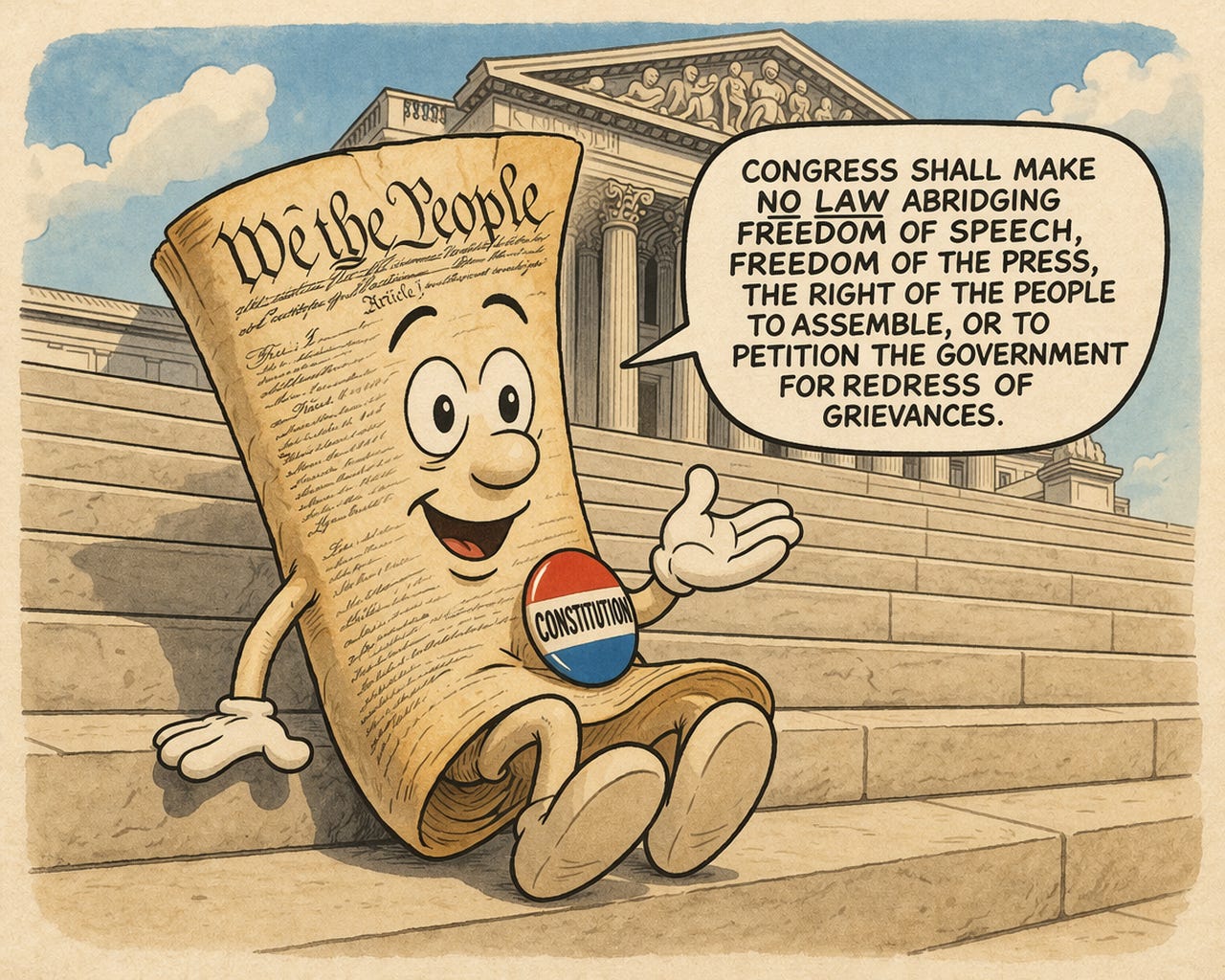
The First Amendment is not ambiguous, and it is not conditional in the way it is often treated in practice. It does not begin with exceptions, and it does not invite interpretation before it establishes command. It states plainly that Congress shall make no law abridging the freedom of speech, the freedom of the press, the right of the people to assemble, and the right to petition the government for redress of grievances.
These are not separate concepts operating in isolation. They are interdependent protections that exist together to ensure that citizens are not merely permitted to hold opinions, but are able to express those opinions directly to the government in the spaces created for that purpose.
When the First Congress transmitted the Bill of Rights to the states in 1789, and when those amendments were ratified in 1791, the concern was not theoretical overreach. The concern was practical power. The framers understood that the danger was not limited to laws that openly prohibited speech, but extended to systems capable of suppressing it indirectly through control of access, procedure, and consequence.
That distinction matters.
The amendment protects speech, but it also protects assembly and petition because speech alone, removed from the places where it can be heard, is easily contained. The right is not simply to speak. The right is to speak where it matters, in the presence of those being addressed.
Public meetings, government buildings, and civic spaces are not incidental to that structure. They are where the First Amendment stops being theoretical and begins to operate in real time.
A Citizen Engages in the Process the Government Created
Consider a scenario that does not require names to be understood.
Our citizen begins attending public meetings, not as a passive observer, but as an active participant in the process the government itself has established. He appears regularly, sits through proceedings, and when permitted, uses the time allocated to speak. He raises concerns directed at public officials, documents what occurs, and returns consistently. His speech is critical, at times uncomfortable, and directed squarely at those exercising public authority. It is not designed to be agreeable or reassuring. It is designed to be heard.
Nothing about this conduct falls outside the structure that has been created for public participation. Public comment periods exist for this purpose, meetings are designated as open for this reason, and the presence of citizens engaging directly with government officials is not incidental to the process. It is the process functioning as designed. Our citizen is not inserting himself into a system that excludes him. He is operating within one that expressly invites participation.
This activity does not exist on the margins of constitutional protection. It sits at the center of it. Political speech directed at public officials in a public forum is among the most protected forms of expression recognized in American law. The ability to question, criticize, and confront those in power in a public setting is not a peripheral right. It is one of the primary mechanisms through which accountability is maintained.
For a period of time, this participation is tolerated, even if it is not welcomed. There is no immediate intervention, no formal objection that results in removal, and no determination that the conduct exceeds the bounds of what is permitted. The process continues, and our citizen continues within it.
Then the characterization begins to change.
The same conduct is no longer described as participation, but as disruption. The same speech is no longer described as criticism, but as interference. The shift is not accompanied by a formal finding or an articulated standard. It occurs through language, through description, and through the perspective of those tasked with maintaining the environment in which the speech occurs. Labels begin to replace analysis, and those labels begin to carry consequences.
At no point in this transition is there a formal adjudication. There is no finding of wrongdoing by a court, no criminal charge, and no administrative hearing establishing that a defined rule has been violated. What exists instead is a change in how our citizen’s conduct is described by those with authority, and that change, rather than any formal determination, becomes the foundation for what follows.
The Mechanism of Exclusion Is Administrative, Not Judicial
The next step is not prosecution. It is exclusion. What had been described as a concern about conduct does not move through a court, does not result in a charge, and does not trigger a formal adjudicative process. Instead, it results in a directive issued outside of the judicial system altogether.
A directive is issued removing our citizen from access to public property. The directive is not tied to a single incident or a narrowly defined space, and it does not reflect a finding that a specific rule has been violated. It is not limited in duration, contains no findings of fact, and provides no procedure through which it can be meaningfully challenged or reviewed. It is not the product of a judicial determination reached after notice and opportunity to be heard. It is administrative in nature, issued through executive authority, and enforced through the threat of arrest rather than through prior adjudication.
The scope of the directive is what gives it its practical effect. It is not confined to a particular meeting, a specific room, or a defined instance of alleged disruption. It extends broadly to municipal property, including buildings and spaces that exist for public participation and civic engagement. The effect is immediate and comprehensive.
Our citizen, who had been attending meetings, observing proceedings, and participating in public comment, is no longer permitted to enter the very spaces where that participation had been taking place.
The directive may include language suggesting that communication remains available through alternative means, such as written correspondence, electronic communication, or scheduled appointments arranged in advance. That language, while appearing to preserve access, does not restore the right that has been removed. The First Amendment does not guarantee a right to speak only through channels selected and controlled by the government. It guarantees the right to participate in the forums the government has opened for that purpose, including the ability to be physically present where public business is conducted.
The distinction between communication and presence is not semantic. It is structural. The right to assemble and the right to petition are not satisfied by allowing a citizen to send an email in place of appearing at a public meeting. Presence carries with it the ability to observe, to respond in real time, and to participate in a process that is designed to be public. When presence is removed, the nature of the right itself is altered, even if some limited form of communication remains technically available.
What is particularly relevant, and what is not always emphasized at the point the directive is issued, is that the conduct giving rise to concern is not alleged to have occurred across the breadth of municipal property covered by the restriction.
It is tied to a single location, and more specifically, to interactions that occurred at or around City Hall, often following the conclusion of lawful public meetings. The speech at issue is described as uncomfortable, pointed, and at times unwelcome, but it remains political in nature and directed at public officials in connection with matters of public concern. That distinction is not incidental. It defines both the character of the speech and the limits of any response to it.
The Legal Challenge Reveals the Absence of Structure
When our citizen challenges the directive, the issue moves into the judicial system, where questions of authority, process, and constitutional limits are supposed to be resolved. The argument itself is not complex. A restriction on access to public forums implicates the First Amendment and triggers due process requirements. At a minimum, the government must demonstrate that it possessed lawful authority at the time the restriction was imposed, that the exercise of that authority complies with constitutional standards, and that there exists a mechanism through which the restriction can be meaningfully reviewed.
The challenge seeks immediate relief because the restriction is not hypothetical. It is ongoing. In cases involving the First Amendment, time is not a neutral factor. Courts have recognized repeatedly that even minimal periods of deprivation of speech rights constitute irreparable harm. A delay does not simply postpone a decision. It extends the operation of the restriction while the question of its legality remains unresolved.
The government’s response does not immediately address the substance of the issue. Instead, it seeks additional time. A continuance is requested on procedural grounds, typically framed in terms of witness availability or the need to prepare a more complete presentation. These requests are not uncommon in litigation, and in many contexts they are unremarkable. In this context, however, they carry a different weight.
Our citizen objects, not because delay is inherently improper, but because delay here has a defined and unavoidable effect. The restriction remains in place. Access is still denied. Participation is still prevented. The harm that prompted the request for relief does not pause while the case is continued. It continues to operate.
The court grants the continuance, and in doing so does not reach the underlying constitutional question at that time. The decision is procedural in form, but its consequences are substantive. The directive remains in effect without judicial validation, and our citizen remains excluded from the very forums in which the challenged conduct had been occurring.
The Hearing Highlights the Gap Between Authority and Action
When the matter is finally heard, the focus shifts, as it should, to the government’s justification. What had been imposed administratively is now required to be explained in legal terms, and the question is no longer how the directive was described, but whether it can be sustained under the law.
The directive is presented as an exercise of authority over municipal property, often tied to general concepts such as maintaining order or invoking trespass principles. Those concepts, in the abstract, are not controversial. The government does possess authority to regulate the use of its property and to ensure that public spaces function as intended. The issue, however, is not whether some authority exists. The issue is whether that authority extends to imposing a sweeping, indefinite restriction on access to public forums without prior adjudication and without procedural safeguards.
When pressed to identify the specific legal basis for such a directive, the answer does not resolve the question. The authority is described in general terms, but it is not anchored in a statute, ordinance, or clearly defined legal mechanism that expressly permits the action taken. The distinction between managing a space and excluding a citizen from it entirely becomes unavoidable. One is a recognized function of government. The other requires justification that is both specific and grounded in law.
The court recognizes this distinction. It questions the breadth of the directive and the absence of a clearly identified legal framework supporting it. The discussion begins to narrow, not because the directive itself has changed, but because its scope becomes difficult to reconcile with the limited factual basis that has been presented. If the underlying conduct involving our citizen is tied to a particular location, the justification for a blanket exclusion across all municipal property becomes increasingly difficult to sustain.
At this stage, the case is positioned where it should be. The question is no longer abstract, and it is no longer framed in terms of characterization.
It is whether the government had lawful authority to act as it did at the time it acted, and whether that action complied with the constitutional requirements that govern access to public forums and participation in public life.
The Focus Shifts Away From the Constitutional Question
At this point, the analysis begins to move in a different direction. What had been centered on the legality of the directive and the scope of the government’s authority does not remain there. Instead, attention turns to the form of the filings submitted by our citizen, and the structure of those filings becomes a subject of inquiry in its own right.
The arguments are not dismissed as unsupported. They are not identified as frivolous. They are not rejected for failure to comply with procedural rules. Rather, they are observed to be organized, to cite authority, and to follow recognizable legal patterns. It is those characteristics, rather than any deficiency in substance, that begin to draw scrutiny.
The inquiry shifts accordingly. It is no longer confined to whether the filings are correct or whether they satisfy the applicable legal standards. It becomes a question of authorship. The issue presented is not what is being argued, but how those arguments came to be presented in that form. The underlying implication is that a pro se litigant should not, or perhaps could not, produce work that resembles formal legal writing without external assistance.
This shift is not overt, but it is significant. It does not directly engage with the merits of the arguments being made. It reframes the discussion around the perceived legitimacy of the person making them. The focus moves from the government’s authority to act, to the citizen’s capacity to challenge that authority.
There is no evidence introduced that an attorney authored the filings. There is no notice of appearance, no attorney signature, and no communication in the record indicating participation by counsel. The concern arises not from proof, but from perception. It is based on how the work appears, rather than on any demonstrable fact about how it was produced.
At that point, the proceeding is no longer focused exclusively on whether the government acted within its lawful authority. It is also addressing whether our citizen is, in effect, too capable to be acting alone, and whether that perceived capability requires explanation before the underlying constitutional question is resolved.
The Escalation From Restriction to Enforcement
When a Civil Dispute Becomes a Criminal Problem
What begins as a restriction does not remain static. Once our citizen is removed from public space and continues to assert the right to challenge that removal, the nature of the response begins to change. The issue is no longer framed solely in terms of access or procedure. It is reframed as a question of compliance, and that shift carries consequences that extend beyond the original directive.
At that point, the system introduces a different set of tools. The same conduct that was previously described as disruptive or inappropriate is no longer evaluated only within the context of public meetings or administrative authority. It begins to be viewed through a criminal lens. Allegations take on the language of statutes. Terms such as harassment, menacing, or misuse of communication systems begin to appear, not as conclusions reached after adjudication, but as characterizations that justify further action.
This transition alters the balance of the situation entirely. A civil dispute over access to public forums becomes intertwined with criminal exposure, and our citizen is no longer engaged solely in defending the right to participate. He is now required to respond to allegations that carry the potential for arrest, prosecution, and incarceration. The posture of the case changes, and with it, the risks associated with continuing to challenge the underlying restriction.
That shift is not theoretical. Our citizen is taken into custody, and the consequences are immediate. The loss of liberty is not abstract, and it is not deferred. It involves confinement, the conditions of detention, and the collateral consequences that accompany the existence of a criminal charge. What had begun as a question of access to public meetings now includes the reality of incarceration.
At the same time, the legal landscape becomes fragmented. Multiple proceedings arise from the same underlying conduct, each operating within its own framework. A civil action challenging the legality of the restriction continues to move forward. A separate proceeding, often derived from the same set of facts, advances along a parallel track. Criminal charges, based on interpretations of the same interactions, are filed and proceed independently.
These proceedings are not isolated from one another. They are connected by a single sequence of events, yet they operate under different standards, different timelines, and different burdens of proof.
Our citizen is required to navigate all of them simultaneously, responding to each while none of them fully resolves the central question that gave rise to the dispute in the first place.
This creates a structural tension that cannot be ignored. In the civil matter, our citizen is expected to present evidence, testify, and challenge the legality of the government’s actions. In the criminal matter, the same statements, the same evidence, and the same narrative carry the risk of self-incrimination. The act of defending one’s rights in one forum begins to conflict with the need to remain silent in another.
At that point, the issue is no longer limited to whether the original restriction was lawful. It becomes a question of whether the system, taken as a whole, allows for a meaningful challenge to that restriction without imposing additional and compounding risk on the person attempting to bring that challenge. The existence of multiple proceedings arising from the same conduct does not resolve the constitutional question. It complicates it, and in doing so, it alters the conditions under which that question can be answered.
The Structural Problem Becomes Visible
When viewed in sequence, the issue is no longer confined to a single decision or a single actor. It becomes structural, not because any one step is inherently unusual, but because of how each step follows the one before it.
A citizen engages in protected speech within a public forum created for that purpose, and over time that speech is recharacterized as problematic conduct without a formal adjudication establishing that a rule has been violated. An administrative directive is then issued removing the citizen from public space, and that directive is broad, indefinite, and not tied to prior judicial determination. The citizen seeks review through the courts, but that review is delayed while the restriction remains in effect.
At the same time, the government struggles to identify a clearly defined legal basis for the scope of the restriction, and the focus of the proceeding begins to shift away from the legality of the action toward the perceived legitimacy of the person challenging it. As the matter progresses, additional proceedings arise from the same underlying conduct, creating overlapping processes that operate under different standards and timelines.
Each of these steps, considered individually, can be explained within the ordinary functioning of government. When viewed together, however, they form a pattern that raises a more fundamental question about how constitutional rights operate in practice, particularly when the exercise of those rights produces sustained and unwelcome pressure on the system itself.
The First Amendment Depends on Access, Not Abstraction
The First Amendment does not function as a guarantee in the abstract, and it was never intended to operate only as a principle that can be acknowledged while being limited in practice. Its protections depend on access to the spaces where speech, assembly, and petition actually occur. When those spaces are available, the right has meaning. When access to them is removed, the right begins to lose its practical force, regardless of how clearly it remains stated on paper.
In this scenario, our citizen is not prevented from speaking in the broadest sense. There is no law prohibiting expression outright, and no formal declaration that speech itself is unlawful.
What has been removed is access to the places where that speech would be heard, observed, and responded to in real time. The distinction is significant. A right that exists only in theory, disconnected from the forums in which it is meant to operate, becomes increasingly dependent on the discretion of those controlling access to those forums.
When removal from those spaces occurs through an administrative act that precedes judicial review, the protection becomes conditional in practice, even if it remains absolute in theory. When that removal remains in effect while the judicial process unfolds, delay ceases to be neutral and begins to function as part of the restriction itself. The passage of time does not simply postpone resolution. It extends the period during which the right cannot be exercised in the manner it was designed to be.
The nature of the inquiry also changes when attention shifts away from whether the government acted within its lawful authority and toward whether our citizen is capable of presenting the challenge. At that point, the question is no longer limited to the legality of the restriction. It includes an implicit evaluation of the person raising it, as though the legitimacy of the argument depends in part on the perceived sophistication of the speaker.
The Constitution does not impose that condition. It does not limit the right to speak based on how comfortably that speech is received, and it does not confine participation to those who present their arguments in a manner that meets an unstated expectation.
It does not require that a citizen’s position be simple, restrained, or agreeable to be considered legitimate. The protections exist precisely because conflict between citizens and government is expected, and because that conflict is not meant to be resolved by restricting access to the places where it is expressed.
The Question That Remains
The scenario does not require a conclusion in order to be understood. The sequence of events, viewed as a whole, does not depend on interpretation to reveal its structure. What it requires instead is that the right question be asked, and that it be asked without distraction from the surrounding details.
What does it mean to guarantee the right to speak, to assemble, and to petition the government if access to the very forums where those rights are exercised can be removed without prior adjudication, if that removal can remain in effect while the judicial process unfolds, and if the legitimacy of the challenge can itself become a subject of inquiry based on the perceived capability of the person bringing it. When each of those conditions is present, the question is no longer confined to a single directive or a single case. It becomes a question about how the right operates when it is tested under pressure.
In this scenario, our citizen does not lose the right in theory. There is no formal declaration that the Constitution no longer applies, and no explicit statement that the protections it provides have been withdrawn. What changes is the ability to exercise that right in the places where it is meant to function. Access is restricted, review is delayed, and the focus of the proceeding expands to include considerations that do not bear directly on the legality of the government’s action. The right remains intact in language, but its operation becomes contingent in practice.
It is also not occurring in isolation. The actions at issue are not taken by private individuals, but by government officials acting within their respective roles, including those responsible for enforcement, prosecution, and adjudication. The same underlying set of events gives rise to administrative action, law enforcement involvement, and prosecutorial decisions, all while the judicial system is engaged in reviewing the legality of the initial restriction. In that context, the absence of a clearly defined external review or independent inquiry becomes part of the overall structure, rather than an incidental detail.
At the same time, the posture of the proceedings reflects an unusual alignment. Judicial officers tasked with hearing related matters may step aside, while other components of the system continue to act on the same underlying facts. Decisions affecting liberty and access are made within overlapping roles, and the sequence in which those decisions occur becomes difficult to separate from the broader process in which they are embedded.
When authority is exercised across multiple functions without clear separation or independent review, the question is not limited to any one action, but extends to how the system as a whole is operating in response to the conduct at issue.
The First Amendment was written as a limitation on power, not as a statement of preference. Its effectiveness does not depend on how often it is quoted or how clearly it is recited, but on how it is applied at the moment it becomes inconvenient to those responsible for enforcing it. The measure of the protection is not found in situations where it is easily accommodated. It is found where it is resisted, narrowed, or recharacterized.
That is where its meaning is tested, and it is where the distinction between a right that exists in principle and a right that operates in reality becomes impossible to ignore.
The Right to Be Difficult
There is a recurring tendency, particularly in situations like this, to move away from the substance of the speech and toward the character of the speaker. It becomes easier to describe the individual as unreasonable, unstable, or disruptive than it is to engage directly with what is being said. That shift is not new, and it is not accidental. It is one of the oldest ways to neutralize criticism without addressing it.
From a constitutional standpoint, that shift misses the point entirely. The First Amendment does not protect speech because it is polished, measured, or universally accepted. It protects speech because it is capable of challenging authority. When speech becomes uncomfortable, persistent, or difficult to ignore, that is often when it is functioning most effectively.
Our citizen’s conduct, viewed through that lens, does not present as irrational. It presents as defiant. Not defiance in the sense of disorder for its own sake, but defiance in the sense that has always existed within a constitutional system, the refusal to remain silent in the face of disagreement with government action. In a system that rejects physical conflict as the means of resolving disputes, the spoken word becomes the primary tool available to a citizen seeking to push back against authority.
That tool is not always quiet. It is not always refined. At times, it may appear exaggerated, repetitive, or even out of place within the formal structure of a meeting. But the Constitution does not require that dissent be delivered in a format that is easy to absorb. It requires that it be allowed.
It is also possible that the purpose of such conduct is not limited to the immediate audience in the room. Public speech, particularly when it is persistent and difficult to ignore, often serves a secondary function. It forces a broader conversation. It draws attention beyond the moment in which it occurs and invites others to engage with the underlying issues. In that sense, what appears disruptive in the moment may be deliberate in design.
There is another dynamic at play as well. The idea that rights should be easily surrendered in the absence of perceived wrongdoing has become increasingly normalized. Phrases suggesting that compliance should be automatic for those who have nothing to hide are often presented as practical or reasonable. From a constitutional perspective, that reasoning reflects a different framework entirely. The protections contained in the Bill of Rights were not written for those who have something to hide or nothing to hide. They were written to define limits on government power, regardless of circumstance.
The right to question, to challenge, and to refuse to yield those protections without scrutiny is not an act of extremism. It is an act consistent with the structure of a constitutional republic. When citizens are criticized for insisting on those rights, or for refusing to reduce their participation to something more comfortable for those in authority, the issue is not simply one of tone. It is a question of whether the expectations placed on citizens remain aligned with the principles the Constitution was written to preserve.
In that context, the presence of defiance, even when it is uncomfortable, should not be mistaken for instability. It may instead reflect a citizen engaging with the only tool available to them, the ability to speak, persist, and refuse to disengage from a system that is designed, at least in principle, to respond to that participation.
Legal Notice and Editorial Disclaimer
This article is a work of investigative commentary and constitutional analysis based on publicly available information, court filings, and documented events. It is presented for the purpose of examining legal principles, procedural structure, and the operation of constitutional rights in practice.
The scenario described is intentionally structured as a generalized case study. Any resemblance to specific individuals, entities, or proceedings reflects the application of publicly documented facts to broader legal analysis. The author does not assert conclusions of wrongdoing by any individual or entity beyond what has been established in the public record.
All opinions expressed herein are those of the author and are offered in the context of protected speech under the First Amendment to the United States Constitution, including the right to comment on matters of public concern and government conduct.
Nothing in this publication should be construed as legal advice.
Government belongs to the people. Transparency is not optional. And constitutional rights do not depend on permission.
© 2026 Unplugged with Knapp Media LLC. All rights reserved. This publication is the intellectual property of Unplugged with Knapp Media LLC.
About The Author