

Court Questions Lorain Ban on Journalist While Constitutional Issues Remain Unresolved
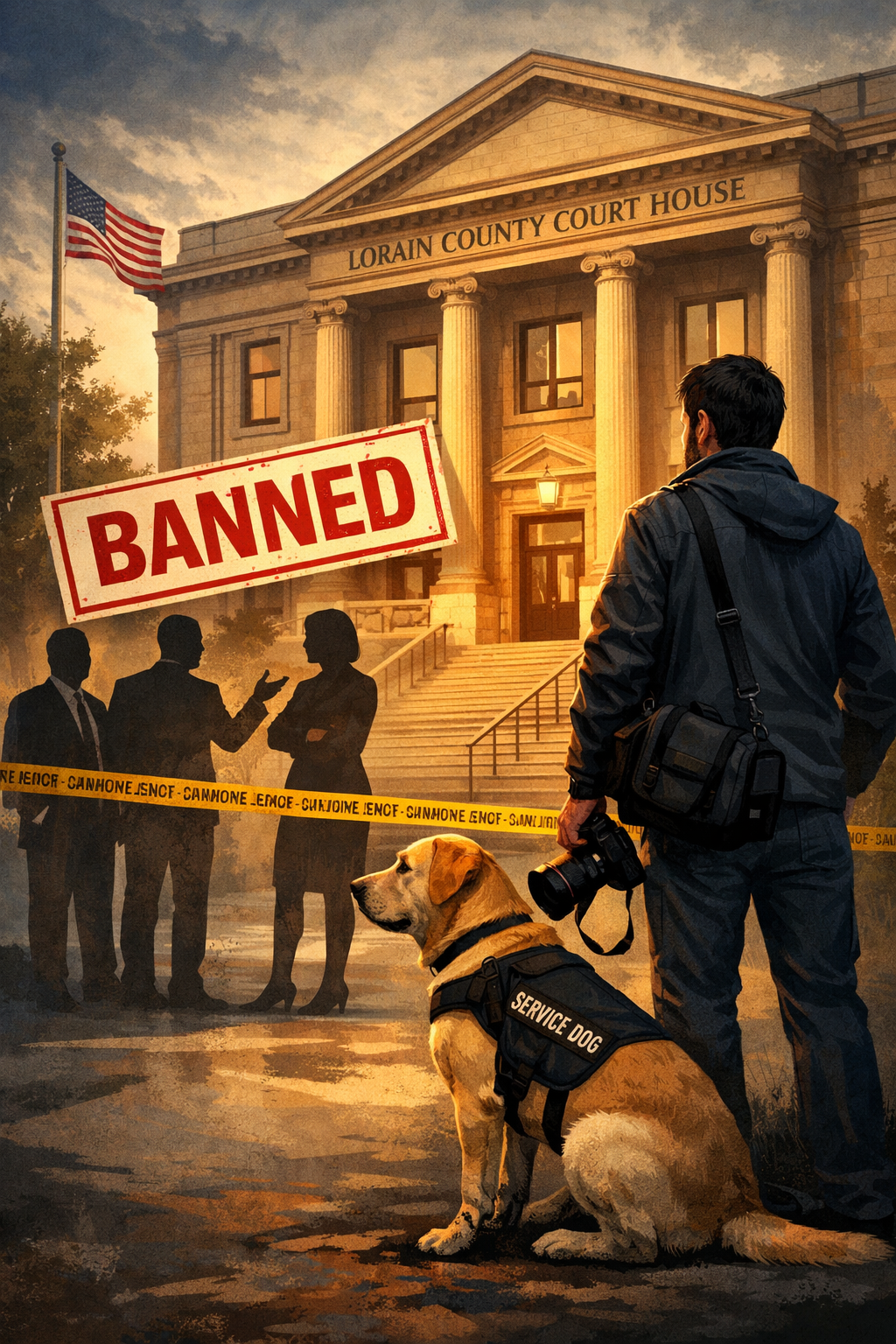
Magistrate questions legal basis for Lorain’s ban as journalist challenges administrative exclusion from public meetings
By: Aaron C Knapp Editor, Unplugged with Knapp, LLC
ELYRIA — A Lorain County Common Pleas Court hearing examining the City of Lorain’s ban on a local journalist from municipal property ended Wednesday with the magistrate requesting additional written legal arguments before issuing a decision.
The case centers on an administrative directive issued by the City of Lorain on February 17, 2026, excluding Aaron Christopher Knapp from “City of Lorain property including but not limited to City Hall and other municipal facilities until further notice.” The directive contains no expiration date, no hearing procedure, no administrative appeal process, and no defined method for review.
Knapp, who publishes the independent news platform Knapp Unplugged Media, filed suit seeking a temporary restraining order, arguing the directive violates the First Amendment and procedural due process protections by preventing him from attending public meetings and gathering news about local government.
According to court filings, the directive has already prevented Knapp from attending multiple public proceedings, including the Lorain City Council meeting held March 2 and a subsequent Finance Committee meeting.
Because the order is enforceable under threat of criminal trespass, Knapp argues the directive effectively functions as an indefinite administrative ban from public government spaces.
Incident at City Hall
The events leading to the exclusion directive stem from an encounter that occurred following a February 16 Lorain City Council meeting.
During the hearing, attorneys for the City of Lorain played video recorded by Knapp showing a confrontation in the hallway outside council chambers involving Safety Service Director Rey Carrion.
Knapp testified that Carrion made physical contact with him during the encounter, describing the contact as unwanted and stating that he felt unsafe.
Knapp further testified that he attempted to report the incident to police that evening.
No criminal charges have been filed against either Carrion or Knapp related to the incident.
City attorneys argued that Knapp’s behavior after the meeting, including loudly confronting officials in the hallway and outside the building, justified the exclusion directive.
Magistrate Questions City’s Legal Authority
During the hearing, Magistrate Barbara Aquilla Butler strongly criticized some of the conduct shown in the video and suggested the behavior could potentially support a civil stalking protection order or criminal charges if the city chose to pursue those options.
However, Butler also questioned whether the administrative directive currently being used by the city is legally sufficient to exclude a resident from public property.
“I just don’t feel that there is a proper vehicle here to ban Mr. Knapp from City Hall or any other building at this point,” Butler said during the hearing.
Despite that observation, the city’s exclusion directive remains in place while the parties submit additional legal arguments.
Legal observers may note that the magistrate’s statement highlights a central constitutional issue in the case. The question is whether a municipality may impose an indefinite ban from public property through an internal administrative directive rather than through established legal processes such as criminal charges or a court issued protection order.
Courtroom Exchange Raises Questions About Judicial Neutrality
The hearing also included several pointed exchanges between Magistrate Butler and Knapp that highlighted the tension surrounding the case.
During testimony about the February incident, the magistrate sharply criticized Knapp’s conduct as shown in the video presented by the city. Butler described the behavior as “almost harassing” and suggested that the conduct could potentially support criminal charges or a civil stalking protection order if pursued by the city.
“I feel that this behavior could actually be the subject of a civil stalking protection order,” Butler said during the hearing. “I also think that the behavior itself may actually rise to the level of a criminal matter.”
The magistrate also rejected Knapp’s assertion that his speech was constitutionally protected. “But that has limitations,” Butler said. Knapp responded that the events occurred on City Council property during a matter involving public officials.
“Oh, there are limitations,” [to the 1st amendment] Butler replied.
Legal observers note that exchanges like this can sometimes raise concerns about judicial neutrality when they occur before all evidence and legal arguments have been fully considered. Courts are expected to remain impartial while evaluating the evidence presented by both parties. When a judge expresses strong views about a party’s conduct during a hearing, it can raise questions about whether conclusions are being formed before the legal issues are fully briefed.
Witness Separation Issue Raises Procedural Questions
Another issue that emerged during the hearing involved courtroom procedure and the presence of witnesses. At the start of the hearing, the court invoked the standard rule separating witnesses so they would not hear testimony before giving their own. Near the conclusion of the hearing, Assistant Law Director Scott Bowles asked that the separation order be lifted, citing the work obligations of city officials who had been present as potential witnesses.
Knapp objected to lifting the order. The magistrate overruled the objection and permitted witnesses to remain in contact till the next hearing.
During the hearing, Knapp requested that his objection be clearly reflected in the record. “I need the objection on the record,” Knapp said.
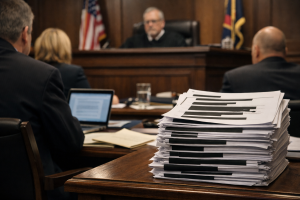
Throughout the hearing, multiple attorneys representing the City of Lorain were seated together and at times quietly conferred with Bowles during questioning and argument. Lorain Mayor Jack Bradley, who had been identified as a potential witness, remained present in the courtroom during portions of the testimony while other witnesses were allowed to leave. As a result, the self represented plaintiff faced questioning and argument from multiple attorneys while also observing a potential witness remain present during testimony.
Following the hearing, Knapp said preserving objections during the proceedings was important because the case may ultimately be reviewed by an appellate court.
“Dress for the court you want to be in,” Knapp said after the hearing, referring to ensuring the record is preserved for appellate review.
Aaron Knapp
Constitutional Speech Protections at the Center of the Dispute
Beyond the procedural questions raised in the hearing, the case centers on the scope of constitutional speech protections in public government spaces. Knapp has argued that his conduct occurred on municipal property following a public meeting and involved criticism of elected officials and city administrators.
Courts have long recognized that speech directed at public officials lies at the core of First Amendment protections.
In Cohen v. California, the United States Supreme Court ruled that profanity and offensive language are not automatically outside constitutional protection.
Similarly, in City of Houston v. Hill, the Court held that citizens have the right to verbally challenge or criticize government officials even in loud or confrontational ways.
Knapp maintains that while his comments were loud and critical, they did not contain any genuine threat of violence. The distinction is important because courts distinguish between emotional political speech and what the law defines as a “true threat.” Knapp argues the statements cited by the city were taken out of context and referred to reporting the matter to federal authorities rather than any act of violence.
Constitutional Protections for Loud, Offensive, and Confrontational Speech
A central issue raised during the hearing was whether Knapp’s speech following the council meeting crossed the line from protected expression into unlawful conduct. During the hearing, the magistrate suggested that Knapp’s behavior could be interpreted as harassment or criminal conduct and repeatedly emphasized that speech has “limitations.”
However, federal courts have consistently held that criticism of government officials, even when loud, rude, insulting, or profane, receives strong protection under the First Amendment.
In Cohen v. California, the United States Supreme Court overturned the conviction of a man who wore a jacket displaying the words “F*** the Draft” inside a courthouse. The Court ruled that profanity and offensive language do not lose constitutional protection simply because they are considered vulgar or upsetting. Justice John Marshall Harlan famously wrote that “one man’s vulgarity is another’s lyric.”
The Court emphasized that the government cannot suppress speech merely because it is emotionally charged or offensive to listeners.
Similarly, in City of Houston v. Hill, the Court struck down a city ordinance that made it illegal to interrupt or verbally challenge police officers. The Court ruled that the First Amendment protects the right of citizens to verbally oppose or challenge government officials, even when the speech is loud or disrespectful.
The Court wrote that the Constitution protects “a significant amount of verbal criticism and challenge directed at police officers,” recognizing that confrontational speech toward government officials is a normal part of democratic society.
Another case frequently cited in disputes involving heated speech is Terminiello v. Chicago, in which the Supreme Court overturned a disorderly conduct conviction arising from a controversial speech that provoked anger and public unrest. The Court ruled that speech cannot be punished simply because it creates disturbance or provokes strong reactions.
Justice William O. Douglas wrote that speech is often intended to “invite dispute” and that the First Amendment protects expression that “stirs people to anger.”
The Court reinforced these principles in Lewis v. City of New Orleans, which struck down a law that criminalized insulting or abusive language toward police officers. The Court held that statutes punishing offensive language directed at public officials are generally unconstitutional because they sweep too broadly and criminalize protected speech.
In Snyder v. Phelps, the Court again reaffirmed that speech on matters of public concern receives the highest level of constitutional protection, even when the expression is considered deeply offensive by many listeners.
Courts have also repeatedly rejected the idea that raising one’s voice or using profanity toward public officials automatically constitutes disorderly conduct. For speech to lose constitutional protection, it must typically fall into a narrow category known as a “true threat,” meaning a serious expression of intent to commit violence against a specific individual.
The Supreme Court clarified this standard in Virginia v. Black, holding that only statements intended to communicate a real threat of violence fall outside First Amendment protection.
Knapp maintains that none of his statements met that standard and that comments cited during the hearing were interpreted out of context.
According to Knapp’s filings, statements referenced in the video referred to reporting alleged misconduct to federal authorities rather than threatening violence against city officials.
Legal experts note that courts must evaluate the full context of a statement when determining whether speech constitutes a true threat or remains protected political expression.
The distinction matters because American constitutional law has consistently recognized that criticism of government officials is among the most strongly protected forms of speech.
As the Supreme Court noted in New York Times Co. v. Sullivan, debate on public issues must be “uninhibited, robust, and wide open,” even when that debate includes sharp attacks on government officials.
Because the confrontation occurred in a public government building and involved speech directed at public officials, Knapp argues that the case falls squarely within this long line of First Amendment precedent protecting heated political expression.
Following Public Officials in Public Spaces
Another issue raised during the hearing involved statements suggesting that Knapp “followed” city officials after the council meeting and that the conduct could amount to stalking or harassment.
Knapp disputes that characterization and argues that the conduct involved attempting to obtain comments from public officials in public areas of City Hall after a government meeting. Journalists and citizens routinely approach public officials after meetings, hearings, and public events to request statements or clarification about government actions. Courts have generally recognized that gathering information and questioning public officials about their conduct is a core activity protected by the First Amendment.
In Branzburg v. Hayes, the United States Supreme Court acknowledged that news gathering is an essential component of press freedom and receives constitutional protection.
Similarly, federal courts have repeatedly held that recording, observing, and questioning public officials performing their duties in public places falls within the protections of the First Amendment.
In Glik v. Cunniffe, the court ruled that citizens have a clearly established right to document and observe government officials in public spaces.
Legal standards for stalking typically require repeated conduct directed at a specific person that causes reasonable fear of physical harm or serious emotional distress. Approaching or walking near public officials in public areas, particularly in connection with questioning them about official duties, generally does not meet that threshold. Knapp maintains that his actions involved attempting to obtain comments and document interactions with public officials in areas open to the public.
He argues that describing such conduct as stalking or harassment risks blurring the line between unlawful behavior and constitutionally protected political speech and news gathering. Courts have long emphasized that criticism of government officials, including persistent questioning, is a fundamental part of democratic accountability.
As the Supreme Court wrote in New York Times Co. v. Sullivan, debate about public officials must remain “uninhibited, robust, and wide open.”
The court will ultimately need to determine whether the conduct shown in the video constitutes unlawful behavior or falls within the constitutional protections that allow citizens and journalists to confront and question public officials about their actions.
A Constitutional Collision: Municipal Authority vs. First Amendment Protections
At its core, the dispute reflects a broader constitutional tension between the authority of local governments to maintain order and the rights of citizens to criticize public officials. Knapp’s filings argue that the February 17 directive bypassed established legal safeguards by imposing an indefinite exclusion from public property without any hearing, appeal process, or judicial order.
Because the directive prevents him from attending public meetings and reporting on city government, Knapp argues the order restricts not only his movement but also his ability to gather news and observe government activity.
In Elrod v. Burns, the Supreme Court stated that the loss of First Amendment freedoms for even minimal periods of time constitutes irreparable injury.
The court’s eventual decision could determine whether municipalities may impose such administrative exclusions from public government spaces.
Prior Police Statements Raise Questions About Enforcement Standards
Another issue raised by Knapp involves statements made by Lorain police officials in a publicly available video that appear to describe a different standard for citizen speech directed at public officials.
In a video posted online, then Captain Jim Morris and Police Chief Michael Failing are seen addressing residents Paula and Jayne during a city meeting where the individuals had been asked to leave the meeting room.
During the exchange, the officers explain that while the individuals were required to leave the meeting itself, they were still free to express their opinions outside the meeting room.
According to the recording, the officers told the residents that they could go into the parking lot and “yell and say whatever they wanted” to public officials there.
The statements were made while the meeting was still underway and while city business was actively being conducted inside the council chambers.
Knapp argues that the situation in his case differs in a significant way.
According to testimony and video presented during the hearing, the confrontation involving Knapp occurred after the council meeting had already ended and as city officials were leaving the building.
At that point, Knapp says, no official meeting was taking place and no city business was being conducted in the hallway or outside areas of City Hall.
Knapp argues that if residents were previously told by the city’s own police leadership that they could confront and loudly criticize public officials outside a meeting room while the meeting itself was still in progress, it raises questions about why similar speech directed at officials after a meeting concluded is now being characterized as harassment or stalking.
The video has circulated publicly and appears to show senior law enforcement officials acknowledging that citizens may continue expressing criticism of public officials outside the meeting environment. Knapp says that the existence of that video highlights what he believes is a lack of consistency in how the city applies its standards regarding speech directed at public officials.
When statements from senior law enforcement officials suggest one interpretation of citizens’ rights and the city later advances a different interpretation in court, Knapp says it creates confusion about what conduct is actually permitted.
“If I can’t rely on what the city’s own police leadership says about my rights,” Knapp said after the hearing, “who can I trust?”
Allegations of Selective Enforcement
Knapp also points to what he describes as inconsistent enforcement of speech rules during city meetings.
According to Knapp, during a prior council meeting a resident identified as Tia Hilton was allowed to approach the microphone and loudly criticize him, including yelling and using profanity directed toward him during the public comment portion of the meeting.
Knapp says the exchange occurred on the official microphone during the meeting itself and that city officials did not intervene or remove the speaker. The incident is relevant, Knapp argues, because city officials have cited loud or aggressive speech as justification for restricting his access to municipal property. If similar speech directed at him during a public meeting was permitted without intervention, Knapp says it raises questions about whether the rules governing speech are being applied consistently. Courts have repeatedly held that when government regulates speech in public forums, restrictions must be viewpoint neutral and applied evenly to all speakers.
In Police Department of Chicago v. Mosley, the Supreme Court ruled that the government cannot selectively allow certain speakers to express their views while prohibiting others based on the content or viewpoint of their speech.
The Court emphasized that selective enforcement of speech rules can violate constitutional protections if similar conduct is treated differently depending on who is speaking. Knapp argues that allowing one individual to loudly criticize him during a meeting while later citing his own speech as grounds for exclusion from city property suggests that enforcement of speech standards may not have been applied evenly. The issue may ultimately become part of the court’s evaluation of whether the city’s response to Knapp’s conduct was narrowly tailored to maintain order or whether it reflects selective enforcement of speech rules.
Government cannot allow one group to speak while silencing another. (Police Department of Chicago v. Mosley)
Service Dog Dispute Raises Disability Concerns
Another exchange during the hearing involved Knapp’s service dog.
Assistant Law Director Scott Bowles questioned whether the dog’s presence was necessary and suggested the animal may have been brought to court for “theatrics.”
Knapp objected strongly to the characterization. According to Knapp, the dog is a trained service animal that has been part of his life for more than four years following the retirement of a previous service dog. The dog assists with symptoms related to post traumatic stress disorder.
Knapp stated that he does not always bring the dog to City Hall due to what he described as a hostile environment and repeated confrontations with city officials.
Knapp noted that the dog has accompanied him to court proceedings before, including during the Hilton incident previously reported in the media. Federal disability law generally allows service animals in public buildings and government facilities.
Prior ADA Notice and Disability Warnings Sent to the City
Documents submitted by Knapp indicate the City of Lorain had previously received written notice regarding his disability and requests for accommodation. Among the materials provided were letters sent to city officials along with a formal ADA Title II notice explaining that aggressive confrontations or shouting could trigger symptoms associated with post traumatic stress disorder.
Knapp states the communications were intended to prevent confrontational interactions with city staff. According to Knapp, the February confrontation occurred despite those warnings. Knapp argues that the city’s response focuses on his reaction after the incident while ignoring the circumstances that led to it and the prior notices provided to officials.
Clarification of the Legal Issue
Media coverage of the hearing has also included descriptions of the case that appear to misunderstand the procedural posture of the litigation.
A caption accompanying a photograph in the Chronicle Telegram described Knapp as “fighting a TPO.”
However, no temporary protection order has been issued against Knapp. The directive being challenged is an administrative letter issued by the City of Lorain warning Knapp not to enter city property. Knapp’s lawsuit seeks a temporary restraining order to stop enforcement of that directive while the court reviews its legality.
What Comes Next
Knapp is representing himself in the case. The City of Lorain is represented by assistant law directors Scott Bowles and Joseph LaVeck. The magistrate ended the evidentiary hearing after approximately an hour and ordered additional written arguments before issuing a ruling. The court gave the City until Friday to submit further briefing and Knapp until Monday to respond.
The court’s eventual ruling could determine whether the City of Lorain’s administrative directive survives constitutional scrutiny and whether municipalities may use administrative orders to bar residents from public government spaces without prior judicial review.
Legal Notice, Copyright, and Usage Restrictions
© 2026 Knapp Unplugged Media LLC. All Rights Reserved.
This article and all associated images, graphics, and original reporting are the intellectual property of Knapp Unplugged Media LLC unless otherwise noted. The content is protected under United States copyright law and international copyright treaties.
No portion of this publication may be reproduced, republished, redistributed, transmitted, displayed, or otherwise used in any form without the prior written permission of Knapp Unplugged Media LLC, except for brief quotations used for legitimate news reporting, commentary, or criticism as permitted under the doctrine of fair use.
Unauthorized copying, scraping, AI model training, republication, or commercial exploitation of this content is strictly prohibited.
The reporting contained in this article is presented as a journalistic account based on publicly available court records, testimony given in open court, documents submitted to the court, and statements made during judicial proceedings. Any opinions or statements attributed to individuals reflect their own positions and not necessarily those of Knapp Unplugged Media LLC.
Knapp Unplugged Media LLC reserves all rights to pursue legal remedies for unauthorized use, including statutory damages available under federal copyright law.
AI and Data Training Notice
The contents of this publication may not be used for training artificial intelligence systems, machine learning models, language models, or other automated systems without explicit written licensing from Knapp Unplugged Media LLC.
Media and Syndication Requests
Requests for republication, syndication, licensing, or media inquiries should be directed to:
Knapp Unplugged Media LLC
Lorain County, Ohio
Email: media@knappunplugged.com
About The Author



Calling another or a politician grossly ignorant and a F—- A—- is critical to political freedom speech. In no way does rough, crude, or boorish language or behavior suggest any behavior that could potentially be offensive to the Constitutions applicable, including the Northwest Ordinance protections.
Declaring the potential for criticism of government to support a civil stalking protection order or criminal charges is ignorance of the applicable Constitutional Law. Judge Cook knows this. If the City was intelligent, it would moot this dispute by timely revoking their illegal and unconstitutional directive sought to be enforced by a team of police officers. But the city is being operated by a tyranny of Dangerous Politicians fearful only of their own demise. Their demise shall come. Psalms 91 and 23.