
City Hall After the Gavel
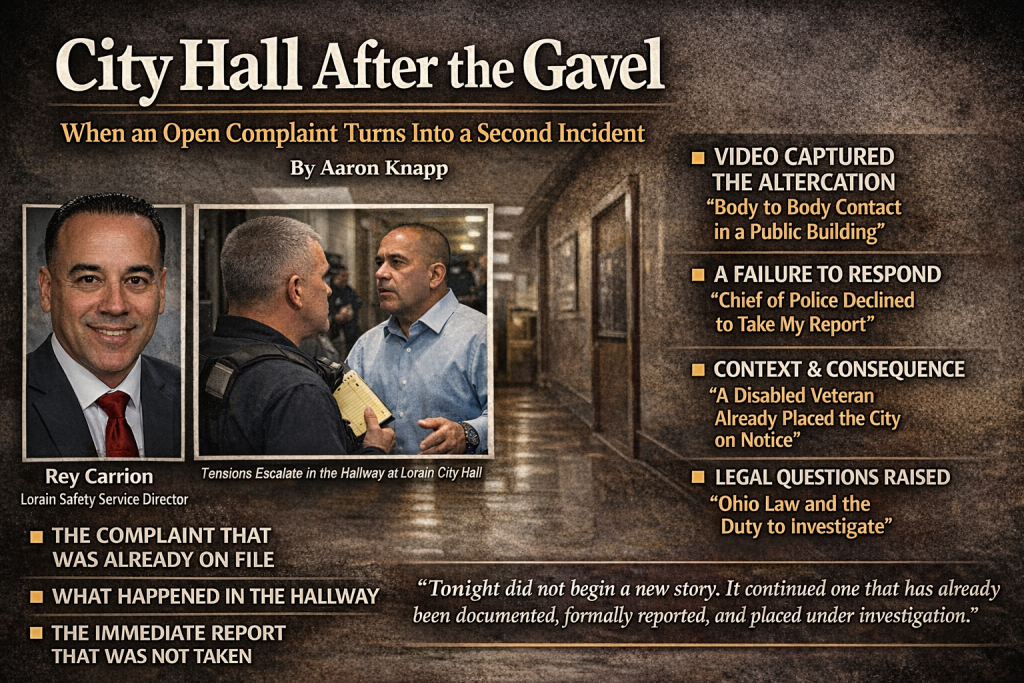
When an Open Complaint Turns Into a Second Incident
By Aaron Christopher Knapp, BSSW, LSW, CDCA(p)
Investigative Journalist | Licensed Social Worker
Founder, Knapp Unplugged Media LLC
Unplugged with Knapp | Lorain Politics Unplugged
Tonight did not begin a new story. It continued one that has already been documented, formally reported, and placed under investigation. The events that unfolded in the hallway at City Hall cannot be separated from what came before them because they are part of the same record, the same complaint, and the same pattern of conduct involving the same public official.
That context matters because it changes how this incident must be understood.
This is not a one time encounter between a citizen and a government official. It is not a disagreement that arose spontaneously or without warning. This is an incident involving the same Safety Service Director who was already the subject of a formal complaint filed on October 21, 2025, after conduct that occurred inside a Lorain City Council meeting. That complaint remains open.
It was submitted as a formal citizen complaint to the Lorain Police Department and includes detailed allegations that the Director initiated a confrontation during a public meeting by shouting at a citizen, disrupting the proceedings, and creating a situation that ultimately forced a recess of Council. The complaint further alleges that the conduct caused alarm, disrupted the meeting, and raised concerns under Ohio Revised Code provisions related to disorderly conduct and disturbing a lawful meeting. The written report does not stand alone. It is supported by recorded evidence, including independent audio and body camera footage, and it was accompanied by formal notice to the City that the conduct had already crossed into an official complaint and required investigation. The City was therefore not operating in the dark. It had been placed on notice, in writing, that concerns existed about aggressive behavior by a department head toward a member of the public.
That notice is critical because what occurred tonight did not happen before the City had an opportunity to act. It happened after. The complaint from October describes a public confrontation initiated by the same official, in the same building, during a government proceeding. According to that report, the Director turned toward a citizen and repeatedly shouted, “Did you say something?” in a loud and aggressive tone, startling those present and disrupting the meeting. Council members intervened, and the meeting was forced into recess. That incident was formally documented, formally submitted, and formally pending.
At the same time, additional concerns about the accuracy of official government records tied to that same meeting were also raised. A separate complaint alleged that the official minutes of the October 20 meeting omitted key statements made by public officials, while including only the citizen’s responses in a way that altered the context of the exchange. That complaint raised concerns under Ohio law regarding the accuracy of public records and the duty of officials to maintain them truthfully. Taken together, those filings establish something more than a single disagreement. They establish that the City was already aware of an alleged pattern involving confrontational conduct, disputed narratives, and contested public records tied to the same set of interactions.
And yet, despite that notice, the situation did not stabilize. It escalated.
What occurred tonight took place while that original complaint was still under investigation. The individuals involved were the same. The location was the same. The underlying issue, access to government and the conduct of public officials in a public space, was the same. The difference is that this time, the incident did not remain verbal.
This time, there is video evidence showing physical contact in a public hallway after the meeting had adjourned.
The footage captures the moment a door is closed in a manner that makes contact with the reporter standing in the doorway. The sequence is brief, but visible. The impact is reflected in the movement of the camera and the position of the notepad being carried at the time.
Immediately after that contact, the interaction escalated further. The official moved into close physical proximity, closing distance in a way that resulted in body to body contact. The presence of another official in the hallway, who can be heard attempting to de escalate by calling out, further reflects that the situation had moved beyond a normal exchange. This did not occur in a private setting. It occurred in City Hall, in a public area, immediately following a public meeting, in a place where citizens have a right to be present.
It also did not occur without prior notice to the City of the risks involved. The City had already been informed, in writing, that the complainant is a disabled veteran with a diagnosed condition of Post Traumatic Stress Disorder, and that prior confrontations in this setting had caused distress. The City had also been placed on notice under federal and state law that reasonable accommodations and appropriate handling of interactions were required in public settings. That notice existed before tonight.
Despite that, the encounter moved from a previously documented verbal confrontation to an alleged physical one while the original complaint remained unresolved. That is why tonight does not stand alone. It is not simply a question of what happened in a hallway. It is a question of what happens when a complaint is filed, when a government is placed on notice, and when the same conduct is alleged again under the same circumstances. That is where this story begins.
The Complaint That Was Already on File
Notice, Documentation, and the Passage of Time
Months before the events that occurred tonight, I filed a formal complaint regarding the conduct of Lorain Safety Service Director Rey Carrion. That complaint was not informal, and it was not a passing objection raised in the moment. It was reduced to writing, supported by recorded evidence, and submitted through the City’s established complaint process for law enforcement review.
The City did not reject it. It did not return it as incomplete. It accepted the complaint and placed it under investigation.
That distinction matters, because once a complaint is formally accepted, it becomes part of the City’s official record. It is no longer an allegation raised in conversation. It is a documented report that the City has an obligation to evaluate. From that point forward, the City is on notice of the conduct being alleged, the individuals involved, and the potential for continued interaction between those same parties.
In this case, the City knew exactly who the complaint involved. It knew the nature of the allegations, which centered on aggressive and confrontational conduct by a senior official in a public setting. It knew that the interaction occurred inside City Hall during a government function. And it knew that the complainant and the official would continue to encounter each other in that same environment. Notice is not an abstract concept. It has practical consequences.
Once a complaint is accepted, the City has the opportunity to act. It can review the conduct. It can assess whether policies were followed. It can take steps to ensure that similar interactions do not escalate while the matter is pending. It can implement safeguards, whether formal or informal, to prevent the situation from repeating itself. Those options exist because time exists.
In this case, the City had that time. The complaint was filed on October 21, 2025. The events described here occurred months later. During that period, the investigation remained open. There was no public indication that it had been resolved. There was no indication that any corrective action had been taken. There was no indication that any measures had been put in place to prevent further conflict between the same individuals. The complaint remained pending.
That means the City was not encountering these issues for the first time tonight. It had already been informed, in writing, that there were concerns about the conduct of this official in interactions with a member of the public. It had already been given the opportunity to address those concerns before they escalated. Despite that, the underlying situation did not change. The individuals remained the same. The setting remained the same. The interactions continued under the same conditions that had already been brought to the City’s attention.
And when those conditions remained unchanged, the result was predictable. The conduct did not resolve itself.
What Happened in the Hallway
Sequence, Escalation, and Witness Response
After the City Council meeting adjourned, I remained inside City Hall. I was in a public hallway, not a restricted area, and not during an active session of Council. The meeting had concluded. Public business had ended. The space was open, and I was engaged in newsgathering, speaking with individuals and asking questions related to ongoing reporting. This is important because it defines the setting. There was no disruption of a meeting. There was no violation of any active proceedings. This was a public space, in a public building, after a public meeting, where members of the public and officials were still present.
At that point, I encountered the same official who is the subject of the ongoing complaint, Rey Carrion. What followed is not based on recollection alone. It is recorded. During that interaction, there is a moment in which Rey Carrion pulled a door closed while I am positioned in the doorway. The contact is brief, but visible on the video. As the door moves, the camera shifts. The notepad in my hand flips upward, partially covering the lens at the moment of contact. The movement of both the camera and the notepad reflects the impact. The door is stopped by my boot and I am heard saying “dont close a door on me”
That is the first physical interaction. It occurs quickly, within a second, but it is captured. The recording shows the change in position and movement at the moment the door is closed. Immediately after that contact, Councilman Tony Dimacchia can be heard addressing Carrion. His voice is audible on the recording as he tells him, “Rey, let it go.” That statement comes after the door contact and reflects an attempt to de escalate the situation at that point.
See the Video CLip here of the last 15 min: youtube.com/watch?v=Zsn2LZkYe80&feature=youtu.be
Despite that intervention, the interaction does not end. It escalates further. Carrion moves closer into my space. The distance between us closes. There is direct body to body contact. I describe that contact as a chest bump, based on the forward movement into my body and the camera position at the time. The camera mounted on my chest reflects that close proximity and contact as he steps into me. If I had a sense of smell left I would have know what he had for dinner.
Only after those events, after the door contact and after the escalation into close physical proximity, am I accused of “instigating” the situation. That characterization is made after the physical contact has already occurred. The sequence matters.
The door contact occurs first.
Councilman Dimacchia tells Carrion, “Rey, let it go.”
The interaction escalates into close physical proximity and body contact.
Only then is I accused of instigating.
My verbal responses occur after the physical contact and after the escalation. They do not precede it. Because in any review of what occurred, the order of events will determine how the interaction is understood.
The Immediate Report That Was Not Taken
Presence, Structure of Authority, and the Only Available Officer
Immediately following the incident, I attempted to report what had just occurred. This was not something raised after the fact or reconstructed later. The report was made in real time, in the same hallway, within moments of the physical contact. Chief of Police Michael Failing was present at that time. He had been identified as law enforcement for the meeting, and he was the only sworn officer on scene when the report was made. I approached him directly, advised him of what had just occurred, and told him I had video evidence documenting the incident. I offered to show him that video at that moment. The circumstances were immediate, the evidence was available, and the officer with authority to receive a complaint was standing there.
The individuals present in that hallway matter, because they define the reality of the situation. The Safety Service Director, Rey Carrion, was the subject of the complaint. He was the individual involved in the physical interaction that had just occurred. Councilman Tony Dimacchia was also present, and as Chair of the Police Finance Committee, he holds an oversight role tied to the police function within the City. Those were the only officials physically present, aside from myself and my recording devices. Between those individuals, there was no neutral administrative channel available in that moment. There was no internal office to step into, no intake desk, and no separate officer assigned to take reports. There was one sworn law enforcement officer present. That was Chief Failing.
Under those circumstances, there was only one appropriate place to report the incident, and that was to the Chief of Police standing in front of me.
The Safety Service Director could not serve as the reporting channel, because he was the subject of the complaint. Directing a complainant to report an incident to the individual being accused of that conduct is not a neutral process. It is not an investigative process. It places the reporting responsibility on the very person whose conduct is being questioned.
Councilman Dimacchia could not serve as a reporting authority, because he is not a sworn law enforcement officer and does not have the authority to receive or document criminal complaints. His presence in the hallway, while relevant as a witness, did not create an alternative avenue for reporting. That left one option.
Chief of Police Michael Failing.
In that moment, given the presence of the individuals involved, the nature of the allegation, and the absence of any other law enforcement personnel, he was the only official on scene with the authority to receive a complaint, document it, and initiate any investigative process. I attempted to make that report. I was told to go somewhere else. I was told that he does not take reports. I was directed to report the matter to the Safety Service Director, the same individual I had just identified as the subject of the complaint.
No report was taken at that time. There was no attempt to separate the parties. There was no attempt to gather information. There was no attempt to view the video evidence that was being offered in that moment. There was no attempt to document what had just been reported. Instead, the only available reporting channel on scene declined to receive the complaint and directed me to the individual whose conduct was being reported. In that moment, based on who was present, what had just occurred, and the absence of any other law enforcement officer, the Chief of Police was the only person to whom the incident could be reported.
The Immediate Report That Was Not Taken
Direction Away from the Scene and the Absence of Immediate Action
Immediately following the incident, I attempted to report what had just occurred. This was done in real time, in the hallway, within moments of the physical contact. Chief of Police Michael Failing was present. He was the only sworn law enforcement officer on scene, and he had been identified as the officer responsible for law enforcement presence at the meeting. I approached him directly and told him I needed to make a report. I explained what had just happened. I told him I had video evidence documenting the incident and offered to show it to him immediately. His initial response was not to receive the complaint.
Instead, he told me to go to the police station and call for an officer to respond there. That direction is significant because it would have removed the report from the scene, separated it from the immediacy of the incident, and delayed any documentation or investigation. Anyone familiar with that process understands that it can take a substantial amount of time before an officer is dispatched, arrives, and begins taking a report.
This was not a situation where time had already passed. This was an alleged incident that had just occurred, with the reporting party, the subject of the complaint, and witnesses still present in the same location.
The opportunity to document the incident at the scene existed in that moment. Despite that, the direction given was to leave and initiate a process elsewhere. At that point, I objected to that instruction and stated that I was making the report to him as the Chief of Police who was present. I raised the concern that refusing to take the report in that moment was a failure to carry out the duties associated with his position. After that exchange, the direction changed.
Rather than instructing me to go to the station, Chief Failing then directed me to report the issue to the Safety Service Director. That instruction is critical to the sequence. The Safety Service Director, Rey Carrion, was the individual I had just identified as the subject of the complaint. He was the person involved in the physical interaction that had just occurred. Directing a complainant to report an alleged assault to the individual accused of that conduct does not create a neutral reporting process. It removes any separation between the reporting party and the subject of the allegation.
The sequence is clear.
An incident occurs.
A report is made immediately to the Chief of Police at the scene.
The Chief directs the reporting party to leave and initiate a delayed report at the station.
The reporting party objects and attempts to make the report in that moment.
The Chief then directs the reporting party to the Safety Service Director.
The Safety Service Director is the subject of the complaint.
No report was taken at that time. There was no attempt to document the allegation at the scene. There was no attempt to review the video evidence being offered. There was no attempt to gather statements from those present. The report was not accepted in that moment, despite the presence of all involved parties and the availability of immediate evidence. This occurred while a prior complaint involving the same official remained under investigation, and while the Chief was aware of that history. In that moment, the only sworn law enforcement officer present did not take the report, did not initiate an on scene inquiry, and directed the reporting party away from both the scene and a neutral reporting channel.
The Public Setting Matters
A Public Forum, Newsgathering, and the Limits of Official Conduct
This did not happen behind closed doors. It did not occur in a private office or in a restricted area removed from public access. It took place inside City Hall, in a public hallway immediately adjacent to the City Council chamber, after a public meeting had adjourned. It involved elected officials, a department head, and a member of the public engaged in newsgathering. That setting is not incidental. It defines the rights that are in play and the limits that apply to those who hold public office.
City Hall is not a private workplace in the ordinary sense. It is a public building. The Council chamber and its surrounding areas are among the most recognized public forums in local government. They are spaces where citizens are expected to be present, where public business is conducted, and where the public has a right to observe, question, and engage with those who exercise governmental authority. That includes asking questions that officials may not want to answer.
Aaron Knapp
As a reporter, I was there to ask those questions. I was there to follow up on issues of public concern. I was there in a place where the law presumes access, not exclusion. There is no requirement that a public official answer every question posed to them. They may decline to respond. They may choose to walk away. They may refer questions to another time or another setting. But there is a line that cannot be crossed. That line is physical conduct. When a public official responds to questions by closing physical distance, by moving into a person’s space, or by engaging in physical contact, the nature of the interaction changes. It is no longer a refusal to answer a question. It becomes a question of conduct.
In a public forum, that distinction matters even more. The Council chamber and the surrounding public areas of City Hall represent one of the core locations where citizens exercise their right to engage with government. It is where accountability is supposed to occur. It is where questions are supposed to be asked, even difficult ones. It is where officials are expected to tolerate scrutiny, not escalate in response to it. The question is not whether the questions asked were uncomfortable. The question is whether physical proximity and contact are an appropriate response to those questions in a public building.
In that setting, after a public meeting, with a citizen engaged in newsgathering, the expectation is not confrontation. The expectation is that officials will either respond, decline to respond, or disengage without escalation. Physical conduct is not part of that framework. That line matters, because without it, the public forum itself begins to lose its meaning.
The Response Will Be Measured by the Record
Notice, Escalation, and the Question of Recourse
There will be responses to what occurred. There will be explanations. There will be attempts to reframe the sequence of events, to focus on tone, or to shift attention away from the underlying conduct. That is expected in any situation involving public officials and allegations of misconduct. What matters is not the explanation. What matters is the record. The record shows that a formal complaint was filed in October regarding the conduct of the same official. The record shows that the complaint was accepted and placed under investigation. The record shows that months passed without resolution. The record shows that a second incident occurred involving the same official in the same setting. The record shows that physical contact occurred in a public building. The record shows that an immediate report was made to the Chief of Police. The record shows that no report was taken at that time.
That is the sequence. There is another part of this that cannot be ignored, and it is the question of recourse. In any ordinary situation, a citizen who believes they have been the victim of a crime reports that conduct to law enforcement. That is the process the public is told to rely on. That is the system that is supposed to function regardless of who is involved. Here, that system breaks down in real time. The individual identified as the subject of the complaint is the Safety Service Director, the administrative authority over the police department. The only officer present to receive the complaint is the Chief of Police, who operates within that same chain of authority. A council member with oversight responsibilities is present as a witness. These are not disconnected roles. They are part of the same governing structure.
In that moment, there was no independent intake process. There was no outside agency present. There was no neutral official to whom the complaint could be directed. The only sworn law enforcement officer present declined to take the report and directed the complaint back toward the structure that includes the individual being accused.
That creates a practical problem that is not theoretical.
When the subject of the complaint is part of the authority over the department, and the officer present declines to receive the report, the question becomes where a citizen is supposed to go in that moment. The instruction to leave the scene and initiate a report elsewhere removes the immediacy of the incident and separates the complaint from the available evidence and witnesses. The direction to report to the Safety Service Director places the complaint back in the hands of the individual whose conduct is being questioned. That is not a functional reporting path in real time.
In that hallway, at that moment, the reporting process did not provide a neutral avenue for a citizen to make a complaint. It left the reporting party without an immediate mechanism to document what had just occurred, despite the presence of all involved individuals and available evidence.
That is not a matter of interpretation. It is the result of the sequence that unfolded. Ultimately, this will not be resolved by explanation. It will be resolved by the record, because the record reflects what happened, in sequence, as it occurred.
Applying Ohio Law to What Occurred in That Hallway
When the Statute Meets the Record
The legal framework is not abstract. It exists to be applied to real situations, in real time, based on what actually happened. In this case, the relevant standard is found in Ohio Revised Code 2903.13, which does not require serious injury, visible damage, or prolonged harm. It requires that a person knowingly cause or attempt to cause physical harm. Under Ohio law, physical harm includes any injury or physiological impairment, regardless of how minor or how brief.
That is the starting point. In the hallway at City Hall, the sequence matters. The contact was not hypothetical. It was not alleged without documentation. It is captured on video. The door closes while I am standing in the doorway. The moment is brief, but it is visible. The camera shifts as the door makes contact, and the notepad in my hand flips upward as the force is applied. That is the first physical interaction.
Under the statute, the duration of the contact is not the issue. The existence of the contact is.
After that initial contact, the situation escalated. The same official moved into my space, closing distance in a manner that resulted in additional physical contact. That contact is also captured, including the moment the camera on my chest is struck. A councilman present in the hallway can be heard intervening, telling him to “let it go” before the second physical contact occurs. That sequence is not disputed by memory. It is preserved on video. That order is critical.
The physical contact occurred before any verbal escalation on my part. My response came after the door made contact and after the situation began to escalate physically. That matters under Ohio law because defenses such as self defense depend on who initiated the physical conduct. When the physical act comes first, it frames the entire legal analysis.
There is also the setting. This did not occur in a private office or a restricted area. It occurred in a public hallway immediately following a public meeting. This is one of the core spaces where citizens engage with their government. It is where questions are asked, where reporting occurs, and where officials interact with the public outside of formal proceedings. The law does not carve out an exception for physical conduct in these spaces. If anything, the expectation of restraint is higher because the conduct is taking place in a public forum.
Public officials do not lose their protections under the law. But they do not gain exemptions from it either. The statute does not contain language that permits a public official to use physical force in response to questioning. It does not create a separate standard for interactions with members of the press. The same rule applies. No person shall knowingly cause or attempt to cause physical harm to another. That includes everyone.
The Importance of the Reporting Failure
The legal analysis does not end with the conduct itself. It extends to what happened immediately afterward. Because in any case involving potential criminal conduct, the first step is documentation. The report is what begins the process. It is what preserves the evidence, identifies the parties, and triggers review. Here, that step failed. Immediately after the incident, I approached the Chief of Police. He was present. He was the only sworn law enforcement officer on scene. I informed him that I needed to make a report. I told him what had just occurred. I told him that I had video evidence. I offered to show him the video in that moment.
No report was taken.
Instead, I was told to leave and go to the station and request an officer. That is not an immediate reporting process. That is a delay. It separates the report from the scene, from the witnesses, and from the evidence while it is still fresh. It turns a real time incident into something that must be reconstructed later. When I challenged that response, I was then directed to report the issue to the Safety Service Director. That direction is not neutral. It is not procedural. It directs the complaint back to the individual whose conduct is being questioned. That is not a functioning reporting mechanism.
At that moment, the individuals present were not just participants in an incident. They were part of the governing structure. The Safety Service Director oversees the police department. The Chief of Police is the highest ranking officer present. A councilman responsible for oversight of police finance was also there as a witness. Those are the highest levels of local authority in that setting. And in that moment, there was no independent path to report what had just occurred.
The Second Failure in Context
This was not the first time concerns had been raised. A formal complaint had already been filed months earlier involving the same official. The City had acknowledged that complaint and placed it under investigation. That means the City was already on notice of the concerns. It had time to review, to intervene, and to ensure that interactions did not escalate.
Instead, a second incident occurred while the first remained unresolved. That changes the context. It is no longer a question of a single event. It becomes a question of what was known, what was done, and what was allowed to continue. When conduct is reported, left unresolved, and then occurs again, the focus shifts from the incident alone to the response to it.
The law provides a framework for evaluating conduct. But that framework depends on a functioning system to apply it. When the report is not taken, the process does not begin. When the complaint is directed back to the subject of the complaint, the process does not function as intended.That is where the breakdown occurs.
When the Law Exists but the Process Does Not
Ohio law does not require a victim to prove their case in a hallway. It requires that law enforcement receive the report and initiate the process. That is the gateway to any investigation, any charging decision, and any review. In this situation, the legal standard exists. The evidence exists. The witnesses were present. The reporting party was present. The officer with authority to receive the complaint was present.
But the report was not taken.
That is not a question of whether the law applies. The law applies the same way it applies in any other setting. The question becomes whether the system that is supposed to enforce that law is functioning when it is needed. Because the statute does not enforce itself. It depends on someone taking the first step and putting the incident into the record.
Selective Access and the First Amendment
When One Reporter Is Shut Out While Another Is Engaged
There is another part of what happened that cannot be separated from the physical encounter, and it goes directly to the role I was there to perform. I was not in that hallway as a bystander. I was there as a reporter, engaged in newsgathering, asking questions related to matters of public concern immediately after a public meeting.
That matters because the First Amendment does not just protect speech in the abstract. It protects the process of gathering information about government. Courts have recognized that newsgathering is an essential part of the press function, and that government officials cannot selectively interfere with that process based on who is asking the questions or what those questions involve. What occurred in that hallway raises a serious question about that principle.
I was asking questions. I was attempting to engage a public official in a public space, following a public meeting, about issues directly related to my reporting. I was refused. Not ignored in a neutral way. Not told that no statements would be given at that time. I was shut down, and that shutdown was accompanied by escalating conduct. At the same time, another reporter present was not treated the same way. After refusing to engage with me, the same official walked into the hallway and attempted to speak with the other reporter. That distinction matters. It was not a refusal to speak to the press. It was a refusal to speak to me.
That is where the constitutional issue begins to take shape. Government officials are not required to answer every question. They are not required to give interviews. They can choose not to speak. But they cannot make those decisions based on viewpoint. They cannot provide access to one member of the press while denying it to another because of who that person is, what they report, or the nature of their questions. That is the core of viewpoint discrimination.
When access is granted to one reporter and denied to another under the same circumstances, the question becomes why. If the difference is not time, place, or manner, then it points to something else. It points to content. It points to viewpoint. It points to the identity of the speaker.
That is where the constitutional concern lies. This was not a controlled press conference. This was not a limited access setting. This was a public hallway in a public building, immediately following a public meeting. Both reporters were present. Both were engaged in news gathering. There was no neutral rule being applied to both. Instead, there was a distinction. One was refused. One was engaged. (5 bucks says Im front page in their paper tomorrow) When that happens, it is no longer just about access. It is about whether the government is treating members of the press differently based on their viewpoint. The First Amendment does not permit that. The government cannot favor one speaker over another because it prefers the message of one and not the other. That is not a discretionary choice. That is a constitutional boundary.
And when that selective access is followed by physical escalation, the issue becomes even more serious. Because it is no longer just a denial of access. It is the combination of exclusion and conduct. The Constitution does not require officials to agree with the press. It does not require them to answer difficult questions. But it does require that they not punish or exclude a speaker because of the viewpoint being expressed. That line matters. Because once the government begins deciding which reporters it will engage and which it will not, based on viewpoint, the issue is no longer just about one interaction.
It becomes about whether the press is being treated equally at all.
Final Thought
When Knowledge of Disability Meets Deliberate Indifference
There is another layer to this that cannot be separated from what happened, and it is not theoretical. It is documented. It is something the City has been told directly, in writing, more than once. I have provided notice of my disabilities. I have explained them. I have explained how they affect me. I have explained what triggers escalation and what de escalation looks like. That was not informal. That was not implied. That was a formal communication placed in the hands of the same government that I am now interacting with in these public settings. That matters because once a public entity has that knowledge, its obligations change.
Under Title II of the Americans with Disabilities Act, a public entity is required to provide meaningful access to its services, programs, and activities. That obligation is not passive. It requires reasonable modifications when necessary to avoid discrimination. It requires that individuals not be excluded, denied benefits, or subjected to different treatment because of disability. It also requires that the entity not use methods of administration that have the effect of discriminating on the basis of disability. That is not limited to formal hearings or written policies. It applies to interactions with officials. It applies to how a person is treated when they are present in a public building engaging with their government.
When a government has been given actual notice of a disability and the ways in which certain conduct can trigger escalation, that knowledge carries responsibility. It means that interactions should be conducted with awareness, with restraint, and with an understanding of how to avoid unnecessary escalation. What happened here raises a different question. Not just whether the conduct was appropriate, but whether the conduct ignored that knowledge entirely. Because when physical contact occurs, when an individual moves into personal space, when a situation escalates instead of being de escalated, and when that is followed by dismissal rather than engagement, it does not exist in a vacuum. It exists in the context of what the City already knew.
And that knowledge matters.
It matters because the law does not require intent to discriminate in the traditional sense. It recognizes deliberate indifference. It recognizes situations where a public entity is aware of a risk and fails to act in a way that prevents harm or exclusion. When notice is given, and the same patterns occur, the question becomes whether the response reflects that knowledge or ignores it. That is not a question that can be answered by pointing to policy. It is answered by conduct. Because the obligation is not just to have rules on paper. The obligation is to apply them in real interactions, in real time, with real people. Especially when the government has been told exactly what is needed to avoid escalation.
That is where this becomes more than a single incident. Because when the same conduct occurs after that notice has been given, the issue is no longer just what happened in that moment. The issue is whether the system took the information it was given and used it to prevent exactly what occurred. Or whether it did not. And that is a question that goes beyond one hallway, one official, or one night. It goes to how a public entity responds when it knows, in advance, that the way it interacts with someone can either de escalate a situation or trigger it.
Because once that knowledge exists, ignoring it is not neutral. It has consequences.
Legal and Editorial Notice
This publication is an investigative news and public accountability report. All factual assertions are based on publicly available records, government documents, payroll rosters, budget summaries, audit findings, meeting minutes, and other materials obtained through lawful public records processes or directly from official sources. Where interpretation or analysis is offered, it is clearly presented as commentary protected under the First Amendment to the United States Constitution and the Ohio Constitution.
All individuals referenced in this reporting are presumed innocent of wrongdoing unless and until proven otherwise in a court of law. The inclusion of names, titles, or compensation data does not constitute an allegation of criminal conduct. The purpose of this publication is to examine public expenditures, statutory compliance, and fiscal management within governmental institutions.
This article does not constitute legal advice. It is published for news, commentary, educational, and public interest purposes only.
Any images used in connection with this publication that are identified as AI generated are artistic renderings created for illustrative or editorial emphasis. AI generated images are not intended to depict real events, actual scenes, or factual representations beyond conceptual illustration. All documentary materials referenced remain grounded in actual public records and source documentation.
All records cited are believed to be authentic copies of official government documents or materials obtained through lawful means. If any party believes factual clarification is warranted, they are invited to provide documentary evidence for review and potential update.
© Knapp Unplugged Media LLC. All rights reserved. Unauthorized reproduction without permission is prohibited.
SUPPORT LOCAL NEWS, KEEP THIS WORK GOING
If you believe in independent, document-driven reporting that follows the law, demands answers, and puts public records in front of the community, then support the work that makes it possible.
Investigations like this take time, records requests, legal review, and persistence. They are not funded by institutions. They are supported by people who believe that transparency matters and that the public has a right to know what its government is doing.
If you value that work, consider supporting Unplugged with Knapp. Your support helps cover records costs, research time, and continued reporting on issues that affect this community.
Because accountability does not happen on its own. It happens when the public decides it matters.

About The Author