

Airspace Over El Paso Closed, Then Quietly Reopened
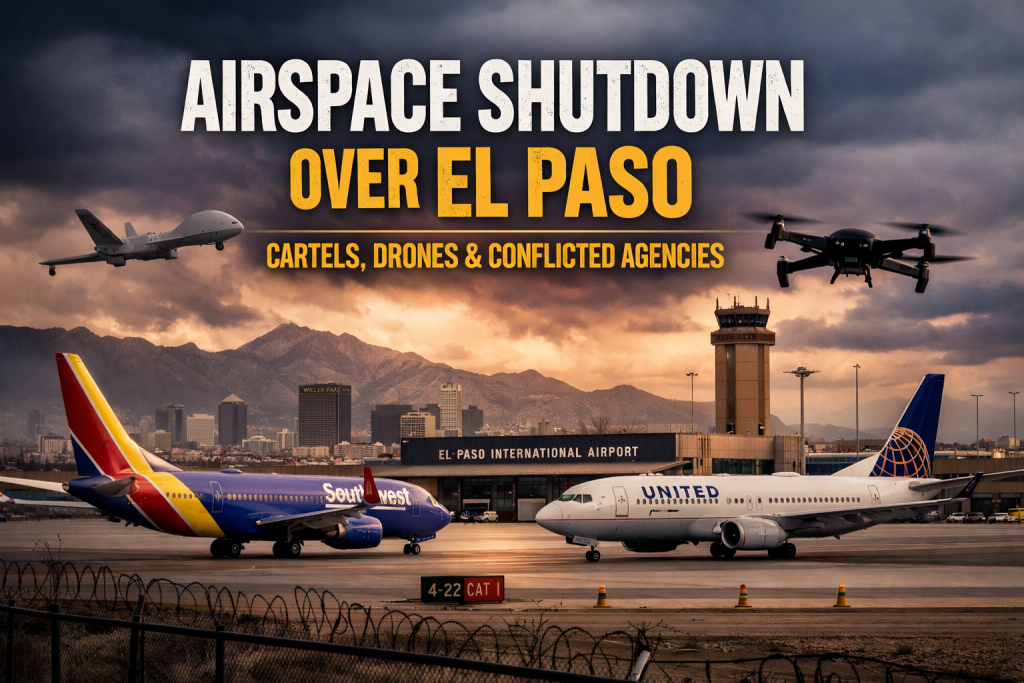
What a Cartel Drone Incursion Reveals About Federal Coordination and Public Communication
By Aaron Christopher Knapp
Investigative Journalist
On Wednesday morning, commercial airspace over El Paso, Texas was abruptly restricted under what the Federal Aviation Administration initially described as “special security reasons.” Flights in and out of El Paso International Airport were halted. A Temporary Flight Restriction was issued. The original timeline suggested the shutdown could remain in place until February 20, a ten day window that would have represented one of the most unusual civilian airspace closures in recent years.
Within hours, the restriction was lifted.
The FAA later stated that there was no threat to commercial aviation and that normal operations had resumed. Transportation Secretary Sean Duffy said federal authorities “acted swiftly to address a cartel drone incursion,” adding that the threat had been neutralized and there was no danger to commercial travel.
That explanation resolves the immediate concern. It does not resolve the broader one.
The Drone Factor
Reporting from CBS News indicates the shutdown stemmed from drone activity in and around the El Paso region. Two airline sources told CBS that carriers were given the impression the halt was imposed out of an abundance of caution because the FAA could not predict where U.S. government drones might be operating.
That detail is significant.
According to the report, the Department of Defense has been using a base near the airport to conduct drone operations aimed at countering cartel drone activity. However, detailed flight information was reportedly not being shared with the FAA. Without that information, civilian air traffic managers could not reliably coordinate commercial aircraft in the affected airspace.
Cartel operated drones, of course, are not filing flight plans or coordinating with air traffic control. When government counter drone systems are layered on top of uncoordinated hostile drones, the airspace becomes unpredictable. In aviation, unpredictability is unacceptable.
CBS reported that flights were permitted above 17,999 feet, an altitude at which drones typically do not operate. That suggests the concern was not commercial aircraft at cruising altitude but the transitional phases of flight. Takeoff. Climb. Descent. Approach. The most vulnerable windows in any flight profile.
Interagency Silence
If the reports are accurate, what occurred was not simply a security event. It was an interagency coordination gap.
The FAA regulates civilian airspace. The Department of Defense conducts military and counter threat operations. When those operations overlap geographically, information sharing is not optional. It is foundational. A shutdown that airlines learned about through a Notice to Air Missions rather than through structured advance coordination raises serious questions about how these processes are being managed in real time.
The airspace restriction was initially scheduled to last ten days. That duration would have had measurable economic and logistical consequences for airlines, cargo carriers, military operations, and the local economy. That it was lifted quickly suggests either the threat was resolved faster than anticipated or the initial scope was broader than necessary.
Neither explanation is inherently alarming. Both demand clarity.
Political Reaction
U.S. Representative Veronica Escobar called the original ten day shutdown “highly consequential” and described it as unprecedented. She stated there was no immediate threat to the community based on information available to her office and noted that neither her office nor local airport officials received advance notice.
When federal action of this magnitude occurs without structured notification to local leadership, it creates a vacuum. That vacuum will always be filled by speculation.
Speculation thrives in silence.
Airline Response
United Airlines issued a travel waiver allowing affected passengers to reschedule without change fees or fare differences for specific travel dates. Southwest Airlines paused operations at the direction of the FAA and later resumed flights once restrictions were lifted, urging passengers to confirm flight status before traveling.
Operationally, the airlines adapted. That is what airlines do. They are built around contingency planning.
The public is not.
The Larger Question
Drone warfare and counter drone operations are no longer theoretical issues confined to overseas battlefields. They are present along the southern border. They are intersecting with civilian infrastructure. They are affecting regulated airspace in American cities.
The federal government acted. The threat was neutralized. Flights resumed. That is the official narrative and it may be entirely accurate.
But what this incident exposes is something larger than a single drone incursion. It reveals how fragile the coordination architecture can be when military countermeasures, hostile non state actors, and civilian transportation systems occupy the same geographic corridor.
Airspace is not abstract. It is regulated, mapped, sequenced, and engineered around predictability. When predictability collapses, the only safe option is restriction.
For now, the skies over El Paso are open.
The deeper question is whether the systems that manage those skies are keeping pace with the evolving threats that operate within them.
Final Thought
What happened over El Paso this week should give every traveler pause, even if your itinerary did not include Texas. The sudden closure of civilian airspace, the involvement of cartel linked drones, and the apparent disconnect between defense operations and the Federal Aviation Administration do not represent a passing blip. They represent a collision of forces we have allowed to coexist without fully reckoning with what that means for civilian safety, federal transparency, and interagency cooperation. When a cartel driven threat can trigger a shutdown of commercial airports, even temporarily, the issue is no longer abstract or distant or confined to press releases. It is real, and it is here.
The FAA lifted the restriction, saying there is no danger to commercial travel, and that is what we are told we should accept. Transportation Secretary Sean Duffy says the threat was neutralized. Airlines adapted. But responses and reassurances do not eliminate the structural problems this event exposed. The FAA should not be left explaining an airspace shutdown on social media. The Defense Department should not operate in ways that airspace managers cannot predict. Local officials should not learn of events of this scale after the fact. Public trust depends on something better, something more precise, something that prioritizes public safety and public notice without leaving gaps that are filled only by speculation and unease.
We can resume our flights and our routines. That is the immediate outcome. But we should also ask how we will prevent this from happening again, and how we will hold national authorities accountable when failures in communication threaten the public’s right to know and to travel without disruption.
Sources and Attribution
This report is informed in part by coverage from KHOU and CBS News. You can read the reporting that helped inform this analysis here: https://www.khou.com/article/news/local/texas/el-paso-airport-flights-canceled-faa-restriction/285-cf126381-e204-4bb8-af78-2520454f5e52?utm_medium=social&utm_source=facebook_KHOU_11_News&fbclid=IwY2xjawP5lPdleHRuA2FlbQIxMABicmlkETFlc01lRlpRbEVXdks4dEkzc3J0YwZhcHBfaWQQMjIyMDM5MTc4ODIwMDg5MgABHucrHzOH2u2LYvxcsv3volXQr2FeJtfXxb54Utp4Zr6d6c-yWHRkZwiiXPMz_aem_UqNeuZaiFxeI7skYxoOe2A
Disclaimer
The views expressed in this report are my own and do not constitute legal advice, nor are they endorsed by any agency or institution. This analysis is based on available reporting and statements from federal agencies at the time of publication. Information is subject to change as more facts emerge.
Lorain County Notice
The contents of this article are intended for general informational and public interest purposes. Nothing in this report should be construed as professional advice, nor does publication imply endorsement of any specific legal, governmental, or policy position. All readers are encouraged to verify independent sources, official government announcements, and primary documents before drawing their own conclusions about matters of public safety and federal action.
All rights reserved, © 2026.
About The Author