

The Enforcement Model in Lorain City Schools
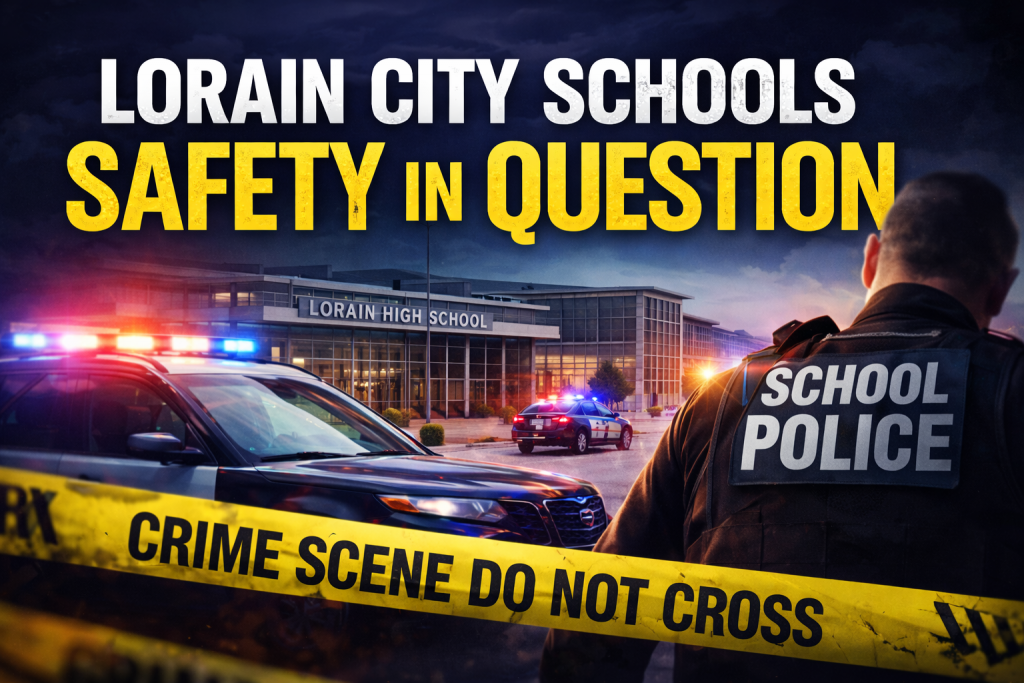
How Lorain City Schools Turned Student Safety Into Enforcement Without Accountability
By Aaron Knapp
Investigative Journalist
Lorain Politics Unplugged
Independent accountability reporting on public institutions in Lorain County
Introduction
This Is Not a Safety Program. It Is an Enforcement Regime Without Safeguards.
Lorain City Schools repeatedly presents its approach to student safety as student centered, preventative, and responsive to community concern. That framing is carefully chosen and consistently repeated. It suggests an environment rooted in care, preparation, and proportional response. The record tells a different story. What the district has built is a security apparatus that mirrors law enforcement in posture and authority, while lacking the transparency, external oversight, training requirements, and accountability structures that even modern policing is formally required to maintain. Safety, as practiced, is not grounded in educational best practice. It is grounded in control.
This is not a story about a bad day, a single altercation, or one employee making the wrong call in the moment. It is a story about design. It examines how Lorain City Schools staffed its safety department, how power was consolidated, how discipline was applied unevenly, and how resignation repeatedly functioned as a pressure release valve when serious questions emerged. It documents a system in which the appearance of action replaced the substance of accountability, and where the exit of an employee was treated as resolution rather than as the beginning of institutional self examination. What emerges is not a collection of unfortunate coincidences, but a coherent pattern produced by structural choices.
At the center of this system is Reuben Figueroa, whose authority extends across supervision, discipline, internal investigation, and coordination with external law enforcement. These functions are normally separated precisely because each carries its own risk of bias, conflict, and institutional self protection. When they are collapsed into a single role without formal firewalls, independent review, or mandatory recusal standards, the result is not efficiency. It is insulation. Decision making collapses inward. Accountability becomes internal. Safety becomes something that is asserted rather than demonstrated.
Safety becomes something that is asserted rather than demonstrated.
What ultimately distinguishes this system is not merely who held authority, but what Lorain City Schools treated as acceptable when placing adults in power over children during moments of crisis. The district did not define safety through preparation, child specific expertise, or preventative capacity. It defined safety through presence, uniform, and enforcement posture. That choice shaped every downstream outcome. It determined who was hired, who was disciplined, who was protected, and who was quietly removed when scrutiny became inconvenient. More than any single incident, that definition explains why what is labeled a safety program functions instead as an enforcement regime without safeguards.
What School Security Actually Requires
Evidence From Research, Not Assumptions
School security is not generic security work, and decades of research now make that distinction unavoidable. It is one of the most complex roles inside a public education system because it places adults in direct, unscripted contact with minors during moments of emotional escalation, disability related behavior, trauma response, bullying, and physical conflict. Students are not compliant adults. They are children and adolescents whose behavior is shaped by brain development, environmental stress, disability status, and instability far beyond the classroom walls.
National data underscores how dramatically schools have shifted toward enforcement oriented safety models. According to research compiled by the Learning Policy Institute, more than ninety percent of U.S. public schools now rely on high visibility security measures. Approximately ninety seven percent use surveillance cameras to monitor buildings. More than seventy six percent have interior classroom door locks, and over sixty percent rely on staff to control access to school grounds. By the 2019–2020 school year, roughly sixty five percent of public schools reported having security staff or school resource officers present at least once per week.
What matters is not how widespread these measures are, but what they actually accomplish.
The research record is clear and deeply uncomfortable for districts that equate security with safety. Studies consistently show that while physical security measures may increase perceptions of safety for some adults, they do not reliably reduce incidents of violence, bullying, or disruption. In some cases, especially when measures become more punitive or carceral in appearance, they increase student fear, anxiety, and disengagement. Metal detectors, heavy enforcement presence, and policing tactics have shown limited effectiveness in preventing violence and are associated in multiple studies with a deterioration in school climate.
By contrast, the strongest protective factor against violence, bullying, and chronic absenteeism is not enforcement. It is relationship.
The Learning Policy Institute and related research bodies have repeatedly found that school connectedness, defined as positive, trusting relationships between students and staff, is the most powerful predictor of student safety outcomes. Schools where students feel known, respected, and supported experience fewer violent incidents, lower absenteeism, and better academic outcomes, even in high poverty environments. That finding holds across urban, suburban, and rural contexts.
This distinction is not academic. It defines what kind of adults should be placed in security roles.
Effective school safety models emphasize de escalation, relationship building, situational awareness, disability accommodation, and early intervention. Physical force is treated as a last resort, not a default response. Staff are trained to recognize trauma responses, understand special education protections, and intervene before conflict turns physical. Preparation matters more than presence. Judgment matters more than dominance.
Lorain City Schools did not build its safety department around that evidence base.
A review of personnel files shows that many security officers hired by the district lacked documented experience working with children, adolescents, or youth in educational or therapeutic settings. Training histories are thin. Certifications, where present, skew toward enforcement or general security credentials rather than child centered competencies. There is little evidence of required preparation in trauma informed care, de escalation frameworks, special education law, or restorative practice. This is not a moral judgment of the individuals hired. It is an institutional failure to define and enforce a standard that matches the job being performed.
Compensation further highlights the mismatch. Security officers were reportedly paid upward of twenty dollars an hour. There was a time when that wage signaled a professionalized role with commensurate training, supervision, and accountability. In today’s labor market, it often reflects availability rather than specialization. A wage does not create expertise. Without structured educational tracks, ongoing training, and supervision grounded in evidence based school safety practice, pay becomes a substitute for preparation rather than a reflection of it.
The conditions under which these officers were deployed magnified the risk. Security staff were routinely placed into environments where they were outnumbered by students by ratios of ten to one or more, particularly during transitions, lunch periods, or moments of heightened stress. Research shows that in such conditions, enforcement strategies are not only ineffective but destabilizing. Physical control is neither realistic nor appropriate. De escalation is not optional. It is the only viable strategy.
Federal research reinforces this conclusion. Studies cited by the National Institutes of Health show that increased security presence does not correlate with reduced bullying, which nearly half of teachers and principals continue to rank as their top safety concern, well above fears of mass violence. Roughly seven percent of students report avoiding areas of their school or skipping school entirely due to safety concerns, a figure that rises in environments perceived as hostile or punitive. Safety that drives avoidance is not safety. It is displacement.
Safety that drives avoidance is not safety. It is displacement.
When adults without child specific preparation are placed into volatile school environments, escalation is not a remote possibility. It is a predictable outcome. Conflicts intensify. Physical interventions increase. Incidents multiply. And when those incidents are later treated as individual failures rather than as symptoms of a structurally flawed staffing model, the cycle repeats.
School security is not about enforcing compliance. It is about preventing harm in environments where harm is most likely to occur. The research is settled on that point. It requires training, relational capacity, and an educational lens. Lorain City Schools chose a model rooted in enforcement posture rather than evidence. The consequences were not accidental. They were built in from the start.
Mark Moos
The Standard the District Failed to Apply
Among the safety officers reviewed, Mark Moos stands apart because his personnel file documents sustained direct experience working with children and adolescents before and during his tenure in Lorain City Schools. This is not an inference. It is reflected plainly in the district’s own records.
Prior to and concurrent with his appointment as a Safety Compliance Officer, Moos worked in student-facing roles that required daily interaction with youth in structured, supervisory, and mentoring capacities. His application materials list service with the Boys and Girls Club of Lorain County, where he served as a Tutor and Mentor, a role that involves academic support, behavioral guidance, and relationship building with minors, often from high-need backgrounds. That experience is categorically different from general security or enforcement work. It reflects familiarity with child development, boundary setting, and non-punitive intervention, all core competencies for school safety roles.
Moos’s personnel file also documents extensive involvement in student activities and athletics, including multiple years as Head Wrestling Coach at Lorain High School under pupil-activity contracts governed by Ohio Revised Code 3313.53. Coaching is not incidental experience. It places adults in positions of authority over minors during emotionally charged, high-stress situations, requiring de-escalation, discipline without force, and constant judgment about student welfare. The district repeatedly entrusted Moos with these responsibilities, renewing contracts across multiple school years, signaling institutional recognition of his suitability to work with students in challenging contexts.
Mark Moos did not fail to meet the standard of school safety work. Lorain City Schools failed to adopt his experience as the standard.
Within the district itself, Moos’s evaluations further reinforce this profile. Performance reviews describe him as collaborative with administrators, engaged with families and community members, supportive of student attendance and truancy interventions, and attentive to professional development. The evaluation language emphasizes communication, problem solving, and reflective practice, not enforcement metrics or command presence. These are precisely the traits identified in national research as protective factors in school safety environments.
In a functioning system, this background would not have been exceptional. It would have been the benchmark. It would have defined the hiring standard for school safety personnel. It would have shaped training expectations and supervision philosophy across the department. It would have reflected an understanding that safety in schools depends on adults who can interpret behavior through a developmental and relational lens.
Instead, Moos’s background became the exception rather than the model.
His personnel file reflects formal discipline, documented escalation, and punitive response. Moos alleged that discipline against him was disproportionate and selectively enforced. Whether one accepts every allegation or not, the contrast in the documentary record is undeniable. His conduct was scrutinized through formal processes. Other safety officers, whose files do not reflect comparable child-centered preparation, were permitted to exit quietly through resignation without documented investigative conclusions.
That inversion is not neutral. It reveals institutional priorities.
When a district disciplines the employee whose documented experience most closely aligns with evidence-based school safety practice, while allowing others to leave without findings, it sends a clear signal about what it values. Child-centered preparation was not rewarded. Experience working with students was not elevated. Proximity to authority and alignment with enforcement culture carried greater institutional weight.
Mark Moos did not fail to meet the standard of school safety work. Lorain City Schools failed to adopt his experience as the standard.
Proximity Hiring
Staffing Schools with Authority Instead of Preparation
The dominant pattern in Lorain City Schools security staffing was not competitive recruitment, specialized preparation, or evidence based qualification. It was proximity. Entry into the safety apparatus repeatedly flowed from availability and familiarity rather than from demonstrated readiness to work with children in crisis.
Personnel records show that several security officers entered the district not through documented vetting for child centered competencies, but through roles adjacent to the system itself. Sean Otero is illustrative. Before assuming duties that placed him in direct, discretionary contact with students during volatile situations, Otero worked as a crossing guard, followed by part time security. Crossing guard service is important and valuable work, but it is not preparation for managing adolescent conflict, disability related behavior, trauma response, or school based de escalation. It involves traffic control, adult compliance, and fixed routine, not behavioral intervention or student supervision inside enclosed environments.
That distinction matters because the district treated proximity as qualification. Transitioning from crossing guard to part time security, and then into student facing safety enforcement, occurred without evidence of intervening training in child development, trauma informed care, special education law, or restorative practice. The personnel files do not reflect a structured evaluation of whether that background prepared an individual to exercise authority over minors in emotionally charged settings. The pathway prioritized familiarity with the system over readiness for the role.
This was not limited to one hire. Many security officers entered the department through familiarity with leadership, law enforcement culture, or internal networks rather than through documented assessment of child centered qualifications. The files do not show a consistent effort to vet candidates for experience with students, disabilities, trauma exposure, or educational environments. Instead, they reflect an assumption that general security presence could be adapted to schools without fundamental re-preparation.
That assumption is flawed.
This approach treated schools as interchangeable with other security settings. They are not. Schools are developmentally complex environments governed by a distinct body of law and ethics. Authority functions differently when exercised over children. The margin for error is narrower. The consequences of escalation are greater.
The deployment conditions compounded the risk. Security officers were routinely placed into buildings and common areas where they were outnumbered by students by ratios that frequently exceeded ten to one, particularly during lunch periods, class transitions, assemblies, or high stress moments. In those circumstances, physical control is neither realistic nor appropriate. Enforcement posture collapses quickly. De-escalation, relationship management, and anticipatory intervention become the only viable tools.
Authority without preparation in a school environment is not strength. It is exposure.
Yet de escalation training was not the consistent foundation of the department. Instead, authority was emphasized first, with preparation treated as secondary or optional. That inversion is dangerous. Authority without preparation in a school environment is not strength. It is exposure. It increases the likelihood of escalation, misinterpretation, and harm, not because individuals intend to fail, but because the system placed them into roles they were never properly prepared to perform.
This is what proximity hiring produces. It fills positions quickly. It satisfies staffing needs on paper. But it substitutes familiarity for fitness and availability for competence. In a school environment, that substitution does not merely lower standards. It creates predictable risk for students, staff, and the district itself.
Reuben Figueroa
When Safety Leadership Mirrors Law Enforcement Instead of Education
The Director of Safety and Security in a public school district occupies one of the most sensitive and consequential roles in the entire institution. That position does not merely supervise personnel. It defines how conflict is interpreted, how student behavior is framed, and whether moments of crisis are treated as educational breakdowns requiring support or as enforcement problems requiring control. The philosophy embedded in that role determines whether safety is preventative and student centered or reactive and punitive.
Effective leadership in this position requires grounding in child development, disability law, trauma informed care, de escalation frameworks, and mandatory reporting obligations. It requires familiarity with how adolescent brains process stress, how trauma manifests behaviorally, and how special education protections constrain and guide adult intervention. Above all, it requires an understanding that safety in schools is inseparable from trust, relationship, and proportionality.
Reuben Figueroa does not come from that professional lineage. His background is in law enforcement. He is not an educator. He is not a licensed social worker. He is not trained as a school psychologist, behavioral intervention specialist, or special education professional. While he also serves as a pastor, faith leadership does not substitute for formal training in educational safety governance, student protection law, or evidence based intervention models. These distinctions are not personal critiques. They are professional realities that shape how authority is exercised.
This distinction is not semantic. It determines outcomes.
Law enforcement culture is built around control, authority, compliance, and command structure. Those tools are designed for adult populations and criminal contexts. Educational safety demands something fundamentally different. It requires proportional response, prevention over reaction, relationship building over dominance, and judgment calibrated to developmental capacity rather than compliance. When enforcement culture is imported wholesale into schools, escalation becomes normalized because the framework used to interpret behavior is mismatched to the environment.
Under Figueroa’s leadership, Lorain City Schools’ safety posture increasingly reflected that mismatch. Uniformed presence expanded. Command hierarchy was emphasized. Enforcement aesthetics became more visible. Preventative infrastructure, including robust training in de escalation, trauma response, disability accommodation, and restorative practice, remained comparatively thin. The system signaled authority more clearly than it built capacity.
Safety leadership that mirrors law enforcement rather than education does not fail loudly. It fails structurally.
This shift did not occur in isolation. Leadership posture shapes departmental culture. When safety is framed primarily through an enforcement lens, hiring priorities follow that frame. Supervision reinforces it. Discipline is applied through it. Over time, the department comes to resemble policing by proxy rather than educational protection, even when operating inside classrooms and hallways rather than on streets.
The consequence is not merely a change in appearance. It is a change in how students experience authority. In environments already marked by instability, poverty, disability, and trauma, enforcement first approaches increase fear, resistance, and disengagement. They do not reduce conflict. They intensify it.
Lorain City Schools did not simply place a law enforcement professional into an educational role. It allowed a law enforcement framework to define what safety meant inside its schools. That choice shaped staffing, training, discipline, and response. And once that framework took hold, the system became less capable of recognizing its own failure, because escalation came to be interpreted as evidence of danger rather than as evidence of misalignment.
Safety leadership that mirrors law enforcement rather than education does not fail loudly. It fails structurally. It appears decisive. It looks firm. But it produces a system that manages crisis instead of preventing it, controls behavior instead of understanding it, and asserts safety rather than earning it.
That is the posture Lorain City Schools adopted. And it explains why safety, as implemented, functioned as enforcement without the safeguards students require.
Dual Authority Without Firewalls
When the Same Person Oversees Safety and Policing
Reuben Figueroa’s authority inside Lorain City Schools is further complicated by his simultaneous service as a part time police officer with the City of Lorain. This dual role is not a technical footnote. It is a structural governance problem that goes to the heart of how student incidents are interpreted, escalated, and resolved.
As Director of Safety and Security, Figueroa holds the discretion to determine whether incidents involving students are handled internally as school discipline matters or referred externally to law enforcement. That discretion carries enormous consequence. It shapes whether an event becomes an educational intervention, a special education accommodation, a mandatory reporting matter, or a criminal referral. It determines what documentation is created, who controls it, and how the public ultimately learns of the incident, if at all.
As a police officer, Figueroa operates under an entirely separate chain of command, different statutory authority, different liability standards, and different institutional incentives. Law enforcement is governed by criminal procedure, qualified immunity doctrines, and investigatory secrecy norms that do not apply to school administrators. When the same individual occupies both roles, the decision to escalate or contain an incident is no longer subject to independent evaluation. It is internalized within a single authority structure.
When dual authority is allowed to operate without firewalls, safety does not become more effective. It becomes less accountable.
This is not a theoretical concern. It directly affects whether incidents involving students are formally investigated, fully documented, disclosed under public records law, or quietly resolved through internal means that foreclose scrutiny. It affects whether potential conflicts are surfaced or suppressed. It affects whether the threshold for law enforcement involvement is applied consistently or selectively.
In systems designed to protect children, this kind of dual authority is treated as a red flag. Best practices require formal firewalls, written recusal standards, and independent review mechanisms to ensure that personal role conflicts do not shape institutional outcomes. Those safeguards exist precisely because the stakes are high and the incentives are misaligned.
The public record in Lorain does not reflect the presence of such safeguards. There is no documented recusal protocol governing when the Director of Safety must step aside. There is no evidence of independent review of escalation decisions. There is no clear separation between school based authority and police based authority when incidents cross that boundary.
Instead, accountability becomes circular. Decisions are made internally, reviewed internally, and justified internally. The same individual who determines the course of action is positioned to influence how that action is documented and explained. Transparency becomes discretionary. Oversight becomes symbolic.
When dual authority is allowed to operate without firewalls, safety does not become more effective. It becomes less accountable. And in a school system, where the subjects of that authority are children, that is not merely a governance flaw. It is a systemic risk.
Sean Otero
Enforcement Experience in a Child Centered Environment
The case of Sean Otero illustrates, in concrete terms, the consequences of Lorain City Schools’ staffing philosophy when proximity and availability are treated as substitutes for preparation.
Otero’s personnel file reflects a background rooted in enforcement adjacent roles rather than education, youth services, or child centered intervention. Prior to assuming duties that placed him in direct, discretionary contact with students, his experience consisted of work as a crossing guard followed by part time security. Both roles involve public safety functions, but neither provides preparation for managing adolescent behavior, disability related escalation, trauma response, or the legal and ethical obligations that govern adult intervention in schools. Crossing guard service is structured, predictable, and compliance based. School safety work is none of those things.
There is no documentation in Otero’s file reflecting experience in therapeutic settings, educational environments, behavioral intervention programs, or youth development roles. There is likewise no indication of required training in child development, trauma informed care, de escalation frameworks, or special education law prior to his placement in student facing security roles. Despite that absence, he was assigned to environments where conflict was frequent, emotions were heightened, and judgment carried immediate consequences for minors.
District records later reference Otero physically “breaking up a fight” involving students. That phrase is often offered as evidence of intervention or effectiveness. In reality, it should prompt a more foundational inquiry. Why was a safety officer without documented child centered preparation repeatedly encountering situations that escalated to physical contact? What preventative tools was he equipped with before force became the mechanism of resolution? And what supervisory safeguards existed to ensure that physical intervention was truly a last resort rather than a predictable outcome of inadequate preparation?
Employment ended. Institutional learning did not occur.
In child centered safety models, physical intervention is treated as a failure of prevention, not a marker of success. It signals that earlier opportunities for de escalation, relationship building, or environmental control were missed or unavailable. When officers are trained primarily in enforcement rather than in youth specific intervention, those opportunities narrow quickly. Escalation becomes more likely, not because of intent, but because the framework used to interpret behavior is mismatched to the setting.
That mismatch became more consequential when Otero was later placed on paid administrative leave for what the district itself described as “an incident involving yourself and a student of the district.” The language is deliberately vague, but its implications are not. The incident was serious enough to remove him from duty, yet the personnel file does not reflect a completed investigation with documented findings, conclusions, or corrective action. Instead, a resignation followed.
Employment ended. Institutional learning did not occur.
This pattern is not incidental. When individuals are hired into roles for which they are not properly prepared, the system is more likely to resolve problems by separation rather than by examination. Resignation becomes a pressure valve that releases scrutiny without requiring answers. The district avoids public findings. Leadership avoids reflection. Structural flaws remain intact.
The Otero case is not a story about one individual failing. It is a story about a system that placed an adult into a child centered environment without equipping him for the realities of that environment, then declined to confront the implications when that mismatch produced harm. In doing so, Lorain City Schools missed an opportunity to correct course, raise standards, and redefine what safety work in schools actually requires.
Instead, it reinforced the same staffing philosophy that created the risk in the first place.
Selective Discipline
When Accountability Depends on Relationships
The most revealing evidence of leadership is not found in policy manuals, mission statements, or public assurances. It is found in how discipline is applied when authority is tested and when outcomes carry reputational or legal risk. Inside Lorain City Schools’ Safety and Security Department, the personnel files tell a consistent and troubling story. Accountability was not applied evenly. It was applied selectively.
A review of multiple safety personnel files under Reuben Figueroa’s supervision shows a pattern of inconsistent documentation, uneven escalation, and a recurring reliance on resignation as a substitute for formal findings. In some cases, discipline was swift, structured, and procedurally complete. In others, serious concerns appear to have ended quietly the moment employment ended, with little or no documented conclusion. The difference does not appear to turn on the seriousness of the underlying conduct alone. It turns on who was involved.
The contrast between the handling of Mark Moos and Sean Otero is unavoidable. Moos, the officer whose background most closely aligned with child centered safety practice and prior experience working with youth, faced formal discipline, documented escalation, and punitive response. His file reflects scrutiny, process, and consequence. Otero, whose background did not reflect comparable preparation for working with children, exited quietly following paid administrative leave tied to an incident involving a student. His file reflects separation without a documented investigative conclusion.
Under such a model, accountability is not a principle. It is a variable.
That inversion matters. In a system committed to learning and accountability, discipline should be proportionate, transparent, and consistent. It should not penalize preparedness while insulating proximity. Yet the records show precisely that outcome. The officer whose experience reflected what school safety research identifies as protective was subjected to the most formal sanctioning process. The officer whose preparation was enforcement adjacent and mismatched to the environment was allowed to depart without resolution.
This pattern does not end with those two cases. Other personnel files, including those of Lynsey Pavlik, Carmen Ransom, Charles Edwards, and Anthony Cornell, reflect similar gaps. Separation paperwork exists. Resignation letters exist. Personnel action forms exist. What is often missing are documented investigative conclusions, findings, or institutional lessons that would normally be expected when student safety is implicated. Employment ends. The file closes. The questions remain unanswered.
Staff accounts describing an internal culture where outcomes depended less on conduct and more on proximity to leadership are not contradicted by the record. They are reinforced by it. When discipline appears rigorous in some cases and truncated in others, when resignation repeatedly functions as closure rather than as the beginning of accountability, the message to staff is unmistakable. Enforcement is discretionary. Standards are situational. Process bends to relationship.
This is not how a safety department earns trust. It is how it erodes it.
Selective discipline has predictable consequences. Internally, it collapses morale and discourages professionalism, because employees learn that preparation and good practice do not protect them from sanction while alignment and familiarity may. Externally, it undermines public confidence, because parents and community members cannot be assured that serious incidents are examined fully rather than managed quietly. Institutionally, it prevents learning, because systems only improve when failures are documented, analyzed, and addressed rather than exited.
What these files collectively reveal is not a department governed by clear and consistently applied standards, but one governed by judgment calls filtered through relationships. Under such a model, accountability is not a principle. It is a variable. And when the safety of children depends on variables rather than standards, the system is already failing, whether or not it admits it on paper.
Conflicts Without Recusal
When Personal Relationships Override Safeguards
Public records establish that Reuben Figueroa shared a religious connection with both Sean Otero and the student involved through his church, and later officiated Otero’s wedding. These facts do not, standing alone, establish misconduct. Personal relationships exist in many communities, particularly in smaller cities. But in governance, context is everything. When those relationships intersect with supervisory authority over student safety and internal investigations, they impose heightened duties, not relaxed ones.
In any system genuinely committed to safeguarding students, such overlap would trigger immediate protective measures. Formal recusal would be documented. Supervisory authority would be reassigned to an independent administrator. Oversight of the incident would be externalized to ensure that decisions about investigation, discipline, and disclosure were insulated from personal influence, whether conscious or unconscious. These safeguards exist not because misconduct is presumed, but because impartiality must be demonstrable, not merely asserted.
Impartiality must be demonstrable, not merely asserted.
No such safeguards appear in the public record. There is no documented recusal by Figueroa. Authority was not reassigned. Investigative control was not transferred to an independent party. The same individual who supervised the officer involved, who held discretionary authority over discipline, and who coordinated with law enforcement retained control throughout the process. Oversight remained internal. Continuity of authority was preserved.
That choice matters.
When personal relationships overlap with investigatory authority, the risk is not only actual bias, but perceived bias. For students and families, the question becomes whether their safety was evaluated through neutral process or through relationships that predated the incident. For staff, the question becomes whether discipline is governed by standards or by proximity. For the institution, the question becomes whether accountability is real or performative.
By declining to impose recusal or independent review, Lorain City Schools signaled that continuity of control mattered more than demonstrable impartiality. That posture is incompatible with best practices in student protection. It undermines confidence in outcomes even if those outcomes were reached in good faith, because the process itself was not insulated from conflict.
Safeguards are not punishments. They are protections. When a district chooses not to deploy them in situations where personal relationships and student safety intersect, it does not merely risk criticism. It risks the integrity of the system designed to protect children.
Resources for Authority, Not Prevention
The district’s spending choices reinforce the same priorities that define its safety posture. What Lorain City Schools chose to fund is as revealing as what it chose not to.
The district purchased a high cost sport utility vehicle for Reuben Figueroa, reportedly valued at approximately sixty thousand dollars, and outfitted it in a law enforcement style configuration. This was not a classroom investment. It was not an expansion of counseling services. It was not a training initiative for frontline safety staff working directly with students. It was an investment in authority signaling.
Vehicles do not de escalate conflict. Equipment does not build trust.
Vehicles do not de escalate conflict. Equipment does not build trust. Enforcement aesthetics do not teach adults how to recognize trauma, respond to disability related behavior, or intervene early before situations escalate. What they do is project power. They reinforce hierarchy. They visually align school safety leadership with policing rather than with education.
To parents and educators, the message is unmistakable. Resources are available for symbols of enforcement and command presence, while investment in prevention, training, and student centered safety infrastructure remains limited. Funds can be mobilized quickly to enhance the visibility of authority, yet comparable urgency is not evident when it comes to equipping staff with the skills required to work safely and effectively with children in crisis.
This imbalance is not merely aesthetic. It shapes behavior. When institutions invest in tools of authority rather than in preparation, they implicitly endorse a response first model rather than a prevention first one. Staff learn that compliance matters more than understanding. Students learn that control is prioritized over care. Escalation becomes more likely because the system has been built to manage it, not to avoid it.
Safety, under this model, looks strong. It appears decisive. It signals command. But it functions shallowly. It lacks the depth that comes from training, prevention, and relationship based intervention. And when a safety system is designed to look powerful rather than to be effective, the people it is meant to protect pay the price.
Lorain City Schools did not accidentally arrive at this posture. It funded it.
Why This Matters
Safety Without Standards Is Not Safety
This is not a story about one good guard and several bad ones. Framing it that way would miss the point entirely. This is a story about what Lorain City Schools treated as acceptable, what it normalized, and what it declined to require when the safety of children was at stake.
Mark Moos demonstrated that child centered preparation is not theoretical. It is achievable. His background showed that adults working in schools can be selected, trained, and evaluated with an understanding that student behavior is developmentally driven, that escalation is often a symptom rather than a cause, and that safety depends on judgment and restraint more than authority. The district had a living example of what that standard could look like.
It chose not to make it the standard.
Instead, Lorain City Schools staffed its safety department through proximity and enforcement posture, elevating availability and familiarity over preparation and fitness for working with children. Officers were placed into buildings where they were routinely outnumbered, particularly during lunch periods, transitions, assemblies, and moments of peak stress. In those environments, control based models are not merely ineffective. They are dangerous. De escalation and prevention are not optional tools. They are the only tools that work.
When that model failed, the district did not pause to reassess hiring criteria, training requirements, or supervisory philosophy. It did not elevate standards or impose uniform accountability. It managed the fallout. Resignations replaced findings. Separation replaced learning. Authority remained intact while the underlying structure went unchanged.
This matters because safety in schools is not a cosmetic function. It is not something that can be bolted on through uniforms, vehicles, or command presence. Students are not suspects. Schools are not precincts. And children in crisis cannot be protected by enforcement models that were never designed for them.
Safety without standards is not safety. It is risk management disguised as protection.
Until Lorain City Schools confronts how it defines qualification, how authority is checked, and how accountability is enforced when children are involved, safety governance will remain performative rather than protective. It will look decisive without being effective. It will project strength while lacking depth.
And as long as that remains true, students will continue to bear the cost of choices they did not make, inside a system that still refuses to hold itself to the standards it demands of everyone else.
togther
Final Thought
This Was Never About Safety, Staffing, or Money in Isolation
None of these stories exist on their own. They are not parallel failures. They are the same failure, expressed through different departments, different titles, and different justifications, but driven by the same governing instinct. What has unfolded inside Lorain City Schools is not a series of unrelated breakdowns in academics, finance, communications, or security. It is a single governance culture that repeatedly prioritizes continuity over correction, proximity over qualification, and narrative management over institutional repair.
The academic collapse did not happen in a vacuum. It occurred alongside the recycling of leadership without reckoning, the normalization of retire and rehire arrangements that insulated executives from consequence, and the steady expansion of administrative layers while classrooms were told to absorb austerity. The financial crisis did not arrive suddenly. It was the predictable result of years of top heavy decision making in which restraint was demanded downward but rarely applied upward. The communications apparatus did not grow accidentally. It was elevated deliberately, again and again, whenever credibility eroded, because controlling the explanation of failure became easier than confronting its causes.
The safety department follows the same pattern because it was built by the same logic.
Security was not designed around children. It was designed around authority. Hiring emphasized proximity and enforcement posture rather than preparation for working with students in crisis. Leadership mirrored law enforcement rather than education. Dual roles collapsed oversight instead of strengthening it. Discipline was applied selectively. Resignation became a substitute for accountability. Investment flowed toward symbols of command rather than toward training, prevention, and child centered standards. When that model produced harm, the system did not reform itself. It contained the damage and moved on.
That is the through line.
Across leadership, communications, and safety, Lorain City Schools has repeatedly demonstrated that it knows how to comply with the letter of rules while hollowing out their purpose. Reporting lines are adjusted to preserve relationships. Authority is redistributed on paper while influence remains concentrated in practice. Oversight exists formally but rarely interrupts outcomes. Failure does not disqualify decision makers. It rearranges titles.
This is why Mark Moos matters beyond his own file. He represents the standard the district could have chosen but did not. He demonstrates that child centered preparation is possible, that safety can be grounded in understanding rather than dominance, and that schools do not have to default to enforcement to maintain order. The fact that his preparation was treated as expendable while less prepared officers were insulated tells you exactly what the system values.
It is also why the communications contradictions matter. A district that claims survival level austerity while expanding messaging capacity is not confused about its priorities. It is clear about them. When trust collapses, the response has not been structural reform or accountability. It has been explanation. When outcomes deteriorate, the solution has not been to change who holds power or how decisions are made. It has been to manage perception until the next crisis arrives.
And this is why none of this will be fixed by a new slogan, a new levy, or a new organizational chart.
Lorain City Schools does not suffer from a lack of plans. It suffers from a lack of standards that apply upward as well as downward. It suffers from a governing culture that treats relationships as stabilizing even when outcomes prove otherwise. It suffers from an institutional unwillingness to separate authority from familiarity when doing so would introduce real accountability.
Until that culture changes, every department will continue to reflect the same failure in its own way. Academics will be explained rather than transformed. Finances will be framed as unavoidable rather than examined honestly. Safety will be enforced rather than prepared for. Communications will be expanded to justify decisions rather than to illuminate them.
This is not a call for punishment. It is a call for clarity.
Students are not variables in an administrative experiment. Families are not obligated to trust systems that refuse to evaluate themselves. And public institutions do not earn legitimacy by insisting on patience while insulating leadership from consequence.
Lorain City Schools has reached a point where the question is no longer whether it faces serious challenges. It does. The question is whether it is willing to confront the one challenge it has consistently avoided. Changing how power is exercised, how standards are defined, and how accountability is enforced when the stakes involve children.
Until it does, every crisis will look new. And every outcome will feel familiar.
Further Reading and Related Reporting
- When a Safety Officer Becomes the Risk — How Lorain City Schools handled a student-involved incident inside its own safety department and why the silence matters. (Lorain Politics Unplugged)
- When “Sister Schools” Means Something Else Entirely — Reporting on district plans that could displace an elementary school and the implications for safety, equity, and community stability. (Lorain Politics Unplugged) :contentReference[oaicite:0]{index=0}
- Stay Titan Strong, but Show the Math — Line-by-line reality check on Lorain City Schools’ financial claims and the records that must exist. (Lorain Politics Unplugged) :contentReference[oaicite:1]{index=1}
- The One-Day Retirement: How Lorain’s Superintendent Turned the STRS Rulebook Into a Paycheck — Investigation of Superintendent Jeff Graham’s retire-rehire and its governance implications. (Lorain Politics Unplugged) :contentReference[oaicite:2]{index=2}
- When a Safety Officer Becomes the Risk — Detailed reporting on the Lorain City Schools safety officer Otero handling, administrative leave, resignation, and institutional accountability issues. (AaronKnappUnplugged.com) :contentReference[oaicite:3]{index=3}
- When “Sister Schools” Means Something Else Entirely — Analysis of district consolidation language, safety, and community impact outside the classroom. (AaronKnappUnplugged.com)
Editorial and Legal Disclosure
This article is the product of investigative journalism and public records analysis. Portions of this work were assisted by artificial intelligence tools used solely for drafting support, structural organization, and language refinement. All factual assertions, interpretations, conclusions, and editorial judgments are those of the author. AI tools did not conduct interviews, access nonpublic records, or independently verify facts. All responsibility for content rests with the author.
This publication is not legal advice. Nothing contained herein should be construed as legal counsel, a legal opinion, or a substitute for consultation with a licensed attorney. References to statutes, policies, procedures, or governance practices are presented for informational and journalistic purposes only.
All individuals referenced in this article are presumed innocent of any criminal wrongdoing unless and until proven guilty in a court of law. This reporting addresses systems, structures, documented practices, and institutional governance. It does not allege criminal intent unless explicitly stated and supported by verified records. Descriptions of conduct, discipline, or administrative outcomes are based on available documentation and are not assertions of criminal liability.
This article reflects ongoing reporting. Additional records, responses, or clarifications may alter or expand the factual landscape. The author welcomes good faith corrections supported by documentary evidence.
© 2026 Aaron Knapp
Investigative Journalist
Lorain Politics Unplugged
Published by Knapp Unplugged Media LLC
All rights reserved. Unauthorized reproduction or redistribution without permission is prohibited.
About The Author