

Why I Filed Formal Complaints With the Sheriff, the Attorney General, and the Chronicle-Telegram

Conflicts, Discretion, and the Consequences of Framing Without Context
By Aaron Knapp
Investigative Journalist
Editor in Chief, Lorain Politics Unplugged
This story exists because something subtle but consequential keeps happening across institutions that are expected to act independently, ethically, and within clearly defined limits, yet repeatedly intersect at the same unresolved fault lines. It is not a defamation claim. It is not a demand for retraction. It is not an attempt to intimidate or silence the press. It is a documented account of how conflicts of interest, discretionary decision making, and incomplete public framing can combine to produce reputational and civic harm without any adjudicated finding of wrongdoing and without any institution being required to explain its choices.
Accountability does not require secrecy. It requires completeness.
The sequence matters, because each complaint followed a failure at the level before it.
My first formal complaint was submitted to the Lorain County Sheriff’s Office. That complaint did not simply allege misconduct. It asked a threshold question that any accountable system should be prepared to answer. How does an office that is conflicted on multiple levels lawfully investigate and close complaints, including three complaints I submitted and one in which I was the named complainant, without addressing the conflict itself.

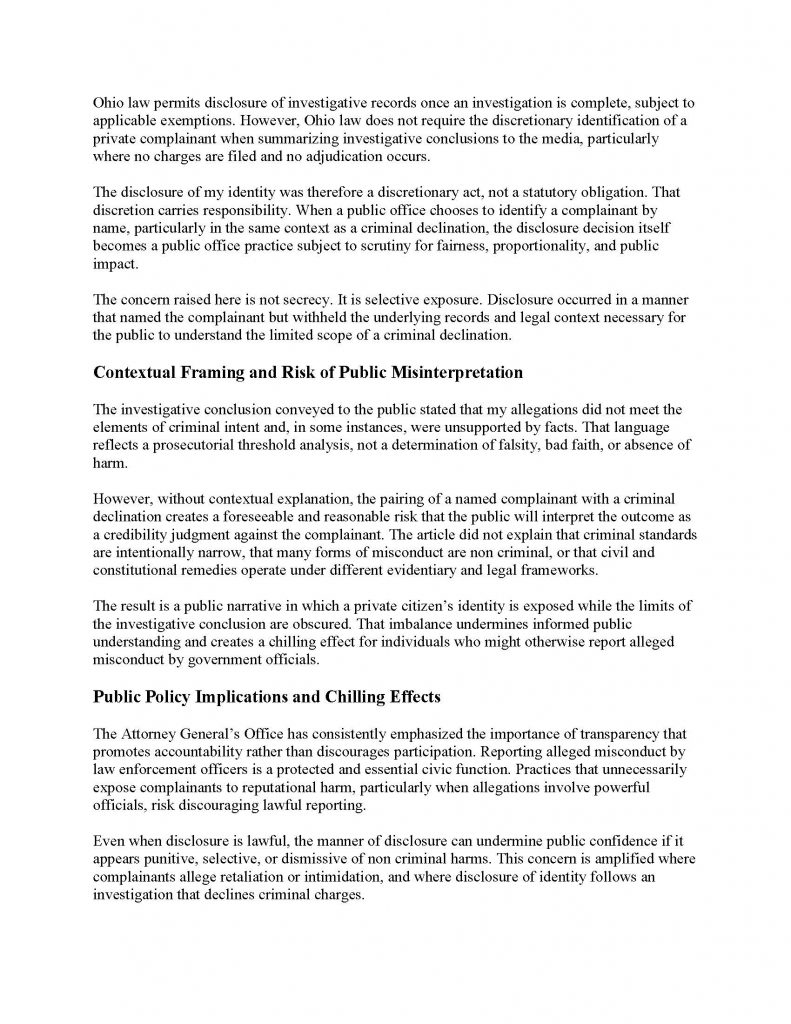
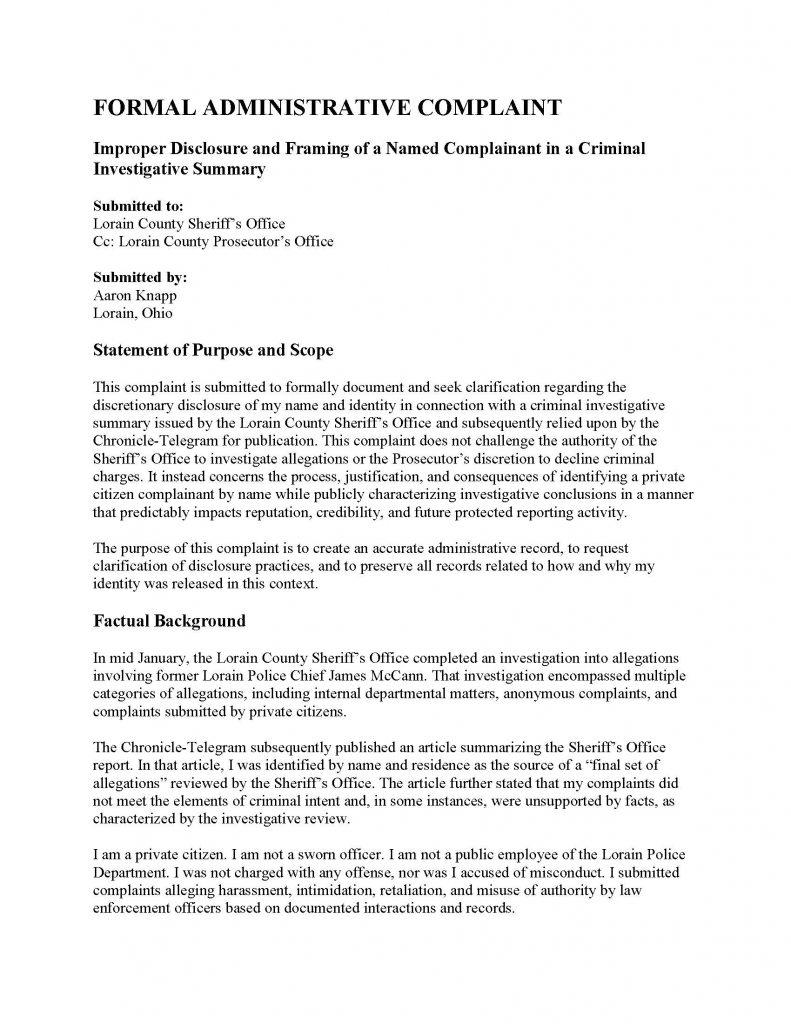
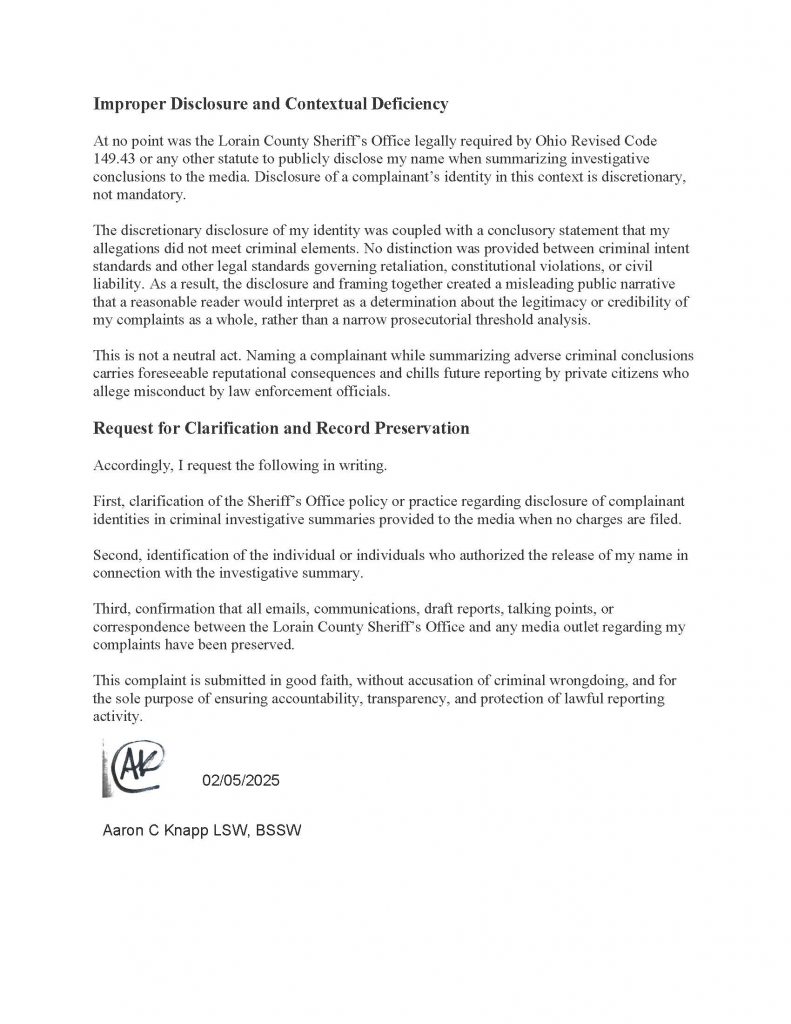
Those conflicts were not hypothetical. They were structural, relational, and institutional. They involved overlapping professional relationships, prior interactions, and direct involvement of the same officials whose conduct or decisions were implicated by the complaints. My request to the Sheriff’s Office specifically sought an explanation of how such an office could credibly act as investigator, evaluator, and closer of matters in which impartiality was plainly in question.
No such explanation was provided.
Instead, the complaints were closed.
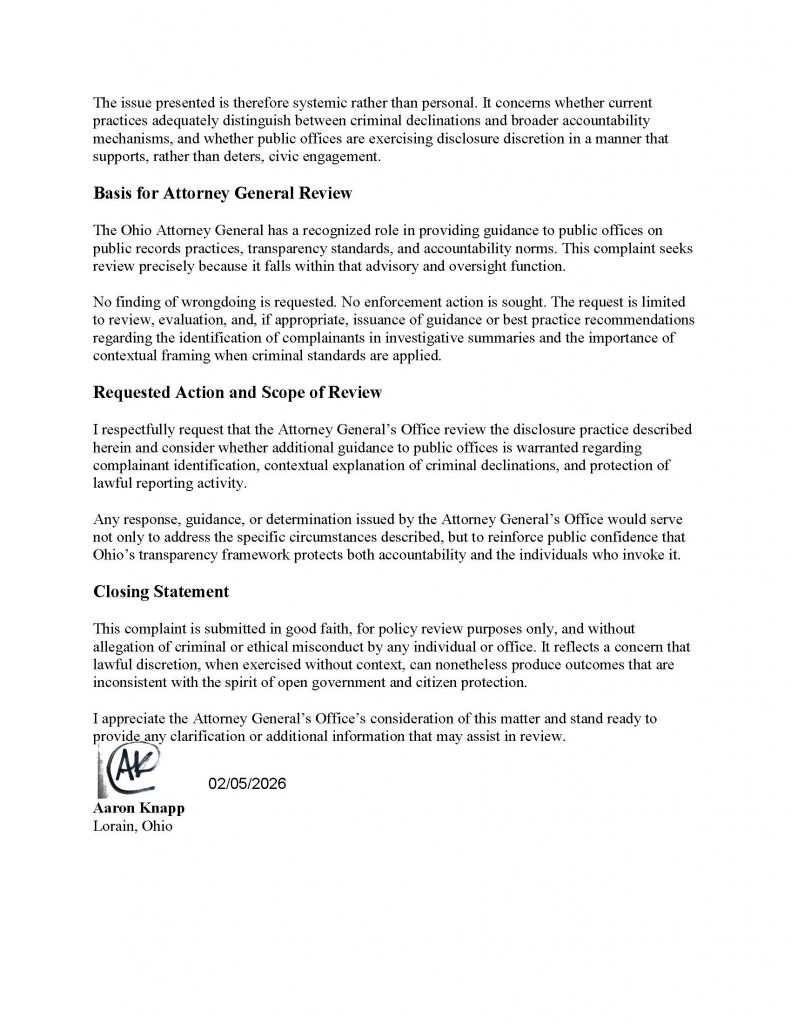
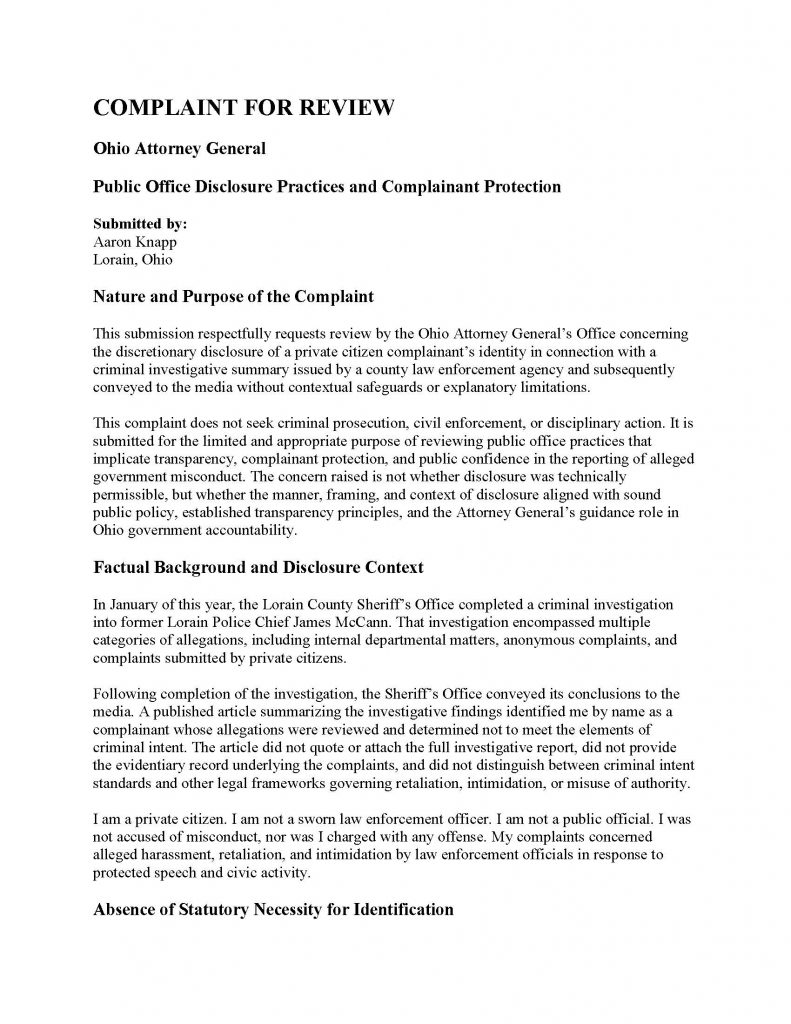
That unresolved issue led directly to my second filing, a policy review complaint with the Ohio Attorney General. That submission did not seek enforcement or punishment. It asked whether the disclosure and handling practices employed by a conflicted office aligned with transparency principles meant to protect citizen participation, rather than chill it, particularly when complainants are private citizens reporting alleged misconduct by public officials.
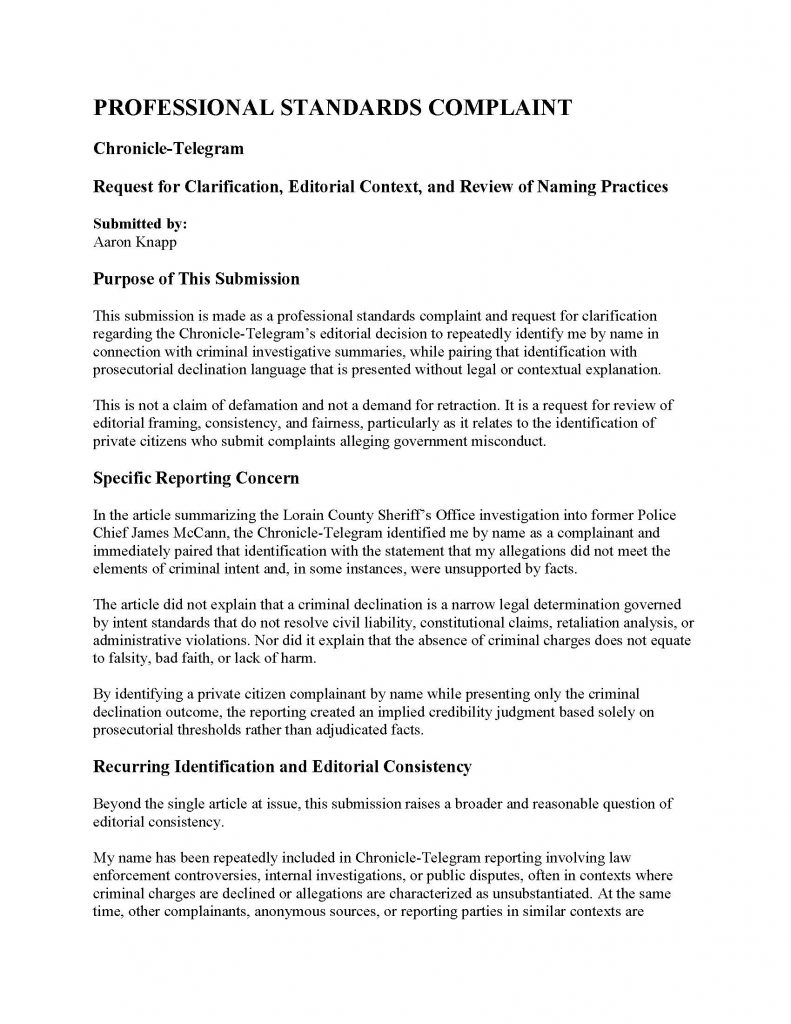
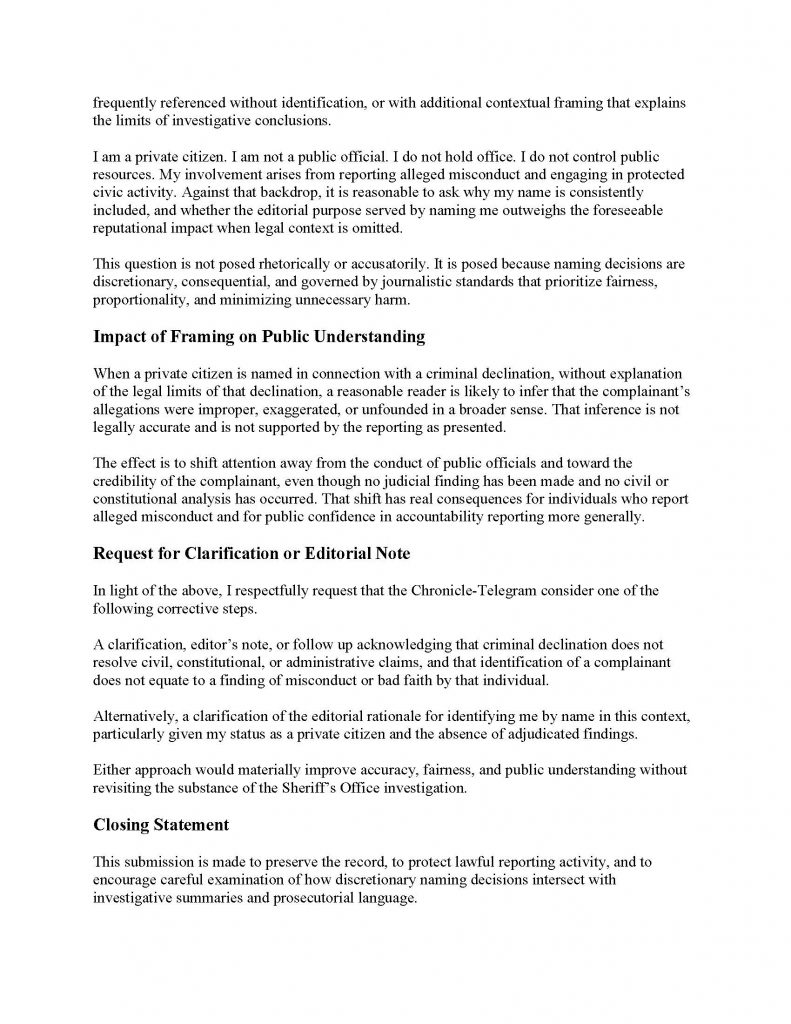
Only after those two actions did I file a professional standards complaint with the Chronicle-Telegram. That complaint addressed a separate, compounding problem that emerged once the actions of a conflicted office were summarized publicly without context.
The issue was not that the paper reported on the investigation. It was how the investigation’s closure, already burdened by unresolved conflicts, was framed.
My name was repeatedly used in connection with a criminal investigative summary involving former Lorain Police Chief James McCann, and that identification was paired with prosecutorial declination language presented without explanation of its legal limits. The reporting did not explain how conflicts were addressed, if at all. It did not explain what a criminal declination does and does not resolve. And it did not distinguish between criminal intent standards and the civil, constitutional, and administrative questions that remain when conflicts go unanswered.
Those omissions matter.
When a private citizen complainant is named in that context, without explaining the narrow scope of a criminal declination and without addressing the conflicts embedded in the investigative process itself, the reporting invites conclusions the law does not support. Attention shifts away from whether the process was sound and toward the credibility of the person who raised concerns, not through accusation, but through implication created by silence.
None of these complaints were filed to relitigate facts or undo coverage. They were filed to examine how discretion is exercised at each stage, by investigators operating under conflict, by oversight bodies asked to review those practices, and by media outlets tasked with conveying outcomes to the public.
That chain of decisions, and the gaps between them, is what this article examines.
How the DNP Was Communicated and What Was Never Answered
The way a prosecutorial decision is communicated often reveals as much as the decision itself.
When Lorain County Prosecutor Anthony Cillo called to inform me of the outcome, he did not describe it as a charging decision reached after presentation or adversarial review. He told me the matters were being closed as a DNP, Do Not Present. In plain terms, the cases were not being presented for charging consideration.
At the time of that call, I was not speaking as a commentator or an observer. I was the named complainant. I was the individual who had submitted multiple complaints, including three complaints I provided to the Sheriff’s Office and one in which I was the complainant, all of which raised overlapping concerns about retaliation, misuse of authority, and institutional conduct.
The call itself was brief and conclusive. There was no explanation of investigative scope. There was no discussion of how conflicts were identified or resolved. There was no acknowledgment of the structural conflict issues I had raised repeatedly in writing.
I asked a narrow and direct question.
I asked how the Prosecutor’s Office and the Sheriff’s Office could investigate and close these matters when the same offices were conflicted on multiple levels, including overlapping professional relationships, prior involvement, and direct institutional exposure. I did not argue the evidence. I did not dispute the merits of the DNP. I asked about process.
Cillo responded that he was not going to argue and ended the call.
There was no subsequent written explanation addressing the conflict question. There was no referral to an independent investigative authority. There was no articulation of how a conflicted prosecutorial office satisfies its obligation of impartial review. The matters were simply marked Do Not Present and closed.
That distinction matters.
A DNP is not an exoneration. It is not a finding that misconduct did not occur. It is a discretionary gatekeeping decision not to advance a matter for charging consideration. It resolves whether a case will be presented, not whether the underlying conduct was proper or whether the investigative structure was sound.
When a DNP is communicated without explanation, and conflict concerns are left unaddressed, the absence of transparency becomes part of the outcome itself.
That unanswered question is what led directly to my subsequent complaint to the Ohio Attorney General and later to my professional standards complaint regarding how this outcome was publicly framed. When a DNP is communicated without explanation, and when conflict concerns are left unaddressed, the absence of transparency becomes part of the outcome itself.
And when that same unexplained DNP later appears in public reporting without context, the gap between what the decision actually means and what the public is likely to infer widens even further.
That gap, not the DNP itself, is what this article places on the record.
When a Name Is Paired With a Declination
In the Chronicle-Telegram article at issue, my name was included as a complainant and immediately paired with language stating that my allegations did not meet the elements of criminal intent or were unsupported by facts. What was absent was any explanation of what that conclusion actually signified, what it did not resolve, or what legal and institutional avenues remained open once a matter was designated Do Not Present.
The article did not explain that a criminal declination, and particularly a DNP, is a gatekeeping decision rather than a finding on the merits. It did not explain that such a determination does not adjudicate retaliation, abuse of authority, constitutional violations, civil liability, or administrative misconduct. And it did not explain that the absence of criminal charges is not a finding that a complainant acted improperly, inaccurately, or in bad faith.
Nothing in the article explicitly accused me of misconduct. Nothing needed to. The framing itself performed the work that an accusation ordinarily would.
That framing cannot be evaluated in isolation. Over a relatively short span of time, the Chronicle-Telegram has published at least seven separate news articles in which I am named, across unrelated subject matter, ranging from public records litigation, to investigative complaints, to campaign activity, to protection order proceedings, to challenges involving city and county government. I am not a public official. I do not hold office. I do not control public resources. Yet my name has appeared with a frequency more typical of an elected official or a criminal defendant than a private citizen engaged in civic reporting.
That repetition matters.
When a private citizen’s name is repeatedly surfaced in news coverage and then placed immediately next to prosecutorial declination language, stripped of legal limits and procedural context, the structure of the presentation invites inference. A reasonable reader is likely to conclude that the individual is unreliable, exaggerating, or not credible. That inference is not compelled by law, it is not supported by an adjudicated record, and it is not required by the underlying facts. It is created by omission and reinforced by repetition.
This is precisely why naming a private citizen complainant in this setting is not a neutral editorial act. It is a discretionary choice with predictable consequences. When legal context is withheld, the burden of interpretation shifts entirely to the reader, and that burden almost always falls on the reputation of the person whose name has been supplied. Over time, repeated exposure converts accountability reporting into something else entirely. A recurring character arc. A quasi-tabloid fixation. A private citizen transformed into a familiar figure not because of proven wrongdoing, but because their name is continually attached to controversy without resolution or explanation.
The Chronicle-Telegram is not a tabloid. It does not present itself as one. That is precisely why this pattern is concerning.
The result is reputational harm without a finding, implication without adjudication, and judgment without process. That outcome does not require malice or intent. It requires only discretion exercised repeatedly and without explanation.
That is the concern this section places on the record.
That this outcome was not inevitable is demonstrated by the fact that other reporting on the same underlying events reached the public without naming me at all.
In separate coverage addressing the county’s handling of related matters, reporter Heather Chapin relied almost entirely on the county’s own narrative and framing. Yet even while largely regurgitating the county’s position, her reporting still managed to convey the outcome without attaching my name to prosecutorial declination language. I noted that contrast explicitly in my own writing at the time, because it underscored a critical point. Naming was not required to tell the story. It was a choice.
That comparison matters because it removes any suggestion that the Chronicle-Telegram’s approach was unavoidable, dictated by law, or necessary for accuracy. Another outlet, working from substantially the same source material, exercised discretion differently and avoided the reputational implications that flow from pairing a private citizen’s name with an unexplained declination.
The difference between those two approaches is not about access or information. It is about editorial judgment.
And when editorial judgment produces materially different outcomes for the same private citizen, the question is no longer whether harm was intended. The question is whether discretion was exercised with sufficient care, proportionality, and regard for the foreseeable consequences.
That is the issue this section, and this article, places squarely on the record.
I Am a Private Citizen, Not a Public Official
I do not hold office. I do not command public resources. I do not exercise state power. I do not direct law enforcement, control prosecutions, or set public policy. My involvement in these matters arises from reporting alleged misconduct, submitting complaints through lawful channels, and engaging in civic activity that Ohio law not only permits but depends upon for accountability to function at all.
Despite that status, the Chronicle-Telegram has repeatedly named me in coverage involving law enforcement controversies, internal investigations, and prosecutorial outcomes. My name has appeared across multiple articles, often in connection with criminal declinations or unresolved matters, while other complainants in comparable situations are routinely referenced anonymously, generically, or with added contextual framing that explains the narrow scope and limits of investigative conclusions. That disparity has never been acknowledged, explained, or justified.
This is not a cosmetic difference. It is a consequential one.
Public officials are named because they wield power and must answer for its exercise. Private citizens do not. When a private citizen is repeatedly identified by name in controversy driven reporting, especially reporting that pairs their identity with prosecutorial declination language stripped of legal context, the effect is not neutral. It redirects scrutiny away from institutions and toward the individual. It converts participation in accountability processes into a visible, recurring target.
Over time, that pattern produces consequences that are both foreseeable and severe. It invites online harassment. It legitimizes public hostility. It signals to others that speaking up carries personal cost. And it places a private citizen in the role of a de facto public figure without the authority, resources, or protections that public office provides.
That is not hypothetical. That is the environment the Chronicle-Telegram’s coverage has helped create around me.
This is how a private citizen becomes a lightning rod. Not through proven wrongdoing. Not through adjudicated findings. But through repetition, omission, and framing that consistently attaches a name to controversy while withholding the legal limits necessary for the public to understand what those outcomes actually mean.
The question I raised in my professional standards complaint was therefore not rhetorical, emotional, or self serving. It was unavoidable. What editorial purpose is served by repeatedly naming a private citizen in this context, and does that purpose outweigh the foreseeable risk of turning that individual into a target when the legal boundaries of a criminal declination are not explained.
That question is not abstract. It goes to the heart of whether accountability reporting protects civic participation or punishes it.
And once a newspaper’s discretionary choices have the effect of placing a private citizen in the crosshairs, the absence of intent does not eliminate responsibility for the result.
This Was Not a Defamation Complaint
Precision matters here, because imprecision is part of the problem this article documents. My submission to the Chronicle-Telegram explicitly stated that it was not a defamation claim and not a demand for retraction. I did not allege false statements. I did not threaten litigation. I did not ask the paper to undo past reporting. What I submitted was a professional standards complaint requesting review of editorial framing, proportionality, and consistency in the exercise of discretionary naming decisions.
That distinction is not semantic. It goes to the core of how accountability journalism is supposed to function.
I asked for one of two narrowly tailored responses, either of which would have materially improved accuracy and public understanding without revisiting the substance of the investigation itself. The first option was a clarification acknowledging that criminal declinations, and particularly Do Not Present determinations, do not resolve civil, constitutional, or administrative claims and do not constitute findings about a complainant’s credibility or good faith. The second option was an explanation of the editorial rationale for repeatedly identifying me by name as a private citizen in that context, given the foreseeable reputational consequences and the availability of alternative approaches demonstrated by other outlets.
Either response would have addressed the structural issue without personalizing the dispute. Either would have demonstrated that discretion was exercised deliberately rather than reflexively. And either would have affirmed that the paper understands the difference between reporting outcomes and shaping narratives through omission.
This was not about punishment. It was about process.
It was about whether editorial discretion is examined with the same seriousness as government discretion, particularly when the exercise of that discretion has the effect of exposing a private citizen to reputational harm, public hostility, and targeting without any adjudicated finding of wrongdoing. It was about whether accountability reporting recognizes that how something is framed can matter as much as what is reported, especially when criminal law’s narrow conclusions are placed before a general audience without explanation.
By framing the submission as a professional standards complaint rather than a legal threat, I was making a deliberate choice. I was asking the Chronicle-Telegram to engage as a newsroom, not as a defendant. I was appealing to journalistic ethics, not legal liability. And I was doing so precisely because the issue at hand is broader than any one article or any one name.
This section exists to make clear that distinction, because when concerns about framing and discretion are reflexively treated as attacks on the press, the underlying question is never reached. And that question remains unresolved.
How much responsibility does a newspaper bear for the predictable consequences of discretionary choices it does not explain.
That is the issue this complaint, and this article, put on the record.
How the Prosecutor’s Office Policy File Entered the Story
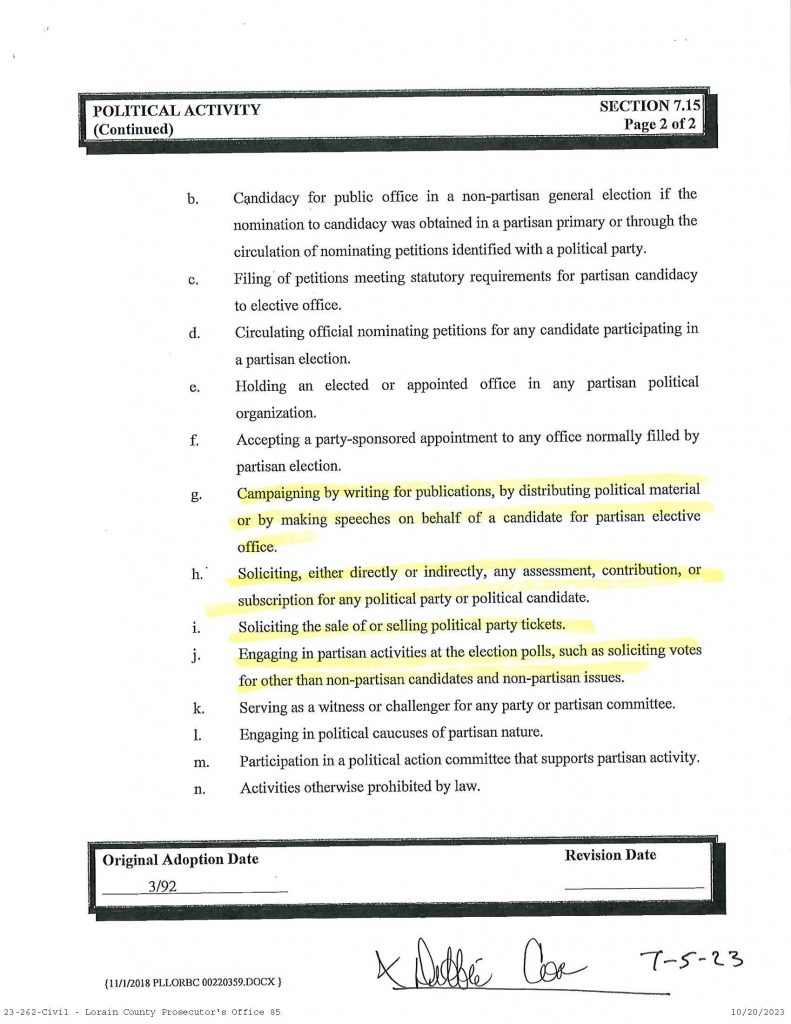
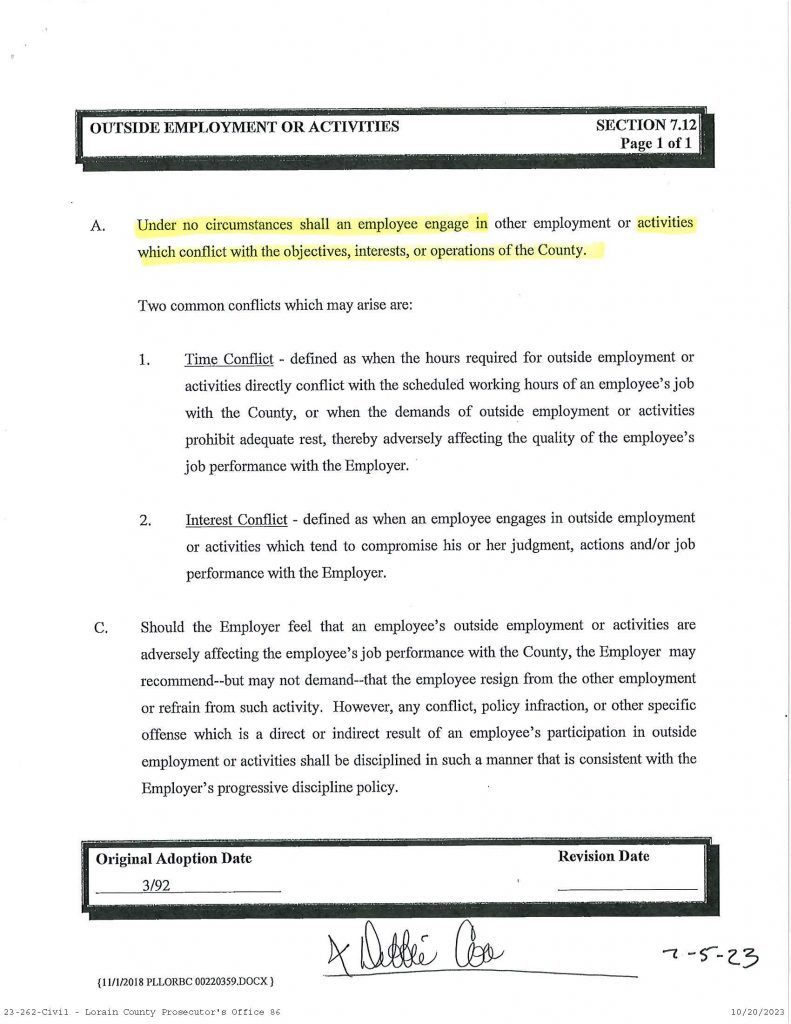
The Lorain County Prosecutor’s Office policy file referenced in this reporting did not come to me through a public records request, a whistleblower, or an internal disclosure. It entered the story through politics.
At the time the document was provided to me, Jack Hall was a candidate for sheriff. Deb Coon was not an adversary. She was an early and visible supporter of his campaign. She defended him publicly, aligned herself with his candidacy, and was treated as an asset rather than a problem. That status changed when she began asking questions, pushing back, and refusing to subordinate her judgment to campaign loyalty.
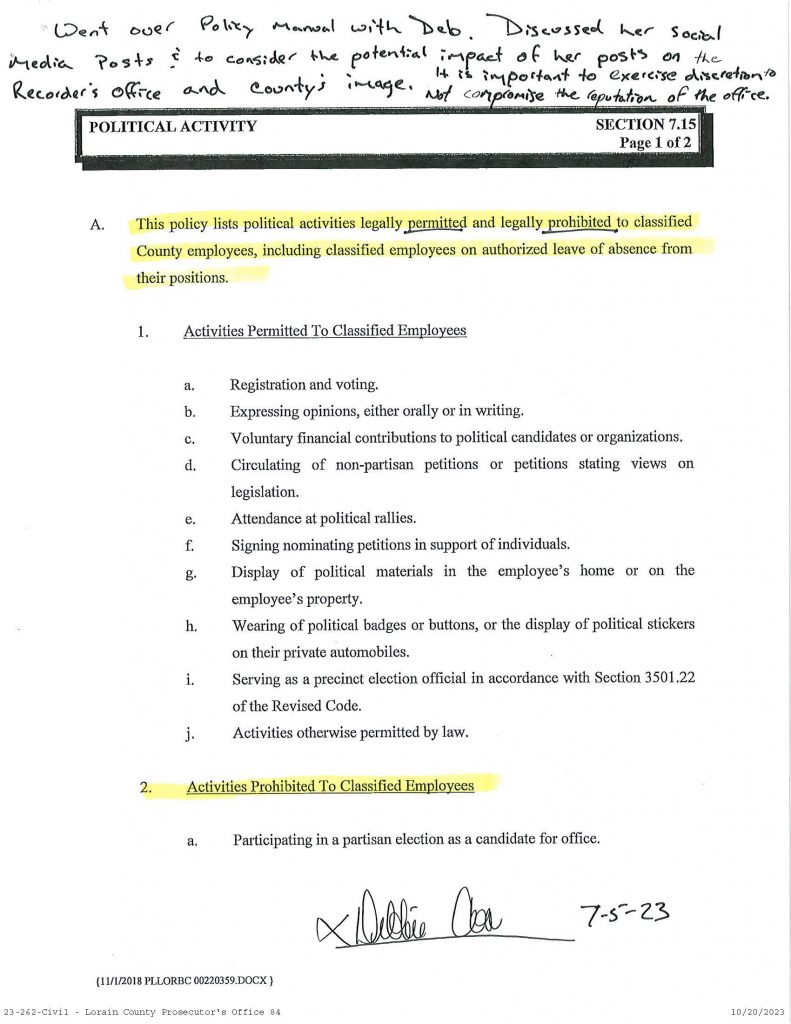
Once that happened, the response escalated.
What followed was not a substantive rebuttal of her concerns, but a shift in framing. The focus moved away from what she was saying and toward who she was. In that context, Hall sent me the prosecutor’s office policy document. The file was not offered as neutral background material or for informational completeness. It was introduced as a framing device, implicitly deployed to suggest that Coon’s conduct was improper, prohibited, or ethically suspect, not because of any adjudicated violation, but because her expressive activity had become inconvenient.
That use of the document is significant because the policy itself says the opposite of what its invocation implied. The provisions at issue recognize broad rights to speak, write, and engage in civic activity, with restrictions narrowly limited to specific forms of partisan conduct. Expressive activity is protected by default. Yet in practice, the policy was being repurposed as a pressure tool, selectively invoked to recharacterize dissent as misconduct once political alignment broke down.
This matters because it illustrates a recurring pattern that runs throughout this article. Rules that exist on paper to protect participation are treated as conditional in practice. When speech aligns with power, it is tolerated or encouraged. When it challenges power, the same rules are reinterpreted, selectively cited, or weaponized to shift attention away from substance and onto the speaker.
The way this document entered the story is not an aside. It is an example. It shows how institutional language is mobilized outside formal processes to shape narratives, how expressive activity is reframed as problematic when loyalty ends, and how discretion becomes a tool of marginalization rather than accountability.
That same dynamic appears later in investigative closures that fail to address conflicts, in declinations communicated without explanation, and in media reporting that attaches names without context. The provenance of this file simply makes the pattern visible earlier in the chain.
This is not about the document itself. It is about how power behaves when challenged, and how quickly protections evaporate when criticism stops being useful and starts being effective.
Why That Origin Matters
The reason this matters is not personal. It is institutional. It goes to how rules function in practice versus how they are represented on paper, and to how discretion is exercised when speech shifts from being convenient to being disruptive.
The policy itself is unambiguous. It affirms that classified employees retain broad rights to express opinions, write, and engage in civic activity. Restrictions are narrow, specific, and limited to clearly defined forms of partisan campaigning and solicitation. Expressive activity is the baseline condition. Limitation is the exception, not the rule. The policy is written to protect participation, not suppress it.
What matters here is how that policy was actually used.
In practice, the document was not invoked to safeguard expressive activity. It was introduced as a warning, a signal, and a framing device. Rather than operating as a shield for lawful speech, it was wielded as a sword against a critic who had ceased to be politically useful. The policy was not applied neutrally or consistently. It was selectively deployed to recast dissent as impropriety once alignment broke down.
That inversion is not isolated. It is the same structural reversal that appears repeatedly throughout this story. It is visible when complainants are publicly named without context while institutions remain insulated. It is visible when criminal declinations are communicated and reported without explanation of their legal limits. And it is visible when scrutiny quietly shifts away from conduct and onto the individual who raised concerns, as though participation itself were the problem.
In each instance, the mechanism is the same. Protections that exist in theory are treated as conditional in practice. Rules designed to encourage reporting and accountability are repurposed to discourage it once reporting becomes effective. Discretion is exercised not to illuminate process, but to redirect attention and manage exposure.
The origin of this document matters because it exposes that mechanism early and clearly. It shows how institutional language can be mobilized outside formal channels to shape narratives, how expressive activity can be reframed as suspect when loyalty ends, and how the appearance of rule enforcement can be used to mask what is, in effect, retaliation through framing.
That same dynamic carries forward into conflicted investigations that close without explanation, into declinations communicated without addressing structural bias, and into media coverage that names private citizens while omitting the context necessary for the public to understand what those outcomes actually mean.
This is not about a policy. It is about how power responds when challenged, and how quickly the protections written into systems disappear once criticism stops being manageable and starts being effective.
The Pattern Becomes Familiar
At a certain point, the details stop looking isolated and start looking recognizable.
What happened to Deb Coon followed a sequence I would later experience myself. Initial acceptance. Quiet encouragement. Then resistance. Then reframing. Then escalation.
The language shifts first. The person is no longer a participant or supporter. They become a problem. Their conduct is no longer framed as civic engagement or protected speech. It is recast as questionable, disruptive, or improper. Policies that were never an issue before suddenly appear, selectively quoted and strategically invoked.
That is what happened to her.
It is also what happened to me.
A Familiar Tactic, Repeated on Others
By the time this pattern turned on me, it was no longer new.
The same tactics had already been used on others who crossed the same invisible line. Deb Coon experienced it first when her support turned into scrutiny and her questions became inconvenient. Garon Petty experienced it when his persistence exposed procedural abuse that could not be defended on the merits. James Maurico experienced it when challenging conduct that should have triggered institutional self correction but instead triggered resistance. And attorney Robert Gargasz has seen it repeatedly across numerous cases he brought before the same offices, cases where the response followed a predictable arc regardless of the underlying facts.
The names change. The posture does not.
In each instance, the sequence is recognizable. Concerns are tolerated at the outset, especially when they are quiet, isolated, or politically useful. Once those concerns escalate into documentation, public exposure, or legal action, the response shifts. Investigations stall or close without explanation. Conflicts are ignored rather than addressed. Outcomes are summarized without context. And attention moves away from the conduct under scrutiny and onto the person who refuses to let it go.
That is not coincidence. It is a method.
The tactic works precisely because it avoids open confrontation. Rather than disproving allegations, the institution reframes the complainant. Rather than correcting misconduct, it manages perception. Rather than answering hard questions, it relies on closure language, declinations, or procedural finality to signal that the matter is over, even when the underlying issues remain unresolved.
What makes this pattern especially corrosive is the contradiction between rhetoric and reality.
This office ran on a promise to stop corruption. It positioned itself as a reformer, an antidote to entrenched misconduct, a corrective force against abuse of power. Yet in practice, its actions have repeatedly had the opposite effect. By failing to investigate properly, by closing matters while conflicted, by reframing critics as problems, and by allowing retaliation through process and publicity, it has helped corruption flourish rather than curtail it.
Corruption does not require bribery or envelopes of cash. It thrives in environments where scrutiny is punished, where complainants are isolated, and where institutions protect themselves by discrediting those who insist on accountability. Every time a case is closed without explanation, every time a conflict is ignored, every time a critic becomes the story, the message is reinforced. Do not push too hard. Do not persist. Do not make this public.
The cumulative effect is chilling.
It tells citizens that reporting misconduct carries personal risk. It tells attorneys that aggressive advocacy will be met with institutional resistance rather than engagement. And it tells public officials that accountability is negotiable so long as the narrative can be controlled.
Seen in that light, what happened to me is not exceptional. It is consistent.
I was not singled out because I was wrong. I was targeted because I was persistent. Because I documented. Because I refused to accept unexplained closure as accountability. And because, like others before me, I crossed the line from being manageable to being effective.
That is the throughline connecting these cases. And once that throughline is acknowledged, the story stops being about individual disputes and starts being about institutional behavior.
An office that truly runs on stopping corruption does not fear scrutiny. It welcomes it. It answers questions. It addresses conflicts openly. It corrects mistakes. And it does not turn its machinery against the very people who are doing the work the institution claims to value.
When the opposite happens consistently, the slogan is exposed for what it is. Not a mission statement, but a shield.
And shields like that do not stop corruption. They protect it.
When the Media Becomes the Final Turn of the Screw
Once an internal frame has shifted, it rarely stays internal. Institutions may begin by containing dissent quietly, through unexplained closures, procedural deflection, or conflict avoidance, but those mechanisms only go so far. The final turn of the screw is external, when the narrative is released into public space, stripped of nuance, stripped of legal boundaries, and attached to a name.
That is where the Chronicle-Telegram reporting fits.
By identifying me by name as a complainant and pairing that identification with prosecutorial declination language, without explaining what a criminal declination does and does not resolve, the reporting did not merely summarize an outcome. It finalized a narrative. The focus moved decisively away from the conduct being reported and onto the person who reported it, completing a process that had already unfolded internally through conflicted investigations and unexplained closures.
At that point, the work of reframing was finished.
The absence of context did not operate neutrally. It functioned as a seal. A criminal declination, already narrow and misunderstood, was allowed to stand in for legitimacy, finality, and judgment, while unresolved questions about conflict, process, and accountability disappeared from view. The public was presented with an endpoint, not a pathway, and with a name, not an institution.
This is how reputational harm occurs without any formal finding. No accusation is required. No adverse ruling is issued. No due process is afforded. The implication is carried entirely by structure, by placement, and by repetition. A private citizen’s name becomes associated with controversy and failure, while the systems that produced the outcome recede into the background, insulated by silence.
Once that happens, the damage is durable.
The individual is left to absorb the consequences of a narrative they did not author and cannot meaningfully correct. Public hostility becomes normalized. Skepticism attaches itself automatically. Future reporting is filtered through the same frame. And the original issue, the conduct that prompted scrutiny in the first place, is effectively buried beneath the story of the person who would not let it go.
This is why media framing matters most at the end of the process, not the beginning. When investigative failures, conflicts, and discretionary closures are laundered through reporting without explanation, journalism does not merely reflect power. It reinforces it.
That is not because reporters intend harm. It is because discretion, once exercised without context, becomes decisive.
And when the final turn of the screw is applied by the press, the opportunity for accountability is not just diminished. It is closed.
Discretion Is Where Accountability Lives or Dies
Criminal declinations are narrow by design. Naming a private citizen complainant in that context is not required by law, by policy, or by journalistic necessity. It is a choice. And when choices are made repeatedly, they reveal values.
That this choice was not unavoidable is demonstrated by contrasting decisions made elsewhere.
In coverage of related matters, the Journal reported on the same underlying events without naming me at all. The facts were conveyed. The institutional actions were summarized. The public was informed. My identity was not necessary to tell the story, and it was not included. That decision did not obscure accountability. It preserved it by keeping the focus where it belonged.
The same principle governs my own reporting.
In recent work, I encountered a Social Security number displayed unredacted on a county court docket, a disclosure that should never have occurred and that remains online through no action of mine. I did not reproduce it. I redacted it. Not because the information was unavailable, but because availability is not the same thing as responsibility. The fact that something can be published does not mean that it should be.
Those are not dramatic gestures. They are baseline exercises of discretion.
When discretion is exercised with care, it protects the public without shielding institutions. When discretion is exercised without explanation or restraint, it becomes framing. When framing omits legal limits, it becomes distortion. And when distortion appears consistently in one direction, it stops looking accidental and starts functioning as policy by practice.
This is the fault line that runs through this story.
The Chronicle-Telegram did not need to name me. Other outlets did not. The law did not require it. Accuracy did not demand it. What remained was editorial discretion, and the foreseeable consequences of how that discretion was exercised.
Accountability journalism depends on that distinction. Transparency is not achieved by maximizing exposure. It is achieved by maximizing understanding. And understanding requires judgment, proportionality, and restraint, especially when the subject is a private citizen engaging in protected civic activity rather than a public official exercising power.
Some choices are simply right. They do not silence truth. They prevent unnecessary harm. They keep attention fixed on conduct rather than character.
That is why discretion is not ancillary to accountability. It is where accountability either survives or fails.
Why This Matters Beyond One Article
This is not an indictment of journalism as a profession, nor is it a claim that reporters act with malice or intent to harm. It is a warning about how easily media can become the final stage of a retaliatory process when discretionary choices are made without explanation and without regard for foreseeable consequences.
Private citizens who report misconduct operate at a structural disadvantage. They do not control investigative scope. They do not determine how conflicts are addressed or ignored. They do not write investigative summaries, prosecutorial memos, or declination notices. And once their names are attached to those outcomes, they do not control how legal conclusions are framed, simplified, or understood by the public.
When identities are disclosed without necessity and legal conclusions are presented without limitation, the effect is chilling, whether intended or not. It signals that participation in accountability processes carries personal risk, public exposure, and reputational harm, even when no wrongdoing is found and no misconduct by the complainant is alleged. Over time, that signal alters behavior. People stop coming forward. Attorneys become more cautious about pressing uncomfortable issues. Reporting becomes less aggressive, not because the facts have changed, but because the costs have become clearer.
That is not a hypothetical concern. It is how accountability erodes in practice.
The press plays a critical role at this juncture, not merely as a messenger of outcomes, but as a translator of meaning. When legal determinations are presented without their boundaries, and when private citizens are named without necessity, journalism does not simply inform the public. It shapes incentives. It can either reinforce civic participation or quietly punish it.
This matters because accountability systems do not fail only when corruption is proven. They fail when the cost of speaking becomes higher than the likelihood of correction. They fail when discretion is exercised in ways that protect institutions at the expense of individuals who lack power. And they fail when media framing transforms lawful civic engagement into a public liability.
Seen in that light, this article is not about one newsroom, one reporter, or one decision. It is about a structural vulnerability in how power, process, and publicity interact, and about the responsibility that comes with being the last link in that chain.
If that responsibility is not examined, the consequences extend far beyond any single article or any single name.
What Accountability Actually Requires
Accountability does not require secrecy. It requires completeness. It requires telling the whole story, not just the portion that is easiest to summarize or safest to publish.
Completeness means explaining that a criminal declination is not exoneration. It means acknowledging that the absence of charges is not the absence of harm, misconduct, or constitutional violation. And it means recognizing that naming a private complainant is a discretionary choice, not an obligation imposed by law, ethics, or accuracy.
When those elements are missing, the public is not informed. It is guided. Attention is steered away from institutional conduct and toward individual credibility. Complex legal outcomes are reduced to shorthand that invites misunderstanding. And discretion, left unexplained, quietly does the work of shielding power rather than scrutinizing it.
That is the point at which reporting stops functioning as a window into power and begins operating as part of the machinery that protects it, not through overt bias, but through omission and repetition.
Sunlight only works when it illuminates the whole picture. Partial light creates shadows, and shadows are where accountability goes to die.
This article exists to put those shadows on the record.
Closing: What Accountability Actually Requires and What This Record Now Shows
Accountability does not require secrecy. It requires completeness. It requires institutions to explain not just what they decided, but how they decided it, under what constraints, and with what unresolved limitations. It requires the press, when reporting on those decisions, to convey those limits honestly rather than allowing implication to do the work of explanation.
Completeness begins with a basic but routinely ignored truth. A criminal declination, including a Do Not Present determination, is not exoneration. It is not a finding that misconduct did not occur. It is not a judgment about credibility. It is not a declaration of good faith. It is a narrow, discretionary gatekeeping decision about whether a matter will be advanced for criminal charging under a specific intent standard. Nothing more.
Completeness also requires acknowledging what criminal law does not touch. Retaliation. Abuse of authority. Constitutional violations. Civil liability. Administrative misconduct. Conflicts of interest. Those questions live in other forums for a reason. When criminal outcomes are presented without that context, the public is not educated. It is misled by omission.
This article has documented how that omission operates across multiple layers.
It begins when complaints are investigated by offices that are conflicted on multiple levels, and when those offices decline to explain how conflicts were identified, mitigated, or deemed irrelevant. It continues when declinations are communicated without addressing unresolved process questions. It hardens when those declinations are summarized publicly without explanation of their limits. And it calcifies when a private citizen’s name is repeatedly attached to those summaries, while institutions recede into the background.
At no point in that chain is there a formal finding of wrongdoing by the complainant. And yet the cumulative effect is reputational judgment without adjudication.
That outcome does not require malice. It does not require conspiracy. It requires only discretion exercised repeatedly without explanation, restraint, or proportionality.
This record also demonstrates that other choices were available at every step. Other outlets reported on the same underlying events without naming me. In my own reporting, I made the decision to redact a Social Security number that remains publicly exposed by the county itself, because availability is not the same thing as responsibility. These are not heroic acts. They are baseline exercises of judgment. They reflect an understanding that accountability is strengthened, not weakened, when unnecessary harm is avoided.
What makes this matter larger than any one article is the signal it sends.
Private citizens who report misconduct already assume risk. They do so without subpoena power, without institutional backing, and without control over how their actions will later be framed. When the consequence of participation becomes public targeting, reputational damage, or attempted prosecution, the rational response is silence. Not because the conduct disappears, but because the cost of speaking becomes too high.
That is how accountability systems fail in practice. Not with dramatic corruption exposed and ignored, but with quieter mechanisms that discourage scrutiny before it ever becomes effective.
This article has also placed on record that this pattern is not unique. The same tactics have been applied to others. Deb Coon. Garon Petty. James Maurico. Numerous cases brought by attorney Robert Gargasz. In each instance, the arc is familiar. Initial tolerance. Then resistance. Then unexplained closure. Then reframing. Then pressure. The names change. The method does not.
An office that truly runs on stopping corruption does not behave this way. It does not fear questions. It does not close ranks around conflict. It does not allow critics to become targets. And it does not rely on media framing to finish work it could not justify on the merits.
Sunlight only works when it illuminates the whole picture. Partial light creates shadows, and shadows are where accountability goes to die.
This closing exists to make clear what this story has shown. That discretion is power. That framing is consequence. And that when those tools are used without explanation, they do not protect the public. They protect institutions at the expense of the people brave enough to challenge them.
Accountability, if it is to mean anything at all, must apply not only to those who wield authority, but to the systems that decide how challenges to that authority are handled, dismissed, and ultimately presented to the public.
That is not a personal demand. It is the minimum standard a functioning democracy requires.
Legal and Editorial Disclosures
This article is published by Aaron Knapp in his capacity as an investigative journalist and commentator. It reflects his analysis, interpretation, and opinion based on documents, communications, and events described in the text. Any factual assertions are intended to be grounded in records, first hand knowledge, or contemporaneous reporting. Readers are encouraged to review original source documents when available and to draw their own conclusions.
No Legal Advice Intended
Nothing in this article is legal advice, and nothing herein creates an attorney client relationship. This publication is for informational, journalistic, and commentary purposes only. If you need legal advice about a specific situation, consult a licensed attorney of your choosing.
Accuracy and Corrections
This story is published in good faith. If any material factual error is identified, a correction will be considered and, where appropriate, published. Readers with relevant documentation that clarifies any point are invited to provide it for review.
Fair Comment and Public Interest
Where this article expresses conclusions about public institutions, public processes, and public officials, it is intended as fair comment on matters of public concern. References to individuals and entities are made for the purpose of reporting, analysis, and accountability commentary.
Not an Official Statement by Any Agency
This article is not an official statement of any government agency and should not be construed as speaking on behalf of any public office. Any references to actions or positions of public agencies are presented as reported or understood by the author based on available information.
Source Protection and Privacy
This publication avoids publishing sensitive personal identifiers. Where records contain private information, the author may redact or omit that information even if it appears elsewhere publicly. The decision to redact is an editorial choice made to minimize unnecessary harm while preserving the substance of the public interest issue.
Artificial Intelligence Disclosure
Portions of this article may have been drafted, edited, reorganized, or proofread with the assistance of artificial intelligence tools used as a writing aid. AI tools do not replace independent judgment. Final content selection, framing, and responsibility for accuracy remain with the author.
AI Image and Graphics Disclosure
If any images, banners, illustrations, or graphic elements accompanying this story are AI generated or AI assisted, they are used for illustrative or editorial presentation purposes only and are not intended to depict real events unless specifically stated. When applicable, AI imagery is not a substitute for documentary evidence.
Business and Copyright Notice
This work is published under Knapp Unplugged Media LLC and may also appear under Lorain Politics Unplugged and related platforms operated by the author. All rights reserved. No part of this publication may be reproduced in full without permission, except for brief excerpts used for commentary, criticism, or news reporting with proper attribution.
Contact and Tips
If you have documents, records, or credible information relevant to this story, you may contact the author through the platform where this article is published. Anonymous tips are evaluated cautiously and are strongest when supported by verifiable documentation.
About The Author