

The Paperwork Gap: How Lorain’s Selective Law Enforcement Starts at the Clerk’s Desk
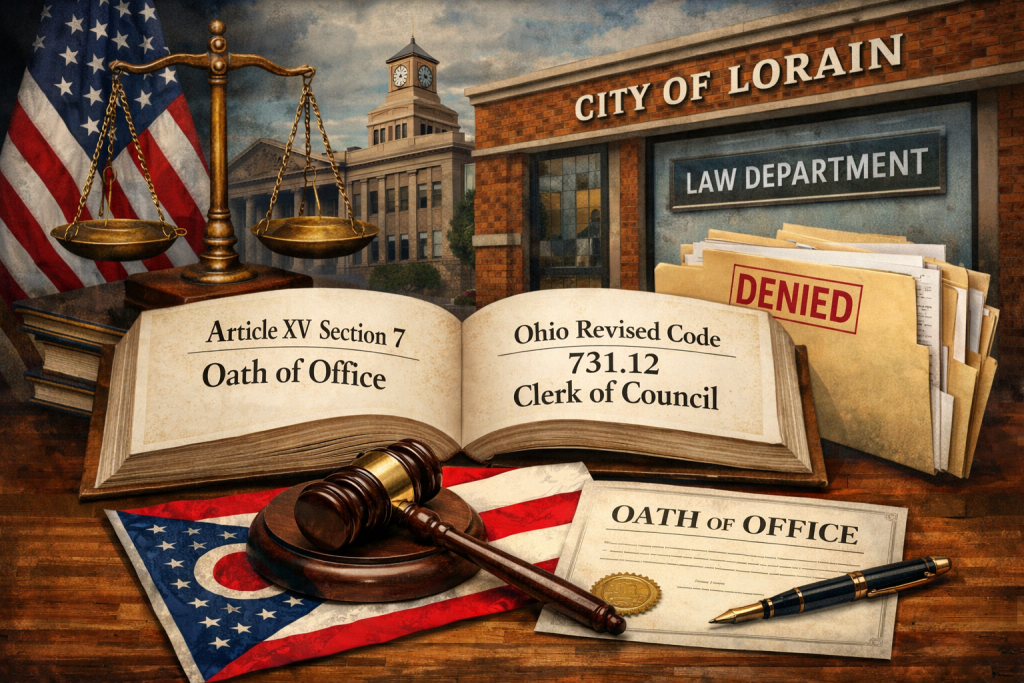
An analysis of Ohio Revised Code 731.12, Article XV of the Ohio Constitution, and the City’s failure to produce mandatory records of office.
By Aaron Knapp
Investigative Journalist
Founder and Editor, Unplugged with Knapp
Knapp Unplugged Media LLC
This issue did not begin as a hypothetical debate, a political disagreement, or an abstract question of municipal procedure. It arose from a routine public records request, followed by a formal written denial issued by the City of Lorain’s Law Department, and then unraveled as the City’s own records were reviewed alongside controlling provisions of Ohio law. When those materials are examined together rather than selectively or in isolation, the narrative becomes narrow, fact driven, and increasingly difficult for the City to reconcile with the position it has taken in writing.
At the center of the dispute is a single, uncontested fact that neither side has challenged and that no reframing can obscure.
Breanna Dull is the Clerk of Council for the City of Lorain.
Once that fact is acknowledged, the governing legal framework is no longer discretionary or subject to municipal interpretation. It is mandatory. It is constitutional. It is statutory. The Ohio Constitution and the Ohio Revised Code define when lawful authority begins and under what conditions a public office may be occupied. Everything that follows flows directly from that starting point.
If you want, I can also give you two or three alternative headline and subtitle pairings depending on whether you want this to read more like a legal brief, an investigative exposé, or a neutral explanatory piece for a general audience.
The Legal Framework That Applies Before Any Local Argument
Ohio law does not permit a municipality to invent, modify, or selectively apply qualification rules for public officers. The obligation to take an oath of office does not originate in a clerk’s handbook, a human resources policy, or the legal advice of a city law director. It originates in the Ohio Constitution and binds every public office created or governed by state law.
Article XV, Section 7 of the Ohio Constitution requires that all public officers take and subscribe an oath to support the Constitution of the United States and the Constitution of Ohio and to faithfully discharge the duties of their office. The language is mandatory, not permissive. It applies to all public officers without distinction and makes no exemption for appointed officials, salaried positions, or municipal classifications. The Constitution draws no line between elected and appointed officers because none exists for purposes of qualification.
The General Assembly implemented this constitutional requirement through Ohio Revised Code Sections 3.22 and 3.23. Those statutes require every person elected or appointed to an office to take an oath before entering upon the duties of that office and further require that the oath be subscribed and filed. The timing language is critical. “Before entering upon the duties” establishes a condition precedent to the lawful exercise of authority. It is not ceremonial, symbolic, or retrospective. Until the oath is taken and filed, the legal authority of the office has not attached.
For statutory cities, the analysis becomes even more direct. Ohio Revised Code 731.12 governs the Clerk of the legislative authority and expressly provides that the clerk shall give bond and take an oath before entering upon the duties of the office. This provision exists precisely because the Clerk of Council is not a routine administrative employee. The clerk is the statutory custodian of the legislative record and the official certifier of council action. Courts, residents, and other public offices rely on the clerk’s acts as legally authoritative.
Because this requirement arises from the Ohio Constitution and is implemented by statute, no municipal policy, no charter silence, and no internal employment classification can override it. Local practice cannot nullify a constitutional mandate, and administrative convenience cannot substitute for lawful qualification.
What the Clerk of Council Is Under Ohio Law
Under Ohio law, the Clerk of Council is not an at will clerical employee. The position exists because the General Assembly created it by statute, not because a municipality chose to staff it. Its authority does not flow from a job description or a supervisor’s discretion. It flows from law.
The duties of the Clerk of Council are defined by statute and longstanding legal practice. The clerk keeps the official journal of council proceedings, certifies ordinances and resolutions, attests to legislative acts, and maintains the official legislative record of the municipality. Those records are not internal paperwork. They are the authoritative record upon which courts, residents, and other public offices rely to determine what the legislative authority has lawfully done.
Performing those functions necessarily involves the exercise of delegated sovereign authority. Ohio courts have consistently distinguished between public employment and public office by examining whether a position exercises independent authority conferred by law rather than direction by a supervisor. Where such authority exists, the position is an office, not employment.
Once a position is a public office, the constitutional and statutory requirements for officeholding attach automatically. The oath requirement is not triggered by compensation, employment status, or internal classification. It is triggered by the nature of the authority exercised.
That distinction matters because it is the point at which the City later attempts to recast the issue as one involving salaried employment rather than statutory officeholding. The law does not permit that substitution.
The Public Records Request and the City’s Written Denial
In September 2025, a public records request was submitted seeking copies of oaths of office held by the City of Lorain. The request was limited to existing records and sought documentation that Ohio law requires to be created, subscribed, and filed before a public officer may lawfully enter upon the duties of office. It did not seek legal opinions, interpretations, or the creation of new records. It asked for records that either exist or do not.
The City of Lorain’s Law Department responded with a formal written denial. In that response, the City asserted that because Lorain is a statutory city, it is not required to have “employees receiving a salary” take an oath of office. The denial relied entirely on the claim that Ohio Revised Code 705.28 does not apply to statutory cities and, by extension, that no oath obligation exists for the position at issue.
That position is narrowly framed and materially misleading in both its legal scope and its factual assumptions.
It is accurate, in isolation, that R.C. 705.28 applies to villages rather than cities. But the public records request was not premised on Chapter 705, and the oath requirement for public officers in cities does not arise from that chapter at all. The controlling authority is Article XV, Section 7 of the Ohio Constitution, which imposes an oath requirement on all public officers. That constitutional command is implemented through Ohio Revised Code Chapter 3 and, with specific application to the Clerk of Council, Ohio Revised Code 731.12. None of those provisions are limited to villages, and none of them contain an exemption for statutory cities.
The City’s response avoided addressing those provisions entirely. Instead, it reframed the request as a question about salaried employees rather than statutory officeholders. That reframing is not a legal analysis. It substitutes an employment classification for the legal status of the position itself. Whether a person receives a salary has no bearing on whether a position is a public office under Ohio law, and it has no bearing on whether the constitutional and statutory oath requirements apply.
By treating the Clerk of Council as a salaried employee rather than as the statutory officer the position is under Ohio law, the City shifted the discussion away from the governing legal framework and toward an issue that was never presented. The denial does not explain how Article XV, Section 7 is satisfied. It does not address Ohio Revised Code Sections 3.22 or 3.23. It does not reconcile Ohio Revised Code 731.12 with the City’s claim that no oath obligation exists.
As a public records response, the denial also fails to engage the binary nature of the request. Either a subscribed and filed oath exists for the Clerk of Council, or it does not. The City did not assert that such a record does not exist. It did not certify nonexistence. It instead asserted that the City was not required to have one. That distinction matters, because public records law does not permit a public office to avoid disclosure by disputing the legal necessity of the record after the fact.
The effect of the City’s written denial was not to resolve the request, but to create a conflict between the City’s stated position and the legal requirements imposed by the Ohio Constitution and the Ohio Revised Code. That conflict is what compelled further examination of the City’s own records and practices, and it is where the City’s position begins to unravel under its own documentation.
The City’s Own Attachments Undercut Its Argument
The written denial issued by the City’s Law Department contains a contradiction that cannot be reconciled with its stated legal position. In the same correspondence asserting that the City of Lorain has no obligation to require or maintain oaths of office for “salaried personnel,” the Law Department attached the Law Director’s own oath of office as a “courtesy.” That attachment is not incidental; it directly undermines the premise of the denial.
The Law Director of the City of Lorain is an elected public officer. While the Law Department attempts to group the Clerk of Council and other statutory roles into a vague category of “salaried employees,” their own production of the Law Director’s oath proves that compensation structure (salary) is irrelevant to the legal obligation of the oath. The Law Director is a salaried official, yet the City administered his oath, required it to be subscribed, and retained it as an official public record. The oath was not treated as ceremonial or optional; it was treated as a mandatory act of lawful qualification under the Ohio Revised Code.
The City’s records reflect that this practice is not a one-time courtesy. The City maintains multiple versions of the Law Director’s oath across different periods of service, administered by different officials and, in some instances, by judges. Each version reflects the same institutional understanding: Before exercising the authority of the office, the official must be sworn in and the oath must be retained as part of the City’s official records.
This practice reflects compliance with Ohio Revised Code Section 3.22, which requires every person chosen or appointed to an office to take and subscribe an oath. By producing the Law Director’s oath while denying the necessity of the Clerk’s, the City is attempting to create a distinction where the law makes none. The Ohio Revised Code does not exempt an officer simply because they are “salaried” or “appointed” rather than elected.
That acknowledgment makes the City’s denial untenable. The City cannot plausibly maintain that it has no obligation to administer or retain oaths of office for its statutory officers while simultaneously doing exactly that for its own chief legal officer. The contradiction is not theoretical; it is documented in the City’s own response.
The Deputy Clerk Records Demonstrate Institutional Knowledge
The Deputy Clerk of the Lorain Municipal Court oath packets from January 2020 contain numerous written appointments and corresponding sworn oaths. Each oath was administered before the individual entered upon the duties of the position. Each was subscribed, signed, and formally filed as an official record. These documents are not informal acknowledgments or internal memoranda. They are structured qualification records created for the express purpose of satisfying Ohio’s oath of office requirements.
The significance of these records lies not in their volume but in what they reveal about the City’s institutional understanding of the law. They demonstrate that the City knows precisely how to comply with Ohio’s constitutional and statutory oath requirements when it recognizes a position as one involving independent authority and responsibility. The process is deliberate and standardized. Appointments are documented. Oaths are administered. Records are retained. There is no indication of confusion, uncertainty, or administrative inability.
The positions reflected in these packets involve authority over court records, certification of filings, and interaction with judicial proceedings. The City’s handling of those positions confirms that it understands such roles to require formal qualification through an oath taken before duties begin. That understanding mirrors the legal distinction Ohio law draws between routine employment and public office.
Because these procedures were followed consistently and contemporaneously, the records cannot be dismissed as historical anomalies or discretionary practices. They reflect settled institutional knowledge. The City understands the legal framework. It understands the timing requirement. It understands the necessity of documentation.
That knowledge does not disappear when applied to a different office. It cannot be selectively invoked for court clerks and ignored for the Clerk of Council. The law does not permit that kind of compartmentalization, and the City’s own records show that it knows better.
The Police Department Policy Confirms the Legal Standard
The Lorain Police Department policy manual provides independent confirmation of the City’s understanding of oath of office requirements. Policy 102 expressly cites Article XV, Section 7 of the Ohio Constitution and Ohio Revised Code Section 3.22 as the legal authority governing oaths of office. The policy does not frame the oath as a symbolic or traditional practice. It identifies it as a legal prerequisite to service and mandates that oaths be administered, subscribed, filed, and retained in accordance with applicable records retention schedules.
This matters because it demonstrates that the City recognizes Chapter 3 of the Ohio Revised Code as binding law, not as optional guidance. The policy applies those constitutional and statutory requirements as a matter of compliance, not discretion. Officers are not permitted to assume their duties until the oath process is completed, and the resulting documents are treated as official public records subject to retention requirements.
The existence of this policy also eliminates any claim that oath requirements are limited to elected officials or to certain forms of appointment. The policy applies broadly to officers whose positions involve the exercise of governmental authority. It reflects the City’s institutional understanding that when authority is conferred by law, formal qualification through an oath is required.
Importantly, this understanding is not confined to the Police Department as an isolated practice. The policy cites the same constitutional and statutory provisions at issue here and applies them in the same manner the Ohio Revised Code prescribes. That alignment confirms that the City knows the legal standard and knows how it must be applied.
Against that backdrop, the City’s claim that no oath obligation exists for the Clerk of Council cannot be reconciled with its own written policy. Oaths are treated as mandatory legal acts for police officers and other appointed officials. They are administered, documented, and retained precisely because the City understands they are required by law.
Selective application of a constitutional and statutory mandate is not compliance. It is a departure from the legal standard the City itself has adopted and enforced elsewhere.
Why This Issue Lands Squarely on the Clerk of Council
When the Ohio Constitution, the controlling statutes, and the City’s own records are examined together, the issue stops being theoretical and becomes evidentiary. The legal framework is fixed. What remains is a question of compliance over time.
Breanna Dull is the Clerk of Council for the City of Lorain. That fact is not disputed. Because she occupies that position, Ohio Revised Code § 731.12 applies. Article XV, Section 7 of the Ohio Constitution applies. Ohio Revised Code §§ 3.22 and 3.23 apply. None of these provisions are conditional, discretionary, or dependent on municipal preference.
What further sharpens the issue is that this was not a one-time inquiry raised in isolation. Garon Petty sought these same oath records during the prior council cycle as well. His requests predate the most recent public records dispute and occurred while the Clerk of Council was still serving in her previous term. That history matters because it establishes duration, repetition, and notice.
By the time of the more recent exchange, the City had already been asked to produce the same category of records. The issue had already been flagged. The absence of production was not corrected, clarified, or formally resolved. Instead, the question persisted across cycles of service.
Against that backdrop, the documented email exchange in which the Clerk of Council herself asked the Law Department whether she was required to take an oath becomes even more significant. It demonstrates that the issue was not merely external pressure from a resident or advocate. It was recognized internally as a legal question requiring guidance.
In that exchange, the Clerk of Council asked directly whether an oath was required. The response she received did not engage Article XV, Section 7 of the Ohio Constitution. It did not analyze Ohio Revised Code Chapter 3. It did not address ORC § 731.12, the very statute that mandates the Clerk “shall… take an oath” before entering office. Instead, the Law Department offered a conclusory answer without reference to the controlling statutory framework.
The existence of that exchange, combined with the fact that oath records had already been requested in a prior council cycle, forecloses any claim that the issue arose suddenly or without warning. It shows that the question of lawful qualification was raised repeatedly, over time, and through multiple channels.
From a legal standpoint, reliance on flawed internal advice does not override constitutional or statutory requirements. This is especially true where those requirements establish a condition precedent to holding office. An unsupported assurance does not cure a legal defect, and silence following repeated requests does not transform noncompliance into compliance.
At this point, the inquiry is narrow and factual: Does a written, subscribed, and filed oath of office exist corresponding to her appointment, taken before she entered upon the duties of the office in either cycle of service?
If such a record exists, it is a public record and must be produced. If it does not exist, then the office was occupied without lawful qualification. That conclusion does not turn on intent, motive, or fault; it flows directly from the statutory framework. The relevance of the earlier requests is that they demonstrate continuity. This was not a transient oversight. It was a question raised, unanswered, and carried forward.
That is why the issue lands squarely on the office itself. The Clerk of Council occupies a statutory office. The law defines the conditions under which that authority exists. The City’s own records, correspondence, and history of requests now place that question squarely on the record.
SIDEBAR: When the Law Department Gets the Law Wrong
This issue does not exist in isolation, and it does not stop at the Clerk’s Office. It implicates the very department charged with ensuring that City government complies with the Ohio Constitution, the Ohio Revised Code, and public records law.
The City of Lorain Law Department routinely positions itself as a repository of expertise. It has been publicly touted by Law Director Patrick Riley as unusually credentialed, with multiple advanced degrees among its attorneys. That representation matters; heightened expertise carries heightened responsibility. When the law is misapplied repeatedly, credentials stop being a shield and start becoming part of the question.
In this instance, the failure is not subtle. Ohio’s oath requirements are not novel. They are constitutional, codified, and cited verbatim in the City’s own internal policies. Yet, the Law Department responded to a public records request by asserting that no oath obligation exists for the Clerk of Council. They did so without addressing Article XV, Section 7 of the Ohio Constitution, without addressing Ohio Revised Code Chapter 3, and without addressing R.C. § 731.12—the specific statute governing the Clerk of Council.
That omission is not academic. A public records denial must be grounded in law. When a record is requested that is required by statute to exist, the public office must either produce it or certify its nonexistence with a legally supported explanation. Asserting that no records are responsive because the Law Department believes an oath is unnecessary is not a legally sufficient denial; it is a conclusion untethered from authority.
The problem is compounded by the Law Department’s own conduct. The City administers, retains, and produces oaths for its officers, including its own Law Director. While the Law Director is an elected official, the City’s practice of maintaining his oath as a mandatory record of qualification contradicts their claim that “salaried” status or “statutory” city status provides an exemption. The Department cannot reconcile its meticulous retention of the Law Director’s oath with its dismissal of the Clerk’s oath without admitting to a double standard.
When the Clerk of Council raised the oath question internally and sought guidance, the response she received came from Don Zaleski, a senior legal officer. That response did not engage the controlling law. It offered reassurance without analysis. However, internal reassurance does not override constitutional mandates. If the law requires an oath as a condition precedent to officeholding, a “don’t worry about it” from the Law Department does not cure the legal defect.
What emerges is not a single mistake, but a pattern. The Law Department has repeatedly advanced positions that collapse under basic statutory review—whether in public records disputes or constitutional interpretation. When errors occur occasionally, they may be dismissed as oversight. When they recur in foundational areas like lawful qualification for office, they point to a systemic failure in legal review.
The consequences of that failure do not fall on the Law Department alone. They fall on the public and the validity of government action. A law department’s role is not to minimize exposure by narrowing the law; it is to ensure compliance by applying the law as written. Degrees do not substitute for statutory analysis, and confidence does not replace citation.
Why Silence or Ratification Does Not Cure the Defect
Ohio law does not permit a municipality to retroactively cure the failure to satisfy a statutory condition precedent to officeholding through silence, assumption, or informal ratification. When the General Assembly establishes mandatory qualifications for a public office, those qualifications must be satisfied before lawful authority attaches. Until that occurs, the individual has no legal capacity to exercise the powers of the office.
Acts taken without lawful authority are ultra vires at the moment they are performed. They are not rendered lawful by the passage of time, by administrative convenience, or by the failure of others to object contemporaneously. Ohio courts have consistently recognized that conditions imposed by statute cannot be waived or cured after the fact through acquiescence or implied approval.
Ratification doctrines do not apply where the defect goes to the legal existence of authority rather than the manner in which authority is exercised. Where an individual lacks authority to act in the first place because a statutory qualification has not been met, there is nothing to ratify. Subsequent acknowledgment of the individual’s actions cannot retroactively supply authority that never attached.
The distinction matters because municipalities often attempt to rely on silence, historical practice, or later acceptance of acts as a substitute for lawful qualification. Ohio law does not permit that substitution. When the statute requires an oath before entering upon the duties of office, failure to take that oath is not a procedural irregularity. It is a failure to satisfy a legal prerequisite.
Once notice of a potential defect is raised, continued exercise of authority without acknowledgment or cure carries additional legal significance. At that point, the issue is no longer inadvertent or technical. The municipality is on notice of a statutory condition that may not have been satisfied. Continuing to rely on silence or informal ratification after notice risks converting a compliance question into one of deliberate noncompliance.
For that reason, the absence of a timely oath cannot be cured by later ratification, nor can it be excused by the lack of earlier objection. The statutory framework is explicit. Lawful authority begins only after the required oath is taken and filed.
The Story in One Sentence
The City of Lorain demonstrates through its own records that it understands and enforces Ohio’s oath of office requirements for public officers but denies that those same requirements apply when asked to produce an oath for the Clerk of Council, even though Ohio law expressly mandates that the Clerk of Council be sworn before assuming office.
Closing Final Thought
At the end of this record, the question is no longer abstract and it is no longer external. It sits squarely inside City Hall, inside the Clerk’s Office, and inside the Law Department.
The Clerk of Council is not a passive role. It is the position charged with knowing the council rules, maintaining the legislative record, certifying council action, and safeguarding the procedural legality of the body’s work. That responsibility is not incidental. It is the core function of the office. If Ohio law requires that the Clerk of Council take an oath before entering upon the duties of the office, that requirement is not obscure, technical, or hidden. It is written plainly in the Ohio Constitution and the Ohio Revised Code. It is the same framework applied to other officers whose authority depends on lawful qualification.
That reality raises a difficult but unavoidable question. If the Clerk of Council is required by law to be sworn, how does that obligation escape notice by the very official charged with enforcing council rules and certifying legality. This is not a matter buried in a footnote or a remote chapter of the Code. It is foundational. It is the condition under which the authority of the office exists at all.
The problem deepens when the focus shifts to the Law Department. The City’s Law Director is not an advisor offering casual guidance. He is the City’s chief legal officer. When asked whether an oath is required, his response carries institutional weight. Yet the answer given did not engage the Ohio Constitution. It did not cite Ohio Revised Code Chapter 3. It did not address Ohio Revised Code 731.12. Instead, it conveyed a conclusion without analysis and later framed the issue as one of non responsive records rather than legal compliance.
That is not how public records law works. A records denial is not satisfied by asserting that a record is unnecessary. If a record is required by law to exist, the public office must either produce it or certify its nonexistence with a legally grounded explanation. Saying that no records are responsive because the City believes no oath is required is not a lawful substitute for analysis. It is a conclusion in search of authority.
What makes this especially troubling is that the City knows better. Its own records show that it administers oaths for appointed officers. Its own policies cite the Ohio Constitution and Ohio Revised Code as mandatory authority. Its own Law Director has taken and signed multiple oaths that the City retains as public records. This is not a City unfamiliar with oath requirements. It is a City that applies them selectively.
Public trust depends on lawful process, not on convenience or internal assurances. When a statutory office is occupied, the law requires that certain steps be taken before authority attaches. Those steps protect the public, the institution, and the integrity of the acts performed under color of office. When questions arise about whether those steps were followed, silence and conclusory denials do not resolve them.
At this point, the path forward is simple, even if the implications are not. Either a written, subscribed, and filed oath exists and should be produced, or it does not and the City must acknowledge that fact and confront the legal consequences openly. Anything less erodes confidence not only in the Clerk’s Office, but in the Law Department charged with ensuring that City government operates within the bounds of the law.
The issue is not personal. It is structural. The law sets the rules. The records tell the story. The City now has a responsibility to answer with precision, transparency, and legal support rather than avoidance.
Disclosures, Methodology, and Use of Artificial Intelligence
Investigative Purpose and Scope
This article is published for informational and journalistic purposes. It is based on publicly available records, public records requests made pursuant to Ohio Revised Code Section 149.43, internal correspondence obtained through lawful means, and analysis of the Ohio Constitution, Ohio Revised Code, and related municipal records. It is not intended to provide legal advice, nor does it substitute for formal legal counsel.
The reporting focuses on compliance with statutory and constitutional requirements governing public offices and public records. Any conclusions expressed are derived from the application of written law to documented facts and are offered for public understanding and accountability.
No Allegation of Criminal Liability
Nothing in this article alleges or asserts criminal conduct by any individual unless expressly stated and supported by a cited statute or official charging document. Discussion of statutory compliance, administrative defects, or ultra vires acts is a legal and procedural analysis, not a criminal accusation.
References to potential legal consequences are limited to civil, administrative, or structural implications arising under Ohio law.
Good Faith Reliance on Public Records
All factual assertions in this article are based on records produced by public offices, written responses to public records requests, internal correspondence, policy manuals, and statutory authority. Where records were denied, withheld, or certified as non responsive, that fact is disclosed and incorporated into the analysis.
The absence of a record is discussed only where Ohio law requires the record to exist or where the public office has asserted a legal position regarding its necessity.
Right of Reply and Ongoing Review
This investigation remains open. Any individual or public office referenced herein is invited to provide additional records, clarifications, or corrections. Verified information received after publication may result in updates or amendments, which will be noted transparently.
Public Office and Public Figure Context
Individuals discussed in this article are referenced in their official capacities as public officers or public employees. Analysis is limited to actions taken, statements made, or records created in the course of public duties. No commentary is offered on private conduct unrelated to official functions.
Artificial Intelligence Assisted Drafting Disclosure
Portions of this article were drafted with the assistance of artificial intelligence tools used for structural editing, clarity refinement, and language consistency. All legal analysis, factual framing, and conclusions were directed, reviewed, and approved by the author.
No artificial intelligence system independently determined facts, interpreted law, or generated conclusions without human review. AI tools were used as an editorial aid, not as a source of information.
No AI Generated Facts or Law
Artificial intelligence tools were not used to invent facts, create statutes, fabricate case law, or substitute for legal research. All statutory citations refer to existing provisions of the Ohio Constitution and Ohio Revised Code. All factual references are grounded in actual records or documented correspondence.
Any errors are unintentional and will be corrected upon verification.
Independence and Non Affiliation
The author is not affiliated with the City of Lorain, its Law Department, City Council, or any municipal agency referenced in this article. The author has no financial interest in the outcome of any administrative or legal action related to the matters discussed.
This publication is independent journalism.
Preservation of Records
Records referenced in this article have been preserved in their original form. Copies are maintained for verification, accountability, and potential legal proceedings. Citations are available upon request where appropriate and lawful.
Copyright and Use
This article is original work. Unauthorized reproduction without attribution is prohibited. Quotation for commentary, criticism, or educational purposes is permitted consistent with fair use.
About The Author