
When a Judge Keeps Acting After Jurisdiction Ends
A Civil Complaint Alleges Ultra Vires Conduct, Retaliation, and Constitutional Violations Inside an Ohio Courtroom
By Aaron Knapp
Investigative Journalist
Founder and Editor, Unplugged with Knapp
Knapp Unplugged Media LLC
A Civil Complaint That Directly Challenges Judicial Power
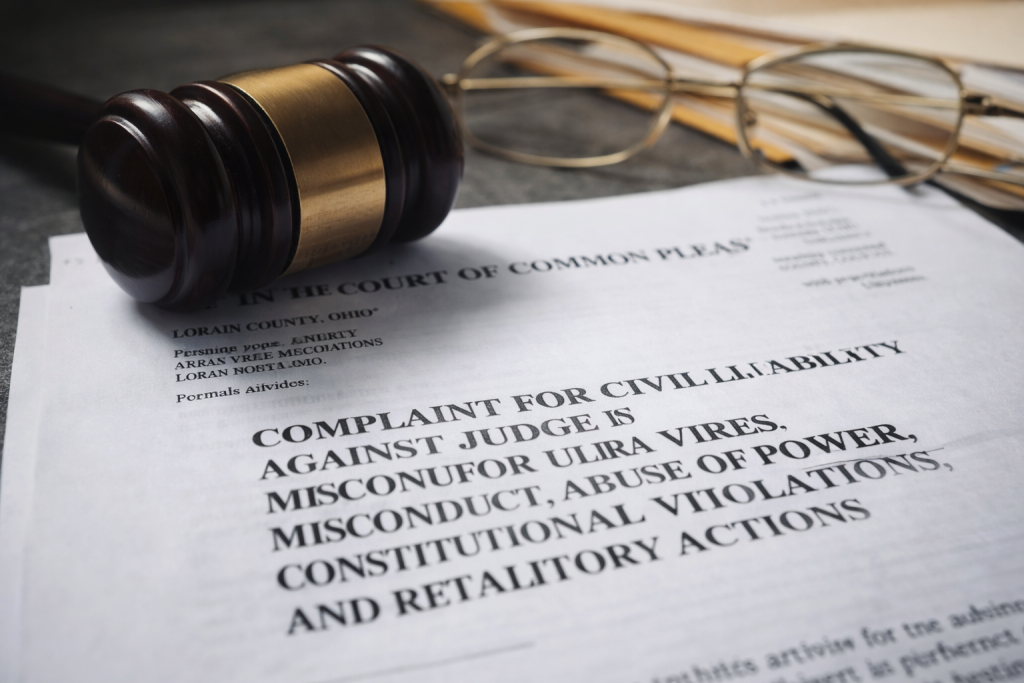
On December 11, 2025, a pro se litigant filed a twenty page civil complaint in the Lorain County Court of Common Pleas that does something rarely seen in modern Ohio litigation. It does not merely criticize judicial conduct through appeal or administrative complaint. It names a sitting judge as a defendant and alleges that her actions were not protected judicial decision making but instead ultra vires conduct taken without jurisdiction, in retaliation, and in violation of constitutional rights.
The case is captioned Michael Anthony Williams, Sr. v. Judge Denise H. McColley, and it is styled as a “Complaint for Civil Liability” rather than an appeal or writ. The distinction is deliberate. From the opening paragraphs, the filing frames the case as one about power exercised after jurisdiction was lost, not about disagreement with rulings made while jurisdiction existed.
The plaintiff alleges that once jurisdiction was divested by the filing of a Supreme Court of Ohio disqualification affidavit under Revised Code 2701.03, the court’s authority ended automatically. What followed, according to the complaint, was not judicial discretion but administrative and ministerial conduct carried out in defiance of that statutory divestiture.
That framing is the foundation of every claim that follows.
“What happens when a judge continues to act after the law says she cannot.”
See the Case File Here: Click this Link
The Core Theory: When Jurisdiction Ends, Immunity Ends With It
Judicial immunity is one of the strongest shields in American law. Judges are generally immune from civil liability for acts taken in their judicial capacity, even if those acts are alleged to be erroneous, malicious, or unconstitutional. The complaint does not dispute that principle. Instead, it argues that immunity only exists where jurisdiction exists.
The complaint relies on a well established but narrowly applied distinction recognized by the United States Supreme Court and Ohio courts. Judicial acts performed without jurisdiction are void, not merely voidable. Administrative and ministerial acts are not protected by judicial immunity at all.
According to the filing, on November 10, 2025, the plaintiff filed an affidavit of disqualification with the Supreme Court of Ohio under R.C. 2701.03. Under Ohio law, once such an affidavit is filed, the challenged judge loses jurisdiction immediately until the Chief Justice rules on the disqualification. The complaint alleges that despite this automatic divestiture, Judge McColley continued to act.
Those actions allegedly included holding hearings, issuing judgment entries, imposing sanctions, ordering filing restrictions, and directing clerical and deputy actions. The plaintiff characterizes these acts as ultra vires conduct taken in the absence of jurisdiction and therefore outside the protection of immunity.
The complaint repeatedly cites the principle that “acts taken without jurisdiction are void,” invoking Ohio Supreme Court precedent and federal authority to argue that what occurred after November 10 cannot be insulated by the robe.
“The complaint argues that immunity only exists where jurisdiction exists.”
Allegations of Physical Harm and Forced Isolation
The factual allegations are not limited to procedural disputes. The complaint describes two separate incidents in August 2025 in which the plaintiff alleges he was physically assaulted by sheriff’s deputies inside the Lorain County Justice Center. The first allegedly occurred on August 29, the second on August 31.
According to the complaint, these incidents resulted in physical injuries requiring ambulance transport and medical attention. The filing asserts that rather than responding to the injuries or accommodating medical needs, the court allegedly permitted deputies involved in the incidents to continue interacting with the plaintiff.
More significantly, the complaint alleges that the plaintiff was forced into a Zoom room against his will, physically barred from entering the courtroom, and isolated from meaningful participation in proceedings. These actions are framed not as courtroom security decisions but as deprivations of due process carried out without jurisdiction and without lawful findings.
The complaint asserts that this forced isolation deprived the plaintiff of the ability to confront witnesses, present evidence, object to proceedings, and participate in hearings that affected parental rights and legal status.
“Procedure stops functioning as a safeguard and starts functioning as a weapon.”
The Disqualification Filing and What Followed
A central turning point in the complaint is the November 10, 2025 filing of the Supreme Court disqualification affidavit. The complaint states that notice of the filing was provided to the judge, the clerk, and opposing counsel. Copies were also filed in the domestic relations docket.
Despite this, the complaint alleges that on November 18, 2025, Judge McColley conducted a hearing anyway. The filing characterizes this hearing as a “hostile ambush hearing” conducted while the plaintiff was unrepresented, physically excluded, and forced to participate remotely without authority to submit evidence or communicate freely.
On November 25, 2025, the court allegedly issued a judgment entry imposing sanctions, filing restrictions, and additional orders. The complaint argues that the judgment entry itself contains admissions that the plaintiff was physically prevented from appearing, which the plaintiff contends makes the entry facially void.
The filing asserts that these actions were not only unlawful but retaliatory, taken in response to the plaintiff’s exercise of statutory rights to seek disqualification and appellate review.
“Once you concede that authority can evaporate, the entire accountability structure changes.”
Allegations of Retaliation and Procedural Sabotage
Beyond jurisdictional arguments, the complaint paints a picture of escalating procedural obstruction. It alleges that filings were struck without cause, transcripts were denied, motions were ignored or refused docketing, and access to records was restricted.
The complaint asserts that the court imposed a filing moratorium without statutory authority, ordered the clerk not to accept filings, and denied access to audio and video recordings necessary for appeal. These actions are framed as deliberate efforts to obstruct appellate rights and insulate the court from review.
The plaintiff alleges that financial sanctions were imposed despite multiple indigency affidavits showing income of approximately $690 per month, and that these sanctions were designed to punish and deter further legal action rather than to address any legitimate court interest.
The Child Safety Allegation That Raises the Stakes
One of the most serious allegations in the complaint involves the handling of a reported sexual assault of the plaintiff’s minor daughter. The filing alleges that the plaintiff informed the court of the assault on January 2, 2025, and that the court responded by stating, “We are not here for that.”
“We are not here for that.”
The complaint asserts that judges are mandatory reporters under Ohio law and that the failure to acknowledge or act on such information constitutes administrative misconduct outside judicial immunity. This allegation is tied to claims of violation of mandatory reporter statutes, failure to protect minors, and retaliation for raising child safety concerns.
The filing alleges that instead of protecting the child, the court sanctioned the parent, restricted filings, and limited access to the children.
What the Lawsuit Is Asking the Court to Do
Procedurally, the lawsuit seeks far more than damages. While it demands compensatory and punitive damages exceeding $25,000 per count, it also seeks declaratory and injunctive relief.
The plaintiff asks the court to declare that all orders issued after November 10, 2025 are void due to lack of jurisdiction under R.C. 2701.03. The complaint further seeks an injunction preventing enforcement of those orders and barring further involvement by the defendant judge in the plaintiff’s legal matters.
A jury demand is included, signaling the plaintiff’s intent to have factual disputes resolved by jurors rather than dismissed at the pleading stage.
The complaint is structured to survive an immunity based motion to dismiss by carefully categorizing alleged conduct as administrative, ministerial, retaliatory, or ultra vires, rather than discretionary judicial decision making.
Why This Filing Matters Beyond One Case
Cases challenging judicial conduct are often dismissed quickly, and many never reach substantive review. This filing attempts to thread a narrow but recognized legal path by anchoring its claims to jurisdictional divestiture and nonjudicial conduct.
Whether the claims succeed will depend on how strictly courts interpret the scope of immunity and whether they accept the complaint’s characterization of post disqualification actions as void acts rather than protected rulings.
What cannot be ignored is the seriousness of the allegations and the precision with which the complaint frames them. This is not a generalized grievance against a judge. It is a document that attempts to force a court to answer a direct question.
What happens when a judge continues to act after the law says she cannot.
That question sits at the center of this case, and its resolution will determine whether the complaint is dismissed quietly or becomes something far more consequential.
Final Thought
This Is Not an Outlier. It Is a Pattern the System Keeps Producing
If this complaint feels familiar, that is not because the facts are identical to other cases I have covered. It is because the structure is the same. Different courthouse. Different docket. Different litigant. Same institutional reflex.
Across my reporting, the common thread is not a single bad ruling or a judge making a hard call under pressure. It is what happens after a system decides that a person has become inconvenient. Once that line is crossed, procedure stops functioning as a safeguard and starts functioning as a weapon. Access narrows. Records become harder to obtain. Filings disappear or are struck without explanation. Appeals become theoretical because the record needed to pursue them is withheld. The rules are still cited, but only selectively and only in one direction.
I have written about courts that claimed transparency while fighting public records requests tooth and nail. I have documented cases where jurisdictional questions were brushed aside because answering them would have required stopping the machine. I have covered situations where litigants were sanctioned into silence, not because their claims lacked merit, but because persistence itself was treated as misconduct. In every one of those stories, the justification was framed as order, efficiency, or discretion. The effect was always the same. Fewer witnesses. Less sunlight. No accountability.
What makes this filing different is not its tone or even its breadth. It is that it refuses to argue inside the usual box. Instead of asking whether a judge exercised discretion properly, it asks whether the judge had the power to act at all. Instead of debating the wisdom of sanctions, it challenges their legal existence. Instead of treating jurisdiction as a technicality, it treats it as the hard boundary the law says it is.
“Systems do not fail loudly. They fail quietly, incrementally, and with paperwork.”
That is uncomfortable for a system built on deference.
Courts depend on the idea that even when mistakes are made, they are made within authority. Once you concede that authority can evaporate, that orders can be void rather than merely wrong, the entire accountability structure changes. Appeals are no longer the only answer. Immunity is no longer automatic. Administrative acts can be scrutinized as conduct rather than cloaked as judgment.
I have seen this resistance before. When a records custodian realizes they cannot retroactively justify a denial. When a public office discovers that a draft was, in fact, a public record. When a security exemption collapses under basic statutory reading. The response is rarely to correct course. It is to double down and hope the challenge goes away.
Sometimes it does. Most people cannot afford to keep pushing. Most people are exhausted long before the system is forced to answer the question it is avoiding.
This case is not about whether every allegation will be proven. That is for a court or a jury to decide. It is about whether the question itself is allowed to be asked. Can a litigant force a court to confront the moment when power ended and action continued anyway. Can jurisdiction mean what the statute says it means. Can procedure still function as a limit rather than a suggestion.
Those are not radical questions. They are foundational ones.
If the answer is that authority persists regardless of law, regardless of notice, regardless of statutory divestiture, then none of the other protections we talk about matter very much. Due process becomes conditional. Access to courts becomes discretionary. Rights exist only so long as they are not inconvenient.
Every court story I have published circles back to the same reality. Systems do not fail loudly. They fail quietly, incrementally, and with paperwork. This complaint forces that quiet process into the open and demands a response.
That is why it matters. Not because it names a judge. Not because it is aggressive. But because it insists that power still has boundaries and that someone has to enforce them when the system will not do it on its own.
Editor’s Note and Source Disclosure
The civil complaint analyzed in this article was provided directly to me by the filer, who requested that the allegations and procedural posture be examined and explained for the public record. I did not draft the complaint, file the complaint, or participate in the litigation underlying it. All descriptions, quotations, and summaries above are drawn from the filed pleading itself and are presented for purposes of public-interest reporting and analysis.
Legal Disclaimer
This article is journalistic analysis and commentary, not legal advice. Allegations described herein remain allegations unless and until adjudicated by a court of competent jurisdiction. No findings of fact have been made by any court in connection with the claims discussed. Readers should not construe this reporting as a statement of liability, guilt, or wrongdoing, but as an explanation of what is alleged and why it is legally significant.
AI Use Disclosure
This article was drafted with the assistance of artificial intelligence as a writing and organizational tool, under the direction and editorial control of the author. All legal analysis, framing decisions, and factual selections were reviewed and approved by the author prior to publication. AI tools did not introduce independent facts or legal authorities beyond those contained in the source document.
About The Author