

The Warning That Preceded the Collapse
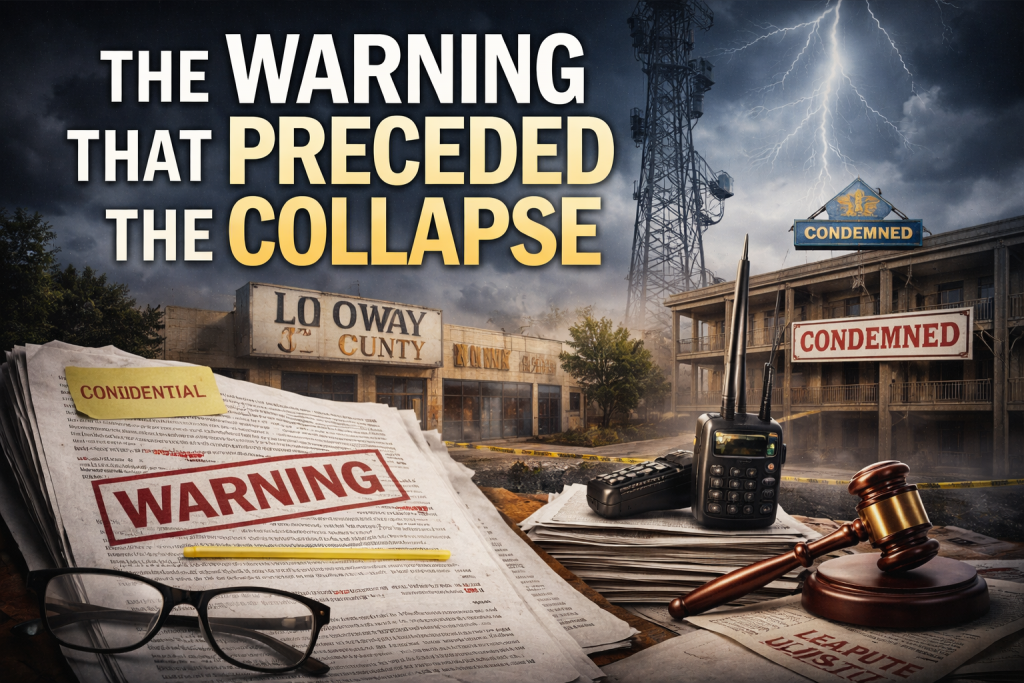
What the Record Shows Was Known Before Midway Mall Failed and the Radio Conflict Escalated
Byline
By Aaron Christopher Knapp, BSSW, LSW
Investigative Journalist and Government Accountability Reporter
Founder and Editor, Lorain Politics Unplugged
Publisher, AaronKnappUnplugged.com
In Midway Mall and the Cost of Certainty, this publication documented how Lorain County converted approximately $13.9 million in public funds into speculative exposure tied to a long-declining enclosed mall, framed that decision as transformational rather than risky, and then compounded that exposure by acquiring a condemned Days Inn property after the redevelopment plan unraveled. That reporting did not treat those events as isolated miscalculations. It identified a recurring governance pattern in which confidence preceded commitment, public assurances substituted for enforceable safeguards, and accountability followed only after consequences were no longer avoidable.
Confidence preceded commitment. Public assurances substituted for enforceable safeguards. Accountability arrived only after consequence became unavoidable.
What remained unresolved at the time was a central question of public accountability. Were the risks that ultimately materialized truly unforeseeable when those decisions were made, or had they already been identified, articulated, and discounted in favor of narrative certainty and institutional momentum, even as the public was being told that the County’s approach was disciplined and controlled.
The record now answers that question with clarity.
Long before the Midway Mall redevelopment collapsed, before the County was left holding financial exposure without the outcome it promised residents, and before the County’s handling of its public safety radio system escalated into federal litigation, a written warning already existed. That warning did not emerge from political fallout or retrospective analysis. It was not drafted in response to press scrutiny, legal strategy, or public criticism. It circulated contemporaneously, at a time when County leadership was still publicly asserting that its major redevelopment and infrastructure decisions were prudent, responsible, controlled, and unavoidable.
The timing of that warning is critical. It establishes that the risks which later materialized were not invisible, theoretical, or unknowable. They were articulated while decisions were still being defended as disciplined governance rather than speculative exposure. The warning addressed the precise conditions under which public entities move from bounded risk into escalation, and it did so before those conditions produced visible failure in Lorain County.
Warnings issued after collapse are commentary. Warnings issued before collapse are notice, and notice is where fiduciary accountability begins.
This article does not speculate about authorship, identity, or motive. It does not rely on conjecture or anonymous attribution to make its case. Instead, it documents the existence of that written warning, the context in which it circulated, the governance dynamics it described, and how closely those dynamics align with what later unfolded across multiple fronts of County action. Most notably, it examines how the warning anticipated both the financial collapse of the Midway Mall redevelopment posture and the operational escalation surrounding the County’s radio system transition and its protracted conflict with Cleveland Communications Inc.
The significance of the warning is not that it predicted specific outcomes in advance. It is that it identified a governing reflex that, once activated, produces the same result across different policy domains. Whether the issue involved speculative redevelopment, acquisition of distressed nuisance property, or disruption of public safety infrastructure, the same pattern emerged. Risk was minimized rhetorically rather than bounded structurally. Concerns raised by those closest to the consequences were reframed as resistance. And once public posture hardened, institutional retreat became more difficult than escalation.
What follows is not a retrospective attempt to assign blame after the fact. It is a record-based examination of what was already knowable, when it was knowable, and how decisions proceeded anyway. In public governance, that distinction matters because accountability does not begin with outcome. Accountability begins with notice.
What the Written Warning Addressed
The written analysis did not focus on a single project, personality, or political disagreement. It examined a recurring failure mode in public decision-making that appears whenever public entities convert liquid taxpayer resources into speculative exposure while relying on confidence, messaging, and asserted inevitability rather than enforceable safeguards to justify that risk. The warning was structural in nature. It addressed how decisions are made, defended, and escalated inside government once public money has been committed without clearly defined limits.
At its core, the analysis warned that when public funds are deployed without bounded downside protections, binding private commitments, or clearly articulated exit strategies, the incentives inside government change in predictable ways. Risk ceases to function as a constraint. Instead, it becomes something to be managed narratively. Officials become invested not only in the outcome of the decision, but in the defense of the decision itself. At that point, institutional behavior begins to shift away from discipline and toward preservation of posture.
When public money is committed without hard limits, the institution becomes invested in defending the decision, not stress-testing it.
The warning explained that this shift has a specific and repeatable consequence. When assumptions begin to fail, the presence of sunk costs discourages reassessment rather than encouraging it. Money already committed becomes a reason to continue rather than a reason to stop. The analysis cautioned that this dynamic rarely produces restraint, even among well-intentioned officials. It produces escalation, not because of conspiracy, malice, or personal animus, but because acknowledging misjudgment becomes institutionally harder than continuing forward under the same narrative frame.
This is where narrative confidence becomes dangerous. The warning emphasized that once leadership publicly frames a decision as inevitable, transformational, or beyond reasonable dispute, retreat carries political and reputational cost. Reassessment is no longer treated as diligence. It is treated as weakness. Internal dissent is no longer treated as risk mitigation. It is reframed as obstruction. As a result, early warning signs are managed rather than addressed, and uncertainty is absorbed rather than bounded.
One passage captured this concern directly by warning that when confidence substitutes for discipline, failure rarely triggers genuine course correction. Instead, it triggers justification, followed by expansion. The institution does not slow down. It doubles down. Each subsequent commitment is framed as necessary to protect or complete the original decision, even when the original assumptions have already begun to erode.
At the time this warning circulated, Lorain County had not yet been forced to confront the visible consequences of this posture. The Midway Mall redevelopment had not yet collapsed. The radio system conflict had not yet hardened into litigation. The costs of escalation had not yet crystallized into balance-sheet exposure and legal risk. But the conditions that make those outcomes likely were already present. The warning did not predict specific events. It identified a governing reflex that, once activated, produces the same result across different policy domains.
What makes this warning significant is not that it anticipated failure in the abstract. It anticipated how failure would be handled once it occurred. It described the exact institutional behavior that later unfolded, where exposure was treated as justification for further commitment, dissent was reframed as resistance, and accountability was deferred until consequences could no longer be avoided.
That is why this analysis matters now. It demonstrates that what followed was not simply the product of unforeseen complication. It was the foreseeable result of a decision-making culture that elevated confidence over constraint and narrative over discipline.
Why Timing Matters for Public Accountability
Warnings issued after a failure function as commentary. They are informed by loss, shaped by outcome, and often dismissed as hindsight. Warnings issued before a failure serve a very different purpose. They operate as notice. They establish what was knowable at the time decisions were made and define the boundary between unforeseeable risk and disregard of observable conditions.
The written warning examined in this report circulated before the Midway Mall redevelopment collapsed, before the County was left holding public exposure without the outcome it promised, and before the conflict over the County’s public safety radio system hardened into federal litigation. At the time the warning circulated, County leadership was still publicly assuring residents that its major financial and infrastructure decisions were controlled, manageable, and necessary. Confidence was being projected outward even as the conditions that would later produce failure were already visible.
The risks associated with enclosed malls were not emerging or speculative. They were widely documented nationwide and well understood within commercial real estate and redevelopment circles. Anchor tenant attrition, declining foot traffic, post-pandemic retail contraction, and the collapse of traditional enclosed mall models were not novel developments in 2023. They were established market realities. Proceeding as though Midway Mall represented a manageable exception to those trends required not ignorance of the data, but disregard of it.
The same is true of the radio system conflict. Long before litigation commenced, first responders across Lorain County were raising operational concerns about coverage, in-building performance, and system reliability. Those concerns were not abstract policy objections. They were grounded in daily use and direct exposure to risk. The warning anticipated that destabilizing an existing communications system without resolving those concerns would produce escalation rather than resolution, particularly once leadership committed publicly to a course of action that framed dissent as resistance rather than as an early warning.
Critically, the written warning did not rely on privileged access, confidential briefings, or insider knowledge. It relied on observable market conditions, publicly visible institutional incentives, and governance patterns that had already played out elsewhere. Its analysis drew from outcomes that were already documented in other jurisdictions when public entities converted liquid resources into speculative exposure or treated operational systems as political abstractions rather than as safety infrastructure.
That timing matters because it forecloses any claim that what followed was unknowable, unforeseeable, or merely the product of unfortunate circumstance. When a warning articulates the risks that later materialize, and when those risks arise under conditions that were already visible at the time of decision, accountability cannot be deferred to hindsight. The issue becomes whether leadership exercised the restraint and diligence required once notice existed.
Public accountability does not require perfect prediction. It requires responsiveness to warning signs when they appear. The existence of this warning, and its circulation before collapse and litigation, establishes that the County was operating in an environment where the consequences that followed were not surprises. They were foreseeable outcomes of choices made under conditions of known risk.
In public governance, that distinction is decisive.
Public Money Meets Private Speculation
Midway Mall and the First Failure of Discipline
After the written warning circulated, Lorain County approved the $13.9 million loan that bound public funds to the Midway Mall property through the Lorain County Port Authority. With that single act, the County converted liquid taxpayer resources into a speculative redevelopment position attached to a largely vacant, long-declining enclosed mall whose market trajectory was already well established nationally and regionally.
This was not a neutral financing decision. It was not routine economic development support. It was a deliberate assumption of risk by the County itself, undertaken in a commercial environment where enclosed malls were failing at scale, anchor tenants were collapsing, and redevelopment success increasingly depended on highly specific conditions that were neither guaranteed nor secured in this case.
Yet the transaction was not presented to the public as speculative. It was framed as strategic, stabilizing, and responsible. Officials spoke in the language of inevitability rather than contingency. The County emphasized vision, transformation, and opportunity while minimizing the structural risks inherent in acquiring a property whose decline was neither sudden nor anomalous. What the public did not receive was a clear, documented explanation of how taxpayer exposure would be limited if the optimistic scenario failed to materialize.
There were no enforceable safeguards presented with the confidence. There were assurances, but no bounded downside.
There were no binding redevelopment commitments from end users made public at the time of approval. There was no enforceable timeline that shifted risk back onto private actors if milestones were missed. There was no articulated exit strategy explaining under what conditions the County would disengage rather than double down. In place of those safeguards, the County offered confidence. Confidence substituted for discipline.
The redevelopment plan later unraveled, exactly as the warning anticipated could happen when speculative exposure is assumed without bounded downside protections. The anticipated private investment failed to materialize. The promised transformation did not occur. The mall remains largely empty, serving as a physical reminder that public funds were committed on the strength of narrative rather than enforceable outcomes. The County was left holding exposure without the redevelopment it assured residents would follow.
At that point, the written warning becomes dispositive, not rhetorical. It did not merely anticipate that the project might fail. It anticipated how institutions often respond when failure arrives. Instead of triggering reassessment, failure becomes a justification for persistence. Instead of narrowing exposure, leadership treats sunk costs as a reason to continue committing resources in the hope of salvaging the original premise.
That is precisely what occurred.
Rather than pausing to reevaluate assumptions, impose hard limits, or conduct a public accounting of why the redevelopment projections proved unsound, the County proceeded as though the exposure itself demanded further action. The initial failure did not produce restraint. It produced escalation. The discipline fiduciary duty requires at the moment assumptions fail was absent when it mattered most.
Midway Mall was not simply a redevelopment gamble that did not pay off. It represents the first clear failure of fiduciary discipline in a sequence that followed. The County did not lose money because it could not predict the future. It assumed risk that was already visible, failed to bound that risk, and then treated the resulting exposure as justification for further commitment rather than as a warning to stop.
That is the point at which redevelopment judgment crosses into governance failure.
Compounding Risk
From Midway Mall to the Condemned Days Inn
Rather than treating the failure of the Midway Mall redevelopment as a warning that demanded reassessment, County leadership and the Port Authority expanded public exposure by acquiring the condemned Days Inn property directly across the street. The timing of that decision is critical. The acquisition did not occur before the mall plan unraveled, when optimism about redevelopment outcomes might at least have been defensible. It occurred after the redevelopment deal collapsed, while the County remained financially tethered to a largely vacant, nonperforming commercial asset with no secured path forward.
That choice alone would warrant scrutiny. But the condition and history of the Days Inn make the decision far more troubling.
By the time the County acquired the property, the Days Inn was not a neutral or dormant asset awaiting reuse. It was a known nuisance property with a documented history of deterioration and repeated law enforcement responses, and it had become widely associated in the community with chronic criminal activity, including its reputation as a hub for prostitution and related offenses. That reputation does not appear without sustained conditions, sustained calls for service, and sustained awareness. Those conditions were neither hidden nor speculative. They were observable, documented, and widely known.
The County did not acquire uncertainty. It acquired a known liability, after a prior speculative bet had already failed.
In other words, the County did not acquire a distressed but manageable property with uncertain downside. It acquired a site whose future costs were foreseeable from the outset. Demolition was not a hypothetical option. Remediation was not a contingent risk. Carrying costs were not abstract projections. They were the predictable consequences of acquiring a property that had already crossed the threshold from underperforming to condemned.
The sequencing of this decision matters because it exposes the escalation dynamic identified in the written warning. Instead of pausing after the Midway Mall failure to reassess exposure, impose limits, or demand accountability for assumptions that proved wrong, County leadership proceeded as though additional acquisition would somehow resolve prior misjudgment. Sunk costs were treated not as a signal to stop, but as justification to continue. Public exposure was not bounded. It was layered.
This is where the issue ceases to be simple judgment error and becomes a failure of fiduciary discipline. Fiduciary responsibility does not require perfect foresight. It requires restraint when assumptions fail and risks crystallize. It requires recognizing when further commitment increases exposure rather than mitigates it. Acquiring a condemned nuisance property with foreseeable criminal, remediation, and demolition costs while already carrying unresolved exposure from a failed redevelopment project does not reflect prudence. It reflects disregard.
The written warning anticipated this precise moment. It cautioned that when public entities respond to failure by expanding commitment rather than narrowing risk, escalation becomes structural rather than incidental. The Days Inn acquisition is the clearest confirmation of that warning in the redevelopment context. It demonstrates that the County’s response to failed assumptions was not recalibration, but accumulation.
In practical terms, the Days Inn did not stabilize the Midway Mall corridor. It amplified its liabilities. It converted an already speculative redevelopment position into a compound problem involving blight, public safety demands, remediation, and inevitable demolition costs. The County assumed not only financial exposure, but responsibility for a property whose decline had already produced real community harm.
This was not bad luck. It was a foreseeable outcome of treating confidence as a substitute for discipline and expansion as a substitute for accountability. The Days Inn did not become a problem after the County acquired it. It was already a problem. The decision to absorb that problem, after the Midway Mall failure had already materialized, is what transforms this episode from miscalculation into a clear example of compounding public risk.
Where the Warning Became Operational
The Radio System Conflict and the Escalation That Followed
While Midway Mall and the subsequent acquisition of the condemned Days Inn illustrate how speculative financial exposure was assumed and compounded, the County’s conflict with Cleveland Communications Inc. represents the same governing posture applied to a system where failure carries immediate and tangible operational consequences. If redevelopment decisions exposed the County’s approach to financial risk and long-term liability, the radio system dispute exposed how that same approach migrated into public safety infrastructure, where the margin for error is far narrower and the cost of escalation is measured not only in dollars, but in risk borne by first responders and the public they serve.
For years, Cleveland Communications Inc. operated a radio system that was relied upon daily by first responders across Lorain County. That reliance did not arise from marketing claims, contractual inertia, or political alignment. It arose from use. Chiefs, line officers, dispatch professionals, and municipal leaders repeatedly emphasized coverage reliability, in-building performance, and operational familiarity developed through years of real-world deployment. These were not abstract or theoretical preferences. They reflected lived experience responding to emergencies in varied terrain, aging structures, and unpredictable conditions where communications reliability is not a convenience but a prerequisite for safety.
The County’s decision to shift away from that system was not preceded by a publicly documented, side-by-side operational evaluation that resolved those concerns in a transparent and verifiable manner. There was no comprehensive record made available to the public demonstrating how competing systems performed under identical conditions, how coverage gaps would be addressed, or how operational risks would be mitigated during transition. Instead, the shift was framed primarily as a policy choice and a procurement matter, and eventually as an inevitability. As with Midway Mall, the public-facing narrative emphasized confidence, modernization, and control, while the technical details necessary for independent verification remained contested, incomplete, or inaccessible.
When a radio system transition is framed as inevitable, unresolved operational concerns stop being treated as risk and start being treated as resistance.
That framing mattered because it narrowed the range of acceptable responses once concerns persisted. When a transition is treated as inevitable rather than contingent, dissent ceases to function as a signal and instead becomes something to be managed. Questions about coverage, reliability, and readiness were not resolved through documented testing that closed the gap between assurance and performance. They were absorbed into a broader narrative that prioritized decisiveness over deliberation. This is precisely the decision-making environment the written warning described, where confidence substitutes for contingency and institutional flexibility erodes as public posture hardens.
As the conflict escalated, the County terminated the tower lease that physically anchored the existing system. Publicly, that action was characterized as procedural or contractual, a matter of rights and obligations rather than operational impact. In practice, it functioned as a forcing mechanism. Removing access to the tower materially undermined the existing system’s viability while accelerating reliance on an alternative system that remained the subject of unresolved concerns. That move did not resolve the technical dispute. It resolved leverage. It converted a contested transition into an imposed one, foreclosing the possibility of meaningful reassessment.
This moment marks the point at which the warning became operational reality. The written analysis anticipated that once a public entity commits itself to a narrative of inevitability, retreat becomes institutionally unacceptable, even when risks remain unresolved. At that stage, escalation is no longer accidental. It is structural. Decisions are made not to test assumptions, but to defend them. Exposure is not bounded. It is enforced.
Once the County committed to that course, dissent stopped functioning as an early warning system and began to be treated as obstruction. Transparency gave way to consolidation of control. Concerns raised by those closest to operational consequences were reframed as resistance rather than evidence. When the conflict hardened further, it did not prompt recalibration or pause. It prompted litigation, transforming a governance failure into a legal confrontation whose resolution now rests with the courts rather than with public accountability mechanisms.
In that sense, the radio system conflict is not a separate controversy layered onto the Midway Mall failure. It is the same warning, fulfilled in a different domain. Where redevelopment exposed speculative financial risk over time, the radio transition exposed operational risk in real time. Both followed the same arc. Assumptions were advanced confidently. Warnings were minimized. Escalation replaced correction. And accountability arrived only after consequences became unavoidable.
That is why the radio system dispute cannot be treated as ancillary to this record. It is where the cost of governing by confidence instead of discipline became operationally visible, and where the written warning’s abstract cautions materialized into concrete, unavoidable outcomes.
See the Filing here: https://acrobat.adobe.com/id/urn:aaid:sc:VA6C2:00ba58a8-e5f6-45ce-9220-510aa9ffb06f
CCI’s Fight as the Central Case Study
Cleveland Communications Inc.’s lawsuit did not arise simply because a contract reached its end or because a county chose to pursue a different vendor. Framing the dispute that way strips it of context and obscures what the record actually shows. The litigation arose because the transition away from CCI unfolded through a series of actions that, according to the complaint, were not neutral, technical, or competitively driven, but coercive in effect and retaliatory in consequence. CCI alleges that the County’s conduct was designed not to resolve identified operational concerns, but to force an outcome by destabilizing an existing system, consolidating control, and eliminating competition through pressure rather than performance.
Those allegations will be tested in federal court, where evidentiary standards, statutory defenses, and immunity doctrines will govern the outcome. But the existence of litigation is only part of the public story. What matters for accountability purposes is how the dispute fits into the broader pattern already documented across Lorain County’s recent major decisions, and how closely that pattern aligns with the written warning that predated both the Midway Mall failure and the radio system escalation.
The warning anticipated precisely the conditions under which disputes like this metastasize. It described a governance dynamic in which confidence hardens into inevitability, dissent is reframed as obstruction, and escalation becomes the default response when assumptions are challenged. In the context of the radio system, that dynamic moved quickly from rhetoric to operational reality. First responder concerns about coverage, reliability, and readiness were raised early and repeatedly. Those concerns were not abstract or speculative. They were grounded in daily operational experience and reflected the realities of emergency response across diverse geographies and structures.
Yet rather than resolving those concerns through transparent, side-by-side evaluation and documented testing, the County advanced a narrative of modernization and control that treated the transition as foregone. Once that narrative was adopted publicly, institutional flexibility narrowed. Reassessment became politically and administratively costly. At that point, escalation was not accidental. It was structural.
Legal immunity can shield authority. It cannot retroactively create discipline, erase foreseeability, or convert escalation into diligence.
The termination of the tower lease illustrates this escalation vividly. Characterized publicly as a contractual or administrative decision, the action functioned operationally as a forcing mechanism. It undermined the existing system’s viability while accelerating reliance on an alternative that was still contested. That move did not resolve technical disputes. It resolved leverage. It transformed a policy disagreement into a power imbalance, precisely the kind of escalation the written warning cautioned against.
CCI’s lawsuit situates that escalation within a legal framework, alleging that County actions crossed from policy choice into coercive conduct. Whether the court ultimately agrees with that characterization is a legal question. But the public accountability question exists independently of the litigation’s outcome. The presence of a written warning that identified these risks before they materialized alters how the County’s conduct must be evaluated. If the risks were known and the escalation dynamic was foreseeable, then the core issue is not surprise. The core issue is choice.
The County now argues that its actions are shielded because they flowed from protected legislative acts. That argument may succeed as a matter of law. Courts routinely distinguish between motive and authority, and immunity doctrines exist precisely to protect legislative decision-making from judicial second-guessing. But immunity does not answer the question this record raises. It does not retroactively transform foreseeable risk into unavoidable consequence. It does not convert escalation into diligence. And it does not negate the significance of warnings delivered before disruption became entrenched.
What this case study ultimately shows is that the radio conflict was not an isolated procurement dispute. It was the clearest operational manifestation of a governing reflex already visible in financial and asset decisions. Midway Mall exposed that reflex economically. The Days Inn acquisition confirmed it institutionally. The radio system conflict exposed it operationally, where the consequences were immediate and unavoidable.
CCI’s fight matters not because it names defendants or alleges wrongdoing, but because it documents what happens when a public entity responds to warning signs by consolidating authority rather than reassessing assumptions. It shows how disputes become entrenched when narrative replaces discipline and how litigation becomes the endpoint of escalation rather than a last resort.
In that sense, the lawsuit is not merely a legal event. It is the culmination of a process that was foreseeable, documented, and warned against before the County chose to proceed. That is why CCI’s case cannot be treated as ancillary to this story. It is the central case study. It demonstrates, in concrete operational terms, how the same decision-making culture that produced speculative financial exposure also produced public safety disruption and legal confrontation.
It reinforces the core conclusion of this investigation that Lorain County’s recent crises are not disconnected failures, but sequential outcomes of a governing posture that prioritized confidence, control, and escalation over restraint, transparency, and correction.
Final Thought
When a Warning Explains a System, Not a Single Failure
Read in full and in sequence, the written warning examined in this article does not merely contextualize one failed redevelopment project or one contested infrastructure decision. It explains a governing posture that has repeated itself across domains, budgets, and years, producing different crises with the same underlying structure. The Midway Mall loan, the subsequent acquisition of the condemned Days Inn, and the County’s escalating conflict with Cleveland Communications Inc. are not discrete episodes that coincidentally resemble one another. They are expressions of a single reflex, applied first to economic development, then to asset acquisition, and finally to public safety infrastructure.
The common element is not corruption alleged or intent presumed. It is the systematic elevation of confidence over contingency and narrative over enforceable discipline. In each instance, County leadership advanced a forward-looking justification that minimized known risks, relied on assurances rather than safeguards, and treated opposition not as an early warning system but as resistance to be overcome. When assumptions failed, the response was not pause or recalibration, but escalation. Exposure was layered rather than bounded. Control was consolidated rather than questioned. Accountability was deferred until consequences became unavoidable.
The radio system conflict makes this pattern impossible to dismiss as abstract. Unlike redevelopment projections or long-term property strategy, public safety communications operate in real time, under operational stress, with consequences that cannot be deferred or reframed after the fact. The concerns raised by first responders about coverage, reliability, and system readiness were not hypothetical. They were grounded in daily use. Yet those concerns were subordinated to a narrative of inevitability, and once the County committed publicly to that narrative, retreat became institutionally unacceptable. The termination of the tower lease was not merely a contractual maneuver. It was the operational manifestation of escalation, a decision that forced outcomes rather than tested assumptions while the County maintained outward confidence that the transition was controlled.
Cleveland Communications Inc.’s lawsuit now stands as the legal endpoint of that process. The case will be decided under evidentiary rules, statutory defenses, and immunity doctrines, and those doctrines may determine what can and cannot be litigated. But even if the County prevails on immunity arguments, the record still raises the question that immunity cannot answer, which is whether County leadership exercised the restraint and diligence required once warning signs existed and once foreseeable risk was placed on the table. Legal protection can shield authority. It cannot retroactively supply judgment. It cannot erase foreseeability. It cannot convert escalation into prudence.
Immunity can decide what is actionable in court. It cannot decide whether a public body honored its duty of care after notice existed.
This is why the timing of the written warning matters more than its authorship. It existed before the Midway Mall deal collapsed. It existed before the Days Inn acquisition compounded exposure. It existed before the radio system conflict hardened into federal litigation. It identified, in advance, the institutional behavior that tends to follow when confidence substitutes for discipline, and then the public record shows that behavior unfolding anyway. That does not establish malice. It establishes notice. In public governance, notice is where fiduciary responsibility begins.
The record now suggests that Lorain County did not stumble blindly into these outcomes. It moved forward under known risk, in an institutional culture that treated confidence as sufficient proof of prudence and treated escalation as a substitute for correction. That culture did not produce one disappointment. It produced a sequence. A speculative redevelopment exposure followed by compounding nuisance-property liability, followed by a public safety infrastructure conflict so entrenched that it moved into federal court.
This article does not ask readers to assume wrongdoing. It asks readers to recognize pattern, sequence, and consequence. When the same warning explains financial exposure, asset acquisition, and public safety disruption, the issue is no longer isolated decision-making. It is systemic discipline, or the absence of it. Once that conclusion is reached, the question facing Lorain County residents is no longer whether these outcomes were unfortunate. The question becomes whether the governing reflex that produced them has been acknowledged, confronted, and meaningfully changed, or whether the County will continue to treat escalation as governance and litigation as closure.
That is the unresolved issue this record leaves behind.
Related Reporting
If you want the full record context and the prior reporting this article relies on, start with the Midway Mall investigation and then follow the radio dispute and litigation timeline through the filings and analysis already published.
Midway Mall and redevelopment exposure
Midway Mall and the Cost of Certainty
CCI and the radio conflict series
The CCI Lawsuit: How Secrecy and Mismanagement Brought Lorain County to the Brink
The Contradictor-in-Chief: Dave Moore’s 8/15 Performance and the Unraveling of the CCI Sabotage Narrative
A Filing the Lorain County Commissioners Did Not Want the Public to Read
Lorain County’s Five-Year Spiral
Investigative and Editorial Notice
This article is a work of investigative journalism and editorial analysis based on public records, public meeting observations, court filings, and documentary materials reviewed by the author. It addresses matters of public concern involving government decision making, public spending, and public safety infrastructure. Readers are encouraged to review the linked source materials and prior reporting to evaluate the record independently.
Not Legal Advice
This publication is provided for informational and journalistic purposes only. Nothing contained herein constitutes legal advice, a legal opinion, or a recommendation regarding any legal strategy or outcome. The author is not acting as legal counsel, and no attorney client relationship is created by reading or sharing this work.
Fair Comment and Public Interest
This reporting concerns issues of public governance and accountability. Any opinions expressed are the author’s own, offered in good faith, and grounded in record based analysis. Where allegations, disputes, or claims are discussed, they are presented as allegations unless and until adjudicated by a court of law.
Ongoing Matters and Presumption
Some matters discussed in this article involve ongoing litigation or unresolved disputes. Allegations remain allegations. This publication does not purport to determine liability or legal conclusions. It reflects an ongoing examination of the public record as it exists at the time of publication.
Corrections and Updates
This report may be updated as additional public records are obtained, filings are made, or new verified information becomes available. Readers who believe a material factual error exists are encouraged to contact the publisher for review and possible correction.
AI Image and Graphic Disclosure
Some images, illustrations, graphics, or cover art used in connection with this publication may be generated or enhanced using artificial intelligence tools. AI assisted visuals are used for illustration, commentary, and expressive purposes and are not presented as documentary photographs unless explicitly identified as such. Any depiction of public figures or scenarios in AI generated imagery is expressive and not a literal representation of real events.
Copyright and Use
© Aaron Christopher Knapp. All rights reserved. This article and its original text may not be reproduced in full without permission, except for brief excerpts used for purposes of criticism, commentary, scholarship, or news reporting consistent with fair use principles. Links may be shared freely with attribution to the original publication.
Editorial Independence
This work is published independently. It is not sponsored by any political campaign, government agency, vendor, or litigant. Financial support for this publication funds public records requests, research, and reporting and does not confer editorial influence.
Independent local journalism exists to do the work that institutions cannot do for themselves.
This investigation is published free and without advertising so that access to information is not conditioned on ability to pay, platform algorithms, or tolerance for distraction. That choice is deliberate. It reflects a belief that public accountability work loses its value the moment it becomes gated, sponsored, or softened to satisfy commercial interests. It is also a choice that carries real cost.
This work requires time, records requests, document review, litigation monitoring, and long-form analysis that cannot be produced on a volunteer basis indefinitely. Filing public records requests is not free. Obtaining transcripts, reviewing filings, preserving evidence, and publishing findings with care and accuracy requires sustained effort and financial support. Doing this work without advertising protects editorial independence, but it removes the revenue streams most media organizations rely upon.
Please consider supporting this reporting.
If this work matters to you, if you believe local government functions best when it is observed rather than trusted blindly, and if you value journalism that documents rather than speculates, your support makes a direct difference. Contributions allow this publication to continue requesting records, reviewing filings, publishing findings, and preserving timelines without pressure to soften conclusions or chase attention.
Transparency is not guaranteed by statute alone. It is guaranteed by people. It is guaranteed by readers who understand that sunlight does not appear automatically, that records do not surface on their own, and that accountability requires sustained, independent effort. When institutions resist scrutiny, the only thing that forces the record into view is persistence backed by public support.
This work remains free because access matters. Its continuation depends on whether the public believes that independent local journalism is worth sustaining.

About The Author





The financial failures described in this article are such a magnitude as to cause even the most ardent conservative Constitutionalists to react negatively. Republicans are shocked at the failures we are witnessing. Follow the money and let’s trace where it went, how it was split, and who was capable of auditing the cash flow.
Did political donations truly recycle from vendors? If so, from whom? The Citizens desire some semblance of long term stability. How does escalation of payroll expense create frugality? Why was it sought by the Board of Commissioners to conceal or obscure public payroll authorizations? Many questions yet only Two Minutes to ask, speak, listen for answers? This indicates a limitation on Constitutional intelligence and integrity that leads a Commissioner astray.
Where in the Constitution does it authorize ZERO as Just Compensation for any taking? I want each Commissioner to answer that Question! Then ask whether they have followed their OathS of Office in denying citizens Just Compensation in public ditch projects!!! Should violation of the terms of the Constitution serve as a legitimate basis to remove the unconstitutionally acting official??? Do we keep lying cheating public officials? A troubling and disturbing time we are living in. No investigation into criminality despite the requests of victims.
Who is responsible for?