
When the Court Becomes the Subject
An Investigative Report on Ongoing Litigation, Record Integrity, and Access to Justice in Lorain County
By Aaron Knapp
Investigative Journalist | Founder, Unplugged with Knapp
Knapp Unplugged Media LLC
Investigative Notice to the Public
An Ongoing Examination of Judicial Process, Record Integrity, and Access to Courts in Lorain County
This article serves as the formal introduction to an ongoing investigative review of all Lorain County and City of Lorain courts, including their judicial officers, clerks, administrative operations, and points of interaction with prosecutorial authority. This is not a retrospective story and it is not limited to a single controversy. It is a live investigation into whether the systems that give courts their legitimacy are functioning as required by law, consistently, transparently, and without retaliation or obstruction.
This is not an opinion piece and it is not advocacy. It is an investigative status report grounded in filed pleadings, docket activity, sworn allegations, transcripts, and the procedural posture of multiple active cases. The purpose is to document what is being alleged, how those allegations surfaced, how frequently the same failures appear across unrelated matters, and why the nature of the claims raises public interest concerns that extend far beyond any single litigant or courtroom.
The litigation discussed here does not merely challenge judicial decisions. It challenges whether the mechanisms that make judicial decisions lawful, reviewable, and enforceable are operating as required by statute and constitutional due process. That distinction is critical. Courts are not insulated from scrutiny when the scrutiny concerns access to court, record accuracy, jurisdictional authority, and the neutrality of the forum itself. Those are not peripheral complaints. They are the structural conditions that separate lawful adjudication from unchecked power.
This investigation arises from a growing body of court filings alleging procedural failures that cannot be explained away as isolated error or dissatisfaction with outcomes. Across multiple cases, litigants have raised sworn allegations of refused filings, missing or altered docket entries, continued exercise of authority during jurisdictional challenges, denial of physical access to court facilities, and the use of prosecutorial power in ways alleged to deter or punish lawful court access. These allegations appear repeatedly, in different courts, under different judges, and in unrelated matters. When the same categories of failure recur, the issue becomes institutional rather than individual.
“Courts derive legitimacy from process, not from reputation.”
Courts derive legitimacy from process, not from reputation. Every appeal, every safeguard, every check on judicial authority depends on one foundational assumption: that the record is accurate, filings are accepted, jurisdiction is honored, and access to court is not conditioned on silence or compliance. When those assumptions are credibly challenged in sworn pleadings, public oversight is not interference. It is necessity.
As part of this ongoing investigation, members of the public are invited to submit their cases for review if they believe procedural errors, record irregularities, jurisdictional violations, or access barriers occurred. Submissions are sought for documentation, verification, and possible publication where the facts warrant. This is an invitation for review, not retaliation. No conclusions are predetermined. Allegations are evaluated against records, law, and corroboration.
This investigation will proceed deliberately, document by document, docket by docket. It will follow the paper trail rather than the rhetoric. Updates will be published as findings develop, and claims will be clearly distinguished from adjudicated facts.
“When the courts themselves become the subject of scrutiny, transparency is not optional. It is the only way public trust can be measured rather than assumed.”
The Triggering Question
What Happens When the Record Cannot Be Taken for Granted
Every court derives its authority from one non negotiable foundation: the existence of a complete, accurate, and verifiable record. Filings must be accepted when tendered. Docket entries must reflect what was actually filed, when it was filed, and how it was resolved. Orders must be traceable to jurisdiction that lawfully existed at the moment they were issued. Appeals, oversight, and public confidence all depend on that chain remaining intact from start to finish.
The ongoing litigation now pending in Lorain County forces a question that courts are rarely asked publicly but cannot avoid when it is credibly raised: what happens when a litigant alleges, with specificity and documentation, that those conditions failed, and that the failure was not clerical, isolated, or accidental.
The pleadings underlying this investigation allege missing or altered docket entries, refusals to accept filings, unexplained gaps in electronic case histories, and judicial actions taken during periods when jurisdiction was statutorily contested or suspended. These are not disagreements over legal reasoning. They are not arguments about how a judge weighed evidence or interpreted law. They are allegations that the basic mechanics of court operation broke down in ways that directly impair review, accountability, and due process.
“When the dispute concerns the integrity of the record itself, appeal may no longer be possible, because the very materials needed for review are alleged to be incomplete, altered, or missing.”
From an investigative standpoint, this distinction is decisive. When the dispute concerns outcomes, the remedy is appeal. When the dispute concerns the integrity of the record itself, appeal may no longer be possible, because the very materials needed for review are alleged to be incomplete, altered, or missing. At that point, the issue exits the realm of routine litigation and enters the realm of institutional accountability.
Courts can withstand disagreement. They cannot function without a reliable record. When sworn pleadings allege that the audit trail of justice itself has become unreliable, the public interest is no longer optional. It is immediate.
Filings:
Mapping the Litigation
Multiple Cases, One Consistent Theory
The current litigation landscape in Lorain County is not confined to a single filing or a single forum. It consists of several separate but interrelated actions that have developed over time and in different procedural postures. These include civil complaints naming judicial officers, jurisdictional challenges triggered by statutory disqualification procedures, and an amended counterclaim against the Lorain County Prosecutor alleging retaliatory misuse of state authority. Each case proceeds on its own docket, under its own caption, and before different decision makers. Yet when examined together, a consistent theory emerges.
Across these filings, the same categories of alleged conduct recur with notable regularity. Physical access to courthouse facilities is alleged to have been denied or restricted under circumstances that impeded participation in proceedings. Filings are alleged to have been rejected, refused, or ignored without explanation. Docket entries are alleged to have disappeared, been altered, or failed to reflect what was actually submitted. Judicial actors are alleged to have continued issuing orders after their authority was challenged under Ohio law through statutory disqualification mechanisms. Prosecutorial resources are alleged to have been deployed not to investigate reported misconduct, but to deter, suppress, or punish the reporting party for invoking the courts.
“Consistency across independent pleadings is not proof of accuracy, but it is a recognized marker of credibility in investigative work.”
From an investigative standpoint, this repetition matters. These allegations appear in pleadings filed months apart, in different cases, and under different procedural circumstances. They are not confined to a single adverse ruling or a single flashpoint. Instead, they track forward in time as the litigation evolved, with each filing incorporating and building upon earlier documented events. That pattern undermines any claim that the allegations were retrofitted to justify a particular loss or outcome.
Consistency across independent pleadings is not proof of accuracy, but it is a recognized marker of credibility in investigative work. It suggests contemporaneous documentation rather than hindsight reconstruction. When the same operational failures are alleged repeatedly, across separate cases, the question shifts. The issue is no longer whether a litigant disagrees with a result. It becomes whether the system itself is producing recurring procedural breakdowns that warrant examination beyond the confines of any one courtroom.
Jurisdiction as a Fault Line
Why the Disqualification Process Matters
One of the most consequential and least discretionary issues raised across the pending filings concerns judicial disqualification and the legal effect of a properly invoked challenge to judicial authority. Under Ohio Revised Code 2701.03, when a disqualification affidavit is filed with the Supreme Court of Ohio, the authority of the challenged judge is suspended by operation of law until the matter is resolved. This is not a courtesy pause. It is not advisory. It is a jurisdictional divestiture imposed by statute to protect the integrity of the proceedings and the rights of the parties.
“Jurisdiction is not a matter of degree. It does not partially exist.”
The litigation under review alleges that despite the filing of such disqualification affidavits, judicial officers continued to conduct hearings, issue orders, impose sanctions, and restrict filings. If those allegations are substantiated, the legal consequence is severe. Acts taken without jurisdiction are not merely erroneous or subject to reversal. They are void from inception under longstanding Ohio precedent. Void acts do not acquire legitimacy through repetition, silence, or later justification. They have no legal force at all.
From an investigative standpoint, this raises questions that go well beyond the merits of any individual case. Courts operate through layered safeguards designed to prevent exactly this scenario. When jurisdiction is challenged by statute, internal mechanisms should halt further action automatically. If proceedings continued regardless, the failure is not judicial discretion. It is systemic breakdown. Either safeguards were absent, ignored, or overridden, and each possibility carries its own implications.
Jurisdiction is not a matter of degree. It does not partially exist. It does not depend on intent or good faith. Either authority exists at the moment an act is taken or it does not. There is no harmless error doctrine for exercising power that the law has withdrawn. That is why the allegations surrounding disqualification and continued judicial action represent a fault line rather than a footnote. If substantiated, they do not affect only the litigants involved. They call into question the validity of proceedings conducted under the same conditions and the reliability of the system tasked with enforcing its own limits.
Ministerial Acts and Immunity Boundaries
Where Judicial Protection Ends and Duty Begins
Judicial immunity is intentionally broad, but it is not absolute, and it was never designed to shield operational failure. Courts have long drawn a firm line between judicial acts, which involve decision making in cases properly before the court, and ministerial or administrative acts, which involve carrying out the mechanics of court operations. Immunity protects the former. It does not automatically protect the latter.
That distinction matters here because several of the allegations raised across the pending filings do not concern how a judge ruled. They concern whether the court performed its basic duties at all. Allegations involving refusal to accept filings, disappearance or alteration of docket entries, exclusion from courthouse facilities, and enforcement actions taken by staff or at judicial direction are not attacks on adjudication. They are challenges to administration.
“If procedures were followed, records should exist to demonstrate that compliance. If procedures were not followed, the absence of records is itself evidence of failure.”
This framing is not rhetorical and it is not accidental. Under established law, acts such as docket maintenance, filing intake, record preservation, access control, and enforcement logistics are ministerial in nature. They are governed by rule, statute, and policy, not judicial discretion. When those acts fail, the legal analysis shifts. Immunity no longer functions as a blanket shield, because the conduct at issue is no longer judicial decision making. It is operational compliance.
From an investigative standpoint, this is where the inquiry becomes especially pointed. Ministerial duties exist precisely because courts cannot function without them. Filings must be logged. Dockets must reflect reality. Access decisions must follow policy. Staff must act under lawful authority. When those duties are alleged to have been ignored, overridden, or selectively enforced, the issue begins to resemble something closer to dereliction of duty than protected judicial conduct, at least as a threshold question.
That does not mean misconduct is assumed. It means accountability mechanisms are triggered. Who controls docket entries. Who has authority to refuse a filing. Under what policy can access to a courthouse be denied. Who documents those decisions. Who reviews them. These are not abstract or philosophical questions. They are operational questions with documentary answers.
If procedures were followed, records should exist to demonstrate that compliance. If procedures were not followed, the absence of records is itself evidence of failure. Either way, ministerial acts leave a paper trail, and that trail is discoverable, reviewable, and subject to public oversight.
The Prosecutor’s Role
Retaliation Allegations, Nonfeasance, and Separation of Powers
The prosecutorial dimension of this investigation cannot be treated as peripheral. It sits at the center of several unresolved allegations and raises questions not merely about discretion, but about whether discretion was exercised at all, and if so, for whose benefit.
Multiple filings now pending allege that the Lorain County Prosecutor’s Office, under Prosecutor Anthony Cillo, failed or refused to act on reported misconduct even after judicial intervention. Among the most serious assertions is that a judge ordered prosecution or further action in a matter involving alleged misconduct by a law enforcement official, yet the Prosecutor’s Office declined to move forward. When a court directs prosecutorial consideration and no meaningful action follows, the issue is no longer a difference of judgment. It becomes a question of nonfeasance and institutional accountability.
“Prosecutorial files, correspondence, notices of appearance, internal memoranda, and court orders will either corroborate or contradict the narrative advanced by the pleadings.”
At the same time, an amended counterclaim alleges that while reported misconduct and courthouse incidents went uninvestigated, the Prosecutor’s Office initiated a vexatious litigator action against the reporting party and provided defense support to judicial actors accused of wrongdoing. That juxtaposition is critical. Prosecutorial power is finite. Decisions about where to deploy it reveal priorities. When enforcement energy flows toward suppressing litigation rather than examining allegations raised in sworn filings, the public interest is directly implicated.
These allegations matter because prosecutors do not represent judges, courts, or county officials as clients in the conventional sense. They represent the people. Their authority exists to enforce the law impartially, not to insulate other branches of government from scrutiny. When prosecutorial discretion is alleged to have been exercised to protect judicial actors from investigation, while simultaneously deterring or punishing those who invoke the courts, separation of powers concerns are triggered by definition.
The investigation also encompasses conduct attributed to assistant prosecutors, including Leah Prugh, whose actions in other cases have drawn judicial rebuke. In at least one recent matter, prosecutorial conduct was rejected outright by a visiting judge, underscoring concerns raised by multiple litigants about preparation, adherence to ethical obligations, and respect for procedural limits. Those rulings are not allegations. They are part of the public record, and they inform the broader question of whether the problems identified are isolated missteps or symptoms of a deeper failure of supervision and judgment.
From an investigative standpoint, the questions are concrete and answerable. When were complaints received by the Prosecutor’s Office. What investigative steps were taken, and when. Were referrals made to outside agencies, or were matters closed without inquiry. Who authorized the initiation of vexatious litigator proceedings, and on what basis. What role did the office play in providing legal defense to judicial officers accused of misconduct. Were conflicts identified and documented. Were recusals considered or required.
These are not questions of tone or rhetoric. They are questions of recorded action or recorded inaction. Prosecutorial files, correspondence, notices of appearance, internal memoranda, and court orders will either corroborate or contradict the narrative advanced by the pleadings. That is why this aspect of the investigation is ongoing and why it warrants independent treatment in a forthcoming report focused specifically on prosecutorial conduct and oversight.
If the allegations are unfounded, the records will show it. If they are substantiated, the implications extend beyond any one case. A prosecutor’s refusal to act in the face of judicial direction, coupled with aggressive action against those raising complaints, would represent not merely poor judgment, but a structural failure with consequences for public trust in the entire justice system.
This investigation does not presume criminality. It documents patterns, rulings, filings, and decisions, and it follows them to their logical conclusions. The role of the Prosecutor’s Office is inseparable from that analysis, because when enforcement power is misapplied or withheld, the harm is not abstract. It is institutional.
Vexatious Litigator Designations
A Severe Civil Restriction, Not a Litigation Tactic
The phrase “vexatious litigator” is often thrown around casually, but in law it carries consequences so serious that courts are instructed to use it sparingly and only as a last resort. A vexatious designation is not a criticism of tone or persistence. It is a judicial finding that strips a person of core civil rights by restricting access to the courts themselves. Once imposed, it commonly results in a prefiling order, meaning the individual may not initiate new litigation without prior judicial permission. That restriction remains in place until lifted, which is not a quick or informal process.
“A vexatious designation conditions access to justice on prior approval, chills future claims, and follows a litigant into every subsequent proceeding.” Pull Quote
The practical effect of a prefiling order is immediate and severe. While it is pending, the individual is functionally barred from pursuing claims, even potentially meritorious ones. Deadlines continue to run. Rights can expire. Claims can become moot. In other words, the restriction does not merely regulate litigation. It halts it. That is why courts have repeatedly recognized that vexatious designations implicate constitutional concerns, particularly the right to petition the government for redress of grievances.
Because the harm is so significant, vexatious statutes exist only under narrow conditions. Both Ohio and Idaho law require far more than unsuccessful litigation. They require a demonstrable pattern of filings that are frivolous, objectively without legal or factual basis, repetitive of matters already decided, and pursued primarily for improper purposes such as harassment. Courts have consistently emphasized that the presence of legal merit defeats a vexatious claim, even if the litigant is persistent, confrontational, or ultimately unsuccessful. Vexatiousness is about abuse of process, not about making people uncomfortable.
This is why vexatious proceedings are most often initiated by judges themselves after extended patterns of abuse, not by opposing counsel reacting to a live dispute. It is also why attempts to deploy vexatious mechanisms in cases involving custody, civil rights, or government accountability draw heightened scrutiny. These are precisely the contexts where access to court is most critical and where misuse of the designation does the most damage.
Years ago, in Idaho, I experienced firsthand how easily this mechanism can be misused. In a custody case, a private attorney attempted to have me declared a vexatious litigant, not because my filings were frivolous, but because they objected to what I was saying and doing in the litigation. That effort failed. It failed because the filings had legal merit. That experience matters now because it establishes context. Efforts to invoke vexatious mechanisms against me have not followed a history of meritless litigation. They have followed cases where the litigation challenged conduct or exposed procedural problems.
One practical reality is often missing from public discussion of vexatious proceedings. While a prefiling order is pending, the individual is effectively silenced in court. That makes early framing critical. In my own case, before proceeding further, I sought professional consultation. I was told by an attorney that the case had legal merit. That statement mattered, not rhetorically, but evidentiary and procedurally.
To be clear, this is not legal advice. It is a description of what I did. When an attorney states during a consultation that a case has merit, that fact directly undermines any later claim that the litigation is frivolous by definition. Vexatious statutes are not designed to override professional legal judgment. They are designed to stop objectively baseless filings, not claims that a licensed attorney recognizes as legally viable.
That reality is central to the current Lorain County litigation. An amended counterclaim alleges that a vexatious litigator action was initiated not after years of frivolous filings, but in response to litigation accusing judicial and prosecutorial actors of misconduct. That inversion matters. If the underlying cases have arguable legal merit, the vexatious inquiry should end.
This is why the order denying a second motion to declare me a vexatious litigator is significant. It is not a procedural footnote. It is a judicial determination that the statutory standard was not met. It confirms that the filings at issue could not be dismissed as frivolous by definition. It also underscores why renewed or parallel attempts to deploy vexatious designations in the current context raise serious red flags that warrant investigation rather than deference.
A vexatious designation is sometimes described as a filing restriction, but that description understates its impact. It conditions access to justice on prior approval, chills future claims, and follows a litigant into every subsequent proceeding. Because of that, courts are required to proceed with extreme caution. If vexatious designations were available whenever litigation became inconvenient or embarrassing, the right to petition would exist only on paper.
This issue is not about personal grievance. It is about whether access to the courts is conditioned on silence and compliance, or whether it remains available to those who raise difficult questions about power and process. Vexatious statutes are meant to protect courts from abuse. When they are alleged to be used to protect institutions from accountability, public trust is not merely strained. It is undermined.
That is why this investigation treats vexatious designations not as a side issue, but as a warning signal. Courts are strongest when they tolerate challenge and weakest when they confuse challenge with harassment. The law recognizes that difference, and the record matters.
Physical Access and Due Course of Law
When Entry to the Courtroom Is Itself Disputed
Several pleadings now pending describe incidents in which physical access to court facilities was allegedly denied, restricted, or conditioned in ways that materially interfered with participation in judicial proceedings. These allegations include being barred from entering courthouses, being compelled to appear remotely over objection and under contested circumstances, and alleged assaults or confrontations within courthouse spaces involving court security or other officials. These claims are not peripheral to the litigation. They go to the core of whether the courts were accessible at all.
“Access is the threshold condition for every other right. Without entry, filings are meaningless. Hearings are illusory. Appeals are hollow.”
Under Article I, Section 16 of the Ohio Constitution, every person is entitled to a remedy by due course of law. That guarantee is not symbolic. It presupposes physical and functional access to the forum where rights are adjudicated. A court that denies entry while purporting to adjudicate rights creates a structural contradiction. It cannot simultaneously require participation and prevent it. When physical access becomes discretionary or selectively enforced, due course of law collapses into administrative control rather than judicial process.
The allegations raise a paradox that cannot be resolved through ordinary appellate review. Courts routinely decide questions about access, but they do so from the position of having jurisdiction over a case in which the parties can appear, file, and be heard. When the allegation is that access itself was denied, the normal assumption that the court can correct its own errors breaks down. One cannot meaningfully challenge an access denial inside a forum that one is barred from entering.
From an investigative perspective, this shifts attention away from judicial reasoning and toward enforcement mechanisms. Who made the decision to deny entry. Under what authority. Based on what policy. Was the decision documented. Was it reviewed. Were alternative accommodations lawful or coerced. These are not discretionary questions. They are administrative ones, and they are governed by statute, rule, and internal policy.
Allegations of forced remote appearances are particularly significant in this context. Remote proceedings can be a lawful accommodation when mutually agreed upon or justified by legitimate necessity. They become problematic when imposed unilaterally over objection, especially where physical exclusion is alleged. The right to be present is not merely ceremonial. It affects the ability to confer with counsel, observe proceedings, present evidence, and preserve the record. When remote appearance is compelled as a substitute for access rather than an accommodation, the issue becomes whether exclusion was effectively used to control participation.
The pleadings also describe alleged confrontations or assaults within courthouse spaces. These allegations carry implications beyond civil procedure. Government buildings are not law free zones. If force is used, there are standards. If incidents occur, there should be reports. If reports exist, there should be review. If review occurred, there should be findings. Each step generates records. The absence, redaction, or withholding of those records is not neutral. It becomes part of the evidentiary landscape.
From an institutional standpoint, courts are expected to maintain clear, written security policies that balance safety with access. Those policies do not authorize arbitrary exclusion. They do not permit retaliation. They do not allow enforcement actions untethered from documented authority. When allegations arise that access was denied without clear legal basis, the investigative focus necessarily turns to whether policy was followed or whether power was exercised ad hoc.
This is why physical access features so prominently in the broader investigation. Access is the threshold condition for every other right. Without entry, filings are meaningless. Hearings are illusory. Appeals are hollow. A justice system that can exclude a litigant while continuing to act upon their case ceases to function as an adjudicative body and begins to resemble an administrative barrier.
If access decisions were made, records should exist. If incidents occurred, reports should exist. If force was used, oversight mechanisms should have been triggered. The existence, absence, or alteration of those records is not a secondary issue. It is direct evidence of whether due course of law was honored or obstructed.
This investigation does not presume wrongdoing. It documents allegations and follows the paper trail. But where the paper trail ends without explanation, the inquiry cannot stop. Physical access is not a courtesy extended by the court. It is the condition that makes the court lawful in the first place.
Why This Becomes a Public Story
Structural Allegations Demand Public Context
Most litigation unfolds quietly because the system is presumed to function as designed. Filings are made, dockets are updated, hearings are held, and rulings issue. The public rarely needs context beyond the final outcome because the mechanisms that produced that outcome are assumed to be intact. That presumption is what allows courts to operate without constant external scrutiny.
“When the record itself is in dispute, the public has a right to know that the dispute exists and why it matters.”
But when litigation itself alleges that those mechanisms failed, relying solely on the same system to explain or correct the allegations becomes circular. If the claims concern refused filings, altered or missing docket entries, jurisdiction exercised without authority, or physical exclusion from court facilities, the normal assumption that the record will resolve the dispute no longer holds. At that point, the question is no longer what the court decided. The question is whether the court functioned lawfully at all.
Public notice does not undermine the judiciary. It acknowledges reality. Courts do not operate in isolation from the public they serve. They operate within a democratic framework that depends on transparency, verifiable records, and the ability of citizens to observe and understand how authority is exercised. When the integrity of that process is credibly challenged in sworn pleadings, silence is not neutrality. It is omission.
This reporting does not assert conclusions and it does not declare outcomes. It documents what has been alleged, how often similar allegations appear across unrelated cases, and why the procedural stakes matter independently of who ultimately prevails. It explains why these claims cannot be dismissed as routine litigation disputes and why their resolution carries implications for anyone who depends on the courts to be accessible, neutral, and accountable.
Structural allegations demand public context because they affect more than individual litigants. They test whether the safeguards that protect due process are working as intended or whether they can be bypassed without consequence. When those questions are raised with specificity and supported by record references, public awareness becomes part of the accountability mechanism, not a threat to it.
Courts draw their legitimacy from trust, but trust is not sustained by assumption. It is sustained by the ability to examine the record and understand how decisions are made. When the record itself is in dispute, the public has a right to know that the dispute exists and why it matters.
What Happens Next
Watching the Record, Not the Rhetoric
These matters are active. Motions remain pending. Jurisdictional questions have not been finally resolved. Some courts will rule. In other instances, higher courts may be asked to intervene. That is the ordinary posture of litigation. What is not ordinary is the nature of the allegations now under review and the degree to which they implicate the operation of the system itself.
“The investigative task going forward is not to speculate about outcomes or to assign motive. It is to track the record with precision.”
The investigative task going forward is not to speculate about outcomes or to assign motive. It is to track the record with precision. That means watching docket activity in real time and comparing what appears publicly with what has been filed. It means noting whether entries are timely, complete, and consistent. It means examining whether rulings identify and rely upon jurisdiction that lawfully existed at the time they were issued. It means scrutinizing whether procedural irregularities are corrected, explained, or ignored.
It also means pursuing records beyond the case docket. Decisions about physical access, security enforcement, filing refusal, and prosecutorial action do not occur in a vacuum. They generate emails, reports, policies, directives, and internal communications. Those materials are public records unless lawfully exempt. Requesting, reviewing, and reconciling those records with sworn allegations is a core part of this investigation.
Where inconsistencies appear, they will be documented. Where records are produced, they will be analyzed. Where records are missing, withheld, or redacted without clear legal basis, that absence will be treated as a fact requiring explanation rather than as an inconvenience to be ignored.
The outcome of the litigation will not be decided in an article. It will be decided in court, through rulings, appeals, and legal process. But the integrity of that process is not a private matter reserved for insiders. It belongs to the public. Courts exercise power in the name of the people, and when questions arise about how that power is exercised, the public has a right to follow the record as it develops.
This investigation will continue to do exactly that. It will follow the paper trail rather than the personalities, the documentation rather than the denials, and the record rather than the rhetoric.
Final Thought
Transparency Is Not an Attack. It Is the Test.
Courts do not lose legitimacy because they are questioned. They lose legitimacy when questions cannot be answered by the record. The allegations examined in this investigation are serious not because they are dramatic, but because they strike at the ordinary, invisible mechanics that make justice possible in the first place. Access to court, reliable dockets, lawful jurisdiction, and neutral enforcement are not abstract ideals. They are the minimum conditions under which the rule of law can exist at all.
“Transparency is not guaranteed by statute alone. It is guaranteed by people who insist on seeing the record and refuse to look away when the record does not add up.” Pull Quote
This reporting does not ask the public to choose sides or to prejudge outcomes. It asks something far simpler and far more important. It asks whether the systems entrusted with public power are functioning in a way that can be verified, reviewed, and trusted. When litigation alleges that those systems failed, even temporarily, public attention is not hostility. It is responsibility.
This is only the beginning of an ongoing court accountability series by Unplugged with Knapp. Future reporting will examine prosecutorial conduct in greater depth, including specific cases, judicial rebukes, internal decision making, and the standards that govern ethical prosecution. Additional installments will analyze court administration, clerk practices, security enforcement, and the patterns that emerge when multiple cases are examined side by side rather than in isolation. The goal is not spectacle. It is documentation.
Independent local journalism exists to do the work that institutions cannot do for themselves. This investigation is published free and without advertising so that access to information is not conditioned on ability to pay or tolerance for distraction. That choice is deliberate. It is also unsustainable without public support.
Please Consider Supporting
If this work matters to you, consider supporting local investigative reporting. Your contributions make it possible to request records, review filings, publish findings, and continue this work without editorial compromise.

Transparency is not guaranteed by statute alone. It is guaranteed by people who insist on seeing the record and refuse to look away when the record does not add up.
Disclosure and Legal Notice
Scope, Limits, and Purpose of This Reporting
This investigation is published in the exercise of protected speech and press activity. It reflects the views, observations, and reporting of the author as an investigative journalist and is offered under the protections of the First Amendment. It is not legal advice. Nothing in this article, or in the broader ongoing court series, should be interpreted as guidance on how to file a case, how to defend a case, or how to pursue legal strategy. Readers are encouraged to consult qualified legal counsel for advice specific to their own circumstances.
This work is a continuing review of judicial equality, procedural integrity, and access to courts in Lorain County. It is grounded in publicly filed pleadings, docket activity, court orders, statutory law, and observable procedural events. Where allegations are discussed, they are identified as such. Where rulings exist, they are cited as part of the public record. No conclusions of liability or wrongdoing are asserted unless and until adjudicated by a court of competent jurisdiction.
All matters described herein involve ongoing litigation. Allegations remain allegations unless and until they are proven, dismissed, or otherwise resolved through judicial process. Filings may be amended. Motions may be granted or denied. Appeals may follow. This report will be updated as the record develops and as additional information becomes available through lawful means.
This investigation is not intended to influence pending cases, intimidate parties, or substitute journalism for adjudication. Its purpose is to document, contextualize, and examine issues of public concern where the operation of public institutions is credibly questioned in sworn filings. Reporting on the existence, nature, and implications of such allegations is not interference. It is a core function of a free press.
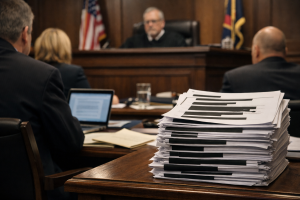
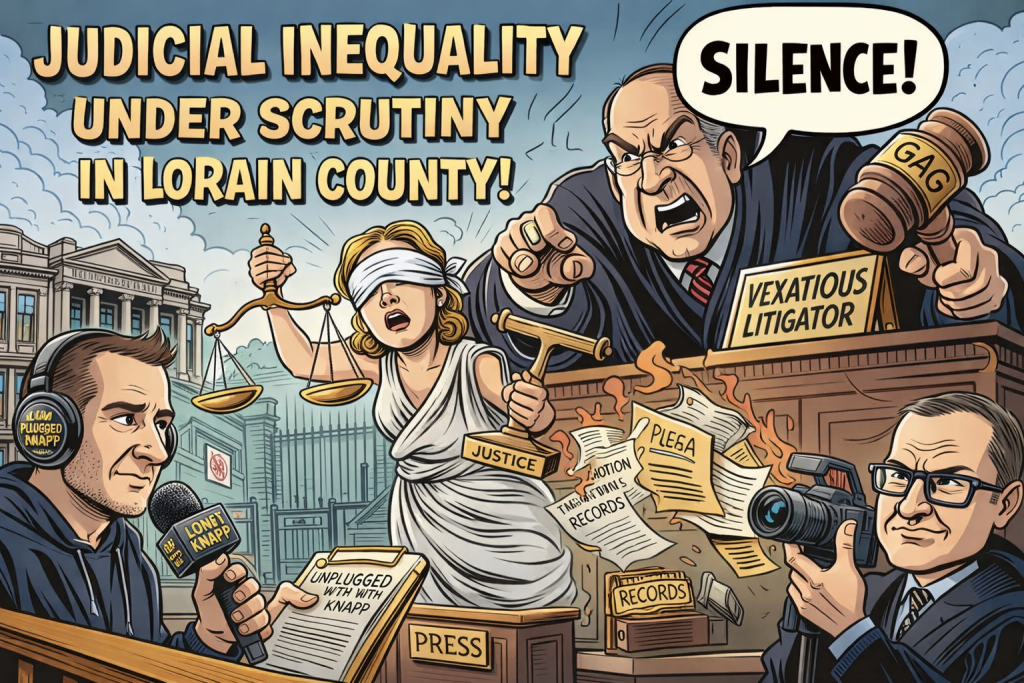
This publication may include the use of illustrative images, including AI generated images, for visual context or design purposes only. Such images are not representations of actual events, persons, or scenes unless explicitly stated. Where AI generated imagery is used, it is disclosed to avoid confusion between illustration and evidence.
Copyright for this work and the broader investigative series is held by Knapp Unplugged Media LLC. All rights are reserved. Unauthorized reproduction or redistribution without permission is prohibited. Quotation for purposes of commentary, criticism, or reporting is permitted consistent with fair use principles.
This work is published free of charge and without advertising. That choice is intentional and reflects a commitment to public access over monetization. Readers who value independent, local investigative journalism are encouraged to support this work voluntarily so it can continue without editorial compromise.
Transparency is not hostility. It is the baseline expectation of any system that exercises power over the public.
Author Bio
Aaron Knapp is an investigative journalist, public records litigator, and media founder based in Lorain County, Ohio. He is the creator of Unplugged with Knapp, an independent investigative reporting project focused on judicial accountability, government transparency, and the real world operation of local power. His work centers on court systems, prosecutorial conduct, public records compliance, and the intersection of civil rights and institutional process at the local level.
Knapp’s reporting is document driven and record focused. Rather than relying on anonymous sourcing or narrative assertion, his investigations are built from filed pleadings, court dockets, statutory analysis, transcripts, public records requests, and contemporaneous documentation. He specializes in identifying systemic failures that are often dismissed as isolated incidents when viewed case by case, but which reveal consistent patterns when examined across institutions and time.
In addition to his work as a journalist, Knapp has extensive experience navigating the court system as a litigant and public records requester. That experience informs his reporting on access to courts, jurisdictional compliance, record integrity, and the practical realities faced by individuals challenging government actors. His work frequently examines where legal theory diverges from courtroom practice and how procedural barriers can quietly erode constitutional guarantees.
Knapp is also a licensed social worker by training, a background that shapes his approach to investigative reporting. His work emphasizes due process, equity, and the human impact of institutional decision making, particularly in cases involving family law, civil liberties, and government accountability. He approaches the courts not as abstractions, but as systems that materially affect lives.
Unplugged with Knapp operates under Knapp Unplugged Media LLC, an Ohio registered media company. The project publishes long form investigative reporting, court analysis, and ongoing series examining Lorain County and City of Lorain institutions. All content is published free and without advertising to ensure public access and editorial independence.
Knapp’s ongoing court accountability series examines judicial process, prosecutorial discretion, clerk operations, and recordkeeping practices across Lorain County. He invites members of the public to submit documentation where they believe procedural errors, access barriers, or record irregularities have occurred, with the understanding that submissions are reviewed for verification and public interest value.
His work is grounded in the principle that courts derive legitimacy from transparent process, accurate records, and equal access, and that journalism has a duty to examine those foundations when they are credibly questioned.
About The Author